

Note: This article contains affiliate links. If you click on these links and make a purchase, I may earn a small commission at no extra cost to you. This helps support my research and content. Read my full affiliate disclosure here.
If rodents are active around your house, picking the right homeowner rat trap makes the difference between a short nuisance and a long-term problem. You need traps that are effective at catching adult rats, easy to use around typical household layouts, and safe for families and pets. This guide covers seven shortlisted options that work well for homeowners, with clear notes on how they perform in real yards, basements, garages, and inside sheds. We evaluated each option for capture effectiveness, ease of setup and cleanup, and safety features you will notice in day-to-day use. Read on for practical pros and cons that help you pick the right trap for your situation and placement needs.
Top Picks at a Glance
| Best Overall The best all-around choice for most situations | TRATPER Dual-Entry Covered Rat and Chipmunk Trap, 4-Pack |  |
| Best Quality Built to a higher standard if you want something more solid | Kat Sense Tunnel Rat Trap, Reusable Covered Snap Trap, 2-Pack |  |
| Best Value The sweet spot between price and what you get | Feeke Large Reusable Rat and Mouse Traps, 6-Pack |  |
| Best Budget The cheapest option that still gets the job done reliably | Tomcat Wooden Rat Trap (1 count) |  |
| Highest Rated A top-rated pick with lots of positive feedback | G-Jyuncyou Electric Rat and Mouse Trap (Reusable, Enclosed 2800V) |  |
| Most Popular A crowd favorite that many people choose with confidence | Tomcat Rat Snap Trap (1 pack) |  |
| Best Seller A high-volume bestseller chosen again and again | UCatch Dual-Entry Tunnel Rat Trap (2-Pack) |  |
TRATPER Dual-Entry Covered Rat and Chipmunk Trap, 4-Pack

| Brand Name | TRATPER |
|---|---|
| Unit Count | 4 Count |
| Item Type Name | Rat Trap |
| Recommended Uses For Product | Chipmunk trap, Rat trap |
| Maximum Range | 10 feet |
The TRATPER dual-entry covered trap is a hands-free snap trap built around an enclosed tunnel that keeps the striking mechanism away from children and pets. You bait the trap (peanut butter works well), set the lever and place it where rodents travel; animals enter through either tunnel, step on the sensitive trigger pad, and are dispatched quickly by the toothed jaw. Its enclosed design reduces accidental triggering and makes placement along walls, in garages, basements, and near sheds discreet. Made from durable ABS plastic, the unit is washable and reusable, and the automatic locking mechanism is simple to set without hooks or exposed wires. Expect reliable performance in typical homeowner scenarios, though very large rats may require heavier commercial traps and human scent on the bait or handling can reduce catch rates. The 4-pack gives you multiple stations to cover likely runs, but each trap is a single-capture device that must be emptied and reset between uses.
Best for: Homeowners who want a safer, discreet trap to manage common rats and chipmunks around houses, garages, and outbuildings and who prefer reusable devices over disposable bait stations.
Less Ideal for: People needing bulk, high-volume commercial trapping or those who require non-lethal live-capture solutions.
- Enclosed dual-tunnel design keeps the striking mechanism away from children and pets
- Sensitive trigger and toothed jaw aim for quick, humane kills
- Reusable, washable ABS construction for multiple uses
- Easy hands-free set and automatic locking with no exposed wires or hooks
- Single-capture design requires frequent emptying and resetting
- May be undersized for very large rats or unusually heavy rodents
Verdict: A safer, easy-to-set reusable snap trap that gives homeowners discreet, effective single-capture control of rats and chipmunks.
Kat Sense Tunnel Rat Trap, Reusable Covered Snap Trap, 2-Pack

| Brand | Kat Sense |
|---|---|
| Unit Count | 2 Count |
| Target Species | Chipmunk, Mouse, Rat |
| Material Type | Plastic |
The Kat Sense tunnel rat trap is a covered snap trap built for homeowners who want a tidy, low-contact way to remove mice, rats, and chipmunks. The dual-entry tunneled design funnels rodents to an internal snap mechanism so catches happen out of sight. A removable bait cup and enclosed capture chamber let you set bait, deploy the trap along runways or near walls, and then release a caught animal directly into waste without touching it. The traps are made of plastic with internal steel components and are intended for repeated use, which keeps ongoing costs down compared with disposable solutions. Because the snapping mechanism is contained, the product is safer to place around pets and children than exposed-bar traps, but it still requires careful placement and routine checks. Size and plastic construction mean very large rats could be less reliably contained than with heavy-duty steel traps, and the design is not a live-catch option. For homeowners focused on fast, hygienic removal without handling pests, these traps deliver straightforward performance.
Best for: Homeowners who prioritize fast, hygienic kills and low-contact cleanup and want a reliable reusable trap for indoor or sheltered outdoor runways.
Less Ideal for: People who need live-capture solutions or who routinely target very large rats and prefer heavy-duty metal hardware for maximum durability.
- Enclosed tunnel design provides touch-free disposal and reduces exposure to the trapped rodent
- Dual-entry funneling improves likelihood rodents enter the trap from either side
- Reusable plastic housing with removable bait cup lowers long-term cost versus single-use traps
- Enclosed mechanism is safer to place around households with pets and children compared with open snap traps
- Plastic housing may be less durable against very large rodents compared with heavy steel traps
- Not a live-capture device so it does not allow relocation
Verdict: If you want a homeowner-friendly, touch-free reusable trap that delivers quick, low-contact kills, this Kat Sense tunnel trap is a practical choice.
Feeke Large Reusable Rat and Mouse Traps, 6-Pack

| Unit Count | 6 Count |
|---|---|
| Target Species | Chipmunk |
| Power Source | Manual |
| Material Type | Plastic |
These Feeke snap traps are a straightforward, reusable option for homeowners who want a manual, no-poison way to remove mice, rats or chipmunks. Each trap uses a sensitive pedal and a strong snap mechanism to deliver an instant kill when baited and set; the package includes six identical traps so you can place multiple stations around a garage, basement or yard perimeter. The plastic construction keeps the traps lightweight and easy to clean and the design avoids sticky glue or poison so pets and children are less likely to be exposed. Setup is simple: place bait in the cup, hold the clamp open to set and position where rodents travel. Important limitations are the need for careful handling to avoid injury when setting or emptying traps and that they require periodic checking and manual disposal of carcasses. These traps are not electronic so they do not offer hands-free dead-animal containment or deterrence between uses, but they are cost-effective and reusable for ongoing pest control plans.
Best for: Homeowners who want a practical, no-poison solution they can place in multiple indoor or sheltered outdoor locations and maintain themselves without electronics or chemicals.
Less Ideal for: People who need a hands-off or tamper-proof system, live with unsupervised pets or children in very close quarters, or prefer electronic or enclosed catch-and-release devices.
- Reusable plastic design is easy to clean and reset for repeated use
- Sensitive pedal and strong snap mechanism aim for quick kills
- Six traps per pack allow multiple placements for better coverage
- Requires manual checking and disposal of trapped animals
- Plastic build may be less durable than metal alternatives
Verdict: A simple, reusable six-pack of manual snap traps that gives homeowners an effective, no-poison option for controlling rodents around the house.
Tomcat Wooden Rat Trap (1 count)

| Target Species | Rat |
|---|---|
| Power Source | Air Powered |
| Unit Count | 1 Count |
| Material Type | Wooden,Gel |
This Tomcat wooden rat trap is a basic, no-frills snap trap intended to kill rats quickly and be disposed of afterward. You bait the trigger (peanut butter or attractant gel recommended), set the U-shaped bar and place the trap along walls or in corners where rats travel. The design is simple to use and can be set by hand or foot, and the strong snap bar delivers a quick kill when triggered. Its single-trap packaging makes it an economical choice for occasional problems or spot monitoring without a large upfront investment. Important limitations are that it is disposable rather than reusable, and only one trap is included so you may need multiple purchases for larger infestations. Because it is a mechanical snap trap, correct placement and fresh bait are important for effectiveness, and disposal requires handling a caught animal or trap.
Best for: Homeowners who want a low-cost, straightforward way to address occasional rat sightings or to monitor rodent activity around the house.
Less Ideal for: People facing heavy or ongoing infestations who need multi-pack traps, reusable devices, or a comprehensive integrated pest control solution.
- Simple, easy-to-set snap design for quick kills
- Intended for indoor or sheltered outdoor placement along walls
- Economical option for spot treatments or monitoring
- Can be set by hand or foot for flexible placement
- Sold as a single disposable unit rather than a reusable trap
- No bait included so attractant must be purchased separately
Verdict: A very inexpensive, easy-to-use disposable snap trap that works well for homeowners needing a simple spot treatment or monitoring tool.
G-Jyuncyou Electric Rat and Mouse Trap (Reusable, Enclosed 2800V)

| Power Source | ac |
|---|---|
| Number of Pieces | 1 |
This compact electronic trap is designed to kill common household rats and mice by delivering a 2800V shock when a rodent steps on the internal plates. It is intended for indoor use along walls, behind appliances, and in corners where rodents travel. Notable features include an enclosed tunnel that keeps the high-voltage area contained, a removable collection tray for no-touch disposal and cleaning, and silent operation except for a brief buzzer after a capture. Because it runs on AC power and includes a USB cable, it provides continuous protection in high-traffic rodent spots without the mess of glue or the reset hassles of snap traps. Practical benefits are fast, hygienic kills, easy reuse after cleaning, and a safer exterior surface for homes with pets when positioned correctly. Limitations to consider are the need for a power source or adapter not included, its small footprint which is best for single rodents rather than large infestations, and the device requires routine cleaning to maintain effectiveness.
Best for: Homeowners who prioritize a reliable, hygienic indoor solution for occasional rat or mouse encounters and want a reusable, low-maintenance trap that can run continuously where rodents travel.
Less Ideal for: People dealing with large, active infestations or those who need a battery-only option for areas without convenient power access should consider more heavy-duty or alternative solutions.
- Enclosed high-voltage chamber reduces accidental contact risk
- Removable tray enables no-touch disposal and easy cleaning
- Silent operation until a capture is made minimizes disturbance
- Reusable design offers ongoing pest control without single-use waste
- Requires an external adapter or powered USB source not included
- Small size best suited to individual rodents rather than heavy infestations
Verdict: A compact, enclosed electric trap that delivers quick, hygienic kills and easy no-touch cleanup for homeowners seeking a dependable indoor rodent solution.
Tomcat Rat Snap Trap (1 pack)

| Target Species | Rat |
|---|---|
| Power Source | manual |
| Recommended Uses For Product | Indoor,Outdoor |
| Material Type | Plastic |
The Tomcat Rat Snap Trap is a straightforward mechanical rat trap that combines a powerful snap mechanism with a removable bait cup for cleaner handling. It sets easily by hand or foot and is intended to be placed perpendicular to walls or along known rat travel routes in basements, garages, sheds, barns, and other covered outdoor areas. The trap uses an interlocking-tooth design and rust-resistant metal parts to capture and hold rats securely, and the removable bait cup lets you bait or service the device without accidentally setting it. Made from high-impact plastic, the trap is reusable and easy to clean between uses. Practical benefits include no need for poison, quick dispatch when placed correctly, and a design that reduces the chance of accidental snaps compared with traditional wooden traps. Important limitations are that it requires correct placement and baiting to be effective, must be kept out of reach of children and pets, and may not be ideal for heavy infestations where multiple traps or a different control method would act faster.
Best for: Homeowners who want a non-chemical, reusable option for targeted rat control and who prefer a product backed by established user experience and clear instructions.
Less Ideal for: People dealing with large-scale or severe infestations who need rapid, whole-structure control or who cannot keep traps out of reach of children and pets.
- Reusable high-impact plastic construction with rust-resistant metal parts for longevity
- Interlocking teeth and firm snap deliver secure capture and quick dispatch
- Removable bait cup allows baiting and servicing without setting the trap
- Easy one-motion set by hand or foot for fast deployment
- Requires correct placement and frequent checking to control active infestations
- Not a hands-off solution for large or widespread rodent problems
Verdict: A reliable, reusable snap trap for homeowners who want an effective non-chemical rat control tool for targeted indoor and covered outdoor use.
UCatch Dual-Entry Tunnel Rat Trap (2-Pack)
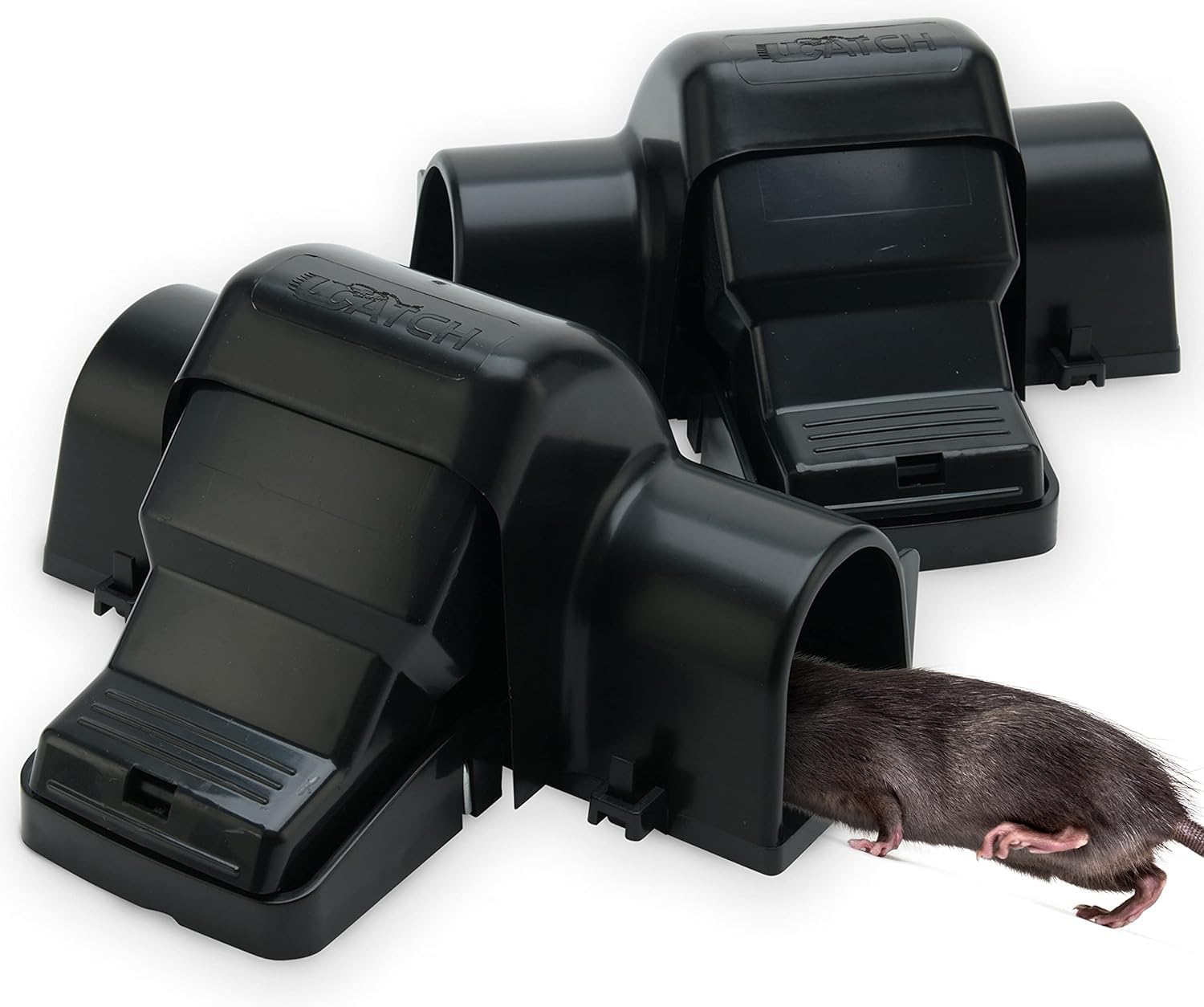
| Unit Count | 2 Count |
|---|---|
| Target Species | Rat, Mouse, Chipmunk, Squirrel |
| Power Source | Manual |
| Material Type | Premium ABS plastic |
The UCatch dual-entry tunnel rat trap is a manual snap trap sold as a two-pack and built to be used both inside the home and around outdoor structures. Its tunneled, dual-entry design lets rodents enter from either side, increasing the chance they trigger the powerful jaws, and the enclosed mechanism keeps fingers and pet noses away during setting and disposal. Typical use is simple: bait the cup, press the lever to set, place in runways or along walls, then remove and wash the reusable plastic housing after a catch. The practical benefits are straightforward for homeowners who want a low-fuss, no-chemicals solution: it is reusable, easy to set without touching the strike area, and targets rats, mice, chipmunks, and squirrels. Important limits are that it is a manual snap device so it requires correct placement and periodic checking, and like all snap traps it can pose a safety risk to curious pets or children if not positioned carefully out of reach.
Best for: Homeowners who prioritize a simple, low-chemical and low-contact way to stop rodents and who want a straightforward reusable trap they can place in known runways.
Less Ideal for: People who need a completely hands-off electronic or remote-monitoring system or those who cannot safely place traps out of reach of non-targets.
- Dual-entry tunnel increases likelihood of capture compared with single-entry traps
- Enclosed design keeps the strike mechanism out of reach for safer hands-free setting and disposal
- Reusable ABS plastic housing that can be washed and redeployed
- Works for a range of small mammals including rats, mice, chipmunks, and squirrels
- Requires manual setting and regular checking which may not suit buyers wanting fully automated or remote solutions
- Not suitable for households that cannot keep traps out of reach of children or pets
Verdict: A practical, reusable dual-entry snap trap that gives risk-averse homeowners a safer hands-free option for trapping common rodents.
Choosing the Right Homeowner Rat Trap: Key Factors to Consider
Trap Type and Mechanism
Different trap mechanisms behave differently with large commensal rats. Snap traps deliver a quick kill when sized and set properly, while live-capture cages allow relocation but require safe handling and legal awareness. Glue-style boards can immobilize but often result in prolonged suffering and are less suitable for many homeowners who want a quick, decisive outcome.
Consider how the mechanism affects placement and baiting. Enclosed triggers and trip-pan designs reduce accidental activation by pets and small wildlife. For indoor use near families, pick mechanisms that minimize the need for close handling during disposal or that allow the trap to be emptied without direct contact.
Size and Access
Adult rats are larger and stronger than mice, so trap dimensions and jaw strength matter. A trap that is too small can fail to hold or injure the animal without a secure capture. Also think about the physical space where you will place traps: narrow gaps behind appliances, attic crawl spaces, and exterior foundation lines need low-profile or elongated traps that still present a reliable trigger.
Access points determine how you bait and where you anchor traps. Traps with built-in anchor points or heavy bases resist being dragged away and are more effective in garages and outdoor areas. For indoor placements, choose traps that fit comfortably against baseboards without obstructing household traffic.
Safety Around People and Pets
Home settings often include children and animals that can accidentally disturb traps. Safety features such as enclosed compartments, tamper-resistant latches, or one-way entry designs reduce accidental contact. Avoid exposed, high-force mechanisms in high-traffic rooms; instead use protected or lockable units in those locations.
Also consider where you will store and handle bait. Bait choices and how the trap presents the bait affect non-target access. Devices that allow bait to be placed inside a protected chamber lower the risk of pets ingesting toxic attractants or encountering the bait directly.
Durability and Weather Resistance
Traps placed in basements, under decks, or near foundations are exposed to moisture and dirt. Materials that resist rust and wear extend service life and maintain reliable trigger action. Metal parts should be sturdy enough to withstand the force of a rat without bending, and plastic housings should be thick to avoid cracking from repeated use or cold conditions.
If you plan to use traps outdoors, look for designs with drainage, raised feet, or protective coatings. Consider how easy it is to inspect and maintain the trap after exposure to the elements so performance does not degrade between uses.
Ease Of Setup, Baiting, And Disposal
A trap that is fiddly to set or hard to access for bait will not get used consistently. Look for clear triggers, intuitive bait wells, and designs that let you set the device safely without placing your fingers in harm's way. Quick visual indicators that show whether the trap has been triggered save time during checks.
Disposal matters for homeowner convenience and hygiene. Removable cartridges, flip-open doors, or mechanisms that allow you to release or contain the animal without touching it reduce exposure to disease and unpleasant handling. Consider whether parts are disposable or washable and how cleanup aligns with your tolerance for contact and sanitizing.
Sanitation and Disease Risk
Rats carry pathogens and cleaning up after captures requires caution. Traps that minimize direct contact and can be disinfected safely help reduce disease transmission. Smooth, nonporous surfaces and removable components permit thorough cleaning. If you intend to relocate captured animals, be realistic about the sanitation steps required for repeated use.
Plan for safe disposal of bait residues and bodily fluids. Have gloves, disinfectant, and a trash protocol ready before handling trapped animals. Devices that limit splatter and contain the animal in a single chamber lower the likelihood of contaminating surrounding surfaces.
Where To Place Traps Around the Home
Successful placement depends more on rat behavior than on the trap itself. Track lines along baseboards, behind appliances, inside attics, and along foundation edges are common routes. Place traps with the trigger surface oriented perpendicular to the run so a rat must put its head or body into the trap to reach the bait.
Outdoors, set traps along walls, fence lines, and under decks where rodents travel. In garages and sheds secure traps to prevent dragging. For indoor spaces, choose discreet corners or behind furniture, and avoid locations where children or pets routinely play.
- Use multiple traps along a run rather than one isolated unit.
- Check traps daily; frequent checks reduce stress if live-capture methods are used.
- Wear gloves and disinfect surfaces after handling traps.
Bait Selection and Placement Tips
Bait choice affects how quickly a trap attracts rats. Fatty, aromatic foods such as peanut butter, bacon, or high-protein pet food are commonly effective. Use small amounts so the bait stays in place on the trigger and does not allow the rodent to steal it without activating the trap.
For enclosed traps, set bait at the far point inside the chamber to ensure the animal fully enters. If a trap has a bait well, secure bait in a way that requires the rat to manipulate the trigger. Replace stale or moldy bait promptly, which can reduce attractiveness.
- Avoid over-baiting; smaller portions encourage proper triggering.
- Rotate bait types if you see low interest over several days.
- Keep pet food stored securely to avoid creating competing food sources.
Safe Handling and Disposal Practices
Always use disposable gloves and avoid direct contact when handling triggered traps. Move traps carefully to minimize the risk of exposure to urine, feces, or bodily fluids. If a trap is reusable, clean it outdoors or in a well-ventilated area using a disinfectant labeled for use against rodent-borne pathogens.
For live captures, check local regulations before attempting relocation. If you plan to dispose of a carcass, double-bag it and seal the trash securely. Wash hands thoroughly after handling traps and disinfect any surfaces that may have been contaminated.
- Keep a dedicated kit with gloves, disinfectant, and waste bags near trap locations.
- Do not shake or aerosolize materials when cleaning trap components.
- Document trap checks to ensure timely disposal and reduce disease risk.
Integrating Traps Into A Broader Rodent Control Plan
Traps are one tool in a larger integrated approach. Seal entry points, eliminate food sources, and reduce clutter to lower long-term rodent pressure. Traps will work better when attractive harborage and easy food access are addressed.
Consider seasonality and breeding cycles. During times of abundant food, rats may be less bait-motivated, so combine sanitation with trapping for best results. Regular inspection and maintenance of trap locations keep control efforts effective.
- Prioritize exclusion work such as sealing gaps and fixing screens.
- Store bird feed and pet food in sealed metal containers.
- Monitor activity and adjust trap density based on observed rodent pressure.
When To Call A Professional
If you have continuous high activity, nests inside walls, or multiple infestation sources, a professional can help with exclusion and large-scale control strategies. Professionals also handle complex access issues such as deep attics, interconnected crawlspaces, or water-damaged areas where rats have established long-term harborages.
Seek professional help if children or vulnerable pets are at risk and you need a short-term, high-confidence removal plan. Additionally, professionals can advise on legal or humane considerations if relocation is part of the strategy.
- Look for technicians who emphasize exclusion and sanitation, not just trap deployment.
- Request clear plans for follow-up monitoring and habitat modification.
- Ask about safe handling protocols for homes with pets and children.
How We Chose the Best Homeowner Rat Trap
We focused on features that matter to people dealing with rats around homes and common outbuildings. Key evaluation criteria included capture effectiveness against adult Norway and roof rats, safety for households with pets or children, and the trap's ease of setting, baiting, and emptying. Durability in outdoor or damp locations, including corrosion resistance and robust mechanics, was also essential. We assessed how discreet and rodent-accessible the trap is for typical placement spots such as along walls, in attics, and near foundations. Finally, we considered sanitation: how easy the trap is to clean or dispose of without direct contact. We excluded traps designed exclusively for commercial settings, agricultural bait stations requiring licensed applicators, or devices that need specialized installation. We filtered out options intended only for mice or small rodents when they were unlikely to reliably capture adult rats. Our selections prioritize homeowner-friendly features that balance humane capture or quick kill mechanisms with clear safety measures and durable construction.
FAQ
How many traps should I set for a typical house infestation?
Often a cluster of three to five traps placed along active runs is more effective than a single trap. The exact number depends on the size of the house, visible activity, and how many entry points you identify.
Can I use mouse traps for rats?
Mouse traps are usually too small for adult rats and can fail to secure them. Use traps sized and rated for common rat species to ensure secure capture and reliable triggering.
Are live-capture traps humane and practical for homeowners?
Live traps can be humane if checked frequently and handled properly, but they require decisions about relocation that are subject to local rules. They also demand secure transport and may pose disease exposure if you must handle captured animals.
What safety steps should I take when checking traps?
Wear disposable gloves, approach traps calmly to avoid startling captured animals, and move triggered traps to a secure area for disposal or cleaning. Disinfect trap components and wash hands thoroughly afterward.
How often should traps be checked?
Check traps at least once daily. Frequent checks reduce animal suffering for live-capture methods and prevent scavenging or decomposition in snap traps, which also helps maintain sanitation.
Will baiting attract more rats to my property?
Properly placed bait in traps is unlikely to attract new rats from far away, but leaving loose food or large bait piles can. Use small bait portions secured to triggers and remove other accessible food sources to avoid increasing attraction.
Final Verdict
Choose a Homeowner Rat Trap based on the setting where you will use it, the level of rodent activity, and the safety needs of your household. Prioritize trap types and sizes that reliably capture adult rats, then match features such as tamper-resistant housing and easy disposal to your family situation. Remember that traps work best alongside exclusion and sanitation efforts. If safety around children or pets is a primary concern, favor enclosed or tamper-resistant options that reduce accidental contact. For outdoor or damp locations, prioritize durable, weather-resistant designs. With clear placement, regular checks, and sensible cleanup, you can manage rodent issues effectively as a homeowner.
