

Note: This article contains affiliate links. If you click on these links and make a purchase, I may earn a small commission at no extra cost to you. This helps support my research and content. Read my full affiliate disclosure here.
Picking the right in ground sprinkler head affects how evenly your lawn waters, how much maintenance you face, and how efficiently you use water. A well-suited sprinkler head reduces dry spots, limits overspray onto walkways and beds, and stands up to seasonal wear so you spend less time adjusting or replacing parts. This guide shortlists seven top in ground sprinkler heads chosen for real garden use. We focus on spray control, durability, clog resistance, and ease of service so you can match heads to lawn size, plantings, and local water pressure. Read on to see how the candidates measure up against practical garden needs and the criteria we used to evaluate them.
Top Picks at a Glance
| Best Overall The best all-around choice for most situations | Rain Bird 42SA+ Gear-Driven Rotor Sprinkler Head (4-Pack) |  |
| Best Quality Built to a higher standard if you want something more solid | Hunter PGP-ADJ 3/4" Gear-Drive Rotor Sprinkler Head, Adjustable 40°–360° |  |
| Best Value The sweet spot between price and what you get | Rain Bird 1804APPR25 1800 Series PRS Pressure-Regulating 4" Pop-Up Sprinkler |  |
| Best Budget The cheapest option that still gets the job done reliably | Hunter Pro 4" Pop-Up Lawn Sprinkler Head (8–15 ft adjustable, 0°–360°) |  |
| Highest Rated A top-rated pick with lots of positive feedback | Orbit Saturn III Gear-Drive Rotor Sprinkler Head, 5-Pack |  |
| Most Popular A crowd favorite that many people choose with confidence | Rain Bird 32SA Gear Drive Rotor Sprinkler Head, 4-Pack |  |
| Best Seller A high-volume bestseller chosen again and again | Rain Bird 1806VAN 1800 Series 6 in. Pop-Up Sprinkler Head (5-pack) |  |
Rain Bird 42SA+ Gear-Driven Rotor Sprinkler Head (4-Pack)

| Maximum Pressure | 55 psi |
|---|---|
| Inlet Connection Size | 0.75 inches |
| Unit Count | 4 Count |
| Adjustable Arc | 40 – 360 degrees |
| Radius | 26 – 38 ft |
The Rain Bird 42SA+ is a professional-style, gear-driven rotor sprinkler head intended for medium to large turf zones where dependable, even coverage matters. It installs as an in-ground pop-up with a 3/4-inch female bottom inlet and delivers a 26 to 38 foot spray distance while allowing top-access adjustments of arc and radius with a flat screwdriver. Notable features include Rain Curtain nozzles that create larger, wind-resistant droplets for uniform coverage and a closed-case design that protects the internal gear drive from sand and debris. The water-lubricated gear drive, stainless steel retract spring, and reinforced seals are practical details that support long service life and reduce maintenance. Because adjustments can be made without disassembly and the unit is factory-preset at 180 degrees, it is straightforward to tune a zone to avoid overspray. The unit performs best within its 45–55 psi operating range and is focused on robust, no-frills reliability rather than decorative or multi-functional accessories.
Best for: Homeowners or landscapers who prioritize dependable, low-maintenance irrigation for medium to large lawn zones and want durable components that minimize service calls.
Less Ideal for: People needing very low-pressure drip irrigation or those who want adjustable fixtures for tiny urban yards and containers.
- Closed-case, gear-driven design resists sand and debris for long-term reliability
- Top-access adjustments let you set arc and distance without removing the head
- Rain Curtain nozzles produce large, wind-resistant droplets for even coverage
- Stainless steel retract spring and reinforced seals improve durability
- Optimal performance depends on maintaining 45–55 psi operating pressure
- Fixed spray radius range (26–38 ft) may not suit very small or very large zones
Verdict: Choose the Rain Bird 42SA+ when you need a rugged, serviceable rotor head that delivers consistent, wind-resistant coverage for medium to large lawn zones.
Hunter PGP-ADJ 3/4" Gear-Drive Rotor Sprinkler Head, Adjustable 40°–360°

| Maximum Pressure | 100 psi |
|---|---|
| Maximum Flow Rate | 14.1 gpm |
| Inlet Connection Size | 0.75 inches |
The Hunter PGP-ADJ is a professional-grade gear-drive rotor sprinkler built for consistent, long-distance coverage in in-ground irrigation systems. It delivers an adjustable arc from 40° to 360° and a spray radius of roughly 22 to 52 feet, so you can use it for both part-circle and full-circle zones and space heads farther apart. The preinstalled 3.0 GPM nozzle and broad operating pressure range make it adaptable to a variety of residential and commercial systems. Gear-driven, water-lubricated internals provide smooth, quiet rotation and better clog resistance than many pop-up spray heads. A standard 3/4" female NPT inlet and 4" pop-up height simplify retrofit and new installations. Expect durable, consistent performance for turf and larger landscape areas, though finer-tuned precipitation control requires selecting alternate nozzles or a different head type. Installers should follow the recommended pressure range for best uniformity and consider nozzle swaps for wind-prone or sloped sites.
Best for: Buyers who prioritize robust, professional-level performance for medium to large lawns and landscapes and who need a reliable rotor that covers long distances with minimal maintenance.
Less Ideal for: Gardeners with small yards, tight planting beds, or those seeking ultra-low-water microirrigation solutions should consider compact spray heads or rotors with lower precipitation rates instead.
- Adjustable 40°–360° arc suits both part-circle and full-circle zones
- Long spray radius (22–52 ft) allows wider head spacing and fewer zones
- Gear-driven, water-lubricated mechanism offers quiet, even rotation and improved clog resistance
- Standard 3/4" inlet and 4" pop-up height simplify retrofit into existing systems
- Higher precipitation rate than some low-volume heads without nozzle changes
- Not optimized for very small or tight garden beds where short radius and lower rpm are preferred
Verdict: Choose the PGP-ADJ when you need a proven, heavy-duty rotor that delivers long-radius, adjustable, professional-grade coverage for in-ground lawns and landscapes.
Rain Bird 1804APPR25 1800 Series PRS Pressure-Regulating 4" Pop-Up Sprinkler

| Maximum Pressure | 30 psi |
|---|---|
| Maximum Flow Rate | 15 liters per minute |
| Material Type | Plastic, Stainless Steel |
| Spray Distance | 8' – 15' |
| Pop-Up Height | 4" |
The Rain Bird 1804APPR25 is a professional 4 inch pop-up spray head that keeps nozzle pressure steady at 30 psi to improve uniformity and cut misting and overspray. It is used in standard in-ground irrigation zones where mid-range spray distance (8 to 15 feet) is needed, and the adjustable collar lets you set the arc from 0° to 360° for corners or full-circle coverage. The integrated PRS regulator and matched precipitation nozzle reduce pressure-related variability across a zone so heads perform more evenly even when system pressure fluctuates. Durable construction — plastic body with stainless-steel spring and a co-molded wiper seal — makes retraction and sealing reliable and simplifies maintenance since components can be removed from the top. Practical benefits include measurable water savings, easier nozzle alignment with the ratchet mechanism, and fewer issues from wind or misting. Important limitations are that it is a fixed spray-style head so it is best for lawns and beds rather than long-distance rotary coverage, and you must choose the correct nozzle type and pop-up height for the exact layout of your system.
Best for: Homeowners or landscapers who want reliable, water-efficient fixed-spray coverage for lawns, beds, and irregular edges and value consistent performance when system pressure varies.
Less Ideal for: Large properties that need long-range rotary rotors or users who prefer variable-flow rotor heads for very wide turf areas.
- Built-in pressure regulator maintains 30 psi at the nozzle for consistent spray performance and reduced misting
- Adjustable 0°–360° arc and top-access distance adjustment provide precise placement without digging
- Durable materials with stainless-steel spring and co-molded wiper seal for reliable retraction and long life
- Matched precipitation nozzle options and ratchet alignment allow uniform coverage across mixed heads
- Spray head design is limited to short-to-mid range fixed spray patterns, not suitable for long-distance rotary needs
- Requires selecting the right nozzle/pop-up height for specific zones which adds planning during installation
Verdict: Choose this Rain Bird PRS pop-up if you need dependable, water-smart fixed-spray coverage with consistent pressure and reduced misting across a lawn zone.
Hunter Pro 4" Pop-Up Lawn Sprinkler Head (8–15 ft adjustable, 0°–360°)

| Maximum Pressure | 80 psi |
|---|---|
| Inlet Connection Size | 0.5 inches |
| Material Type | Plastic |
The Hunter Pro 4" Pop-Up is a professional-grade spray head designed for standard in-ground irrigation zones. It installs on a 1/2" NPT inlet and is typically used for lawn, garden, and flower-bed zones where a fixed or adjustable spray pattern is required. Key features include a fully adjustable arc from 0° to 360°, a user-adjustable radius from about 8 to 15 feet, a pull-ring flush cap to help clear debris, and a heavy-duty ribbed body and spring for reliable pop-up and retraction. In real use this translates to straightforward hand adjustments without tools, easy servicing of clogged nozzles, and a stable fit in softer soils. The head is compatible with most Hunter nozzles so you can swap in MP Rotators or specialty patterns to improve water distribution or efficiency. Limitations are that it is not pressure-regulated and maximum pressure is 80 psi, so you may need pressure regulation elsewhere for optimal performance, and plastic construction means extreme-impact resistance is lower than for metal-bodied rotors.
Best for: Homeowners and DIYers looking for a reliable, low-cost replacement or upgrade for standard in-ground spray zones who value easy installation and straightforward manual adjustment.
Less Ideal for: Those who need built-in pressure regulation or heavy-duty metal bodies for commercial applications should consider pressure-regulated or rotor-style alternatives.
- Adjustable arc and radius let you target irregular areas and reduce overspray
- Flush-cap pull ring simplifies clearing debris and routine maintenance
- Ribbed body and strong spring give stable installation and reliable pop-up/retraction
- Compatible with all Hunter nozzles for easy performance tuning and upgrades
- Not pressure-regulated so may need a separate pressure regulator for high-pressure systems
Verdict: A dependable, easy-to-adjust pop-up spray head that delivers professional performance for typical lawn and garden zones at a budget-friendly level.
Orbit Saturn III Gear-Drive Rotor Sprinkler Head, 5-Pack

| Number of Packs | 5 |
|---|---|
| Inlet Connection Size | 0.5 inches |
| Pop-up Height | 4" |
| Coverage Radius | 15-25 ft |
The Orbit Saturn III is a geared rotor sprinkler head intended for medium lawn and garden zones where reliable, even coverage matters. It operates quietly and smoothly, rotating to cover part- to full-circle patterns with an adjustable radius from about 15 to 25 feet and arc settings from 40 to 360 degrees. Installation uses a standard 1/2" FNPT inlet and the unit has a 4" pop-up height, making it a straightforward replacement for many in-ground systems. Notable features include a large removable filter that helps resist clogging and simple screwdriver adjustments for radius and arc, which reduces service visits and makes fine-tuning easy. The gear-drive mechanism provides consistent performance compared with impact-style heads, producing uniform coverage with less noise. Limitations are that the head is sized for medium coverage only, so multiple heads are required for large areas, and adjustments require a tool rather than on-head knobs. The 5-pack format suits replacing multiple worn heads at once or outfitting several zones.
Best for: Homeowners who prioritize dependable, low-maintenance in-ground irrigation for medium-sized lawn zones and want quiet, consistent sprinkler performance.
Less Ideal for: People needing wide-coverage heads for very large turf areas or installers who prefer tool-free adjustment mechanisms.
- Gear-drive rotor delivers quiet, smooth rotation for even water distribution
- Adjustable radius (15–25 ft) and arc (40–360°) for precise zone tuning
- Large removable filter reduces clogging and simplifies maintenance
- Standard 1/2" FNPT connection and 4" pop-up height for easy in-ground replacement
- Designed for medium coverage only, so more heads are needed for larger lawns
- Adjustments require a flathead screwdriver rather than tool-free controls
Verdict: Buy this 5-pack if you want quiet, dependable gear-drive sprinkler heads that make medium-zone in-ground systems easier to maintain and tune.
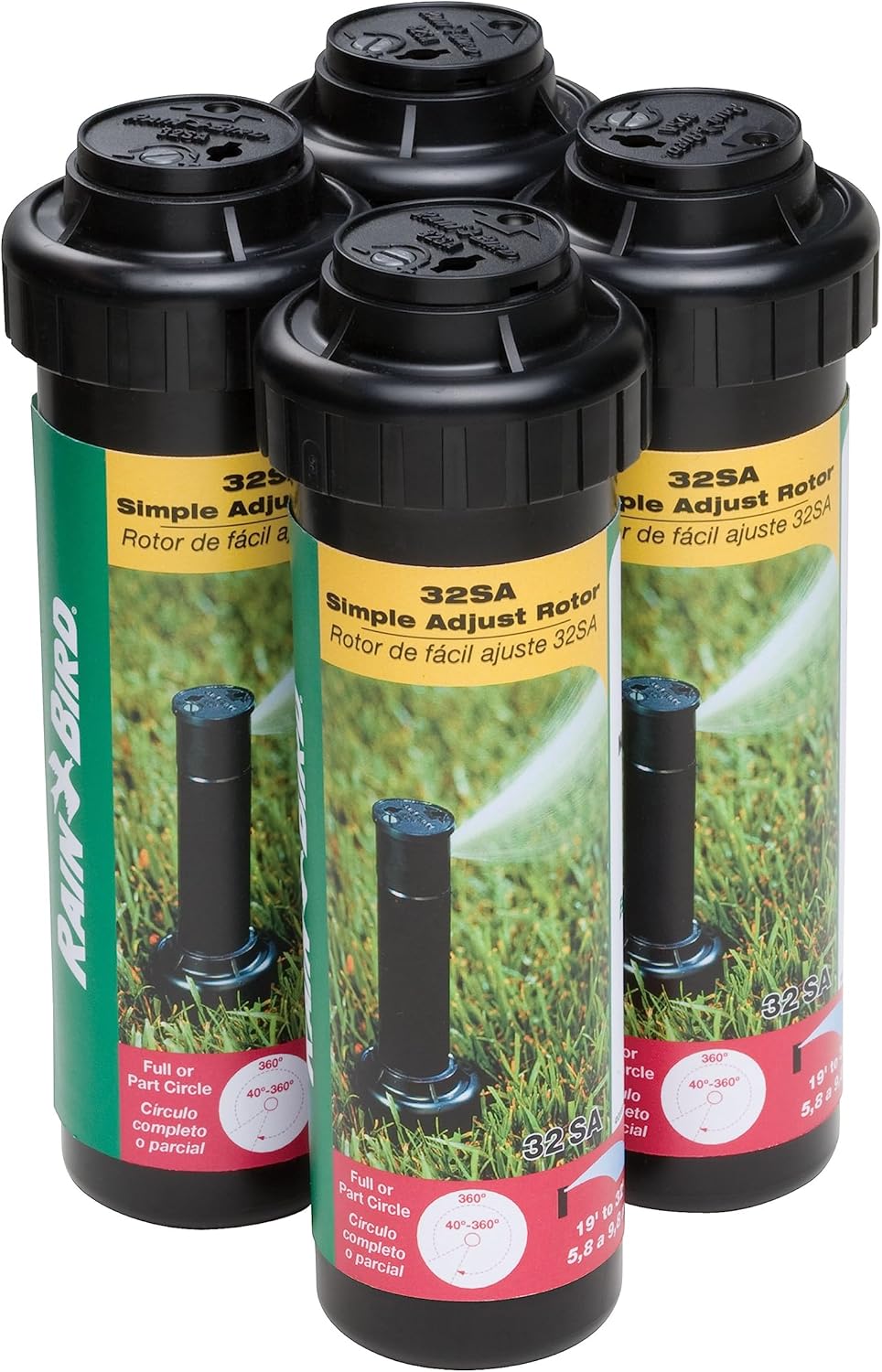
Rain Bird 32SA Gear Drive Rotor Sprinkler Head, 4-Pack
| Maximum Pressure | 70 psi |
|---|---|
| Maximum Flow Rate | 27.6 liters per minute |
| Inlet Connection Size | 0.5 inches |
| Material Type | ABS Plastic |
The Rain Bird 32SA 4-pack supplies reliable, contractor-style rotor coverage for residential in-ground systems. Each closed-case, gear-driven rotor pops up 4 inches and delivers a 19 to 32 foot throw using a preinstalled 3.0 gpm nozzle, with top-side adjustments for arc (40°–360°) and distance using a flat screwdriver. Rain Bird’s Rain Curtain nozzle produces larger, wind-resistant droplets and micro ramps that help avoid dry rings near the head, which improves uniformity and can reduce runtime. The unit includes a removable filter screen and nozzle for straightforward maintenance, plus O-rings and a dual-action wiper seal to protect internals in gritty water. Practical limitations are that the standard nozzle and pressure requirements target typical residential pressures, so very low-pressure systems or specialized long-range designs may need different nozzles or a different model. Also the ABS plastic housing is durable for most yards but not as long-lived as metal-shaft pro rotors in extremely abrasive conditions. For homeowners who value dependable coverage and easy adjustments, these heads are a solid choice for standard lawns.
Best for: Homeowners upgrading or repairing an in-ground sprinkler system who want consistent, easy-to-adjust rotor coverage and prefer proven products with broad user acceptance.
Less Ideal for: Commercial installers or users with very high-abrasion sites and large turf areas who need premium stainless components or extremely long-throw rotors.
- Adjustable 40°–360° arc with top-side screwdriver controls for quick on-site tuning
- Rain Curtain nozzle produces larger, wind-resistant droplets for more uniform coverage
- Closed-case design and wiper seal protect internals from debris and gritty water
- Includes removable filter screen and removable nozzle for simple maintenance
- Plastic shaft and ABS construction are less heavy-duty than premium metal-shaft rotors
- Preinstalled nozzle and pressure targeting may require swapping nozzles for atypical pressure or distance needs
Verdict: A dependable, easy-to-adjust rotor head pack that delivers uniform 19–32 ft coverage with contractor-style features for most residential lawns.
Rain Bird 1806VAN 1800 Series 6 in. Pop-Up Sprinkler Head (5-pack)

| Unit Count | 5 Count |
|---|---|
| Maximum Flow Rate | 17.4 liters per minute |
| Inlet Connection Size | 0.5 inches |
| Material Type | Stainless Steel |
The Rain Bird 1806VAN is a straightforward, dependable pop-up sprinkler head sold in a five-pack for small to medium lawn systems. Each head installs on a standard 1/2-inch female NPT riser and offers an adjustable 0 to 360 degree arc so you can set quarter, half, or full-circle patterns without tools. The unit sprays reliably out to about 15 feet with a matched-precipitation nozzle and uses a stainless-steel spring and a pressure-activated wiper seal to reduce leakage and ensure the head retracts flush. In practice the build quality and UV-resistant materials mean these hold up well in typical residential conditions, and the textured adjustment collar makes fine-tuning quick during layout or repairs. Limitations: these are fixed-pattern spray heads rather than multi-stream rotors, so they work best on smaller zones and turf areas rather than large-reach landscapes where rotors are more efficient. Also they do not include a built-in pressure regulator model in this SKU, so very high-pressure zones may need external regulation for best uniformity.
Best for: Homeowners who want a reliable, no-nonsense replacement or new-install spray head for small to medium lawn zones and who prioritize ease of setup and long-term reliability.
Less Ideal for: Large properties or irrigation zones that require long throw and high efficiency where rotor heads would provide better coverage and lower run times.
- Adjustable 0–360° arc for precise coverage of corners and strips
- Matches precipitation over its spray radius for even watering
- Durable construction with stainless-steel spring and UV-resistant materials
- Standard 1/2-inch female inlet for easy retrofit into existing systems
- Fixed spray type is less water-efficient than rotor heads on large lawns
- No built-in pressure regulation in this model
Verdict: A dependable, easy-to-install spray head pack that gives precise, leak-resistant coverage for small to medium residential lawn zones.
Choosing the Right In Ground Sprinkler Head: Key Factors to Consider
Spray Pattern And Arc Control
Spray pattern determines how evenly water is distributed across turf and planting beds. Adjustable arcs and interchangeable nozzles let you tailor throw distance and coverage arcs to the shape of your lawn, reducing overspray onto hardscapes and conserving water. For narrow strips or irregular beds, fine control of arc and radius prevents watering waste and avoids runoff.
When heads provide clear nozzle options with predictable spray radii, you can mix nozzle sizes on a single zone to handle transitions between turf and beds without redesigning pipework. Poor arc control either creates dry pockets or forces overlaps that increase water use.
Durability And Construction Materials
Sprinkler heads live at ground level and face sun, foot traffic, mower strikes, and seasonal freezing in some climates. Bodies made from UV-stable plastics or brass components resist cracking and warping. Robust seals and corrosion-resistant internals extend service life and reduce the need for replacements.
Pay attention to cap and riser strength if your lawn is mowed frequently; weaker materials deform and can leak. Long-term durability reduces total maintenance time and keeps irrigation uniform without frequent repairs.
Clog Resistance And Filtration Needs
Systems drawing from well water or older pipes are more likely to introduce sand, silt, and debris that clog nozzles and valves. Sprinkler heads with built-in screens or easily removable filters simplify cleaning and maintain consistent spray patterns.
If your site has sediment, choose heads that allow quick disassembly of the nozzle and access to the filter seat. Regularly flushing the zone and adding a coarse screen in the supply line can also prevent frequent clogs and maintain even coverage.
Serviceability And Ease Of Maintenance
Ease of maintenance determines how quickly you can restore proper coverage after a problem. Features such as tool-free nozzle swaps, simple riser height adjustments, and common thread fittings speed repairs and seasonal servicing.
Heads that standardize nozzle sizes and use replaceable internal cartridges let you carry a small kit of spares and complete common fixes in minutes. Consider whether replacement parts are common garden-store items or proprietary components that complicate future servicing.
Pressure And Flow Compatibility
Residential water pressure varies by location and changes with other irrigation zones and household use. A sprinkler head that performs across a broad pressure range reduces misting at high pressure and avoids short throws at low pressure. Look for heads specifying operating pressure ranges and matched nozzles that keep droplet size appropriate for typical garden conditions.
For systems with marginal pressure, use nozzles with lower radius and wider droplet size to avoid evaporation and drift. Conversely, high-pressure situations benefit from pressure-regulating nozzles or built-in regulators to prevent misting and uneven distribution.
Matching Heads To Zone Layout
Lay out sprinkler zones by plant type and sun exposure rather than by pipe run alone. Turf needs consistent, overlapping coverage while beds and shrubs often need targeted, lower-flow heads. Grouping similar hydrozones helps you pick head styles and nozzle families that work with the same pressure and radius settings.
- Use rotors or larger spray heads on expansive turf for fewer heads and gentler overlap.
- Choose low-profile spray heads near walkways and edging to minimize overspray.
- Group beds with drip or low-angle sprays to reduce water on foliage and limit disease risk.
Installation And Winterizing Tips
Set heads so the top of the cap is slightly above grade to avoid mower damage but not so high that they are a trip hazard. Ensure proper backfill to minimize settlement and keep lubricant-free threads accessible. During winterize season, fully drain zones or blow them out according to local best practices to protect internal seals and pistons from freeze damage.
- Check riser height after settling and add gravel or compacted soil if needed.
- Avoid overtightening fittings which can crack plastic bodies when cold.
- Replace brittle seals and spray caps before winter if they show cracking.
Common Problems And Quick Fixes
Uneven coverage often comes from a clogged nozzle, a shifted arc, or a riser that is not fully seated. Start troubleshooting by looking for physical damage, then remove and clean the nozzle screen if present. Replace or rotate the nozzle to retune radius or arc. Loose or collapsed risers are commonly fixed by re-seating the spring and ensuring the body is not full of sediment.
- If heads mist at high pressure, try a nozzle with pressure regulation or reduce zone pressure.
- If a head fails to pop up, check for debris in the riser tube or damaged springs.
- Visible leaks usually indicate a cracked body or failed seal that should be replaced rather than patched.
Water-Smart Practices With In Ground Heads
Use matched precipitation rates across a zone by selecting nozzles with similar application rates so different throw distances do not cause under- or over-watering. Time irrigation to avoid peak sun and wind to reduce evaporation and drift. Consider splitting large zones by exposure to ensure morning watering for sun-exposed areas and later cycles for shady beds to better match plant needs.
- Install a pressure regulator if your static pressure exceeds the head's recommended range.
- Adjust run times seasonally rather than relying solely on timer settings.
- Use rain sensors or soil moisture sensors to prevent unnecessary cycles.
How We Chose the Best In Ground Sprinkler Head
Our selection process looked for sprinkler heads that deliver reliable, maintainable irrigation in real-world garden and landscape conditions. We prioritized spray coverage and pattern control since consistent distribution prevents runoff, dry spots, and plant stress. Durability and material resistance to corrosion and sunlight were next, because heads sit exposed and must resist cracking or seizing across seasons. Clog resistance and screening mattered for sites with sediment or hard water. Serviceability earned weight: easily replaceable nozzles, simple riser adjustments, and access for cleaning reduce long-term labor. Flow and pressure range compatibility were included so heads work with typical residential system pressures without misting or short throws. Finally, we filtered out heads that lacked clear nozzle options, had complex installation needs unsuitable for typical DIY yards, or had poor availability of common replacement parts.
FAQ
How do I know what nozzle size my in ground sprinkler head needs?
Nozzle size is chosen based on throw radius and desired precipitation rate. Measure the distance you need to cover and select a nozzle with a matching radius rating while checking the application rate to match other nozzles in the same zone.
Can I swap nozzle types on existing heads to change coverage?
Often you can. Many heads accept a family of interchangeable nozzles that change radius and arc without replacing the body. Make sure the replacement nozzle fits the head and is rated for your system pressure.
What causes a sprinkler head to mist and how can I stop it?
Misting is usually caused by excessive pressure or a failed pressure regulator. Switching to pressure-regulating nozzles or adding a regulator at the zone can increase droplet size and reduce misting.
How often should I inspect and clean my in ground sprinkler heads?
Inspect heads at least once per season and after any major storms. In sites with sediment or biological growth, clean nozzle screens and flush the zone more frequently to maintain consistent patterns.
Are metal-bodied heads worth using in a home lawn?
Metal bodies resist some forms of wear and UV damage better than cheaper plastics, but they can corrode in certain water chemistries. Choose materials appropriate to your soil and water conditions and prioritize replaceable internals.
Will changing nozzle radius affect run times?
Yes. Different nozzle radii and precipitation rates change how long a zone must run to deliver the same depth of water. After changing nozzles, recalcibrate run times so zones receive uniform application. You may need to split zones for very different radii.
Final Verdict
Focus on the irrigation outcomes you need: even coverage, low maintenance, and compatibility with your water pressure. Prioritize heads that offer predictable spray control, accessible filters, and materials suited to your climate and maintenance habits. Think of sprinkler heads as parts of a system rather than standalone items: matching nozzle sets and pressure behavior across a zone yields the biggest improvement in watering consistency. With those priorities, you can pick an in ground sprinkler head that minimizes adjustments and keeps turf and plantings healthy.
