

Note: This article contains affiliate links. If you click on these links and make a purchase, I may earn a small commission at no extra cost to you. This helps support my research and content. Read my full affiliate disclosure here.
If you spend time on beaches, dunes, or marshy coastal areas, sand flies can turn a pleasant outing into an uncomfortable one. The right insect repellent for sand flies reduces biting activity, prevents itchy welts, and helps you enjoy the outdoors without constant swatting. This guide shortlists the top options suited to beachgoers, campers, and gardeners who need dependable protection against tiny biting flies. We evaluated candidates using practical, garden-and-outdoor-focused criteria like duration of protection, skin compatibility, and ease of application. Below are the top choices and the reasoning behind our picks, followed by buying factors and practical advice to help you choose the best repellent for your situation.
Top Picks at a Glance
| Best Overall The best all-around choice for most situations | Sawyer Premium Insect Repellent Lotion, 20% Picaridin, 4 oz |  |
| Best Quality Built to a higher standard if you want something more solid | Repel 100 Insect Repellent Pump Spray, 4 oz (98% DEET) |  |
| Best Value The sweet spot between price and what you get | Proven Insect Repellent Spray, 6 fl oz (Picaridin 20%) — Odorless |  |
| Best Budget The cheapest option that still gets the job done reliably | OFF! Deep Woods Dry Insect & Mosquito Repellent Spray, 2.5 oz |  |
| Highest Rated A top-rated pick with lots of positive feedback | Proven Insect Repellent Lotion 20% Picaridin, 2 fl oz (2-Pack) |  |
| Most Popular A crowd favorite that many people choose with confidence | OFF! Deep Woods Dry Insect & Mosquito Repellent Aerosol, 4 oz (2-Pack) |  |
| Best Seller A high-volume bestseller chosen again and again | OFF! Clean Feel Picaridin Insect & Mosquito Repellent Spray, 5 oz |  |
Sawyer Premium Insect Repellent Lotion, 20% Picaridin, 4 oz

| Active ingredient | 20% Picaridin |
|---|---|
| Protection duration (mosquitoes/ticks) | Up to 14 hours (lotion) / 12 hours (spray) |
| Protection duration (biting flies, gnats, chiggers) | Up to 8 hours |
| Application type | Topical lotion / pump spray |
Sawyer Premium Insect Repellent is a 20% picaridin lotion designed for topical use to keep mosquitoes, ticks, and biting flies at bay. In practice you apply a thin layer to exposed skin before going outdoors; the manufacturer states up to 14 hours of protection against mosquitoes and ticks and up to 8 hours against biting flies and no‑see‑ums. The lotion is non‑greasy, largely odorless when dry, and safe to use on the whole family and on many synthetic fabrics and gear without harming plastics or coatings. That makes it convenient for backyard use, hiking, fishing, and other activities where you want long protection without the strong scent or oily feel of some repellents. Limitations to note are the need to reapply if you towel off or sweat heavily and that topical picaridin does not protect clothing the same way permethrin treatments do, so combine with treated clothing for extended gear protection in high‑infestation areas. The product is available in multiple pump sizes including travel friendly bottles that fit airline limits.
Best for: Buyers who want a comfortable, long‑lasting skin repellent for everyday outdoor use and who value a low‑odor, non‑greasy formula for family activities and trips.
Less Ideal for: People who need built‑in clothing protection or multi‑week coverage for fabrics should consider a permethrin clothing treatment instead.
- High concentration of picaridin (20%) for long duration protection on skin
- Non‑greasy, low odor formula that dries comfortably
- Safe for use on family members and on many synthetic fabrics and gear
- Does not damage plastics or synthetic coatings so it can be used around watches and sunglasses
- Topical lotion does not treat clothing so it must be paired with a clothing repellent for full gear protection
- Protection can be reduced by heavy sweating or swimming requiring reapplication
Verdict: A long‑lasting, low‑odor picaridin lotion that offers comfortable, multi‑hour skin protection against mosquitoes, ticks, and biting flies.
Repel 100 Insect Repellent Pump Spray, 4 oz (98% DEET)

| Active ingredient | DEET 98.11% |
|---|---|
| Protection duration | Up to 10 hours |
| Form | Pump spray |
| Net volume | 4 oz |
Repel 100 is a small, travel-friendly pump spray formulated with 98.11% DEET for heavy-duty insect protection. You apply it to exposed skin or outer clothing to repel mosquitoes that can carry Zika, West Nile, Dengue and other viruses, as well as ticks, gnats, biting flies, chiggers and fleas. The 4-ounce bottle is convenient to carry in a daypack and the manufacturer claims up to 10 hours of protection in severe conditions, which makes it suitable for long hikes, camping, and extended outdoor work. Practical features include a pump spray for controlled application and clear label directions about avoiding sensitive areas and washing treated skin afterward. The main limitation is the very high DEET concentration, which requires careful use around children, and can damage some materials and finishes, so you need to avoid contact with plastics, leather, watches and certain fabrics. Users who want a milder or scented repellent should consider lower DEET percentages or alternative active ingredients.
Best for: Buyers who prioritize maximum, long-duration insect protection for extended outdoor activities and want a compact, easy-to-carry repellent for severe conditions.
Less Ideal for: People looking for low-DEET, fragrance-free, or natural alternative repellents and those who need a product safe for frequent use on children or on delicate gear.
- Very high DEET concentration for strong, long-lasting protection in severe insect conditions
- Compact 4 oz pump bottle that is easy to carry for travel and day trips
- Effective against a wide range of pests including mosquitoes, ticks, biting flies, chiggers and fleas
- Label provides specific use and safety directions for clothing, children, and post-exposure washing
- High DEET content can damage plastics, leather, painted or varnished surfaces and some synthetic fabrics
- Not suitable for users seeking low-odor or natural ingredient repellents
Verdict: Choose Repel 100 when you need compact, maximum-strength DEET protection for long outdoor outings in severe insect conditions.
Proven Insect Repellent Spray, 6 fl oz (Picaridin 20%) — Odorless

| Active ingredient | Picaridin 20% |
|---|---|
| Size | 6 fl oz |
| Protection time | Up to 12 hours (mosquitoes/ticks), up to 8 hours (biting flies/no-see-ums) |
| Formulation | Odorless spray |
| Registration | EPA-registered |
Proven Insect Repellent Spray uses 20% Picaridin to deliver multi-hour protection against mosquitoes, ticks, black flies and other biting insects, making it suitable for extended outdoor use like hiking, camping, or beach days. The product is a clear, non-greasy, odorless spray that is easy to apply over exposed skin and leaves a clean feel. The label claims up to 12 hours of protection for mosquitoes and ticks and up to 8 hours for biting flies and no-see-ums, which aligns with needing longer coverage when sand flies are a concern. Because it is Picaridin-based and DEET-free it is marketed as family-safe for use on young children when directions are followed. Practical benefits include a visible bottle to track remaining product and EPA registration that supports stability up to several years after opening. Limitations to consider are that spray delivery can be less precise than a lotion for face or small areas and that real-world protection depends on correct application and environmental pressure from heavy insect activity.
Best for: Buyers who want reliable, long-lasting insect protection for full-body outdoor use and prioritize an odorless, family-safe DEET alternative for extended trips.
Less Ideal for: People who need very precise application around the face or prefer a skincare-feel product may prefer a lotion or pump-applied repellent instead.
- Contains 20% Picaridin, a CDC-recommended DEET alternative effective against mosquitoes and ticks
- Odorless, non-greasy formula for comfortable, long-wear use
- Claims extended protection times suitable for multi-hour outdoor activities
- Clear bottle makes it easy to see remaining product
- EPA-registered and labeled as family-safe when used as directed
- Spray format is less precise than lotion for targeted application on the face or small areas
- Protection duration can vary with local insect pressure and activity level
Verdict: A long-lasting, odorless Picaridin spray that offers practical full-body protection against sand flies and other biting insects for multi-hour outdoor use.
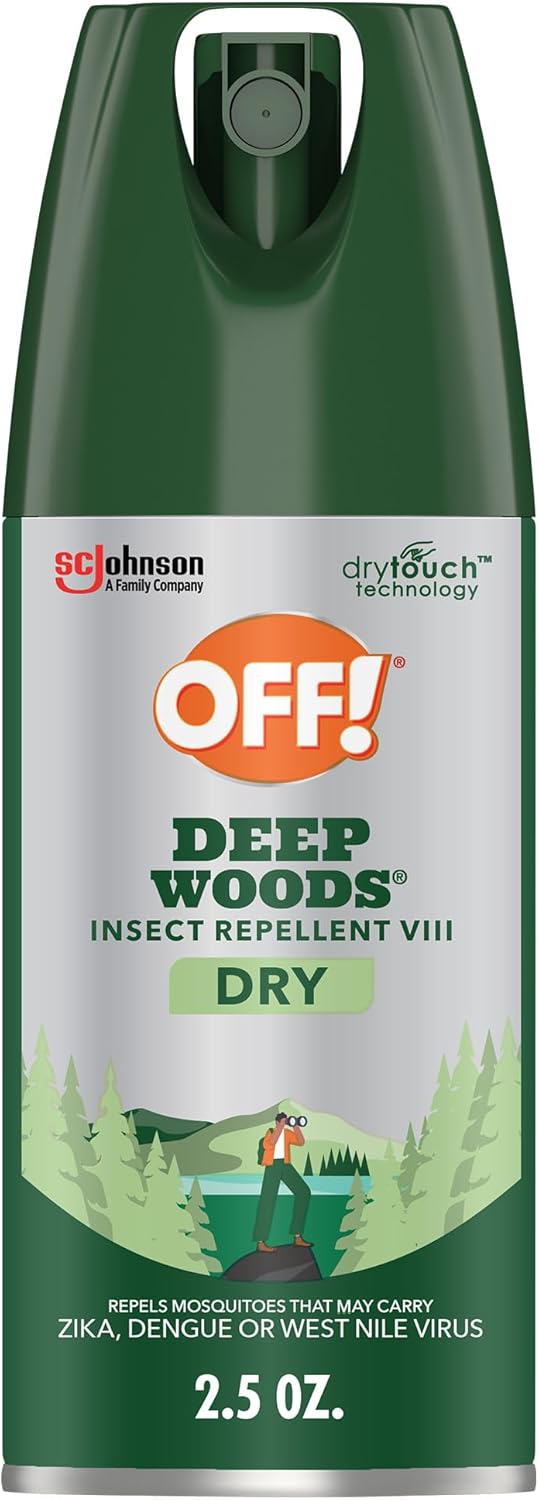
OFF! Deep Woods Dry Insect & Mosquito Repellent Spray, 2.5 oz
| Active ingredient | 25% DEET |
|---|---|
| Formulation | Aerosol spray, dry non-greasy |
| Claims | Up to 8 hours protection; repels mosquitoes, ticks, biting flies, gnats, chiggers |
| Indicated uses | Hunting, fishing, camping, backpacking |
OFF! Deep Woods Dry is an aerosol repellent formulated with 25% DEET for up to eight hours of protection against mosquitoes, ticks, biting flies, gnats, and chiggers. You use it by spraying from about 6 to 8 inches onto exposed skin or outer clothing and spreading sparingly; the powder-dry formula is designed to feel non-greasy so it is comfortable during active outdoor activities like hiking, fishing, and camping. The label emphasizes tick protection and cautions about avoiding synthetic fabrics and sensitive areas such as the face and eyes. Practical benefits include a compact 2.5 ounce can that is easy to carry and a proven active ingredient effective against a wide range of biting insects. Important limitations are that it contains DEET so it requires careful application around children and certain materials, and it is an extremely flammable aerosol so it must be kept away from heat and flame. Also the scent and aerosol delivery may be less desirable for people who prefer lotions or fragrance-free options.
Best for: Buyers who want a budget-friendly, proven DEET spray for outdoor activities and need long-lasting, portable protection from biting insects.
Less Ideal for: People who prefer non-DEET alternatives, fragrance-free formulations, or lotion-based repellents should consider other products.
- Contains 25% DEET, an effective, long-lasting active ingredient against mosquitoes and ticks
- Powder-dry, non-greasy formula that is comfortable for active outdoor use
- Compact aerosol can that is easy to carry on hikes, fishing trips, or camping
- Provides up to 8 hours of protection on a single application when used as directed
- Aerosol spray is extremely flammable and must be stored and handled carefully
- Contains DEET which requires precautions for use on or around children and some fabrics
Verdict: A compact, budget-friendly DEET spray that delivers long-lasting, dry-feeling protection for outdoor activities against sand fly–type biting insects.
Proven Insect Repellent Lotion 20% Picaridin, 2 fl oz (2-Pack)

| Active ingredient | Picaridin 20% |
|---|---|
| Format | Lotion |
| Size | 2 fl oz |
| Protection duration | Up to 14 hours (mosquitoes/ticks); up to 8 hours (biting flies/sand flies) |
This Proven lotion-format repellent uses 20% picaridin to provide reliable, long-duration protection in a small, travel-friendly 2 fl oz bottle. It is applied directly to skin for targeted coverage and is marketed to repel mosquitoes and ticks for up to 14 hours and biting flies and sand flies for up to 8 hours. The lotion texture is non-greasy and absorbs cleanly, making it comfortable for repeated wear during outdoor activities like beach days, hiking, or yard work. It is EPA-registered and labeled as a DEET alternative that is safe for family use when directions are followed, including infants older than two months per CDC guidance. The product comes in odorless or a mild rosemary-lavender scent and is TSA-friendly for travel. Limitations are that protection times for different insects vary, so reapplication is needed for extended exposure to sand flies or heavy biting-fly conditions, and lotion application is slower to cover large areas compared with a spray.
Best for: Buyers who prioritize dependable, long-lasting protection for family outings and travel and who prefer a non-greasy lotion over aerosol sprays for targeted application.
Less Ideal for: People who need rapid whole-body coverage for large groups or who prefer continuous misting sprays for very quick application should consider a spray-format repellent instead.
- Contains 20% picaridin, a CDC-recommended DEET alternative shown to repel ticks and mosquitoes
- Lotion format provides targeted, non-greasy application that absorbs without heavy residue
- Long labeled protection windows: up to 14 hours for mosquitoes and ticks and up to 8 hours for biting flies and sand flies
- TSA-friendly travel size and family-safe labeling for use on young children when used as directed
- Lotion requires more time to apply evenly over large areas compared with sprays
- Protection duration differs by insect type so periodic reapplication may be needed in heavy exposure scenarios
Verdict: Choose this picaridin lotion when you want vetted, long-lasting protection against sand flies and other biting insects in a travel-friendly, family-safe format.
OFF! Deep Woods Dry Insect & Mosquito Repellent Aerosol, 4 oz (2-Pack)

| Active ingredient | DEET 25% |
|---|
OFF! Deep Woods Dry is a portable aerosol repellent designed for active outdoor use like hiking, fishing, and hunting. Each 4 oz can contains 25% DEET and sprays in a powder‑dry formula that is non‑greasy and intended to last up to eight hours per application. You use it by holding the can 6 to 8 inches from skin or clothing and applying a light, even layer; it can also be sprayed on outer clothing to help guard against ticks and chiggers. Practical features include clear label directions, broad coverage against mosquitoes, ticks, biting flies, gnats and chiggers, and warnings and first‑aid information printed on the container. Important limitations are the DEET concentration, which while effective may be stronger than needed for casual backyard use, and the aerosol format, which is flammable and requires careful storage and application away from heat and children. The product does not protect against insect bites immediately after application so following label directions for sparing, even coverage and avoiding over‑application is important.
Best for: Buyers who prioritize reliable, long‑lasting protection for active outdoor trips and want a portable, easy spray to carry on hiking, fishing, or hunting outings.
Less Ideal for: People who prefer fragrance‑free or non‑DEET solutions, parents seeking repellent to apply directly to young children, or those who need a non‑aerosol option for indoor or enclosed‑space use should consider alternatives.
- Effective active ingredient (25% DEET) for long‑lasting protection against mosquitoes and ticks
- Powder‑dry, non‑greasy aerosol goes on without leaving an oily feel or staining clothing
- Convenient 4 oz aerosol size suitable for day trips and portable to pack in a backpack
- Label includes clear directions for safe application and specific guidance for treating clothing
- Aerosol formulation is extremely flammable and must be kept away from heat and flames
- DEET at 25% may be stronger than necessary for low mosquito pressure or around children
Verdict: A portable, powder‑dry DEET aerosol that delivers reliable, long‑lasting protection for outdoor activities.
OFF! Clean Feel Picaridin Insect & Mosquito Repellent Spray, 5 oz

| Active ingredient | Picaridin 20% |
|---|---|
| Form | Aerosol spray |
| Protection duration | Up to 8 hours (when used as directed) |
OFF! Clean Feel is a lightweight, fragrance-free aerosol repellent that uses 20% picaridin to protect exposed skin from mosquitoes, ticks, and biting flies for up to eight hours when used as directed. It sprays on easily from an aerosol can and spreads smoothly without leaving a greasy or sticky residue, which makes it convenient for everyday outdoor activities where frequent reapplication would be inconvenient. The formula is DEET-free and designed not to stain clothing or leave strong odors, so it is a good fit for people who want effective protection without the typical insect-repellent smell. Important practical points: you should hold the can 6 to 8 inches from skin and apply evenly, avoiding the face by spraying on hands first, and reapply around every 90 minutes if needed per directions. As with any topical repellent, it can cause eye irritation and some individuals may experience skin sensitivity after repeated contact. The aerosol format is quick to use but less precise than a pump or lotion for targeted application around the face and neck.
Best for: Buyers who prioritize reliable, proven insect protection without DEET and prefer a quick, no-smell aerosol they can use for routine outdoor activities.
Less Ideal for: People who need very precise application around the face or who prefer lotions for children and infants under six months should consider alternative formats.
- Contains 20% picaridin which delivers long-lasting protection against mosquitoes, ticks, and biting flies
- Fragrance-free, non-greasy formula that goes on clear and does not leave sticky residue
- Aerosol spray is easy and fast to apply for everyday outdoor use
- Formulation is DEET-free and stated not to stain clothing
- Aerosol delivery is less precise than a gel or pump for applying around the face and sensitive areas
- May cause eye irritation and can provoke allergic skin reactions in susceptible individuals
Verdict: Choose OFF! Clean Feel if you want an easy, fragrance-free picaridin spray that delivers long-lasting protection from biting flies and mosquitoes for everyday outdoor use.
Choosing the Right Insect Repellent for Sand Flies: Key Factors to Consider
Duration of Protection
How long a repellent keeps sand flies from landing and biting is central to selecting the right product. Protection windows can vary widely between formulations and concentrations. Longer-lasting repellents reduce the need for frequent reapplication, which is helpful for day trips, hikes, or long beach sessions.
Consider the expected activity level and whether you will be sweating or getting wet. If water exposure is likely, choose a formulation that maintains efficacy for several hours under damp conditions. Short-duration options can still work if you plan scheduled reapplications, but that adds planning and can be inconvenient in the field.
Skin Compatibility and Safety
Repellents contact bare skin, so formulation matters for irritation risk, allergies, and suitability for children. Look for product information on hypoallergenic formulations, dermatological testing, and clear age recommendations. Some active ingredients are better tolerated on sensitive skin than others.
Consider any preexisting skin conditions, history of reactions to topical products, and whether you will be applying near the face. Lotions and creams tend to be gentler than high-alcohol sprays, while certain natural alternatives can still cause irritation for some people.
Resistance to Sweat, Water, and Transfer
Sand fly hotspots are often humid and windy, so a repellent that rubs off onto clothing or washes away quickly will leave you exposed. Products with formulations designed to resist transfer or retain effectiveness when damp are more reliable for outdoor use.
Assess how the repellent behaves when you sit on towels, lean against gear, or get caught in a drizzle. Transfer-resistant options reduce staining and keep protection active after light contact with moisture or friction.
Ease of Application and Coverage
How you apply a repellent affects actual protection. Sprays reach hard-to-reach areas quickly and work well over clothing, while lotions and creams allow more controlled coverage on delicate skin. Pumps and sprays also differ in how evenly they coat exposed skin.
Think about whether you will be reapplying in the field, whether children will need help, and if you require precise application around the ears, ankles, and neck where sand flies often bite.
Scent and Residue
Scent and how a product feels on the skin influence user comfort and frequency of use. Strong chemical odors can be off-putting during long outdoor stays, while greasy or sticky residues may attract sand and grit.
Select a formulation that you will tolerate for hours. Low-odor or pleasantly scented options tend to encourage consistent application, which improves overall protection.
Applicator Safety and Portability
Packaging and dispenser type affect safe use in the field. Spray bottles are convenient for quick coverage but can create aerosols that are not ideal for use near children or face application. Lotions provide controlled dosing and are often easier to measure for children.
Consider the size of the container for multi-day trips, whether the dispenser can be locked to prevent leaks in a pack, and whether the product is easy to carry in a daypack or beach kit.
Why Sand Flies Are Different
Sand flies are tiny and persistent biters that can reach through loose clothing and bite low on the legs and ankles. Their small size and low weight make them harder to discourage than larger mosquitoes, so repellents need to offer consistent coverage and sufficient active concentration to be effective.
Because they often operate at dawn, dusk, and in shaded coastal vegetation, a product that holds up to humidity and light activity will generally work better than a short-lived spray applied once.
- Bite locations are often around ankles, behind knees, and lower limbs
- Smaller target size means repellents need thorough coverage
- Coastal conditions add humidity and sand exposure challenges
Applying Repellent Effectively
Apply evenly to exposed skin, paying attention to ankles, lower legs, and behind knees where sand flies target. If using a spray, first spray into your hands and then rub onto the face rather than spraying directly at the face to avoid inhalation.
Reapply according to the product instructions and sooner if you towel off, swim, or notice the protection fading. For children, follow age guidance and apply adult products to your own hands first, then transfer to the child to avoid aerosol exposure.
- Target lower legs and exposed skin near shoes and ankles
- Avoid spraying directly on the face; use hands for facial application
- Wash hands after applying before eating or handling food
Clothing Treatments and Layering Strategies
Using repellent on clothing as a supplement can reduce bites through thin fabrics. Treating cuffs, hems, and sock tops helps create a protective barrier at common entry points for sand flies. Treated clothing is not a substitute for skin-applied repellent but can extend protection, especially during long outdoor sessions.
Combine treated clothing with a skin repellent on exposed areas for best results. Light, breathable long sleeves and high socks further reduce exposed skin and make repellents more effective by limiting access points.
- Treat cuffs, collars, and sock tops for added protection
- Wear light, breathable layers in hot weather to cover vulnerable areas
- Re-treat clothing as directed, especially after washing
Protecting Children and Sensitive Users
Children and people with sensitive skin need special consideration. Use formulations that specify age limits and avoid high-alcohol sprays on young children. Lotions and creams are often easier to apply gently and with controlled amounts.
Always follow pediatric guidance on concentration and frequency. If irritation occurs, wash the area and discontinue use. Consider carrying a mild topical remedy for itch relief when spending extended time outdoors.
- Check age recommendations and follow dose guidelines
- Apply adult products to your hands first when treating children
- Watch for signs of irritation and rinse if a reaction occurs
Managing Bites and Aftercare
Even with the best repellent, a few bites can happen. Clean the area with mild soap and water and avoid scratching to reduce infection risk. Nonprescription topical anti-itch treatments and cold compresses can relieve immediate discomfort.
If bites worsen or show signs of infection, seek medical advice. For long trips in remote areas, include a small first-aid kit with antiseptic wipes and a topical itch reliever.
- Clean bites and avoid scratching
- Use cold compresses and topical itch relievers for discomfort
- Monitor for infection and seek care if symptoms worsen
How We Chose the Best Insect Repellent for Sand Flies
We prioritized products that deliver reliable protection against small, persistent biting flies common near water and shaded coastal vegetation. First, we looked at duration of effective protection under real-world conditions such as sweating, light activity, and occasional water exposure. Second, skin safety and formulation matters for repeated daily use, especially for people with sensitive skin or who spend long days outdoors. Third, ease of application and coverage determines whether a repellent is practical for quick reapplication or full-body coverage. Fourth, resistance to rubbing off or transferring to clothing is important for activities like sitting on beach towels or handling gear. Finally, packaging and spray or lotion format affects use on children and ease of targeted application. We excluded products designed only for indoor pest control, food-safe repellents not intended for skin, and any items that rely solely on clothing treatment without skin-applied options. Our selection favors formulations that balance longevity, skin tolerance, and field usability for coastal and outdoor conditions.
FAQ
How often should I reapply insect repellent for sand flies?
Reapplication depends on the product and exposure. Many formulations last several hours, but you should reapply after heavy sweating, towel-drying, or swimming. Follow the label intervals for safe and effective use.
Can I use the same repellent on children and adults?
Some products are formulated for all ages, while others have specific age restrictions. Use products that list pediatric guidance for children and apply adult formulations to your hands first when applying to young kids to avoid inhalation.
Are natural repellents effective against sand flies?
Natural repellents can provide some protection but often have shorter durations than synthetic options. They may work for light exposure but usually require more frequent reapplication in areas with heavy sand fly activity.
Will sunscreen interfere with insect repellent effectiveness?
Sunscreen can affect how a repellent spreads and how long it lasts. Apply sunscreen first, allow it to absorb, then apply repellent. Some combined products exist, but following label guidance on layering is best.
Is it safe to use repellent on broken or irritated skin?
Avoid applying repellent to open wounds, cuts, or severely irritated skin. If skin is compromised, protect the area with clothing or a bandage and consult product instructions or a healthcare provider for alternatives.
Final Verdict
When choosing an insect repellent for sand flies, prioritize protection duration and skin compatibility for the conditions you expect. Think practically about application method, resistance to sweat and transfer, and whether you will need clothing treatments as a supplement. Balance longevity against tolerability and ease of reapplication. For most beach and coastal outings, a transfer-resistant formulation applied to exposed lower limbs, combined with treated clothing or high socks, provides the most reliable bite reduction.
