

Note: This article contains affiliate links. If you click on these links and make a purchase, I may earn a small commission at no extra cost to you. This helps support my research and content. Read my full affiliate disclosure here.
If pests are gathering around your foundation, eaves, porch, or landscaping, choosing the right insecticide for outside house use can make the difference between occasional sightings and a season-long problem. Outdoor insect control behaves differently than indoor products: UV exposure, rain, and plant sensitivity affect how long a treatment lasts and where you can safely apply it. This guide walks through shortlisted products that are appropriate for exterior home zones and explains the practical tradeoffs you should weigh. We evaluated options based on how long treatments last outdoors, ease and safety of application, and compatibility with common landscape plants and pets. Read on for a concise explanation of the decision factors and practical tips for treating typical outside-house trouble spots before the product reviews below.
Top Picks at a Glance
| Best Overall The best all-around choice for most situations | Ortho Home Defense Insect Killer for Indoor & Perimeter, 24 oz (2-Pack) |  |
| Best Quality Built to a higher standard if you want something more solid | Talstar One Insecticide Concentrate, 1 Gallon |  |
| Best Value The sweet spot between price and what you get | Cutter Backyard Bug Control Spray Concentrate, 32 oz (2-pack) |  |
| Best Budget The cheapest option that still gets the job done reliably | Spectracide Triazicide Insect Killer for Lawns & Landscapes, 32 oz |  |
| Highest Rated A top-rated pick with lots of positive feedback | Envu Suspend SC Insecticide Concentrate, 16 oz |  |
| Most Popular A crowd favorite that many people choose with confidence | Atticus Talak 7.9% Bifenthrin Indoor/Outdoor Insecticide Concentrate (32 oz) |  |
| Best Seller A high-volume bestseller chosen again and again | Ortho Home Defense Insect Killer for Indoor & Perimeter Refill, 1.33 gal |  |
Ortho Home Defense Insect Killer for Indoor & Perimeter, 24 oz (2-Pack)

| Unit Count | 48 Fluid Ounces |
|---|---|
| Item Form | Liquid |
| Target Species | Ants, Beetles, Ticks, Cockroaches |
| Active Ingredients | Bifenthrin, Zeta-Cypermethrin |
Ortho Home Defense is a ready-to-use insect spray formulated for both indoor spot treatments and outdoor perimeter applications. It comes as two 24 oz trigger-spray bottles so you can treat kitchens, bathrooms and entry points inside and spray a band around foundations, patios and decks outside. The formula lists bifenthrin and zeta-cypermethrin as active ingredients and targets a wide range of pests from ants and roaches to ticks and mosquitoes. Practical benefits include fast-drying, no-fume Invisi-Shield technology and an advertised indoor barrier that can last up to 12 months on nonporous surfaces for ants, roaches and spiders. Because it is ready to use with a spray wand there is no mixing and application is straightforward for homeowners. Important limitations are that effectiveness outdoors depends on correct perimeter coverage and resists only listed species, and this product contains synthetic insecticides that require following label safety instructions around children, pets and desirable plants.
Best for: Homeowners who want a straightforward, all-purpose indoor and perimeter spray to prevent and control common household pests around entry points and foundations.
Less Ideal for: People seeking organic or non-synthetic pest control solutions or those who need specialized treatments for structural termite infestations should consider alternatives.
- Ready-to-use trigger spray in two 24 oz bottles for immediate application
- Broad target list covering common household and perimeter pests
- Invisi-Shield formula dries clear and is labeled no-fume for indoor use
- Advertised up-to-12-month indoor barrier against ants, roaches and spiders
- Contains synthetic pyrethroid active ingredients so users must follow safety precautions around people, pets and plants
- Outdoor performance depends on consistent perimeter application and may require reapplication in high-rain or heavy-traffic areas
Verdict: A convenient ready-to-use spray that delivers broad-spectrum indoor and perimeter protection for homeowners wanting a practical, long-lasting barrier against common insects.
Talstar One Insecticide Concentrate, 1 Gallon

| Active ingredient | Bifenthrin 7.9% |
|---|---|
| Other ingredients | 92.1% |
Talstar One is a concentrated bifenthrin insecticide intended for both perimeter and indoor crack-and-crevice use to control ants, spiders, roaches, fleas, ticks, mosquitoes and many other pests. You mix the concentrate with water to treat foundations, doorways, windows, ornamental beds, lawns and structural surfaces, creating a residual barrier that reduces reapplication frequency. The product is water-based, low-odor and dries clear, so treated areas maintain a tidy appearance and are suitable for porches and patios. Notable features are the broad 75+ pest label coverage and a long track record of field use, which make it a reliable choice for heavy pest pressure on larger properties or seasonal maintenance. Important limitations are that this is a professional-strength pesticide requiring careful adherence to label directions and proper protective measures, and it is not a ready-to-use spray so you will need compatible mixing and application equipment for even coverage.
Best for: Buyers seeking professional-level, performance-focused perimeter control for yards, foundations and outdoor living areas who prioritize long-lasting efficacy over convenience.
Less Ideal for: Casual users who prefer a trigger-spray ready-to-use product or those uncomfortable handling concentrated pesticides should consider simpler consumer formulations.
- Broad-spectrum control listed for over 75 pests including ants, spiders, roaches and mosquitoes
- Concentrated formulation stretches coverage for large properties or multiple treatments
- Low-odor, water-based formula that dries clear and is suitable for visible outdoor living areas
- Effective residual activity for perimeter and structural protection when applied per label
- Requires mixing and a separate sprayer or application equipment rather than being ready-to-use
- Contains a potent active ingredient that requires careful handling and full label compliance
Verdict: Choose Talstar One when you need a concentrated, long‑lasting perimeter insecticide that delivers professional-grade control across a wide range of outdoor pests.
Cutter Backyard Bug Control Spray Concentrate, 32 oz (2-pack)

| Unit Count | 64 Fluid Ounces |
|---|---|
| Item Form | Spray |
| Target Species | Insects |
| Active Ingredients | Lambda Cyhalothrin |
This Cutter Backyard Bug Control Spray Concentrate is a hose-end ready insecticide for treating lawns, shrubs, trees and outdoor surfaces where insects hide. The bottle attaches to a garden hose with the QuickFlip sprayer so water automatically mixes the concentrate and you can sweep the product across up to 5,000 sq ft of lawn without measuring or mixing. It lists lambda-cyhalothrin as the active ingredient and is formulated to kill mosquitoes, certain ants, fleas and a range of listed insects with residual control up to about 12 weeks when applied as directed. Practical features include the built-in hose nozzle for quick application and guidance for foliar versus lawn use. Important limitations are that it is a chemical insecticide that requires keeping children and pets out of treated areas until dry and careful adherence to label directions to avoid runoff or application near sensitive water bodies. Users should also test siding for staining before spraying close to structures.
Best for: Buyers who prioritize an efficient, time-saving solution to reduce common outdoor insects across a whole yard and prefer a product that is easy to apply with a hose-end nozzle.
Less Ideal for: People seeking organic or non-chemical pest control methods or those with lawns adjacent to sensitive aquatic habitats should consider alternative products or professional advice.
- Hose-end QuickFlip sprayer lets you apply without premixing for fast coverage
- Covers up to 5,000 sq ft per bottle for large lawns
- Provides residual control up to 12 weeks against listed insects
- Effective against a broad list of common outdoor pests including mosquitoes and certain ants
- Contains a synthetic pyrethroid active ingredient that requires label precautions around people, pets and water
- May cause staining on some siding so testing is recommended before use
Verdict: If you want fast, whole-yard insect control with a convenient hose-end applicator, this concentrate delivers broad, long-lasting knockdown and coverage.
Spectracide Triazicide Insect Killer for Lawns & Landscapes, 32 oz
| Unit Count | 32 Ounce |
|---|---|
| Item Form | Spray (concentrate) |
| Target Species | Insects |
| Active Ingredients | Gamma-Cyhalothrin (0.08%) |
| Liquid Volume | 32 fluid ounces |
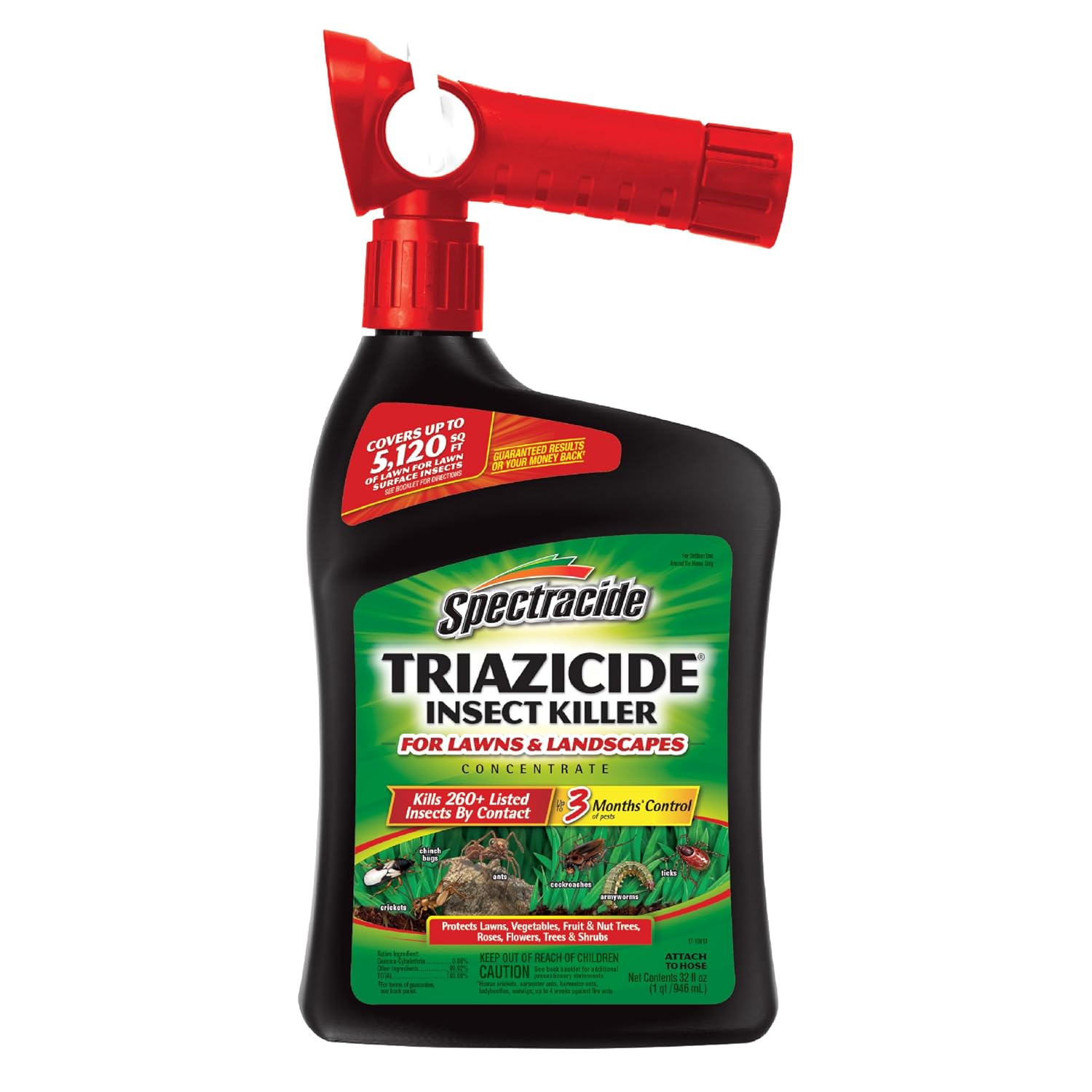
Spectracide Triazicide is a 32-ounce concentrate designed to protect lawns, landscape beds and ornamentals by contact kill of more than 260 listed insects, including fleas, ticks, ants and Japanese beetles. You mix it with water and apply with a tank sprayer or use the ready-to-spray hose-end option on labeled packages, which makes it practical for treating turf, flower beds, shrubs and around trees. The formula acts quickly, often reducing active infestations within 24 hours, and is labeled to provide residual control for up to three months when used as directed. Practical benefits include broad-spectrum control that covers surface and soil pests and flexible application rates for small spot treatments or treating up to thousands of square feet. Important limitations are safety and environmental cautions: the product is highly toxic to fish and bees and requires careful handling, timing around blooming plants, and avoidance of runoff. Users must follow label directions precisely for mixing rates, timing and restrictions on frequency of application.
Best for: Buyers who need an economical, versatile insecticide to treat lawns and landscapes and who are comfortable following label safety and mixing instructions.
Less Ideal for: People with ponds, small wetlands, frequent pollinator activity nearby, or those unwilling to follow pesticide safety precautions should consider less-toxic or nonchemical alternatives.
- Broad-spectrum control listed for 260+ insects including common lawn pests and ticks
- Concentrate format lets you dilute for spot treatments or large-area coverage
- Fast-acting contact kill often shows results within 24 hours
- Can be applied with tank sprayer or hose-end ready-to-spray option for convenience
- Highly toxic to aquatic life and bees, so it must not be applied near water or blooming plants
- Requires careful mixing and adherence to label directions to avoid environmental harm
Verdict: A cost-effective, fast-acting concentrate for treating a wide range of lawn and landscape pests when used with careful attention to safety and label directions.
Envu Suspend SC Insecticide Concentrate, 16 oz

| Item Form | Spray |
|---|---|
| Target Species | Ants, Bed Bugs, Cockroaches, Fleas, Mosquitoes, Scorpions, Spiders, Ticks, Wasps, Yellow Jackets |
| Liquid Volume | 16 fluid ounces |
| Active Ingredients | Deltamethrin |
| Specification Met | EPA |
Suspend SC is a concentrated deltamethrin insecticide intended for perimeter and crack-and-crevice treatments around homes. You mix the concentrate with water and apply it to foundations, door thresholds, window perimeters, garages, crawl spaces, patios, shrubs, and landscaped areas to create a protective barrier that reduces insect entry. The low-odor, water-based formulation and EPA specification make it practical for both indoor spot treatments and larger outdoor perimeter jobs. Its residual activity means treatments remain effective on treated surfaces, so preventive applications can last longer than knockdown-only sprays. As a concentrate it covers more area per bottle than ready-to-use products, which is useful for routine maintenance programs. Limitations are typical of professional concentrates: it requires careful mixing, correct application rates, and safety precautions around people, pets, and pollinators, and it is not a quick fumigant for heavy indoor infestations without complementary methods.
Best for: Buyers who prioritize a reliable, long-lasting perimeter treatment and prefer a concentrated product they can dose for scheduled preventative applications around a house.
Less Ideal for: People who need an immediate knockdown or who do not want to handle concentrated pesticides should look at ready-to-use or professional service options instead.
- Concentrated formula covers large areas and supports multiple perimeter applications.
- Contains deltamethrin, a broad-spectrum active ingredient effective against many crawling insects.
- Low-odor, water-based formulation suitable for indoor spot treatments and outdoor use.
- Provides long residual control on treated surfaces for ongoing prevention.
- Requires proper dilution and handling, so it is less convenient than ready-to-use sprays.
- Not appropriate as a standalone solution for severe indoor infestations that need immediate knockdown or professional structural treatment.
Verdict: Choose Suspend SC when you want a concentrated, long-residual perimeter treatment that reduces reapplications and supports a reliable preventative pest program.
Atticus Talak 7.9% Bifenthrin Indoor/Outdoor Insecticide Concentrate (32 oz)

| Active Ingredient | Bifenthrin |
|---|---|
| Formulation | Suspension Concentrate |
| Liquid Volume | 32 fluid ounces |
| Length of Control | Up to three months |
Talak 7.9% is a concentrated bifenthrin insecticide designed for perimeter, landscape and limited indoor use. You dilute the liquid with water and apply it as a spray to lawns, shrubs, eaves, porches, baseboards and other entry points to create a knockdown barrier against more than 75 pests including ants, mosquitoes, spiders and ticks. The water‑based formula mixes easily, dries clear, leaves no odor or visible residue, and the label claims residual activity up to three months depending on application and exposure. Practical benefits include a single product that covers turf, ornamentals and structural perimeters plus a pour‑friendly bottle that helps reduce mess while measuring. Important limitations are that concentrates must be mixed for same‑day use only and it is not labeled for fogger use, so applications require a pump sprayer and attention to dilution rates; local restrictions also block sale in a few states. As with any broad‑spectrum pyrethroid, follow label safety rules around people, pets and pollinator exposure to avoid unintended impacts.
Best for: Buyers who want a single, professional‑strength concentrate to protect outdoor living areas and home perimeters and who prioritize proven pest control backed by many customer reviews.
Less Ideal for: People looking for an all‑natural or non‑pyrethroid solution, or those who prefer ready‑to‑use sprays rather than mixing concentrates.
- Broad-spectrum control listed for 75+ indoor and outdoor insect pests
- Water-based concentrate that dilutes easily and dries clear with no odor
- Long residual claim of up to three months for perimeter and landscape treatments
- Versatile label uses: lawns, landscapes, porches, eaves and limited indoor crack-and-crevice applications
- Requires correct dilution and same‑day mixing so you must prepare only what you will use
- Not approved for fogger use and needs a sprayer for application
- Restricted sale in certain states so availability may vary
Verdict: Use Talak 7.9% when you want a single, water‑based bifenthrin concentrate that provides proven, long‑lasting perimeter and landscape insect control.
Ortho Home Defense Insect Killer for Indoor & Perimeter Refill, 1.33 gal

| Unit Count | 170.24 Fluid Ounces |
|---|---|
| Liquid Volume | 1.33 gallons |
| Item Form | Spray |
| Target Species | Insects |
Ortho Home Defense Insect Killer refill is a large-format spray concentrate intended for indoor use on non-porous surfaces and for treating the perimeter around a home. It is typically poured into the brand's Comfort Wand applicator or a ready-to-use sprayer and applied as a 4-inch indoor band or a 12-inch outdoor band along foundations, doorways, patios, and garages. The formula claims up to 12 months of residual control against ants, roaches, and spiders and lists a wide range of target insects including mosquitoes, ticks, fleas, and flies. Key practical benefits are the long residual protection for routine preventative treatments, the no-fumes Invisi-Shield technology that dries clear, and the convenience of a refill that extends an existing applicator. Limitations to consider are that the 12-month protection applies to specific pests and non-porous indoor surfaces only, reapplication or different products may be needed for porous surfaces or other insect types, and safety precautions are required when applying around children, pets, and garden plants. For homeowners who want a durable perimeter barrier without repeated short-term sprays, this refill is a straightforward option.
Best for: Homeowners who want a low-maintenance perimeter and indoor barrier to reduce recurring insect problems and prefer a trusted, long-lasting treatment they can apply themselves.
Less Ideal for: People who need immediate spot treatments without a separate applicator or those looking for organic or non-chemical pest control methods.
- Provides up to 12 months of residual control against ants, roaches, and spiders on non-porous indoor surfaces
- Large 1.33 gallon refill reduces the need to buy frequent small bottles and lets you reuse the Comfort Wand applicator
- Invisi-Shield formula dries clear and is formulated to give off no noticeable fumes during use
- Wide labeled spectrum covers many common household and perimeter pests including mosquitoes, ticks, fleas, and flies
- 12-month claim is limited to certain pests and surface types so results may vary for other insects or porous surfaces
- Requires a compatible applicator for comfortable, accurate application rather than being ready-to-spray out of the bottle
Verdict: A refill-size insecticide for homeowners who want a durable, low-fuss indoor and perimeter barrier that provides long residual control against common household pests.
Choosing the Right Insecticide for Outside House: Key Factors to Consider
Residual Lifespan and Reapplication Interval
How long an insecticide remains effective on exterior surfaces matters for how often you need to retreat common hotspots like foundation seams, porch skirting, and eaves. Outdoor residues break down faster than indoor applications because of sunlight, rain, and microbial action in mulch or soil. A longer residual means fewer applications over the season, but labeled longevity depends on the treated surface and local climate.
Consider the manufacturer's specified reapplication interval and whether that interval accounts for rainfall or power washing. For porous surfaces and mulch beds, expect shorter effective life than on vinyl or brick. If frequent rain is typical where you live, choose products with faster rainfast claims or plan applications to avoid imminent storms.
Application Method and Precision
Application format affects how easily you can treat narrow gaps, high soffits, or dense shrubbery. Ready-to-use sprayers and hose-end options are convenient for broad perimeter sprays, while pump sprayers and aerosol crack-and-crevice products let you target specific entry points without overspraying plants.
Precision reduces non-target exposure and product waste. If you have climbing vines near fascia boards or ornamentals close to the foundation, pick a delivery method that allows low-volume, directed application. Also evaluate nozzle choices, flow control, and whether the product mixes cleanly if dilution is required.
Safety Around Children, Pets, and Beneficials
Safety instructions and labeled restrictions determine where and how you can use an insecticide around active yards. Look for clear re-entry intervals for people and pets, guidance on keeping treated areas dry until safe, and any warnings about toxicity to pollinators. Some exterior insecticides require keeping children and pets off treated surfaces until dry; others have longer exclusion windows.
If you maintain pollinator-friendly plantings or have outdoor cats and dogs, prioritize options with lower toxicity to beneficial insects and clear mitigation steps. Always follow label directions for buffer zones and avoid spraying flowering plants when pollinators are active.
Plant Compatibility and Phytotoxicity Risk
Many insecticides can cause leaf burn or discoloration on sensitive ornamentals when applied in hot sun or at incorrect dilutions. Check whether the label lists common landscape species or gives temperature and sunlight guidelines for spraying. Some formulations are unsuitable for newly planted specimens or certain broadleaf evergreens.
When treating beds adjacent to valuable plantings, test a small inconspicuous area first or use a lower-concentration, targeted treatment at the base of plants rather than foliar sprays. Consider non-plant contact applications like perimeter barriers along foundations when plant sensitivity is a concern.
Spectrum of Control and Target Pests
Different insecticides are formulated to control different groups such as ants, spiders, wasps, mosquitoes, fleas, or crawling pests that invade through foundation gaps. A broad-spectrum product can simplify management if you face multiple pests, but it may also increase non-target impacts. Conversely, a product targeted at specific pests may be more effective and reduce collateral effects.
Match the product's labeled pests with the species you commonly see around your house. For recurring invasive species, consider rotation between products with different modes of action to help delay resistance.
Weather Resistance and Environmental Persistence
Outdoor treatments must stand up to rain, high humidity, and UV exposure. Some formulations include adjuvants or microencapsulation to resist wash-off and prolong activity; others degrade rapidly and require reapplication after rain. Environmental persistence also raises concerns about runoff into garden beds and nearby water features.
Balance the desire for long-lasting control with the responsibility to avoid contamination of soil and water. Choose products with clear information on rainfall windows, runoff precautions, and labeled setbacks from storm drains or bodies of water.
Common Outside-House Problem Areas and How To Treat Them
Foundations, door thresholds, window wells, eaves, and porch skirting are frequent entry points for insects. Treatments aimed at the band of soil and mulch directly adjacent to the foundation create a barrier that discourages crawling pests from approaching the structure.
For overhead entry points like soffits and eaves, use low-drift, directed applications to avoid overspray on plants. Aerosol dusts or fine jets are useful for cracks and attics where direct contact with insects is the goal.
- Treat a 2 to 3 foot band along foundation perimeters for crawling insects.
- Avoid spraying flowering plants during pollinator activity times.
- Use crack-directed application methods for gaps and behind siding.
Timing Treatments for Best Results
Apply preventive perimeter treatments in spring before peak insect activity and again according to the product reapplication interval. For seasonal invaders like wasps or certain ants, target applications when workers are active but not during peak heat of the day to reduce drift and plant stress.
For mosquito control near foundations or in low-lying yards, time treatments for dusk or dawn when adult activity is highest and when wind is minimal. Adjust timing if heavy rain is forecast.
- Plan barrier treatments in early spring and mid-summer as needed.
- Avoid application before forecasted heavy rain unless product is rainfast.
Integrated Pest Management Strategies
Relying solely on chemical insecticides is rarely the best long-term approach. Combine exterior sprays with habitat modification such as trimming vegetation away from the house, removing standing water, and sealing entry cracks to reduce pest pressure.
Use targeted insecticide applications only where monitoring shows pest activity. Incorporate non-chemical controls like traps, mechanical exclusion, and beneficial predators when appropriate to reduce chemical use.
- Remove debris and wood piles near foundations to reduce harborage.
- Repair screens and seal gaps to limit indoor incursions.
Application Safety and Personal Protective Equipment
Follow label directions for protective gear, including gloves, eye protection, and masks if specified. Even products labeled for home use can irritate skin or eyes during mixing and spraying.
Store products away from children and pets and keep containers sealed. Clean equipment after each use to avoid cross-contamination with garden fertilizers or other pesticides.
- Wear long sleeves, gloves, and eye protection when mixing concentrates.
- Avoid applying on windy days to minimize drift onto non-target areas.
Environmental Considerations and Water Safety
When applying near gutters, storm drains, ponds, or runoff channels, choose formulations with lower aquatic toxicity and follow label setback instructions. Preventing runoff is critical to protect beneficial insects and aquatic life.
Consider buffer zones and avoid treating directly into drainage paths. Use spot treatments rather than broad sprays where water contamination is a concern.
- Keep a buffer from water features and avoid direct runoff into drains.
- Prefer targeted applications in sensitive landscape areas.
How We Chose the Best Insecticide for Outside House
We selected insecticides for outside house use by focusing on attributes that matter in real landscapes and on building exteriors. Key evaluation criteria included residual lifespan outdoors, labeled application zones for foundations and eaves, mode of action against common pests, and user safety details for households with children and pets. We also considered weather tolerance, specifically rainfastness and UV stability, plus compatibility with common ornamental plants and turf to avoid phytotoxicity. Products that lacked clear exterior labeling for home perimeter use, had ambiguous safety directions for pets or children, or relied on unproven modes of action were excluded. We prioritized insecticides with clear application guidance, measurable residual claims, and diverse modes of action to reduce resistance risk. Finally, packaging and delivery method were assessed for practical use by typical homeowners and gardeners, favoring options that allow targeted application to foundations, soffits, shrub bases, and mulch beds.
FAQ
How often should I reapply an outdoor insecticide around my foundation?
Reapplication intervals depend on the product's labeled residual lifespan and local weather. Many exterior products recommend reapplying every 30 to 90 days, but heavy rain or high UV exposure can shorten that window. Follow label instructions and retest treated areas after storms.
Can I spray insecticide directly on shrubs and flowering plants?
Not always. Some formulations are safe for foliar application, while others risk burning leaves or harming pollinators. Avoid spraying flowering plants when pollinators are active and consult the label for plant safety guidelines. When in doubt, perform a small spot test or use a perimeter barrier instead.
Are exterior insecticides safe for pets once dry?
Many outdoor insecticides are considered safe for pets after treated areas have fully dried, but specific re-entry intervals vary. Labels will state how long to keep pets away. For households with roaming animals, choose products with shorter re-entry times and follow all precautions.
Will using a broad-spectrum insecticide harm beneficial insects in my yard?
Broad-spectrum products can reduce beneficial insect populations if applied broadly to flowering or pollinator habitats. Targeted, non-bloom applications and spot treatments reduce risk. Avoid treating areas where pollinators forage and follow label guidance to minimize non-target impacts.
What is the best application method for treating eaves and soffits?
Directed low-drift applications work best for high overhead spots. Use an applicator that lets you aim into cracks and voids or a dust product labeled for such use. Avoid high-volume misting that can drift onto nearby plants and surfaces.
Can I rotate products to prevent resistance among pests?
Yes. Rotating products with different modes of action is a recommended practice to slow resistance development. Check the mode of action information on labels and alternate between products from different chemical classes when managing recurring infestations.
Final Verdict
Prioritize insecticides for outside house use that match the specific pest pressure and application zones around your home. Balance a desire for long residual control with safety around children, pets, and desirable landscape plants. Choose application methods that allow precision at foundations, soffits, and shrub bases to reduce non-target exposure. Ultimately, integrate chemical treatments with habitat modification and exclusion measures. That approach reduces repeat treatments and preserves beneficials while giving you reliable protection where it matters most.
