

Note: This article contains affiliate links. If you click on these links and make a purchase, I may earn a small commission at no extra cost to you. This helps support my research and content. Read my full affiliate disclosure here.
When you need reliable pest control outside, the right outdoor insecticide spray can protect people, pets, and plants while keeping nuisance insects at bay. You want a product that knocks down pests quickly, covers the right treatment area, and leaves an effective residual without excessive reapplication. This guide shortlists seven top outdoor insecticide sprays chosen for garden and patio use, and evaluates them against the needs most gardeners face. Below we break down how each product handles application, coverage, and safety so you can pick a spray that fits your outdoor space and pest pressures.
Top Picks at a Glance
| Best Overall The best all-around choice for most situations | Envu Suspend SC Insecticide Concentrate, 16 oz |  |
| Best Quality Built to a higher standard if you want something more solid | Talstar One Insecticide Concentrate, 1 Gallon |  |
| Best Value The sweet spot between price and what you get | Spectracide Bug Stop Home Barrier 1.33 Gal AccuShot Sprayer Refill |  |
| Best Budget The cheapest option that still gets the job done reliably | Spectracide Triazicide Insect Killer for Lawns & Landscapes, 32 oz |  |
| Highest Rated A top-rated pick with lots of positive feedback | Envu Tempo SC Ultra Insecticide Concentrate, 240 ml |  |
| Most Popular A crowd favorite that many people choose with confidence | Atticus Talak 7.9% Bifenthrin Indoor/Outdoor Insecticide Concentrate (32 oz) |  |
| Best Seller A high-volume bestseller chosen again and again | Cutter Backyard Bug Control Spray Concentrate, 32 oz (2 Pack) |  |
Envu Suspend SC Insecticide Concentrate, 16 oz

| Item Form | Spray |
|---|---|
| Target Species | Ants, Bed Bugs, Cockroaches, Fleas, Mosquitoes, Scorpions, Spiders, Ticks, Wasps, Yellow Jackets |
| Liquid Volume | 16 fluid ounces |
| Active Ingredients | Deltamethrin |
| Specification Met | EPA |
Suspend SC is a concentrated deltamethrin insecticide designed to create a perimeter barrier around homes and other structures. It mixes with water for crack-and-crevice, spot, and surface applications on foundations, doorways, patios, lawns, shrubs, garages and crawl spaces, and can also be used in limited indoor situations specified on the label. The suspension concentrate delivers a longer residual than typical knockdown sprays, so treated areas remain protective for weeks when applied correctly. It targets ants, spiders, cockroaches, fleas, ticks, scorpions and other common crawling pests, making it useful for routine seasonal maintenance or pre-emptive treatments. Because it is a concentrated product, it covers large areas economically but requires careful measuring and adherence to the label for safe mixing and application. Users should follow all safety and use restrictions for indoor use and around sensitive plants or non-target animals.
Best for: Homeowners who want a dependable perimeter-focused solution for seasonal maintenance and prevention and who are comfortable following label directions for mixing and application.
Less Ideal for: People seeking an immediate knockdown aerosol for spot indoor-only use or those unwilling to handle concentrated insecticide mixing should consider ready-to-use or non-chemical alternatives.
- Concentrated formula covers large areas and stretches a single bottle across multiple applications.
- Long residual control when applied per label reduces frequency of re-treatments.
- Broad-spectrum activity against common crawling pests including ants, spiders and cockroaches.
- Low-odor, water-based suspension suitable for many perimeter and spot applications.
- Requires careful mixing and precise application because it is a concentrated professional-grade product.
- Contains a synthetic pyrethroid so precautions are needed around aquatic areas and pets.
Verdict: Choose Suspend SC when you want a concentrated, long-residual perimeter insecticide that covers large areas and reduces reapplication frequency.
Talstar One Insecticide Concentrate, 1 Gallon

| Active ingredient | Bifenthrin 7.9% |
|---|---|
| Other ingredients | 92.1% |
| Intended use | Indoor and outdoor perimeter and structural applications |
| Manufacturer | Envu |
Talstar One is a professional‑grade bifenthrin concentrate intended for treating structures, perimeters, and vegetation to control ants, spiders, roaches, fleas, ticks, mosquitoes and many other pests. You mix the concentrate with water and apply it to foundations, door frames, cracks and crevices indoors or to lawns, shrubs and ornamental plantings outdoors following label directions. Notable features include a water‑based, low‑odor formula that dries clear and long residual activity that reduces the need for frequent reapplication. Because it is concentrated, a single gallon stretches to treat large areas or multiple buildings, which makes it practical for whole‑yard perimeter programs and seasonal maintenance. Important limitations are that it contains a potent synthetic pyrethroid so users must follow label safety precautions and avoid direct application to pollinator blooms and aquatic areas. It performs best when used as part of an integrated approach rather than as a one‑time spot fix.
Best for: Homeowners or property managers who prioritize strong, long‑lasting pest control for whole‑structure and perimeter treatments and who are comfortable following professional label safety instructions.
Less Ideal for: People seeking organic or pollinator‑safe pest solutions or those who only need spot treatment inside a single room should consider gentler or targeted alternatives.
- Broad spectrum control for 75+ common pests including ants, spiders, ticks and mosquitoes
- Concentrated formula that mixes with water so one gallon covers large areas
- Water‑based, low‑odor formula that dries clear for discreet perimeter treatments
- Long residual activity reduces frequency of reapplications
- Contains bifenthrin, a synthetic insecticide that requires careful handling and label compliance
- Not appropriate for direct application to pollinator flowers or sensitive aquatic environments
Verdict: Choose Talstar One when you need a concentrated, long‑lasting insecticide for reliable perimeter and structural control across large outdoor areas.
Spectracide Bug Stop Home Barrier 1.33 Gal AccuShot Sprayer Refill

| Unit Count | 170.24 Fluid Ounces |
|---|---|
| Item Form | Liquid |
| Target Species | Insects |
| Specification Met | Unscented |
Spectracide Bug Stop Home Barrier is a water-based insecticide refill formulated for use with the AccuShot continuous-power sprayer to treat indoor hiding spots and outdoor perimeters. It kills on contact a range of pests including ants, roaches, spiders, fleas and silverfish and claims up to 12 months of control for cockroaches on non-porous surfaces. The clear, unscented formula leaves no oily residue so it is practical for baseboards, window and door frames, and foundation treatments. Using the AccuShot cap and extendable wand makes targeted application easier and reduces hand fatigue during larger perimeter jobs. Because this is a refill, you need the AccuShot sprayer cap and batteries to use it which adds setup steps compared with a ready-to-spray can. It is strong for perimeter and crack-and-crevice work but should be applied according to label directions and kept away from areas where pets and children have direct access until treated surfaces dry.
Best for: Buyers who want a cost-effective, bulk refill for regular perimeter and crack-and-crevice insect control and who prefer a targeted sprayer for efficient application.
Less Ideal for: Casual users who want a single ready-to-use aerosol or those who need an all-surface residual solution without following specific label instructions.
- Large 1.33 gallon refill reduces frequency of repurchasing for extensive perimeter treatments
- Water-based clear formula leaves no odor or oily residue after application
- Kills on contact a broad list of common household and yard insects
- Designed for the AccuShot sprayer with an extendable wand and continuous trigger to improve accuracy and reduce hand fatigue
- Requires AccuShot sprayer cap and batteries so it is not ready-to-use out of the container
- Effectiveness claim for up to 12 months applies only to cockroaches on non-porous surfaces and may not generalize to other pests or porous areas
Verdict: A practical bulk refill for homeowners who regularly treat foundations and entry points and want a no-residue formula paired with a targeted sprayer.
Spectracide Triazicide Insect Killer for Lawns & Landscapes, 32 oz
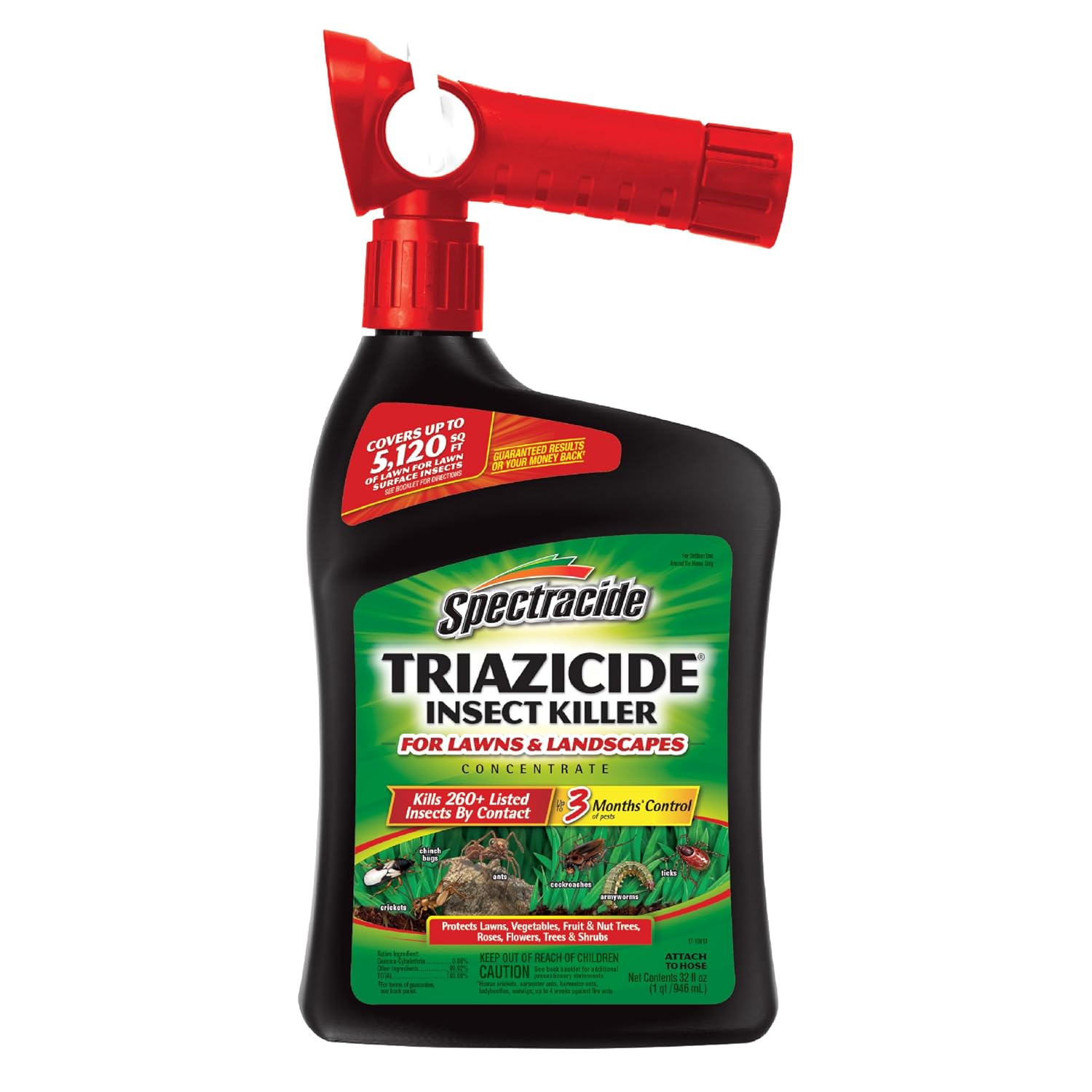
| Unit Count | 32 Ounce |
|---|---|
| Item Form | Spray concentrate |
| Target Species | Insects |
| Active Ingredients | Gamma-Cyhalothrin (0.08%) |
Spectracide Triazicide is a concentrated insect killer formulated to protect lawns, flower beds, shrubs, trees and edible gardens from more than 260 listed pests. You mix the 32-ounce concentrate with water and apply it with a tank or hose-end sprayer to target surface insects like ants and fleas or to treat mounds such as fire ants. The formula is fast acting and claims control within 24 hours and residual protection that can last up to three months when used as directed. Practical benefits include broad-spectrum control for both above- and below-ground pests and the ability to cover large areas when diluted, which makes it economical for routine seasonal treatments. Important limitations are standard pesticide precautions: it is highly toxic to fish and bees and requires careful application to avoid drift or runoff, and users must follow label directions for safe timing around blooms and water. It is a workhorse product for homeowners who want a concentrated, multipurpose lawn insecticide and are comfortable following handling and environmental safety guidance.
Best for: Homeowners who need a cost-effective, broad-spectrum lawn and landscape insecticide and are willing to mix and apply a concentrate for larger coverage and seasonal control.
Less Ideal for: People who prefer ready-to-use sprays, those with ponds or frequent pollinator activity nearby, or gardeners unwilling to follow pesticide safety and runoff precautions.
- Broad-spectrum concentrate that targets 260+ listed insects above and below ground
- Fast action with reported results in about 24 hours
- Dilutable formula covers large areas, making single bottles economical for multiple treatments
- Non-staining when used as directed on most home siding
- Extremely toxic to fish and harmful to bees, requiring careful timing and application to avoid environmental damage
- Requires mixing and a sprayer, which adds setup time compared with ready-to-use aerosols
Verdict: A concentrated, budget-friendly choice for treating large lawns and landscapes that delivers broad, fast insect control when used responsibly.
Envu Tempo SC Ultra Insecticide Concentrate, 240 ml

| Item Volume | 240 ml |
|---|---|
| Item Form | Liquid |
| Target Species | Ants, flies, cockroaches, crawling pests, and ticks |
| Scent Name | Chalk-like |
| Ingredients | Beta-Cyfluthrin |
Tempo SC Ultra is a suspension-concentrate insecticide designed for professionals and homeowners who need reliable perimeter and spot control of crawling pests. The product mixes with water and is applied as a general surface, crack-and-crevice, or mist treatment around foundations, doorways, garages and patios. Its active ingredient, beta-cyfluthrin, provides quick knockdown plus residual activity so treated areas continue suppressing ants, spiders, cockroaches and ticks after application. The low-odor, non-staining formulation and concentrated format mean a small bottle covers large areas when diluted correctly. Important practical limitations are that it requires careful dilution and proper protective use because it is a concentrated pesticide and it is intended for targeted pest types rather than flying insects broadly. For routine outdoor perimeter maintenance this concentrate offers a dependable, long-lasting option when applied according to label directions.
Best for: Buyers who prioritize dependable, long-lasting perimeter pest control and are willing to follow label directions for dilution and application to maintain home and yard protection.
Less Ideal for: Casual users who want a ready-to-use spray without mixing or people focused primarily on mosquito or flying insect control should consider alternative formulations.
- Broad-spectrum control of common crawling pests including ants, spiders, cockroaches and ticks
- Fast knockdown combined with residual activity for longer-lasting protection
- Water-based concentrate mixes easily and treats large areas when diluted
- Low-odor and non-staining formulation suitable for indoor and outdoor use
- Requires careful dilution and personal protective equipment because it is a concentrated pesticide
- Not formulated as a general flying-insect repellent so may need a different product for flies or mosquitoes
Verdict: A concentrated, low-odor insecticide that delivers reliable knockdown and lasting perimeter control when mixed and applied correctly.
Atticus Talak 7.9% Bifenthrin Indoor/Outdoor Insecticide Concentrate (32 oz)

| Liquid Volume | 32 fluid ounces |
|---|---|
| Active Ingredients | Bifenthrin |
| Formulation | Suspension Concentrate |
| Length of Control | Up to three months |
Talak 7.9% is a water-based bifenthrin concentrate designed as a multi-use insecticide for lawns, landscapes, hardscape perimeters, and indoor perimeter treatments. You mix the concentrate with water at label rates and apply it with a pump or hand sprayer to create barrier and contact treatments for more than 75 pest types, including ants, mosquitoes, ticks, spiders, and roaches. Notable practical features include a clear, low-odor formula that dries without visible residue and pre-marked bottle sections to pour measured amounts for small batches. The label lists dilution rates for turf, landscape, and indoor surface work and says one gallon of mixed solution treats roughly 1,000 sq ft at typical rates, which makes coverage planning straightforward. Important limitations are that you must mix only what you need for same-day use because solutions should not be stored, it cannot be applied with a fogger, and it is restricted from sale in a few states. For gardeners wanting a dependable residual perimeter treatment, Talak offers broad-spectrum control and flexible application options, but users should follow label safety instructions and mix carefully each use.
Best for: Buyers who want a single, proven perimeter and landscape treatment to reduce common outdoor pests and are comfortable following label dilution and safety directions.
Less Ideal for: People seeking ready-to-use sprays or long-term stored solutions, or those who need a fogger-compatible product for large-scale misting applications.
- Broad-spectrum control for 75+ indoor and outdoor insect pests
- Water-based formula that dries clear, leaves no residue, and is low-odor
- Long residual activity claimed up to three months per application
- Dilutes easily with water and includes labeled rates for turf, landscape, and perimeter use
- Mixed spray cannot be stored and must be prepared fresh for same-day use
- Not approved for fogger application and unavailable for sale in some states
Verdict: A flexible, water-based bifenthrin concentrate that delivers broad outdoor perimeter and landscape control with up to three months of residual protection when mixed and applied per the label.
Cutter Backyard Bug Control Spray Concentrate, 32 oz (2 Pack)

| Unit Count | 64 Fluid Ounces |
|---|---|
| Item Form | Spray |
| Target Species | Insects |
| Active Ingredients | Lambda Cyhalothrin |
The Cutter Backyard Bug Control Spray Concentrate is a hose-end concentrate designed to treat lawns, shrubs, trees and other outdoor surfaces to reduce mosquitoes, ants, fleas and several listed insects. You attach the included QuickFlip hose-end sprayer to a garden hose, walk the area in an even sweeping motion and spray until surfaces are wet to the point of dripping for best coverage. The formula claims rapid knockdown and residual control lasting up to 12 weeks for certain pests, and one bottle covers up to 5,000 square feet, so it is suited for typical suburban yards. Notable features are the ready-to-use hose connection that eliminates measuring and the guidance for foliar and landscape applications. Important limitations are the need to follow label directions carefully for safe use around people, pets and water, and the product must remain dry until it dries after application and must not be applied in rain. This is a practical option if you want a straightforward, broad‑spectrum lawn treatment and prefer a hose‑end delivery rather than mixing concentrates in a separate sprayer.
Best for: Buyers who want a simple, whole‑yard solution to reduce mosquitoes and common lawn insects without mixing measurements and who prefer hose‑end application for routine seasonal treatments.
Less Ideal for: People looking for an organic or pet‑friendly insect control method or those who need spot treatments or insecticides labeled for specific edible garden vegetables.
- Hose-end QuickFlip sprayer for easy, no‑mix application
- Covers up to 5,000 sq ft per bottle for whole‑yard treatments
- Provides residual control claimed up to 12 weeks against listed insects
- Kills a range of pests including mosquitoes, listed ants and fleas
- Contains a synthetic active ingredient that requires strict adherence to safety and application restrictions
Verdict: A convenient hose‑end concentrate that makes treating a typical backyard for mosquitoes and common lawn insects quick and straightforward.
Choosing the Right Outdoor Insecticide Spray: Key Factors to Consider
Target Pest Spectrum
Know which pests you need to control and match the spray's labeled spectrum. Some outdoor insecticide sprays are formulated for biting flies, mosquitoes, and ticks, while others focus on crawling insects such as ants, crickets, and certain beetles. A broad-spectrum product can reduce the need for multiple treatments, but a targeted formula often gives stronger control against a specific pest type.
Read label directions for life stage control. Many labels specify adult knockdown versus larval control or egg interruption. If you are managing mosquito larvae or grub larvae, a product that specifically lists those life stages will be more effective than a general surface spray.
Residual Activity
Residual duration determines how often you must reapply and affects long-term pest pressure. Longer residuals cut down on application frequency but can increase non-target exposure time. For seasonal yard protection, look for clear residual timeframes on the label and instructions for reapplication after rain or irrigation.
Factor in treated surface types. Porous soil and plant foliage often reduce residual life compared with concrete or wood. If you need persistent control in shaded, vegetated areas where insects brew, prioritize sprays with proven longer residuals and explicit guidance for foliage application.
Application Method and Coverage
Consider how the product is applied and whether the delivery matches your yard setup. Ready-to-use trigger bottles, hose-end concentrates, compressed aerosol sprays, and dilute concentrates for pump sprayers all behave differently in coverage and user effort. Hose-end attachments simplify perimeter treatments but may waste product on windy days. Pump sprayers give precise placement on foliage and borders.
Estimate the treated area per container using label rates. A product with good coverage efficiency minimizes trips to refill and reduces overall application time for large lawns or multiple beds.
Safety and Environmental Guidance
Outdoor treatments intersect with people, pets, wildlife, and pollinators. Check label instructions for reentry intervals after application, restrictions near edible crops, and pollinator protection statements. Some sprays have explicit guidance to avoid treating blooming plants or to wait a certain number of hours before allowing pollinators back into the area.
Also consider water safety instructions. Labels should include buffer zone recommendations for ponds and storm drains and guidance to avoid runoff. Following label directions reduces risk to non-target organisms and helps you use the product legally and safely.
Compatibility With Plants and Surfaces
Not every spray is safe for all plant types or hardscape surfaces. Some formulations can scorch tender foliage, stain painted surfaces, or harm beneficial groundcover. Look for label statements about safe use on ornamental plants, vegetables, or lawns. When treating near delicate annuals or newly planted transplants, choose products with explicit foliage-safety guidance and recommended test areas.
Pay attention to mixing instructions and dilution rates. Overconcentration increases phytotoxic risk, while under-dilution reduces effectiveness and wastes product.
Weather and Timing Considerations
Weather affects both application success and residual life. Apply sprays during calm, dry windows to reduce drift and improve coverage. Many labels advise avoiding application during or immediately before rain and recommend waiting several hours or days after watering.
Timing treatments for pest activity cycles improves effectiveness. Evening applications often work better for mosquitoes and some night-active pests, while morning treatments may be better for ants and ground-active insects. Check label guidance about temperature ranges for safe application to avoid reduced performance or unintended plant damage.
Where to Use Outdoor Insecticide Spray
Outdoor insecticide sprays are useful in several treatment zones: perimeter barriers around structures, lawns and turf patches, ornamental beds, patios and seating areas, and targeted spots where insects concentrate. Each zone has different needs for coverage, residual expectations, and safety precautions.
Perimeter treatments focus on creating a barrier to keep crawling pests out of buildings. For patios and seating areas you want a product that provides quick knockdown for flying pests without lingering residues that could contact people. In beds and around ornamentals choose sprays labeled safe for foliage and follow pollinator guidance if plants are blooming.
- Perimeter: emphasis on persistence and soil or baseboard application.
- Patios and walkways: prioritize quick knockdown and low-staining formulas.
- Beds and borders: choose foliage-safe instructions and avoid bloom-time treatments where possible.
Application Tips to Maximize Effectiveness
Prepare the area by removing obvious debris and trimming overgrown vegetation to improve spray penetration. Calibrate your sprayer or test a short burst from an aerosol can to learn typical output before treating the whole area.
Apply in calm conditions and follow label-specified distances from target surfaces. For concentrates, measure and mix carefully. When using hose-end applicators, walk at a steady pace to distribute product evenly and overlap slightly with previous passes to avoid streaking or gaps.
- Avoid application on windy days to reduce drift.
- Spot-treat heavy infestation sites rather than blanket-spraying the entire yard when possible.
- Rinse sprayers and equipment according to label instructions to prevent residue buildup and accidental contamination.
Reducing Risks to Pollinators and Beneficials
Many outdoor sprays can harm bees and other beneficial insects if used on blooming plants or when pollinators are active. To reduce risk, avoid spraying flowers and plan applications for early morning or late evening when pollinator activity is lower.
Use targeted applications and select products with lower toxicity to pollinators when that is a priority. Maintaining buffer zones around flowering hedges and following label-specific pollinator protection instructions helps preserve beneficial insect populations while controlling pests.
- Do not treat open blooms or nectar sources.
- Follow reentry and wait-time guidance listed on the label.
- Prefer spot treatments over broad-area sprays when pollinators are present.
Integrated Outdoor Pest Management
Sprays are one tool in an integrated approach that includes habitat modification, exclusion, and biological controls. Reduce standing water, seal entry points, manage mulch depth, and clean up leaf litter to lower pest breeding grounds and make sprays more effective.
Combine non-chemical tactics with targeted spray use for the longest-term control and least environmental impact. Observing pest hotspots and treating those areas only when thresholds are exceeded preserves beneficial insects and reduces chemical load.
- Eliminate standing water to reduce mosquito breeding.
- Use physical barriers and traps where appropriate to lower dependence on chemical treatments.
- Monitor pest levels and reapply sprays only when necessary.
Storing and Disposing Leftover Product
Store unused insecticide sprays in a cool, dry place out of direct sunlight and away from children and pets. Keep containers tightly sealed and in their original labeled packaging so mixing rates and safety instructions remain accessible.
Follow local guidelines for disposal of leftover concentrates and empty containers. Rinsing and triple-rinsing procedures are often provided on labels to reduce hazard during disposal. Never pour surplus product into storm drains, waterways, or onto bare soil where it can run off.
- Keep products in original containers with labels intact.
- Follow label rinsing and disposal steps.
- Store away from food and feed sources.
How We Chose the Best Outdoor Insecticide Spray
We focused on attributes that matter for real outdoor use rather than lab-only claims. Selection prioritized sprays with clear labeled uses for lawns, garden beds, patios, or perimeter treatments and formula options suited to common outdoor pests. We evaluated coverage efficiency to estimate how much surface area a can or container treats per typical application. Residual duration was a key filter because reapplication frequency affects seasonal workload and exposure. Ease of application and compatible delivery methods were included so gardeners can choose options that fit sprayers, hose connections, or misting routines. We also considered labeled restrictions related to edible plants and pollinator-safety guidance when that information was available. Products were excluded if they lacked clear outdoor use instructions, had ambiguous application rates, or were intended solely for indoor use. We did not include foggers or bait-only solutions that do not provide direct surface contact control. The final short list reflects a balance of coverage, residual action, ease of use, and label-based environmental safeguards.
FAQ
Can I use outdoor insecticide spray around edible gardens?
It depends on the product label. Some formulations have clear directions for use on or near edibles with specific pre-harvest intervals, while others prohibit application on food crops. Always follow label instructions and use physical barriers or spot treatments to minimize contact with produce.
How soon after spraying can I let my pets back into the treated area?
Reentry intervals vary by product. Many labels recommend waiting until sprayed surfaces are dry, which can be an hour or more, but some recommend longer. Follow the specific reentry guidance on the label and keep pets off treated lawns until the product has dried or the label permits access.
Will outdoor insecticide sprays affect beneficial insects in my yard?
Some sprays can harm beneficial insects, especially if applied to flowering plants. Using targeted spot treatments, avoiding bloom-time applications, and following pollinator protection guidance reduces impact. Choosing products with explicit pollinator-safety statements is helpful when beneficials are a priority.
How often should outdoor insecticide spray be reapplied?
Reapplication frequency depends on the product's residual duration and environmental conditions. Labels give recommended intervals and should guide your schedule. Heavy rain, irrigation, or high pest pressure typically shorten effective intervals and may require more frequent treatments.
Can I apply outdoor insecticide sprays with a pump sprayer or hose-end?
Many concentrates are formulated for pump sprayers and hose-end applicators, but not all. Check the label for approved delivery methods and mixing rates. Proper calibration and correct wand settings are important to achieve the coverage listed on the label.
Final Verdict
Choose an outdoor insecticide spray based on the pests you need to control, the treatment zones you will cover, and the residual action you prefer. Prioritize clear label instructions for application method, reentry intervals, and pollinator or edible-plant guidance to reduce risks and legal issues. Balance long residuals against potential non-target exposure and use targeted, integrated tactics whenever possible to minimize chemical use while keeping outdoor spaces comfortable and pest-managed.
