

Note: This article contains affiliate links. If you click on these links and make a purchase, I may earn a small commission at no extra cost to you. This helps support my research and content. Read my full affiliate disclosure here.
Flies in the kitchen are more than an annoyance. They spread bacteria, land on food and surfaces, and make meal prep unpleasant. Picking the right kitchen fly trap reduces fly activity quickly while fitting into the rhythms of a busy household. This guide covers seven top-rated kitchen fly traps shortlisted for their real-world performance in homes and apartments. We focus on capture effectiveness, safety around food, and how easy each device is to maintain. Read on to find the style and features that suit your kitchen layout and hygiene priorities.
Top Picks at a Glance
| Best Overall The best all-around choice for most situations | Zevo MAX Bug Catcher — Indoor Plug‑In Trap with 2 Refills |  |
| Best Quality Built to a higher standard if you want something more solid | Catchmaster Vector 30 Commercial UV Fly Light Trap (30W) |  |
| Best Value The sweet spot between price and what you get | Safer Home Indoor Plug-In Fly Trap, 2-Pack (with 2 Glue Cards) |  |
| Best Budget The cheapest option that still gets the job done reliably | TERRO Fly Magnet Sticky Fly Paper Trap, 8-Count |  |
| Highest Rated A top-rated pick with lots of positive feedback | ELEGENZO DIY Fruit Fly Trap Kit with Reusable Escape-Proof Trap and Sticky Sheets |  |
| Most Popular A crowd favorite that many people choose with confidence | TERRO Fruit Fly Trap 4-Pack (180-Day Lure Supply) |  |
| Best Seller A high-volume bestseller chosen again and again | ZEVO Flying Insect Trap Starter Kit (Plug-In Base + Refill) |  |
Zevo MAX Bug Catcher — Indoor Plug‑In Trap with 2 Refills

| Target Species | Fly, Fruit Fly, Gnat |
|---|---|
| Power Source | Electric |
| Unit Count | 3 Count |
| Material Type | Plastic |
The Zevo MAX is a plug‑in indoor bug catcher designed to run continuously and trap flying insects without chemicals. It uses a 360° blue and UV light array to attract house flies, fruit flies and gnats into disposable adhesive cartridges so you never handle the insects. Typical use is to place the unit where insects congregate — kitchens, near indoor plants, garages or living rooms — and keep it powered via the included five foot cord for flexible placement. Notable features include the wider capture area compared with compact models, two starter refill cartridges, and a mess‑free adhesive system. Practical benefits are continuous 24/7 operation, child‑ and pet‑friendly design when used as directed, and easy maintenance by replacing cartridges. Limitations are that it requires a wall outlet and replacement refills over time, and like any light trap its effectiveness depends on room layout and competing light sources. For performance‑minded buyers this is a straightforward, low‑maintenance solution for reducing flying insect activity in indoor spaces.
Best for: Buyers who prioritize consistent, measurable performance in reducing indoor flying insects and want a low‑maintenance, continuously operating solution for kitchens and larger rooms.
Less Ideal for: Those who need a cordless or purely battery‑powered option or who prefer non‑light‑based control methods such as bait stations or traps designed for outdoor use.
- 360° blue and UV lighting increases attraction area compared with compact plug‑ins
- Mess‑free adhesive cartridges eliminate direct contact with insects
- Includes two starter refill cartridges so you can begin using it immediately
- Five foot power cord gives flexible placement around the home
- Requires replacement adhesive cartridges to maintain effectiveness
- Needs a nearby electrical outlet so placement can be limited
Verdict: Choose the Zevo MAX if you want a high‑coverage, plug‑in indoor trap that continuously captures flies, gnats, and fruit flies with minimal upkeep.
Catchmaster Vector 30 Commercial UV Fly Light Trap (30W)

| Target Species | Fly |
|---|---|
| Power Source | Electric |
| Material Type | Aluminum |
| Coverage | ~1,500 sq. ft. |
The Catchmaster Vector 30 is a heavy-duty indoor UV fly trap designed for continuous use in spaces that need reliable, low-noise insect control. It uses two 15W actinic UV bulbs to lure flies and gnats into the housing where they become stuck on replaceable Catchmaster glue boards. The aluminum casing and shatterproof bulbs make it resilient for demanding environments and the unit ships with a glue board and bulbs installed so it is ready to operate. Typical placement is mounted about 6 feet off the ground and away from competing light sources; in a garage it will quietly reduce flying insect activity without zapping or chemical sprays. Maintenance is straightforward: monthly glue board changes under normal pressure and bulb replacement every 6 to 12 months. Limitations are that it requires mains power and periodic consumables, and its performance drops if placed near open doors or bright lights that compete with the UV attractant. For a garage where discreet, continuous, and non-toxic fly control is the priority, the Vector 30 is a robust choice.
Best for: Buyers who need a durable, low-noise fly control solution for a garage or workshop and prioritize continuous, chemical-free performance over one-off treatments. Ideal for someone who wants a professionally oriented device they will service regularly for consistent results.
Less Ideal for: People who need a completely portable or battery-powered trap or who want a one-time disposable solution rather than a permanently mounted, serviced unit.
- Commercial-grade aluminum housing and shatterproof bulbs for durability in heavy-use areas
- Dual 15W actinic UV bulbs provide a wide attractant range for up to about 1,500 sq ft
- Silent, non-zapping glue-board capture keeps trapped insects out of view
- Simple maintenance with replaceable glue boards and commonly available bulbs
- Designed for indoor, continuous operation in food-service and high-traffic spaces
- Requires mains power and cannot be used where outlets are unavailable
- Ongoing cost for replacement glue boards and periodic bulb changes
- Attractant effectiveness is reduced near competing light sources or open doors
Verdict: For garages that need continuous, professional-grade, non-zapping fly control, the Vector 30 delivers durable, quiet performance with replaceable glue boards.
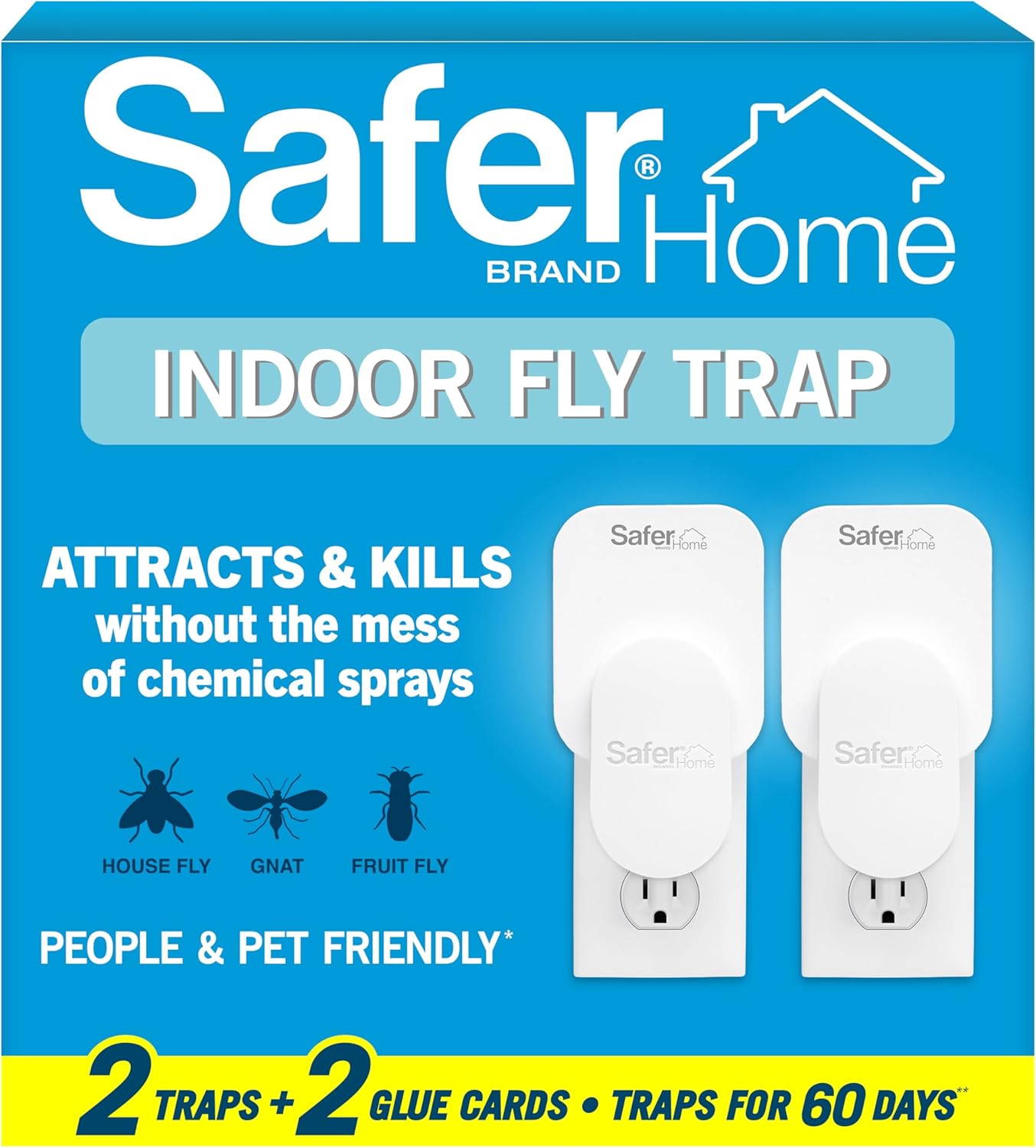
Safer Home Indoor Plug-In Fly Trap, 2-Pack (with 2 Glue Cards)
| Target Species | Fly |
|---|---|
| Power Source | ac |
| Unit Count | 4 Count |
| Material Type | Glue, Plastic |
The Safer Home Indoor Plug-In Fly Trap is a simple, low-effort solution for reducing flying insects around the house. You plug each compact unit into a standard outlet, insert a StickyTech glue card, and the UV-LED light attracts flies, fruit flies, moths, and gnats onto the adhesive where they stay until you replace the card. The rotating plug and small profile make it easy to position near kitchens, houseplants, pet areas, or entryways without standing out. Each glue card is rated up to 30 days of use and the two-device pack covers about 800 sq ft, so it can protect multiple rooms or provide backup while cards are swapped. Because it does not use chemical insecticides, it is a practical choice for households with children or pets when used as directed. Limitations to expect are routine maintenance to replace full cards and reduced effectiveness in very large or heavily infested spaces where multiple units or additional pest measures may be necessary.
Best for: Homeowners who want a low-maintenance, non-chemical way to reduce flying insects around living spaces and prefer discreet, plug-and-play devices that blend with décor.
Less Ideal for: People needing immediate control for large-scale infestations or those who require cordless placement far from outlets should consider higher-capacity or alternative solutions.
- Chemical-free operation using UV-LED light and glue cards, safer around children and pets when used as directed
- Plug-in rotating design fits any standard outlet and is easy to position discreetly
- StickyTech glue cards last up to 30 days and are designed to catch more insects than generic cards
- Two devices in the pack provide coverage for up to 800 sq ft for multi-room protection
- Requires regular replacement of glue cards and disposal of trapped insects
- Effectiveness drops in very large rooms or extremely heavy infestations without additional units
- Needs power outlet access which limits placement options
Verdict: A practical, family-friendly plug-in trap that delivers chemical-free, around-the-clock control of common indoor flying pests for typical homeowner needs.
TERRO Fly Magnet Sticky Fly Paper Trap, 8-Count

| Unit Count | 8 Count |
|---|---|
| Item Type Name | Fly Magnet Sticky Fly Paper Fly Trap |
| Manufacturer | Woodstream |
| Material Type | Plastic |
| Recommended Uses For Product | House |
The TERRO Fly Magnet is a simple, low-cost sticky ribbon trap sold in an eight-pack for indoor use. Each unit comes in a cardboard tube; pull and twist to expose the adhesive ribbon, then hang it with the included thumbtack or loop the ribbon around a nail in a corner or other fly-prone spot. It requires no bait or chemicals and leaves no odor, which makes it safe to use around family areas when placed out of reach of children and pets. The traps are lightweight and disposable, so maintenance is just removing and throwing away the used ribbon. Limitations are obvious: it is a passive, visible sticky strip that needs periodic replacement and is best for moderate fly problems rather than heavy infestations, and it must be kept away from windy areas to avoid tangling. For someone who wants a straightforward, inexpensive way to cut down on house flies without sprays or complicated traps, these are effective and easy to deploy.
Best for: Buyers looking for an inexpensive, no-fuss indoor solution to reduce house flies in kitchens, porches, or other small spaces who prioritize simplicity and low ongoing cost.
Less Ideal for: People needing an invisible or high-capacity solution for large or heavily infested areas should consider powered or baited traps instead.
- No bait or chemical needed so it can be used around living spaces
- Easy to activate and hang from the included ribbon and tack
- Disposable cardboard tube keeps the sticky surface protected before use
- Sold in an 8-count pack for extended, low-cost coverage
- Visible sticky ribbon that may be unsightly in living areas
- Not designed for heavy infestations or outdoor windy locations
Verdict: A very affordable, chemical-free disposable fly trap that delivers quick, easy indoor fly control for budget-minded buyers.
ELEGENZO DIY Fruit Fly Trap Kit with Reusable Escape-Proof Trap and Sticky Sheets

| Brand | ELEGENZO |
|---|---|
| Unit Count | 1 Count |
| UPC | 810228386998 |
| Manufacturer | ELEGENZO |
This ELEGENZO kit is built to make indoor fruit fly control simple and tidy. The system pairs a small reusable escape-proof trap and a dedicated bait cup with ten adhesive sheets so flies are caught either by entering the bait or landing on the sticky surface. You supply a common kitchen bait such as apple cider vinegar, red wine, or sweet tea, which keeps the method transparent and lets you change recipes as needed. The kit is intended for countertop or pantry placement and eliminates the need for open bowls or improvised containers, reducing mess. Notable features include the dual-capture design that increases chances of catching both attracted and hovering flies and the reusable components that cut down waste. Limitations to note are that you must refresh bait and replace sticky sheets periodically and the trap is sized for localized indoor use rather than large infestations or outdoors. For a reliability-focused buyer this kit is convenient, low-maintenance, and predictable when traps are maintained on a schedule.
Best for: Buyers who prioritize a dependable, low-mess indoor solution for spot control of fruit flies and who will maintain bait and sheets on a regular schedule.
Less Ideal for: People dealing with large-scale infestations, outdoor fruit fly problems, or those seeking an entirely maintenance-free, long-term extermination method.
- Dual-capture design combines bait cup and adhesive sheets to catch flies that enter or hover
- Reusable escape-proof trap reduces spills and repeated makeshift setups
- Includes bait cup and simple bait recipes so you can use common household ingredients
- Compact, tidy kit designed for kitchen counters and pantries
- Sticky sheets and bait require regular replacement and refresh to stay effective
- Not intended for large heavy infestations or outdoor use
Verdict: A compact, reusable dual-capture kit that gives reliable indoor spot control when bait and sticky sheets are refreshed regularly.
TERRO Fruit Fly Trap 4-Pack (180-Day Lure Supply)

| Unit Count | 4 Count |
|---|---|
| Target Species | Fly |
| Power Source | manual |
| Material Type | Plastic |
The TERRO Fruit Fly Trap is a simple, low-effort solution for indoor fruit fly problems. Each apple-shaped trap comes prefilled with a non-staining liquid bait that draws adult fruit flies through funnel-shaped entry holes where they cannot escape. Typical use is to place traps near likely breeding spots such as fruit bowls, sinks, garbage areas, or countertops; visible results are often noticeable within days. Notable features include a discreet apple design that blends into a kitchen, a built-in window to monitor captures and lure level, and a long-lasting bait that the manufacturer states provides up to 45 days per unit for a 180-day supply across the four traps. Practical benefits are that they require no mixing or electricity, are mess-free, and can be positioned wherever flies congregate. Limitations are that these traps target adult flies rather than larvae in hidden breeding sites, so effective control depends on locating and removing sources of breeding, and heavy infestations may require multiple placements or repeated cycles to fully suppress populations.
Best for: Homeowners who want a low-effort, visible indoor solution to reduce fruit fly activity and prefer straightforward products with an established track record.
Less Ideal for: People dealing with severe multi-room infestations or commercial food-preparation settings that need professional-grade or large-scale pest control methods.
- Ready-to-use liquid lure attracts and traps adult fruit flies without mixing or setup
- Designed to blend into kitchens with apple-shaped appearance and a monitoring window
- Long-lasting bait advertised to provide up to 45 days of protection per trap
- Mess-free, manual operation with no chemicals to spray or power required
- Only captures adult flies and will not eliminate larvae hidden in drains or trash
- Effectiveness depends on placing traps near breeding sites so some trial placement may be needed
Verdict: An easy, no-fuss indoor trap kit that offers visible, long-lasting control of adult fruit flies for homeowners seeking a simple preventive solution.
ZEVO Flying Insect Trap Starter Kit (Plug-In Base + Refill)

| Target Species | Fly, Fruit Fly, Gnat |
|---|---|
| Power Source | Electric |
| Unit Count | 2 Count |
| Material Type | Plastic |
The ZEVO Flying Insect Trap is a compact plug-in unit designed for continuous indoor use to reduce small flying pests around kitchens, bathrooms, and indoor plants. It uses blue and UV light to lure flies and gnats into a disposable adhesive cartridge so insects are captured quietly and out of sight on the wall-facing glue pad. Setup is simple — plug the base in, slide in a cartridge, and position the device near likely insect sources such as fruit bowls, trash, or potted plants. Notable features include a no-mess removal tab, a blinking reminder to check the cartridge about every six weeks, and a chemical-free, odor-free design that is safe for occupied rooms when used as directed. Practical benefits are low ongoing noise, no zapping or sprays, and discreet continuous protection. Limitations are that it targets small flying insects rather than larger pests, requires regular cartridge replacement, and is intended for indoor coverage so multiple units may be needed for larger rooms.
Best for: Buyers who want a low-risk, everyday indoor solution to reduce fruit flies, gnats, and house flies without chemicals or loud zappers and who prefer a discreet, continuous trap in kitchens and living areas.
Less Ideal for: People needing fast knockdown of larger flies, mosquitoes, or broad multi-room coverage from a single device should consider more powerful or different-style solutions.
- Chemical-free, odor-free capture using blue and UV light
- No-mess disposable adhesive cartridge with removal tab
- Quiet continuous operation suitable for occupied rooms
- Easy plug-in setup and a blinking reminder for cartridge checks
- Designed for small flying insects only and not effective on larger pests
- Requires periodic purchase and replacement of adhesive cartridges
Verdict: A convenient, low-risk plug-in trap that provides quiet, chemical-free day-and-night control of small indoor flying pests.
Choosing the Right Kitchen Fly Trap: Key Factors to Consider
Capture Method and Target Pests
How the trap catches flies determines where it works best. Sticky surfaces, glue boards, UV or visible-light lures, baited traps, and mechanical suction each behave differently in a kitchen. Sticky boards can be effective for lingering flies near windows or fruit bowls, while light-based lures tend to attract insects from a distance but may also pull pests away from specific hotspots.
Consider whether the trap targets only houseflies or also small fruit flies and gnats. Fruit flies are drawn to fermenting baits and may require different placement and lure types. A trap that lists multiple capture modalities or offers replaceable lures will adapt better to shifting pest populations.
Food-Safe Materials and Placement
In a kitchen, any device should avoid contaminating food, utensils, or prep surfaces. Look for enclosures or baffles that keep trapped insects and baits contained. Materials should be non-toxic and easy to wipe clean; avoid traps that use open liquid baits or volatile attractants near food prep areas.
Placement matters as much as design. Traps that can be wall-mounted, placed on high shelves, or tucked into cabinets let you keep them near fly entry points while staying out of the work zone. Smaller footprint units are helpful in compact kitchens where counter space is limited.
Maintenance Frequency and Ease
Routine maintenance influences whether a trap stays in use. Consider how often collection trays need emptying, how easy it is to remove and replace sticky boards or baits, and whether parts can be washed with mild detergent. Devices with disposable inserts reduce cleaning time but raise ongoing replacement needs.
Ease of maintenance also affects sanitation. Traps that seal when opened or that let you remove a full catcher without touching trapped insects reduce the chance of mess during servicing. Think about how the maintenance routine fits your household schedule.
Noise, Light, and Household Disruption
Some active traps use fans, motors, or bright lights to attract and capture flies. Noise levels and visible light patterns can be disruptive, especially in open-plan kitchens or at night. Quieter units or models with shielded lights are preferable near dining areas or where people work.
Consider also any blinking or ultraviolet output that might interfere with sleep or attract other insects. A trap that offers adjustable settings or a night mode can reduce disruption while maintaining control.
Size, Installation, and Aesthetics
Kitchens vary widely in size and layout, so trap footprint and mounting options matter. Slim, vertical units can fit beside appliances or in narrow gaps; hanging units clear counters but require hooks or rail space. A trap that looks neutral or unobtrusive integrates better into visible kitchen areas.
Also weigh how permanent you want the installation to be. Magnetic or adhesive mounts are easy to move, while screwed mounts provide a stable long-term solution. Removable components and straightforward reassembly make seasonal storage simple.
How to Place a Kitchen Fly Trap for Best Results
Place traps where flies congregate and where they enter the kitchen. Common spots include near windows, over dish tubs, beside fruit bowls, and close to trash or compost containers. Avoid positioning directly above food-prep areas so any debris or liquid bait is kept away from surfaces.
Match placement to the trap type. Light-based traps work best in darker corners where the lure stands out. Sticky boards are well-suited to narrow windows or along cabinet sides. Hanging units should be installed at about head height so flying insects are intercepted in normal flight paths.
- Keep traps 1 to 2 meters from food and eating areas.
- Use multiple small units for large or open kitchens rather than one central trap.
- Check and adjust placement after a few days to find the most active spots.
Managing Fruit Flies Versus Houseflies
Fruit flies and houseflies respond to different cues. Fruit flies are attracted to fermenting aromas and tend to stay low near sinks, drains, and ripe produce. Houseflies are larger and travel farther; they may be drawn to light sources and open windows. Choose trap types and lure formulations tailored to the pest you see most often.
For mixed infestations, combine strategies: a trap with bait targeted at fruit flies near produce storage, plus a light-based or suction unit near entry points for larger flies. Removing breeding sources such as drain residue and overripe fruit is essential alongside trapping to prevent reinfestation.
- Inspect drains, compost bins, and recycling containers for breeding cues.
- Store ripe fruit in the fridge or sealed containers to reduce attraction.
- Rotate lure types seasonally if different fly species predominate.
Sanitation Practices That Reduce Trap Load
A trap is a control tool, not a cure. Regular sanitation reduces the number of insects a trap must handle and improves overall kitchen hygiene. Clean spills promptly, empty food waste daily, and wipe down fruit and produce areas. Routine sink and drain cleaning can remove breeding sites for fruit flies.
Periodically inspect the trap mounting and surrounding surfaces for residues. Cleaning the area around the trap prevents secondary attraction and keeps the device working efficiently.
- Wipe counters and sweep floors daily in high-traffic prep areas.
- Keep garbage and compost lids secured and away from kitchen openings.
- Schedule trap maintenance tasks with regular kitchen cleaning routines.
Replacing Lures and Consumables
Many traps rely on replaceable sticky boards, bait cartridges, or disposable liners. Check manufacturer guidance for replacement intervals and watch for reduced capture rates as a sign to change consumables. Some units offer refill indicators or translucent windows to show when a board is full.
Budget for ongoing consumable replacement if you prefer low-cleaning models. Alternatively, choose washable, reusable catchers if you want to minimize recurring purchases, but be prepared to clean them more frequently.
- Mark calendar reminders for changing baits or sticky boards.
- Keep spare consumables on hand during peak fly season.
- If you see reduced catches, inspect lures before assuming the trap is faulty.
Safe Use Around Children and Pets
Kitchens often double as family spaces, so choose traps that limit access to attractants and captured insects. Enclosed designs keep sticky surfaces and baits out of reach, and wall-mounted units can be installed above counter level to reduce contact. Avoid traps that use open liquids or exposed sticky pads within reach of curious hands or paws.
If you use any chemical attractants, verify they are formulated for indoor use and follow precautions. Prefer mechanical or light-based capture when households include young children or pets to reduce accidental exposure.
- Install traps high and away from edges children can reach.
- Use tamper-resistant mounts or covers in family homes.
- Choose low-toxicity or non-chemical lures where possible.
How We Chose the Best Kitchen Fly Trap
We selected these kitchen fly traps using criteria that reflect everyday use in food-preparation areas. Effectiveness at capturing common houseflies and similar small flying pests was a primary filter; devices had to demonstrate plausible capture methods that work indoors rather than relying on outdoor attractants. Safety and materials were next: we prioritized traps that avoid toxic baits or exposed insecticide where food is handled and that can be placed near counters without contaminating surfaces. Ease of maintenance was a major factor, including how simple it is to empty, clean, or replace collection media. Quiet operation and low ongoing attention were important for kitchen placement. We also considered footprint and aesthetic integration so traps can sit on counters or hang without dominating the space. Excluded items include outdoor-only traps, broad agricultural systems, and products that rely on volatile or hazardous chemicals unsuitable for indoor kitchens. The final list balances capture performance, sanitation, usability, and installation flexibility.
FAQ
How long does it take for a kitchen fly trap to reduce fly numbers?
Results vary by infestation size and trap type. In small infestations you may see fewer active flies within a day or two. Larger or breeding-source problems often take several days of trapping plus sanitation to show significant reduction.
Are sticky traps safe to use near food prep areas?
Sticky traps are safe when enclosed or placed away from direct food-contact surfaces. Avoid open adhesive boards above counters and choose models with a closed collection tray or mount them on walls outside the immediate prep zone.
Can kitchen fly traps eliminate fruit fly breeding sites?
Traps catch adults but do not address larvae in drains or waste. To eliminate breeding sites, clean drains, remove overripe produce, and empty compost containers regularly. Traps are most effective when combined with these sanitation measures.
Do light-based traps attract more insects into the house?
Light-based traps can draw flying insects from nearby spaces, but when placed near likely entry points they tend to intercept pests before they spread. Avoid placing bright lights toward open windows that lead directly outdoors.
How often should I replace sticky boards or bait cartridges?
Replacement frequency depends on trap usage and fly load. Typical intervals range from two weeks to two months. Inspect consumables regularly and replace them when capture declines or boards become saturated.
Final Verdict
Choose a kitchen fly trap that matches the type of flies you encounter and the layout of your kitchen. Prioritize food-safe designs and easy maintenance if you spend a lot of time preparing meals. Expect to pair trapping with sanitation and targeted placement for the best results. Weigh tradeoffs between disposable convenience and reusable cleanliness, and select a unit with appropriate noise and footprint for your space. With the right combination of placement, upkeep, and trap type, you can regain a cleaner, more pleasant kitchen environment.
