

Note: This article contains affiliate links. If you click on these links and make a purchase, I may earn a small commission at no extra cost to you. This helps support my research and content. Read my full affiliate disclosure here.
Picking the right lawn fertilizer for spring shapes how fast your turf recovers from winter and how well it grows through the growing season. In early-season applications you are targeting recovery, root development, and building a foundation for summer resilience. The options in this guide are a vetted shortlist of top choices for spring use, selected for different lawn sizes and maintenance approaches. Below we explain the evaluation criteria used, then walk through the recommended products and practical tips on timing, application, and follow-up care to get a greener, healthier lawn.
Top Picks at a Glance
| Best Overall The best all-around choice for most situations | Milorganite 6-4-0 Slow-Release Fertilizer with Feeding Tips Brochure, 32 lb |  |
| Best Quality Built to a higher standard if you want something more solid | Yard Mastery Flagship Granular Lawn Fertilizer 24-0-6 with 3% Iron, Bio-Nite — 45 lb |  |
| Best Value The sweet spot between price and what you get | Scotts Turf Builder Lawn Food, 37.5 lb |  |
| Best Budget The cheapest option that still gets the job done reliably | O.M. Scott & Sons Natural Grass Food, 12.72 lb |  |
| Highest Rated A top-rated pick with lots of positive feedback | Ferti-lome Slow Release Nitrogen Lawn Fertilizer 15-0-15 with Iron, 2 × 16 lb Bags |  |
| Most Popular A crowd favorite that many people choose with confidence | Scotts Turf Builder Weed & Feed5 Granular Lawn Fertilizer (33.95 lb) |  |
| Best Seller A high-volume bestseller chosen again and again | Scotts Turf Builder Lawn Food, 12.5 lb |  |
Milorganite 6-4-0 Slow-Release Fertilizer with Feeding Tips Brochure, 32 lb

| N-P-K | 6-4-0 |
|---|---|
| Form | Pelletized |
| Application method | Broadcast, rotary or manual |
| Coverage | 2,500 Square Feet |
| Unit count | 32 lb |
Milorganite 6-4-0 is a pelletized, slow-release biosolid fertilizer intended for regular lawn and garden feeding. It is typically broadcast with a rotary or manual spreader and delivers a low-salt, organically complex nitrogen plus iron that promotes steady greening without the rapid flush of synthetic fertilizers. The product is designed for broad use on turf, flowers, shrubs, trees, and edibles and includes a printed brochure with seasonal timing and spreader settings to simplify application. Its slow-release nature means you do not need to water it in and it feeds plants for roughly two months, reducing the frequency of applications. Because it is high in organic matter it also helps improve soil structure in clay or sandy soils over time. Limitations are that it has an initial earthy odor for a few days and that results are more gradual than with fast-release synthetics, so you should not expect instant color change after a single application. This makes it best used as part of a seasonal feeding plan rather than for emergency green-up.
Best for: Homeowners who want a dependable, low-maintenance fertilizer to include in a seasonal spring program and prefer steady, soil-building nutrition over fast cosmetic results.
Less Ideal for: Gardeners seeking rapid, immediate greening before an event or those who need a high-nitrogen quick-fix should look at fast-release synthetic options instead.
- Slow-release feeding for up to 8–10 weeks reduces application frequency
- Low-salt formula lowers risk of burn and streaking in hot or dry conditions
- Organically complex iron promotes steady greening without staining like some iron salts
- Suitable for a wide range of uses including lawns, flowers, shrubs, trees and vegetable gardens
- Includes a feeding and spreader tips brochure for seasonal timing and application rates
- Has an earthy odor when first applied that may attract pets until watered or rained on
- Provides gradual results so it is not ideal for immediate, dramatic green-up
Verdict: A dependable, low-salt slow-release fertilizer that fits into a spring feeding schedule for steady, soil-friendly lawn and garden greening.
Yard Mastery Flagship Granular Lawn Fertilizer 24-0-6 with 3% Iron, Bio-Nite — 45 lb

| Item Form | Granules |
|---|---|
| Application Method | Spread and water-in |
| Coverage | 15000 |
| Target Species | all grass types |
| Mixing Ratio | 24-0-6 |
This 45 lb bag of Yard Mastery Flagship is a performance-focused granular fertilizer for homeowners who want pro-level results without complicated mixing. The 24-0-6 NPK provides a high, slow-release nitrogen dose for steady growth while 6% potassium helps with stress and drought resistance. The included 3% iron and micronutrients target leaf color, and Bio-Nite adds organic matter to feed soil microbes and support stronger roots. It is applied with a spreader at 3 lb per 1,000 sq ft and requires watering in within 48 hours, so it fits routine spring maintenance schedules and covers large lawns up to 15,000 sq ft per bag. Practical strengths are the long-lasting nutrient release and combined turf and soil-health approach, which reduce how often you need to reapply and can improve vigor over a season. Important limitations are that it is a granular product that requires a spreader and timely irrigation, and it contains no phosphorus so it is not suited where a phosphorus boost is specifically required.
Best for: Gardeners who prioritize fast, visible lawn performance and want a pro-style, low-maintenance fertilizer program for spring applications on larger yards.
Less Ideal for: Those managing small container lawns, lawns that specifically need phosphorus, or gardeners who prefer liquid or foliar feeding methods.
- High slow-release nitrogen (24%) for steady, vigorous growth
- Contains 3% iron and multiple micronutrients to improve turf color
- Bio-Nite organic component supports soil microbes and root health
- Large coverage per bag up to 15,000 sq ft reduces application frequency
- Granular form requires a spreader and timely watering to activate
- No phosphorus in the formulation for turf needing P-based recovery
Verdict: Choose this if you want a professional-grade, slow-release spring fertilizer that boosts green-up and soil health across large lawns.
Scotts Turf Builder Lawn Food, 37.5 lb

| Item Form | Granules |
|---|---|
| Specific Uses For Product | Lawn |
| Coverage | 15000 |
| Mixing Ratio | 32:0:4 |
Scotts Turf Builder Lawn Food is a granular, all-purpose lawn fertilizer designed to thicken and green lawns while building stronger roots. It is intended for use on any grass type and can be applied to a wet or dry lawn in spring, summer, or fall. The bag covers up to 15,000 square feet, so it suits full-yard applications without frequent repurchasing. Scotts provides recommended spreader settings and suggests lightly watering after application for faster greening, though watering is not required. In practice the product speeds visible greening and helps lawns recover from seasonal stress because it supplies a balanced nutrient mix that supports deeper root growth. The convenience of a single large bag and clear application instructions makes it an easy choice for routine seasonal feeding. Important limitations are that it is a general lawn food rather than a weedkiller or targeted treatment, and its granular form requires a spreader for even coverage and some cleanup if granules land on hard surfaces.
Best for: Homeowners who want a straightforward, seasonal fertilizer to thicken and green an entire lawn with minimal fuss and planning. Good for people who follow a routine lawn care schedule and prefer one product that covers large areas.
Less Ideal for: If you need a combined weed-and-feed, targeted pest control, or a liquid feed for spot treatments, choose a product designed for those specific problems instead.
- Works on all common grass types so one product fits an entire yard
- Large coverage (up to 15,000 sq. ft.) reduces how often you need to buy fertilizer
- Granular formula builds deeper roots and improves water and nutrient uptake
- Clear spreader settings and simple directions make application straightforward
- Not formulated to kill weeds or pests so additional products may be needed for weed control
Verdict: A dependable, large‑coverage granular lawn food that makes seasonal spring feeding quick and effective for whole-yard maintenance.
O.M. Scott & Sons Natural Grass Food, 12.72 lb

| Item Type Name | O.M. Scott and Sons Natural Grass Food |
|---|---|
| Material Features | Natural lawn fertilier, feeds up to 10 weeks. |
| Coverage | One 12.72 lb. bag covers up to 2,000 sq. ft. |
| Application Frequency | Feed every 8 to 10 weeks, up to 4 times a year. |
O.M. Scott & Sons Natural Grass Food is a straightforward, natural lawn fertilizer aimed at DIY homeowners who want an easy seasonal feed. You apply it with a broadcast spreader following the bag dial settings, water lightly right after application, and it begins feeding immediately while continuing to release nutrients for up to 10 weeks. The formula contains no added artificial ingredients or pesticides and is marketed as safe for people and pets when used as directed, which makes it convenient for family yards. A single 12.72 lb. bag covers about 2,000 sq. ft., so it works well for small to medium lawns and repeat applications every 8 to 10 weeks are recommended. Practical limits are that this is a general-purpose, natural feed rather than a targeted treatment for specific problems like weeds, grub control, or pH correction, and larger properties will require multiple bags. If you need a simple, pet-friendly seasonal boost and prefer recyclable packaging, this delivers predictable, easy-to-follow results.
Best for: Homeowners who want a simple, pet-safe spring feed for a small to medium lawn and prefer a natural, easy-to-apply product.
Less Ideal for: Those needing targeted treatments for weeds, pests, soil pH, or large acreage lawns should consider specialized or higher‑coverage options.
- Natural formula with no added artificial ingredients or pesticides
- Feeds immediately after watering and continues feeding up to 10 weeks
- Safe for use around people and pets when used as directed
- Recyclable paper bag packaging
- Covers up to 2,000 sq. ft. per 12.72 lb. bag for small to medium lawns
- Not formulated to address specific issues like weed or pest control
- Single bag size requires multiple purchases for larger lawns
Verdict: A simple, pet‑friendly spring fertilizer that gives an immediate and sustained nutrient boost for small to medium lawns.
Ferti-lome Slow Release Nitrogen Lawn Fertilizer 15-0-15 with Iron, 2 × 16 lb Bags

| N-P-K | 15-0-15 |
|---|---|
| Form | Granules |
| Includes | Iron and micronutrients |
| Pack | 2 bags |
This two-pack of Ferti-lome slow-release 15-0-15 fertilizer is designed to deliver steady nitrogen over time while adding iron and micronutrients to boost lawn color. Each 16 lb bag covers up to 4,000 sq ft so the bundle suits larger yards or repeated seasonal applications without frequent repurchasing. Typical use is a spring or fall application at the recommended rate (16 lbs per 4,000 sq ft), broadcast with a spreader and watered in; the slow-release nitrogen reduces the need for rapid follow-up feedings and lowers flush growth risks. The product lists compatibility with common turf types including Centipede, Bermuda, Zoysia, St. Augustine and cool-season grasses, giving flexibility across many lawns. Practical benefits include predictable, long-lasting feeding and built-in iron for deeper green color. Limitations are that it is a straight nitrogen-plus-iron formula with no phosphorus, so it will not correct phosphorus deficiencies, and application still requires correct spreading and timing to avoid uneven growth or burn.
Best for: Homeowners who prioritize a low-maintenance, reliable spring feed to maintain steady growth and deeper green color across common lawn types.
Less Ideal for: Gardeners needing a balanced N-P-K starter fertilizer or those treating specific soil nutrient deficiencies should choose a different product.
- Slow-release nitrogen provides longer-lasting feeding and reduces the need for frequent applications
- Includes iron and micronutrients to improve lawn color without separate supplements
- Two 16 lb bags cover larger areas or multiple treatments, reducing reordering
- Compatible with a wide range of warm- and cool-season grasses for flexible use
- Contains no phosphorus so it will not address phosphorus deficiencies
- Requires proper spreading and timing to avoid uneven application or localized overfeeding
Verdict: Choose this two-pack slow-release 15-0-15 fertilizer if you want dependable, long-lasting spring feeding and built-in iron to keep a lawn consistently green with minimal reapplication.
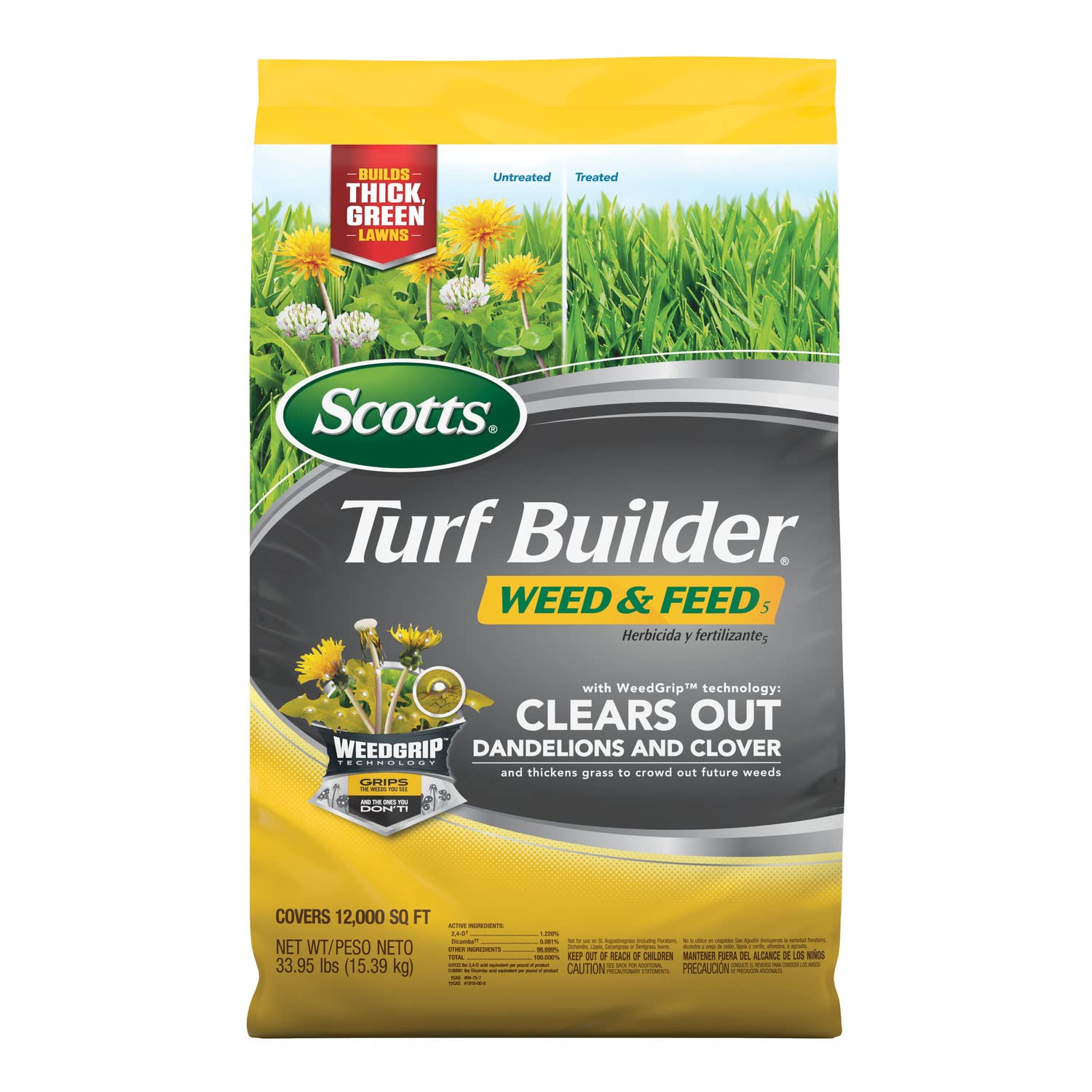
Scotts Turf Builder Weed & Feed5 Granular Lawn Fertilizer (33.95 lb)
| Item Form | Granule |
|---|---|
| Coverage | 12000 square feet |
| Active Ingredients | 2.4-D, Dicamba |
Scotts Turf Builder Weed & Feed5 is a late-spring granular treatment that kills common broadleaf lawn weeds while feeding grass to encourage thicker growth. You apply it with a broadcast, drop, or handheld spreader when weeds are actively growing and temperatures are between 60°F and 90°F; the granules stick better to wet foliage so dew or recent watering improves performance. The formula lists 2,4-D and dicamba as active ingredients and a nitrogen-heavy guaranteed analysis that supplies both quick-release and slowly available nitrogen to green up and thicken turf. Practical benefits include proven control of dandelions, clover, plantain and many other listed weeds while simultaneously nourishing established lawns up to 12,000 sq. ft. per bag. Important limitations are compatibility and timing: it must not be used on several grass types such as St. Augustine or bentgrass and you should avoid application before rain or on hot, stressed turf; also follow the 24-hour no-water window and keep people and pets off until dust settles. For spring use on recommended grass types it is straightforward and effective when used per label directions.
Best for: Homeowners who want a single, proven spring treatment to kill common broadleaf weeds and feed an established lawn and who prefer guidance-backed products with lots of user feedback.
Less Ideal for: Owners of excluded turf varieties such as St. Augustine or creeping bentgrass and gardeners who need an all-season or crabgrass-preventing solution.
- Combines broadleaf weed control and fertilizer in a single application
- Covers up to 12,000 square feet from one 33.95 lb. bag
- Contains both fast-release and slowly available nitrogen for sustained feeding
- Clear application guidance for use with Scotts spreaders for even coverage
- Contains herbicides (2,4-D and dicamba) so not suitable for all turf types and requires careful handling
- Must avoid watering and foot traffic for 24 hours after application which can limit scheduling
Verdict: A reliable late-spring weed-and-feed that kills common broadleaf weeds while feeding recommended warm- and cool-season lawns up to 12,000 sq. ft.
Scotts Turf Builder Lawn Food, 12.5 lb

| Item Form | Powder |
|---|---|
| Specific Uses For Product | Lawn |
| Coverage | 5,000 sq. ft. |
| Target Species | grass |
| Mixing Ratio | 32:0:4 |
Scotts Turf Builder Lawn Food is a ready-to-use granular fertilizer designed to thicken and green lawns while building stronger roots. You apply it with a broadcast or drop spreader (Scotts gives spreader settings) to a wet or dry lawn in spring, summer, or fall; light watering after application speeds results but is not required. The formula is pesticide-free and aims to improve a lawn's ability to absorb water and nutrients, which helps it recover from stress and resist future problems. Practical benefits include straightforward application, clear directions for common spreaders, and coverage suitable for small to midsize yards. Limitations are that this is a basic lawn food rather than a weed-and-feed or season-specific formula, so it will not control broadleaf weeds or pests; heavy clay or severely damaged lawns may need soil amendments or specialized products. The 12.5 pound bag covers about 5,000 square feet, making it useful for routine seasonal feeding on established turf.
Best for: Homeowners who want a low-risk, easy-to-use spring fertilizer to green and strengthen an existing lawn without pesticides and prefer predictable, manufacturer-backed application guidance.
Less Ideal for: People who need weed or pest control integrated into their fertilizer program or who are renovating a severely damaged lawn should consider a combined or specialized product instead.
- Works on any grass type for straightforward seasonal feeding
- Builds stronger, deeper roots to help turf absorb water and nutrients
- Clear application instructions with recommended spreader settings
- Can be applied to wet or dry lawns and watered in if faster results are wanted
- Does not include herbicide or insect control so weeds and pests are not managed
- 12.5 lb bag is sized for about 5,000 sq ft which may be small for larger properties
Verdict: A simple, dependable spring lawn food that reliably greens and strengthens established turf with easy application guidance.
Choosing the Right Lawn Fertilizer for Spring: Key Factors to Consider
Nutrient Ratio and Early-Season Priorities
The nutrient ratio printed as N-P-K directly affects what your lawn does after a spring feeding. Higher nitrogen helps push green-up and leaf growth, while modest phosphorus supports early root development if soil tests show deficiency.
For most established lawns in spring, choose a formula with a clear emphasis on nitrogen but not an extreme broadcast rate that risks soft, pest-prone growth. Balanced blends that provide some slow-release nitrogen cushion feed turf steadily as temperatures rise.
Nitrogen Source and Release Profile
Nitrogen can come as soluble forms that act quickly or as stabilized and coated sources that release over weeks. Fast-acting nitrogen gives rapid green-up, which is useful when you want visible recovery quickly after thaw, but it also burns off or leaches faster.
Controlled-release nitrogen reduces the need for repeat applications and lowers burn risk during variable spring weather. Consider blends that combine an immediate fraction for quick color and a controlled-release fraction for steady feeding through the season.
Application Method and Equipment Fit
Fertilizers come as granular, liquid, or water-soluble products. Granular spreaders simplify coverage for broad yards, while liquid or soluble types can be useful for spot treatments or when using a hose-end sprayer.
Choose a format that matches the equipment you already have and the typical area you fertilize. Also think about granule size and flow characteristics, because these affect spreader calibration and evenness of application.
Timing, Weather, and Soil Temperature
Spring applications are most effective when soil temperatures are consistently in the optimal range for your grass species. Applying too early, when the ground is still cold or saturated from melt, reduces uptake and increases runoff risk.
Monitor local soil temperature and wait for signs of active growth. Also avoid applying before heavy rain events that could wash nutrients away; light moisture after application helps move soluble nutrients into the root zone.
Compatibility With Overseeding and New Seedlings
If you plan to overseed in spring, fertilizer choice matters. High-soluble nitrogen can harm new seedlings, while starter fertilizers formulated for new grass support root establishment.
Look for products labeled as safe for overseeding or apply a starter formulation to seed rows while using a milder maintenance fertilizer on established turf. Stagger application timing so seedlings receive nutrients without exposure to potentially damaging high-salt products.
Environmental Impact and Runoff Risk
Spring runoff from heavy rains can carry soluble nutrients into waterways. Choosing a product with a controlled-release fraction or using split applications reduces the chance of excess nutrient loss.
Also consider placement and application rates. Avoid applying fertilizer to impervious surfaces and sweep any granules off sidewalks back onto the lawn. Following label rate recommendations helps minimize environmental impact while meeting turf needs.
When to Apply Fertilizer in Spring
Timing matters more than exact calendar dates. Aim to apply when soil temperatures reach the active range for your grass type and green-up is under way. For cool-season grasses that means soil consistently above roughly 50°F, while warm-season grasses typically respond once soil temps are higher and growth has resumed.
Apply after turf begins active growth and the ground is no longer waterlogged. Light rain or irrigation after application helps move nutrients into the root zone, but avoid heavy rain forecasts that could cause runoff.
- Check soil temperature with a probe or local extension service guidance.
- Wait for visible green-up and active tillering for cool-season lawns.
- Stagger applications if heavy spring rains are expected.
Starter Fertilizer Versus Maintenance Feed
Starter fertilizers are designed for new seed and often contain higher phosphorus to encourage root growth. For established lawns, maintenance feeds focus on nitrogen to support leaf expansion and recovery. If overseeding, plan to use a starter formulation in seed zones and a gentler maintenance product on mature turf.
Using the right product for the situation avoids harming seedlings while still giving established grass the nutrition it needs to recover from winter stress.
- Starter formulas are best at seeding time or for bare patches.
- Maintenance feeds are suited for whole-lawn spring greening.
Application Techniques for Even Coverage
Proper spreader calibration and overlapping patterns are key to even results. Test run a spreader on a driveway to check flow rate and pattern before treating the lawn. For liquids, follow recommended dilution and move at a steady pace to get consistent coverage.
After you apply, irrigation should be light and even to wash soluble nutrients off leaf surfaces and into the soil. Avoid heavy watering that could push nutrients below the root zone or increase leaching risk.
- Calibrate spreader using the label rate and your yard size.
- Apply in a crisscross pattern for granular products to reduce streaking.
- Rinse spreaders and spray equipment after use to prevent corrosion.
Managing Burn Risk and Overapplication
Excessive application or using high-soluble nitrogen at the wrong time can scorch grass, especially under dry, sunny conditions. Follow label rates closely and consider using controlled-release formulations if you are concerned about burn or uneven distribution.
If you accidentally overapply, water the area deeply to dilute surface salts and reduce stress on plants. Monitor treated areas for a week and avoid additional fertilization until the lawn shows recovery.
- Stick to labeled rates and adjust for slope and soil type.
- Use controlled-release products when exact spreader calibration is uncertain.
- Water lightly after application to reduce leaf contact time.
Coordinating Fertilizer With Pest and Weed Programs
Spring fertilization fits into a broader turf management calendar that often includes pre-emergent weed control and early insect monitoring. Timing matters because some herbicides require specific application windows relative to fertilization.
Plan your spring tasks so that fertilization supports turf density without interfering with necessary weed or pest treatments. When in doubt, check product labels for recommended sequencing or consult extension guidance.
- Apply pre-emergent herbicides according to temperature cues for your region.
- Avoid applying certain herbicides to newly seeded areas until seedlings are established.
- Coordinate irrigation timing to suit both fertilizer and pest control needs.
How We Chose the Best Lawn Fertilizer for Spring
We evaluated products that are specifically suitable for spring applications and prioritized formulas and formats that address early-season lawn needs. Key evaluation criteria included nutrient ratio and available nitrogen forms, release profile and predictability, and ease of application for common yard sizes. We also considered safety for newly emerging grass, compatibility with overseeding, and potential for surface burn when applied at recommended rates. We excluded products formulated only for winterizing or those designed solely for late-season root development because their nutrient balance does not match spring recovery goals. We also filtered out fertilizers with unclear labeling on nitrogen sources or guaranteed analysis. The final selections reflect products that strike a practical balance between active nitrogen availability, controlled-release behavior, and straightforward application for homeowners and landscape pros alike.
FAQ
How soon after a spring fertilizer application will I see results?
Often you will see visible green-up within one to three weeks depending on grass type and product. Fast-release nitrogen shows color quicker, while controlled-release blends produce steadier improvement over several weeks.
Can I fertilize if I plan to overseed my lawn?
It depends. Starter fertilizers formulated for new seed are appropriate in seeded areas, but high-soluble maintenance feeds can harm seedlings. For overseeding, use starter formulations or time maintenance feeds so seedlings are not exposed to strong soluble salts.
Is controlled-release fertilizer better for spring than quick-release?
Controlled-release products reduce burn risk and extend feeding, which is helpful in variable spring weather. Quick-release options give faster color if you need immediate recovery. Many gardeners choose a blend to get both effects.
How do I match fertilizer amount to my yard size?
Measure your lawn area and apply the product at the label rate for the recommended pounds of nitrogen per 1,000 square feet. Calibrate your spreader or measure liquid output to ensure you deliver the correct rate across the entire lawn.
Will spring fertilizer increase my watering needs?
Fertilizer itself does not greatly change water needs, but rapid top growth from high nitrogen can require more regular mowing and may need adequate moisture to avoid stress. Light irrigation after application helps move nutrients into the root zone.
Final Verdict
Spring is a time to promote recovery, encourage root development where needed, and set your lawn up for summer stress. Prioritize a fertilizer with an appropriate nutrient ratio and a nitrogen release profile that matches how quickly you want results and how confident you are in your application technique. Weigh tradeoffs between immediate green-up and environmental or burn risk, plan timing around soil temperature and seeding, and choose a format that fits your equipment and yard size. With those priorities in mind, you can pick a spring fertilizer that meets your goals and supports a healthier lawn through the season.
