

Note: This article contains affiliate links. If you click on these links and make a purchase, I may earn a small commission at no extra cost to you. This helps support my research and content. Read my full affiliate disclosure here.
St. Augustine grass has specific nutritional and timing needs that affect color, density, and stress tolerance. Choosing the right lawn fertilizer for St. Augustine grass matters because incorrect nutrient ratios or application timing can encourage disease, excessive thatch, or weak roots. This guide shortlists seven top options suited to St. Augustine's growth pattern and climate responses. We evaluated products for nutrient balance, granule or liquid handling, and real-world application ease. The following roundup covers the options that fit common lawn sizes and maintenance schedules and explains the criteria we used to pick them.
Top Picks at a Glance
| Best Overall The best all-around choice for most situations | Lesco St. Augustine Lawn Fertilizer 24-2-11, 50 lb |  |
| Best Quality Built to a higher standard if you want something more solid | The Andersons Professional PGF Complete 16-4-8 Fertilizer with Humic (40 lb) |  |
| Best Value The sweet spot between price and what you get | Scotts Turf Builder Lawn Food, 37.5 lb |  |
| Best Budget The cheapest option that still gets the job done reliably | Milorganite All-Purpose Slow-Release Nitrogen Fertilizer, 5 lb |  |
| Highest Rated A top-rated pick with lots of positive feedback | Milorganite 6-4-0 Slow-Release Fertilizer, 32 lb (with Feeding Tips Brochure) |  |
| Most Popular A crowd favorite that many people choose with confidence | Scotts Turf Builder Lawn Food, 12.5 lb |  |
| Best Seller A high-volume bestseller chosen again and again | Scotts Turf Builder WinterGuard Fall Lawn Food, 10 lb. |  |
Lesco St. Augustine Lawn Fertilizer 24-2-11, 50 lb

| Item Form | Granules |
|---|---|
| Specific Uses For Product | Lawn |
| Coverage | Full |
| Target Species | St. Augustine lawn grass |
This granular Lesco 24-2-11 fertilizer is formulated specifically for St. Augustine grass and is meant to jump-start green-up during cool spring conditions. It is typically broadcast across full lawns using a spreader and watered in according to label directions. Notable features include a high nitrogen ratio for rapid growth and 6% iron to improve turf color without needing supplemental iron treatments. The 50 lb bag covers large areas, so it suits whole-yard maintenance cycles rather than small patch fixes. Practical benefits are clear: faster leaf growth, deeper green color, and simplified application when following spreader settings on the label. Important limitations are that it is designed for cool-weather application and should not be used during hot periods, and it is a general-purpose turf fertilizer rather than a slow-release, low-burn specialty product, so timing and correct application rate matter to avoid overfeeding. Users should follow safety guidance when handling and keep it away from children and pets.
Best for: Gardeners who maintain medium to large St. Augustine lawns and prioritize quick green-up and strong seasonal growth with straightforward, regular fertilizer applications.
Less Ideal for: Homeowners looking for slow-release, low-maintenance fertilizers or those with very small lawns who prefer concentrated or specialty spot treatments.
- Formulated specifically for St. Augustine grass to address its nutrient needs
- High nitrogen content for rapid spring green-up
- Includes 6% iron to improve turf color without extra treatments
- Large 50 lb bag provides coverage for extensive lawns
- Not intended for application during hot weather so timing is important
- Granular quick-release formula requires careful rate control to avoid overfeeding
Verdict: Choose this fertilizer if you want a large-bag, high-nitrogen granular product that reliably greens and strengthens St. Augustine turf in cooler spring conditions.
The Andersons Professional PGF Complete 16-4-8 Fertilizer with Humic (40 lb)

| Unit Count | 640 Ounce |
|---|---|
| Item Form | Granules |
| Specific Uses For Product | Lawn Care |
| Mixing Ratio | 16-4-8 |
| Target Species | lawn grasses |
This granular professional fertilizer is built for steady, high-performance lawn feeding. It combines quick- and slow-release nitrogen in a 16-4-8 formula so you get an immediate green-up followed by up to eight weeks of continued feeding. Super-fine particles promote even distribution across the turf and the formula includes iron, micronutrients, and Humic DG to support color and soil health. Typical use is broadcast spreading over established lawns followed by watering to activate nutrients; coverage is listed to match a 40-pound bag for medium-to-large turf areas. Practical benefits include fewer applications thanks to the extended-release nitrogen and improved uptake from added humic substances. Important limitations are that it is a conventional synthetic fertilizer that can irritate skin and eyes if mishandled and the product is not labeled for sale in California, so check local regs before purchase. Also, as a 40-pound bag it requires proper storage and handling to avoid spills and moisture exposure.
Best for: Homeowners and groundskeepers who prioritize performance and predictable, long-lasting green-up for warm-season lawns and want a professional-style granular fertilizer that reduces reapplication frequency.
Less Ideal for: People seeking organic or slow-only natural fertilizers or those who prefer lightweight, small-package options for very small lawns.
- Balanced 16-4-8 N-P-K with both quick and slow-release nitrogen for immediate and extended feeding
- Includes iron, micronutrients, and Humic DG to support color and soil health
- Super-fine granules promote even spreading and consistent coverage
- Designed to feed lawns for up to eight weeks, reducing application frequency
- Can cause skin, respiratory, and eye irritation if not handled with proper PPE
- Not approved for sale in California which limits availability in some regions
Verdict: Choose this product when you want a high-performance granular fertilizer that gives fast green-up plus up to eight weeks of extended feeding for turf.
Scotts Turf Builder Lawn Food, 37.5 lb

| Item Form | Granules |
|---|---|
| Specific Uses For Product | Lawn |
| Coverage | 15000 |
| Mixing Ratio | 32:0:4 |
Scotts Turf Builder Lawn Food is a granular, all-purpose lawn fertilizer designed to thicken and green turf while building stronger roots. You apply it with a broadcast or drop spreader (Scotts gives exact spreader-settings) to a wet or dry lawn in spring, summer, or fall; watering after application speeds results but is not required. The product delivers a high-nitrogen formula in granule form that works across grass species and is intended to improve the lawn's ability to absorb water and nutrients. Practical benefits include wide coverage from a single 37.5 lb bag and simple application instructions that pair with common spreaders. Limitations to note are that the NPK is represented as a mixing ratio rather than a full label of micro- and secondary nutrients, and this formulation is a general lawn food rather than a product tailored specifically for St. Augustine grass problems like salt sensitivity or regional disease pressures. For best outcomes on St. Augustine, follow local timing recommendations and test soil to confirm nutrient needs before routine use.
Best for: Homeowners who want a straightforward, no-fuss fertilizer to maintain an even, thicker lawn across large areas and who value coverage and easy application.
Less Ideal for: People managing turf with specific issues like salt damage, severe thatch, or disease-prone St. Augustine cultivars who need targeted formulations or a customized soil nutrient plan.
- Covers up to 15,000 sq. ft. from one 37.5 lb bag
- Granular formula works on wet or dry lawns and pairs with standard spreaders
- Promotes thicker turf and stronger root development compared with unfed lawns
- Not specifically formulated for St. Augustine grass or regional disease and salt issues
- Product information lists a mixing ratio rather than a detailed nutrient breakdown
Verdict: A reliable, easy-to-apply granular lawn food that gives broad coverage and strengthens turf, making it a practical choice for homeowners maintaining large St. Augustine lawns.
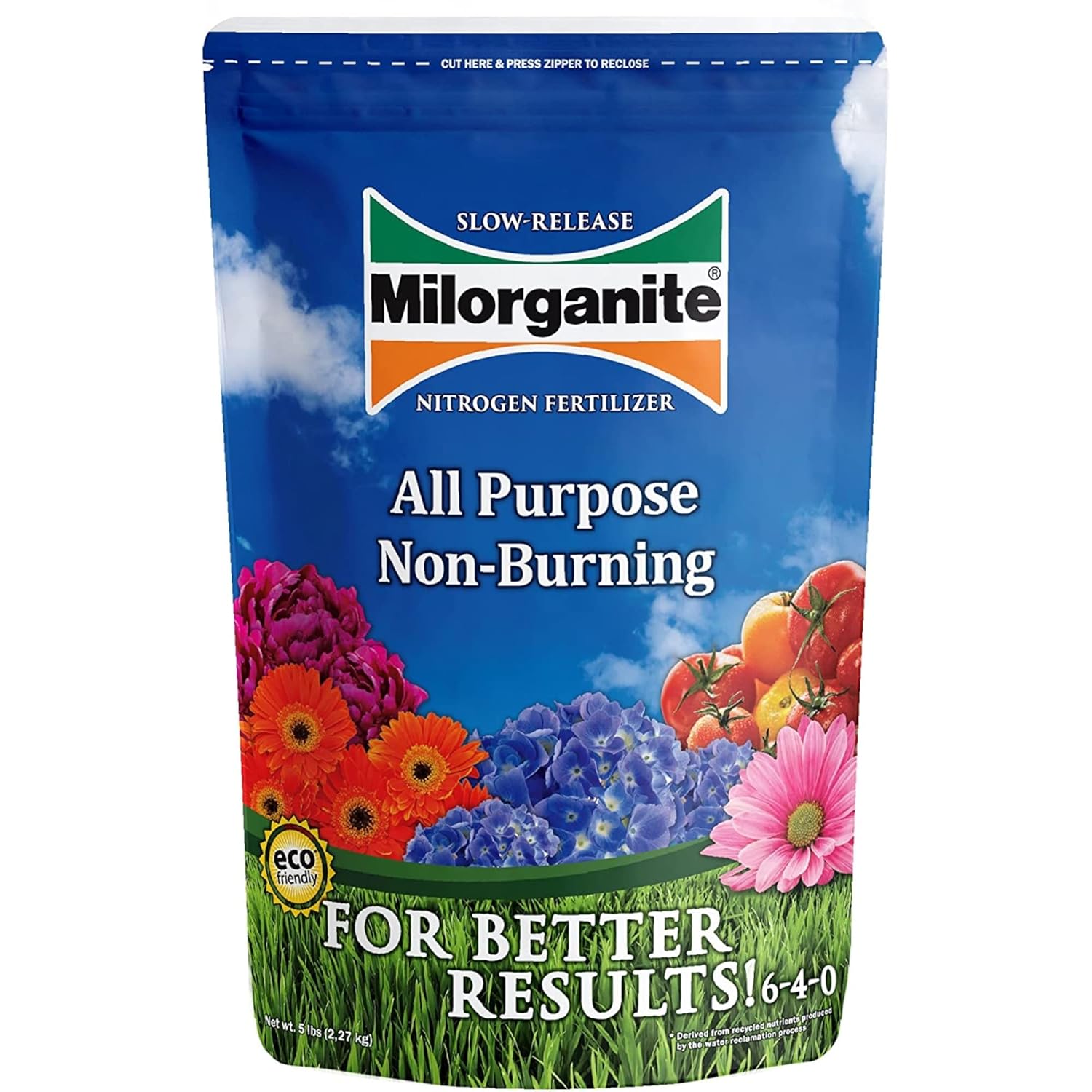
Milorganite All-Purpose Slow-Release Nitrogen Fertilizer, 5 lb
| N-P-K | 6-4-0 |
|---|---|
| Item Form | Granules |
| Specific Uses For Product | Lawns, Flowers and Gardens |
| Coverage | 390 Square Feet |
Milorganite is a granular, slow-release organic fertilizer that supplies nitrogen and iron without high salts or burning risk. It is typically broadcast across lawns or worked lightly into soil around flowers, shrubs, and vegetables and does not require immediate watering to begin working. Key features include a low-salt formulation that reduces burn risk, organically complex iron that greens turf without staining concrete, and an extended feeding window that lasts about 8 to 10 weeks. Because it is largely organic material, it also adds soil organic matter over time which helps improve clay or sandy soils by increasing aeration and water retention. Limitations are that it is not a quick-release synthetic fertilizer, so it will not provide an immediate green-up in the way high-nitrogen chemical products do, and coverage per 5 lb bag is modest at about 390 square feet, so multiple bags are needed for larger yards. It is straightforward to apply and well suited to repeat seasonal use for steady, low-risk feeding of warm-season grasses like St. Augustine.
Best for: Homeowners looking for an affordable, low-risk fertilizer to maintain warm-season turf with steady, long-lasting feeding and soil-improvement benefits.
Less Ideal for: People who need rapid, dramatic green-up after dormancy or who manage large lawns and prefer concentrated high-nitrogen products for fewer applications.
- Slow-release nitrogen feeds turf for up to 8–10 weeks, reducing frequent applications
- Low salt formulation minimizes risk of burning grass, even in hot conditions
- Adds organic matter to soil, improving structure in clay and sandy soils
- Provides organically complex iron that greens turf without staining concrete
- Not a fast-acting synthetic fertilizer for immediate green-up
- Small 5 lb bag covers only about 390 sq ft, requiring more product for larger lawns
Verdict: An economical, low-salt slow-release fertilizer that steadily feeds St. Augustine grass while improving soil health over time.
Milorganite 6-4-0 Slow-Release Fertilizer, 32 lb (with Feeding Tips Brochure)

| Item Form | Pelletized |
|---|---|
| Application Method | Broadcast, Rotary or Manual |
| Coverage | 2,500 Square Feet |
| Specific Uses For Product | Lawns, Flowers and Gardens |
Milorganite 6-4-0 is a pelletized, slow-release organic fertilizer intended for routine lawn and garden feeding. It is typically broadcast with a rotary or manual spreader and supplies low-salt nitrogen and organically complex iron that helps deepen turf color without the staining associated with some iron salts. The product releases nutrients gradually over about 8 to 10 weeks so you can expect steadier growth and less risk of burn, and one 32 lb bag covers roughly 2,500 sq ft when applied at recommended rates. Its high organic matter content also improves soil structure and microbial activity, which is helpful in heavier soils. Practical limits include a modest N-P-K ratio that may not correct acute phosphorus or potassium deficiencies quickly, and the earthy odor when fresh that dissipates after watering or rain. For reliability-focused lawn care this product reduces the need for frequent reapplication and performs well on warm-season turf when used according to seasonal timing guidance in the included brochure.
Best for: Gardeners and homeowners who prioritize steady, predictable feeding and soil-building for warm-season lawns and want a low-risk, maintainable program.
Less Ideal for: Users needing a quick corrective dose for specific nutrient deficiencies or those who prefer fast-acting synthetic fertilizers for immediate greening effects.
- Slow-release nitrogen feeding for up to 8–10 weeks reduces application frequency
- Low-salt formulation lowers risk of fertilizer burn in hot or dry conditions
- Contains organically complex iron for deeper green without common iron-staining issues
- Pelletized form works with broadcast, rotary, or manual spreaders and covers ~2,500 sq ft per bag
- High organic matter content improves soil structure and microbial activity over time
- Lower phosphorus and potassium levels so it will not quickly correct nutrient deficiencies
- Has an earthy odor on initial application that fades after watering or a few days
Verdict: Choose Milorganite for dependable, low-salt slow-release feeding that supports steady growth and long-term soil health for St. Augustine and other warm-season lawns.
Scotts Turf Builder Lawn Food, 12.5 lb

| Item Form | Powder |
|---|---|
| Specific Uses For Product | Lawn |
| Coverage | 5,000 sq. ft. |
| Target Species | grass |
| Mixing Ratio | 32:0:4 |
Scotts Turf Builder Lawn Food is a granular fertilizer intended to thicken and green lawns while building stronger roots. It is applied with a broadcast or drop spreader to a wet or dry lawn and can be lightly watered in for quicker greening. The product lists a mixing ratio and recommended spreader settings for consistent coverage and one 12.5 pound bag covers roughly 5,000 square feet. In practice this makes it easy to add routine nutrition across a season and to follow Scotts' application guidance for even results. Notable features include its all-grass formulation and the brand guidance for spreader settings, which reduces guesswork and helps avoid over- or under-application. Limitations to consider are that the bag is sized for small to medium lawns so larger St. Augustine yards will need multiple bags, and this formula is a general lawn food rather than a St. Augustine-specific mix that addresses regional pest or soil issues. Users should follow safety directions and keep product away from water features and pets.
Best for: A cautious homeowner who values proven, easy-to-follow products and wants a dependable seasonal fertilizer to improve color and root strength on a small to medium St. Augustine lawn.
Less Ideal for: Owners of large properties who prefer a single-package solution or gardeners looking for a St. Augustine-targeted fertilizer with pest control or soil-specific amendments.
- Designed for any grass type so it can be used on St. Augustine lawns
- Clear spreader settings provided for consistent application
- Feeds and promotes deeper roots which improves drought and nutrient uptake over time
- Can be applied to wet or dry turf and lightly watered in for faster visible results
- 12.5 lb bag only covers about 5,000 sq. ft. so larger lawns require multiple bags
- Not formulated specifically for St. Augustine's common regional issues like chinch bugs or high-salt soils
Verdict: A reliable, easy-to-apply general lawn food that safely strengthens roots and improves greenness for small to medium St. Augustine lawns.
Scotts Turf Builder WinterGuard Fall Lawn Food, 10 lb.

| Item Form | Granules |
|---|---|
| Specific Uses For Product | Lawn Fertilizer |
| Application Method | spread |
| Coverage | 4000 |
| Target Species | lawn grasses |
Scotts Turf Builder WinterGuard is a fall-focused granular lawn food intended to strengthen roots and help turf recover from summer heat and drought. You apply it with a broadcast or drop spreader across your lawn in autumn; the bag covers about 4,000 square feet and can be applied to wet or dry grass. Notable features include an NPK formulation tailored for fall feeding and easy application using standard spreader settings listed on the label. In practical use it helps thicken lawns and prepare them for winter by promoting deeper root growth, which is useful if your St. Augustine lawn suffered summer stress. It does not require immediate watering in, though a light watering speeds results. Limitations are that this is a general lawn food rather than a product formulated specifically for St. Augustine, and a single 10 lb. bag is sized for small to medium yards, so larger lawns will need multiple bags.
Best for: Homeowners who prioritize a low-risk, easy-to-follow fall feeding routine to restore summer-weary St. Augustine lawns and prefer a well-known, general-purpose product.
Less Ideal for: Those managing large acreage or seeking a fertilizer tailored specifically for St. Augustine disease or insect issues should consider specialized or higher‑coverage options.
- Formulated to build strong, deep roots during fall to improve winter survival
- Works on any grass type so it is compatible with St. Augustine turf
- Clear application instructions and spreader settings for straightforward DIY use
- Covers approximately 4,000 sq. ft. per 10 lb. bag for small to medium lawns
- Not specifically formulated for St. Augustine with targeted micronutrients or pest control
- 10 lb. bag size means multiple bags are needed for larger properties
Verdict: A reliable, easy-to-apply fall lawn food that helps rebuild roots and recover summer-stressed St. Augustine turf on small to medium yards.
Choosing the Right Lawn Fertilizer for St. Augustine Grass: Key Factors to Consider
Nutrient Ratio and Analysis
St. Augustine grass responds differently to nitrogen, potassium, and phosphorus than cool-season lawns. Look for a fertilizer with an appropriate N-P-K profile for warm-season turf, often a moderate to high nitrogen component for greening with adequate potassium for stress tolerance. Micronutrients such as iron can quickly darken leaf color, but iron-only fixes do not replace balanced nutrition.
Understanding the guaranteed analysis printed on the bag helps you match product strength to your lawn's needs and avoid overapplication. Too much phosphorus can be unnecessary in many established lawns and may contribute to run-off concerns in some regions.
Release Profile and Timing
Slow-release formulas feed the lawn steadily and reduce the risk of burn and excessive top growth, which matters for warm-season grasses that can be pushed into weak, succulent growth by rapid nitrogen spikes. Quick-release options deliver fast green-up but require careful timing and watering for safety.
Timing the application to active growth phases of St. Augustine grass reduces stress: apply during spring green-up and as maintenance in summer, avoiding late-season high-nitrogen feeds that can hinder cold hardiness. Match the product's release profile to how often you want to fertilize.
Application Method and Equipment Compatibility
Granular fertilizers need consistent spreader settings and uniform particle size to avoid banding that causes streaky color. Liquid fertilizers offer quicker uptake and can be easier to apply to irregular shapes, but they often require dilution and may be less convenient for large lawns.
Consider your existing spreader or sprayer and how often you are willing to treat the lawn. Products that specify spreader settings and provide clear instructions reduce the chance of user error and uneven results.
Lawn Size and Coverage Efficiency
Choose a product that matches the scale of your lawn so you are not constantly repurchasing or left with excess. Coverage claims are estimates; real coverage varies with application rate and lawn conditions. Buying in appropriately sized packages can save handling time and reduce long-term storage of fertilizer in damp conditions.
Also consider the granule bulk density and how that affects the number of passes with a spreader for large properties. Smaller yards may benefit from concentrated liquids or small-bag granules that are easier to store.
Disease and Pest Considerations
Certain fertilizer programs can influence disease susceptibility. High-nitrogen, quick-release feeds can produce lush top growth that is more prone to fungal issues under humid conditions common where St. Augustine is grown. Balanced nutrition with adequate potassium and measured nitrogen reduces that risk.
Consider how a fertilizer fits into your broader pest and disease plan, including cultural practices like mowing height and irrigation, which interact with nutrition to affect overall turf health.
Environmental Safety and Runoff Risk
Fertilizer applied improperly can contribute to nutrient runoff, which harms local waterways. Slow-release formulations and products that recommend lower application rates reduce immediate leaching risk. Follow label guidance on watering after application; some products require light watering to activate while others should remain dry until rainfall.
Check local regulations or best-practice guides about application timing and buffer zones near water features. For small properties close to waterways, choose products and schedules that lower runoff potential.
When to Fertilize St. Augustine Grass
Timing matters more than frequency for warm-season turf. Apply fertilizer when the grass is actively growing and after the chance of frost has passed in spring. A moderate follow-up during summer can maintain color and density, but avoid heavy late-season nitrogen that reduces winter hardiness.
Assess your lawn's green-up and growth rate before applying. If root growth and green-up are slow, a balanced feed in spring paired with proper irrigation will produce better long-term results than repeated quick fixes.
- Apply at spring green-up and once or twice during the growing season as needed
- Avoid late-season high-nitrogen applications
- Light watering after application often helps with granule activation unless label specifies otherwise
Granular Vs Liquid Formulations
Granular fertilizers are convenient for many homeowners, provide easy coverage for medium to large lawns, and often include slow-release granules for steady feeding. Liquid formulations give faster color response and are useful for spot treatments or smaller areas but require dilution and more frequent applications.
Choose based on lawn size, how quickly you want results, and the equipment you already own. For many yards, a granular slow-release product balances convenience and predictable turf response.
- Use granular for even coverage on larger lawns
- Use liquid for quick green-up or targeted areas
- Confirm spreader settings or dilution rates before application
Adjusting Rates for Soil Test Results
A soil test tells you what nutrients your lawn actually lacks and prevents unnecessary phosphorus or potassium applications. Local extension services often provide testing and tailored recommendations for warm-season grasses. Adjust fertilizer rates based on soil test results rather than relying solely on blanket schedules.
If a test shows sufficient phosphorus, choose a product with little or no extra phosphorus and focus on nitrogen and potassium needs. Over-application can create imbalances and increase environmental risk.
- Base application rates on soil test recommendations when possible
- Reduce phosphorus if soil levels are adequate
- Increase potassium if turf shows stress or poor winter hardiness
Addressing Common Nutrient Deficiencies
Iron deficiency shows as a quick yellowing or paler green without affecting soil phosphorus or potassium. Iron supplements or turf foods with added iron can darken color rapidly but are best used alongside balanced nutrition. Nitrogen deficiency causes overall pale turf and reduced density; correction should be paced to avoid excessive top growth.
Correct deficiencies by targeting the missing nutrient and following label directions. Combining micronutrient applications with a proper maintenance fertilizer schedule prevents repeated deficiency cycles.
- Use iron for quick color improvement, not as a substitute for nitrogen
- Address nitrogen slowly with slow-release sources to maintain root health
- Consult soil test before adding micronutrient mixes
Application Best Practices
Calibrate your spreader and apply half-rate passes in two perpendicular directions for more uniform coverage. Avoid applying fertilizer to wet foliage when a rain is imminent that could wash product off the lawn and increase runoff risk. Store fertilizer in a dry, secure place to maintain effectiveness.
Follow label instructions on mowing height and watering after application. Mowing too short before fertilizing can stress the grass and reduce the benefit of the nutrients you apply.
- Calibrate spreader and make perpendicular passes
- Avoid fertilizing before heavy rain
- Store product dry and sealed to maintain shelf life
How We Chose the Best Lawn Fertilizer for St. Augustine Grass
We narrowed the list to products that match St. Augustine grass growth habits and common regional challenges. Evaluation emphasized nutrient formulation that supports leaf color and root health, timing and release profile appropriate to warm-season turf, and application methods that reduce burn and encourage even coverage. Contributors examined nitrogen source and ratio, presence of potassium and micronutrients, and whether the fertilizer uses a slow-release or quick-release strategy. We also assessed granule size consistency and spreader compatibility for even turf response, plus handling and safety considerations for homeowners. Performance in improving density and color under routine lawn care practices was a priority, as was compatibility with common pest and disease management routines. Products were excluded if they lacked clear nutrient analysis for warm-season grasses, relied solely on unverified organic claims without guaranteed analysis, or required specialized equipment most homeowners do not have. The final short list balances predictable turf response, application convenience, and formulations tuned for St. Augustine grass.
FAQ
How often should I fertilize St. Augustine grass?
It depends on the product release profile and turf condition. Many homeowners apply at spring green-up and again in midsummer, with a possible light feed in early fall. Slow-release formulations allow longer intervals between applications.
Can I use a high-nitrogen fertilizer to quickly green my lawn?
High-nitrogen feeds produce fast green-up but can encourage soft, disease-prone growth if used improperly. For St. Augustine grass, balance quick response with slow-release nitrogen to maintain root health and reduce fungal risk.
Is phosphorus necessary for established St. Augustine lawns?
Often not. Established lawns frequently have adequate phosphorus. A soil test will show whether phosphorus is needed. Avoid routine phosphorus application if test results indicate sufficient levels.
Will liquid iron harm my lawn if I use it regularly?
Liquid iron darkens turf quickly and is safe when used as directed, but it does not replace balanced nutrition. Overuse can stain hardscapes and may mask underlying nutrient problems that need correction.
What mowing height helps fertilizer work best for St. Augustine?
Higher mowing heights favor root growth and drought tolerance in St. Augustine grass. Maintain the recommended height for your variety to let the fertilizer support both leaf color and root development.
Final Verdict
Prioritize a fertilizer that matches the nutrient profile and growth rhythm of St. Augustine grass. Focus on appropriate nitrogen levels, a measured release profile, and application methods you can execute evenly across your lawn. Balance quick color improvement with long-term turf health by choosing products that support root strength and stress tolerance. Follow soil test recommendations and application best practices to get the most reliable results for thick, green St. Augustine turf.
