

Note: This article contains affiliate links. If you click on these links and make a purchase, I may earn a small commission at no extra cost to you. This helps support my research and content. Read my full affiliate disclosure here.
If ticks are a seasonal worry where you live, choosing the right lawn tick spray changes how often you need to treat and how well outdoor spaces stay safe. You want a product that knocks down active ticks quickly, leaves a lasting residual, and covers the size of your lawn without excessive application time. This guide covers seven shortlisted lawn options selected for yard and pet-friendly use, with attention to coverage area, residual protection, ease of application, and safety considerations. Read on to see the practical factors we used to evaluate each pick and how to match a spray to your lawn size and use patterns.
Top Picks at a Glance
| Best Overall The best all-around choice for most situations | Wondercide Flea & Tick Yard Spray, 32 oz |  |
| Best Quality Built to a higher standard if you want something more solid | Quali-Pro Bifenthrin I/T 7.9F Concentrate (1 Gallon) |  |
| Best Value The sweet spot between price and what you get | Spectracide Triazicide Insect Killer for Lawns & Landscapes, 32 oz Concentrate |  |
| Best Budget The cheapest option that still gets the job done reliably | Ortho BugClear Insect Killer for Lawns & Landscapes Ready‑to‑Spray, 32 oz |  |
| Highest Rated A top-rated pick with lots of positive feedback | Ortho BugClear Insect Killer for Lawns & Landscapes Ready-to-Spray (3-Pack) |  |
| Most Popular A crowd favorite that many people choose with confidence | Cutter Backyard Bug Control Spray Concentrate, 32 fl oz (2 pack) |  |
| Best Seller A high-volume bestseller chosen again and again | Atticus Talak 7.9% Bifenthrin Indoor/Outdoor Insecticide Concentrate (32 oz) |  |
Wondercide Flea & Tick Yard Spray, 32 oz

| Liquid Volume | 946 ml |
|---|---|
| Item Form | Spray |
| Active Ingredient | Cedarwood Oil 12.63% |
Wondercide Flea & Tick Yard Spray is a ready-to-use, hose-attachable treatment designed to protect yards and outdoor spaces from fleas, ticks, and mosquitoes. You connect the bottle to a garden hose, turn the dial, and sweep the spray across lawns, foundations, patios, and garden beds; the manufacturer says one bottle covers up to 5,000 sq ft for fleas and mosquitoes and up to 2,500 sq ft for ticks and repellency. The active ingredient is cedarwood oil, supported by sesame oil and surfactants, which provides an alternative to conventional chemical pesticides and is formulated to be safe around people, cats, and dogs when used as directed. Practical benefits include no-mix convenience, suitability for repeat or maintenance applications, and a formula that the brand reports is gentle on pollinators when applied properly. Limitations to expect are sensitivity of some plants to application in high heat or full sun, the need to reapply after heavy rain for continued protection, and the fact that control timing depends on pest pressure so multiple applications may be required for established infestations.
Best for: Buyers who want an easy, plant-based option to reduce ticks and fleas across a typical yard and prioritize a product that is simple to apply and safe for households with pets.
Less Ideal for: People seeking a single-application, long-term residual pesticide for severe tick infestations or those who need a product rated for aquatic use should consider alternative, professional treatments.
- Pre-mixed hose-end bottle for quick, no-mess yard application
- Plant-based active (cedarwood oil) that targets fleas, ticks, and mosquitoes
- Coverage claim up to 5,000 sq ft for fleas and mosquitoes simplifies yard planning
- Formulated to be safe around people and pets when used according to directions
- May cause phytotoxic burn on plants if applied in high heat or direct sun
- Heavy rain can reduce effectiveness and require reapplication
- May need multiple applications to control established infestations
Verdict: A convenient, plant-powered hose-end spray that makes routine yard protection against ticks and fleas easy for pet-owning households.
Quali-Pro Bifenthrin I/T 7.9F Concentrate (1 Gallon)

| Item Form | Spray |
|---|---|
| Target Species | Termites, Carpenter Ants, ticks and more |
| Liquid Volume | 1 gallons |
| Active Ingredients | Bifenthrin |
Quali-Pro Bifenthrin I/T 7.9F is a professional-style flowable insecticide concentrate designed to deliver durable residual control across lawns, ornamentals, and perimeter areas. Mixed and applied with standard sprayers, it targets ticks, termites, carpenter ants, fleas, mites and other turf and structural pests. The formulation is noted for a low-odor, non-irritating feel and claims no visible residue or plant-damaging solvents, which makes it suitable for treated lawns and landscape plants when used per label. It is compatible with many tank-mix partners such as herbicides, fungicides and liquid fertilizers, allowing integrated pest treatments in one pass. Because it is a concentrated active (bifenthrin), accuracy in measuring and following safety directions is important and personal protective equipment is required when mixing and applying. This product is best suited for users who need long-lasting, broad-spectrum control and are comfortable handling concentrated pesticides and calibrating application equipment.
Best for: Homeowners or landscape professionals who prioritize performance and lasting pest suppression on lawns and perimeters and are comfortable handling and applying a concentrate.
Less Ideal for: Casual gardeners or users who prefer ready-to-use, low-hazard solutions or those unwilling to follow pesticide safety and mixing instructions.
- Long-lasting residual control against a broad range of turf and perimeter pests including ticks
- Concentrated 1 gallon size suitable for treating larger lawns or multiple applications
- Low-odor, non-irritating formula that dries without visible residue
- Compatible with common tank-mix partners so treatments can be combined
- Concentrated insecticide requires careful measuring, PPE, and proper sprayer calibration
- Not a ready-to-use product so it needs mixing and appropriate application equipment
Verdict: Choose this concentrate when you need professional-strength, long-lasting tick and turf pest control across larger lawns and landscape perimeters.
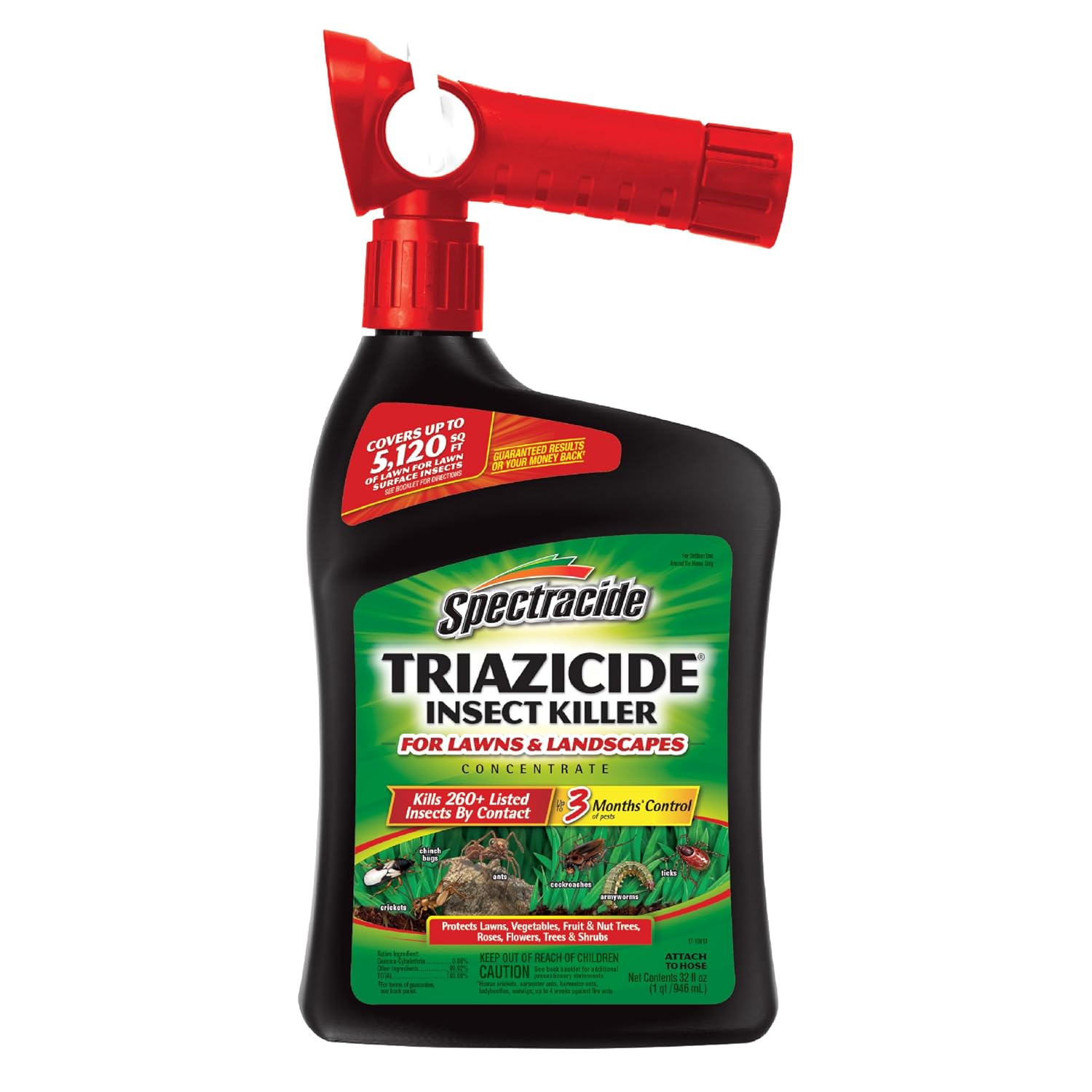
Spectracide Triazicide Insect Killer for Lawns & Landscapes, 32 oz Concentrate
| Unit Count | 32 Ounce |
|---|---|
| Item Form | Spray concentrate |
| Target Species | Insects |
| Active Ingredients | Gamma-Cyhalothrin (0.08%) |
| Liquid Volume | 32 fluid ounces |
Spectracide Triazicide is a dilutable concentrate designed to control more than 260 listed insects across lawns, flower beds, shrubs and ornamental trees. You mix the 32 oz bottle with water and apply with a tank or hose-end sprayer to treat surface pests such as ants, fleas and ticks as well as certain soil insects and grubs. The active ingredient gamma-cyhalothrin delivers fast contact kill—the label notes control can be seen in about 24 hours—and the concentrate format covers large areas when mixed to the recommended rates. It is non-staining when used as directed and labeled rate tables allow treatment of expansive lawns or targeted mound drenchings for fire ants. Be mindful of the safety guidance: this product is highly toxic to fish and bees and requires careful application to avoid drift and runoff. For gardeners focused on rapid, broad-spectrum insect control over lawns and surrounding landscape plantings, it is an effective, workmanlike option; those needing organic or pollinator-safe choices should look elsewhere.
Best for: Buyers who prioritize effective, fast-acting insect control across lawns and perimeter landscapes and want a concentrated product that treats large areas economically.
Less Ideal for: Homeowners seeking organic, pollinator-friendly or aquatic-safe solutions or those uncomfortable handling concentrated pesticides should consider alternative products.
- Broad-spectrum control listed for 260+ insects including fleas, ticks and Japanese beetles
- Concentrate format treats large areas when mixed, reducing trips to buy multiple ready-to-use cans
- Fast contact action with label guidance for visible control in about 24 hours
- Non-staining when used as directed and suitable for lawns, flower beds, trees and shrubs
- Highly toxic to aquatic life and bees so must not be applied near water or flowering plants with pollinators present
- Requires careful mixing and correct application equipment to cover the intended area safely
Verdict: Choose this concentrate when you need a fast, broad-spectrum lawn and landscape insect killer that covers large areas efficiently.
Ortho BugClear Insect Killer for Lawns & Landscapes Ready‑to‑Spray, 32 oz

| Item Form | Aerosol |
|---|---|
| Target Species | Ant |
| Liquid Volume | 32 fluid ounces |
Ortho BugClear Ready‑to‑Spray is a hose‑attached lawn and landscape insecticide designed for homeowners who want fast, broad‑spectrum control without mixing liquids. You attach the bottle to a garden hose and spray ornamental beds, turf and perimeter areas; the formula claims to start killing within minutes and lists control for ticks, ants, mosquitoes and more. The product is non‑staining and odor‑free, and one 32 fl oz bottle covers up to a roughly 5,300 sq ft lawn or smaller perimeters and foliage areas, so it can treat typical suburban yards quickly. Key active ingredients are bifenthrin and zeta‑cypermethrin, which provide residual control that can reduce insect activity for weeks to months when applied per label. Important limitations are the need to avoid spraying blooming plants to protect pollinators and the usual precautions for pesticides such as wearing protective clothing and avoiding runoff; it also requires a hose for application so it is not suited to spot treatments far from a water source. Read and follow the label for safe use around edible plants and to confirm the full list of labeled pests and plants.
Best for: Homeowners who need an easy, no‑mix solution to control ticks and other yard pests across a typical suburban lawn and perimeter and who prioritize quick application and broad coverage.
Less Ideal for: Gardeners who need pesticide-free or organic controls, or those who only need occasional spot treatments away from a hose connection.
- Ready‑to‑spray hose attachment makes application fast and simple for homeowners
- Broad label coverage including ticks, mosquitoes and common lawn pests
- Non‑staining, low‑odor formula suitable for use around lawns and ornamentals
- One 32 fl oz bottle covers up to ~5,300 sq ft of lawn, reducing the need for frequent repurchases
- Requires a water source and hose connection so not ideal for remote or spot applications
- Contains synthetic pyrethroid active ingredients so users must follow safety directions to protect pollinators and avoid runoff
Verdict: If you want a fast, no‑mix hose‑on treatment to reduce ticks and other yard pests across a whole lawn, this ready‑to‑spray Ortho bottle gets the job done efficiently.
Ortho BugClear Insect Killer for Lawns & Landscapes Ready-to-Spray (3-Pack)

| Item Form | Aerosol |
|---|---|
| Indoor Outdoor Usage | Outdoor |
| Scent Name | Unscented |
| Number of Items | 3 |
Ortho BugClear is a hose-attachment ready-to-spray insect killer designed to control a wide range of outdoor pests across lawns, foundations and ornamental plantings. You apply it by connecting a bottle to a garden hose and spraying the targeted area; each 32 fl. oz. bottle is rated to treat up to 5,300 sq. ft. of lawn or focused perimeter and foliage areas. The formula is labeled to kill 235 listed insects including ticks and mosquitoes and is described as non-staining and odor free, so it can be used around turf, flower beds and shrubs without obvious residue. Practical benefits include fast knockdown within minutes and broad coverage so fewer applications cover larger yards. Because it is a ready-to-spray hose product it is quick to use for routine perimeter and lawn treatments, but you must follow label directions carefully for rates and safe use around food-bearing plants. Also, hose-end application means the spray pattern and coverage depend on water pressure and hose handling, so results are more consistent when applied evenly and on calm days.
Best for: Buyers who prioritize reliable, routine perimeter and turf protection and want a fast, low-effort way to reduce ticks and other common yard pests across medium to large lawns.
Less Ideal for: Gardeners who need spot treatments with precise, low-volume applications or those who prefer pump sprayers or non-hose delivery methods for delicate plantings.
- Ready-to-spray hose attachment provides fast, large-area coverage
- Label lists control of ticks specifically, useful for reducing tick presence in lawns
- Non-staining and odor free formula suitable for use around ornamental plants
- Each bottle covers a large area, reducing application frequency for medium to large yards
- Effectiveness and uniform coverage depend on water pressure and even application technique
- Requires strict adherence to label for safe use on listed vegetables and fruit trees
Verdict: Choose Ortho BugClear when you want a reliable, ready-to-spray solution to reduce ticks and other common yard pests across large lawn and perimeter areas.
Cutter Backyard Bug Control Spray Concentrate, 32 fl oz (2 pack)

| Unit Count | 64 Fluid Ounces |
|---|---|
| Included Components | Cutter Backyard Bug Control Spray Concentrate (2 Pack) |
| Item Form | Spray |
| Target Species | Insects |
| Active Ingredients | Lambda Cyhalothrin |
The Cutter Backyard Bug Control Spray Concentrate is a hose-end lawn treatment designed to control mosquitoes, ants, fleas and other listed insects across turf and landscape areas. You attach the included QuickFlip hose-end sprayer to a garden hose, flip the switch and walk the yard applying an even cover to lawns, shrubs and trees; the product mixes automatically with water so there is no measuring or pouring. The label claims coverage up to 5,000 square feet per bottle and up to 12 weeks of control for several common pests, which makes it convenient for seasonal applications. Notable features include the hose-end applicator for quick coverage and an active ingredient, lambda-cyhalothrin, that is commonly used for perimeter and landscape treatments. Important limitations are that users must follow safety and use instructions closely, keep people and pets away until surfaces dry, avoid applying before rain, and follow any local restrictions; the product is not labeled for use that differs from the directions on the container. For homeowners who want a straightforward, broad-spectrum lawn treatment, this concentrate is an efficient option when used as directed.
Best for: Homeowners who want a simple, walk‑behind hose-end treatment to reduce common lawn and landscape insects and prefer a single, seasonal application approach backed by many user reviews.
Less Ideal for: Gardeners seeking a product explicitly labeled for tick control or professional applicators who need concentrated formulations for targeted spot treatments should consider alternatives.
- Hose-end QuickFlip sprayer mixes automatically for easy, no-measure application
- Manufacturer states up to 12 weeks of residual control for certain listed insects
- One bottle covers up to 5,000 sq ft, suitable for typical residential lawns
- Contains lambda-cyhalothrin, an effective active ingredient for perimeter treatments
- Requires careful adherence to label directions and safety restrictions before re-entry
- Not specifically labeled for ticks in the provided product details
Verdict: A convenient hose-end concentrate for homeowners who want an easy, broad-spectrum lawn treatment that covers large yards with minimal mixing.
Atticus Talak 7.9% Bifenthrin Indoor/Outdoor Insecticide Concentrate (32 oz)

| Liquid Volume | 32 fluid ounces |
|---|---|
| Active Ingredients | Bifenthrin |
| Item Form | Liquid |
| Target Species | Insects |
| Specification Met | EPA |
Talak 7.9% is a water‑based bifenthrin concentrate designed for treating lawns, landscapes, outdoor surfaces and indoor perimeter areas. You mix the concentrate with water at label rates to make spray solutions for turf, plants, porches, eaves and baseboards. The formula targets more than 75 pests including ticks and mosquitoes, kills on contact and is labeled to provide residual control for up to three months depending on application site and rate. Practical features include clear drying and low odor, a pourable bottle with pre‑marked dosing, and flexible dilution rates so you can treat small areas or large lawns with the same product. Important limitations are that treated solutions should not be stored and the product is not approved for foggers; follow label directions for rates and reentry times. Also some states restrict sale of this formulation. For tick control it is effective as a perimeter and lawn treatment when applied at recommended rates, but success depends on thorough coverage and seasonal timing.
Best for: Homeowners who want a conventional, label‑driven solution to reduce ticks and other pests around lawns, landscape edges and outdoor living areas and who prioritize predictable, residual control and clear reentry instructions.
Less Ideal for: People seeking organic or non‑synthetic tick control methods or those who need products approved for fogging or for use in states where this formulation is restricted.
- Contains 7.9% bifenthrin, a proven broad‑spectrum insecticide effective on ticks and many other pests
- Water‑based concentrate that dilutes easily and dries clear with low odor
- Label provides specific dilution rates for lawns, landscapes and perimeter surface treatments
- Long residual activity claimed—up to three months—reducing application frequency
- Bottle has pour markings to help measure small doses and reduce spills
- Solution cannot be stored for later use so you must mix only what you need for same‑day application
- Not approved for use in foggers and availability is restricted in some states
Verdict: A reliable, label‑driven bifenthrin concentrate for homeowners who want long‑lasting perimeter and lawn control of ticks and many other pests.
Choosing the Right Lawn Tick Spray: Key Factors to Consider
Coverage Area and Dilution Rate
Know your lawn square footage and match it to the product's stated coverage per container and recommended dilution rate. A lower dilution rate usually means you can treat more area with the same bottle, but excessive dilution can reduce efficacy. Accurate coverage estimates prevent under-treatment, which leaves refuges where ticks survive, and over-application, which wastes product and increases environmental load.
Consider whether the product is designed for hose-end application, concentrate mixing, or ready-to-use spray. Hose-end applicators can speed treatment of large lawns but may deliver uneven spray if not calibrated. Concentrates give flexibility for small or large areas but require careful measuring and mixing to maintain labeled efficacy.
Residual Protection Length
Residual protection is the time period after application when ticks contacting treated surfaces will be affected. Longer residual control reduces how often you need to reapply and lowers the window of high risk during peak tick season. However, residual length depends on active ingredient chemistry, formulation stability, exposure to sunlight and rain, and the type of vegetation in treated areas.
Expect shorter residuals in sunny, irrigated lawns and longer persistence in shaded or less-trafficked zones. Match the product's labeled residual claims to your lawn use pattern; high-traffic areas may need more frequent reapplications or integrated approaches like habitat reduction.
Application Method and Ease
Application practicality determines whether treatments get done correctly and on schedule. Hose-end sprayers, pump-up backpack sprayers, and ready-to-use trigger bottles each demand different effort and give different spray patterns. Ease of application affects coverage uniformity, user fatigue, and the likelihood of missed spots along borders, shrub lines, and under eaves where ticks often quest.
Also consider label directions for personal protective equipment, mixing steps, and post-application re-entry intervals. Clear, homeowner-friendly instructions reduce the chance of misuse and increase the chances of achieving labeled control.
Safety Guidance for Pets and Families
Because lawns are shared spaces, check label guidance for pets, children, and the timing of allowed re-entry after application. Some formulations require pets and people to stay off treated areas until dry, while others may specify longer wait times. Safety directions often include instructions for treating pet bedding, kennels, or perimeter zones differently than open turf.
Products with clear, conservative safety instructions and specific guidance for pet-safe practices reduce risk of accidental exposure. Also assess whether the product recommends removal or covering of food, toys, or water features before treatment.
Target Spectrum and Non-target Impact
Not all tick sprays have the same activity spectrum. Some formulations focus narrowly on ticks and biting pests, while others are broad-spectrum insecticides that affect pollinators and beneficial arthropods. Understand what the product will impact and where you are applying it: avoid broad-spray treatments directly onto flowering plants where pollinators forage.
Consider timing and placement to reduce non-target harm. Spot-treatment of tick hot spots, perimeter band treatments, or focused shrub-line applications can limit collateral impact while still controlling ticks where people and pets are most likely to encounter them.
Weather Resistance and Rainfastness
A lawn treatment's effectiveness often depends on how soon after application it will withstand irrigation or rain. Rainfastness determines how long you must wait before watering or expecting natural rainfall without washing the product away. Labels typically give a rainfast window or directions about reapplication after heavy precipitation.
If you live in a rainy region or plan to irrigate shortly after treatment, choose formulations known for quicker binding to foliage or soil, or plan applications during a weather window that allows the product to set. This ensures the residual protection anticipated on the label is realized in your yard.
Best Application Patterns for Yard Layouts
Different lawn and landscape layouts call for different spray patterns. Open, regularly mowed turf responds well to uniform broadcast applications, while properties with wooded edges, stone walls, or tall grass pockets benefit from banded perimeter treatments and targeted shrub-line spraying.
For properties with pets and children, focus treatment on play areas, lawn perimeters, and corridors between lawn and woodland rather than blanket-spraying flowering beds. Spot-treat likely tick habitat such as leaf litter, brush piles, and shady borders to reduce tick populations where they thrive.
- Broadcast spray for even turf with low surrounding vegetation
- Perimeter banding along yard borders adjacent to woods or tall grass
- Spot treatment of leaf litter, stone walls, and brush piles
Timing Treatments with Tick Activity
Time applications to coincide with peak tick activity in your region. Early spring and late summer see pulses of different life stages. A well-timed initial treatment followed by monitoring and selective follow-ups will reduce overall product use while controlling risk during high-activity windows.
Avoid treating right before heavy rain unless the product label indicates short rainfastness. Also consider coordinating treatments with mowing and irrigation so the spray contacts the vegetation and ground where ticks quest.
- Treat at the start of local tick season and again based on residual length
- Avoid immediate watering or rain to preserve residual
- Combine with habitat management like removing brush and trimming tall grass
Mixing, Storage, and Disposal Best Practices
Mix concentrates only in well-ventilated areas using the exact proportions listed on the label. Use measuring tools dedicated to pesticide mixing and never pour leftover mixtures back into the storage container. Careful mixing prevents over-application and reduces smell and drift.
Store products in a cool, dry place away from children and pets, in their original containers with labels intact. Dispose of empty containers and unused concentrate according to local hazardous waste guidance and label instructions to avoid contaminating soil or waterways.
- Measure precisely and rinse measuring tools away from storm drains
- Store in original container with label
- Follow local guidelines for disposal of unused product or empty containers
Integrating Sprays with Non-Chemical Tick Control
Sprays are most effective when used as part of an integrated approach. Combine perimeter treatments with habitat reduction like removing leaf litter, keeping grass mowed short, and creating dry, sunlit buffers between lawn and wooded areas. These cultural practices make the environment less hospitable to ticks and reduce the need for repeated chemical treatments.
Regularly check and treat pets with veterinarian-recommended tick prevention, and consider targeted fencing or mulch barriers along property edges to limit wildlife corridors that bring ticks into the yard.
- Mow regularly and remove leaf litter to reduce tick habitat
- Create dry, sunny borders between lawn and woods
- Use targeted sprays in combination with pet prevention measures
Understanding Label Directions and Legal Restrictions
Read product labels carefully before purchase and again before application. Labels are legal documents and they specify where the product may be used, allowed application rates, and safety precautions for people, pets, and the environment. Some formulations have specific restrictions for use near edible crops, water features, or in certain states.
If a label requires professional application or special licensing, that product should be avoided by homeowners looking for DIY options. Following label directions protects your family and ensures the product performs as advertised.
- Labels specify allowed use sites and re-entry intervals
- Some products restrict use near water or edible plants
- Avoid formulations requiring professional applicators if you plan to treat yourself
How We Chose the Best Lawn Tick Spray
We prioritized products that deliver reliable tick control while fitting common yard sizes and gardener workflows. Key evaluation criteria included spray coverage and application rate to estimate how much product a typical homeowner needs per treatment; residual protection to understand how long the product remains effective against ticks after application; target spectrum to confirm the active ingredients are appropriate for common tick species and non-target insects gardeners want to protect; and ease of application covering hose-end compatibility, handheld sprayers, and recommended re-entry intervals. We also looked at formulation features that affect real-world use such as weather resilience after application, safety directions for pets and children, and label instructions for vegetation and ornamental areas. Products with unclear label guidance, restricted-use formulations not intended for residential lawns, or requirements for specialized equipment were excluded. The final shortlist contains options that balance practical coverage, documented residual activity, clear homeowner instructions, and compatibility with typical lawn care routines.
FAQ
How often should I apply a lawn tick spray?
Frequency depends on the product's labeled residual and local tick pressure. Many homeowner formulations require reapplication every two to eight weeks during peak season, but always follow the label and consider spot-treating high-risk areas between scheduled treatments.
Are lawn tick sprays safe for pets and children?
Safety varies by formulation. Most labels require people and pets to stay off treated areas until the spray dries, and some list longer re-entry intervals. Follow label instructions closely and treat pet bedding or kennels according to specific guidance to minimize exposure.
Can I spray near flowering plants without harming pollinators?
To protect pollinators, avoid spraying blooms and apply treatments during times when pollinators are least active, such as early morning or late evening. Consider spot-treating non-flowering borders and use targeted approaches to limit exposure to beneficial insects.
Will rain wash away an application immediately?
Rainfastness differs by product. Some formulations bind quickly and resist light rain after a short period, while others need longer dry windows. Check the label for rainfast guidance and try to apply when no heavy rain is forecast for the next 24 to 48 hours.
Can I use a lawn tick spray if I have vegetable beds nearby?
Many lawn sprays restrict application near edible crops or require precautions to avoid drift. Maintain a buffer between treated turf and vegetable areas, cover edible containers during application, and follow label instructions to prevent contamination.
What's the best way to treat yard edges and wooded borders?
Use a focused perimeter band treatment along the lawn-woodline interface and spot-spray leaf litter and brush piles where ticks are most likely to be. Targeted application reduces overall product use while controlling ticks where human and pet contact is most likely.
Final Verdict
Choose a lawn tick spray by matching coverage needs and residual protection to your yard size and use patterns. Prioritize products with clear safety guidance for pets and people, a practical application method you can manage, and labeled instructions that fit your local conditions. Balance chemical control with habitat reduction and pet prevention to lower overall tick encounters. With those tradeoffs in mind, pick a spray that fits your lawn layout and reapplication tolerance to keep outdoor spaces safer throughout tick season.
