

Note: This article contains affiliate links. If you click on these links and make a purchase, I may earn a small commission at no extra cost to you. This helps support my research and content. Read my full affiliate disclosure here.
Picking the right LED grow light for the vegetative stage changes how quickly and uniformly plants establish before flowering. For seedlings, clones, and young vegetative growth you need a fixture that gives the right spectral balance, even coverage across the canopy, and controllable intensity so stems stay compact and leaves form properly. This guide covers seven shortlisted LED options chosen for veg-stage use and explains the practical tradeoffs that matter in a real indoor garden or grow tent. Below we summarize how each light performs on spectrum control, intensity, heat management, and energy use so you can match a light to your space and plant goals.
Top Picks at a Glance
| Best Overall The best all-around choice for most situations | MARS HYDRO TS600 100W Dimmable LED Grow Light |  |
| Best Quality Built to a higher standard if you want something more solid | VIVOSUN LumaLight 400W Full Spectrum LED Grow Light |  |
| Best Value The sweet spot between price and what you get | Spider Farmer SF1000 100W Full Spectrum LED Grow Light |  |
| Best Budget The cheapest option that still gets the job done reliably | DOMMIA Under-Shelf USB LED Grow Light Panel, 2-Pack |  |
| Highest Rated A top-rated pick with lots of positive feedback | Spider Farmer G4500 LED Grow Light 320W (App‑Controlled, Dimmable) |  |
| Most Popular A crowd favorite that many people choose with confidence | GooingTop HY-021 6000K Full-Spectrum Clip Grow Light |  |
| Best Seller A high-volume bestseller chosen again and again | Aokrean Halo Full-Spectrum LED Grow Light with Base (3-Pack) |  |
MARS HYDRO TS600 100W Dimmable LED Grow Light

| Wattage | 100 watts |
|---|---|
| Light Output Maximum | 10000 lumens |
| Light Source Special Features | Sunlike Full Spectrum |
| Number of Light Sources | 225 |
| Power Source | Corded Electric |
The MARS HYDRO TS600 is a 100W dimmable full-spectrum LED designed for small indoor grows, particularly 2×2 ft tents and single-plant setups. It produces a plant-focused spectrum (including red/IR and mid-to-cool white ranges) and a claimed PPF around 190 µmol/s with a PPE of roughly 2.0 µmol/J, which makes it suitable for vegetative growth and the full cycle for a couple of plants. The added dimming lets you back off intensity for seedlings or vegetative stages to save energy and reduce heat without moving the light. The flat panel and patented 120° reflector aim to spread light evenly across a compact footprint. Practical benefits include low power draw (about 100W), lightweight aluminum construction, and an easy floor or hang mounting for tight spaces. Important limitations are its limited effective area if you plan a multi-plant canopy and modest total photon output compared with larger fixtures, so you may need multiple units or a higher-watt model for bigger tents or heavier flowering loads.
Best for: Growers who want an efficient, beginner-friendly LED for veg-stage work in a 2×2 ft tent or a single-plant shelf and who value low energy use and adjustable intensity.
Less Ideal for: Experienced growers running multi-plant or larger tents who need higher total light output and broader coverage should choose a larger fixture or multiple units.
- Dimmable output lets you match intensity to veg and seedling stages for energy savings
- Full-spectrum diodes including red/IR suitable for vegetative and flowering stages
- Low power consumption (~100W) for modest electricity use
- Compact, lightweight aluminum design fits 2×2 ft tents, shelves, and cabinets
- PPF and overall photon output are modest, so coverage is limited for larger canopies
- Not powerful enough alone for multi-plant 3×3 or larger grow tents
Verdict: A compact, energy-efficient dimmable LED that gives balanced veg-stage light for 1–2 plants in a 2×2 ft grow space.
VIVOSUN LumaLight 400W Full Spectrum LED Grow Light

| Light Source Type | LED |
|---|---|
| Wattage | 400 watts |
| Mounting Type | Ceiling Mount |
| Light Source Special Features | Dimmable |
| Power Source | AC/DC |
The VIVOSUN LumaLight 400W is a performance-oriented LED grow fixture built to push plants through vegetative and flowering stages. It combines white, blue, red and far-red diodes to provide a broad spectrum that supports photosynthesis from seedling to harvest, and an increased diode count for stronger PPFD and more even coverage across a typical greenhouse bench or tent. The fixture is dimmable from 25 to 100 percent via an on-unit knob and can be integrated with VIVOSUN GrowHub for automated scheduling and remote control. Its metal housing and advanced thermal design keep operating temperatures low, while IP65 dustproof and waterproof protection makes it safe to use in humid greenhouse environments and easy to clean. Expect long service life with the stated long maintenance hours and low heat output. Limitations include its single hardwired GU24-compatible unit and reliance on the GrowHub for advanced smart features, so gardeners wanting plug-and-play wireless control out of the box may need additional accessories.
Best for: Growers who prioritize high light output and uniform canopy coverage in greenhouse or controlled-environment setups and who plan to integrate lighting into a performance-focused system.
Less Ideal for: Casual hobbyists who want a simple plug-and-play lamp with built-in wireless control or growers on a very tight budget seeking lower-wattage entry units.
- Full spectrum (white, blue, red, far-red) tailored for all growth stages
- High-intensity, even PPFD distribution for consistent canopy coverage
- Dimmable 25%–100% for precise light management
- IP65 rating for safe use in humid greenhouse conditions
- Robust thermal design for lower operating temperatures and long lifespan
- No built-in wireless controller; advanced scheduling requires separate GrowHub
- Bulb base listed as GU24 may require specific wiring or adapter for some installs
Verdict: Choose this light if you need a high-intensity, full-spectrum LED that delivers even PPFD and reliable greenhouse performance.
Spider Farmer SF1000 100W Full Spectrum LED Grow Light

| Light Source Type | LED |
|---|---|
| Light Output Maximum | 10000 lumens |
| Light Source Wattage | 100 watts |
| Light Source Special Features | Dimmable |
| Specification Met | IP67 |
The Spider Farmer SF1000 is a compact 100W full spectrum LED grow light intended for 2×2 to 3×3 grow spaces and small tents. It uses a high diode count and upgraded LED chips to deliver broad-spectrum output that supports seedlings through flowering, with a dimmer knob to reduce intensity for early stages and ramp up for bloom. The fanless design and thick aluminum heatsink keep operation quiet while providing passive cooling, and the fixture meets IP67 for durable performance. Typical use is ceiling or tent mounting above individual plants or a small canopy where uniform coverage and deeper canopy penetration matter. Notable features include daisy-chain compatibility for linking multiple units under unified dimming, a 0–100% dimmable control, and a driver claimed to offer efficient power delivery. Practical benefits are even light distribution in a small footprint, predictable veg-to-flower capability, and near-silent operation. Limitations are inherent to its class: it is sized for small areas so you will need multiple units for larger tents, and the product description emphasizes specs from manufacturer tests rather than independent third-party PPFD maps.
Best for: Growers who want a quiet, compact full spectrum light for a small tent or single-plant setup and value adjustable intensity for each growth stage.
Less Ideal for: People running larger multi-plant rooms or commercial operations who need higher total output and broader single-fixture coverage.
- Full spectrum output suitable for all growth stages with added red and IR for flowering
- Dimmable 0–100% control lets you tailor light intensity to seedlings, veg, and bloom
- Fanless design with sturdy aluminum heatsink for quiet, low-maintenance operation
- Compact footprint ideal for 2×2 to 3×3 tents and small indoor setups
- Daisy-chain capable so multiple fixtures can be linked and dimmed together
- Coverage and power are intended for small grows so larger areas require multiple units
- Manufacturer gives efficiency and coverage figures without independent third-party PPFD charts
Verdict: A quiet, dimmable 100W full spectrum fixture that is a practical, balanced choice for hobbyists running 2×2 to 3×3 tents.
DOMMIA Under-Shelf USB LED Grow Light Panel, 2-Pack

| Wattage | 10 watts |
|---|---|
| Light Source Type | LED |
| Power Source | Corded Electric (USB 5V 2A) |
| Mounting Type | Under Cabinet Mount |
| Number of Light Sources | 2 |
The DOMMIA two-panel grow light is a compact LED solution made for cramped shelves, plant cabinets, and seedling trays. Each 4" square panel is ultra-thin and mounts with adhesive or magnets so you can position light directly over small pots or seedling flats. The panels provide a full 380–780nm spectrum with built-in optical lenses that concentrate light downward; the listing reports about 260 µmol/m²/s PPFD at 4 inches, which is well suited to germination and early vegetative growth. Controls live on a USB-powered smart controller with a 6/12/16 hour auto timer and four brightness levels, plus memory to restore settings after power loss. USB power and a 6 ft cord make it easy to use with a power bank or USB adapter, and the low-voltage design is safer around humid setups. Expect good coverage for a few seed trays or multiple small pots, but larger flats or multiple shelving tiers will need additional panels for even light. The construction is lightweight aluminum and plastic which keeps cost and bulk down but may be less robust than heavier fixtures.
Best for: Ideal for home gardeners starting seeds or growing a few small seedlings on a tight budget who need a low-profile, easy-to-install light for shelves and cabinets.
Less Ideal for: Not a good fit for growers who need high output over large trays, full shelving racks, or consistent commercial-scale lighting across many plants.
- Ultra-slim 4"x4" panels mount easily under shelves or inside cabinets.
- Full 380–780nm spectrum with optical lenses for focused light on seedlings.
- Built-in 6/12/16H auto timer and 4 brightness levels for set-and-forget use.
- USB 5V power and 6 ft cord work with adapters, power banks, and USB hubs.
- Small panel size limits effective coverage per unit, so multiple panels are needed for larger seedling batches.
- Lightweight plastic/aluminum build may feel less durable than heavier fixtures.
Verdict: A very affordable, ultra-slim USB LED panel set that gives seedlings focused full-spectrum light and automatic timers for small-scale indoor starts.
Spider Farmer G4500 LED Grow Light 320W (App‑Controlled, Dimmable)

| Light Source Type | LED |
|---|---|
| Wattage | 320 watts |
| Light Source Special Features | Dimmable, App-Controlled, Daisy-Chain Function |
| Power Source | Corded Electric |
The Spider Farmer G4500 is a high-efficiency LED grow light built for full-cycle indoor growing in small commercial or serious hobby setups. It delivers 320 watts using high-density Bridgelux diodes and a long bar design that spreads light more evenly across the canopy, making it suited to 2×4 and up to 3×5 coverage areas. The fixture is dimmable from 10 to 100 percent, supports daisy-chaining up to 50 units for synchronized control, and connects to the Spider Farmer app for scheduling and remote brightness adjustments. Practical benefits include strong PPE (listed at 2.85 umol/J in the G series data), low heat output from efficient diodes, and an aluminum housing that helps with passive cooling. The light is aimed at growers who prioritize uniform penetration and programmable control rather than novelty extras. Limitations are typical of high-output fixtures: you will need appropriate ventilation and mounting height to avoid light stress, and the elongated bar requires enough horizontal space in the tent or room. Assembly is not required but plan for cable management and app setup time.
Best for: Growers who want strong, uniform light and programmable control for full-cycle performance in a 2×4 to 3×5 tent or small grow room and who prioritize output and efficiency over minimal footprint.
Less Ideal for: Casual plant owners with a single small shelf or tabletop setup who need a compact, low-intensity lamp rather than a high-output grow fixture.
- High-efficiency Bridgelux diodes with reported PPE of 2.85 umol/J for strong light output per watt
- Elongated bar design for more uniform edge-to-edge canopy coverage over 2×4 to 3×5 areas
- Dimmable 10–100% plus daisy-chain support for synchronized control of multiple units
- App control with scheduling, remote dimming, and sunrise/sunset simulation for hands-off management
- Aluminum housing that helps dissipate heat and supports continuous operation
- Requires adequate ventilation and mounting height to manage intensity and heat in small enclosures
- Large footprint compared with compact panels, so it needs enough horizontal space in the grow area
Verdict: Buy this if you need a high-efficiency, app-controlled LED that delivers uniform, high-output coverage for performance-focused 2×4 to 3×5 indoor grows.
GooingTop HY-021 6000K Full-Spectrum Clip Grow Light
| Power Source | Corded Electric |
|---|---|
| Color Temperature | 6000 Kelvin |
| Light Output Maximum | 2500 lumens |
| Light Source Special Features | Dimmable |
| Number of Light Sources | 84 |
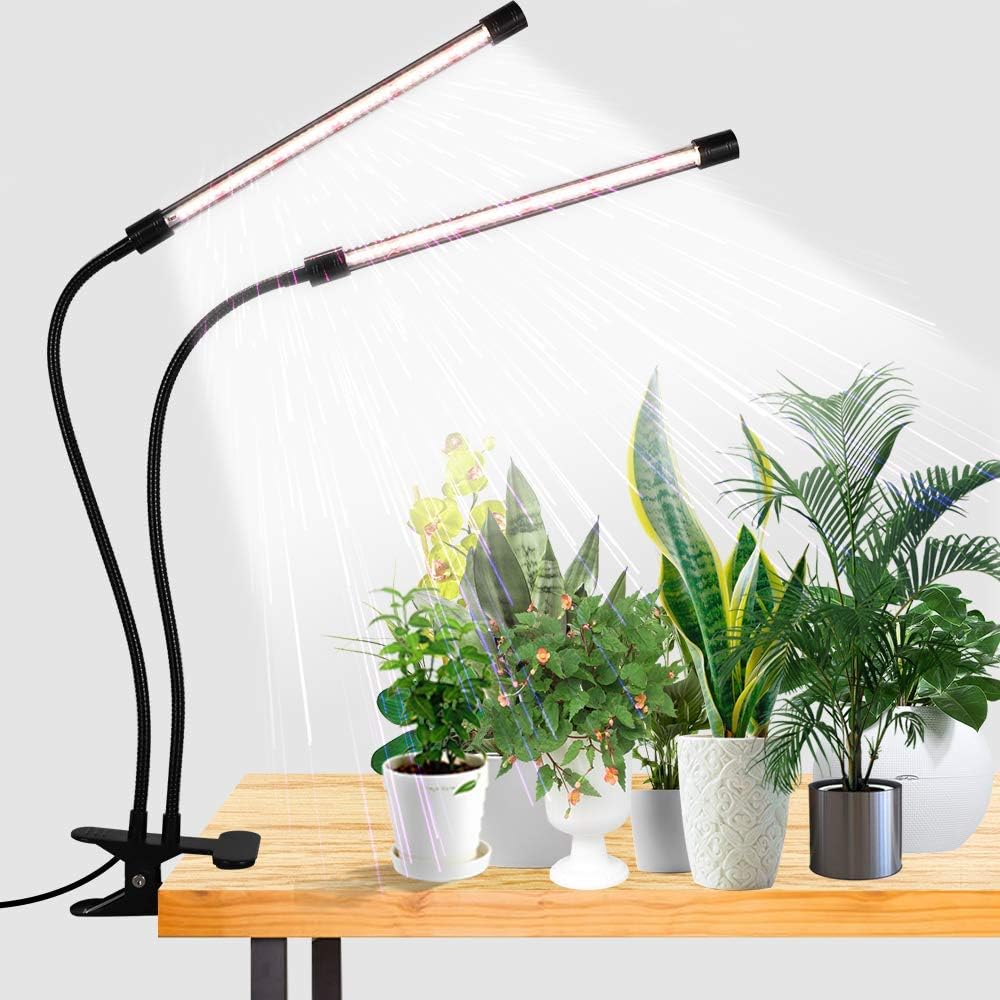
This GooingTop HY-021 is a compact clip-on grow light built for small houseplants, seedlings and shelf gardens. It uses 84 LEDs (white plus deep red) to deliver a 6000K full-spectrum output intended to mimic midday sun, with a high color-rendering output that also makes it pleasant as a reading lamp. Two flexible gooseneck heads and a strong clamp let you aim light precisely over pots and seed trays, while the attached remote provides 50%/100% dim levels and repeating timers at 4, 8 or 12 hours for hands-off scheduling. Practical benefits include low power draw (listed as roughly 10 W LED draw), a claimed 1 to 2 square meter coverage for seedlings, and an included timer that simplifies day/night cycles. Limitations are its design for small setups rather than large grow racks and the clip mounting limits placement compared with freestanding fixtures. The unit also relies on the corded remote instead of a smartphone app and the lifespan claim is typical of LEDs but not independently verifiable from the listing.
Best for: Buyers who want a simple, low-power, plug-and-play grow light to boost seedlings and a few houseplants on a desk or shelf and who value an easy-to-use timer and adjustable brightness.
Less Ideal for: Growers planning multi-shelf installations, larger vegetable grows, or who need networked or app-based control should consider larger bar lights or fixtures designed for commercial racks.
- Full-spectrum 6000K output with added 660 nm red LEDs to support vegetative growth and flowering
- Attached remote with dimming (50%/100%) and repeat timer settings (4/8/12 hours) for easy scheduling
- Flexible dual goosenecks and strong clamp enable precise positioning over small pots and seed trays
- High reported color rendering for comfortable viewing and accurate plant color assessment
- Low electrical draw around 10 W while covering small growing areas
- Clip-mount design and stated 1–2 m² coverage make it better suited to individual plants or small trays rather than large multi-shelf setups
- No smart app or wireless control option; remote is cord-attached which limits placement flexibility
Verdict: A compact, easy-to-use clip grow light that delivers full-spectrum light and convenient timer/dim controls for small indoor plant setups.
Aokrean Halo Full-Spectrum LED Grow Light with Base (3-Pack)

| Light Source Type | LED |
|---|---|
| Number of Light Sources | 48 |
| Wattage | 10 watts |
| Control Method | Touch |
| Power Source | Corded Electric |
This Aokrean Halo grow light is a small, versatile LED solution for indoor plants that offers a lot of convenience in a compact package. Each lamp uses 48 LEDs with a full-spectrum output and three lighting modes plus ten brightness levels, so it can be tuned for seedlings, vegetative growth, or supplemental light for potted houseplants. The lamp can be inserted into soil or mounted on the included base, and the telescoping pole adjusts up to about 26 inches to suit taller pots or change light intensity. Controls are touch-based and include a timer with preset cycles for automated daily on/off. Practical benefits include a neat decorative look, low power draw at 10 watts, and USB/Bluetooth connectivity for modern setups. Limitations are that the base requires the pot to help stabilize the stand and the unit is not water resistant, so it must stay dry and indoors. For balanced buyers looking for adaptable, easy-to-use grow lights for multiple indoor plants, this hits the mark.
Best for: Buyers who want a compact, adjustable grow light that works for seedlings and small to medium houseplants and who value easy controls and automated timers.
Less Ideal for: Growers needing heavy-duty, waterproof fixtures for greenhouse or outdoor use or those who require high-output lighting for large-scale indoor gardens.
- Full-spectrum LED array (48 LEDs) with three lighting modes and 10 brightness levels for flexible plant lighting
- Height-adjustable pole and dual mounting (insert in soil or use the base) to fit a range of pot sizes
- Touch controls with built-in timer options for automatic daily cycles
- Low power consumption (10 watts) and high efficiency for continuous use
- Base stability depends on placing a pot on it so it can be less secure with lighter containers
- Not water resistant so unsuitable for humid or outdoor environments
Verdict: Aokrean's Halo is a space-saving, full-spectrum grow light with adjustable height and timers that makes it easy to give small indoor plants the right light without complex setup.
Choosing the Right LED Grow Light for Veg Stage: Key Factors to Consider
Light Spectrum and Blue Balance
Blue-rich light encourages compact, sturdy vegetative growth and influences leaf thickness and stomatal behavior. For veg-stage work, fixtures that emphasize blue wavelengths or offer adjustable spectrum let you favor shorter internodes and dense foliage.
A spectrum that is too red-heavy will produce elongated, leggy plants during veg. Look for clear spectral charts or a dedicated veg mode so you can dial in the blue-to-red balance as plants progress from seedling to full vegetative size.
PPFD Levels and Canopy Coverage
Photosynthetic Photon Flux Density indicates how much useful light reaches the canopy. For veg-stage crops you usually aim for moderate-to-high PPFD depending on species, with seedlings and clones requiring less than full-size veg plants.
Equally important is uniformity across the footprint. Hot spots and deep shading force plant repositioning and uneven growth. Check manufacturer PPFD maps or lighting calculators and consider the height and area you're lighting to ensure consistent coverage without burning foliage.
Heat Output and Thermal Design
LED efficiency varies and wasted energy appears as heat. Poor thermal design shortens LED lifespan and can raise canopy temperature, stressing plants or increasing ventilation needs. Fixtures with active cooling or large passive heatsinks tend to run cooler and remain stable over long cycles.
In small tents or enclosed spaces, lower fixture-surface temperatures reduce the risk of heat buildup. Consider how the light's heat interacts with your exhaust and intake setup so you do not trade light quality for extra cooling work.
Dimming, Control, and Expandability
Being able to dial intensity up or down is crucial as plants move from seedling to full veg. Smooth dimming preserves spectrum and prevents color shifts. Digital control options and compatibility with timers or external controllers let you automate day-length and ramp schedules.
Expandable systems or daisy-chain power and control simplify scaling to larger canopy areas. If you plan staged increases in canopy size, choose fixtures with reliable dimming ranges and clear control protocols.
Electrical Efficiency and Running Costs
Look beyond wattage to useful photon output per watt. Higher electrical efficiency delivers more plant-usable light for less electricity and typically less heat. For long veg cycles this adds up in operational savings and reduced HVAC load.
Also review driver quality and warranty terms for long-term reliability. Efficient fixtures with stable drivers maintain consistent performance across many growth cycles.
Fixture Footprint and Mounting Options
The physical size and hanging configuration determine how well a fixture integrates into tents, racks, or benches. A light that is too narrow forces multiple fixtures and complex spacing to achieve uniform coverage.
Adjustable hangers, ratchets, or included mounting hardware make setup easier and let you fine-tune distance to the canopy. Consider clearances for surrounding equipment and ease of access for pruning and inspections when selecting form factor.
Matching Light Intensity to Plant Stage
Different veg stages need different intensity. Seedlings and fragile clones need gentler PPFD and a bit more distance to avoid bleaching, while established vegetative plants can take higher PPFD for faster photosynthesis and compact growth. Start lower and raise the fixture or intensity gradually as leaf area expands.
Use a PAR meter or trusted PPFD chart to set target intensities. If you do not have a meter, follow safe distance guidelines from manufacturers and watch leaf response over several days. Slight leaf cupping indicates strong but acceptable light; bleaching or mottling suggests intensity is too high.
- Seedlings/clones: low PPFD, moderate blue spectrum
- Young veg: moderate PPFD, maintain blue dominance
- Established veg: higher PPFD with consistent uniformity
Practical Mounting and Tent Layout Tips
Centering fixtures and maintaining even spacing avoids shaded zones that stunt lower nodes. Overlap light footprints slightly to even out edges, and keep hanging points adjustable so you can alter height as plants grow.
Consider airflow paths around fixtures. Even passive-cooled lights need clearance for heat to dissipate. Route ducting and fans so they do not blow directly onto leaves unless you need extra cooling; gentle airflow is better for strengthening stems than high-velocity blasts.
- Plan for fixture height adjustments as canopy expands
- Overlap coverage to reduce edge shading
- Allow clearance for heat dissipation and fan placement
Integrating Lights with Environmental Controls
Lighting interacts with temperature, humidity, and CO2. When increasing light intensity expect higher transpiration and possibly heat load. Balance light schedules with ventilation and humidification so stomatal behavior and water uptake stay steady.
If you use supplemental CO2, higher PPFD will translate into greater growth only when CO2 and nutrient availability keep pace. Coordinate all environmental systems when you dramatically change light intensity or cycle length.
- Monitor humidity when raising intensity
- Adjust nutrient and water schedules to match increased photosynthetic rates
Common Veg-Stage Problems and Light Fixes
Leggy plants often result from insufficient blue light or fixtures mounted too far away. Increase blue proportion or reduce height to promote compact internodes. Conversely, bleached or curled leaves usually point to excessive intensity or too much heat at the canopy surface.
Uneven canopy growth signals inconsistent coverage. Reposition fixtures, add reflectors, or use multiple smaller fixtures for better distribution. When troubleshooting, change only one variable at a time so you can identify the cause.
- Legginess: increase blue light or lower fixture
- Bleaching: reduce intensity or raise fixture
- Patchy growth: improve uniformity with spacing or additional fixtures
Energy and Lifecycle Considerations
LEDs vary in lifespan and lumen depreciation. Higher-quality diodes and drivers maintain useful output longer. Consider upfront efficiency versus long-term energy use, especially if you run long veg cycles or multiple fixtures.
Look for fixtures with replaceable drivers or modular components to extend usable life. Regular cleaning and keeping fixtures cool slows lumen depreciation and preserves output across many growth cycles.
- Prioritize efficient diodes and stable drivers
- Maintain fixtures and manage heat to extend lifespan
How We Chose the Best LED Grow Light for Veg Stage
We evaluated fixtures against the needs of vegetative growth, prioritizing objective, gardener-relevant dimensions. First, spectral output: units needed a good blue-dominant or adjustable veg spectrum to encourage short internodes and strong leaf development. Second, usable PPFD and canopy uniformity: we measured reported PPFD maps and spread at typical veg heights to ensure even coverage without hot spots. Third, thermal management: efficient heat dissipation and low fixture temperature preserve light longevity and reduce the need for extra ventilation. Fourth, electrical efficiency: watts per useful photon and driver quality were used to assess running costs and stability. Fifth, dimming and control: units with smooth dimming or veg-specific modes made it easier to scale intensity from seedlings to larger plants. We excluded fixtures that were strictly bloom-only spectrums, lacked clear spectral or PAR data, or had poor thermal design that risks short operational life. The scoring focused on measurable specs and real-use behaviors that affect veg-stage outcomes rather than brand claims.
FAQ
What PPFD range should I aim for during vegetative growth?
It depends on species, but seedlings and clones often do well with lower PPFD while established veg plants benefit from moderate to high PPFD. Monitor leaf response and raise intensity gradually rather than making large jumps.
Is a veg-specific spectrum necessary or can I use full-spectrum lights?
Full-spectrum lights can work if they provide adequate blue proportion for veg. Veg-specific or adjustable spectrum fixtures give more control to favor compact, leafy growth, but many full-spectrum fixtures with good blue output perform well.
How close should LED fixtures be to the canopy during veg?
Safe distance varies by fixture output and design. Start at the manufacturer-recommended height if available, then observe plants and inch the light closer over several days. Watch for signs of stress like bleaching or leaf curl.
Will higher wattage always speed up vegetative growth?
Not necessarily. Useful photon delivery and uniformity matter more than raw wattage. Higher wattage that produces uneven coverage or excess heat can harm plants. Aim for efficient photon output and proper distribution.
Do I need active cooling or is passive cooling enough?
Many modern fixtures use passive cooling effectively, but in small enclosed spaces or when running many lights, active cooling or better ventilation helps manage heat. Consider your grow space and total thermal load when choosing.
Can I use the same lights for veg and bloom?
Some fixtures are designed for both and offer spectrum or intensity adjustments. Using a light that can be tuned simplifies transitions, but ensure bloom settings provide the red-rich spectrum plants need later in flowering.
Final Verdict
Prioritize spectrum control, uniform PPFD across your canopy, and efficient thermal design when choosing an LED grow light for veg stage. Matching intensity and coverage to plant size prevents legginess and uneven development, while good dimming and driver quality let you scale as plants grow. Balance upfront fixture features with long-term efficiency and cooling needs to pick the best fit for your space and workflow.
