

Note: This article contains affiliate links. If you click on these links and make a purchase, I may earn a small commission at no extra cost to you. This helps support my research and content. Read my full affiliate disclosure here.
Choosing the right liquid ant bait matters because treating visible workers usually does not eliminate the nest. A well-formulated liquid ant bait attracts foragers, is palatable enough to be carried to the colony, and has a delayed effect that lets ants share the toxicant. This guide focuses on the top shortlisted options suited to households and indoor spaces where baiting is the preferred non-spray approach. We evaluated products for attraction, bait stability, and safety in living areas. Below you will find short product summaries and a practical framework for deciding which bait is best for your infestation and home layout.
Top Picks at a Glance
| Best Overall The best all-around choice for most situations | TERRO Liquid Ant Baits, 12-Pack |  |
| Best Quality Built to a higher standard if you want something more solid | Rockwell Labs InTice Thiquid Liquid Ant Bait, 4 oz |  |
| Best Value The sweet spot between price and what you get | TERRO Liquid Ant Killer 3-Pack (T200-3SR) |  |
| Best Budget The cheapest option that still gets the job done reliably | Raid MAX Liquid Ant Baits, 4 Count |  |
| Highest Rated A top-rated pick with lots of positive feedback | TERRO Ultra Complete Kill Ant Baits, 6 Dual-Formula Bait Stations |  |
| Most Popular A crowd favorite that many people choose with confidence | TERRO Liquid Ant Killer Bait Stations, 12-Pack (T300B) |  |
| Best Seller A high-volume bestseller chosen again and again | Raid Ant Killer Baits, 8 Count (Child-Resistant) |  |
TERRO Liquid Ant Baits, 12-Pack

| Brand | Terro |
|---|---|
| Unit Count | 24 Fluid Ounces |
| Included Components | 12 Ant Killer Bottles |
| Item Form | Liquid |
| Target Species | Ant |
TERRO Liquid Ant Baits is a straightforward indoor ant control solution that uses a borax-based liquid bait in prepackaged bottles and cardboard tiles. You apply small drops of the liquid onto the included tiles and place them where ants are active; worker ants feed on the bait and transport it back to the nest, which helps reduce the whole colony over several days. The product is easy to use, requires no mixing or special tools, and the 12-bottle pack provides multiple placements for larger infestations or repeat use. Expect to see more ants initially as they are drawn to the bait, then a noticeable drop in activity after a few days. The formula is intended for indoor use only and will not provide fast-contact knockdown like sprays, so patience and sufficient bait placements matter for effectiveness. Also keep the liquid away from pets and children and place tiles out of reach since the bottles contain borax.
Best for: Buyers who want a low-effort, colony-focused indoor solution to reduce household ant infestations and prefer baiting over sprays or traps.
Less Ideal for: People needing immediate visible knockdown, outdoor ant control, or who cannot safely place baits where pets or small children might access them.
- Ready-to-use liquid bait that requires no mixing or setup
- Designed for indoor placement so ants carry bait back to the colony
- Comes in a 12-bottle pack for multiple placements or repeat treatments
- Simple application on included cardboard tiles for targeted placement
- Not a contact killer so results take several days rather than immediate removal
- Contains borax which must be kept away from children and pets
Verdict: A simple, ready-to-use indoor bait pack that helps eliminate ant colonies by letting worker ants carry borax back to the nest.
Rockwell Labs InTice Thiquid Liquid Ant Bait, 4 oz

| Item Form | Liquid |
|---|---|
| Target Species | Insects |
InTice Thiquid is a thick syrup ant bait formulated to be highly palatable so foraging workers feed and transfer the product back to the nest. It is supplied in a 4 ounce dropper bottle for spot application onto small pieces of cardboard, foil, or into bait stations placed along ant trails, baseboards, window sills, and other areas where ants are active. The 5% borax active ingredient is nonrepellent, which helps ants consume the bait and survive long enough to deliver a lethal dose to the colony, with manufacturers noting control can take up to two weeks. The formula is odorless and designed not to run on flat surfaces, and it can be diluted for large multi-colony situations. Practical benefits include flexible placement indoors and outdoors, suitability for food-handling areas when used correctly, and compatibility with integrated programs that may use contact treatments over the bait. Limitations are that results are not instant, multiple placements are needed for best results, and highly bait-averse ant populations or non-feeding castes may reduce effectiveness.
Best for: Buyers who prioritize colony-level control and are willing to use multiple bait placements and monitoring to eliminate persistent ant problems in homes or commercial indoor spaces.
Less Ideal for: People who need rapid knockdown of visible ants or who prefer instant-contact sprays for quick cosmetic control.
- Thick, palatable syrup formulation encourages ants to feed and transport bait to the colony
- Odorless and non-running formula makes indoor placements neater and safer around food areas when used as directed
- Suitable for both indoor and outdoor use and compatible with bait stations or small substrate placements
- Can be diluted to lower concentrations for larger or multi-colony infestations
- Not an immediate kill—complete control can take up to two weeks
- Requires frequent monitoring and multiple placements to maintain fresh bait supply
Verdict: Choose InTice Thiquid when you want a palatable, colony-focused liquid bait that foraging ants will carry back to eliminate nests rather than just kill workers on contact.
TERRO Liquid Ant Killer 3-Pack (T200-3SR)

| Item Form | Liquid |
|---|---|
| Active Ingredients | Sodium Tetraborate Decahydrate (Borax) 5.40% |
| Target Species | Insects |
| Specification Met | EPA |
TERRO Liquid Ant Killer is a straightforward indoor bait system designed to eliminate common household ants by having workers feed on a borax-based liquid and transfer it to the colony. You apply drops of the bait onto the included cardboard tiles and place them along ant trails, baseboards, counters, and other activity hotspots. The 3-pack gives multiple bait stations for treating several rooms or repeated placements. The active ingredient, sodium tetraborate decahydrate, works slowly enough to be shared among nestmates so the queen and hidden workers are affected, which can produce visible reductions in a few days. Because the formulation is liquid and comes in drip bottles, placement and reapplication are simple and low-mess compared with granular or spray options. Limitations are that the product is intended for indoor use only and requires ants to find and feed on the bait, so heavily contaminated or outdoor nests may need additional measures. When used as directed it is a practical, low-effort solution for routine household infestations.
Best for: Homeowners wanting a low-effort, indoor-focused solution to eliminate sugar ants and other household species who prefer baiting over sprays.
Less Ideal for: People who need immediate knockdown of visible ants outdoors or who require a product for large external infestations should look at targeted outdoor nest treatments.
- Borax-based liquid attracts worker ants and allows transfer to the colony for more complete elimination
- Three 2 oz bottles provide multiple placements for whole-house coverage
- Simple drop application on included cardboard tiles makes setup and reapplication low-mess
- EPA specification met and formulated for common household ant species including sugar and ghost ants
- Only effective if ants discover and consume the bait, so results depend on placement and ant behavior
- Designed for indoor use and may not address outdoor nests feeding into the house
Verdict: A simple, effective indoor bait that uses borax to knock out sugar ant colonies by relying on worker-to-colony transfer.
Raid MAX Liquid Ant Baits, 4 Count

| Unit Count | 4 Count |
|---|---|
| Item Form | LIQUID |
| Target Species | Insects |
| Active Ingredients | Spinosad |
Raid MAX Liquid Ant Baits are small pre-filled liquid stations intended to be placed where ants are active indoors or at entry points outdoors. The bait attracts sweet-feeding and foraging ants which drink the liquid and carry it back to the nest, so the product targets the colony rather than only killing visible workers. Typical use is to set the stations along baseboards, in pantries, near trash or along ant trails; they are spill-proof and come ready to use so there is no measuring or mixing. The active ingredient listed is spinosad which is effective against many common household ants but is explicitly not for fire ants, carpenter ants, harvester ants or pharaoh ants. Practical benefits are ease of placement, low handling, and colony-level control when the target species are present. Limitations include a narrow list of excluded ant species, small individual bait volume that may need frequent replacement in heavy infestations, and the need to identify ant type for best results.
Best for: Homeowners or renters who want an inexpensive, low-effort way to reduce common household ant colonies around kitchens, pantries, and entryways.
Less Ideal for: People dealing with infestations of fire ants, carpenter ants, pharaoh ants, or large outdoor mound infestations should choose a product formulated for those species or consult a pest professional.
- Ready-to-use, pre-filled liquid stations require no mixing or measuring
- Designed for indoor and outdoor placement to treat ant activity at entry points
- Targets the colony by having worker ants carry bait back to the queen
- Spill-proof station design reduces mess and exposure during use
- Not effective against several ant species including fire ants and carpenter ants
- Small bait volume may require multiple units or frequent replacement in heavy infestations
Verdict: An easy, budget-friendly liquid bait for homeowners who need simple indoor and perimeter control of common household ants by knocking out colonies from the inside.
TERRO Ultra Complete Kill Ant Baits, 6 Dual-Formula Bait Stations

| Unit Count | 6 Count |
|---|---|
| Included Components | 4 Bait Stations |
| Target Species | Ant |
TERRO Ultra Complete Kill Ant Baits use a dual-formula design—liquid sugar in the top chamber and a protein paste in the bottom—to appeal to ants in different feeding cycles and life stages. You simply open a station and place it near ant trails, baseboards, counters, or other indoor hotspots; worker ants feed on the baits and carry the active ingredient back to the nest, which helps eliminate the queen and colony over time. The product is sold as a 6-count pack of ready-to-use stations and is intended for common indoor species such as pavement, odorous house, and little black ants. In practice you may see increased ant activity initially as more workers are drawn to the bait, but reductions are typically noticeable within days and full control can take a few weeks. The stations are convenient for indoor placement and can remain effective for weeks while visited, but they are not labeled for fire ants, pharaoh ants, carpenter ants, or harvester ants and will not address outdoor mound-only infestations.
Best for: Buyers who prioritize a dependable, low-effort indoor solution for common household ant sightings and want a product that targets the colony rather than only the visible workers.
Less Ideal for: Those dealing primarily with outdoor mound infestations or with specialist ant species that the formula does not cover should consider targeted outdoor treatments or professional pest control.
- Dual bait formula (liquid sugar plus protein paste) attracts ants with different dietary needs
- Ready-to-use stations require no mixing or setup for quick placement
- Designed to be carried back to the nest to reach the queen and reduce the entire colony
- Compact stations suitable for indoor use along baseboards, counters, and corners
- Not effective against fire ants, pharaoh ants, carpenter ants, or harvester ants
Verdict: Use TERRO Ultra when you want a reliable, ready-to-use indoor bait that targets the whole ant colony by offering both sugar and protein attractants.
TERRO Liquid Ant Killer Bait Stations, 12-Pack (T300B)

| Unit Count | 12 Count |
|---|---|
| Item Form | Liquid |
| Target Species | Insects |
| Active Ingredients | Sodium Tetraborate Decahydrate (Borax), 5.40% |
Terro Liquid Ant Killer bait stations are prefilled, single-use traps designed for indoor control of common sugar-loving ants. You place the small stations along baseboards, in corners, under appliances, or on countertops where you see ant activity. Worker ants are drawn to the sweet liquid, feed on it, and take it back to the nest so the borax-based active ingredient can eliminate the colony over days to weeks. The product is easy to use with no mixing or setup and the 12-pack gives coverage for several rooms. Because the bait is contained inside a low-profile plastic station, it reduces incidental contact risk compared with loose sprays or powders and lasts for weeks while ants continue to visit. Limitations are that the formula targets sugar-preferring species so very protein- or grease-attracted ants may ignore it, and control can take 2 to 4 weeks for larger infestations. Also stations should be placed away from pets and children despite the contained design since the bait contains borax.
Best for: Homeowners who prioritize an easy, low-hassle indoor solution and want a bait that works at the colony level with minimal hands-on pest handling.
Less Ideal for: People who need immediate knockdown of ants or who have pets or children that frequently access treated areas and cannot reliably keep them away from placed stations.
- Ready-to-use stations require no mixing or setup
- Designed to be carried back to the nest for colony-level control
- Low-profile enclosed bait reduces messy exposure compared with loose liquids or sprays
- 12 stations provide coverage for multiple rooms or hotspots
- Formulation is sugar-based so less effective on ants that prefer protein or grease
- Control can take 2–4 weeks for large or established colonies
Verdict: A simple, low-contact indoor bait system that reliably reduces sugar-loving ant infestations by getting worker ants to carry borax back to the colony.
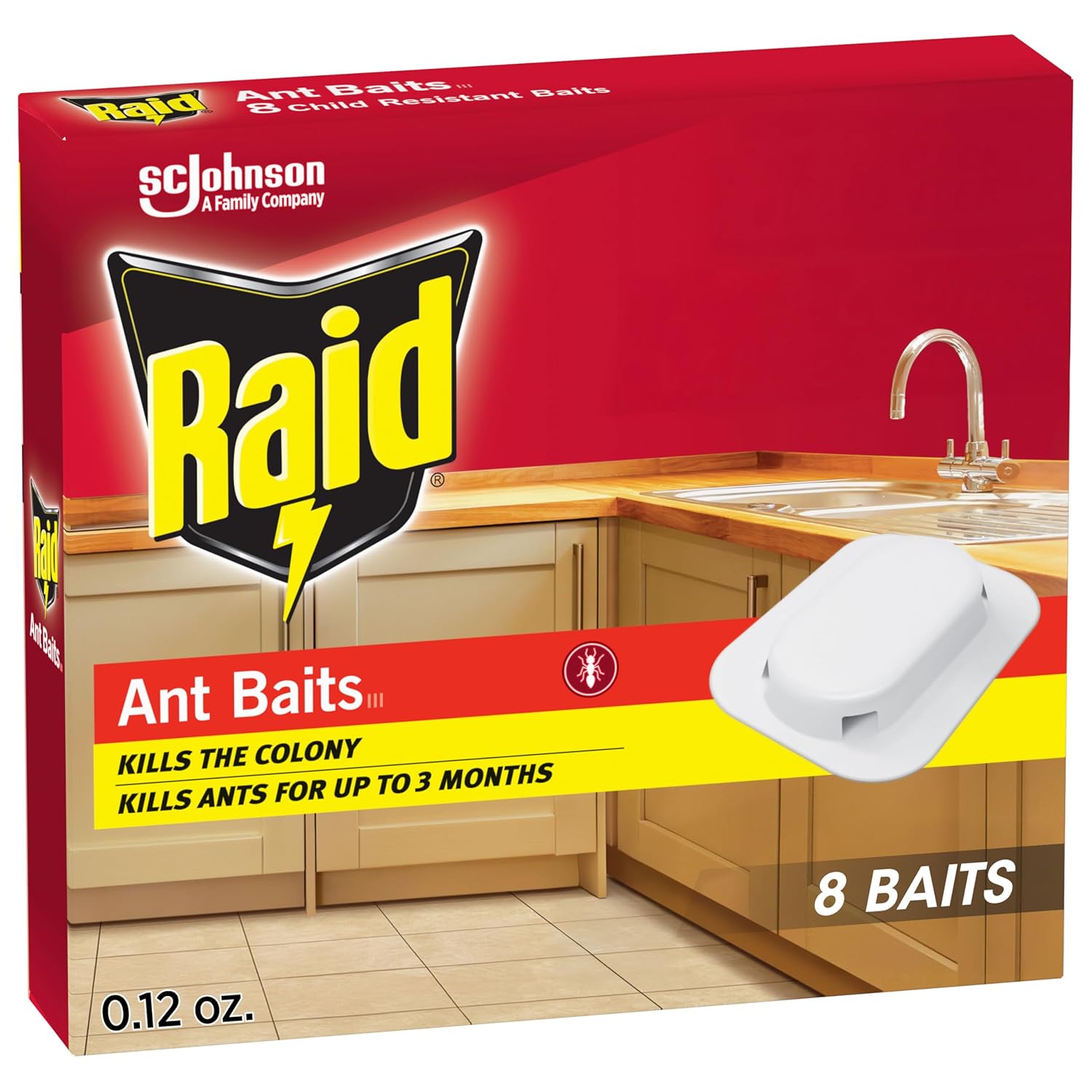
Raid Ant Killer Baits, 8 Count (Child-Resistant)
| Package quantity | 8 Count |
|---|---|
| Child safety | Child-resistant |
| Intended use | Indoor |
| Effect duration | Up to 3 months |
These Raid Ant Killer Baits are small, ready-to-use indoor stations that dispense an attractive liquid bait ants carry back to the colony, which can eliminate the nest over time. You place the bait along walls, in corners, and near entry points where small ants forage; after ants feed, the active ingredient is shared with other colony members, including the queen, and protection can last for weeks. The child-resistant design reduces accidental access in homes with children while the compact stations are low-profile and easy to position. Because they are prefilled and disposable, there is no mixing or measuring, which makes them convenient for quick treatment in kitchens, pantries, and baseboards. Limitations are that the product is for indoor use only and may be less effective if competing food sources are left available or if multiple heavy infestations require broader perimeter treatment. For someone looking for a simple, no-fuss bait to try first, these are a practical option.
Best for: Budget-minded homeowners or renters who want an easy, low-effort indoor solution to control small ant trails and try baiting before calling for broader treatments.
Less Ideal for: People needing immediate knockdown for very large or outdoor ant colonies or those who prefer non-chemical mechanical control methods.
- Ready-to-use prefilled bait stations that require no setup
- Child-resistant design reduces accidental access
- Bait formula is transferred through the colony to target the queen
- Compact, low-profile stations are easy to place along walls and entry points
- Intended for indoor use only, not suited for outdoor colony control
- May be less effective if other food sources are available or in very large infestations
Verdict: A low-cost, no-fuss indoor bait station that effectively targets small ant colonies by having foragers carry bait back to the nest.
Choosing the Right Liquid Ant Bait: Key Factors to Consider
Attractant Type and Ant Preferences
Different ant species prefer different food sources. Some common indoor ants are attracted to sugary liquids, while others forage for protein or greasy foods. Choosing a bait formulation that matches the target species increases the chance that workers will accept the bait and bring it back to the nest.
Misjudging the attractant type wastes time and product. If you are unsure which ants you have, observe what they are carrying or try multiple bait types in small amounts. Foraging schedules and seasonal food availability also influence acceptance, so placement and timing matter.
Bait Consistency and Stability
Liquid baits must remain palatable between feedings. A bait that evaporates, crystallizes, or thickens quickly will be ignored or become unusable. Formulations that resist rapid drying and bait containers that limit exposure to air extend effective feeding windows.
Stability matters particularly in warm, dry rooms or near vents. If a bait thickens, worker ants may not be able to ingest and transport it. Evaluate how long a specific bait stays liquid under normal indoor conditions before repurchasing or deploying widely.
Transferability and Delayed Toxicity
The goal of using a bait is colony-level control, not just killing foragers. Effective liquid baits are both palatable and slow-acting so that ants can carry the bait back and trophallactically share it with nestmates. Rapid-acting toxicants may kill foragers before they return, reducing colony impact.
Consider whether the active ingredient is known for horizontal transfer within the colony and how that aligns with infestation size. For large, established nests, strong transfer and delayed mortality are essential for reducing future re-infestation from surviving brood.
Delivery System and Placement
How the bait is presented determines both safety and uptake. Sealed or child-resistant bait stations reduce accidental exposure and keep the bait accessible to ants while deterring pets and children. Open trays or poorly designed dispensers increase spill risk and non-target access.
Place stations along ant trails, near entry points, and at the edges of kitchens or pantries where ants travel. Keep stations out of sunlight and away from vents. Consider the number of stations needed for multi-room infestations and how often you will need to refresh them.
Indoor Safety and Non-Target Risk
Indoor use requires attention to household members, pets, and food surfaces. Choose baits with clear labeling for indoor spaces and follow placement instructions to avoid contamination of food preparation areas. Some active ingredients present higher acute risks to pets and children, so product labeling, station design, and the number of bait points should reflect household vulnerability.
Use spill-containment measures when refilling and store unused bait securely. If you have curious pets or young children, prioritize bait designs that minimize exposure and consider using elevated stations or enclosed housings.
Monitoring and Follow-Up Requirements
Baiting is seldom a single-step fix. You need to monitor bait uptake, refill or replace consumed stations, and track activity patterns to determine when treatment is complete. Ant activity may decline for days or weeks as the colony declines, so persistence and observation are part of an effective plan.
Record where you placed stations and check them daily at first, then every few days. If bait acceptance is poor, relocate stations or switch attractant types. Long-term prevention includes sealing entry points and removing food sources to reduce re-infestation risk.
Identifying The Right Placement
Placement is as important as product selection. Set liquid bait stations directly on ant trails, along baseboards, and near likely entry points such as door thresholds and utility penetrations. For kitchen infestations, place stations near sinks, counters, and pantry edges rather than on food-preparation surfaces.
- Place stations in corners and along walls where ants prefer to travel
- Avoid direct sunlight, heat sources, and vents that dry out liquid baits
- Use multiple small stations spread across the infested area for larger trails
When To Use Liquid Bait Versus Other Methods
Liquid baits are best when you can observe worker trails and want to target the colony indirectly. They work well in kitchens, bathrooms, and indoor entryways. Avoid liquid baits in areas where frequent spills or cleaning will remove the bait quickly.
If ants are nesting in structural voids or deep within walls and foragers are scarce, combining baiting with mechanical exclusion or professional inspection may be necessary. Liquid baits should be part of an integrated approach that includes sanitation and entry-point sealing.
- Use baiting early in the infestation when foragers are active and trails are clear
- Switch attractant type or station if uptake is low after a few days
- Combine baiting with exclusion and sanitation for lasting control
Dealing With Different Ant Species Behaviors
Observe what ants are collecting and when they forage. Some species forage primarily at night and are drawn to sweet baits, while others prefer protein during certain seasons. Simple observations will help you choose a sweet or protein-based liquid bait.
If species identification is uncertain, start with sweet formulations because many common indoor ants favor carbohydrates. Rotate to protein-based baits if workers ignore sugars. Be patient; acceptance can change with food availability in the home.
- Monitor trail times to match bait placement with peak foraging
- Try several small bait placements to find what the colony prefers
- Avoid moving bait stations excessively once acceptance begins
Safety Best Practices For Homes With Pets And Children
Treat indoor spaces with caution. Use enclosed bait stations and place them out of reach of curious hands and paws. Read label directions for indoor placement and storage to minimize accidental exposure.
Consider temporary barriers or elevated stations in busy households. If ingestion by a pet or child is suspected, have product labeling and emergency contact guidance accessible. Proper placement and containment reduce risk while allowing baits to remain accessible to ants.
- Secure stations in corners or under appliances where pets cannot reach easily
- Keep unused bait locked away and clean up spills immediately
- Use stations with tamper-resistant features in family homes
Maintaining Bait Effectiveness Over Time
Check bait stations frequently and replace or refresh them when consumption is low or the liquid is evaporating. Environmental conditions like airflow and temperature affect how long a bait remains attractive.
Rotate products or reposition stations if uptake stalls. Long-term success often requires multiple cycles of bait placement and observation, followed by sealing entry points and removing attractants that drew ants indoors.
- Record dates and locations of each station to track progress
- Replace bait that has dried or been contaminated
- Follow up with exclusion work to prevent reinfestation
How We Chose the Best Liquid Ant Bait
We selected candidates that match real indoor ant-control needs by applying measurable, garden-and-home-focused filters. First, attraction tests: we preferred liquid baits with formulations known to entice common indoor species, including sweet- and protein-seeking workers. Second, palatability and transfer potential: we looked for baits formulated to remain attractive long enough for worker ants to feed, return to the nest, and share the material with nestmates. Third, persistence and residual effect: products that maintain a usable consistency without rapid drying or crystallizing score higher because they improve uptake. Fourth, container and delivery design: bait stations or stable reservoirs that reduce spills and limit non-target access were favored. Fifth, indoor safety features: think child- and pet-resistant design and clear application guidance. We excluded contact-only sprays, bulk concentrates requiring significant dilution, and products without clear indoor-use instructions. The listed evaluation criteria reflect what gardeners and homeowners need when choosing a liquid ant bait for indoor colony control.
FAQ
How long does it take for liquid ant bait to reduce visible ant activity?
It often takes several days to a few weeks for visible activity to decline. Foragers may take bait back to the nest and pass it to nestmates, so expect a lag between initial uptake and colony-level effects. Persistent monitoring and replenishing stations as needed speeds results.
Can I use liquid bait around pets and children?
You can use liquid bait indoors but choose enclosed stations and follow label safety guidance. Place stations where pets and children cannot access them, and clean up spills immediately. Some active ingredients are more hazardous, so read instructions carefully.
What if ants ignore the bait?
Try moving the station closer to active trails, change attractant types, or add additional stations to increase the chance of discovery. Environmental factors like competing food and temperature can reduce uptake, so eliminate other food sources and try again.
How long should I leave bait stations in place?
Leave stations until no feeding activity is observed for several days, then remove them. Depending on the infestation size, this can take from a few days to multiple weeks. Continue to monitor for reappearance after removal.
Will liquid bait prevent ants from returning long term?
Baiting reduces the immediate colony and can prevent near-term re-infestation if the nest is eliminated. Long-term prevention depends on addressing entry points, sanitation, and external nesting sites. Baiting is one part of an ongoing prevention plan.
Final Verdict
Choose a liquid ant bait that matches the species-specific food preferences you observe, presented in a stable, pet- and child-safe delivery. Prioritize attractant type, bait persistence, and transferability when deciding which product to use. Expect to monitor and refresh stations over days or weeks, and pair baiting with exclusion and sanitation for lasting control. With the right bait and placement strategy you can reduce colony pressure and regain control of indoor spaces.
