

Note: This article contains affiliate links. If you click on these links and make a purchase, I may earn a small commission at no extra cost to you. This helps support my research and content. Read my full affiliate disclosure here.
When crabgrass appears it can quickly take over bare spots and thin turf, so choosing the right liquid treatment matters for lawn health. You want a product that stops grassy weeds without damaging desirable grass, applies cleanly from a sprayer, and fits into your seasonal lawn care routine. This guide covers six top short-listed liquid crabgrass killers that perform well in home lawns and explains the practical tradeoffs that matter in the yard. We evaluate each option for speed of control, turf safety, application ease, and environmental handling. Below you will find our top picks, followed by the buying factors gardeners should weigh before treating their lawn.
Top Picks at a Glance
| Best Overall The best all-around choice for most situations | BioAdvanced All‑In‑One Lawn Weed and Crabgrass Killer, Concentrate, 40 oz |  |
| Best Quality Built to a higher standard if you want something more solid | BASF Drive XLR8 Crabgrass Killer Concentrate, 64 oz |  |
| Best Value The sweet spot between price and what you get | Spectracide Weed Stop for Lawns Plus Crabgrass Killer, Ready-to-Use, 1 Gal |  |
| Best Budget The cheapest option that still gets the job done reliably | Spectracide Weed Stop for Lawns Concentrate, 32 oz Ready-to-Spray |  |
| Highest Rated A top-rated pick with lots of positive feedback | Quali pro Quinclorac 1.5L Liquid Herbicide (32 oz) |  |
| Most Popular A crowd favorite that many people choose with confidence | Ortho WeedClear Lawn Weed Killer Ready-to-Spray, 32 fl. oz. |  |
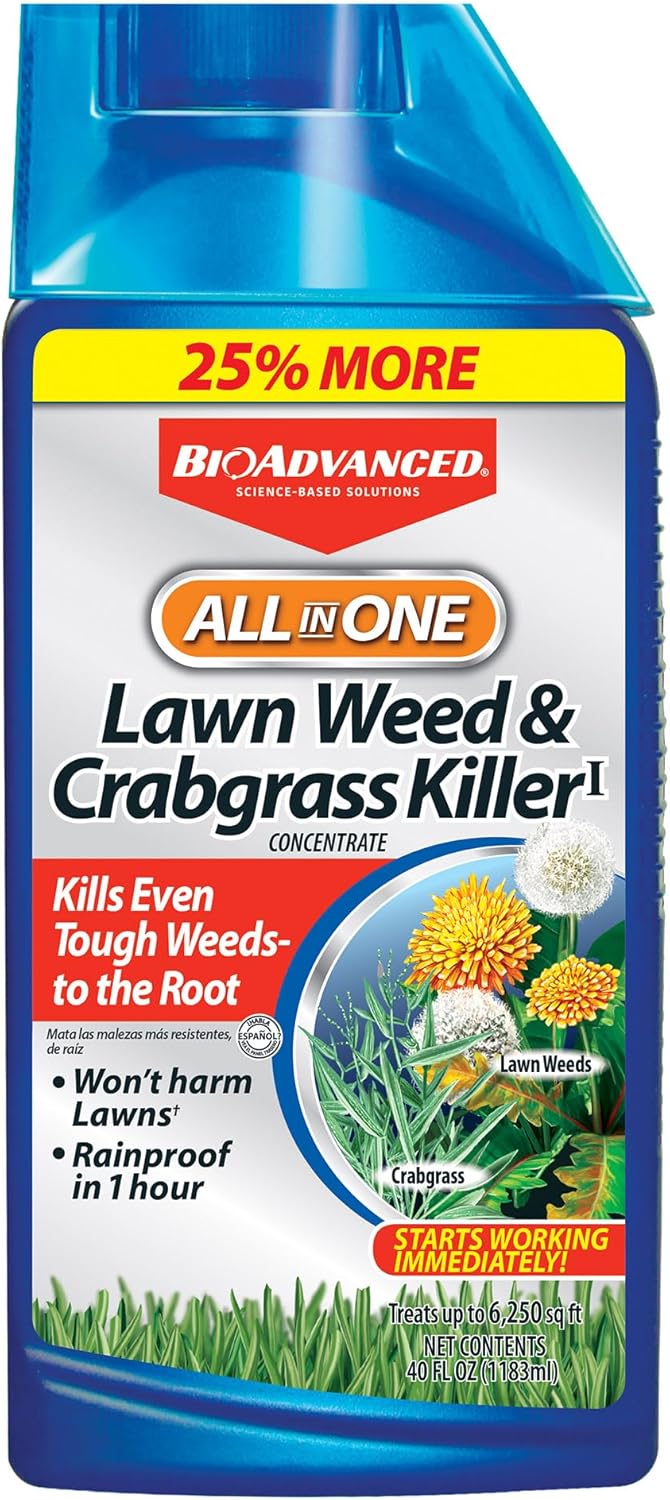
BioAdvanced All‑In‑One Lawn Weed and Crabgrass Killer, Concentrate, 40 oz
| Unit Count | 40 Fluid Ounces |
|---|---|
| Item Form | Spray |
| Coverage | 6250 square_feet |
| Active Ingredients | Herbicide (Quinclorac, 2,4-D, Dicamba salts listed in description) |
This BioAdvanced concentrate is a one‑step lawn herbicide meant to control a wide range of broadleaf weeds and crabgrass by spraying a hose‑connected applicator across the lawn. It is designed to penetrate and kill weeds down to the root and the label lists more than 200 targeted species, making it suitable for persistent problems such as spurge when applied as directed. The product is rainproof in about an hour, which reduces the risk of wash‑off after treatment, and the concentrate format lets you mix only what you need for the area you treat. Practical benefits include coverage for roughly 6,250 square feet from the 40 oz bottle at recommended rates and compatibility with many common turf types when used per label instructions. Important limitations: it should not be used on certain grasses like St. Augustine or centipede, and timing matters because weeds should be small and actively growing for best control. As with all herbicides, careful handling, exact mixing rates, and following safety directions are required.
Best for: Homeowners looking for a cost‑effective, broad‑spectrum weed control that treats whole‑lawn infestations and reduces repeat spot treatments.
Less Ideal for: People who need a spot treatment for a few isolated spurge plants or who maintain lawns with sensitive grass varieties listed on the label.
- Targets over 200 listed broadleaf weeds including common lawn spurge
- Concentrate formula allows mixing to treat large areas economically
- Rainproof in one hour, reducing loss from unexpected showers
- Penetrates to the root for longer lasting control
- Not safe for use on several turf types such as St. Augustine and centipedegrass
- Requires precise mixing and hose‑end application which may be fiddly for small patches
Verdict: A budget‑friendly concentrated herbicide that provides economical, wide‑area control of spurge and many other lawn weeds when used according to label directions.
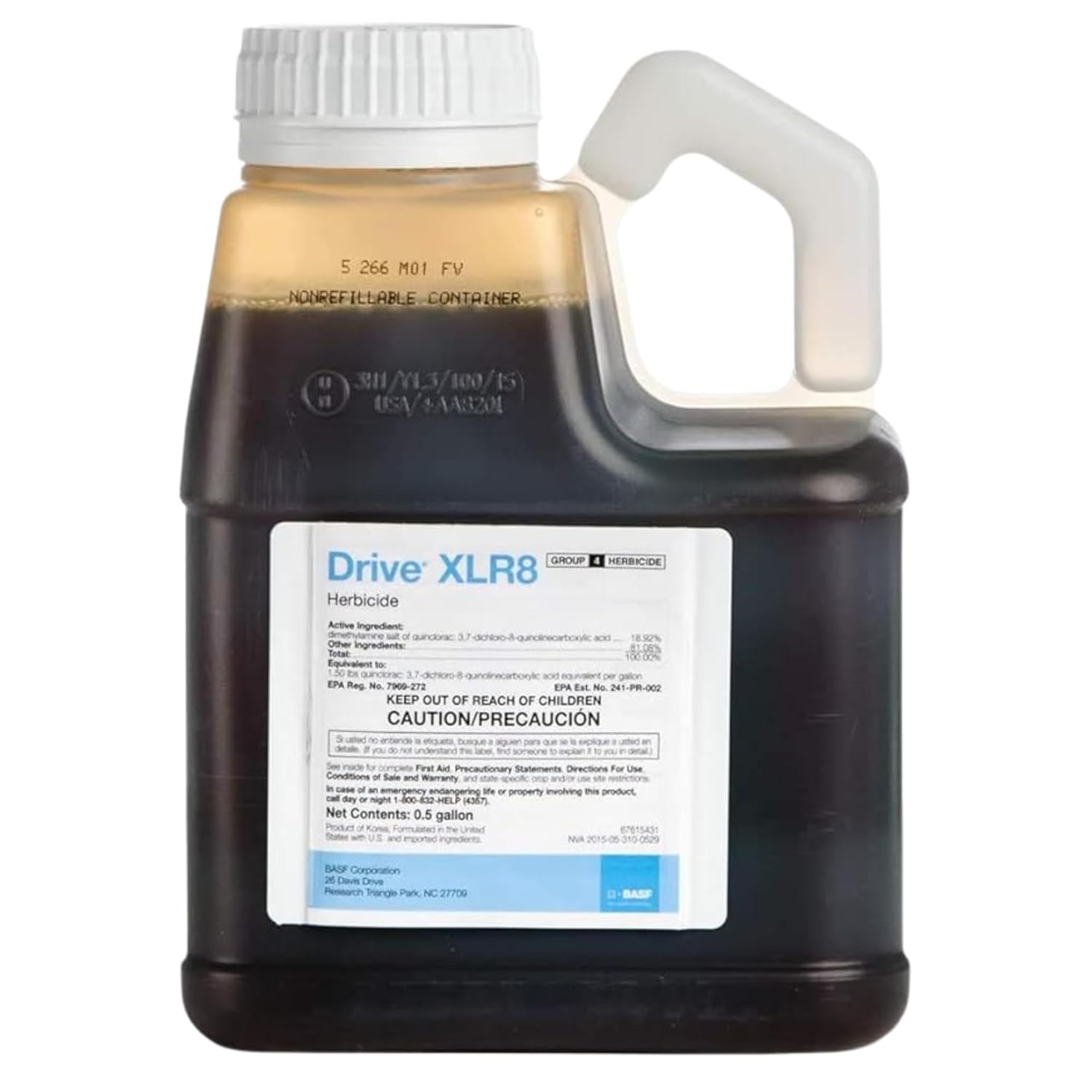
BASF Drive XLR8 Crabgrass Killer Concentrate, 64 oz
| Unit Count | 64 Ounce |
|---|---|
| Item Form | Liquid |
| Active Ingredients | Quinclorac 18.92% |
| Coverage | Full |
Drive XLR8 is a concentrated liquid herbicide built mainly to knock down crabgrass and other grassy and broadleaf weeds in turf. You mix a small measured amount with water and a methylated seed oil adjuvant and spray over the turf for spot or broadcast treatment. Its water-based formulation and quinclorac active ingredient deliver relatively fast uptake and labeled rainfast protection within about an hour, and the product advertises up to 30 days of residual control, which reduces how often you need to reapply. It is labeled for both warm- and cool-season turf and can be tank-mixed with other turf herbicides when label directions allow, giving flexibility for complicated weed problems. Important limitations are that it is a chemical herbicide that requires careful PPE and strict adherence to label directions, and some local restrictions apply, including reduced use patterns in certain states and spot-application limits. For gardeners who follow the label, it offers reliable, professional-strength control of crabgrass and many common lawn weeds.
Best for: Homeowners and groundskeepers who want a strong, professional-style postemergent solution to quickly reduce crabgrass and mixed weed populations and who are comfortable following label safety and application steps.
Less Ideal for: People seeking an organic or nonchemical approach to crabgrass control or users who prefer no-handling of concentrated herbicides should consider alternative cultural or nonchemical options.
- Concentrated 64 oz formula covers large areas when mixed per label directions
- Water-based formulation for faster plant uptake and rainfast protection in under an hour
- Provides up to 30 days of residual control against crabgrass and several grassy weeds
- Labeled for use on both warm-season and cool-season turf and compatible with some tank mixes
- Requires careful handling and PPE because it is a chemical herbicide
- Some state-specific use restrictions and label limitations apply
Verdict: Choose Drive XLR8 when you want a concentrated, fast-acting postemergent herbicide that delivers reliable crabgrass control and multi-week residual protection.
Spectracide Weed Stop for Lawns Plus Crabgrass Killer, Ready-to-Use, 1 Gal

| Item Form | Spray |
|---|---|
| Coverage | Up to 5,000 sq ft |
| Liquid Volume | 1 gallons |
Spectracide Weed Stop for Lawns Plus Crabgrass Killer is a one-gallon, ready-to-use spray formulated to kill a wide range of lawn weeds by contact down to the root. You use it by spraying affected areas after mowing and when daytime temperatures are between 45 and 90 degrees F; the label warns about possible temporary discoloration on Bermudagrass at higher temperatures. Notable features include a no-mix formulation, advertised coverage up to 5,000 square feet, and a contact-action formula that produces visible wilting in about five hours. For clover in lawns this product is effective because it is designed to kill broadleaf weeds without harming turf when applied as directed. Important limitations are that it kills on contact, so complete coverage of foliage is necessary, and timing and temperature restrictions must be followed to avoid lawn stress on certain grass types. Also, as a spray it treats only visible weeds and does not provide residual preemergent control.
Best for: Buyers who want a simple, ready-to-use spray to remove visible clover and other broadleaf weeds quickly without mixing chemicals, and who prefer following label directions to protect their lawn.
Less Ideal for: People seeking long-term prevention of new weed growth or a solution for large commercial turf areas where broadcast application and residual control are needed should consider alternative products.
- Ready-to-use spray requires no mixing and is easy to apply to spot infestations
- Claims visible results in about five hours, so you can confirm effectiveness quickly
- Broad spectrum label lists 470+ weed types including clover and crabgrass
- Advertised coverage up to 5,000 sq ft from the one-gallon container
- Kills by contact so it requires thorough leaf coverage to be effective
- Temperature restrictions and potential temporary yellowing on Bermudagrass limit when it can be used safely
- No residual or preemergent activity so it will not prevent new weed germination
Verdict: A user-friendly, ready-to-use spray that quickly kills clover and other listed broadleaf weeds when applied carefully and at the right temperatures.
Spectracide Weed Stop for Lawns Concentrate, 32 oz Ready-to-Spray

| Coverage | 8,000 square feet |
|---|---|
| Liquid Volume | 32 fluid ounces |
| Item Form | Liquid |
| Active Ingredients | 2,4-D, Mecoprop-P, Dicamba, Sulfentrazone |
Spectracide Weed Stop for Lawns is a hose-attach ready-to-spray concentrate designed to control broadleaf weeds across common turf types. It kills by contact and down to the root, listing over 460 weeds such as clover, dandelion and chickweed, and promises visible browning in around three hours. The QuickFlip sprayer makes treatment fast for larger yards and the formula is labeled for use on bluegrass, fescue, Bermuda and perennial rye, though you should avoid zoysiagrass coming out of dormancy and not spray above 90°F. Practical benefits include quick application without mixing and one-hour rainproofing so treatments are less weather-dependent. Important limitations are temperature restrictions for safe use, the need to keep people and pets off the lawn until dry, and the usual reseeding wait time of three to four weeks. For homeowners focused on routine clover control, this product offers a straightforward, time-saving option, but follow label directions closely to protect desirable turf and nearby plants.
Best for: Homeowners who want an inexpensive, no-mix solution to knock back clover and other broadleaf weeds quickly across a typical lawn and value fast application.
Less Ideal for: Gardens that need constant reseeding, very young lawns or yards with delicate ornamentals close to treatment areas should consider more targeted options.
- Ready-to-spray QuickFlip hose attachment speeds up application for medium to large lawns
- Kills broadleaf weeds including clover, dandelion and chickweed with visible results in about three hours
- Rainproof in one hour which reduces the chance of losing treatment to light rain
- Works on a variety of common turf types when used as directed
- Should not be applied when daytime temperatures exceed 90°F which limits use in hot weather
- Requires waiting 3–4 weeks before reseeding treated areas
Verdict: A convenient ready-to-spray concentrate that quickly controls clover and other broadleaf weeds for budget-minded homeowners who want fast, low-effort treatments.
Quali pro Quinclorac 1.5L Liquid Herbicide (32 oz)

| Liquid Volume | 1.5 liters |
|---|---|
| Item Form | Liquid |
| Coverage | Crabgrass and broadleaf weeds |
| Active ingredient concentration | 17.79% Quinclorac |
Quali pro Quinclorac 1.5L is a professional-strength liquid herbicide designed to target crabgrass and many common grassy and broadleaf weeds in turfgrass. It is mixed and applied to lawns, athletic fields, golf courses, and commercial turf where persistent grassy weeds are a problem. The liquid formulation contains 17.79% quinclorac and is engineered for easy mixing with minimal agitation, including in cold water, which simplifies preparation on site. It offers quick plant uptake and becomes rainfast in under an hour, so treated areas are less likely to lose activity to unexpected rain. Practical benefits include broad-spectrum control that covers crabgrass, foxtail, kikuyugrass, bindweed, clover, and dandelion, plus suitability for both residential and large-scale turf managers. Limitations to note are that it is a targeted turf herbicide so it should be used according to turf type and label directions to avoid damage to desirable plants, and handling precautions are required since it is a concentrated professional product.
Best for: Buyers who prioritize consistent, dependable crabgrass control for lawns or large turf areas and want a product that performs quickly and predictably across applications.
Less Ideal for: Casual gardeners seeking an all-purpose household weed spray or those uncomfortable handling concentrated herbicides should consider simpler, ready-to-use alternatives.
- Professional-strength active ingredient (17.79% quinclorac) for effective crabgrass control
- Liquid formulation mixes readily with minimal agitation, including in cold water
- Fast plant uptake with rainfast protection in under one hour
- Broad-spectrum activity against both grassy weeds and many common broadleaf weeds
- Concentrated professional product that requires careful handling and adherence to label directions
- Not a general-purpose garden herbicide and must be applied only where labeled to avoid turf or plant injury
Verdict: Choose this product when you need a fast, professional-strength liquid solution that reliably controls crabgrass and other tough turf weeds.
Ortho WeedClear Lawn Weed Killer Ready-to-Spray, 32 fl. oz.

| Coverage | 5000 square_feet |
|---|---|
| Item Form | Spray |
| Liquid Volume | 32 fluid ounces |
| Active Ingredients | 2,4-D; Quinclorac; Dicamba |
Ortho WeedClear Ready-to-Spray is a hose-attached weed killer made for treating common lawn weeds without mixing concentrates. Attach the sprayer to a garden hose, switch it on, and spray evenly until the lawn surface is wet; the formula is rainproof in about an hour and claims visible results within hours. It lists active ingredients including 2,4-D, quinclorac, and dicamba, which target broadleaf species such as dandelion, clover, chickweed and creeping charlie as well as some grassy weeds like crabgrass. The product covers up to 5,000 sq. ft. from a 32 fl. oz. bottle, so one container treats a typical medium lawn in a single pass. Practical benefits are ease of use, fast action, and compatibility with many northern lawn grasses when used as directed. Important limits are that it is not labeled for several turf types (for example St. Augustine and centipedegrass) and there are temperature restrictions for safe bermudagrass use; following safety directions to keep people and pets off treated areas until dry is necessary. For persistent infestations multiple applications or a targeted spot treatment may still be needed.
Best for: Homeowners who want a simple, ready-to-use spray to quickly knock back creeping charlie and other broadleaf weeds across a typical lawn and prefer an easy hose-end application.
Less Ideal for: People with warm-season lawns not listed on the label, organic-only gardeners, or those wanting a long-term preemergent solution should consider other approaches.
- Ready-to-use hose-end applicator for quick, no-mixing treatment
- Fast-acting formula that becomes rainproof within about one hour
- Targets common broadleaf weeds including creeping charlie and crabgrass
- Covers up to 5,000 sq. ft. from a single 32 fl. oz. bottle
- Works on many northern lawn grasses when directions are followed
- Not safe for several turf types and restricted on some grasses like St. Augustine and centipedegrass
- Contains synthetic herbicides requiring careful handling and keeping people and pets off until dry
- May require repeat or spot treatments for heavy or mature infestations
Verdict: If you need a fast, no-mix hose-end spray to reduce creeping charlie and common broadleaf weeds across a medium lawn, this product delivers quick, easy coverage.
Choosing the Right Liquid Crabgrass Killer: Key Factors to Consider
Speed of Control and Residual Activity
How quickly a liquid crabgrass killer shows visible decline in crabgrass affects when you can expect results and whether repeat treatments are needed. Fast-acting chemistries can brown and collapse shoots within days, reducing competition for the lawn, while slower products may take longer to suppress seedheads and lower the need for retreatment.
Residual activity determines whether the product keeps acting on new flushes after the initial application. High residual may reduce follow-up work during an active growing window but can increase runoff risk and extend the time before you can reseed treated areas.
Turf Grass Compatibility and Phytotoxicity Risk
Different lawn species vary in tolerance to herbicides. A liquid product that is safe on tall fescue may be risky on bentgrass or newly seeded lawns. Always check label-listed compatible grasses and recommended mowing intervals to limit scorch or thinning.
Phytotoxicity risk also increases with high temperatures, drought stress, or when applied to recently fertilized turf. Understanding those interactions helps you pick timing and rates that control crabgrass while protecting desirable grass.
Application Method and Ease of Use
Liquids are commonly applied with pump sprayers, hose-end sprayers, or professional handheld gear. Products that mix cleanly, leave minimal foaming, and have forgiving spray patterns reduce user error and give more uniform coverage across dense stands of crabgrass.
Clear label instructions for nozzle type, pressure, and droplet size matter for uniform results. Ease of measuring and pouring, plus any required tank-mix order, also affects how likely you are to apply the product correctly.
Mixing Compatibility and Tank Stability
Home gardeners often tank-mix a crabgrass killer with a surfactant or other lawn care product. Not all formulations are compatible. Stable emulsions that do not separate in the tank reduce the risk of uneven application and nozzle clogging.
Labels that list compatible adjuvants and provide clear mixing sequences reduce the chance of phytotoxicity and help ensure the active ingredient remains effective through the spray window.
Environmental and Water Management Considerations
Liquid herbicides move with water, so runoff, irrigation timing, and slope all influence off-target movement. Choosing a product with lower mobility or following label guidance on rainfall-free intervals reduces contamination risk to nearby plants and water bodies.
Consider buffer distances, recommended waiting times after rain, and whether the product requires special disposal of leftover mixed spray. These steps protect gardens, pollinators, and local waterways.
Timing in the Lawn Calendar
Crabgrass control effectiveness depends heavily on application timing relative to weed growth stage. Post-emergent liquid treatments work best when crabgrass is young but actively growing; they are less effective on mature, seed-producing plants.
Align applications with lawn growth, soil temperatures, and local flushes of seedling emergence to maximize control while avoiding repeated unnecessary applications.
When to Use A Liquid Post-Emergent Treatment
Use a liquid post-emergent when crabgrass is actively growing and individual plants are visible but not yet producing seeds. Early summer and late spring flushes are common times to treat, depending on your region.
If the lawn shows widespread, dense crabgrass or plants are mature and seeding, a liquid alone may not deliver complete control and cultural fixes such as aeration or overseeding should be part of the plan.
- Treat young, succulent crabgrass for best results.
- Avoid treating during heat waves or drought-stressed conditions.
- Follow label rain-free interval to prevent wash-off.
Preparing Your Lawn and Sprayer
Mow at the recommended height before application to reduce turf stress and improve spray contact with crabgrass. Remove excessive clippings so the spray reaches the soil and weed crowns.
Check your sprayer for leaks, clean nozzles, and calibrate output if treating larger areas. Use recommended nozzle types and maintain steady walking speed for even coverage.
- Calibrate sprayer to apply the labeled rate per 1,000 square feet.
- Use protective gear recommended on the label when mixing and spraying.
- Avoid drift by spraying at low wind speeds and using coarse droplets.
Managing Treated Areas After Application
Do not irrigate right after application unless the label allows it. Many liquid herbicides require a rain-free period to be absorbed by the plant. If rain is forecast, postpone treatment to avoid ineffective applications.
Wait the recommended interval before mowing, overseeding, or allowing pets on the treated area. This preserves the product's activity and reduces turf injury risk.
- Observe treated crabgrass for signs of browning over the first 7 to 21 days.
- Plan follow-up spot treatments rather than blanket reapplications where possible.
- Use cultural practices such as fertilizing and overseeding to fill gaps after weeds decline.
Tank-Mixing and Adjuvant Guidance
Only add adjuvants that are listed as compatible on the product label. Some surfactants improve uptake on grassy weeds, while others can increase turf injury risk if used incorrectly.
When attempting a tank-mix with other lawn products, do a small jar test to check for separation. Follow recommended order of addition and agitation instructions to maintain a stable spray mix.
- Start with clean water, add any water-soluble products first, then the herbicide, then surfactants if directed.
- Rinse sprayer thoroughly between different chemistries to avoid cross-contamination.
Integrated Lawn Management After Herbicide Use
Herbicide use is one part of long-term crabgrass management. Address underlying issues such as thin turf, soil compaction, and improper mowing height to reduce future outbreaks.
Plan seasonal tasks like aeration, overseeding with a suitable grass species, and balanced fertility to build a thicker, more competitive lawn that suppresses crabgrass naturally.
- Seed high-quality grass adapted to your region for dense cover.
- Improve soil health with organic matter and correct pH where needed.
- Adjust irrigation to encourage deep rooting rather than shallow growth.
How We Chose the Best Liquid Crabgrass Killer
We shortlisted products that are formulated specifically for post-emergent crabgrass control and that have labels indicating use on common lawn grasses. Selection prioritized demonstrable activity against grassy weeds, predictable turf safety when used as directed, and clear application instructions suitable for homeowners. Key evaluation criteria included speed of visible control and duration of activity, labeled turf grass compatibility and risk of phytotoxicity, ease of mixing and applying with common sprayer setups, and environmental handling such as runoff potential and re-entry intervals. We also considered label clarity and available application rates for different grass heights. We excluded products intended only for pre-emergent control, granular-only formulations, or those labeled strictly for agricultural use. We did not include broad herbicide blends whose primary claim is broadleaf control rather than targeted grassy-weed action. The resulting list focuses on liquid formulations that gardeners can reasonably apply in home lawn settings while managing turf safety and environmental exposure.
FAQ
Can I apply a liquid crabgrass killer to a newly seeded lawn?
It depends on the product and the label. Many liquid post-emergent herbicides advise against use on new seedings until the new grass has reached a certain maturity. Check label restrictions and wait the recommended establishment period to avoid damaging seedlings.
How soon will I see results after applying a liquid treatment?
Visible decline often appears within a few days to three weeks depending on the active ingredient, weather, and weed size. Younger plants respond faster while mature crabgrass can take longer to collapse.
Is it safe to water my lawn after treatment?
You should follow the product label. Many formulations require a rain-free window of several hours to a day to ensure uptake. Irrigating too soon can reduce effectiveness by washing the herbicide off the foliage.
Can I mix a liquid crabgrass killer with fertilizer or other lawn products?
Mixing is sometimes possible but only when the label explicitly allows it. Incompatible mixes can reduce efficacy or increase turf injury. When in doubt, perform a small compatibility test and follow the label's mixing order.
Will a liquid crabgrass killer harm nearby flower beds or vegetables?
Spray drift and runoff pose the main risks to adjacent plantings. Use coarse droplets, avoid spraying on windy days, and maintain buffer distances recommended on the label to protect sensitive plants.
How often should I reapply if crabgrass returns?
Reapplication frequency depends on the product label and the severity of the infestation. Spot treating new flushes is usually preferable to repeated blanket applications. Make sure to observe required intervals between treatments.
Final Verdict
Choosing the right liquid crabgrass killer is about matching product characteristics to your lawn conditions and timing. Prioritize formulations that show reliable activity on young crabgrass, list your turf species as compatible, and come with clear mixing and application instructions. Balance the desire for fast control against the need to protect desirable grass and nearby plants. When used at the correct time and rate, liquid post-emergent treatments can be an effective part of a broader lawn management plan that emphasizes cultural improvements to reduce future weed pressure.
