

Note: This article contains affiliate links. If you click on these links and make a purchase, I may earn a small commission at no extra cost to you. This helps support my research and content. Read my full affiliate disclosure here.
If you grow vegetables, flowers, or maintain a small to mid-size yard, the right tiller cultivator saves hours of backbreaking work and helps build better planting beds. A well-chosen machine breaks up compacted soil, incorporates compost or amendments, and keeps weed pressure down so your seedlings get established quickly. This guide covers seven shortlisted tiller cultivators that suit a range of garden sizes and ground conditions. We evaluate machines on the real tasks you face in the garden: digging depth and power, handling and maneuverability, build durability, and maintenance needs. Read on to see how each machine stacks up and which features matter most for the way you garden.
Top Picks at a Glance
| Best Overall The best all-around choice for most situations | Sun Joe Corded Electric Garden Tiller & Cultivator TJ604E |  |
| Best Quality Built to a higher standard if you want something more solid | Mantis 7940 4-Cycle Tiller/Cultivator with Honda Engine |  |
| Best Value The sweet spot between price and what you get | SOARFLY Cordless Tiller Cultivator with 2×4.0Ah Batteries |  |
| Best Budget The cheapest option that still gets the job done reliably | Jardineer Manual Twist Hand Tiller with Foot Plate |  |
| Highest Rated A top-rated pick with lots of positive feedback | Sun Joe TJ603E 16-Inch Corded Electric Garden Tiller & Cultivator |  |
| Most Popular A crowd favorite that many people choose with confidence | BILT HARD 14-inch Corded Electric Tiller Cultivator, 10 Amp |  |
| Best Seller A high-volume bestseller chosen again and again | HEINPRO Cordless Garden Tiller Cultivator (Compatible with DEWALT 20V MAX) |  |
Sun Joe Corded Electric Garden Tiller & Cultivator TJ604E

| Power Source | Corded Electric |
|---|---|
| Motor | 13.5-Amp |
| Tilling Width | Up to 16 inches |
| Tilling Depth | Up to 8 inches |
The Sun Joe TJ604E is a compact corded electric tiller built to prepare small garden plots and flower beds without the fuss of gas maintenance. It runs on a 13.5-amp motor that tills a 16-inch-wide swath up to 8 inches deep, using six angled alloy steel tines that resist rust and handle light to medium soil. The folding handle and three-position wheel adjustment make it easy to store and to control working depth across different soil types. As an electric machine it delivers quieter, cleaner operation and continuous power as long as you have an outlet nearby, which simplifies upkeep compared with small gas tillers. Limitations include dependence on a cord for power, which restricts range and requires care to avoid tangling, and it is best suited for softened or loamy soils rather than heavy clay or rocky ground where a more powerful gas model would perform better.
Best for: Gardeners who want a low-maintenance, easy-to-use cultivator for preparing and refreshing small vegetable beds, flower borders, or starter plots and who prioritize simplicity and reliable electric power.
Less Ideal for: Large-acreage gardeners or those who regularly work compacted clay or rocky ground should consider a heavier gas-powered tiller or professional equipment instead.
- 13.5-amp motor provides steady power for small to medium garden beds
- Six angled alloy steel tines designed to resist rust and cultivate effectively
- Folding handle and compact footprint for easy storage and transport
- Three-position wheel adjustment for better control of tilling depth
- Corded electric design means quieter operation and low maintenance
- Corded power limits working range and requires attention to avoid the cord
- Not intended for very heavy clay, large roots, or rocky conditions
Verdict: If you need a simple, low-maintenance electric tiller to quickly prepare and maintain small gardens, the Sun Joe TJ604E delivers reliable power and easy storage.
Mantis 7940 4-Cycle Tiller/Cultivator with Honda Engine
| Power Source | gas-powered |
|---|---|
| Material Type | Metal |
| Manufacturer Warranty Description | 2-year limited |
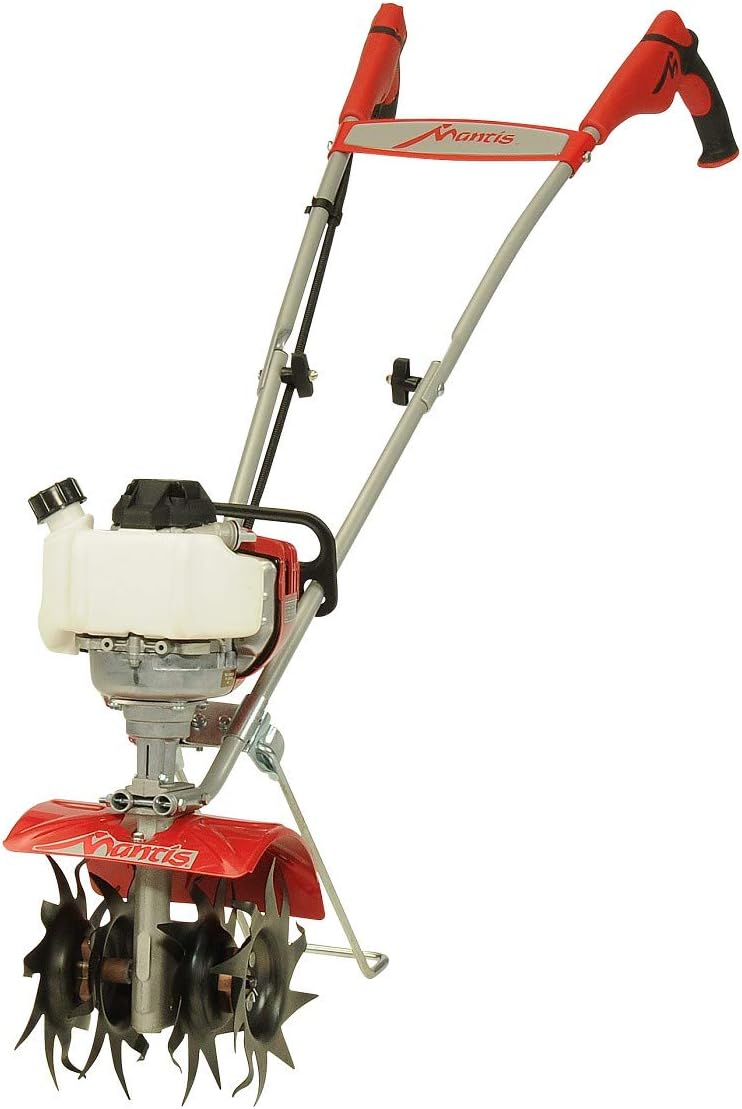
The Mantis 7940 is a compact, performance-focused mini tiller that uses a Honda 4-cycle engine to deliver strong tilling power without the need for fuel mixing. It is typically used to break sod, loosen compacted soil, and prepare planting beds where a full-size tiller would be overkill. Notable features include a high-tine speed (up to 240 rpm), finger-controlled throttle for infinite speed adjustment, ergonomic sure-grip handles, folding handlebars for storage, and a standard kickstand for easy staging. In practice the machine is easy to start and maneuver thanks to its light 24-pound build, yet the transmission and tine design let it dig deeply—claims note up to 10 inches—so you can tackle tougher ground and precision-weed around plants by flipping the tines. The main trade-offs are that it is a small, single-purpose tool: it is ideal for garden beds and rows but not intended to replace larger tillers for very large acreage or heavy-duty landscaping, and being gas-powered it requires routine engine maintenance and hearing/eye protection during use.
Best for: Gardeners who prioritize tilling performance in small to medium beds and want a compact, easy-to-handle machine that still delivers strong digging power for sod and compacted soil.
Less Ideal for: Landscapers or homeowners who need to cultivate large acreages or who prefer zero-emission electric tools for frequent, heavy-duty work.
- Honda 4-cycle engine provides reliable, no-mix gas power and strong tine speed.
- Lightweight 24 lb design makes it easy to carry, maneuver, and store.
- Finger-controlled throttle offers infinite speed control for delicate or aggressive work.
- Folding handlebars and a kickstand improve storage and on-site handling.
- Small, single-tine design is not suited for very large areas or heavy landscaping jobs.
- As a gas engine tool it requires regular maintenance and produces noise and emissions.
Verdict: If you want a lightweight mini tiller that punches above its size for serious bed preparation, the Mantis 7940 delivers reliable Honda-powered performance in a compact package.
SOARFLY Cordless Tiller Cultivator with 2×4.0Ah Batteries

| Unit Count | 2 Count |
|---|---|
| Material Type | Alloy Steel, Plastic |
| Power Source | Battery Powered |
| Operation Mode | Electric |
This SOARFLY cordless tiller is built for small gardens, raised beds, and flower plots where maneuverability and ease matter more than industrial power. It runs on two included 4.0Ah lithium batteries and drives 48 steel tines at a stated 360 RPM to loosen soil, remove weeds, and aerate moderately compacted ground. Adjustable handle height and an auxiliary grip make it simple to steer in tight rows and reduce operator fatigue during longer sessions. Because it is cordless and relatively lightweight, it is easy to carry between beds and safe to use where extension cords would be impractical. The machine performs best in normal garden soil and slightly moist clay when started shallow and increased gradually; very hard, rock-filled, or deeply compacted ground will slow progress and may require multiple passes or a heavier gas unit. Safety features include a two-step start with a safety lock to prevent accidental engagement. For gardeners who want a fuss-free, portable cultivator for prepping planting areas and spot weeding, this model is a practical, user-friendly option.
Best for: Home gardeners with small plots, raised beds, or tight planting rows who prioritize a lightweight, cordless tool that is easy to maneuver and reduces physical strain.
Less Ideal for: Large acreage owners or users who need to break up deep, heavily compacted or rock-strewn soil should consider a heavier gas-powered tiller instead.
- Comes with two 4.0Ah batteries for extended runtime and quick battery swaps
- 48 steel tines provide effective soil loosening for small beds and raised planters
- Adjustable height and auxiliary handle improve comfort and control during use
- Cordless design makes it highly portable and usable where power outlets are unavailable
- Not powerful enough for very hard, rocky, or deeply compacted soil compared with gas tillers
- 360 RPM and lightweight build mean slower progress on large areas
Verdict: A portable, easy-to-use cordless cultivator ideal for prepping and maintaining small gardens and raised beds with minimal hassle.
Jardineer Manual Twist Hand Tiller with Foot Plate

| Power Source | Manual |
|---|---|
| Material Type | Iron, Metal |
| Operation Mode | Manual |
| Unit Count | 1 Count |
This Jardineer manual twist tiller is a heavy-duty hand cultivator that uses a foot plate and twisting action to penetrate and loosen compacted soil. You plant the tines into the ground with a stomp on the anti-slip foot plate, then twist the long curved handle to break up soil, aerate beds, remove weeds, and mix in amendments like peat or fertilizer. The powder-coated steel tines are sharp for aggressive penetration, so it works well on firm or clay soils if the ground is slightly moistened first. Its long handle and curved grip reduce bending and twisting, making it easier on the back for repeated use in raised beds and flower boxes. The tool ships disassembled and requires basic assembly with included wrenches. Expect solid durability from the iron construction, but the manual design means it takes physical effort on large areas and is not a replacement for powered tillers where deep or wide tilling is needed.
Best for: Gardeners who want a durable, low-maintenance hand tool to efficiently loosen and aerate small beds, raised planters, or clay soil patches while minimizing bending and strain.
Less Ideal for: People who need to till large lawns or full garden plots frequently should choose a powered tiller instead; this tool is best for targeted small-area work.
- Anti-slip foot plate concentrates downward force for easier tine penetration into compacted soil
- Razor-sharp steel tines suitable for aeration, mixing amendments, and breaking up firm or clay soils
- Long curved handle reduces bending and twisting, easing use for gardeners with back or joint sensitivity
- Powder-coated steel construction provides durability and corrosion resistance for outdoor use
- Manual operation requires significant physical effort on larger areas or very hard ground
- Less effective in extremely rocky soil without pre-watering or clearing
Verdict: A sturdy manual twist tiller that gives you aggressive soil penetration and mixing power for small clay patches and raised beds without the fuss of a power tool.
Sun Joe TJ603E 16-Inch Corded Electric Garden Tiller & Cultivator

| Power Source | Corded Electric |
|---|---|
| Motor | 12 Amp |
| Tilling Width | 16 Inch |
| Tine Material | Steel |
The Sun Joe TJ603E is a compact corded tiller and cultivator built to break up soil and prepare garden beds quickly. It uses a 12-amp electric motor to power six angled steel tines that cultivate a 16-inch swath and reach about 8 inches deep, making it a good choice for turning small to medium vegetable plots, flower beds, and prepping new planting rows. The folding handle and three-position wheel adjustment make it easy to set working depth and transport or store in a garage. Being electric, it runs cleaner and quieter than gas models and requires little maintenance beyond keeping tines clean. Practical limitations are the corded power source, which restricts reach without an extension, and the unit is intended for lighter soils and moderate workloads rather than heavy, compacted ground or commercial-scale tilling. For gardeners who want reliable, low-maintenance performance for routine bed preparation, this machine delivers straightforward, efficient results.
Best for: Gardens where routine bed preparation and moderate digging are the priority; ideal for homeowners who want a low-maintenance, reliable electric tool to prep vegetable plots and flower beds quickly.
Less Ideal for: Large acreage, professional landscapers, or anyone who needs to break up dense, compacted clay or heavy turf should consider a more powerful gas or heavy-duty tiller instead.
- Decent 12-amp motor for consistent power during typical home gardening tasks
- Six angled steel tines for effective soil turnover and durability
- 16-inch tilling width covers beds efficiently for quicker passes
- Folding handle and adjustable wheel positions for easier transport and storage
- Electric operation reduces maintenance and eliminates gas fumes and oil
- Corded design limits working range without an outdoor extension cord
- Not intended for very hard, compacted soils or commercial-scale tilling
Verdict: A practical, low-maintenance electric tiller that delivers dependable performance for routine garden bed preparation.
BILT HARD 14-inch Corded Electric Tiller Cultivator, 10 Amp

| Power Source | Corded Electric |
|---|---|
| Working Width | 14" |
| Working Depth | 8.7" |
| Tines | 4 rust-resistant steel blades |
The BILT HARD 14-inch corded electric tiller is built for small vegetable patches, flowerbeds, and light soil prep where maneuverability matters more than heavy-duty power. Its 10 amp AC motor turns four rust-resistant steel tines to till a 14-inch swath to roughly 8.7 inches deep, making short work of breaking up topsoil, mixing in compost, and removing shallow weeds. The unit is compact and light enough for one person to handle and the two-position wheels plus foldable H-handle make transport and storage straightforward. Safety features include a lock button to reduce accidental starts. Practical limitations are its corded power and modest tine setup, which mean it is best for looser soil and smaller plots rather than compacted ground or deep, rocky beds. Expect quicker work on established garden soil and lighter prep tasks but consider a larger electric or gas tiller for heavy duty turning or large acreage.
Best for: Gardeners with small to medium raised beds or flower borders who want an easy-to-handle, low-maintenance tiller for routine soil prep and compost mixing.
Less Ideal for: People preparing large plots, hard-packed ground, or stony soils should look at more powerful gas or larger electric tillers built for heavy-duty turning.
- Lightweight and foldable handle for easy transport and compact storage
- Four rust-resistant steel tines that slice and mix soil for small beds
- Two-position wheels simplify moving between work and transport modes
- Safety lock button reduces risk of accidental activation
- Corded power limits range and requires an appropriately rated extension cable
- Modest tine configuration and 10 Amp motor are not ideal for very hard or rocky soil
Verdict: A compact, easy-to-use electric tiller that handles routine prep of small garden beds quickly and with minimal storage footprint.
HEINPRO Cordless Garden Tiller Cultivator (Compatible with DEWALT 20V MAX)

| Power Source | Battery Powered (Battery and Charger not Included) |
|---|---|
| Working Width | 9In tilling width |
| Tilling Depth | 7In depth |
| Blades | 4 hardened steel blades |
| Speed | 360 RPM |
This HEINPRO cordless tiller is a compact electric cultivator aimed at quick soil prep in small plots and raised beds. It uses DEWALT 20V MAX-compatible batteries so you can borrow power from an existing tool collection, and an integrated battery gauge shows runtime at a glance. The unit turns soil with four hardened steel blades at about 360 RPM across a 9-inch working width and up to 7-inch depth, making light plowing, aerating, mixing compost, and weeding straightforward. The tiller is easy to assemble with a three-section pole and quick-release collar and has an adjustable auxiliary handle and non-slip soft grip for better control. Safety is addressed with a dual-switch system to prevent accidental starts. Limitations include modest power and a narrow working width that make it unsuitable for heavy sod, dense grass, or large acreage, and the battery and charger are not supplied. For small vegetable plots and tight garden spaces it is a practical, low-maintenance alternative to gas tillers.
Best for: Buyers who want a simple, low-maintenance electric tiller for small vegetable plots, raised beds, or flower borders and who prioritize safety and ease of use over maximum power.
Less Ideal for: People needing a heavy-duty tiller for large gardens, commercial use, or for removing established turf should consider a larger gas or higher‑power electric model.
- Cordless design compatible with DEWALT 20V MAX batteries for convenient shared power
- Lightweight and ergonomic with adjustable handle and soft grip for reduced user fatigue
- Four hardened steel blades provide efficient soil mixing, aeration, and light plowing
- Dual safety switch reduces accidental starts and improves user safety
- Quick three-section assembly and compact storage for tight sheds and garages
- Not intended for heavy sod or dense grass where blades can tangle
- Battery and charger are not included so runtime depends on separate purchase or existing batteries
- Narrow 9-inch width and modest RPM limit efficiency on larger areas
Verdict: A lightweight, safe cordless tiller that makes quick soil prep in small beds easy using DEWALT 20V MAX batteries.
Choosing the Right Tiller Cultivator: Key Factors to Consider
Engine or Motor Power
How much power a tiller cultivator delivers determines the maximum digging depth and how well it handles compacted soils. Higher power helps when you need to break sod, incorporate heavy amendments, or cut through root mats, but it also increases weight and fuel or energy use.
Consider the typical soil condition in your garden. Loose, friable soil needs less raw power than old, compacted beds or virgin turf. For smaller raised beds or light seasonal weeding, a lower-powered electric or small-gas unit is often easier to control and maintain. For turning new ground or working in clay, look for higher torque and a machine built to hold steady under load.
Tine Configuration and Spacing
Tine design affects how effectively the tool breaks and moves soil. Narrow, closely spaced tines are better for cultivating between rows and refreshing surface soil, while wider or heavier-duty tines are needed to break dense sod and mix in large amounts of organic material.
Spacing also impacts the finish: tight spacing leaves a finer, more workable seedbed, whereas wider spacing leaves larger clods that may need follow-up raking. Removable or reversible tine options increase versatility, letting you switch between shallow cultivation and deeper turning as the season demands.
Maneuverability and Control
How a machine handles around beds, fence lines, and garden paths determines how much extra work you will do by hand. Lighter units with responsive steering are easier to use in tight spaces and require less physical effort to reposition. Counterbalance and handle ergonomics reduce wrist and shoulder strain during extended use.
Consider features such as adjustable handle height, forward and reverse control, and a compact footprint for storage. For raised bed gardeners or those with many narrow rows, compact and nimble machines minimize accidental plant damage and make repetitive passes less tiring.
Durability and Corrosion Resistance
Tiller cultivators spend a lot of time in moist, abrasive soil. Materials, protective finishes, and sealing on bearings and drive components determine how long a machine lasts with normal garden use. Steel tines and gearboxes benefit from thicker paint or powder coat, and stainless or plated fasteners resist rust where soil and water contact is frequent.
A more durable machine may cost more up front but lowers long-term maintenance and replacement needs. Pay attention to how exposed drive belts, chains, and control cables are to grit and moisture, since those are common failure points in seasonal garden equipment.
Ease of Maintenance and Parts Availability
Routine maintenance keeps a tiller cultivator reliable. Look for straightforward access to air filters, spark plugs, belts, and oil fill points. Machines that allow routine checks and service without special tools reduce downtime during the busy planting season.
Parts availability is important because tines, belts, and control cables wear out. Models with common, off-the-shelf replacement parts typically cost less to maintain. Also consider whether routine items like oil and filters are easy to find, and whether the design isolates sensitive components from direct soil contact to extend service intervals.
Noise, Emissions, and Energy Source
The power source influences noise level, emissions, and operating costs. Gas engines typically provide higher torque for heavy work but are noisier and require fuel and oil changes. Electric models are quieter, cleaner, and lighter, making them well suited for smaller gardens, but may be limited by cord length or battery runtime.
Think about where you will operate the machine. If you often work early morning in a closely spaced neighborhood or in a greenhouse, lower noise and emissions may be important. If you have large areas or very compacted soil, the extra capability of a gas unit may be necessary despite the tradeoffs.
How Tiller Cultivators Behave in Different Soils
Soil texture and compaction change how a tiller cultivator performs. In loose loam the machine mostly lifts and mixes surface material, producing a fine seedbed in a few passes. In heavy clay or compacted ground the tines meet much greater resistance and may produce large clods that need breaking down with additional passes or a harrow.
Adjusting depth and reducing forward speed helps manage heavy soils. Multiple shallow passes often give a better finish than one deep cut. For new ground with roots or sod, plan on one pass to slice and another to mix in amendments rather than expecting a single pass to finish the bed.
- Loose soils: quicker, finer finish
- Clay/compacted soils: slower, need multiple passes
- Sod: may require cutting tines or heavier duty configuration
Electric Vs Gas: Choosing the Right Energy Source
Electric tiller cultivators are lighter, quieter, and require less routine service. They work well for raised beds, container gardens, and small plots where cord management or battery life is not a limiting factor. Their lower weight reduces turf or bed damage when maneuvering close to plants.
Gas-powered units typically offer more sustained torque and can tackle larger areas and tougher ground. They need fuel, periodic oil changes, and more storage care. Consider storage space, noise tolerance, and how often you will use the machine when choosing an energy source.
- Electric: low maintenance, suitable for small plots
- Gas: higher torque, better for new ground and large areas
Preparing Your Garden Before Tilling
Prepping the area makes tilling faster and yields a better seedbed. Remove large stones, sticks, and debris that could damage tines or jam the drive. If you are working established beds, trim perennial roots and remove large weeds rather than relying on a single pass to clear everything.
If incorporating compost or amendments, spread them on the surface before you begin and make two shallower passes rather than one deep pass. This encourages even mixing and avoids compacted layers beneath newly added material.
- Clear debris and large roots
- Spread amendments before tilling
- Use multiple shallow passes for even incorporation
Safe Operation and Common Mistakes to Avoid
Operate at a controlled forward speed and avoid forcing the machine through heavy roots or sod. Forcing a tiller cultivator increases wear and can flip light models when a tine catches. Keep bystanders and pets away while the machine is running and follow basic personal protective equipment guidance such as eye protection and sturdy footwear.
A common mistake is trying to do a single deep pass on hard soil. Instead, make several shallower passes and check progress. Also avoid storing the machine with soil caked on moving parts; cleaning after use prevents rust and component damage.
- Avoid forcing the machine through dense material
- Make multiple shallow passes in hard soil
- Clean and inspect after each use
Storing and Winterizing a Tiller Cultivator
Proper storage extends machine life. Clean caked soil from tines and moving parts, and lubricate exposed linkages. Drain gas or add a stabilizer for long-term storage, and remove the battery on electric models if recommended by the manufacturer.
Store in a dry, sheltered spot off the ground when possible. Covering the machine protects painted finishes and keeps moisture and pests away. Periodically check fasteners and controls before the next season to catch any issues early.
- Clean soil from tines and moving parts
- Stabilize or drain fuel for long storage
- Store in dry, sheltered location
How We Chose the Best Tiller Cultivator
We focused on features that directly affect how a tiller cultivator performs in real-world garden conditions. Key evaluation criteria included engine or motor power and torque for workable digging depth, tine design and spacing for soil turnover and weed control, maneuverability for working around beds and obstacles, and build quality and corrosion resistance for long-term outdoor use. Practical maintenance and parts availability were also considered because ease of upkeep keeps machines running season after season. We prioritized machines that balance digging capability with controllability for small and mid-size plots rather than oversized, commercial-only units. Units that required specialized tools for routine service or that had limited replacement part support were excluded. Our shortlist reflects machines that handle typical garden soils, from loose loam to moderately compacted clay, while remaining serviceable and safe for home gardeners.
FAQ
How deep should I set a tiller cultivator for seedbed preparation?
Depth depends on soil condition and what you are planting. For most garden seedbeds, 3 to 6 inches is sufficient. In compacted or previously untilled ground, start shallower and make multiple passes to avoid overly large clods.
Can I use a tiller cultivator in raised beds?
Yes. Choose a compact, low-weight unit with adjustable depth and careful tine spacing to avoid damaging bed walls. Electric or smaller gas models are often easier to maneuver in the confined space of raised beds.
How often do tines and belts need replacement?
Wear rate varies with soil type and frequency of use. In abrasive soils, expect to check tines and drive belts annually if used every season. Inspect components before each busy season and plan replacements as part of routine maintenance.
Is it safe to till over gravel or rocky soil?
Tilling over rocky ground is not recommended. Rocks damage tines and drivetrain. Remove large stones before operating and use a soil rake to clear the surface to prevent impact damage.
Will tilling control perennial weeds?
Tilling can help disrupt perennial weeds but may also spread root fragments that regrow. For aggressive perennials, combine initial tilling with removal of large root pieces and repeated shallow cultivation or smothering strategies for better control.
Final Verdict
Choose a tiller cultivator by matching its power, tine setup, and size to the work you need done. Prioritize torque and tine durability for new ground or compacted soils, and favor lighter, easier-to-control units for raised beds and frequent maintenance cultivation. Consider maintenance needs and parts access as part of the long-term cost of ownership. Balance tradeoffs between power, weight, and ease of use to pick a machine that fits your garden layout and soil type. A well-chosen tiller cultivator will make soil prep faster and less physically taxing while helping produce a better seedbed for productive growing seasons.
