

Note: This article contains affiliate links. If you click on these links and make a purchase, I may earn a small commission at no extra cost to you. This helps support my research and content. Read my full affiliate disclosure here.
If mosquitoes turn your yard into a no-go zone, the right mosquito killer can make outdoor time pleasant again. Yard-focused mosquito control differs from patio or indoor options because you need wider coverage, durable weatherproofing, and insect-friendly safety considerations. This guide looks at seven shortlisted mosquito killers for yards that perform well in outdoor conditions and on common backyard landscapes. We evaluated coverage area, ease of maintenance, weather resistance, and user safety to identify yard-appropriate choices. Read on to understand which features matter most for your lawn or garden layout before the product list.
Top Picks at a Glance
| Best Overall The best all-around choice for most situations | Flowtron BK-40D 40W Electric Outdoor Bug Zapper (1-acre) |  |
| Best Quality Built to a higher standard if you want something more solid | Mosquito Magnet Patriot Plus Propane Mosquito Trap |  |
| Best Value The sweet spot between price and what you get | Ortho BugClear Insect Killer for Lawns & Landscapes Ready-to-Spray, 32 oz |  |
| Best Budget The cheapest option that still gets the job done reliably | Repel Outdoor Camp Fogger Aerosol, 16 oz |  |
| Highest Rated A top-rated pick with lots of positive feedback | ZwrKing 4200V Electric Indoor/Outdoor Bug Zapper with Replaceable 15W LED Bulb |  |
| Most Popular A crowd favorite that many people choose with confidence | Cutter Backyard Bug Control Spray Concentrate, 32 oz (2-Pack) |  |
| Best Seller A high-volume bestseller chosen again and again | Atticus Talak 7.9% Bifenthrin Indoor/Outdoor Insecticide Concentrate (32 oz) |  |
Flowtron BK-40D 40W Electric Outdoor Bug Zapper (1-acre)

| Coverage | 1 acre |
|---|---|
| Light source | 40W UV bulb |
| Grid voltage | 5600V |
| Power source | Corded Electric |
| Includes | 100-hour octenol cartridge |
The Flowtron BK-40D is a straightforward outdoor insect control unit designed for yard and patio use. It combines a 40W UV bulb with a heated octenol cartridge to attract mosquitoes, gnats, moths and other flying pests, then kills them instantly on a 5,600-volt nonclogging grid. The vertical design and weatherproof polycarbonate housing make it suitable for continuous outdoor placement, and dead insects fall away so there is no sticky tray to clean. Typical use is plug-and-play: hang or set the unit near problem areas, replace the bulb and octenol cartridge when needed, and leave it running evenings and overnight for best results. Notable features include ETL listing, easy bulb replacement, and an included 100-hour octenol cartridge. Limitations are that it requires a nearby outdoor outlet and works best for light-attracted species so it will not affect all biting insects equally; effectiveness drops if placed too close to competing lights or in heavy wind where odors disperse. For a yard up to about one acre it provides low-maintenance, continuous control without chemicals.
Best for: Buyers who want a low-maintenance, chemical-free way to reduce mosquitoes and other light-attracted flying pests across a backyard up to about an acre and prefer a set-and-forget, weatherproof unit.
Less Ideal for: People who need a cordless or battery-operated solution or who need reliable control of non–light-attracted biting pests like ticks or certain species of midges.
- Combines 40W UV lamp with octenol attractant for improved mosquito draws over UV-only units
- 5,600-volt nonclogging grid provides instant kills with minimal maintenance
- Weatherproof polycarbonate housing suitable for year-round outdoor use
- Dead insects fall away naturally so there is no sticky tray to empty
- ETL listed with easy tool-free bulb replacement
- Requires corded power so placement depends on access to an outdoor outlet
- Attracts only light- and scent-responsive species so some biting insects may be unaffected
Verdict: A weatherproof, plug-in bug zapper that reliably reduces light-attracted mosquitoes and flying pests across up to one acre with minimal upkeep.
Mosquito Magnet Patriot Plus Propane Mosquito Trap

| Target Species | Fly |
|---|---|
| Power Source | Corded Electric |
| Recommended Uses For Product | Outdoor |
| Manufacturer Warranty Description | 1 year warranty |
The Mosquito Magnet Patriot Plus is a propane-powered mosquito trap designed to reduce flying insect populations around yards of roughly one acre. It uses CounterFlow Technology to emit carbon dioxide, heat, and moisture that mimic human cues, then pulls mosquitoes and similar pests into a rigid net with a continuous vacuum. Typical use is simple: place the unit outdoors, connect a standard propane tank, plug into an outlet and run continuously; the manufacturer says noticeable reductions appear within 7 to 10 days. Notable features include a 50-foot power cord for flexible placement, a stable non-tipping base that holds the propane tank, and replaceable attractant packs and nets that each last about 21 days. The system is best for owners committed to continuous operation to break breeding cycles rather than occasional spot treatments. Important limitations are the need for ongoing propane, attractant and net replacements and reliance on electrical power, so running costs and periodic maintenance should be expected.
Best for: Homeowners who prioritize performance and want a long-term, hands-off method to reduce mosquitoes across a yard rather than short-term repellents; suitable for those willing to run and maintain a continuous control system.
Less Ideal for: People who need a portable or short-term solution, or those unwilling to manage recurring supply replacements and electrical hookups.
- CounterFlow Technology that emits CO2, heat, and moisture to effectively lure flying insects
- Continuous vacuum capture into a rigid net to remove breeding females rather than just repelling bugs
- 50-foot power cord for flexible outdoor placement
- Sturdy, non-tipping design that securely holds a propane tank for stable operation
- Requires ongoing propane, attractant packs, and replacement nets, which add running costs
- Needs continuous electrical power and propane to be effective so it is not a one-time solution
Verdict: Choose this trap if you want a performance-focused, continuous propane-powered system that actively reduces mosquito populations across a yard rather than temporary relief.
Ortho BugClear Insect Killer for Lawns & Landscapes Ready-to-Spray, 32 oz

| Item Form | Aerosol |
|---|---|
| Target Species | Ant |
| Liquid Volume | 32 fluid ounces |
Ortho BugClear Ready-to-Spray is a hose-attach insect killer intended for DIY lawn and landscape pest control. You connect it to a garden hose, spray affected areas and it starts killing many listed insects within minutes while providing longer-term perimeter protection. Notable features include an easy hose-end applicator that eliminates mixing, an aerosol-like ready formulation, and label guidance for use on lawns, ornamentals, trees, shrubs and listed vegetables. Practical benefits are fast knockdown of ants, ticks and mosquitoes, wide coverage for typical suburban yards, and instructions to avoid spraying blooms to protect pollinators. Important limitations are that it contains synthetic pyrethroids (bifenthrin and zeta-cypermethrin), so extra care is required near water, pollinators and edible plants, and the hose-based delivery can use more product along edges and irregular beds than a targeted wand would. Follow label directions for reentry times and rainfall-free windows for best results.
Best for: Homeowners who want an easy, no-mix solution to quickly reduce mosquitoes and other yard pests across a typical suburban lawn and landscape.
Less Ideal for: People who need extremely targeted spot treatments, those with ponds or water features where pyrethroids are a concern, or organic gardeners seeking non-synthetic options.
- Ready-to-spray hose attachment removes mixing and speeds application
- Covers a large area (up to 5,300 sq ft lawn) for single-bottle treatment
- Fast-acting formula that begins killing many listed insects within minutes
- Can be applied to lawns, perimeter, ornamentals and some edible plants per label guidance
- Contains synthetic pyrethroid active ingredients requiring cautious use around water and pollinators
- Hose-end application is less precise than a wand for spot treatments
Verdict: Choose this ready-to-spray Ortho formula when you want a fast, no-mix hose-on solution to control mosquitoes and a wide range of yard pests across a typical lawn.
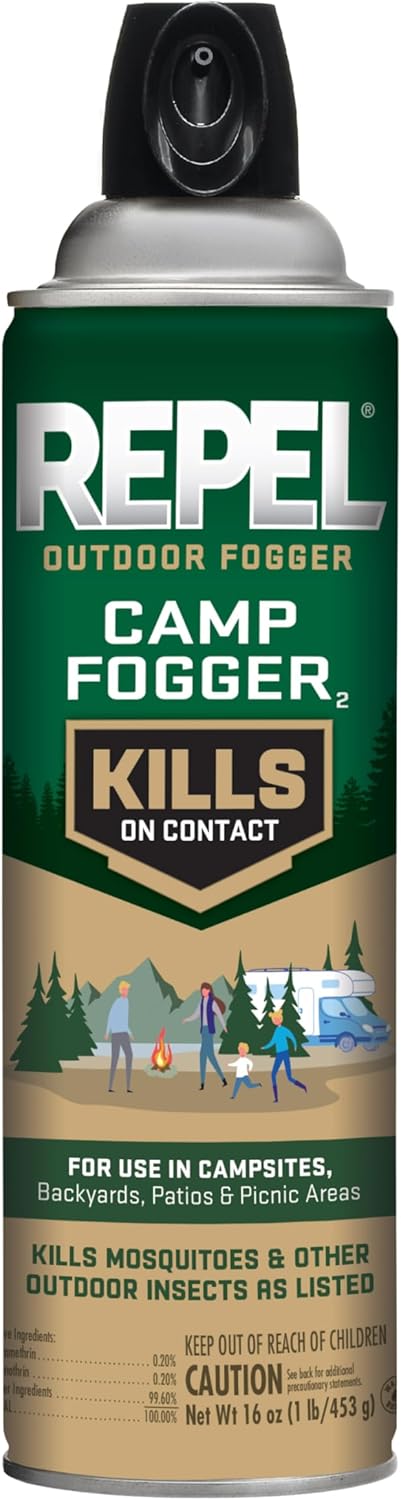
Repel Outdoor Camp Fogger Aerosol, 16 oz
| Item Volume | 16 fluid ounces |
|---|---|
| Scent Name | Unscented |
| Item Form | Aerosol |
| Indoor Outdoor Usage | Outdoor |
| Target Species | Mosquito |
The Repel Outdoor Camp Fogger is a handheld aerosol designed for quick knockdown of mosquitoes and other common outdoor pests around campsites, patios and yards. You use it by spraying into the air and toward insect harborage when the air is calm, holding the can at a slight downward angle and allowing a few minutes for insects to drop. Its active ingredients (tetramethrin and phenothrin) provide fast contact kill of flying and crawling insects listed on the label, making it useful for spot treatments before outdoor gatherings. The product is convenient to carry and applies immediately without mixing, but it is a short-duration solution and intended for outdoor-only, localized use rather than long-term barrier control. It contains synthetic insecticides and carries a California warning for reproductive and cancer risks, so follow label precautions and avoid use near people, pets and food. Reapplication is allowed but limited to no more than once per day per label instructions.
Best for: Buyers who need an inexpensive, grab-and-go spray to quickly reduce mosquito activity for short outdoor events and occasional spot treatments.
Less Ideal for: People seeking continuous yard-wide mosquito control or nonchemical/eco-friendly alternatives should consider multi-week treatments or different product types.
- Fast knockdown of mosquitoes and other listed outdoor insects on contact
- Ready-to-use aerosol requires no mixing or equipment
- Portable and convenient for campsites, patios and picnics
- Provides only short-term, localized control rather than season-long protection
- Contains chemicals with health warnings that require careful handling
Verdict: A low-cost, ready-to-use aerosol that delivers fast, short-term knockdown of mosquitoes and other listed outdoor pests for spot treatments.
ZwrKing 4200V Electric Indoor/Outdoor Bug Zapper with Replaceable 15W LED Bulb

| Target Species | Mosquitoes, Midges, Flies, Fruit Flies, Houseflies, Horse Flies, Moths and Wasps |
|---|---|
| Power Source | ac |
| Material Type | ABS Fireproof Plastic |
| Coverage | Up to 1/2 acre |
The ZwrKing bug zapper combines a 15W UV LED attractant and a 4200V shock grid to deliver chemical-free control of mosquitoes, flies, moths and other flying pests. It is a plug-in unit with a 6.6 foot cord and hanging hook so you can mount it on a porch or set it on a table; the ABS fireproof housing and protective outer cage reduce the risk of accidental contact. The replaceable LED bulb is useful for long-term use because you can refresh the light without replacing the whole fixture, and the manufacturer rates coverage up to roughly a half acre in dark conditions. Practical benefits include quiet operation and a child- and pet-protective outer shell. Important limitations are that it requires AC power and works best at night or in low light, and performance depends on placement and insect pressure so it will not eliminate all mosquitoes in heavy-infestation areas.
Best for: Buyers who want a dependable, low-maintenance electric solution for reducing flying insects around yards and patios and who prefer a chemical-free, durable unit they can mount or set near outdoor seating.
Less Ideal for: People who need a cordless or solar-powered option for remote areas or those expecting a complete elimination of heavy mosquito infestations without additional control methods.
- High-voltage 4200V grid plus UV LED attracts and kills a wide range of flying insects
- Replaceable 15W LED bulb extends the unit's usable life and reduces replacement cost
- Protective ABS housing and outer cage improve safety around children and pets
- 6.6 ft power cord and hanging hook make placement flexible for porches and patios
- Quiet operation suitable for evening use near seating areas
- Requires AC power so it cannot be used away from an outlet without an extension or adapter
- Most effective in darkness and may be less effective during daytime or under strong outdoor lighting
Verdict: A reliable, chemical-free plug-in zapper with replaceable LED and safety features that is well suited for consistent evening use around yards and patios.
Cutter Backyard Bug Control Spray Concentrate, 32 oz (2-Pack)

| Unit Count | 64 Fluid Ounces |
|---|---|
| Included Components | Cutter Backyard Bug Control Spray Concentrate (2 Pack) |
| Item Form | Spray |
| Target Species | Insects |
| Active Ingredients | Lambda Cyhalothrin |
The Cutter Backyard Bug Control Spray Concentrate is a hose-end concentrate for treating lawns, shrubs and outdoor surfaces to reduce mosquitoes and a range of listed insects. You attach the included QuickFlip hose-end sprayer, walk the perimeter or treatment area and apply until foliage and turf are evenly wet; the product is intended for preventative and contact control and claims coverage up to 5,000 sq. ft. per bottle with residual control for up to 12 weeks on some pests. Notable features are the ready-to-use hose connector that mixes automatically with water and the active ingredient lambda-cyhalothrin, a synthetic pyrethroid effective against many common yard insects. Practical benefits include fast knockdown of pests and simple application without measuring or separate mixing. Important limitations are that it is a pesticide with label restrictions and safety precautions, treated areas must stay dry until the spray is dry, and it should not be applied near sensitive aquatic areas or where runoff can occur. Expect good seasonal control when used as directed and timed before insect populations surge.
Best for: Buyers who want a straightforward, professional-style lawn treatment to reduce mosquitoes and other common yard insects without mixing concentrates, and who follow label directions and safety precautions.
Less Ideal for: People who prefer organic or non-chemical pest control methods or who need a product approved for use near ponds, streams, or other aquatic habitats.
- Hose-end QuickFlip sprayer for one-step application with no pre-mixing
- Active ingredient lambda-cyhalothrin provides rapid knockdown of common yard insects
- Label claims up to 12 weeks of residual control on certain pests
- One bottle covers up to 5,000 square feet, suitable for typical residential yards
- Contains a synthetic pesticide requiring careful adherence to label safety and environmental restrictions
- Not safe for application where runoff can reach water bodies or sensitive aquatic habitats
Verdict: Choose this product if you want a simple hose-end concentrate that delivers fast, season-long control of mosquitoes and other yard insects when used according to label directions.
Atticus Talak 7.9% Bifenthrin Indoor/Outdoor Insecticide Concentrate (32 oz)

| Active Ingredients | Bifenthrin |
|---|---|
| Formulation | Suspension Concentrate |
| Liquid Volume | 32 fluid ounces |
| Length of Control | Up to three months |
| Target Species | Insects |
Talak 7.9% is a liquid concentrate that dilutes with water for use as a spray barrier or broadcast treatment on lawns, landscaping, hardscapes and indoor perimeter areas. It contains 7.9% bifenthrin, an established broad-spectrum insecticide, and the label lists control for more than 75 pest species including mosquitoes, ants, ticks, roaches and mites. Typical use is mixing teaspoons of concentrate per gallon of water depending on the application and treating 1,000 sq ft per gallon of mixed solution for turf or landscape. The water-based formula dries clear, is odor-free, and is advertised not to cause phytotoxicity to plants. Notable practical benefits are flexible indoor/outdoor use, a long residual effect of up to three months, and an easy-pour bottle for measured mixing. Important limitations are that solutions should be mixed fresh and not stored, it is not approved for fogger application, and local restrictions may apply since it is not sold in all states. As with any pesticide, follow label instructions for safe application and re-entry times.
Best for: Buyers who want a single, reliable product to reduce mosquitoes and other common yard pests with predictable, label-driven application and residual protection.
Less Ideal for: People seeking non-chemical or organic mosquito control methods or those who need fogger-compatible treatments should look at alternative approaches.
- Broad-spectrum control covering over 75 named pests including mosquitoes and ticks
- Works indoors and outdoors so one product can treat lawns, landscapes and interior perimeter areas
- Long residual activity up to three months per labeled application
- Water-based formula that dilutes easily, dries clear and is odor-free
- Convenient bottle design with pour markings for controlled mixing
- Mixed spray solutions cannot be stored and must be prepared fresh for each application
- Not labeled for use in foggers which limits some application methods
- Not available for sale in certain states
Verdict: A single, water-based bifenthrin concentrate that offers flexible indoor/outdoor use and up to three months of dependable mosquito and general pest control when applied per the label.
Choosing the Right Mosquito Killer for Yards: Key Factors to Consider
Coverage Area and Effective Radius
How many square feet a mosquito killer can influence matters because yards vary from small urban lawns to large suburban lots. A unit with a small effective radius may only protect a single seating area, while higher-capacity devices spread their attraction or kill zone across more of the yard. Consider your typical outdoor activity locations and whether you need whole-yard mitigation or targeted protection around a patio or deck.
Coverage also affects placement strategy. Units meant for broad coverage may be located near the yard perimeter, while smaller units work best close to people. Remember that topography, vegetation, and prevailing wind change real-world coverage versus stated numbers.
Attractant Type and Non-target Impact
Different mosquito killers use light, CO2 mimics, heat, scent lures, or chemical baits to attract insects. Some attractants are broad-spectrum and may draw non-target insects like moths or beneficial pollinators, while others are more selective for biting mosquitoes. Consider attractant type based on nearby gardens, water features, and beneficial insect habitat.
A bait that reduces non-target capture is especially important if you have flowering plants or support pollinators. Check whether the device allows you to adjust or disable certain attractant modes to limit unintended impacts.
Weatherproofing and Build Durability
Yard devices face sun, rain, wind, dust, and seasonal temperature swings. Durable housings, corrosion-resistant components, and sealed electronics prolong service life. IP ratings or manufacturer guidance about outdoor use are practical indicators, but construction quality and user serviceability matter too.
Consider whether parts that commonly wear out are easily replaceable and whether the design allows winter storage or mounting out of direct elements. A unit that fails after one season often costs more in time and hassle than a slightly more expensive, sturdier option.
Maintenance Cycle and Cleaning
Maintenance determines long-term convenience. Some mosquito killers require frequent emptying, trap swaps, or lure replacements; others run longer between service tasks. Easy-to-clean traps, tool-free access panels, and widely available replacement parts reduce upkeep friction.
Factor in how often you want to perform maintenance and whether access is safe and simple when the device is installed at height or near landscaping. A model with a longer refill or trap cycle can be worth it for larger yards where frequent servicing is impractical.
Placement Flexibility and Mounting Options
Where you can put a mosquito killer affects how well it protects the yard. Some units sit on stakes and can be relocated with seasonal changes, while others are designed for permanent posts, poles, or wall mounts. Placement flexibility also influences safety; being able to locate the unit away from play areas or high-traffic flower beds is useful.
Consider cable length or battery options for units requiring power. If you have tree cover or tall hedges, choose mounting options that let you position the attractant above or around obstructions to maximize efficiency.
Power Source and Operational Cost
Yard mosquito killers run on battery, mains power, propane, or a combination. Battery-powered models offer flexible placement but require recharge or battery swaps, while mains-powered units run continuously if you have an outlet nearby. Propane or gas-driven attractants can cover larger areas but require fuel handling and storage.
Operational cost includes replacement lures, fuel, and energy use. Assess how often you'll run the unit during mosquito season and whether the ongoing consumables are easy to source and store.
Planning Placement in Your Yard
Think about typical wind direction, prevailing shade, and where people spend time. Positioning a mosquito killer downwind of seating areas helps draw mosquitoes away from gatherings rather than toward them. Also avoid placing units immediately next to flowering beds or vegetable patches to limit impact on pollinators.
Divide large properties into zones and consider multiple smaller units if a single device cannot cover the full landscape. Temporary placement changes can be useful during big outdoor events versus everyday evening use.
- Place units beyond 10 to 20 feet from active seating when possible
- Use higher mounting for devices that rely on scent or CO2 to spread attractants
- Relocate units seasonally to match mosquito breeding hotspots
Using Mosquito Killers with Integrated Landscaping
Design your planting and water management to reduce mosquito breeding while using mosquito killers for adult control. Eliminating standing water in gutters, planters, and yard containers reduces source populations and lessens pressure on any single device.
Combine mechanical controls with cultural practices such as aerating ponds, cleaning roof troughs, and maintaining tight-fitting lids on rain barrels. This integrated approach reduces the number of units needed and improves overall effectiveness.
- Inspect and remove standing water weekly during warm months
- Choose plants that do not hold water in leaf axils
- Keep gutters and drains clear to prevent pooling
Seasonal Use and Storage Tips
Most yards only need active mosquito control during warm months. Plan to operate devices during dusk and night hours when mosquitoes are most active, and store or winterize units when temperatures routinely drop below operational ranges.
Before storing for the off-season, clean traps, remove lures or fuel, and dry all parts thoroughly. Label small consumables and keep spares in a dry place so you can restart quickly when the season returns.
- Run devices during peak mosquito months and shut down during cool periods
- Perform a full clean before long-term storage
- Check seals and gaskets each spring before redeploying
Safety and Neighbors
When using mosquito killers outdoors, consider the safety of pets, children, and neighbors. Place units where curious hands cannot reach and where lures or fuels are not attractive to animals. If you live close to neighbors, aim units toward your property and follow local guidance on outdoor insect control.
Communicate with neighbors if you plan to use larger or more conspicuous devices so everyone understands placement and timing. Respecting sightlines and shared spaces helps avoid conflicts and ensures the devices serve your household without impacting others unduly.
- Mount devices out of reach of children and pets
- Avoid directing attractants toward shared paths or neighbors' yards
- Follow local regulations regarding outdoor insect control when applicable
Combining With Other Yard Controls
Mosquito killers are one part of a broader pest management plan. Combining them with larval source reduction, targeted biological controls, and timed barrier sprays can reduce pressure more effectively than a single tactic. Use mosquito killers to reduce adult populations while you address breeding sites around the yard.
For heavily infested properties, coordinating multiple approaches on a schedule reduces rebound effects and lowers the frequency of maintenance for each device.
- Pair adult traps with weekly inspections for standing water
- Consider non-chemical larval controls for ponds and water features
- Use mechanical controls in high-traffic areas and other methods in hard-to-reach zones
How We Chose the Best Mosquito Killer for Yards
We prioritized attributes that matter in real yard conditions rather than lab numbers. First, coverage area and effective attraction radius determine how much of a lawn a unit can influence, so devices that specify or demonstrably handle larger square footage were favored. Second, weather resistance and build quality were key because yard units face sun, rain, and fluctuating humidity; models with durable housings and IP-rated protection scored higher. Third, maintenance burden was evaluated by looking at refill cycles, trap-cleaning access, and whether parts are tool-free to service. Fourth, non-target safety and human exposure controls were considered, including shielding, bait types, and placement flexibility. We also checked energy use and runtime for units intended to operate overnight and whether power options fit typical yard setups. We excluded devices designed solely for indoor use, tiny personal repellents, and unproven DIY traps. We did not include professional-only commercial fogging rigs that require special handling. The resulting shortlist reflects practical yard-appropriate mosquito killers that balance coverage, durability, and manageable maintenance.
FAQ
How close should I place a mosquito killer to my patio or deck?
Place a unit at least 10 to 20 feet away and downwind of your seating area when possible. This draws mosquitoes away rather than attracting them toward where people gather.
Can mosquito killers harm pollinators or other beneficial insects?
Some attractant types can draw non-target insects. To reduce impact, avoid placing units near flowering plants and choose attractant modes that are selective for biting mosquitoes when available.
How often do yard mosquito killers need maintenance?
Maintenance frequency varies by device and season. Expect tasks ranging from weekly emptying or cleaning during peak months to monthly lure swaps. Choose a model whose upkeep matches how much time you will invest.
Are battery-powered units effective for larger yards?
Battery models offer flexible placement but often have smaller coverage than mains or fuel-driven units. For larger yards, consider multiple battery units or a power option that supports longer runtime.
When is the best time of day to run a mosquito killer?
Run units during dusk and early night when adult mosquitoes are most active. Continuous overnight operation can help over time, but targeted evening use often provides the most benefit for social outdoor hours.
Can landscaping changes reduce my reliance on mosquito killers?
Yes. Removing standing water, increasing airflow, and choosing plants that do not hold water significantly reduce breeding sites and lower the load on any mosquito killer.
Final Verdict
Selecting a yard-appropriate mosquito killer means balancing coverage needs, weather durability, maintenance effort, and safety for people and pollinators. Prioritize units that match the size and layout of your property and that offer manageable upkeep cycles. For many gardeners, combining a properly placed mosquito killer with habitat reduction and seasonal maintenance produces the most consistent relief.
