

Note: This article contains affiliate links. If you click on these links and make a purchase, I may earn a small commission at no extra cost to you. This helps support my research and content. Read my full affiliate disclosure here.
If you grow raspberries, the right natural fertilizer makes the difference between a sparse patch and a productive bounty. Raspberries respond to steady, plant-available nutrients and rich, living soil more than to quick chemical feeds. This guide looks at seven shortlisted natural fertilizers chosen for how they feed cane growth, support root health, and improve soil structure over time. We evaluate each option based on nutrient balance, how it affects soil biology, application ease, and ongoing maintenance needs. Read on to understand which natural approach fits your patch, whether you are starting new plants or improving an established bed.
Top Picks at a Glance
| Best Overall The best all-around choice for most situations | Down To Earth Acid Mix Organic Fertilizer 4-3-6, 25 lb |  |
| Best Quality Built to a higher standard if you want something more solid | Down To Earth Acid Mix Organic Fertilizer 4-3-6, 5 lb |  |
| Best Value The sweet spot between price and what you get | Back to the Roots Organic Worm Castings, 5 lb |  |
| Best Budget The cheapest option that still gets the job done reliably | True Organic All Purpose Plant Food, 4 lb bag |  |
| Highest Rated A top-rated pick with lots of positive feedback | Espoma Berry-tone Organic Fertilizer, 4-3-4, 4 lb (2-pack) |  |
| Most Popular A crowd favorite that many people choose with confidence | Espoma Berry-Tone Organic Fertilizer for Berries, 4 lb (2-pack) |  |
| Best Seller A high-volume bestseller chosen again and again | Espoma Organic Holly-Tone 4-3-4 Evergreen & Acid-Loving Plant Food, 4 lb. Bag (Pack of 2) |  |
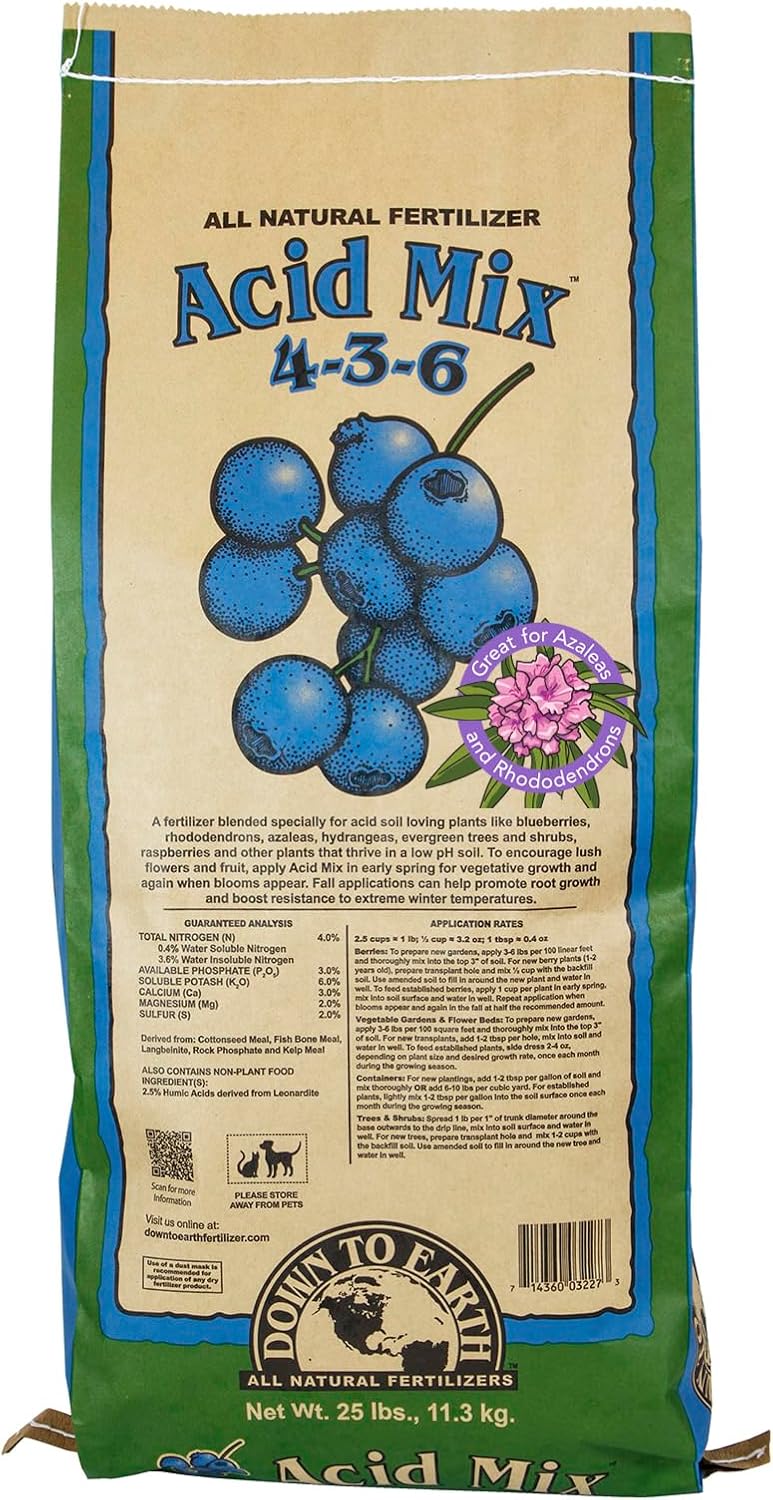
Down To Earth Acid Mix Organic Fertilizer 4-3-6, 25 lb
| Item Form | Granules |
|---|---|
| Target Species | Acid-Loving Plants |
| Mixing Ratio | 4-3-6 |
| Unit Count | 400 Ounce |
Down To Earth Acid Mix is a granular, all‑natural fertilizer blended for acid‑loving plants such as raspberries, blueberries, azaleas and rhododendrons. It supplies a balanced 4‑3‑6 N‑P‑K mix from organic sources like cottonseed meal, fish bone meal, rock phosphate, humates and kelp meal. You apply it to the soil surface or mix it into planting holes and water in; the brand recommends spring and bloom‑time applications and a fall application to support roots before winter. Because it is OMRI‑style natural feed material, it fits into organic gardening workflows and will release nutrients steadily rather than forcing rapid growth, which suits cautious gardeners. Important limitations are that it will not alter soil pH and contains phosphorus so local runoff rules may apply; if you need to lower pH or correct acidity you must use a separate sulfur product. The 25 lb bag gives good coverage for multiple plants or a small patch of raspberries, but handling and storage considerations apply for that size.
Best for: Gardeners who prefer organic, slow‑release nutrition for acid‑loving fruiting plants and want a predictable, steady feeding plan for raspberry patches rather than quick synthetic boosts.
Less Ideal for: Growers who need to quickly correct soil pH or want an instant soluble feed for foliar feeding should choose a pH amendment or a water‑soluble fertilizer instead.
- Formulated specifically for acid‑loving plants including raspberries and blueberries
- Made from recognizable organic ingredients such as fish bone meal, kelp and rock phosphate
- Granular form can be top‑dressed or incorporated at planting and waters in easily
- Stable, shelf‑stable formula suitable for organic gardening practices
- Does not change soil pH so you must test soil and add sulfur or lime separately if pH adjustment is needed
- Contains phosphorus which may be restricted in some areas due to runoff regulations
Verdict: A dependable organic granular fertilizer tailored to acid‑loving plants that provides steady, plant‑friendly nutrition for raspberry patches.
Down To Earth Acid Mix Organic Fertilizer 4-3-6, 5 lb

| Item Form | Granules, Powder |
|---|---|
| Specific Uses For Product | Plant Growth |
| Target Species | rhododendrons, azaleas, hydrangeas, evergreen trees and shrubs, blueberries, raspberries |
| Mixing Ratio | 4-3-6 |
| Unit Count | 80 Ounce |
This Acid Mix is a granular organic fertilizer designed for acid-loving plants such as blueberries, azaleas, rhododendrons and other shrubs. It is applied to the soil surface or mixed into planting soil and watered in, with recommended timing in early spring and again at bloom to support vegetative growth and fruit set. The 4-3-6 NPK ratio delivers steady nitrogen, phosphorus and potassium from natural sources like cottonseed meal, fish bone meal, kelp and rock phosphate, so plants receive nutrients over time without synthetic salts. The formula is OMRI-friendly and shelf-stable, so it stores well when kept dry. Important limitations are that it will not change soil pH, so you still need sulfur or lime to adjust acidity, and results are slower than with soluble fertilizers, meaning it suits planned seasonal feeding rather than rapid corrections. Use protective gear when handling because it contains concentrated organic inputs.
Best for: Gardeners who want an organic, low-maintenance feed for blueberry plants and other acid-loving shrubs and who plan seasonal, preventative fertilizing rather than fast corrections.
Less Ideal for: Growers needing rapid nutrient correction, growers who must adjust soil pH quickly, or those who prefer liquid soluble fertilizers for immediate feeding.
- Formulated specifically for acid-loving plants like blueberries and rhododendrons
- Made from natural ingredients such as cottonseed meal, fish bone meal and kelp
- Slow-release granules provide steady feeding over the season
- Shelf-stable and storeable when kept in a cool dry place
- Does not alter soil pH so a separate acidifier is needed to lower pH
- Slower to show results compared with water-soluble synthetic fertilizers
Verdict: A dependable organic slow-release fertilizer tailored to support blueberries and other acid-loving plants throughout the growing season.
Back to the Roots Organic Worm Castings, 5 lb

| Item Form | Granules |
|---|---|
| Specific Uses For Product | Plant Growth, Root Development, Seed Development, Soil Conditioning |
| Target Species | all plants |
| Included Components | Resealable Bag |
| Ingredients | Vermicompost |
These worm castings are a straightforward organic soil amendment you sprinkle into flower beds, potting mixes, or around established plants to boost soil life and root development. The product is pure vermicompost in granules, so it adds beneficial microbes and organic matter without burning seedlings or producing strong odors. Use it as a top dressing, mix a light amount into planting holes, or blend with potting soil for container-grown flowers; directions are simply to sprinkle and water. The resealable bag keeps the granules dry between uses and the ingredient list is just vermicompost, which makes this an easy, low-maintenance way to improve soil structure and long-term fertility. Limitations are that it is not a complete fertilizer with measurable NPK values, so for rapid nutrient correction or specific feed schedules you will still need a balanced fertilizer. Also the five pound bag covers modest area, so larger beds will require multiple bags or bulk sourcing.
Best for: Gardeners who want a low-effort, organic way to improve soil biology and structure in flower beds or containers without strong smells or risk of burning plants.
Less Ideal for: People needing a precise, high-nitrogen feed or immediate nutrient correction for large-scale beds should consider formulated fertilizers or bulk amendments instead.
- Pure vermicompost adds beneficial microbes and improves soil structure
- Odor-free, non-burning formula safe for seedlings and established plants
- Versatile use as top dressing, soil mix amendment, or in containers
- Resealable bag preserves product between uses
- Does not list NPK or act as a standalone, fast-acting fertilizer
- Five pound bag provides limited coverage for larger flower beds
Verdict: A simple, odor-free organic amendment that boosts soil life and is ideal for gardeners wanting an easy way to improve flower bed and container soil health.
True Organic All Purpose Plant Food, 4 lb bag

| Item Form | Granules |
|---|---|
| Unit Count | 64 Ounce |
| Coverage | Full |
| Specific Uses For Product | Agriculture, Gardening |
True Organic All Purpose Plant Food is a granular, organic blend designed to feed garden plants while building soil life. It supplies a balanced N-P-K profile with 3.75% slow-release nitrogen plus phosphate, potash, calcium, and sulfur from natural inputs such as seabird guano, fish bone meal, and shell meals. Typical use is monthly broadcast or side-dressing during the growing season for in-ground beds and containers; the 4 lb bag is sized to cover roughly 87 sq ft. The slow-release fraction helps steady growth without large nutrient spikes, and the diverse organic ingredients support microbial activity and longer-term soil health rather than just feeding foliage. Because it is granular and made from animal- and plant-based meals, it can have a noticeable smell and may take a few watering cycles to fully break down. It is not a high analysis synthetic fertilizer, so results are gentler and build over time rather than producing quick, dramatic flushes of growth. For gardeners wanting a low-chemical, soil-improving option for berry patches, this product delivers steady, usable nutrition when applied as part of a monthly program.
Best for: Gardeners who want a budget-friendly, naturally derived fertilizer that improves soil health while providing steady nutrition for fruiting plants like raspberries.
Less Ideal for: Growers who need immediate, high-N pushes for rapid vegetative growth or who require strictly synthetic-free inputs for ethical reasons.
- Balanced, low-analysis N-P-K with a slow-release nitrogen fraction for steadier plant uptake
- Made from organic, sustainable ingredients that support soil microbial activity
- Suitable for both in-ground beds and container-grown raspberries
- Multiple bag sizes available to match small patches or larger plantings
- Contains animal-derived ingredients so not suitable for strictly vegan organic systems
- Granular organics release nutrients more slowly than synthetic fertilizers, so slower visible results
Verdict: A wallet-friendly organic fertilizer that steadily feeds raspberry plants while rebuilding soil life.
Espoma Berry-tone Organic Fertilizer, 4-3-4, 4 lb (2-pack)

| Item Form | Granules |
|---|---|
| Specific Uses For Product | Gardening,Organic,Plant Food |
| Coverage | Medium |
| Target Species | Blueberries, Strawberries, Raspberries, Blackberries |
Espoma Berry-tone is an organic granular fertilizer made specifically for blueberries, strawberries, raspberries, and blackberries. It supplies a balanced 4-3-4 N-P-K plus sulfur and organic matter that you sprinkle around the drip line of plants or incorporate into beds when planting. Typical use is twice yearly feeding for established beds in early and late spring or as a soil amendment at planting using the package rates. Notable features include ready-to-use granules, an organic certification suitable for certified organic production, and a Bio-tone formula intended to support root development. Practical benefits are easier application compared with liquid concentrates, a formulation tailored to acid-loving berries, and clear directions for both beds and individual plants. Limitations are that its nutrient analysis is moderate so heavy-feeding situations may need supplemental inputs, and the granular form requires watering in and occasional reapplication rather than providing instant foliar uptake.
Best for: Buyers who prioritize a dependable, organic fertilizer for acid-loving berry plants and want a straightforward granular product with clear application guidance.
Less Ideal for: Growers needing rapid foliar correction or high immediate nutrient boosts for very large or nutrient-poor plantings should consider concentrated liquids or targeted supplements instead.
- Formulated specifically for berry crops including blueberries and strawberries
- Ready-to-use granules require no mixing and are simple to apply
- Organic certified ingredients suitable for organic gardening and certified production
- Includes sulfur and Bio-tone components to support acid-loving berries and root health
- Moderate N-P-K (4-3-4) may be insufficient alone for heavy-producing or nutrient-depleted soils
Verdict: A reliable, ready-to-use organic granular fertilizer tailored to berry plants for gardeners who want simple, certified organic feeding.
Espoma Berry-Tone Organic Fertilizer for Berries, 4 lb (2-pack)

| Item Form | Granules |
|---|---|
| Specific Uses For Product | Gardening |
| Coverage | Medium |
| Target Species | Berries |
| Mixing Ratio | 4:3:4 |
Espoma Berry-Tone is an organic granular fertilizer designed for blueberries, strawberries, raspberries and blackberries. It supplies a balanced 4-3-4 N-P-K blend with added sulfur and Espoma’s Bio-tone formula to support root establishment and steady growth. Typical use is mixing a cup into amended planting holes at transplanting and applying twice yearly to established plants in early and late spring. The granules are ready-to-use and labeled for organic production, so it fits into certified organic gardening and home berry patches. Practical benefits include gentle nutrient release that lowers burn risk, added sulfur which helps acid-loving berries, and straightforward directions for planting and feeding. Limitations are that the analysis is low compared with synthetic feeds so you may need supplemental applications for heavy feeders, and the product is sold in modest 4 lb bags so larger plantings will require multiple bags.
Best for: Home gardeners who grow a small to medium patch of blackberries or raspberries and prioritize organic, low-risk feeding and straightforward application.
Less Ideal for: Growers with large commercial beds or those who need high-concentration quick fixes for nutrient-deficient soils should consider higher-analysis or bulk options.
- Formulated specifically for berries with a balanced 4-3-4 N-P-K ratio
- Organic ingredients and approved for organic gardening
- Includes sulfur and Bio-tone to support root health and soil microbes
- Granular, ready-to-use formula with clear planting and feeding directions
- Lower nutrient concentration than many synthetic fertilizers so larger or high-yield patches may need more frequent feeding
- Bag size is small for extensive plantings requiring multiple purchases
Verdict: Choose this product when you want an organic, berry-specific fertilizer that supports root development and steady seasonal feeding.
Espoma Organic Holly-Tone 4-3-4 Evergreen & Acid-Loving Plant Food, 4 lb. Bag (Pack of 2)

| Item Form | Powder |
|---|---|
| Specific Uses For Product | Organic,Plant Food |
| Application Method | Sprinkle over the root zone and water in |
| Coverage | Medium |
| Target Species | Acid-loving Plants |
Espoma Holly-Tone is a ready-to-use organic fertilizer made for acid-loving plants such as blueberries and raspberries. Supplied as a powder/granular form with an N-P-K of 4-3-4 and added sulfur, it is intended to be sprinkled around the root zone and watered in, providing a slow-release nutrient reservoir that supports blooms and fruiting over the growing season. Its organic ingredients and Bio-tone inoculant are designed to feed plants while improving soil biology, which suits gardeners who prefer low-chemical approaches. Practical benefits include simple application with no mixing, suitability for spring and fall feedings, and certification for organic gardening. Limitations are that it delivers modest nutrient levels per application, so heavy-feeding situations may need more frequent use or supplementary fertilizer, and the medium coverage means larger plantings require multiple bags. For cautious gardeners wanting predictable, organic nutrition for blueberries and raspberries, Holly-Tone offers a reliable, low-risk option that integrates easily into standard care routines.
Best for: Gardeners who prioritize organic, low-risk feeding for acid-loving fruit shrubs and want a simple, no-mix fertilizer to maintain soil health and steady fruiting.
Less Ideal for: Growers managing large commercial patches or plants that need high immediate nutrient boosts should consider higher-analysis or concentrated products instead.
- Organic formula with Bio-tone to support soil biology and gradual nutrient release
- Formulated specifically for acid-loving plants like blueberries and raspberries
- Ready-to-use granular powder that requires no mixing and is simple to apply
- Contains sulfur to help maintain acidic soil conditions favored by target plants
- Low N-P-K ratio means heavier feeders may need additional applications or supplements
- Medium coverage requires multiple bags for larger patches or rows
Verdict: A dependable organic, ready-to-use fertilizer that makes feeding blueberries and raspberries simple while supporting soil biology.
Choosing the Right Natural Fertilizer for Raspberries: Key Factors to Consider
Nutrient Balance and Timing
Raspberries have distinct nutrient needs through their growth cycle. Early spring growth and cane development demand available nitrogen to push vegetative growth, while bloom and fruit set need adequate phosphorus and potassium to support flowers and berry size.
A natural fertilizer should provide a predictable release pattern or be paired with a feeding schedule that matches cane stages. Slow-release organic sources provide steady nutrients, while certain manures or compost teas offer quicker availability. Timing applications to early spring and post-harvest supports bud formation for the following season without overstimulating late growth that can invite winter damage.
Soil Structure and Organic Matter
Raspberries prefer well-draining soil rich in organic matter. Natural fertilizers that also build humus improve water retention, root aeration, and nutrient-holding capacity, all of which support consistent berry production.
Materials that increase soil organic matter, such as compost or well-aged manures, have long-term benefits beyond immediate nutrient delivery. Over seasons, improved structure reduces water stress and creates a better environment for beneficial microbes that cycle nutrients to plant roots.
Soil Biology and Microbial Activity
Healthy raspberry roots thrive in biologically active soil. Natural fertilizers that encourage beneficial fungi and bacteria help with nutrient mineralization and disease suppression.
Products that contain or promote microbial life, including composts, mycorrhizal inoculants, and some fermented amendments, can improve nutrient uptake and stress tolerance. Avoid harsh salts or treatments that harm microbes if your goal is to build a living soil ecosystem for raspberries.
Salt Load and Residual Effects
Some organic amendments still carry salts or soluble salts from feedstocks. Salt buildup concentrates in the root zone and can harm young roots and reduce water uptake, leading to weaker canes and smaller fruit.
Choose amendments with low salt content for established beds and especially for newly planted raspberry starts. Regular soil testing and incorporation of bulky organic matter can help dilute residual salts and maintain a safe root environment.
Application Practicality and Safety
Gardeners need fertilizer options that fit their tools, labor, and plot layout. Broadcast granular amendments, sidedressing, top-dressing with compost, and foliar feeds each have different labor profiles and equipment needs.
Consider proximity to walkways and edible harvests when choosing application methods. Some manures and raw amendments require composting or aging before use to avoid burning roots or introducing pathogens. Safety and smell are also practical concerns for home gardens, especially near patios or neighbors.
Environmental Impact and Sustainability
Natural does not automatically mean low impact. Sourcing, transport, and the production method of an amendment affect its environmental footprint.
Prefer locally produced composts and responsibly sourced organic materials to reduce ecological cost. Consider the potential for runoff from high-nutrient amendments and use practices that keep nutrients in the root zone, like mulching and minimal tillage, to reduce impact on nearby water bodies.
When to Feed Raspberries
Raspberries respond best to feeding at two key times: early spring as growth resumes and after harvest to support cane recovery and bud formation for the next season. A light feed in early spring encourages strong cane elongation, while a post-harvest application helps roots rebuild carbohydrate reserves.
Avoid heavy late-season nitrogen applications that prolong soft growth into fall. That new growth can be vulnerable to cold damage and may reduce winter hardiness. For most gardens, matching slow-release natural fertilizers to the plant's cycle gives steady support without forcing late growth.
- Early spring: encourage cane growth with modest nitrogen availability
- At bloom: ensure phosphorus and potassium are available for fruit set
- After harvest: replenish reserves and build organic matter
Compost and Compost Top-Dressing
Well-made compost is a foundational natural amendment for raspberries. Spread a 1 to 2 inch layer of compost as a top dressing in spring or fall and lightly fork it into the topsoil to avoid disturbing roots.
Compost supplies a broad range of nutrients, improves soil structure, and feeds soil life. Using compost regularly reduces dependence on single-source amendments and helps stabilize moisture and temperature in the root zone.
- Best for: long-term soil building and steady nutrient supply
- Application tip: avoid fresh, hot manure in the root zone
Using Aged Manure and Processed Organics
Aged manures and processed organic fertilizers offer concentrated nutrients with lower pathogen and weed seed risks than fresh manure. They are useful for established beds where a nutrient boost is needed without excessive salt or odor.
Apply well-aged material in early spring or incorporate into soil before planting new rows. Keep a buffer from the crown of plants to prevent stem rot and watch for salt levels if repeated yearly applications are made.
- Best for: quick nutrient top-up with less risk than raw manure
- Application tip: choose well-aged or pelletized forms for easier handling
Cover Crops and Green Manures
Planting cover crops in raspberry aisles or in beds between rotations builds nitrogen, prevents erosion, and increases organic matter. Legumes fix atmospheric nitrogen, offering a natural source of fertility when incorporated as green manure.
Use cover crops during fallow periods or in larger plantings where rotation is possible. Terminate and incorporate at the right stage to avoid competition with your raspberries and to maximize the nutrient contribution.
- Best for: seasonal beds and larger plantings where rotation is possible
- Application tip: mow and incorporate legumes before seed set for best nitrogen return
Foliar Feeds and Compost Teas
Foliar applications and properly brewed compost teas can supply quickly available micronutrients and stimulate microbial life on root or canopy surfaces. They are not substitutes for building soil organic matter but can be a useful supplement during bloom or stress periods.
Apply foliar feeds in calm, cool parts of the day and use them as targeted boosters rather than the main fertility strategy. Ensure teas are well-aerated and free of contaminants to avoid introducing pathogens.
- Best for: targeted micronutrient delivery and short-term stress support
- Application tip: avoid foliar sprays during very hot or wet weather
Mulching as a Nutrient Strategy
Organic mulches such as straw, wood chips, or leaf mold reduce weed competition, conserve moisture, and slowly release nutrients as they decompose. Mulch also moderates soil temperature and can protect shallow raspberry roots from heat stress.
Apply a moderate layer around plants, keeping mulch away from direct contact with canes to prevent rot. Over time, mulches break down and contribute to soil organic matter, complementing other natural fertilizer inputs.
- Best for: moisture conservation and gradual nutrient release
- Application tip: replenish mulch annually to maintain a steady supply of organic matter
How We Chose the Best Natural Fertilizer for Raspberries
We focused on fertilizers and soil amendments that deliver plant-available nutrients while supporting the soil life raspberries rely on. Selection prioritized products and materials with clear nutrient profiles or demonstrated benefits for cane crops, plus evidence they improve soil organic matter or microbial activity. Key evaluation criteria included nutrient balance for cane growth and fruiting, contribution to soil structure and organic matter, compatibility with common raspberry planting systems, application ease and timing, and potential effect on pest or disease pressure through healthier plants. We excluded synthetic or chemically formulated fertilizers and any products without reliable information on nutrient content or how they act in the soil. We also filtered out options that require specialized equipment to apply or those that create salt buildup over time. The remaining picks represent broadly applicable natural solutions that gardeners can use across different climates and soil types, with notes on when each approach is most useful.
FAQ
How often should I apply natural fertilizer to raspberry beds?
Often gardeners apply a main dressing in early spring and a lighter application after harvest. Frequency depends on soil fertility and amendment type; compost can be added annually while some processed organics may be applied once or twice per season.
Can I use fresh manure on raspberry plants?
Fresh manure can be too hot and may contain weed seeds or pathogens. Use only well-aged manure or composted materials in the root zone to avoid burning roots and to reduce health risks.
Will mulching replace the need for fertilizer?
Mulch contributes to nutrient cycling and moisture retention but may not supply all nutrients in the amounts raspberries need. Combining mulch with periodic compost or targeted organic feeds is a balanced approach.
Are foliar sprays effective for correcting nutrient deficiencies?
Foliar sprays can correct certain micronutrient shortages quickly, but they are temporary fixes. Long-term correction requires improving root-zone fertility and soil biology.
How does soil pH affect raspberry nutrient uptake?
Soil pH influences nutrient availability; raspberries prefer slightly acidic to neutral soils. If pH is outside the ideal range, nutrients may become less available even when present in the soil, so test and adjust pH before changing fertilization plans.
Final Verdict
Choose a natural fertilizer approach that balances immediate nutrient needs with long-term soil health. For most raspberry gardens, regular additions of well-made compost, strategic use of aged manures or processed organics, and seasonal mulching provide the steady fertility raspberries prefer. Prioritize soil-building tactics and match application timing to growth stages. That approach minimizes risks like salt buildup or late-season flushes while supporting bigger, healthier harvests over multiple seasons.
