

Note: This article contains affiliate links. If you click on these links and make a purchase, I may earn a small commission at no extra cost to you. This helps support my research and content. Read my full affiliate disclosure here.
Picking the right organic fertilizer for trees and shrubs matters because permanent woody plants respond to steady, soil-focused feeding rather than frequent high-nitrogen boosts. The right formula supports deep roots, sustained leaf and twig growth, and resilience to seasonal stress while avoiding nutrient runoff and root burn. This guide covers seven shortlisted organic options suited to established trees and young shrubs in a variety of soils and climates. We evaluate each pick on nutrient profile, application method, and how it performs in typical garden and landscape conditions. Read on to find an approach that fits your planting situation and maintenance routine.
Top Picks at a Glance
| Best Overall The best all-around choice for most situations | Espoma Organic Plant-Tone All-Purpose 5-3-3 Organic Plant Food, 50 lb Bag |  |
| Best Quality Built to a higher standard if you want something more solid | Espoma Tree‑Tone 6-3-2 Organic Fertilizer, 4 lb. Bag (Pack of 2) |  |
| Best Value The sweet spot between price and what you get | Jobe's Organics Granular Fruit & Citrus Fertilizer, 4 lb |  |
| Best Budget The cheapest option that still gets the job done reliably | Jobe's Organics Granular Fruit & Nut Fertilizer, 4 lb |  |
| Highest Rated A top-rated pick with lots of positive feedback | EB Stone Organic Tree and Shrub Food, 4 lb |  |
| Most Popular A crowd favorite that many people choose with confidence | Espoma Organic Plant-Tone 5-3-3 All-Purpose Granular Plant Food (2 × 4 lb.) |  |
| Best Seller A high-volume bestseller chosen again and again | Jobe's Organics All-Purpose Granular Fertilizer (16 lb) |  |
Espoma Organic Plant-Tone All-Purpose 5-3-3 Organic Plant Food, 50 lb Bag

| Item Form | Fertilizer |
|---|---|
| Specific Uses For Product | Gardening |
| Target Species | all flowers, vegetables, trees and shrubs |
| Mixing Ratio | 1:1:1 |
Plant-Tone is designed to feed a range of garden plants by releasing nutrients slowly from natural ingredients and a proprietary Bio-tone microbial formula. In practice you apply it around the drip line of flowers, vegetable plants, shrubs or trees in spring and fall, and for annuals and vegetables you can top-dress monthly during the season. The 5-3-3 analysis with 5% calcium supports balanced growth and blossom set while the organic base builds soil biology over time rather than giving an immediate synthetic spike. A 50 lb bag covers large beds and landscape plantings so it is convenient for serious flower-bed upkeep. Limits are that it is not a quick-fix for severe nutrient deficiency and results accumulate over weeks to months, so impatient gardeners may need a faster-acting supplement for rescue feeding. Also being granular, it requires spreading and watering in rather than foliar application.
Best for: Gardeners focused on steady, reliable performance who maintain multiple flower beds or mixed plantings and prefer improving soil health while feeding blooms and foliage.
Less Ideal for: People needing immediate corrective feeding for yellowing or severely deficient plants or those who only want small-quantity, single-plant solutions.
- Organic, slow-release formula that builds soil biology over time
- Broadly suitable for flowers, vegetables, trees and shrubs
- Includes 5% calcium to support bloom and fruit development
- Large 50 lb bag is practical for maintaining multiple flower beds or landscape areas
- Not a rapid corrective feed for acute nutrient deficiencies
- Requires spreading and watering in; not suitable for foliar feeding
Verdict: Choose this if you want a proven organic, slow-release fertilizer that steadily feeds flower beds and builds soil health while supporting blooms.
Espoma Tree‑Tone 6-3-2 Organic Fertilizer, 4 lb. Bag (Pack of 2)

| Item Form | Powder |
|---|---|
| Specific Uses For Product | Plant Growth |
| Coverage | Medium |
| Target Species | trees |
| Mixing Ratio | No mixing required |
Espoma Tree‑Tone is a ready‑to‑use organic fertilizer made for trees and larger woody plants. It delivers a balanced 6-3-2 NPK formulation with 5% calcium and organic inputs that feed roots slowly while improving soil biology. Typical use is in spring and fall: spread around the root zone according to label guidance and leave it on the soil surface since no mixing is required. The product comes in two 4 lb. bags that make treating multiple small trees convenient. Notable benefits are its organic certification and the inclusion of Bio-tone to support microbial activity, which helps sustained plant growth rather than a quick surge of foliage. Because it is granular and medium coverage, it is easy to apply precisely around drip lines. Limitations are its lower NPK numbers compared with synthetic fertilizers, so results are steady rather than dramatic, and you may need larger quantities for mature trees or fast corrective feeding. For gardeners prioritizing long-term soil health and consistent growth, Tree‑Tone performs reliably as a regular maintenance fertilizer.
Best for: Gardeners who want reliable, soil‑friendly feeding for shade, fruit, and ornamental trees and who prioritize steady, long‑term plant health over rapid foliage boosts.
Less Ideal for: People seeking fast, high‑nitrogen corrective feeding for heavy feeders or large mature trees that require concentrated, immediate nutrient correction.
- Organic formula approved for organic gardening and made with natural ingredients
- Contains 6-3-2 NPK plus 5% calcium to support steady tree growth and fruiting
- Ready to use granular form requires no mixing and is easy to apply
- Includes Bio-tone to encourage soil microbial activity and long-term soil health
- Lower nutrient concentration means larger or repeated applications may be needed for large or nutrient‑depleted trees
Verdict: Choose Tree‑Tone if you want an organic, easy‑to‑apply fertilizer that promotes steady tree growth and long‑term soil health.
Jobe's Organics Granular Fruit & Citrus Fertilizer, 4 lb

| Item Form | Granules |
|---|---|
| Specific Uses For Product | Plant Growth, Root Development, Seed Development, Soil Conditioning |
| Application Method | Spread evenly around base |
| NPK | 3-5-5 |
| OMRI Listed | Yes |
This granular Jobe's Organics fertilizer is designed to feed fruit and citrus trees with a slow-release, root-targeted NPK of 3-5-5. It is typically applied by measuring and spreading the granules evenly around the base of the tree, then watering in; applications are recommended every 4 to 8 weeks during the growing season. Notable features include OMRI listing for organic gardening, a blend of feather meal, bone meal and processed poultry manure for organic nutrient sources, and a resealable bag for convenient storage. In practice the formula supports root development and fruit set without synthetic chemicals, and the slow-release nature reduces the need for very frequent feeding. Limitations are that the lower nitrogen level makes it better suited for fruiting and flowering stage nutrition rather than rapid leafy growth, and larger trees will require repeated applications or larger quantities. For gardeners aiming for an organic, low-fuss feed for citrus, this provides predictable, targeted nutrition, but it is not a quick-fix soluble feed for immediate green-up.
Best for: Gardeners who prefer organic, low-maintenance feeding for citrus and fruit trees and want a slow-release product that focuses on fruit and root health.
Less Ideal for: Growers needing fast, high-nitrogen correction or a soluble foliar feed; landscapers managing many mature trees who need bulk quantities more often.
- OMRI listed organic formula suitable for certified organic gardens
- Balanced 3-5-5 NPK aimed at improving flowering and fruit production
- Slow-release granules that feed roots over time and reduce application frequency
- Resealable packaging keeps product fresh between uses
- Lower nitrogen content means it will not rapidly promote leafy growth
- 4 lb bag may be insufficient for mature trees or larger plantings
Verdict: A reliable OMRI-listed granular fertilizer that delivers slow-release, fruit-focused nutrition for organic citrus gardeners.
Jobe's Organics Granular Fruit & Nut Fertilizer, 4 lb

| NPK | 3-5-5 |
|---|---|
| Target Species | Fruit and nut |
| Item Form | Granules |
| Unit Count | 64 Ounce |
| Specific Uses For Product | Plant Growth, Root Development, Seed Development, Soil Conditioning |
Jobe's Organics Granular Fruit & Nut Fertilizer is a small-bag, slow-release granular designed to feed the roots of fruit and nut trees, including pears. It supplies a balanced 3-5-5 NPK plus calcium, magnesium, and sulfur derived from organic sources such as feather meal and bone meal. Typical use is to broadcast or side-dress around the root zone every 4 to 8 weeks during the growing season; granules release nutrients gradually so you do not need frequent reapplication. Benefits include organic certification for use in organic gardens, straightforward measuring and application, and nutrients aimed at improving bloom and fruit set rather than quick leafy growth. Important limitations are the small 4 lb bag size, which means multiple bags will be needed for larger orchards, and the lower nitrogen ratio compared with general-purpose fertilizers if you want foliage-heavy growth. It is safe to use around people and pets when directions are followed, but users should avoid applying in windy conditions to prevent drift.
Best for: Home gardeners and small-plot fruit growers who prioritize organic inputs and want an easy-to-apply fertilizer to support fruit set and steady production in pear trees.
Less Ideal for: Commercial orchards or large properties that need bulk fertilizer or fast-acting high-nitrogen feed to drive rapid vegetative growth.
- OMRI listed organic formula suitable for certified organic gardens
- Balanced 3-5-5 NPK geared toward flowering and fruit production
- Slow-release granules that feed roots over weeks reducing application frequency
- Includes secondary nutrients like calcium and magnesium to support fruit quality
- 4 lb bag is small for multiple or mature trees
- Lower nitrogen percentage may be insufficient when rapid vegetative growth is desired
Verdict: A small, OMRI-listed granular fertilizer that reliably supports flowering and fruit production in pear trees for gardeners who prefer organic, slow-release nutrition.
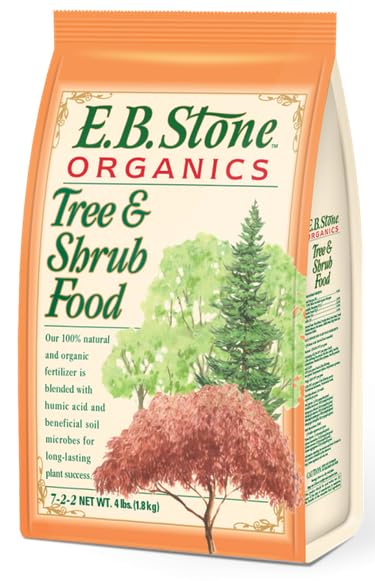
EB Stone Organic Tree and Shrub Food, 4 lb
| Item Form | Granules |
|---|---|
| Specific Uses For Product | Landscape,Organic |
| Coverage | Medium |
| Target Species | trees and shrubs |
| Mixing Ratio | 7-2-2 |
This granular organic Tree and Shrub Food is designed to boost foliage and flowering for a wide range of woody plants. You apply it around the root zone of established trees and shrubs following the package mixing ratio, and it releases nutrients that favor leafy growth thanks to its higher nitrogen content while still supplying phosphate and potash for blooms and overall vigor. The formula includes humic acid and mycorrhizae, which support soil biology and root health so plants can take up nutrients more effectively. Practical benefits include simple granular application without measuring complicated liquid feeds and suitability for ornamental vines and sensitive species like Japanese maple. Limitations worth noting are the small 4 lb size, which suits gardens with only a few specimens but will require more frequent repurchasing for larger landscapes, and the product does not list detailed N-P-K numbers beyond the mixing ratio so precise nutrient planning is limited.
Best for: Gardeners who prioritize reliable, biologically supportive organic feeding for a few trees and shrubs and want a straightforward granular product that encourages foliage and blooms.
Less Ideal for: Large properties, commercial landscapers, or anyone wanting a single bulk fertilizer to cover many specimens should choose higher-volume or clearly quantified N-P-K options.
- Organic granular formula supports leafy growth and flowering
- Includes humic acid and mycorrhizae to improve soil biology and root nutrient uptake
- Simple granular application suitable for trees, shrubs, and ornamental vines
- Formulated specifically for woody landscape plants including Japanese maple
- Small 4 lb package is not economical for large properties
- Nutrient analysis is not presented as explicit N-P-K percentages for precise dosing
Verdict: A dependable organic granular feed that supports soil biology and promotes greener foliage and better flowering for a few landscape trees and shrubs.
Espoma Organic Plant-Tone 5-3-3 All-Purpose Granular Plant Food (2 × 4 lb.)

| Item Form | Granules |
|---|---|
| Specific Uses For Product | Organic,Plant Food |
| Coverage | All-purpose |
| Target Species | all flowers, vegetables, trees and shrubs |
| Mixing Ratio | 5-3-3 |
Espoma Plant‑Tone is a ready‑to‑use granular organic fertilizer designed to feed a wide range of garden plants, from roses and perennials to shrubs and vegetables. You broadcast it around the drip line and water it in; because it is slow‑releasing, it builds a steady nutrient reservoir rather than delivering a quick burst. Notable features include its 5-3-3 NPK formulation with added calcium and the Bio‑Tone microbial blend that aids nutrient breakdown and uptake. Practical benefits are improved bloom and foliage development with monthly applications for flowers and vegetables and spring/fall feeding for trees and shrubs, plus certification for organic gardening. Limitations are that results are gradual compared with synthetic quick‑release fertilizers and the product is sold in multiple small bags, which may require more frequent replenishing for larger beds. Also it is a general all‑purpose formula, so gardeners seeking highly specific high‑nitrogen or bloom‑boost mixes will need to supplement or choose a specialized product.
Best for: Gardeners who prioritize steady, plant‑friendly performance and organic inputs for shrubs and flowering beds and who plan regular seasonal or monthly feedings.
Less Ideal for: Growers who need immediate, high‑intensity nutrient boosts for rapid vegetative growth or who prefer single large bulk bags for extensive acreage.
- Organic, slow‑release granules that feed plants steadily over time
- Includes Bio‑Tone microbes to help break down organics and improve nutrient availability
- Versatile all‑purpose formula suitable for flowers, vegetables, trees and shrubs
- Slower visible results compared with fast‑acting synthetic fertilizers
- Packaging is in 4 lb. bags which may be small for very large gardens
Verdict: Choose Espoma Plant‑Tone when you want a proven organic, slow‑release fertilizer that reliably improves shrubs and flowering plants over the season.
Jobe's Organics All-Purpose Granular Fertilizer (16 lb)

| Item Form | Granules |
|---|---|
| Specific Uses For Product | Plant Growth, Root Development, Seed Development, Soil Conditioning |
| Mixing Ratio | 4-4-4 |
| Coverage | Resealable |
This is a straightforward organic granular fertilizer designed for regular feeding of vegetable gardens and other ornamentals. With an NPK of 4-4-4 and ingredients like feather meal, bone meal, and processed poultry manure, it supplies balanced nutrients and some calcium and sulfur for steady growth and improved root development. You apply it to soil every 2 to 3 weeks during the growing season; as a slow-to-release granular it reduces the need for daily attention and lowers the risk of burning when used as directed. The product is OMRI listed for organic gardening and is presented in a resealable bag for tidy storage. Limitations to be aware of are the modest NPK numbers, which mean it is best for maintenance feeding rather than rapidly correcting severe nutrient deficiencies, and the need to reapply frequently compared with longer-term slow-release formulations. For growers wanting an easy, certified-organic feed for vegetables and mixed beds, this covers most bases without complex application methods.
Best for: Home vegetable gardeners and practical growers who prioritize organic inputs and want a simple, repeatable feeding routine to maintain steady plant growth.
Less Ideal for: Growers who need a high-concentration or targeted corrective fertilizer for severe nutrient deficiencies or for single-crop intensive production should consider specialized formulas instead.
- OMRI listed and made from organic-derived sources suitable for certified organic vegetable production
- Balanced 4-4-4 NPK supports foliage, flowers, and fruit development without strong spikes
- Granular, slow-to-release form reduces immediate burn risk and simplifies feeding schedule
- Resealable packaging helps keep product dry and minimizes mess during storage
- Lower nutrient concentrations mean more frequent application or higher volumes are needed for nutrient-poor soils
- Not formulated for a single crop nutrient correction so may be insufficient for plants with specific high-demand deficiencies
Verdict: A reliable, OMRI-listed all-purpose granular fertilizer that gives practical, balanced organic feeding for vegetable gardens with minimal fuss.
Choosing the Right Organic Fertilizer for Trees and Shrubs: Key Factors to Consider
Nutrient Ratio and Guaranteed Analysis
Nutrient ratio determines what a fertilizer supplies in the short term and what it encourages over the season. Trees and shrubs usually need a balanced supply of nitrogen, phosphorus, and potassium rather than a single high-nitrogen dose. Look for formulas that show a clear guaranteed analysis so you can match inputs to soil test results.
Guaranteed analysis helps you calculate application rates for large woody plants. Too much available nitrogen can force soft growth that is vulnerable to pests and winter injury, while too little phosphorus can slow root development. A balanced analysis means you can feed for both canopy and root health without guesswork.
Release Pattern and Longevity
Organic materials release nutrients more slowly than synthetic fertilizers, but release rates vary widely by ingredient and particle size. Slow-release feeding is usually better for trees and shrubs because it reduces flush growth and lowers leaching risk. Consider whether a product feeds for weeks, months, or a full season and align that with the maintenance window you prefer.
Longer-lasting products reduce the number of applications and limit soil disturbance around roots. For newly planted shrubs you may prefer a shorter, gentler release to encourage root establishment, while mature trees often benefit from a season-long release that supports sustained growth and recovery.
Organic Matter and Soil Biology Support
Good organic fertilizers do more than supply N-P-K; they feed soil life and help build structure. Ingredients such as composted manures, kelp, rock minerals, and slow-composted plant meals add organic matter and provide micronutrients that trees and shrubs need over time.
A product that supports microbial activity and improves soil texture can increase water retention and nutrient availability. For established woody plants, improved soil biology often translates into deeper root systems and better drought tolerance, so prioritize fertilizers that list soil-building components.
Application Method and Safety Near Roots
How a fertilizer is applied affects both its effectiveness and the risk of harming roots. Granular amendments, surface-applied composts, and liquid soil drenches each behave differently in the root zone. For trees and mature shrubs, surface applications that allow nutrients to leach into the root spread are often safer than concentrated spot treatments.
Avoid products that require direct contact with fine roots at high concentrations. Also consider whether the material is easy to broadcast, suitable for drill-and-fill feeding, or compatible with irrigation systems when planning applications in landscape beds or containers.
Salt Content and Root Safety
Salinity can stress woody plants and limit water uptake. Even organic fertilizers vary in salt index depending on ingredients and processing. Low-salt materials reduce the chance of root burn and are especially important in container growth or poorly drained soils.
If you garden in hot, dry climates or use saltsensitive species, choose fertilizers with low soluble salts or apply them more sparingly. Checking sodium and chloride content, when available, helps protect sensitive shrubs and newly planted trees.
Timing Fertilizer Applications for Trees and Shrubs
Apply organic fertilizer when plants are actively growing but avoid late-season highnitrogen applications that promote tender growth before winter. For most temperate trees and shrubs, early spring feeding supports leaf-out and root activity, while a midseason top-up can help sustain summer growth.
Match the product release profile to seasonal needs. Slow-release organics are forgiving if applied early, whereas fasteracting soil drenches are better timed to immediate nutrient shortfalls identified via tissue or soil testing.
- Early spring supports canopy growth and root uptake as soils warm.
- Midseason applications can address sustained demand during hot months.
- Avoid late fall high-nitrogen feeding that delays dormancy.
Adjusting Rates by Plant Age and Size
Young shrubs and recently transplanted trees need gentler, more frequent feeding to encourage root establishment without shocking fragile root systems. Use lower rates and products with mild, steady release to encourage root growth rather than rapid top growth.
Mature trees can accept larger seasonal doses spread over a longer period. Instead of concentrating fertilizer at the trunk, distribute it over the root zone out to the dripline to reach more fibrous feeder roots.
- New transplants: lower rate, shorter release, focus on root support.
- Established plants: higher total seasonal supply, broadcast across root zone.
- Container-grown shrubs: reduce rate and increase frequency to avoid salts.
Application Techniques for Best Uptake
Surface broadcasting followed by water or a light mulch layer is a common and lowrisk method for established plants. It avoids root damage and allows microbes to transform organic ingredients into plantavailable forms.
For targeted feeding, soil probes or ring applications that place material under mulch and within root spread can improve uptake. Liquid soil drenches and compost teas provide quicker delivery but their effects are usually shorterlived compared with granular organics.
- Broadcast and water in for broad coverage.
- Use ring or drilled applications for deeper delivery when needed.
- Combine organic matter additions with mulching to preserve moisture.
Interpreting Soil Tests and Matching Inputs
A soil test is the most reliable guide to what your trees and shrubs need. Tests reveal pH, phosphorus levels, and other limiting factors that influence which organic fertilizer is appropriate. For example, low phosphorus may call for a bone or rock phosphate source, while trace element deficiencies may require mineral amendments.
Balance soil test results with visible plant symptoms. Uniform leaf yellowing, weak growth, or poor establishment can all point to specific nutrient shortfalls that organic fertilizers can address if chosen to match the deficiency.
- Test every few years for established beds and before major fertilization.
- Match source material to the nutrient shortfall rather than guessing.
- Consider pH adjustments alongside nutrient additions for best results.
Integrating Fertilizers with Mulch and Irrigation
Mulch preserves soil moisture and moderates temperature, both of which help organic fertilizers break down steadily. Apply fertilizer before adding a 2 to 4 inch layer of mulch or work small amounts into the topsoil to promote microbial activity.
Irrigation affects how fast nutrients move into the root zone. Light, frequent watering helps microbial breakdown of surfaceapplied organics, while deep watering after application moves nutrients down to deeper feeder roots. Coordinate irrigation schedules with feeding to optimize uptake.
- Apply fertilizer prior to mulching or under an existing mulch layer.
- Use irrigation to regulate release speed and depth of nutrient movement.
- Avoid overwatering immediately after application to reduce leaching risk.
How We Chose the Best Organic Fertilizer for Trees and Shrubs
We focused on features that actually affect long-term tree and shrub health rather than one-off leaf color changes. We shortlisted products that provide steady nutrient release, favor soil-building ingredients, and minimize salt or volatile nitrogen spikes that can harm roots. Our evaluation prioritized four to six specific, measurable dimensions: nutrient balance and guaranteed analysis, release behavior and longevity, soil-building benefits such as organic matter and microbial support, ease and safety of application for established woody plants, and compatibility with common planting situations including containers, compacted sites, and established landscape beds. Exclusions included any fertilizer formulations intended solely for lawns, high-salt synthetic-only blends, or products formulated specifically for annual vegetables or flowers. We also filtered out products lacking clear application rates for trees and shrubs. The final list reflects options that are practical to use around woody plants and that emphasize soil health and steady feeding.
FAQ
How often should I feed established trees and shrubs with organic fertilizer?
Often once or twice per growing season is sufficient for many mature woody plants when using slowrelease organics. Frequency depends on the product's longevity and your soil fertility; shorterrelease materials may need more frequent but smaller applications.
Can I use the same organic fertilizer on both trees and shrubs?
Usually yes. Most organic fertilizers formulated for woody plants are suitable for both trees and shrubs, but adjust the application rate and distribution by plant size and root spread to avoid overfeeding smaller shrubs.
Will organic fertilizer change soil pH?
Some organic materials can influence pH over time, especially those high in lime or acidic amendments. However, most organic fertilizers shift pH slowly and are not a substitute for deliberate pH correction when tests show a clear need.
Is it safe to apply organic fertilizer near newly planted trees?
Yes if you use a lowconcentration, slowrelease product and avoid placing high amounts directly against the root ball. Gentle feeding timed to encourage root growth and combined with proper watering is safest for new transplants.
How do I prevent nutrient runoff when using organic fertilizers?
Prevent runoff by applying materials to dry soil followed by light watering to incorporate nutrients, using mulch to slow surface movement, and avoiding applications before heavy rain. Choosing slowrelease, lowsoluble formulations also reduces leaching risk.
Final Verdict
Prioritize steady, soilfocused nutrition when choosing an organic fertilizer for trees and shrubs. Balance and release duration should guide your choice: use gentle, shorterrun products for new plantings and longerlasting organics for established specimens. Always match application method and rate to plant size and root spread to protect feeder roots and maximize uptake. With careful timing and attention to soil health, you can support stronger roots, better stress tolerance, and sustained seasonal growth.
