

Note: This article contains affiliate links. If you click on these links and make a purchase, I may earn a small commission at no extra cost to you. This helps support my research and content. Read my full affiliate disclosure here.
If oxalis has taken over beds, containers, or patches of lawn, you need an approach that removes the bulbs and stops quick regrowth without harming nearby ornamentals. Choosing the right oxalis weed killer matters because these plants regenerate from underground bulbs and can quickly spread if a treatment only scorches leaves. This guide presents seven carefully shortlisted options suited to garden and lawn settings. We evaluated products for how well they control oxalis bulbs, how safe they are around common garden plants, and how easy they are to apply and manage. Read on to compare the leading choices and the criteria used to pick them.
Top Picks at a Glance
| Best Overall The best all-around choice for most situations | Roundup For Lawns Ready-to-Use Weed Killer with Extend Wand, 1.33 gal |  |
| Best Quality Built to a higher standard if you want something more solid | Nufarm Change Up Premium Selective Herbicide, 32 oz |  |
| Best Value The sweet spot between price and what you get | Spectracide Weed Stop for Lawns Concentrate, 40 oz |  |
| Best Budget The cheapest option that still gets the job done reliably | Bonide Chickweed, Clover & Oxalis Killer Concentrate, 16 oz |  |
| Highest Rated A top-rated pick with lots of positive feedback | T-Zone Turf Herbicide (1 Quart) by PBI Gordon |  |
| Most Popular A crowd favorite that many people choose with confidence | Scotts Liquid Turf Builder Plus 2 Weed Control Ready-To-Spray, 32 fl. oz. |  |
| Best Seller A high-volume bestseller chosen again and again | Roundup Weed & Grass Killer with Comfort Wand, 1.33 gal. |  |
Roundup For Lawns Ready-to-Use Weed Killer with Extend Wand, 1.33 gal

| Coverage | 5,000 square feet |
|---|---|
| Liquid Volume | 1.33 gallons |
| Item Form | Liquid |
| Active Ingredients | Mcpa, Dimethylamine Salt, Quinclorac, Dicamba, Dimethylamine Salt, Satrentrazone |
This ready-to-use Roundup For Lawns jug is designed for homeowners who need a straightforward spot treatment for persistent lawn weeds like oxalis, dandelions, clover, and crabgrass. The formula kills weeds and roots and claims up to three months of control on listed northern grasses when used as directed. It comes with an extendable wand and continuous spray that make applying to patches and isolated weeds easier without mixing or transferring to another sprayer. It starts showing visible effects within hours and becomes rainproof in about three hours, which helps when weather windows are short. Use is recommended on actively growing weeds in spring, early summer, or fall and only on specified turf types such as Kentucky bluegrass, ryegrass, fescues, and zoysiagrass. Important considerations are following safety directions about keeping people and pets off treated areas until dry and that it is intended as a spot treatment rather than a broadcast solution for entire lawns or incompatible grass types.
Best for: Homeowners who want a no-fuss, ready-to-use product to remove oxalis and other common lawn weeds with an easy-to-use wand for targeted spot treatments.
Less Ideal for: Gardeners seeking an all-purpose, whole-lawn broadcast herbicide or who need a product safe for non-listed turf types and mixed ornamental beds.
- Ready-to-use liquid requires no mixing and is convenient for quick spot treatments
- Extendable spray wand provides reach and continuous spray for targeted application
- Starts working within hours and is rainproof in about three hours
- Formulated for use on a variety of northern grasses and lists control for many common lawn weeds
- Intended for spot treatments only, not a broadcast solution for entire lawns
- Restricted for use on listed northern grasses and not suitable for other turf types
Verdict: A convenient ready-to-use option for homeowners who need fast, targeted control of oxalis and other common weeds on northern lawn grasses.
Nufarm Change Up Premium Selective Herbicide, 32 oz

| Unit Count | 32 Ounce |
|---|---|
| Item Form | Liquid |
| Coverage | 1000 square feet |
| Active Ingredients | MCPA, fluroxypyr, dicamba |
Nufarm Change Up is a professional-strength selective herbicide that combines MCPA, fluroxypyr and dicamba to kill a wide range of broadleaf weeds, including difficult species like oxalis. It is mixed and applied to turf at labeled rates to target weeds while leaving most common turfgrasses unharmed. Notable features include coverage of about 1,000 square feet per container and labeled tolerance for both cool- and warm-season grasses, which makes it practical for lawns and commercial turf. In practice it starts working quickly on broadleaf targets and reduces the need for repeat applications compared with single-ingredient products. Important limitations are that it is a chemical control requiring careful mixing and precise application rates, and it is not a nonselective burn-down product so it will not control grass or all weed types. Users should follow label directions for timing, rates, and turf compatibility to avoid turf injury and off-target movement.
Best for: Gardeners or turf managers who prioritize strong, reliable control of broadleaf weeds like oxalis in maintained lawns and want a product suited to both cool- and warm-season turf.
Less Ideal for: People seeking organic or nonchemical solutions, or those who need a product that knocks back grassy weeds or provides nonselective spot treatment.
- Combines three active ingredients for broad-spectrum control of over 200 broadleaf weeds
- Labeled for both cool- and warm-season turf so it works across common lawn grasses
- Starts acting quickly on treated weeds, reducing the need for repeated applications
- 32 oz volume provides coverage listed at 1000 square feet for straightforward planning
- Requires careful mixing and precise application to avoid turf damage and off-target effects
- Not effective on grassy weeds or as a nonselective contact herbicide
Verdict: Choose Change Up when you need a powerful, multi‑ingredient selective herbicide to reliably defeat oxalis and other stubborn broadleaf weeds in turf.
Spectracide Weed Stop for Lawns Concentrate, 40 oz

| Unit Count | 40 Fluid Ounces |
|---|---|
| Coverage | 20000 square_feet |
| Item Form | Liquid |
Spectracide Weed Stop for Lawns Concentrate is a mix-with-water liquid herbicide designed to control broadleaf weeds across large lawns. You dilute the 40 oz concentrate in a garden sprayer and apply it over problem areas in spring or fall; the formula targets weeds by contact and claims visible results within hours and root kill for longer control. Notable practical features are its high coverage rate, with a single bottle treating up to 20,000 square feet, and a rainfast window of six hours so light rain soon after application is unlikely to reduce effectiveness. It is intended for use on established lawns and when applied according to label directions will not harm turf. Important limitations are standard for concentrated herbicides: you must measure and mix correctly, wear protective clothing to avoid skin or eye contact, and certain tough weeds may require a repeat spot treatment after a few weeks. Also, you need a separate sprayer since one is not included.
Best for: Homeowners who want an efficient, high-coverage weed control option to manage broadleaf weeds across a lawn and who are comfortable measuring and mixing a concentrate for spray application.
Less Ideal for: People without a sprayer or those seeking an all-in-one ready-to-use product for small spot jobs should consider alternatives more suited to limited use.
- Concentrated formula treats up to 20,000 sq ft from one 40 oz bottle
- Kills over 200 listed broadleaf weeds and works down to the root
- Rainfast after 6 hours, reducing loss to light rainfall
- Produces visible results quickly, often within hours
- Requires a separate garden sprayer and correct mixing for safe effective use
- May need repeat spot treatments for especially persistent weeds
Verdict: Choose this concentrate if you need a fast-acting, high-coverage broadleaf weed killer that treats large lawns and is rainfast within hours.
Bonide Chickweed, Clover & Oxalis Killer Concentrate, 16 oz

| Item Form | Spray |
|---|---|
| Coverage | 5000 square_feet |
| Unit Count | 16 Ounce |
| Active Ingredients | Herbicide |
Bonide Chickweed, Clover & Oxalis Killer is a 16 ounce concentrate designed for homeowners who need to target stubborn broadleaf weeds in lawns. You mix the concentrate with water according to the label, then spray directly on actively growing weeds; the formula claims to kill roots as well as top growth so repeat spotting is often reduced. Notable features include a ready-to-mix concentrate form that covers up to 5,000 square feet and specific directions to avoid mowing for a day or two around applications. In practice this product is straightforward to use for small to medium lawns and works best on calm, cooler days to reduce drift onto desirable plants. Limitations are that it is a nonselective herbicide for broadleaf weeds only and requires careful application to avoid contact with flowers, vegetable gardens, or ornamentals. Also follow safety directions closely since the concentrate is hazardous if ingested and must be kept away from children.
Best for: Gardeners on a budget who need an effective, concentrated spot or lawn treatment for troublesome broadleaf weeds and prefer a product that treats roots as well as shoots.
Less Ideal for: People who need a non-chemical or organic solution, or those treating large commercial areas where professional application methods are preferred.
- Concentrated formula covers up to 5,000 square feet when mixed per label
- Specifically targets chickweed, clover and oxalis and claims to kill roots as well as foliage
- Ready-to-mix liquid is easy to measure and apply with a pump or handheld sprayer
- Formulated to spare lawn grasses when used according to directions
- Requires careful application to avoid drift and damage to nearby desirable plants
- Contains hazardous ingredients and must be handled and stored safely
Verdict: A cost-conscious, concentrated herbicide that reliably targets oxalis and other broadleaf lawn weeds while sparing grass when applied carefully.
T-Zone Turf Herbicide (1 Quart) by PBI Gordon
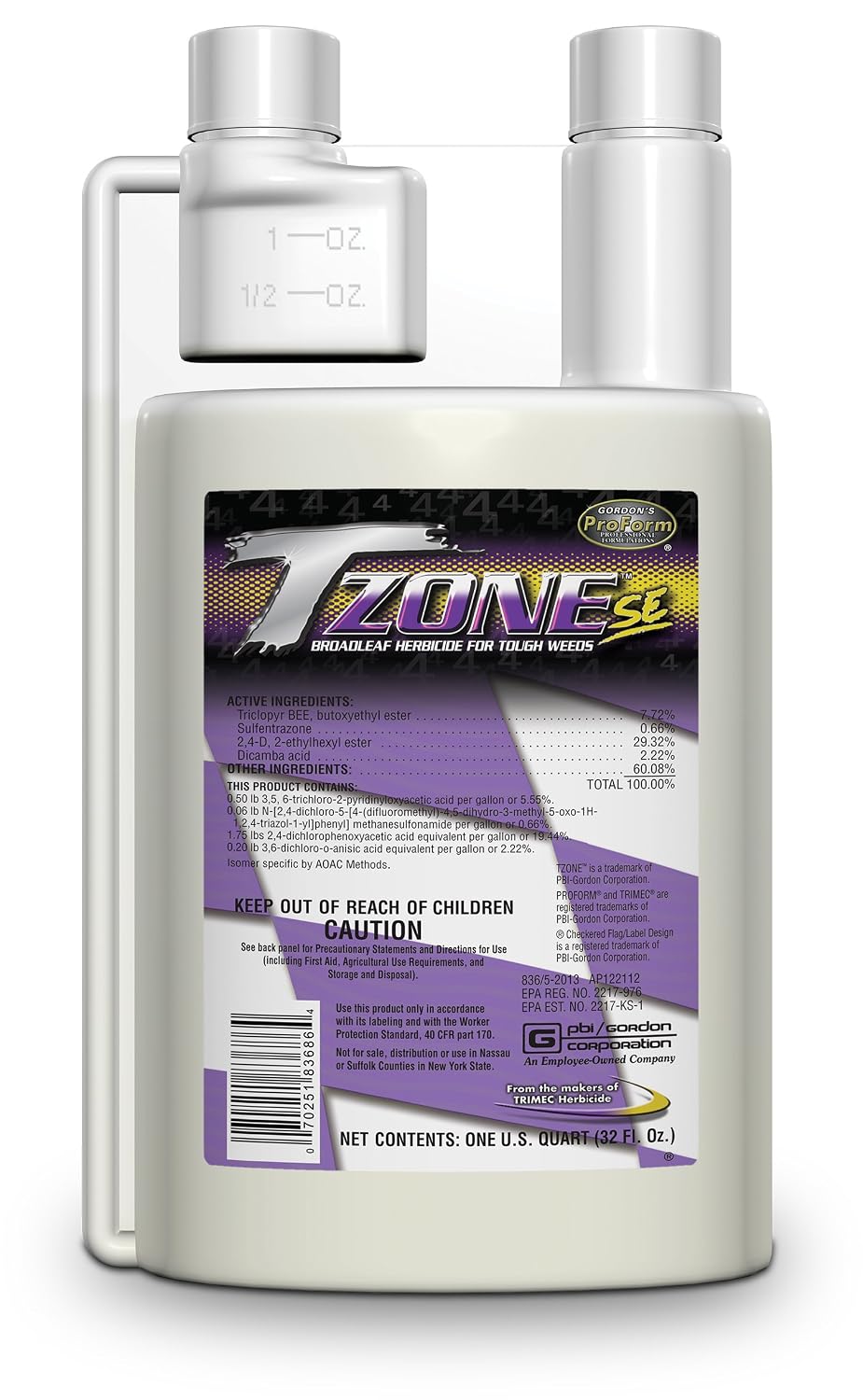
| Unit Count | 32 Fluid Ounces |
|---|---|
| Item Form | Liquid |
| Coverage | broad-leaf weeds, grassy weeds |
| Active Ingredients | Dicamba, triclopyr, others |
T-Zone Turf Herbicide is a concentrated liquid formula intended for spot and broadcast treatment of tough broadleaf and grassy weeds in lawns and turf areas. It contains multiple active ingredients including triclopyr and dicamba that give a fast visual response and help suppress difficult targets such as yellow nutsedge and oxalis when used according to label directions. Typical use is mixing to label rates and applying with a handheld sprayer or professional equipment on cool, calm days to avoid off-target movement. Notable features include suitability for residential, commercial, and golf sites and effectiveness at lower temperatures down to about 50°F. Practical benefits are reliable performance on persistent broadleaf weeds and a multi-ingredient formula that reduces the need for repeat applications. Important limitations are the need for protective gear during handling, restrictions and careful timing to prevent damage to desirable plants, and the potential for off‑target drift, so precise application technique is required.
Best for: Buyers who prioritize reliable, professional-strength control of persistent lawn weeds and who are comfortable following label directions and using proper protective equipment. Ideal for property owners or groundskeepers who need a solution that performs in cool weather and on challenging species.
Less Ideal for: Casual gardeners who want an all‑purpose, low‑risk product for mixed plantings or those unwilling to follow pesticide safety practices should consider gentler, selective options.
- Multi‑ingredient formulation targets a broad spectrum of stubborn broadleaf and grassy weeds
- Works in cool conditions (around 50°F) so seasonal timing is more flexible
- Fast visible weed control that can reduce repeat treatments
- Suitable for use on residential, commercial, and golf turf sites
- Contains potent active herbicides that require careful handling and PPE
- Risk of off‑target movement means application must be precise and weather‑aware
Verdict: Choose T-Zone when you need a dependable, professional-strength herbicide to knock back stubborn oxalis and other persistent turf weeds.
Scotts Liquid Turf Builder Plus 2 Weed Control Ready-To-Spray, 32 fl. oz.

| Item Form | Spray |
|---|---|
| Liquid Volume | 32 fluid ounces |
| Coverage | 6000 square_feet |
| Active Ingredients | Nitrogen |
Scotts Liquid Turf Builder Plus 2 Weed Control is a ready-to-use hose-end applicator that combines a quick nitrogen boost with post-emergent broadleaf weed control. You attach the bottle to a garden hose, spray evenly over the lawn when weeds are actively growing, and the product begins to curl and suppress listed weeds within days. Notable features include the 25-0-2 NPK formulation for a fast green-up, kill control for common weeds such as dandelions and clover, and a large advertised coverage area (up to 6,000 sq ft on warm-season turf). Practical benefits are speed and convenience for homeowners who want fertilizer and basic weed control in a single step without mixing concentrates. Important limitations are that it targets listed broadleaf weeds only and may cause temporary injury on some bermudagrass types, it should not be used on garden beds, and you must avoid watering for 48 hours after application for best effect. Stubborn weeds may need a repeat treatment in 3 to 4 weeks and applications should be avoided in temperatures above 85°F.
Best for: Homeowners who want a quick, low-effort way to fertilize their lawn and reduce common broadleaf weeds using a hose-on applicator and who prefer products with widespread use and clear instructions.
Less Ideal for: Gardeners seeking a targeted oxalis-only solution, professional applicators who need concentrated formulations, or anyone needing weed control in beds or non-listed turf types.
- Ready-to-spray hose-end applicator requires no measuring or mixing
- Provides quick nitrogen boost with 25-0-2 NPK formula for visible greening
- Controls a range of common broadleaf lawn weeds including dandelions and clover
- Large coverage claim (up to 6,000 sq ft on warm-season lawns) from a single 32 fl. oz. bottle
- Only controls listed broadleaf weeds and may not be effective on oxalis in all cases
- Not safe for use in garden beds or on non-listed grasses and can temporarily injure some bermudagrass
Verdict: A convenient ready-to-spray lawn fertilizer that also kills many common broadleaf weeds, ideal for homeowners who want fast green-up and basic weed control with minimal effort.
Roundup Weed & Grass Killer with Comfort Wand, 1.33 gal.

| Item Form | Liquid |
|---|---|
| Coverage | 400 sq. ft. |
| Liquid Volume | 1.33 gallons |
This 1.33 gallon Roundup Weed & Grass Killer comes with a Comfort Wand for one-touch continuous spray, making spot applications around flower beds, walkways, driveways, and fence lines straightforward. The formula is fast acting with visible results in as little as six hours and becomes rainproof in about 30 minutes, so treated areas are less likely to be washed away if weather changes soon after application. It claims control to the root of common tough weeds and grasses, which is useful for persistent patches including broadleaf species. The included wand simplifies targeted spraying and reduces hand fatigue compared with repeated small bottles. Coverage is listed at about 400 square feet, which makes it practical for small to medium problem areas. Important limitations are that it is a nonselective herbicide so it will damage desirable plants if drift or overspray occurs, and you must wait the specified days before replanting in treated spots. For cautious users follow label directions closely, apply on calm days, and keep people and pets away until the spray has dried.
Best for: Buyers who want a reliable, ready-to-use herbicide for spot-treating persistent weeds and prefer a simple wand applicator that reduces hand strain while delivering fast results.
Less Ideal for: People who need a selective treatment safe for lawns or mixed beds where desirable plants are nearby should look for a targeted or selective product instead.
- Fast visible results in as little as six hours
- Rainproof in about 30 minutes so treatments hold up to light rain
- Comfort Wand provides continuous one-touch spray for easier targeted application
- Covers up to 400 sq. ft., suitable for small to medium treatment areas
- Nonselective formula will kill desirable plants if it drifts or contacts them
- Requires waiting period before replanting in treated areas according to label
Verdict: A convenient ready-to-use herbicide with a comfort wand that gives fast, reliable control of tough weeds for small to medium outdoor treatment areas.
Choosing the Right Oxalis Weed Killer: Key Factors to Consider
Bulb and Tuber Control
Oxalis stores energy in small underground bulbs that can survive many seasons. Effective control requires a treatment that either destroys or exhausts those bulbs over multiple applications. A single application that only burns leaves will leave bulbs intact and allow regrowth within weeks.
When selecting a product, consider whether it is documented to affect underground structures or if it relies on repeated foliar treatments. Expect to plan for follow-up applications and mechanical removal in heavy infestations to reduce the bulb population over time.
Selectivity and Impact on Desirable Plants
Many treatments that kill oxalis can also harm nearby ornamentals or grass. Selective formulations or targeted spot-application techniques reduce collateral damage. Read label guidance on timing, dilution, and buffer distances from sensitive plants.
If you have mixed beds or a lawn with desirable groundcovers, choose an approach that allows precise application, such as a wicking applicator, gel formulas, or spot-sprays with shielded wands. For broad applications, accept that nonselective options will require replanting or patching of affected areas afterward.
Method of Application
How a product is applied affects both effectiveness and safety. Ready-to-use sprays and hose-end applicators are convenient for spot treatments, while concentrated liquids allow customization of dosage for larger areas. Granules may be less suited to penetrating dense oxalis foliage and bulbs.
Consider whether you can apply treatments accurately around delicate plants and whether the method fits the scale of infestation. Equipment needs, personal protective gear, and cleanup requirements should be balanced with the expected control benefits.
Environmental Persistence and Safety
Some active ingredients persist in soil, potentially affecting future plantings or beneficial soil organisms. Others break down faster but may require repeated use. Evaluate persistence in relation to your gardening goals-do you plan to replant soon, or is leaving a residual effect acceptable?
Also weigh runoff risks and whether the product can be used safely on slopes or near water. Choose options with clear label instructions to reduce environmental exposure and follow local regulations for application near waterways.
Speed of Control and Follow-Up Needs
Gardeners often want visible results quickly, but oxalis control typically requires patience. Some treatments show leaf yellowing or wilting within days, while true eradication of bulbs can take weeks to months and multiple treatments.
Plan for monitoring and scheduled follow-ups. Faster-acting products may still need repeat use to exhaust bulbs. Slow-acting but persistent options can reduce labor but may limit immediate replanting plans.
Safety for People and Pets
If children or pets use the garden, safety and re-entry intervals matter. Some treatments require keeping people and animals away until sprays dry or for a specified interval after application. Consider whether you can restrict access during treatment and whether you are comfortable storing and handling concentrated formulations.
Look for clear label instructions on protective equipment, first-aid measures, and disposal. When in doubt, opt for targeted, low-residue approaches or mechanical control combined with less persistent products.
Spot Treatment Strategies
For small patches or individual clumps, spot treatment limits harm to surrounding plants. Use a shielded sprayer or a wick applicator to place product directly on oxalis foliage. Repeat applications are often required to reach bulbs.
Mechanical removal combined with spot treatment improves results. Dig up visible clumps and immediately treat any remaining foliage or freshly exposed bulbs to reduce regrowth.
- Apply on calm days to avoid drift
- Treat when plants are actively growing for best uptake
- Mark treated areas to avoid double application
Treating Oxalis in Lawns
Lawn applications demand products that are selective for oxalis without harming turf. Spot-spraying rather than broadcasting reduces stress on grass. Time applications when turf is actively growing so it can recover faster from any incidental damage.
After treatment, expect dead spots where oxalis was dense. Plan for overseeding or targeted patching once oxalis has been suppressed and the soil is ready for new grass seed.
- Mow a few days before treatment to expose more leaf surface
- Avoid applying before heavy rain to reduce runoff risk
Managing Oxalis in Containers and Planters
Containers concentrate bulbs and make oxalis harder to eliminate. For small pots, physically removing soil and bulbs or repotting with fresh media is often the fastest solution. If using chemical control, apply carefully to avoid phytotoxicity to container plants.
When repotting, inspect root balls and gently tease out any bulbs. Replace at least some of the potting mix and use fresh, weed-free media to reduce recurrence.
- Check drainage holes for displaced bulbs
- Sterilize or replace contaminated potting mix when infestations are heavy
Timing and Seasonal Considerations
Apply treatments when oxalis is actively growing and before bulbs enter dormancy for best uptake of systemic products. Spring and early fall often give the best window. Avoid treating when plants are water-stressed or during extreme heat.
Follow label timing for any product-specific seasonal limits and plan follow-up applications at intervals recommended for bulb control.
- Early season applications can reduce seed and bulb development
- Monitor for resprouting and schedule follow-ups accordingly
Combining Mechanical and Chemical Methods
Relying solely on one control method rarely eliminates oxalis in heavy infestations. Digging, hand-pulling, and smothering reduce bulb numbers while targeted chemical treatments weaken remaining bulbs and prevent rapid recovery. Combining methods reduces chemical use overall.
After mechanical removal, apply a spot treatment to any remaining foliage or freshly disturbed bulbs to increase the chance of long-term control.
- Use mulch to suppress light penetration and reduce regrowth
- Repeat the cycle of removal and treatment as new shoots appear
How We Chose the Best Oxalis Weed Killer
We focused on treatments that address oxalis biology and common garden scenarios. Evaluation emphasized proven control of underground bulbs and rapid suppression of new shoots, along with safety around turf and ornamentals. We looked for products and application methods that minimize off-target damage, including selective formulations and spot-treatment options. Persistence and re-treatment requirements were considered so gardeners understand how often follow-up is likely. Ease of use, including application method, mixing, and cleanup, was weighed for typical backyard users. Environmental exposure risks were assessed by looking at runoff potential and how long active ingredients remain in the soil. We excluded products that only provide temporary top-growth suppression without addressing bulbs, as well as treatments unsafe for ordinary garden use or requiring professional licensing. The shortlist reflects treatments that balance bulb control, selectivity, safety, practicality, and reasonable re-treatment schedules.
FAQ
How long does it take to control oxalis after treatment?
Visible wilting or browning can occur within days, but full control of bulbs usually takes weeks to months and often requires repeat treatments. Expect to monitor and re-treat at recommended intervals.
Can I use a general weed killer on oxalis in my flower beds?
General nonselective weed killers will kill oxalis foliage but may also damage desirable plants. Use spot-application techniques or selective options that reduce harm to ornamentals, or protect nearby plants during application.
Is mechanical removal effective on its own?
Hand-pulling and digging reduce bulb numbers but often leave small bulbs behind that regrow. Mechanical removal is most effective when combined with follow-up chemical treatment or repeated removal over time.
Will treating oxalis harm my lawn permanently?
Spot treatments done correctly usually do not permanently damage turf. Broad applications of nonselective products can create dead patches that need overseeding. Use targeted methods and follow recovery practices like reseeding where necessary.
Are there safe options for gardens with pets and children?
Some methods require restricted access until sprays dry or for a labeled interval. Choose low-residue, targeted approaches and follow label guidance on re-entry and storage. Mechanical control and mulching are lower-risk complements.
How often should I re-treat a persistent oxalis patch?
Re-treatment frequency depends on the chosen product and severity of infestation. Many control plans call for follow-ups every few weeks until new shoots cease to appear, then periodic monitoring for recurrence.
Final Verdict
For successful oxalis control, prioritize methods that address underground bulbs while protecting desirable plants. Match application method to the infestation scale: spot tactics and mechanical removal for small patches, selective lawn products for turf, and repotting or media replacement in containers. Expect multiple treatments and plan for monitoring and follow-up. Balance speed of visible control with soil persistence and safety. Choosing a product that fits your garden layout, tolerance for follow-up work, and safety needs will lead to the most reliable long-term results.
