

Note: This article contains affiliate links. If you click on these links and make a purchase, I may earn a small commission at no extra cost to you. This helps support my research and content. Read my full affiliate disclosure here.
If you want consistent, vigorous growth from a hydroponic system you need a nutrient formula that dissolves reliably and delivers the right balance of elements. Choosing the right plant food for hydroponics matters because soilless systems lack the buffering and microbial help that soil provides. The wrong mix can cause rapid pH swings, nutrient lockout, or uneven growth. This guide covers seven shortlisted options that suit a range of hydro setups and crop types. We evaluated each pick on solubility, nutrient profile, and ease of use so you can match a formula to your system and plants. Read on to understand how these criteria influence day-to-day feeding and system maintenance.
Top Picks at a Glance
| Best Overall The best all-around choice for most situations | General Hydroponics Flora Series 3-Part Nutrient System, 1 qt Bottles |  |
| Best Quality Built to a higher standard if you want something more solid | General Hydroponics FloraSeries 3-Part Nutrient System (FloraMicro, FloraGro, FloraBloom), 16 oz each |  |
| Best Value The sweet spot between price and what you get | Haligo A&B Hydroponic Nutrient Solution (800 ml total, 8-pack dosing bottles) |  |
| Best Budget The cheapest option that still gets the job done reliably | Ahopegarden 800ml A&B Hydroponic Nutrients Liquid Plant Food |  |
| Highest Rated A top-rated pick with lots of positive feedback | Pegmapri Organic Liquid Plant Food, 8.45 fl oz Concentrated |  |
| Most Popular A crowd favorite that many people choose with confidence | TPS Nutrients Liquid Plant Food for AeroGarden and Hydroponics, 8 oz |  |
| Best Seller A high-volume bestseller chosen again and again | TPS Nutrients Liquid Plant Food for AeroGarden and Hydroponic Systems, 32 oz |  |
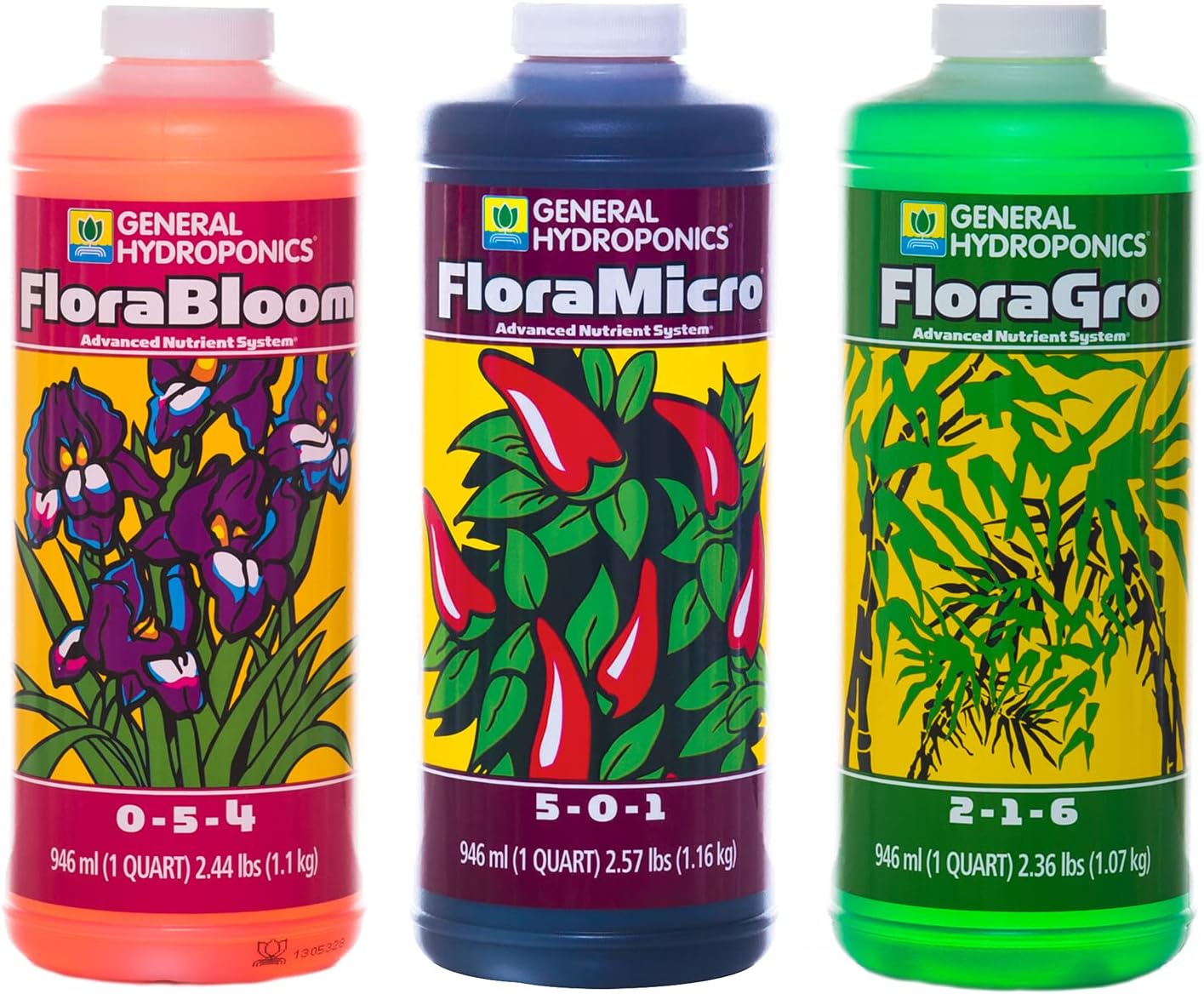
General Hydroponics Flora Series 3-Part Nutrient System, 1 qt Bottles
| Item Form | Liquid |
|---|---|
| Specific Uses For Product | Hydroponics |
| Included Components | FloraGro, FloraMicro, FloraBloom |
| Liquid Volume | 32 fluid ounces |
| Mixing Ratio | 1:1:1 |
The General Hydroponics Flora Series is a classic 3-part liquid nutrient system formulated to cover plants from seedling through flowering in hydroponic setups. You start with a reservoir of water and add FloraMicro first, then FloraGro and/or FloraBloom according to the growth stage and the recommended 1:1:1 mixing guidance. FloraMicro supplies nitrogen, calcium, and trace minerals, FloraGro boosts structural and vegetative growth with extra nitrogen and potassium, and FloraBloom supplies phosphorus, potassium, magnesium, and sulfur to support flowering and fruit development. The concentrate format gives you flexibility to tweak ratios for different crops or growth phases, and the 32 fl oz total volume is enough for multiple reservoir mixes. Important limitations are that you must monitor pH and EC separately and adjust quantities to your specific crop and system because the formula is not a single-solution feed for every situation. Users should also follow mixing order and dilution carefully to avoid nutrient lockup. For growers who want a proven, adjustable baseline nutrient program, Flora Series delivers practical, predictable results.
Best for: Growers who want a flexible, proven nutrient baseline for hydroponic systems and who prefer to tune feed ratios for both vegetative growth and flowering.
Less Ideal for: Beginners looking for a single-bottle, no-measure feed or growers who want a pre-mixed solution with automated dosing and monitoring built in.
- Complete three-part formula that covers macro and micronutrients for all growth stages
- Concentrated liquid bottles allow flexible ratio adjustments for different crops and growth phases
- Clear mixing order and 1:1:1 mixing guidance simplify initial setup
- Widely used, time-tested formulation with trace minerals and calcium included
- Requires separate pH and EC monitoring and adjustments for optimal results
- Not a one-step feed so it needs measuring and mixing for each reservoir
Verdict: Choose this if you want a versatile, time-tested three-part nutrient system that you can adjust across vegetative and flowering stages for hydroponic plants.
General Hydroponics FloraSeries 3-Part Nutrient System (FloraMicro, FloraGro, FloraBloom), 16 oz each

| Item Form | Liquid |
|---|---|
| Specific Uses For Product | Hydroponics |
| Coverage | Full |
| Liquid Volume | 48 fluid ounces |
| Mixing Ratio | 2:1 |
The General Hydroponics FloraSeries is a three-part concentrated nutrient system for hydroponic crops that separates primary, secondary, and micronutrients into FloraMicro, FloraGro, and FloraBloom so you can tailor feeds by growth stage. Typical use is simple: start with a reservoir of fresh water, add FloraMicro first, then FloraGro and/or FloraBloom per recommended mixing ratios and feed charts. The kit’s liquid concentrates give precise control over NPK and micronutrient balance, supporting vigorous vegetative growth with FloraGro and encouraging flowering and fruiting with FloraBloom. Practical benefits include flexible dosing for different strains and growth goals, easy integration into reservoir-based systems, and clear directions to avoid nutrient lockout. Important limitations are that it requires periodic EC/pH monitoring and some familiarity with feed charts to avoid over- or under-feeding, and it contains phosphorus so local runoff regulations may apply for non-hydroponic uses. For growers focused on performance, this system provides the building blocks to optimize nutrition across a full crop cycle.
Best for: Serious hobbyists and small commercial growers who prioritize crop performance and want full control over nutrient ratios throughout the crop cycle.
Less Ideal for: Beginners who prefer ready-to-use or single-solution fertilizers and gardeners who do not want to monitor reservoir EC and pH regularly.
- Three-part design separates micro, vegetative, and bloom nutrients for precise stage-specific feeding
- Liquid concentrates mix readily into reservoirs for consistent delivery in hydroponic systems
- Clear mixing order and feedcharts help prevent nutrient lockout when followed
- Suitable across a full crop cycle so one system covers vegetative and flowering stages
- Requires monitoring of EC and pH and some knowledge of feed schedules to get best results
- Contains phosphorus which may be regulated for non-hydroponic outdoor applications
Verdict: Buy this if you want a proven, stage-by-stage hydroponic nutrient system that gives precise control over feeding to maximize crop performance.
Haligo A&B Hydroponic Nutrient Solution (800 ml total, 8-pack dosing bottles)

| Item Form | Liquid |
|---|---|
| Specific Uses For Product | Root Development |
| Target Species | Herb |
| Liquid Volume | 800 centiliters |
| Mixing Ratio | 1:1 |
This Haligo A&B hydroponic nutrient is a two-part liquid fertilizer intended for indoor hydroponic systems such as Aerogarden and similar countertop growers. You mix measured amounts of part A and part B into water (manufacturer recommends 5 ml of each per 1 L) and add the solution to your reservoir on a regular feeding schedule. The product ships as multiple small dosing bottles totaling 800 ml and includes a dispensing cup for accurate measuring. Its pH-balanced, fully water-soluble formulation is targeted at root development and herb growth, which helps plants absorb nutrients efficiently in soilless setups. The compact bottles and clear mixing ratio make it easy to dose consistently, useful for growers who track feedings and want predictable results. Important limitations are that it is designed as a general A&B formula rather than a crop-specific recipe, so heavy-feeding vegetables or large systems may need higher volumes or supplemental formulations, and safety precautions are required when handling concentrated liquid nutrients.
Best for: Buyers who run small to medium indoor hydroponic systems and value predictable, easy-to-measure feedings to keep herbs and small vegetables healthy.
Less Ideal for: Growers managing large commercial systems or specialty crops that require tailored nutrient regimens should consider higher-volume or crop-specific nutrient programs instead.
- Two-part A&B formula tailored for hydroponics for balanced nutrient delivery
- Clear mixing ratio and included dispensing cup for consistent, easy dosing
- pH-balanced and fully water-soluble for efficient nutrient uptake in soilless systems
- Packaged as multiple small bottles that make regular feedings convenient and reduce waste
- General-purpose formulation may not meet the higher nutrient demands of large or heavy-producing hydroponic crops
- Product labeling requires careful handling and safety precautions due to concentrated liquid ingredients
Verdict: A practical two-part, pH-balanced A&B nutrient that makes accurate, repeatable feedings easy for small indoor hydroponic setups.
Ahopegarden 800ml A&B Hydroponic Nutrients Liquid Plant Food

| Item Form | Liquid |
|---|---|
| Specific Uses For Product | Hydroponic Nutrients, Plant Growth, Root Development, Seed Development |
| Target Species | Vegetables, Fruits, Flowers |
| Liquid Volume | 800 ml |
| Mixing Ratio | 1:1 (5ml A + 5ml B per 1L then use 1:200) |
This two-part Ahopegarden hydroponic nutrient comes as an 800 ml concentrate intended to feed plants through every growth stage in indoor hydroponic systems. You mix 5 ml of Solution A and 5 ml of Solution B into 1 L of water (a 1:200 working ratio) and dose that solution to your reservoir; the product separates incompatible minerals across two bottles to keep the formula stable and bioavailable. In practice it is easy to use for beginners thanks to clear directions and a marked cap for measuring, and the complete A&B formula means you do not need multiple specialty bottles for veg versus bloom phases. The concentrate should support many refill cycles, which helps stretch value for budget-minded growers. Limitations are typical of concentrated A&B systems: you must keep the two parts separate until mixing and follow the dosing precisely to avoid nutrient imbalance, and no N-P-K breakdown or micronutrient list is provided on the label for fine-tuning advanced nutrient programs.
Best for: Growers who want an affordable, all-in-one hydroponic nutrient that is easy to measure and stretches across multiple refill cycles for year-round indoor vegetables and herbs.
Less Ideal for: Advanced hobbyists who need exact N-P-K and micronutrient specifications or growers running specialized nutrient regimens will want a product with full analytical data.
- Large 800 ml concentrate provides enough solution for multiple grow cycles
- Two-part A&B formulation keeps incompatible minerals separate for stable potency
- Simple, marked cap and clear mixing instructions make it beginner-friendly
- Marketed as complete full-cycle feed suitable for vegetables, fruits, and flowers
- Label does not list a detailed N-P-K or full micronutrient breakdown for precision feeding
- Requires careful mixing of two parts and accurate dosing to avoid imbalance
Verdict: Ahopegarden's 800 ml A&B concentrate is a budget-friendly, easy-to-use complete feed that stretches across many hydroponic cycles for reliable full-cycle indoor growing.
Pegmapri Organic Liquid Plant Food, 8.45 fl oz Concentrated

| Item Form | Liquid |
|---|---|
| Specific Uses For Product | Plant Growth, Root Development, Seed Development, Soil Conditioning |
| Application Method | Watering can, Drip irrigation, Soil drenching |
| Target Species | Houseplants |
| Liquid Volume | 8.45 fluid ounces |
This Pegmapri liquid plant food is a small, concentrated bottle designed to stretch into multiple gallons of ready-to-use nutrient solution for houseplants, herbs, vegetables, and flowers. You use it by diluting the concentrate in water for routine watering, soil drenching, drip irrigation, or hydroponic feedings. Notable features include an all-purpose organic nutrient blend, fast root uptake compared with granular slow-release feeds, and a low-residue formula meant to avoid clogging pumps and lines. In practice it provides quick, visible green-up and supports root and stem development when applied at regular intervals. The compact, leak-resistant bottle is convenient for storage and precise pouring. Limitations are that the product listing does not show an NPK breakdown or specific dosing chart on the product page, so users should follow included directions carefully or start at reduced strength to avoid overfeeding sensitive plants.
Best for: Buyers who prioritize a dependable, easy-to-use feed for routine indoor container gardening and want a concentrated organic option that works across watering and hydroponic systems.
Less Ideal for: Growers who require exact nutrient formulations for advanced fertilization schedules or commercial-scale nutrient management should consider products with full lab-verified analyses and detailed dosing charts.
- Concentrated formula that dilutes to feed multiple gallons, saving shelf space
- Organic nutrient blend suitable for indoor and outdoor container plants
- Water-soluble and low-residue so it works with watering cans, drip systems, and hydroponics
- Fast root uptake to encourage quicker green-up and root development
- No explicit NPK ratio or full ingredient breakdown provided in the product details
Verdict: A compact, concentrated organic liquid fertilizer that reliably feeds indoor container plants and hydroponic setups for steady growth and stronger roots.
TPS Nutrients Liquid Plant Food for AeroGarden and Hydroponics, 8 oz

| Item Form | Liquid |
|---|---|
| Specific Uses For Product | Plant Growth, Root Development |
| Target Species | Herb, Vegetable |
| Mixing Ratio | 5 mL (1 tsp) per quart of feedwater |
| Unit Count | 8 Fluid Ounces |
This 8 oz liquid plant food provides concentrated, reservoir-safe nutrition intended for AeroGarden and comparable hydroponic units. It is used by mixing the recommended 5 mL per quart of feedwater into the system reservoir on a regular feeding schedule to supply macro and micronutrients for herbs, greens, and other compact edible plants. Notable features include a liquid formulation that dissolves easily, a focus on root development, and explicit compatibility with indoor hydroponic gardens. In practice it simplifies feeding for small indoor crops because a measured teaspoon per quart is straightforward to dose and store. Important limitations are the small bottle size, which will require frequent repurchasing for larger or multiple units, and the need to follow dilution directions carefully to avoid overfeeding. Safety handling is necessary because the concentrate should be kept away from children and pets. For risk-averse growers, the product’s clear mixing ratio and hydroponic focus make predictable feeding simple, but you should track reservoir concentrations rather than guessing frequency or volume adjustments.
Best for: Buyers who want a simple, low-risk feeding routine for indoor green onions and other small edible hydroponic crops and prefer clear dosing instructions they can follow reliably.
Less Ideal for: Growers managing large hydroponic setups, outdoor beds, or those who need a detailed NPK profile for tailored nutrient programs should look for larger or fully specified concentrates.
- Designed specifically for AeroGarden and similar hydroponic systems for straightforward compatibility
- Liquid formula mixes easily for even nutrient distribution in the reservoir
- Clear mixing ratio (5 mL per quart) simplifies dosing and repeatable feeding
- Targets root development and steady growth for herbs and vegetables
- Small 8 oz bottle may not last long for multiple or larger units
- No full nutrient analysis or NPK breakdown provided on the product listing
Verdict: A compact, easy-to-dose liquid fertilizer that makes predictable feeding of indoor green onions simple and low risk.
TPS Nutrients Liquid Plant Food for AeroGarden and Hydroponic Systems, 32 oz

| Brand | TPS NUTRIENTS |
|---|---|
| Unit Count | 32 Fluid Ounces |
| Item Form | Liquid |
| Specific Uses For Product | Plant Growth, Root Development |
| Mixing Ratio | 5 mL per quart of feedwater |
This liquid plant food is designed specifically for AeroGarden and comparable indoor hydroponic setups, delivering a balanced nutrient mix in a ready-to-dilute liquid form. You mix the recommended 5 mL per quart of feedwater and add it to the system reservoir on your regular feeding schedule. Because it is reservoir-safe and made for hydroponic use, it dissolves easily, supports steady vegetative growth and root development, and is suitable for herbs, leafy greens, and other compact indoor plants. Practical benefits include a concentrated 32 oz bottle that lasts for many feedings and clear directions that simplify dosing for routine maintenance. Important limitations are that it is formulated for general growth rather than crop-specific bloom or fruiting boosts, and safe handling precautions are required since it is a concentrated chemical solution. For someone looking for an easy-to-use, hydroponic-specific nutrient to maintain healthy indoor plants, this product gives predictable, consistent results when used as directed.
Best for: Buyers who want a reliable, easy-to-use nutrient for indoor hydroponic herb and salad gardens and who prioritize predictable, low-maintenance feeding routines.
Less Ideal for: Gardeners focused on heavy fruiting or bloom enhancement who need crop-specific bloom or bloom-boosting formulations should look elsewhere.
- Formulated for AeroGarden and similar indoor hydroponic systems so it integrates into reservoir feeding routines
- Liquid concentrate mixes easily and uses a simple 5 mL per quart dosing guideline
- Supports steady vegetative growth and root development for herbs and leafy greens
- Large 32 oz bottle provides many feedings for small indoor gardens
- Designed as a general growth formula and not tailored for flowering or high-yield fruiting stages
- Contains concentrated chemicals so safe handling and storage are required
Verdict: A straightforward, hydroponic-specific liquid concentrate that delivers consistent, low-effort nutrition for indoor herbs and leafy greens.
Choosing the Right Plant Food for Hydroponics: Key Factors to Consider
Nutrient Profile and Ratios
A complete nutrient profile lists macronutrients (nitrogen, phosphorus, potassium) and the secondary and micronutrients plants need in hydroponics. Ratios matter because they influence vegetative growth, root development, and flowering. For example, higher nitrogen favours leafy growth while higher phosphorus and potassium support blooms and fruit. Knowing the intended crop and growth stage helps you choose a formula with the right balance.
Incomplete or poorly balanced mixes force you to supplement individual elements, which adds complexity and potential dosing error. Look for formulas with clear percentages and guidance for stage-specific feeding so you can maintain appropriate EC and avoid deficiencies or toxicities.
Solubility and Reservoir Clarity
Hydroponic plant food must dissolve cleanly and remain in solution without forming particulates that clog pumps, emitters, or drip lines. Poorly soluble powders or concentrates that leave residue increase maintenance and raise the risk of blockages in small emitters and filters.
Formulas that produce clear solution and minimal sediment reduce the need for frequent reservoir cleaning and lower the chance of biofilm hotspots. Consider how a product behaves at the concentrations you intend to use and whether it requires pre-dissolving or separate A/B mixing to avoid precipitation.
Ease of Dosing and Measurement
Accurate dosing is central to hydroponic success because changes in concentration show immediate plant response. Products with straightforward mixing instructions, measured scoops, or dosing tables tied to EC/ppm values make routine feeding easier. Liquid concentrates that include clear dilution ratios or granular mixes with a supplied scoop reduce guesswork.
Complex regimens that require many separate supplements increase the chance of error. If you are running multiple reservoirs or swapping crops frequently, choose a formula that simplifies routine measurement and record keeping so you can reproduce successful feeds.
pH Impact and Stability
Soilless systems have limited pH buffering, so the acid or base load of a feed can shift reservoir pH rapidly. Choose plant food that either has minimal pH impact or comes with clear instructions on expected pH change after dosing and how to adjust. Some formulas are formulated to be pH-neutral once mixed, while others require routine correction.
Frequent pH swings reduce nutrient availability and stress roots. Consider the typical pH drift of a formula at the concentrations you will use and whether your system includes a reliable way to monitor and correct pH between feedings.
Compatibility With Hydro Systems
Different hydro systems present different demands. Recirculating deep water culture or NFT channels need ultra-clear solutions and low sediment to protect pumps and channels. Ebb-and-flow systems and drip setups may tolerate slight particulates but still benefit from soluble feeds. Foliar sprays and fertigation setups often require very fine particulate size to avoid nozzle clogging.
Match a nutrient's physical form and mixing instructions to your setup. Also consider how often you change reservoirs and whether the formula requires separate A and B solutions to avoid precipitation in concentrated form.
Concentration, EC Targets, and Crop Guidance
A good hydroponic plant food provides target electrical conductivity or ppm ranges for different crop stages. Those targets let you calibrate concentration for seedlings, vegetative growth, and flowering. Without target EC ranges you are guessing, which risks underfeeding or overfeeding sensitive crops.
Products that include clear charts for common crops and stages reduce the learning curve. Pay attention to recommended maximum concentrations and any cautions about young plant roots or transplant shock, as seedlings typically need much lower EC than mature plants.
Stage-Specific Feeding Strategies
Hydroponic crops benefit from feeds tailored to their growth stage. Seedlings and clones need a milder, lower-EC solution with a modest nutrient load to avoid osmotic stress. During vegetative growth increase nitrogen relative to phosphorus and potassium to support leaf and stem buildup. For flowering or fruiting switch to higher phosphorus and potassium while maintaining adequate calcium and magnesium.
Implement changes gradually over several feedings and monitor plant response and EC. Sudden jumps in concentration or dramatic ratio shifts often cause stress or nutrient imbalances.
- Start seedlings at a fraction of the recommended EC and raise gradually
- Use clear EC/ppm targets when increasing feed strength
- Adjust stage transitions based on plant appearance and root health
Managing Reservoirs and Preventing Clogs
Reservoir maintenance reduces system failures. Strain solution when refilling, and clean pumps and filters regularly to prevent buildup of residues or biofilm. Some feeds deposit more sediment than others, so schedule inspection intervals based on how a product behaves in your system.
When using drip or micro-spray emitters, flush lines frequently and consider a fine inline filter. If you notice a pattern of clogging after switching formulas, try pre-dissolving the feed in a separate container or using the product at a slightly lower concentration.
- Use inline strainers and replace filters on a schedule
- Pre-dissolve powders to check for undissolved particles
- Flush tubing between crop cycles to clear accumulated residue
Monitoring EC and Adjusting Feed Strength
EC meters give you objective control over nutrient strength. Establish baseline EC targets for your crop and system and log readings after each feed. If EC climbs between feedings, that indicates either plant uptake lagging behind evaporation or buildup due to insufficient reservoir changes.
Adjust concentration slowly and keep detailed notes. When plants show signs of deficiency or excess, cross-check EC, pH, and root condition before changing feeds to avoid compounding issues.
- Record EC and pH after each reservoir change
- Lower EC if roots appear burned or leaves show tip burn
- Increase EC incrementally when growth is sluggish but pH and roots look healthy
Supplementing Calcium and Magnesium
Calcium and magnesium are commonly limiting in hydroponic setups, especially in soft water regions. Some base formulas include these elements, but many growers add a dedicated calcium-magnesium supplement to prevent blossom end rot and support strong cell walls. Adding these separately also allows you to correct deficiencies without altering macro ratios.
When adding calcium or magnesium, follow manufacturer guidance and measure EC and pH since these supplements alter both. Apply supplements in small increments and observe plant response over several days.
- Test for calcium and magnesium deficiency signs like weak new growth
- Use dedicated supplements when base formulas omit adequate secondary nutrients
- Add supplements slowly and monitor EC and pH
Adapting Formulas for Different Crops
Leafy greens, herbs, and fruiting crops have distinct nutrient needs. Leafy greens prioritize nitrogen and faster feed cycles, while tomatoes and peppers need more potassium and calcium during fruit set. Adjust not just concentration but feeding frequency to match crop uptake patterns.
If you grow mixed crops in a single system, aim for a compromise formula or segregate species by system. Trying to optimize one formula for vastly different crops often leads to underperformance for some plants.
- Use higher nitrogen for rapid leaf production crops
- Increase potassium and calcium during flowering and fruiting
- Consider separate reservoirs for crops with different EC targets
How We Chose the Best Plant Food for Hydroponics
We focused on attributes that actually affect hydroponic success. Primary evaluation criteria were nutrient profile balance and completeness, solubility and clarity in water, ease of dosing and measurement, pH stability after feeding, and compatibility with common hydroponic systems and crop stages. Each product had to offer clear analysis by weight for N-P-K and essential secondary and micronutrients so we could judge whether it supports vegetative growth, flowering, or both. We excluded formulas that require soil or substantial microbial supplements to function because they do not suit true hydroponic setups. We also filtered out poorly documented products lacking a detailed ingredient breakdown or mixing guidance. Additional checks included manufacturer guidance for EC/ppm targets and any reported compatibility with typical reservoir volumes and circulation patterns. The result is a list emphasizing predictable solubility, consistent nutrient ratios, and practical dosing that gardeners can apply in common hydro systems.
FAQ
How often should I change my hydroponic reservoir?
Frequency depends on crop load and system size but often ranges from one to two weeks. High-demand crops or small reservoirs may need more frequent changes. Monitor EC drift and root color to decide when a refresh is necessary.
Can I mix different plant food formulas together?
Mixing formulas can cause precipitation or unpredictable ratios. If you must combine products, follow dilution guidance and avoid mixing concentrated solutions directly. Pre-dissolve and inspect for cloudiness before adding to the reservoir.
What EC range should I aim for with most leafy greens?
Leafy greens typically do well at lower EC ranges than fruiting crops. A common target range is moderate and conservative; adjust upward slowly as plants mature. Always monitor plant response rather than relying on a single number.
How do I correct a deficiency without disturbing my whole system?
Identify the limiting nutrient via symptoms and test results, then apply a targeted supplement in small, measured doses. Use separate solution top-ups rather than large reservoir dumps so you can monitor plant response and avoid sudden EC or pH swings.
Are liquid concentrates better than powdered formulas for hydroponics?
Both types have pros and cons. Liquids dissolve quickly and are convenient for frequent small feeds, while powders are economical and stable in storage. Choose based on how often you feed, storage constraints, and whether your system tolerates any particulates.
Will tap water affect how I dose plant food?
Yes. Tap water mineral content changes starting EC and can supply calcium or other elements. Always test your source water and subtract baseline EC from your target when mixing nutrient solutions.
Final Verdict
Pick a hydroponic plant food that matches your crop stage and system type. Prioritize clear solubility and a documented nutrient profile so you can set reliable EC and pH targets. Expect tradeoffs between simplicity and fine-tuned control: single-solution feeds are easier to manage while multi-part programs offer precision for demanding crops. Focus on predictable mixing, routine reservoir maintenance, and monitoring EC and pH. With those priorities, you can choose a formula that keeps roots healthy, cuts maintenance time, and supports consistent yields in a soilless setup.
