

Note: This article contains affiliate links. If you click on these links and make a purchase, I may earn a small commission at no extra cost to you. This helps support my research and content. Read my full affiliate disclosure here.
Finding plants that thrive in rooms without natural light is possible if you match species to the actual conditions of the space. In dim hallways, windowless bathrooms, or offices lit only by fluorescent bulbs, some plants survive and even grow on low light and minimal care. This guide shortlists six reliable indoor plants suitable for those situations and explains why each made the list. We focus on how each plant behaves in real indoor settings and what routine care looks like, evaluating light tolerance and maintenance needs to help you choose the best greenery for your room.
Top Picks at a Glance
| Best Overall The best all-around choice for most situations | Costa Farms ZZ Plant — Live Indoor Air‑Purifying Houseplant |  |
| Best Quality Built to a higher standard if you want something more solid | Tropical Plants of Florida ZZ Plant (Zamioculcas zamiifolia) in 6" Nursery Pot |  |
| Best Value The sweet spot between price and what you get | Plants for Pets Essential Houseplant Collection, 4‑Pack (4.25" Nursery Pots) | 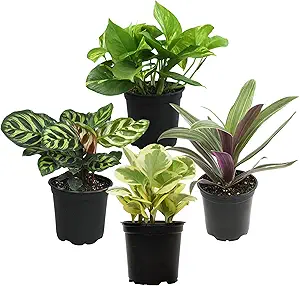 |
| Best Budget The cheapest option that still gets the job done reliably | Der Rose 2-Pack Mini Pink Artificial Succulents in White Pots |  |
| Highest Rated A top-rated pick with lots of positive feedback | BACAMA Faux Hanging Eucalyptus Plant in White Pot (1 pc) |  |
| Most Popular A crowd favorite that many people choose with confidence | Costa Farms Snake Plant (Sansevieria) live indoor plant in decorative pot |  |
Costa Farms ZZ Plant — Live Indoor Air‑Purifying Houseplant

| Indoor Outdoor Usage | Indoor |
|---|---|
| Other Special Features | Air Purification, Drought Tolerant, Low Maintenance |
| Sunlight Exposure | Partial Sun |
| USDA Hardiness Zone | 9-11 |
| Moisture Needs | Little To No Watering |
The Costa Farms ZZ Plant is a resilient, compact indoor houseplant suited to tabletops, shelves, and low-light corners. It’s grown to arrive in a 6-inch plastic grower pot and displays upright, glossy leaf clusters that add structured, modern greenery to a room. Typical use is simple: place the plant in medium indirect to low light and water sparingly — roughly one cup every two weeks — allowing soil to drain and avoid standing water. Notable features include drought tolerance, low maintenance needs, and suitability across a wide range of indoor light levels, which makes it a good pick for busy households or offices. Practical benefits are minimal care time, attractive vertical form that fits small spaces, and modest air-purifying properties. Important limitations are that it is a slow grower so it does not become a large statement plant quickly and the included plastic grower pot has no drainage holes which requires care when watering or repotting. Also it is hardy in warmer zones indoors and needs protection from freezing temperatures during transport or delivery.
Best for: Buyers who want a fuss-free, attractive indoor plant that tolerates low light and irregular care and who prefer a dependable, low-maintenance addition for desks, shelves, or small living spaces.
Less Ideal for: Anyone who wants a fast-growing, large statement plant or a bloom-producing specimen for seasonal flowers should choose a different species.
- Very low water needs and drought tolerant for infrequent watering schedules
- Thrives in low to medium indirect light making it suitable for offices and dim rooms
- Glossy, upright foliage provides a tidy, modern look for small spaces
- Arrives in a ready-to-display grower pot and transfers easily to decorative containers
- Slow growth means it will take time to reach larger sizes
- Shippped grower pot lacks drainage holes so repotting or careful watering is needed
Verdict: A no-fuss, low-light tolerant houseplant that delivers attractive glossy foliage and minimal care requirements for busy indoor spaces.
Tropical Plants of Florida ZZ Plant (Zamioculcas zamiifolia) in 6" Nursery Pot

| Indoor Outdoor Usage | Indoor, Outdoor |
|---|---|
| Other Special Features of the Product | Air Purification, Compact, Drought Tolerant, Low Maintenance |
| Sunlight Exposure | Partial Sun |
| USDA Hardiness Zone | 9, 10, 11 |
| Moisture Needs | Little To No Watering |
The ZZ Plant (Zamioculcas zamiifolia) is a resilient, performance-focused houseplant suited to low- or no-sun interiors like offices, bathrooms, and windowless rooms. Arriving in a 6-inch grower pot, it produces upright stems of glossy green leaflets that keep their shape with minimal intervention. Care is straightforward: place in low to bright indirect light and water only when the top inch of soil is dry so the pot drains fully. Notable features include drought tolerance, low maintenance needs, and reported air-purifying qualities, which make it forgiving for busy owners or frequent travelers. Because it tolerates low light better than many houseplants, it functions well as a decorative, long-lived green accent where light is limited. Important limitations are that it prefers indirect light for best growth and is susceptible to overwatering, which causes yellowing; it is not a fast grower, so you should not expect rapid size gains. For someone prioritizing dependable, low-effort greenery in low-light spaces, the ZZ Plant delivers consistent, attractive results.
Best for: Buyers who want a dependable, low-effort green accent for low-light rooms and prioritize a plant that survives neglect while still looking polished.
Less Ideal for: People seeking a fast-growing statement plant or someone who wants flowering houseplants or bright direct-sun lovers.
- Tolerates low to bright indirect light making it suitable for windowless or dim spaces
- Very drought tolerant and forgiving of infrequent watering
- Compact size from the 6-inch nursery pot fits desks, shelves, and small corners
- Glossy, upright foliage provides year-round decorative interest and air-purifying benefits
- Slow grower compared with faster houseplants
- Sensitive to overwatering and root rot if not allowed to dry between waterings
Verdict: If you need a low-light, low-maintenance plant that stays healthy with minimal care, the ZZ Plant is a top practical choice.
Plants for Pets Essential Houseplant Collection, 4‑Pack (4.25" Nursery Pots)

| Indoor Outdoor Usage | Indoor, Outdoor |
|---|---|
| Other Special Features of the Product | Air Purification, Compact, Low Maintenance |
| Sunlight Exposure | Partial Sun |
| Moisture Needs | Regular Watering |
This four-pack of assorted houseplants delivers a convenient starter set for low-light indoor spaces by shipping four healthy greenhouse-grown plants in 4.25" nursery pots. The assortment includes popular, easy-care genera such as Pothos, Philodendron, Peperomia, Calathea and similar foliage plants that tolerate indirect or lower light. Typical use is to place these on shelves, desks, or bathrooms with limited sunlight and follow simple care guidance: bright indirect to partial sun and water when the soil begins to dry. Notable features are the hand-selected stock from climate-controlled greenhouses, small nursery pots for easy placement, and emphasis on low maintenance and air purification. Practical benefits include variety in foliage types for quick visual impact, minimal initial upkeep for new plant owners, and plant choices that broadly tolerate lower light. Important limitations are the small pot size which means more frequent watering and earlier repotting for long-term growth, and the exact varieties are randomized so you cannot guarantee a specific species in each pack.
Best for: Buyers who want a practical, low-effort way to add greenery to dim rooms and prefer a ready-to-place assortment that requires minimal initial care.
Less Ideal for: Collectors who need specific species or mature specimens and gardeners who want plants already planted in decorative or larger containers.
- Includes four different, easy-care houseplants that tolerate indirect and lower light
- Shipped in small 4.25" nursery pots that are easy to place around the home
- Plants are greenhouse-grown and hand-selected for health and vibrant foliage
- Promoted as low-maintenance with general air purification benefits
- Small nursery pots limit long-term growth and require repotting sooner
- Assortment is randomized so you may not receive a specific desired variety
Verdict: A convenient, low-maintenance four-pack of small houseplants that makes it easy to add tolerant foliage to low-light indoor spaces.
Der Rose 2-Pack Mini Pink Artificial Succulents in White Pots

| Pack quantity | 2 |
|---|---|
| Material | Plastic |
| Pot style | White plastic pot with gold stripe |
| Care | No watering or sunlight required |
These two mini artificial succulents are designed as petite, decorative accents for rooms that lack natural light. Each faux plant comes pre-potted in a small white plastic pot with gold stripes and tiny pebbles for a finished look, and the set includes two slightly different heights so they can be grouped on a desk, shelf, or bathroom ledge. Made from molded plastic, the leaves are colored to appear lifelike and require no watering or sunlight, which makes them an easy way to add color to dim spaces or windowless rooms. The compact footprint fits crowded desks and dorm rooms and the durable plastic construction tolerates occasional handling. Limitations are that they are very small so they do not make a large visual statement on their own, and the plastic material is not a substitute for the texture and depth of live plants. For someone who wants instant, no-care pink decor in a low-light room these are a practical, budget-friendly option.
Best for: Buyers who want an inexpensive, no-maintenance way to add color and a finished decorative touch to desks, bathrooms, or dorm rooms that receive little or no natural light.
Less Ideal for: Shoppers seeking a large visual focal plant or the texture and air-quality benefits of live plants should consider larger artificial arrangements or live low-light houseplants instead.
- Realistic-looking molded leaves and colored finish create a lifelike appearance without maintenance
- Comes as a coordinated 2-pack with slightly different heights for grouped styling
- Pre-potted in decorative white pots with gold stripes and pebbles for ready display
- Requires no water or sunlight, ideal for windowless rooms or low-light spaces
- Very small size limits impact as a standalone focal piece
Verdict: A cheap, ready-to-display pair of realistic pink faux succulents that add color to windowless rooms with zero upkeep.
BACAMA Faux Hanging Eucalyptus Plant in White Pot (1 pc)

| Plant or Animal Product Type | Eucalyptus |
|---|---|
| Recommended Uses For Product | indoors |
| Material Type | Polypropylene |
| Additional Features | Eco-Friendly, Lightweight, Tear Resistant, Water Resistant |
This BACAMA faux eucalyptus comes as a trailing vine set in a compact white plastic pot intended for shelves, hanging displays, or small tabletops. The vine is about 60 cm long with 11 leaf trails and a handful of decorative stones in the pot to help it sit stably. Made from polypropylene, the leaves are tear and water resistant which makes it low maintenance and suitable for bathrooms or kitchens where real plants struggle. Its lightweight construction and neutral light green color make it easy to reposition or layer on a floating shelf or in a hanging nook. Expect minor plastic odor out of the package and the stems may need a few minutes of adjustment to get a natural drape. Because it is a small, decorative piece it does not replace larger hanging baskets but it is a good no-care option to add greenery to compact indoor spaces.
Best for: Buyers who want a low-maintenance, realistic hanging accent for small indoor spots like shelves, bathrooms, or bedside spaces and who prioritize ease of placement over live-plant care.
Less Ideal for: People seeking a large, lush living hanging basket or those who prefer natural plants for air-purifying or seasonal variety.
- Realistic trailing shape with 11 eucalyptus leaf trails for natural-looking drape
- Lightweight and easy to hang or place on shelves
- Water resistant and tear resistant polypropylene material for low maintenance
- Comes in a small pot with stones for stable display without extra work
- Small size suited for accents rather than filling large hanging baskets
- May have a mild plastic smell initially that requires airing out
Verdict: A fuss-free, realistic eucalyptus trailing plant that instantly adds greenery to small indoor hanging or shelf displays without any watering or upkeep.
Costa Farms Snake Plant (Sansevieria) live indoor plant in decorative pot

| Indoor Outdoor Usage | Indoor |
|---|---|
| Other Special Features of the Product | Air Purification, Drought Tolerant, Low Maintenance |
| Sunlight Exposure | Partial Sun |
| USDA Hardiness Zone | 3 |
| Moisture Needs | Moderate Watering |
This Costa Farms Snake Plant is a compact, low-maintenance Sansevieria sold ready-to-display in a decorative pot. It provides upright, architectural foliage that works well on a windowsill or narrow spot and is commonly used to add vertical interest to living rooms, offices, or bedrooms. The plant is drought tolerant and thrives in a wide range of light conditions, so it adapts to an east-facing window where morning sun and bright indirect light are typical. Notable features include air-purifying qualities, simple care instructions (bright indirect light and light weekly watering), and a reputation for longevity when not overwatered. Practical benefits are easy placement, minimal daily attention, and durable growth even for beginners. Important limitations are that it does not bloom and care still requires avoiding consistently soggy soil; varieties may differ in leaf pattern so appearance is not guaranteed. For buyers prioritizing a resilient, low-effort plant that performs well in morning sun, this is a sensible choice.
Best for: Buyers who want a resilient, easy-care houseplant that performs reliably in an east-facing window and requires minimal daily attention.
Less Ideal for: Anyone seeking a flowering or fast-growing showy specimen for seasonal color or rapid canopy filling.
- Very low maintenance and drought tolerant, suitable for busy owners
- Tolerates a wide range of light including bright indirect morning sun common to east windows
- Provides vertical, architectural foliage that fits narrow spots and enhances decor
- Marketed with air-purifying properties to improve indoor air quality
- Does not produce blooms and offers primarily foliage interest
- Appearance may vary between individual plants since varieties are hand-selected
Verdict: Choose this Snake Plant when you need a low-effort, durable houseplant that thrives in morning sun and adds structured foliage to an east-facing window.
Choosing the Right Plants for Rooms Without Natural Light: Key Factors to Consider
Actual Light Levels Versus Perception
Rooms without natural light are not all identical. Hallways with indirect ambient light and a windowless bathroom with a light fixture produce very different photon levels. Assess the space at different times of day and note whether artificial lights are on for long periods. A plant rated for low light will survive in a dim space but still needs some light to avoid legginess and pale leaves.
Measure light roughly by observing shadow clarity: soft, faint shadows mean low light, while no discernible shadow is near darkness for plants. Positioning within the room matters. Moving plants closer to doorways, skylights, or under a lamp can make the difference between surviving and thriving.
Watering Style and Soil Drainage
Many indoor plant failures in low-light rooms come from overwatering. Reduced light lowers a plant's water use, so soil stays moist longer and root rot risk rises. Choose species that tolerate irregular schedules and opt for well-draining potting mix to prevent waterlogging.
Consider container size and drainage holes. Smaller pots dry faster but need more frequent attention, while larger pots retain moisture and hide wet soil problems. Aim for a watering routine tied to the pot and plant, not a calendar. A finger test or simple moisture meter helps you water only when the top inch of soil is dry.
Growth Rate and Size Management
Plants in low light often grow slowly and can become leggy as they reach for light. Understanding typical growth habits helps you plan pot size and pruning. Choose species that retain a compact form or respond well to trimming to keep proportions appropriate for the room.
Regular light pruning improves shape and reduces the risk of stems bending toward scarce light sources. If space is very tight, prefer slow-growing varieties or plan to rotate and relocate plants periodically to balance light exposure and maintain attractive structure.
Tolerance of Indoor Climate
Windowless rooms can have different climate issues: poor air circulation, stable but cooler temperatures, or artificially warmed air from HVAC. Plants that are forgiving of temperature swings and low humidity will fare better. Check typical indoor ranges for the species and how they handle dry winter air or central heating.
Some low-light plants are tropical and appreciate humidity, while others tolerate dry rooms. You can raise humidity with pebble trays or occasional misting for sensitive species, but heavy-handed humidity solutions are not a substitute for choosing a plant suited to the baseline indoor climate.
Maintenance and Pest Vulnerability
Routine tasks such as dusting leaves, checking for pests, and occasional feeding matter more in low-light rooms because stressed plants show problems slowly. Dust blocks light and reduces photosynthesis, so smooth-leaved plants need occasional cleaning. Inspect plants regularly for scale, spider mites, or mealybugs-these pests find hiding places in dim corners.
Select plants with robust pest resistance if you prefer lower maintenance. If you spot pests early, isolated treatment and improved air circulation usually control outbreaks without heavy intervention.
Safety and Placement Around People
Consider how a plant fits into daily life. In bathrooms, choose species that tolerate moisture and less frequent disturbance. In offices or bedrooms, pick plants that do not shed excessive leaves or pollen. If pets or children use the room, verify toxicity; prefer non-toxic species if there is risk of chewing or ingestion.
Placement also affects longevity: avoid tight spots where leaves can be nicked by doors or where airflow is restricted. A stable pot with a weighted base reduces tipping in high-traffic zones.
How Artificial Light Can Substitute for Sunlight
Not all artificial light is created equal for plants. Warm white household bulbs and fluorescent office lighting provide some usable light, but intensity and spectrum vary. Full-spectrum LED grow lights mimic natural light best and can be used to supplement an otherwise dark room.
Positioning a lamp with the light source above the plant and on a daily timer helps simulate a consistent day length. Even a few hours of supplemental light during the darker part of the day can prevent stretching and pale foliage.
- Use full-spectrum LEDs when possible for more balanced growth
- Keep lamps 12 to 24 inches from foliage, adjusting distance to prevent heat stress
- Run supplemental light 6 to 10 hours per day to mimic daylight cycles
Container and Soil Choices for Low-Light Plants
Choose containers with drainage holes and a well-draining potting mix. In low light, roots are prone to staying wet, so mixes that include perlite or coarse sand improve aeration.
Self-watering containers can be useful in rooms where you cannot water often, but they can also hide saturated soil problems. Use them with caution and monitor moisture levels regularly.
- Select breathable pots for tropical species if humidity is higher
- Match pot size to expected mature root spread to avoid overpotting
- Ensure saucers are emptied after watering to avoid standing water
Placement Strategies to Maximize Light Exposure
Even in windowless rooms, small differences in light matter. Place plants near doorways, reflective walls, or under ceiling fixtures rather than tucked into a dark closet. Rotating plants every few weeks ensures all sides receive what light is available and prevents one-sided growth.
If a room connects briefly to a brighter space when doors open, position plants to take advantage of that intermittent light. Avoid locations directly behind large objects that cast deep shadows for most of the day.
- Rotate plants to prevent one-sided stretching
- Use mirrors or light-colored walls to bounce light into darker corners
- Group plants with similar needs together to simplify care
Common Signs of Light Stress and How to Respond
Leaves that yellow from the base, long leggy stems, and slowed growth are common signs plants need more light. Diagnose by checking leaf color, internode spacing, and overall vigor rather than reacting to a single pale leaf.
If stress appears, try moving the plant to a brighter nearby spot or add supplemental lighting. Prune leggy stems to encourage bushier growth and reduce the plant's energy needs. Avoid overfertilizing stressed plants, as excess nutrients can worsen root problems in low light.
- Prune leggy growth to stimulate new shoots
- Confirm watering practices before adding fertilizer
- Consider a light meter or phone app for objective readings
Humidity Boosts and Microclimate Tricks
Some low-light species prefer higher humidity. Create microclimates with pebble trays, grouping plants together, or placing them near humidity sources like a bathroom sink if appropriate. Be careful to balance humidity with air circulation to avoid fungal issues.
Short daily misting can help for a few sensitive species, but long-term solutions like a small room humidifier are better for consistently dry spaces. Monitor leaves for water spots or mold when increasing humidity around foliage.
- Group plants to raise local humidity naturally
- Use pebble trays with shallow water below the pot base
- Avoid stagnant air; use occasional ventilation to prevent fungus
How We Chose the Best Plants for Rooms Without Natural Light
We selected entries that reliably tolerate very low light and are commonly recommended for rooms without windows. The editorial filters prioritized plant survival under artificial or reflected light, forgiving water requirements, and predictable growth habits indoors. We also evaluated how much routine pruning or repotting a plant usually needs, and whether it tolerates common indoor stresses such as dry air, temperature swings, and low humidity. Ease of sourcing and broad availability were secondary filters to ensure practical replacement options. Exclusions: plants that require seasonal direct sunlight, high light windows, extensive grooming, or specialized greenhouse conditions were not considered. The result is a list of low-light, low-maintenance plants that perform consistently in windowless or dim indoor spaces.
FAQ
Can any plant survive in a room with no windows?
Some species tolerate very low light and can survive in windowless rooms, but survival depends on supplemental light, watering discipline, and overall care. Very dark spaces with no light at all will not support true photosynthesis for most plants.
How often should I water plants in low-light rooms?
Watering frequency usually drops in low light. Check the soil moisture before watering and allow the top inch to dry for many species. Overwatering is a more common problem than underwatering in dim interiors.
Are grow lights necessary for rooms without natural light?
Grow lights are not always necessary but are the most reliable way to provide usable light for plants in windowless rooms. Short-duration supplemental lighting often prevents legginess and maintains leaf color.
Will low light increase pest problems?
Low light can stress plants and make them more susceptible to pests, but pests are usually drawn by dust buildup and weak growth rather than light level alone. Regular inspection and leaf cleaning reduce the risk of infestations.
Can I keep plants in a bathroom without windows?
Many low-light plants tolerate the higher humidity of bathrooms, especially if there is occasional ventilation. Choose species that handle moisture and avoid those prone to fungal issues in persistently damp environments.
How do I prevent plants from becoming leggy in low light?
Rotate plants, provide supplemental light when possible, and prune elongated stems to encourage bushier growth. Selecting naturally compact species also reduces the tendency to stretch.
Final Verdict
Prioritize species that match the real conditions of your room: light intensity, humidity, and how often you can water or rotate plants. Focus on low-light tolerance, watering forgiveness, and ease of size control when choosing plants for windowless or dim spaces. With the right species and a few simple care adjustments like cautious watering and occasional supplemental light, you can have reliable, attractive greenery even in rooms without natural light.
