

Note: This article contains affiliate links. If you click on these links and make a purchase, I may earn a small commission at no extra cost to you. This helps support my research and content. Read my full affiliate disclosure here.
If you have a yard with significant incline, a regular mower can be risky and exhausting. A robotic lawn mower designed for steep slopes reduces manual labor and improves safety by handling gradients while keeping grass even. This guide covers seven top picks tailored to steep terrain and explains the practical features that matter in real-world yards. Expect clear evaluation of hill traction, boundary control, and battery endurance so you can pick a mower that fits your slope, lawn size, and maintenance habits. Below are the shortlisted robotic mowers that perform well on inclines, followed by the factors we used to assess them and answers to common questions about slope mowing.
Top Picks at a Glance
| Best Overall The best all-around choice for most situations | roborock RockMow X130H Robot Lawn Mower with 4WD and Quad-Vision Navigation |  |
| Best Quality Built to a higher standard if you want something more solid | Husqvarna Automower 410iQ Robot Lawn Mower (Wire-Free, EPOS Navigation) |  |
| Best Value The sweet spot between price and what you get | roborock RockNeo Q110H Robot Lawn Mower with RTK + VSLAM Navigation |  |
| Best Budget The cheapest option that still gets the job done reliably | ANTHBOT M5 Robotic Lawn Mower with Garage and RTK Positioning |  |
| Highest Rated A top-rated pick with lots of positive feedback | LOPKIN L2500 Robot Lawn Mower with NetRTK, AI Vision and Wi‑Fi HaLow |  |
| Most Popular A crowd favorite that many people choose with confidence | Mammotion LUBA 2 AWD 3000HX Robot Lawn Mower (All-Wheel Drive, UltraSense AI) |  |
| Best Seller A high-volume bestseller chosen again and again | Mammotion LUBA mini 2 AWD 1500H Robot Lawn Mower |  |
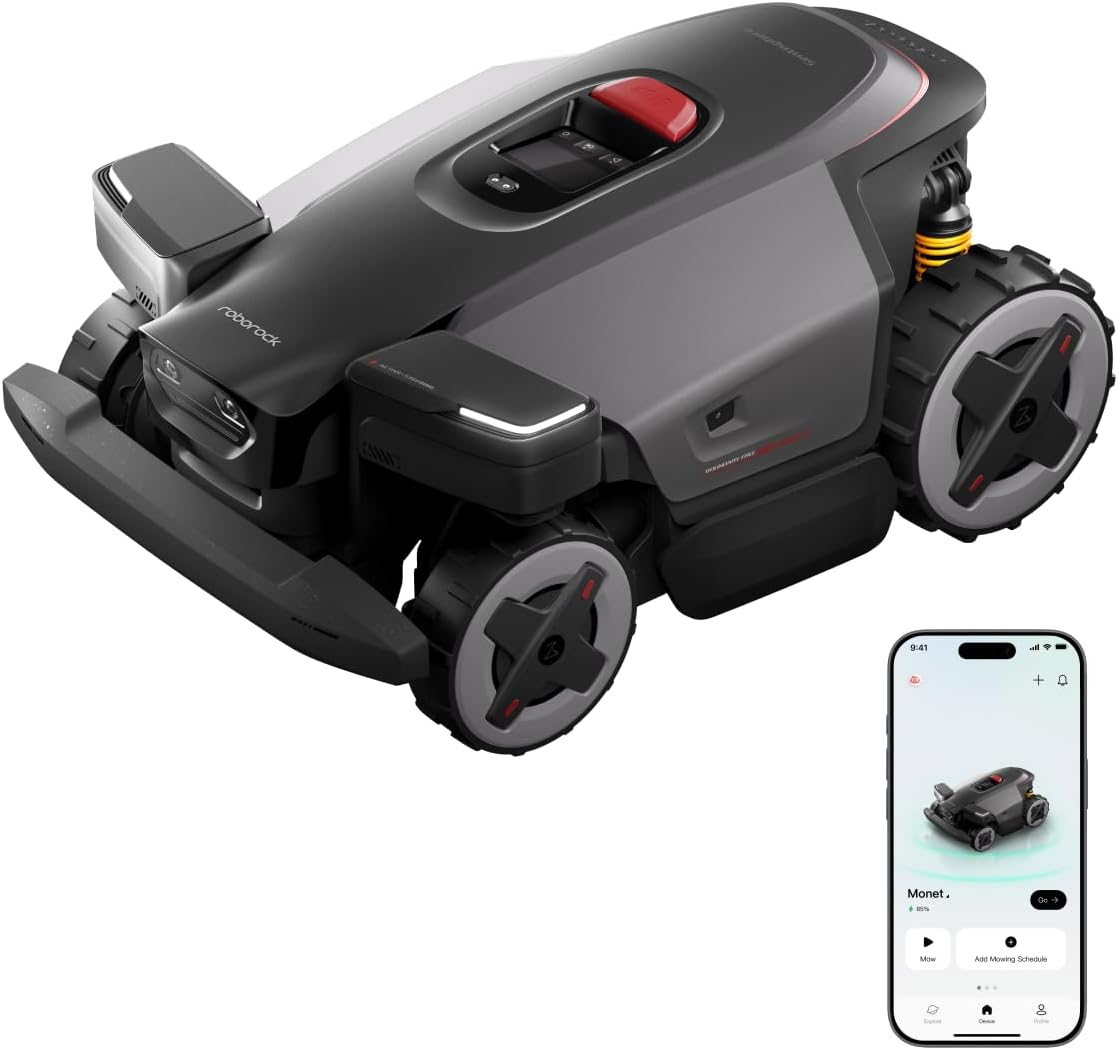
roborock RockMow X130H Robot Lawn Mower with 4WD and Quad-Vision Navigation
| Power Source | Battery Powered |
|---|---|
| Cutting width | 9.5 inches |
| Maximum Adjustable Cutting Height | 3.5 inches |
| Battery Average Life | 140 minutes |
The roborock RockMow X130H is a high-capability robot mower built to handle steep, uneven, and complex lawns without a buried perimeter wire. It uses Full-Band RTK plus a quad-camera AI vision system for precise positioning and dual mapping modes so you can either auto-map open areas or manually trace boundaries from the app. The pro-grade four-wheel drive, active steering, and dynamic suspension let it climb slopes up to 80% and roll over obstacles up to about 3.1 inches while keeping a floating cutting deck for consistent surface-following. Practical benefits include a relatively wide 9.5-inch cut to reduce runtime, multi-zone scheduling and a real-time app dashboard, plus anti-theft features and 4G connectivity. Important limitations are its weight and size for handling and storage, and the advanced navigation and connectivity mean a learning curve during setup and when customizing complex zones. For homeowners with steep or irregular yards who want largely hands-off mowing, this mower brings robust, reliable performance.
Best for: Homeowners with steep, irregular, or obstacle-filled lawns who want a durable, hands-off mower that prioritizes precise navigation and traction over simplicity.
Less Ideal for: Small, flat lawns or buyers who want a very lightweight, simple plug-and-play robot mower with minimal setup and fewer connectivity features.
- Four-wheel drive, active steering, and dynamic suspension that handle slopes up to 80% and 3.1-inch obstacles
- Full-Band RTK plus quad-camera AI vision for accurate positioning under trees and near fences
- Wire-free dual mapping options with app control and multi-zone scheduling for flexible setup
- 9.5-inch cutting width and floating deck for efficient, even mowing across contours
- Built-in anti-theft features including PIN lock, alarm, and GPS tracking
- Heavy and bulky compared with smaller robotic mowers, making manual transport and storage more cumbersome
- Advanced navigation and connectivity increase setup complexity and may require time to fine-tune for complex yards
Verdict: Choose the RockMow X130H if you need a wire-free, high-traction robot mower that can reliably conquer steep, uneven lawns with precise navigation.
Husqvarna Automower 410iQ Robot Lawn Mower (Wire-Free, EPOS Navigation)

| Power Source | Battery Powered |
|---|---|
| Maximum Adjustable Cutting Height | 4 inches |
| Minimum Adjustable Cutting Height | 1 inches |
| Slope Capability | 45% slope |
| Operation Mode | Automatic |
The Husqvarna Automower 410iQ is a performance-focused wire-free robotic mower built to manage complex yards and steep terrain. It uses EPOS satellite-based positioning plus onboard sensors to create centimeter-accurate virtual maps and custom stay-out zones via the Automower Connect app, so you can define mowing areas and change schedules without boundary wire. The mower tackles slopes up to 45 percent and is designed for smooth transitions over driveways and uneven surfaces thanks to larger wheels and a reinforced bumper. Practical benefits include pattern mowing options, adjustable cut height from 1 to 4 inches, GPS-based anti-theft tracking, and hose-washable construction for easy cleanup. Important trade-offs are its targeted coverage of up to 1/2 acre, which limits use on larger properties, and the complexity of a satellite-and-cell connected setup that may require time to map and fine-tune in very irregular yards. Buyers should also plan for professional-quality support and periodic blade replacement to keep peak cutting performance.
Best for: Buyers who prioritize precise, high-performance automated mowing on challenging, sloped yards and want app-driven control and mapping rather than a simple wire boundary system.
Less Ideal for: Owners of larger lawns beyond half an acre or those who prefer a simple, plug-and-play mower without satellite or cellular features.
- EPOS wire-free centimeter-accurate positioning enables precise virtual mapping and stay-out zones
- Handles slopes up to 45 percent, suitable for steep terrain
- App control with scheduling, cut-height adjustment, and remote tracking
- Larger wheels and reinforced bumper improve traversal of surface transitions and uneven ground
- Recommended for lawns up to 1/2 acre, so not suitable for larger properties
- Advanced satellite and cellular setup can require time and occasional troubleshooting
Verdict: Choose the 410iQ if you need a high-precision, app-controlled robot mower built to tackle steep slopes and complex yard layouts up to half an acre.
roborock RockNeo Q110H Robot Lawn Mower with RTK + VSLAM Navigation

| Power Source | Battery Powered |
|---|---|
| Operation Mode | Automatic |
| Battery Average Life | 130 minutes |
| Maximum Adjustable Cutting Height | 3.1 inches |
| Minimum Adjustable Cutting Height | 1.6 inches |
The roborock RockNeo Q110H is a high-tech robot mower designed to handle complex yards and steep terrain without perimeter wires. It maps lawns automatically or via manual app mapping and navigates using a combined Full-Band RTK and VSLAM system for steady positioning under trees and near fences. Dual cameras and AI vision let the mower avoid furniture, pets, and people while rolling over low, crossable obstacles to keep runs continuous. A floating cutting deck and large-diameter wheels help it track uneven ground and climb slopes up to 45 percent, and the adjustable cutting height covers typical turf needs. The Roborock app provides multi-zone scheduling, live progress, and safety features including a PIN lock and loud alarm with optional 4G tracking for theft protection. Practical limitations to note are the relatively narrow 8.7-inch cutting width that may require longer run times on larger lawns and the dependence on battery life for up to about 130 minutes per charge, which could need multiple sessions for very steep or fragmented properties.
Best for: Best for homeowners who want an autonomous mower that reliably handles steep, uneven yards and complex boundaries while minimizing hands-on setup and supervision.
Less Ideal for: Not the best choice for buyers who need to quickly mow large open lawns in a single pass or who prefer wider-deck commercial-style mowers.
- Wire-free dual mapping options for easy setup around complex garden features
- Full-Band RTK plus VSLAM navigation maintains accurate positioning in shaded or cluttered areas
- AI stereo vision for active obstacle avoidance of people, pets, and garden objects
- Floating cutting deck and large wheels enable stable mowing on uneven ground and up to 45% slopes
- App control with multi-zone scheduling and real-time progress monitoring
- Narrow 8.7-inch cutting width increases total run time on larger lawns
- Battery life around 130 minutes may require multiple charging cycles for fragmented or extensive lawns
Verdict: Choose the RockNeo Q110H if you need a wire-free, navigation-accurate robot mower built to climb steep slopes and handle complex, uneven yards.
ANTHBOT M5 Robotic Lawn Mower with Garage and RTK Positioning

| Power Source | Battery Powered |
|---|---|
| Operation Mode | Automatic |
| Minimum Adjustable Cutting Height | 3 centimeters |
| Cutting width | 7.9 inches |
The ANTHBOT M5 is a self-contained robotic mower designed for small-to-medium yards that need reliable slope performance. It combines dual AI cameras with RTK positioning so it builds virtual maps in the app and navigates without perimeter wire; the included RTK reference station improves positional accuracy for repeatable paths. Typical use is hands-off: set up the charging base and garage, let the mower map the lawn via the app, create work zones and no-go areas, then let it run automatically and self-charge when needed. Notable features include multi-zone management for up to 20 areas, adjustable cutting height down to about 3 cm, a five-blade mulching disc for fine clippings, and an ability to climb grades up to 45 percent. Practical benefits are precise navigation on steep terrain, quiet operation under 58 dB, and obstacle recognition from the dual 150° HDR cameras. Important limitations are that the M5 is aimed at smaller yards (around 0.12–0.15 acre recommended) and uses plastic bodywork, so very large properties or buyers seeking industrial‑grade durability should consider larger models.
Best for: Buyers who need a budget-conscious, automated mower capable of confidently handling steep residential slopes and who prioritize easy app setup and hands-off maintenance.
Less Ideal for: Homeowners with large acreages or those who need industrial-grade, heavy‑duty construction should look at higher-capacity commercial models.
- Wire-free mapping with dual AI vision and RTK improves positioning on slopes and complex layouts
- App control with multi-zone management and customizable no-go zones for tailored scheduling
- Handles steep terrain up to 45% gradient, suitable for most residential slopes
- Adjustable cutting height and five-blade mulching system for fine, even cuts
- Quiet operation under 58 dB and self-charging for mostly hands-off maintenance
- Recommended for relatively small lawns (approx 0.12–0.15 acre) so not ideal for large properties
- Plastic construction may not match the long-term durability of heavier commercial units
Verdict: If you want an affordable, app-driven robot mower that reliably handles steep residential slopes, the ANTHBOT M5 delivers precise, low‑noise mowing for small to mid-size yards.
LOPKIN L2500 Robot Lawn Mower with NetRTK, AI Vision and Wi‑Fi HaLow

| Power Source | Battery Powered |
|---|---|
| Cutting width | 9.45 inches |
| Battery Average Life | 4 hours |
| Maximum Adjustable Cutting Height | 3 inches |
| IP Rating | IP66 |
The LOPKIN L2500 is a wire-free robotic mower designed for acre-scale lawns and steep terrain. It combines NetRTK, GNSS/INS fusion and AI vision to map yards, avoid obstacles and navigate without a boundary wire, while a dedicated Wi‑Fi HaLow router maintains a long-range connection for remote monitoring and app control. Typical use is set-and-forget: map your zones in the app, set schedules and let the mower handle routine passes; it supports multi-zone plans and stores many maps. Notable features include AI visual obstacle avoidance that recognizes common items without bumping, adjustable cutting height for different grass lengths, IP66 protection and rain sensing for automatic pauses. The L2500 is heavy and built for durability, offers up to four hours of runtime per charge and manages steep slopes up to 57 percent, which is especially useful on hilly properties. Important trade-offs are its physical weight and the complexity of advanced navigation tech, which may require a brief learning curve in the app during initial mapping and setup.
Best for: Buyers who prioritize a dependable, autonomous solution for large or steep lawns and who want a mower that navigates without boundary wire while staying connected across complex properties.
Less Ideal for: People with very small, flat yards who prefer a simpler, lighter mower or those who want a plug-and-play unit with minimal app interaction.
- High-precision NetRTK and GNSS/INS fusion enable reliable wire-free navigation in complex yards
- AI vision obstacle avoidance reduces collisions with pets, toys and garden features
- Built to handle large lawns and steep slopes up to 57 percent, suitable for hilly sites
- Long-range Wi‑Fi HaLow connectivity and multi-zone mapping let you manage multiple separate areas remotely
- IP66 rating and rain sensor provide weather-resistant operation and automatic pause in wet conditions
- Heavier unit that may be harder to move manually for maintenance or relocation
- Advanced setup and mapping options require time and some familiarity with the app
Verdict: If you need a robust, wire-free robot mower that reliably handles large, steep, and complex lawns while staying connected, the LOPKIN L2500 is built for that job.
Mammotion LUBA 2 AWD 3000HX Robot Lawn Mower (All-Wheel Drive, UltraSense AI)

| Cutting width | 15.7 inches |
|---|---|
| Operation Mode | Automatic |
| Battery Capacity | 12 Ah |
| Charging Time | 120 min |
| Connectivity | Bluetooth & Wifi & 4G |
The Mammotion LUBA 2 AWD 3000HX is a self‑driving lawn mower built for challenging terrain and multi-zone lawns. It uses all-wheel drive and a 165 W motor per cutting disc to climb slopes up to 80% and push through uneven or thick grass while its dual‑blade disk delivers a 15.7-inch cutting width for consistent passes. The mower relies on UltraSense AI vision and RTK positioning rather than a perimeter wire, which enables precise edge cutting and autonomous mapping of up to 30 zones. Connectivity via 4G, Wi‑Fi, and Bluetooth lets you monitor and schedule jobs from the app and receive alerts if the unit leaves its zone or is moved. Practical benefits include resume‑after‑charge behavior, intelligent obstacle avoidance for 200+ object types, and built‑in GPS anti‑theft tracking. Important limitations are the modest per‑charge coverage (about 0.25 acre for this model) and a 120‑minute charge time, so larger properties or continuous long runs may need a higher‑capacity variant or multiple units. Setup and learning the app features add an initial configuration step before hands‑off mowing.
Best for: Buyers who prioritize reliable slope performance and want a tech‑forward mower that handles steep, irregular yards with minimal physical barriers and app‑based control.
Less Ideal for: Homeowners with single large lawns substantially larger than a quarter acre who need long continuous run time without recharging should consider higher‑capacity models or options sized for larger areas.
- All‑wheel drive and 165 W motors provide strong traction for very steep slopes up to 80%
- UltraSense AI vision plus RTK navigation enables perimeter‑wire‑free mapping and precise edge cutting
- Supports multi‑zone management and intelligent obstacle avoidance for complex yards
- 4G/Wi‑Fi/Bluetooth connectivity and app control with GPS anti‑theft tracking
- Per charge mowing area is relatively small at about 0.25 acre for this configuration
- Requires an initial setup and app learning curve to unlock advanced features
Verdict: Choose the LUBA 2 AWD 3000HX when you need a robotic mower that reliably climbs very steep slopes and navigates complex multi‑zone lawns with AI vision and RTK precision.
Mammotion LUBA mini 2 AWD 1500H Robot Lawn Mower

| Power Source | Battery Powered |
|---|---|
| Operation Mode | Automatic |
| Cutting Height | 2.2-4.0 inches |
| Number of Positions | 7 |
| Cutting width | 7.9 inches |
The Mammotion LUBA mini 2 AWD 1500H is a purpose-built robotic mower for small residential yards with steep or complex terrain. It uses 360° LiDAR and dual‑camera AI vision to detect obstacles early and plan smoother routes, and its AWD drivetrain with two independent motors can climb slopes up to 80 percent while negotiating curbs and roots. Dual cutting discs including a dedicated edge blade deliver closer trimming along borders, and the main disc height can be adjusted from the app for seasonal or turf changes. The mower supports up to 20 independent mowing zones and a DropMow mode for quick one‑off jobs without mapping. Battery features such as custom charge limits and off‑peak charging help preserve battery life and cut energy costs. Practical limitations to expect are modest coverage per model (about 0.37 acre) so larger properties will need a bigger unit, and being a sophisticated autonomous machine it requires initial setup and occasional app management and blade replacements. For homeowners prioritizing safe, hands‑free mowing on slopes, this model balances power and smart navigation.
Best for: Homeowners who need a reliable, autonomous mower that can handle steep, uneven lawns and prefer safety‑focused features and simpler hands‑off operation.
Less Ideal for: Owners of large lawns significantly bigger than 0.37 acre or those who want a purely plug‑and‑play pushbutton mower with no app or setup work.
- 360° LiDAR plus dual‑camera AI vision for improved obstacle detection and navigation.
- All‑wheel drive with independent motors and adaptive suspension for climbs up to 80% and better traction on uneven terrain.
- Dual cutting discs including a dedicated edge blade for cleaner margins and automatic height adjustment via app.
- Multi‑zone support and DropMow mode handle complex lawns and quick temporary jobs without permanent mapping.
- Battery management options (custom charge limit and off‑peak charging) to extend battery life and reduce running costs.
- Rated for about 0.37 acre coverage per charge, so not suited for larger properties.
- Advanced features require initial setup and occasional app interaction and maintenance.
Verdict: Choose the LUBA mini 2 AWD 1500H when you want a compact, safety‑oriented robot mower that confidently handles very steep slopes and complex residential lawns.
Choosing the Right Robotic Lawn Mower for Steep Slopes: Key Factors to Consider
Maximum Slope Rating
The maximum slope rating is the single most important specification for steep properties because it tells you the steepest incline the mower can safely handle. Ratings are often given as degrees or percent gradient; match the mower's specification to the steepest pitch in your lawn. If your property has both gentle and very steep sections, prioritize a mower rated for the steepest pitches you expect it to enter.
Choosing a mower with a slightly higher slope rating than your steepest hill provides a safety margin. Remember that real-world factors such as wet grass, loose soil, or uneven ground reduce traction, so a mower that barely meets the spec on paper may struggle in practice.
Traction System and Wheel Design
Traction matters more on inclines than on flat lawns. Look for aggressive tread patterns, larger-diameter wheels, or dedicated all-wheel-drive systems that maintain grip while climbing and descending. Some mowers use rubberized studded wheels or specialized compounds to resist slipping when the grass is wet or when encountering loose soil.
Wheelbase and weight distribution also affect grip. A lower center of gravity and balanced weight across the axle reduce the chance of wheel spin and improve handling when turning on slopes. Consider how wheel size and design interact with your typical turf and any obstacles like rock outcrops or compacted strips.
Navigation and Boundary Control
Reliable boundary control prevents the mower from wandering into dangerous zones on a slope. Traditional perimeter wire systems define a strict working area, while more advanced GPS-assisted navigation can guide the mower without physical wire. On steep terrain, consistent detection of boundaries is crucial because a momentary navigation loss can lead to slips or unsafe movements.
Assess how the mower handles tight inclines near edges, terraces, or drop-offs. Features like virtual boundaries, automatic return-to-base when signal quality degrades, and redundant sensing help reduce the risk of the mower crossing unsafe angles or operating too close to hazards.
Battery Capacity and Real-World Runtime
Climbing drains battery faster than level mowing, so advertised runtimes may be optimistic for steep lawns. Consider batteries with higher capacity, fast charging, or models that can manage partial-charge cycles efficiently. For larger or highly sloped properties, a mower with longer runtime or rapid recharge cycles reduces downtime and ensures coverage.
Also check how the mower behaves when battery runs low mid-slope. Smart systems that return to base along the safest route prevent risky shutdowns on inclines. Batteries rated for many charge cycles are preferable since frequent full-discharge climbs increase wear over time.
Cutting System and Deck Design
A mower that cuts evenly on a slope has deck geometry and blade placement that compensate for tilt. Look for decks that minimize scalping when transitioning from flat to inclined areas and that maintain a consistent cutting height despite pitch. Multiple small blades or floating decks can adapt better to undulating terrain than a rigid single-blade assembly.
Consider blade protection and ease of service too. On slopes, impacts with hidden rocks or roots are more likely, so blades and mountings that are easy to replace will reduce maintenance hassle.
Safety Features and Sensors
Safety features are essential for slope operation. Tilt and lift sensors should stop the blades if the mower tips or is lifted, and obstacle sensors should detect sudden changes in terrain or unexpected objects. Emergency stop options, audible alerts, and scheduled operation windows help manage when and how the mower works on tricky sections.
Redundant sensors and well-calibrated detection reduce false positives and risky behavior. Also check whether the mower has programmable exclusion zones so you can keep it away from terraces, steep drop-offs, or areas that are unsafe when wet.
Assessing Your Lawn's Slope and Risks
Walk the property to identify the steepest pitches and note where those slopes intersect with obstacles, terraces, or drainage channels. Use a handheld inclinometer app or a simple level to estimate gradients in percent or degrees so you can compare against mower specs. Mark areas that are never suitable for autonomous mowing, such as near drop-offs or tight edging near paths.
Also check turf condition and soil. Wet, sandy, or loose soils reduce traction even for mowers with good slope ratings. If you have erosion-prone sections, avoid scheduling mower runs immediately after heavy rain since traction and safety will be reduced.
- Measure steepest pitch to match mower rating
- Identify edges, terraces, and hazards
- Note turf condition and drainage patterns
Installation Options on Inclines
Perimeter wire installation on slopes requires secure anchoring and careful routing. Keep the wire snug to the ground so the mower's sensors consistently detect it along the incline. On steep edges, place the wire with a small offset from hazardous drop-offs to provide a safety buffer.
For GPS-assisted systems, calibration on the actual lawn helps the mower learn slope behavior. Expect initial adjustment runs and monitor how the mower navigates corners and transitions. Professional installation can be worth it on complex slopes to optimize boundary placement and reduce future troubleshooting.
- Anchor perimeter wire firmly on slopes
- Allow margin between wire and hazards
- Consider professional setup for complex sites
Maintenance Practices for Slope Performance
Maintain sharp blades and clean wheel treads to preserve traction and cut quality. Dull blades and clogged wheels reduce efficiency and increase the effort required to climb. Inspect the underside of the deck regularly for grass buildup which can affect balance on inclines.
Check fasteners and suspension points for wear since slope operation puts extra stress on drive components. Keep battery contacts and charging stations free of debris and ensure the base is placed on a level, well-drained spot to prevent charging issues after wet weather.
- Sharpen blades and clean wheel treads regularly
- Inspect drive components for wear more often
- Place charging base on stable, level ground
Seasonal Considerations and Safe Operation
Slope mowing is safest when grass and soil are relatively dry. Avoid running a robotic mower on steep pitches during or immediately after rain and during freeze-thaw periods when traction is poor. Adjust mowing frequency seasonally to prevent excessive scalping during drought or turf stress.
In winter months or during heavy leaf fall, store the unit indoors if the manufacturer recommends it. Clear the lawn of sticks, stones, and other debris that are more likely to become hazards on inclines.
- Avoid mowing steep slopes when wet
- Adjust schedule with seasonal turf stress
- Store unit indoors if exposed to harsh winter conditions
Retrofitting Terraces and Small Stepped Areas
If your yard includes terraces or small steps, consider a hybrid approach. Use perimeter exclusion to keep the robotic mower away from terraced sections and maintain those areas with a handheld or push mower. Alternatively, regrade small terraces or add gentle transition zones where feasible to create safer autonomous paths.
For narrow terraces, manual mowing or targeted trimming is often faster and safer than trying to force an autonomous unit into tight geometry. Design landscaping features with mower accessibility in mind to reduce long-term maintenance complexity.
- Use exclusions for terraces and narrow steps
- Regrade small transitions where practical
- Plan landscape features for future autonomous access
How We Chose the Best Robotic Lawn Mower for Steep Slopes
We focused on features that directly affect slope performance and safe autonomous operation. Key evaluation criteria included maximum slope capability and traction systems because these determine whether a mower can climb and descend without slipping. Battery life and charge recovery were assessed to ensure the mower can cover the intended lawn area on a single charge, including the extra energy hill climbing consumes. Boundary control and navigation were evaluated to determine how reliably the mower stays on course on uneven terrain and avoids returning erratically over steep sections. Cutting system consistency and deck design were reviewed to confirm an even finish on inclines and to minimize scalping. Build durability and weather resistance were considered because mounts and drive components take extra stress on slopes. We excluded basic domestic models rated only for flat lawns and any units without clear slope specifications. We also filtered out mowers lacking essential safety features such as lift/tilt sensors or reliable perimeter control. The remaining picks were those that combined documented slope capability with practical features gardeners need for safe, low-maintenance mowing on steep properties.
FAQ
How steep is too steep for a robotic mower?
It depends on the mower's rated maximum slope. Many models handle moderate inclines, but very steep pitches-especially with wet grass-may exceed safe limits. Measure your steepest sections and choose a mower rated above that pitch to allow a safety margin.
Can a robotic mower slip on wet slopes?
Yes. Wet grass and soft soil reduce traction, increasing the chance of slipping even for mowers rated for steep slopes. Avoid mowing immediately after rain and consider models with aggressive treads if your property often stays damp.
Is perimeter wire necessary for slope mowing?
Perimeter wire provides a reliable physical boundary and is often the safest option on complex slopes. GPS systems can work, but wire gives consistent detection along edges and helps prevent accidental excursions near hazards.
How should I position the charging base on a slope?
Place the charging base on a level, well-drained area at the top or bottom of the lawn that the mower can access safely. Avoid placing the base on a slope where the mower must dock uphill immediately after finishing a run.
Will frequent slope use shorten battery life?
Climbing uses more energy than flat mowing, which can increase charge cycles and affect battery longevity over time. Choose higher-capacity batteries and follow recommended maintenance to maximize lifespan.
Can I use a robotic mower on terraced lawns?
Small terraces and narrow steps often require manual maintenance. Use exclusion zones to keep the robotic mower away from terraces, or reconfigure terraces to have gentler transitions if you want full autonomous coverage.
Final Verdict
Prioritize slope rating, traction design, and reliable boundary control when choosing a robotic lawn mower for steep slopes. Battery capacity and a well-designed deck matter too because climbing drains power and affects cut consistency. Expect tradeoffs between aggressive traction systems and battery runtime; pick the balance that suits your yard size and terrain complexity. With the right combination of slope capability, navigation, and safety features you can automate most mowing on hilly properties. Focus on measured specs, careful installation, and routine maintenance to keep uphill mowing safe and effective.
