

Note: This article contains affiliate links. If you click on these links and make a purchase, I may earn a small commission at no extra cost to you. This helps support my research and content. Read my full affiliate disclosure here.
Getting grass seed out evenly is the first step toward a thick, resilient lawn. The right seed spreader for lawns saves time, reduces waste, and improves germination by putting seed where it belongs rather than in clumps or bare patches. This guide covers seven shortlisted seed spreaders that suit common lawn sizes and job types, from small residential yards to larger suburban lawns. We evaluate each option on practical gardener-focused criteria like application control and coverage consistency to help you pick the right tool for your turf needs.
Top Picks at a Glance
| Best Overall The best all-around choice for most situations | WORX 20V Cordless Broadcast Spreader WG869 |  |
| Best Quality Built to a higher standard if you want something more solid | John Deere 130 lb Push Broadcast Spreader |  |
| Best Value The sweet spot between price and what you get | VEVOR 15 lb Broadcast Push Spreader, 9.8 ft Spread Width |  |
| Best Budget The cheapest option that still gets the job done reliably | CHAPIN 8740A 64 oz Hand Shaker Spreader |  |
| Highest Rated A top-rated pick with lots of positive feedback | Scotts Whirl Hand-Powered Spreader |  |
| Most Popular A crowd favorite that many people choose with confidence | Scotts Turf Builder EdgeGuard Mini Broadcast Spreader |  |
| Best Seller A high-volume bestseller chosen again and again | Agri-Fab 130 lb Pull-Behind Broadcast Spreader (Model 45-0463) |  |
WORX 20V Cordless Broadcast Spreader WG869

| Battery | 1 Lithium Ion battery required (included) |
|---|---|
| Max spread distance | Up to 5 ft. |
| Coverage per load | Up to 4,600 sq. ft. |
| Speed settings | 6-speed control |
| Flow settings | 8 flow-rate levels |
The WORX 20V Cordless Broadcast Spreader WG869 is a battery-powered handheld unit that makes seeding, fertilizing, and de-icing faster and less tiring than manual broadcasters. You fill the tub, set one of six speeds and eight flow-rate levels, then walk the yard while the motor broadcasts material up to about 5 feet and covers roughly 4,600 sq ft per load. The anti-clog agitator and edge-control deflector help keep material flowing evenly and reduce overspray onto driveways or garden beds. At around 3 pounds and with a trigger-style handle it is comfortable for one-handed use and easy to carry for small to medium lawns. The unit uses a PowerShare lithium battery (included) so it integrates with other WORX tools in that system. Limitations are its handheld capacity for larger properties and the need to match flow and speed settings to each material type for consistent distribution; very large yards will still require multiple refills or a wheeled spreader for greater efficiency.
Best for: Homeowners with small to medium lawns who want an easier, faster way to seed, fertilize, or apply ice-melt without the bulk of a tow-behind or wheeled spreader and who value portability and adjustable output.
Less Ideal for: Owners of large properties or commercial users who need to cover many acres quickly should consider a larger wheeled or tow-behind spreader for fewer refills and faster throughput.
- Cordless motorized operation reduces physical effort compared with manual spreaders
- Six-speed control and eight flow-rate settings let you tune distance and material flow for different granule sizes
- Anti-clog agitator and edge-control deflector promote even distribution and reduce mess
- Lightweight 3 lb design and trigger handle enable comfortable one-handed use
- Covers up to about 4,600 sq ft per load, suitable for small to medium yards
- Small hopper capacity and handheld form limit efficiency on large lawns
- Requires the WORX PowerShare battery platform which may not be ideal if you do not use compatible tools
Verdict: A lightweight, easy-to-use cordless spreader that gives balanced control and portability for homeowners maintaining small to medium lawns.
John Deere 130 lb Push Broadcast Spreader

| Capacity | 130 lbs. |
|---|---|
| Approximate coverage | Up to 25,000 sq ft |
| Spread width | 10 – 12 ft |
| Wheels | 13" x 4" pneumatic tires |
This John Deere push broadcast spreader is built for larger lawns and frequent use. The 130 lb rust-proof poly hopper lets you cover roughly half an acre between refills, while the broadcast plate delivers a 10 to 12 ft spread that speeds application and reduces passes. Control is simple: a direct rod gate and adjustable flow stop let you dial output for seed, fertilizer, weed control products, or ice melt so you get more even coverage and less waste. Durability is focused on practical longevity rather than lightweight portability — heat-treated steel gears are enclosed to resist corrosive materials and large turf-tread pneumatic tires make it easy to push across uneven turf. Assembly is required and the unit is substantial to maneuver compared with compact hand spreaders, but that heft contributes to stability and capacity. For performance-focused gardeners with mid-size to large lawns, it reduces refill frequency and produces consistent spreading; casual users with very small yards may find it larger than necessary.
Best for: Gardeners and property owners who prioritize efficient, consistent coverage across mid-size to large lawns and want a durable spreader that reduces refill interruptions.
Less Ideal for: People with very small yards, limited storage space, or who need a lightweight, highly portable seed spreader.
- Large 130 lb poly hopper reduces refills for up to 25,000 sq ft of coverage
- Wide 10–12 ft broadcast spread speeds application and improves uniformity
- Direct rod control and adjustable flow stop for precise output with different materials
- Enclosed heat-treated steel gears and turf-tread pneumatic tires improve durability and maneuverability
- Substantial size and weight make it less convenient for very small yards or frequent transport
- Some assembly required before first use
Verdict: Choose this spreader if you need high-capacity, consistent broadcast coverage for mid-size to large lawns without frequent refilling.
VEVOR 15 lb Broadcast Push Spreader, 9.8 ft Spread Width

| Spread width | 9.8 ft |
|---|---|
| Hopper capacity | 15 lbs |
| Settings | 30 |
| Tire size | 10 in |
The VEVOR broadcast push spreader is a basic, easy-to-use option for homeowners who need to seed, fertilize, or apply granular treatments to small yards. It uses a 9.8 ft spreading width and a 30-setting control so you can dial coverage for seed or fertilizer and the 15 lb hopper holds enough material for typical home lawns without being heavy to push. The powder-coated steel frame and UV-resistant, impact-tough hopper make it more weather resistant than cheaper plastic models, and large 10 in tires roll smoothly over grass and uneven ground. Assembly is straightforward with key parts preinstalled and the detachable handle and hopper make storage simple. Limitations are its modest hopper capacity and manual push design, which mean more refills and physical effort on larger properties and steep terrain. For small to medium lawns it delivers predictable coverage and durable build at a practical price; larger properties or contractors will likely need a tow-behind or larger-capacity spreader.
Best for: Homeowners who want a practical, no-frills spreader for routine seeding and fertilizing on small to medium lawns and who prioritize ease of use and durability.
Less Ideal for: Property owners with large lawns, steep terrain, or commercial needs who need higher capacity or a tow-behind power option.
- Adjustable 30-setting spread control for precise coverage
- 9.8 ft spread width covers ground quickly for small lawns
- Powder-coated steel frame and UV-resistant hopper for better durability
- Large 10-inch tires that roll smoothly over lawn and uneven surfaces
- 15 lb hopper capacity requires refilling on larger lawns
- Manual push design requires physical effort on long or hilly yards
Verdict: A durable, easy-to-use push spreader that gives precise coverage for small to medium lawns, making routine seeding and fertilizing quicker and more consistent.
CHAPIN 8740A 64 oz Hand Shaker Spreader

| Capacity | 1.8 kg |
|---|---|
| Bottle Type | Shaker Bottle |
| Reusability | Reusable |
| Material Type | Plastic |
The CHAPIN 8740A is a straightforward hand shaker spreader built for year-round small-area jobs like patching turf, seeding shaded spots, and dispensing ice melt on steps and walkways. It holds 64 ounces in a wide-mouth poly bottle that is easy to fill and has a large handle for one-handed use with or without gloves. The twist lid offers three opening sizes so you can match the flow to fine seed, pelletized fertilizer, or coarse ice melt. Because it is reusable plastic with few moving parts it is low maintenance and can be stored upright with product inside. The design is best for targeted spots and tight spaces where a broadcast spreader cannot reach, not for treating whole lawns. The plastic construction is lightweight and inexpensive but less durable than metal alternatives and it lacks precise calibrated settings for exact application rates. For gardeners on a budget who need a simple, portable tool for patching and winter pathways, this does the job well.
Best for: Buyers who want an inexpensive, no-frills tool for spot-seeding, small patch repairs, and winter de-icing in tight or hard-to-reach areas.
Less Ideal for: Homeowners who need to treat whole lawns, apply fertilizer at precise rates, or who prefer heavy-duty metal equipment for frequent large-area work.
- Large 64-ounce capacity reduces refill frequency for spot jobs
- Three twist-open lid sizes let you handle fine seed, pellet fertilizer, and coarse salt
- Simple plastic construction with few wear parts keeps maintenance minimal
- Large ergonomic handle is easy to grip with or without gloves
- Portable and can be stored upright with product inside
- Not suited for spreading over an entire lawn or large areas
- Plastic body is less durable than metal spreaders for heavy-duty use
- No calibrated metering for precise application rates
Verdict: A budget-friendly, portable hand shaker that makes quick spot seeding and ice-melt jobs easy without fuss.
Scotts Whirl Hand-Powered Spreader

| Material Type | Metal, Plastic |
|---|---|
| Handle Material | Rubber |
| Capacity coverage | Up to 1,500 sq. ft. |
| Additional Features | Adjustable Arm Support, Smooth Even Coverage |
The Scotts Whirl is a small, hand-powered spreader built for routine work on small lawns and walkways. It holds enough product to cover about 1,500 sq. ft. and arrives ready to use, so you simply fill the hopper and walk while operating the trigger to distribute granules. Notable features include an adjustable arm support for comfort during longer passes and a design intended to deliver smooth, even coverage across treated areas. Because it is hand-held and lightweight, it is easy to maneuver around beds, patios, and tight spots where a wheeled spreader would be awkward. Practical benefits are precise spot work, straightforward winter use for ice melt, and minimal setup or maintenance. The main limitations are capacity and speed: for larger yards you will make many refills and cover less ground per hour than with a push spreader, and it does not offer the fine calibration controls found on larger models. For homeowners who prioritize reliable, no-fuss application on small areas, the Whirl is a dependable tool.
Best for: Homeowners who need a reliable, low-maintenance spreader for small yards, spot seeding, or seasonal ice-melt work and who value straightforward operation over high capacity.
Less Ideal for: Those with medium to large lawns or contractors who need to cover large areas quickly should consider a larger wheeled spreader instead.
- Handheld design is easy to maneuver in tight spaces and around landscaping
- Adjustable arm support improves comfort during extended use
- Engineered for smooth, even coverage to reduce missed spots
- Ready to use out of the box with minimal assembly or maintenance
- Holds only enough product for about 1,500 sq. ft., so frequent refills on larger lawns
- Lacks the precise spreader calibration and capacity of larger push models
Verdict: A dependable, easy-to-use handheld spreader that makes reliable seed and fertilizer application on small lawns fast and fuss-free.
Scotts Turf Builder EdgeGuard Mini Broadcast Spreader
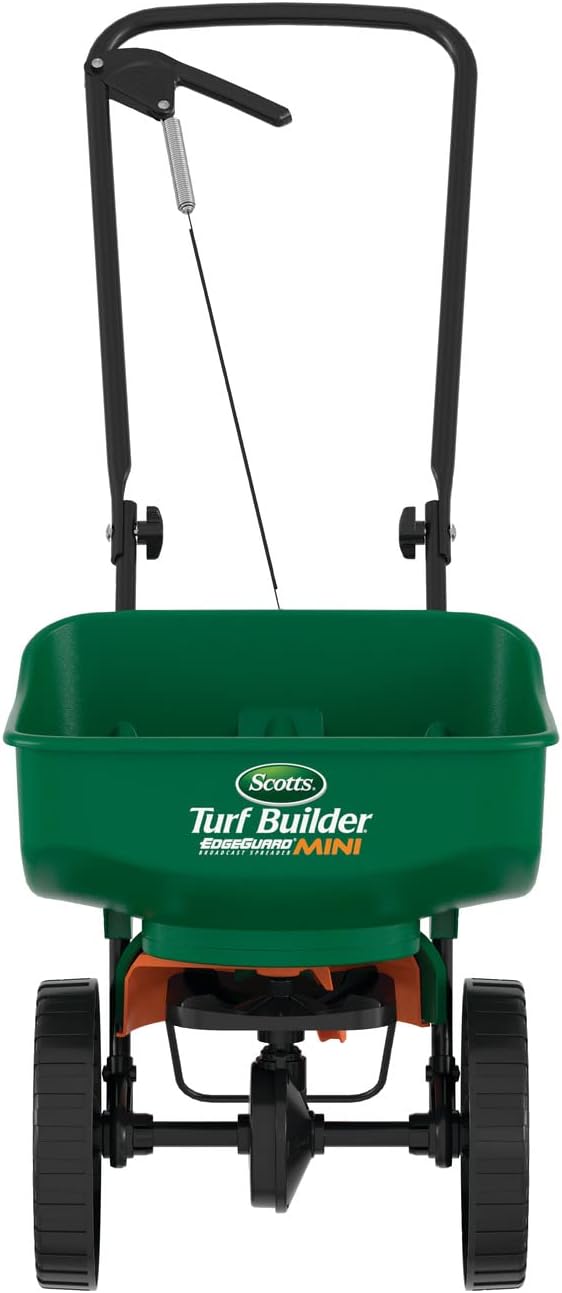
| Capacity | Up to 5,000 sq. ft. |
|---|---|
| Usage | Fertilizer, seed, granular weed control, salt, ice melt |
| Assembly | Comes fully assembled |
| Features | EdgeGuard side shield; fold-down handle |
The Scotts EdgeGuard Mini Broadcast Spreader is a pre-calibrated, ready-to-use push spreader made for smaller lawns up to 5,000 sq. ft. It distributes fertilizer, seed, granular weed control, salt, and ice melt with a curved hopper and dual-bladed agitator that help keep flow consistent and reduce clumping. The defining feature is Scotts EdgeGuard technology, a right-side shield you engage to block product from driveways, sidewalks, and planting beds for cleaner edges. The unit is compact and stores easily with a fold-down handle, and its open-spoke wheels roll across typical yard terrain without flats. Because it is designed for smaller areas, the hopper capacity and broadcast width are intentionally modest, so filling and walking are required for larger lawns. The spreader comes assembled and pre-set to common Scotts settings, which speeds setup but may require manual calibration if you use non-Scotts products. Overall it is a practical, low-effort option for homeowners who want reliable, even coverage and fewer mistakes at lawn edges.
Best for: Homeowners with small to medium lawns who value straightforward, low-effort lawn feeding and want a spreader that reduces accidental application onto hard surfaces.
Less Ideal for: Property owners with large lawns who prefer high-capacity or tow-behind spreaders for faster coverage should consider larger models instead.
- Pre-calibrated and ready to use out of the box for quick setup
- EdgeGuard side shield prevents product from reaching sidewalks and driveways
- Curved hopper and dual-bladed agitator promote smooth, consistent material flow
- Fold-down handle and compact size make storage easy
- Suitable for year-round use including salt and ice melt application
- Smaller capacity intended for areas up to 5,000 sq. ft., so it is not efficient for large lawns
- Pre-set calibration may need adjustment for non-Scotts products
Verdict: If you need a simple, ready-to-use spreader that delivers even coverage and protects edges on small lawns, this is a dependable pick.
Agri-Fab 130 lb Pull-Behind Broadcast Spreader (Model 45-0463)
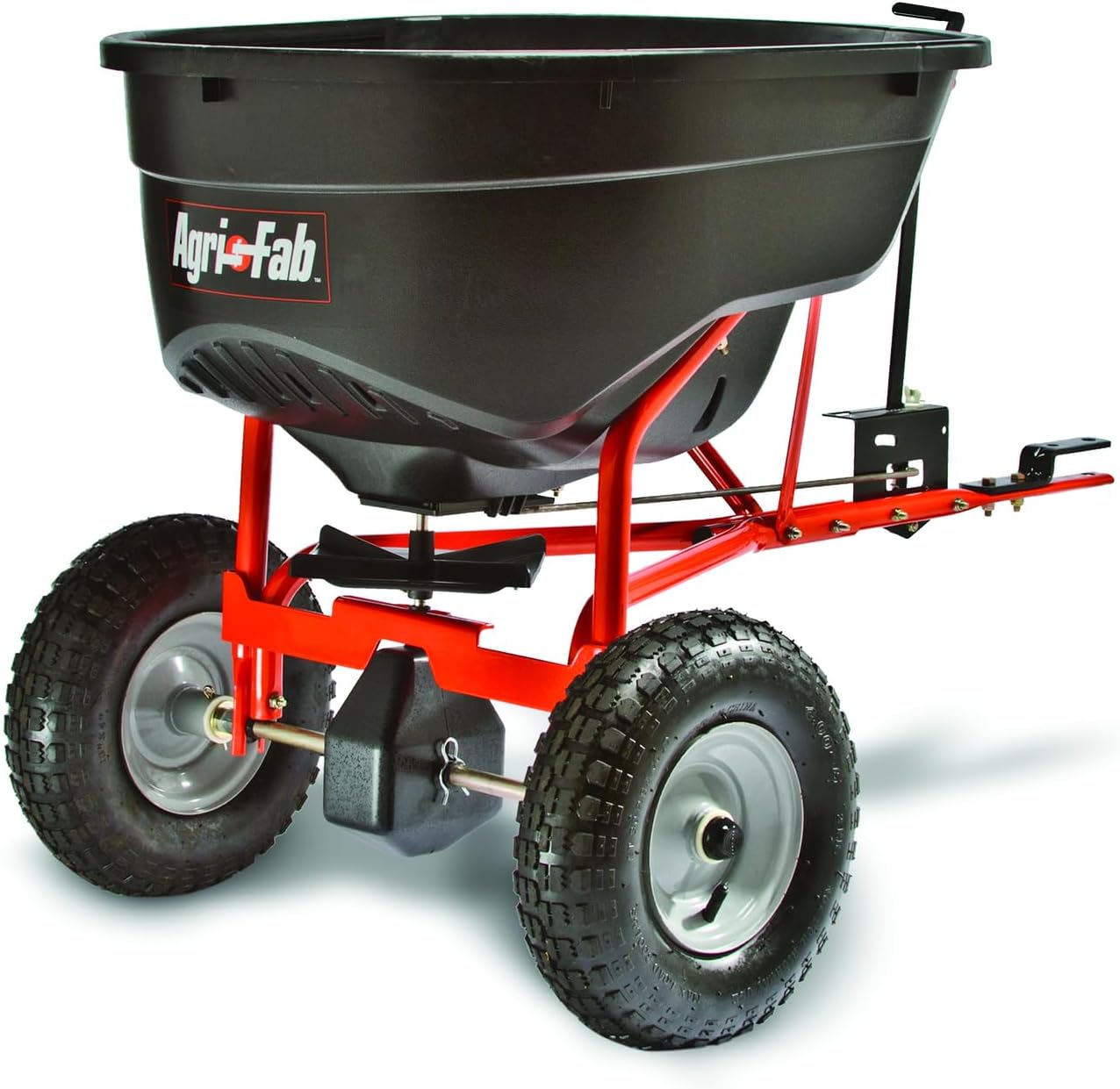
| Weight Capacity Maximum | 130 pounds |
|---|---|
| Spread Width | 10-12 ft |
| Tire Type | Pneumatic |
| Material Type | Alloy Steel, Polypropylene (PP), Rubber |
The Agri-Fab 130 lb pull-behind broadcast spreader is built for straightforward, dependable lawn care on larger yards. It mounts to most riding mowers with a universal hitch and holds up to 130 pounds, letting you cover roughly half an acre per fill to reduce interruptions. The wide 10 to 12 foot spread pattern and enclosed gear box promote more even dispersal and protect internal parts from dirt and moisture. A simple steel-rod flow control is reachable from the tractor seat so you can change application rates without stopping. The construction combines a poly hopper with alloy steel frame tubing and pneumatic tires for durability and smoother towing over uneven ground. Expect easy seasonal use for grass seed, fertilizer, granular lawn treatments, and salt. The main limitations are that it is a basic broadcast design, so very precise banding or ultra-fine calibration for specialty seed mixes may require additional passes or a different spreader type, and some assembly is required before first use.
Best for: Homeowners or property managers who want a reliable, no-nonsense tow-behind spreader to cover medium to large lawns efficiently and with minimal fuss.
Less Ideal for: Gardeners who need highly precise application patterns or small-plot users who prefer a handheld or walk-behind drop spreader for tight spaces.
- Large 130 lb hopper covers up to about 25,000 sq ft per fill to reduce refills on bigger lawns
- Universal hitch fits most riding mowers and lawn tractors for quick hookup
- Wide 10–12 ft spread width delivers even coverage with fewer passes
- Enclosed gear housing and steel frame improve durability and protect moving parts
- Seat-accessible steel-rod flow control lets you change settings without dismounting
- Broadcast design is less suited to precision banding or very narrow applications
- Requires assembly before first use
Verdict: A durable, easy-to-use tow-behind spreader that reliably covers larger lawns with fewer refills and minimal operator adjustments.
Choosing the Right Seed Spreader for Lawns: Key Factors to Consider
Coverage Consistency
Coverage consistency determines how uniformly seed is distributed across the lawn. Uneven spread produces thin patches and wasted seed in overlaps. For lawns, look for spread patterns that throw seed in an even swath without heavily biased edges.
Consistent coverage shortens the time to an acceptable turf density and reduces the need for repeated spot-seeding. It also matters when combining seed with starter fertilizer because uneven application can burn or underfeed areas of the lawn.
Application Control and Calibration
Application control refers to how precisely you can set the output rate and how reliably that setting matches actual seed delivery. Different grass seed types and mixes have varying seed sizes and flow characteristics, so the ability to fine-tune the spreader is essential.
Calibration options and clearly marked rate settings let you measure how much seed is delivered per area and adjust to match recommended seeding rates. Good control minimizes over-seeding near walkways or flower beds and reduces waste on wider areas.
Hopper Capacity and Flow Management
Hopper capacity affects how often you need to reload while seeding. For small lawns a compact hopper is fine, but larger yards benefit from bigger capacity to keep the job moving.
Equally important is hopper design and flow management. Baffles, smooth plastic or coated reservoirs, and adjustable gates help prevent bridging and clogging when using mixes or wet seed. A well-designed hopper keeps the flow steady so coverage remains uniform from start to finish.
Durability and Weather Resistance
Seed spreaders live outdoors and often get exposed to damp seed, fertilizer, and soil. Corrosion-resistant materials, sealed bearings, and robust frame connections extend the tool's useful life.
Durability matters for repeated seasonal use. Frames that flex or plastic components that crack under UV stress create inconsistent performance. Choose spreaders with parts that can tolerate occasional bumps and wet storage conditions.
Maneuverability and Suitability for Lawn Size
How easy a spreader is to push or tow affects fatigue and job time. Lightweight push-style spreaders work well on small to medium lawns and in tight spaces. Larger lawns may require a tow-behind or wheel-driven broadcast spreader to cover ground efficiently.
Also consider turning radius and how the spreader handles slopes and turf obstacles. A model that tracks well and maintains even flow on gentle grades will save time and improve results.
Maintenance and Cleaning
After seeding, leftover seed, fertilizer, and debris can lodge in the mechanism. Models that disassemble simply and have smooth internal surfaces are easier to rinse and dry, reducing corrosion risk and seed spoilage.
Maintenance also includes replacement parts availability and how easy it is to adjust or tighten linkages. Routine cleaning and simple serviceability keep spread patterns consistent season after season.
When to Overseed Vs Spot-Seed
Deciding between full-lawn overseeding and targeted spot-seeding depends on the extent and pattern of thin turf. Overseeding the whole lawn is best when large areas show thinning or when you want to introduce a new grass variety uniformly. Spot-seeding is more efficient when damage is limited to isolated patches caused by pets, disease, or localized wear.
Use a seed spreader for overseeding to ensure even distribution, and use a smaller hand spreader or targeted application for isolated holes. For spot work, consider lightly raking the area, applying a thin seed layer with a controlled setting, and pressing seed into contact with soil for best germination.
- Overseed for area-wide thinning and variety updates
- Spot-seed for localized bare or damaged patches
- Prepare soil and adjust rates differently for each approach
Preparing Lawn and Seed for Best Results
Preparation improves the seed-to-soil contact that makes germination successful. Mow slightly lower than usual and remove clippings for uniform contact. Lightly dethatch or aerate compacted areas before seeding to open soil and improve water and nutrient penetration.
Choose seed blends suited to your region and sun exposure, and keep them dry until application. Calibrate your spreader using a small test area to confirm the output setting matches the recommended seeding rate. Water gently and consistently after seeding until seedlings are established.
- Mow and remove clippings prior to seeding
- Aerate compacted turf to improve seed contact
- Calibrate settings with a test pass over a measured area
Seasonal Timing and Weather Considerations
Timing overseeding or seeding depends on grass type and local climate. Cool-season grasses perform best when sown in early fall or spring, while warm-season grasses are usually seeded in late spring to early summer when soil is warm. Avoid seeding before heavy rains that can wash seed away or when prolonged drought will prevent establishment.
Check the forecast and pick several consecutive days of moderate temperatures and light winds for best distribution and topsoil settling. Early morning or late afternoon seeding helps reduce wind drift and desiccation of seed.
- Seed during peak germination windows for your grass type
- Avoid seeding before heavy rain or extended drought
- Pick calm, moderate temperature days to reduce drift
Mixing Seed with Amendments
Some gardeners combine seed with starter fertilizer or soil amendments in the hopper to speed establishment. If you plan to mix materials, make sure the spreader is rated for the coarser or heavier particle sizes and has appropriate flow controls to prevent clogging.
Calibration is more important when spreading mixes because fertilizer has a different flow rate than seed. Consider separate passes for fertilizers if your spreader cannot handle mixed particle sizes without inconsistent flow.
- Confirm hopper can handle fertilizer or amendments
- Calibrate for mixed-material flow rates
- Consider separate spreads for fertilizer when in doubt
Storage and Off-Season Care
After the seeding season, empty the hopper and rinse any remaining seed, fertilizer, or dust. Dry the spreader thoroughly before storing to prevent rust and seed spoilage. Store in a dry, sheltered location away from prolonged sun exposure to reduce plastic degradation.
Periodically check moving parts, replace worn seals, and lubricate linkages per the manufacturer's guidance. Proper off-season care preserves spread accuracy and prevents unexpected repairs the next season.
- Empty and clean hopper before storage
- Dry completely to avoid corrosion and mold
- Perform light maintenance and store sheltered from sun and moisture
How We Chose the Best Seed Spreader for Lawns
We selected products that perform well specifically for lawn overseeding and reseeding tasks. Our filters prioritized devices that offer adjustable application rates, consistent broadcast patterns across typical lawn grasses, and construction suited to outdoor, seasonal use. We favored spreaders with calibration options so gardeners can match seed size and mix to the machine rather than guessing settings. Durability under light-to-moderate lawn use was required, including corrosion-resistant materials where seed and moisture contact moving parts. We also looked for ease-of-use features such as simple hopper access, intuitive controls, and straightforward cleaning. Excluded from consideration were heavy-duty agricultural spreaders intended for large-acreage farming and small hand-crank models that cannot deliver even coverage for typical residential lawns. Final selection balanced coverage uniformity, control precision, build durability, and operational convenience. Those four dimensions guided inclusion and ranking of the seven spreaders in this roundup.
FAQ
What spreader setting should I use for lawn seed?
Settings vary by model and seed size. Start by checking the seed bag for recommended pounds per 1,000 square feet, then calibrate your spreader on a small test strip and adjust until the measured delivery matches the target rate.
Can I mix seed and starter fertilizer in the hopper?
Sometimes. It depends on the spreader and the particle sizes. Many spreaders can handle mixed loads, but calibration is essential and some models may clog with coarser fertilizer granules, so a separate pass may be safer.
How often should I clean my seed spreader?
Clean after every use that involved seed or fertilizer. Even small residues can attract moisture, cause corrosion, or clog gates. A quick rinse and thorough drying usually suffice for seasonal storage.
Is a tow-behind spreader necessary for medium lawns?
It depends on terrain and yard size. Tow-behind spreaders reduce push fatigue on larger plots and cover ground faster, but for medium lawns with obstacles or tight spaces a walk-behind model often offers better control.
Will wind ruin my spreading pattern?
Wind can increase drift and lead to uneven placement. Spread on calm days or when wind is light. If some breeze is present, reduce your throw width or slow walking speed to maintain consistency.
Final Verdict
For most homeowners, prioritize a spreader that combines consistent coverage, reliable application control, and a hopper size that matches your lawn scale. Expect tradeoffs between capacity and maneuverability: larger hoppers cut refill time but can be heavier to push and harder to handle in tight yards. Focus on spread pattern uniformity and ease of calibration above all else. With those priorities in mind and proper preparation, you can achieve even germination and a thicker lawn without excessive reseeding or waste.
