

Note: This article contains affiliate links. If you click on these links and make a purchase, I may earn a small commission at no extra cost to you. This helps support my research and content. Read my full affiliate disclosure here.
If you want precise, efficient watering without extra chores, a smart irrigation controller can automate schedules and react to weather or soil conditions. Choosing the right smart water irrigation controller matters because controllers behave differently in real yards: some prioritize simple app setup, others focus on sensor integration or robust weather-based adjustments. This guide shortlists the top options for home gardens and small lawns and explains the practical differences gardeners will notice in daily use. We evaluate each controller for setup and connectivity, scheduling flexibility, and leak or fault handling so you can pick one that fits your irrigation system and maintenance style.
Top Picks at a Glance
| Best Overall The best all-around choice for most situations | Rain Bird ARC8 Smart WiFi Irrigation Controller — 8-Zone |  |
| Best Quality Built to a higher standard if you want something more solid | Hunter PRO‑HC 6‑Zone Wi‑Fi Smart Irrigation Controller (Hydrawise) |  |
| Best Value The sweet spot between price and what you get | Orbit B-hyve Indoor Smart Sprinkler Controller (8-Zone) |  |
| Best Budget The cheapest option that still gets the job done reliably | HiOazo Smart Sprinkler Controller (4-Zone, App-Controlled) |  |
| Highest Rated A top-rated pick with lots of positive feedback | HiOazo Outdoor Smart Sprinkler Controller, Wi‑Fi, 12‑Zone |  |
| Most Popular A crowd favorite that many people choose with confidence | Rachio 3 Smart Sprinkler Controller, 8-Zone |  |
Rain Bird ARC8 Smart WiFi Irrigation Controller — 8-Zone

| Zones | 8 |
|---|---|
| WaterSense Certified | Yes |
| Wireless Networks Supported | 2.4 GHz 802.11b/g/n |
| Input | 120 VAC, internal transformer to 24 VAC |
| Display Type | LED |
The Rain Bird ARC8 is a smart 8‑zone sprinkler controller built to give homeowners remote, program‑based control of an in‑ground irrigation system. You set up three separate programs (A, B, C) with up to four start times each, name zones, and start or stop zones manually from the app or the unit. The controller connects to 2.4 GHz Wi‑Fi and uses local weather and historical averages to automatically adjust run times, which Rain Bird says can cut water use by up to 30 percent. It supports common accessories such as a rain sensor, master valve or pump relay and can be mounted indoors or outdoors in a sealed case. Practical benefits include flexible scheduling to meet regional water restrictions, temporary watering delays for rain or freeze events, and shareable access for family or landscapers. Important limitations are that it requires a 2.4 GHz network and a 120 VAC power source or direct wiring, and advanced features depend on the mobile app and cloud connectivity rather than fully local control.
Best for: Homeowners who want a reliable, feature‑rich smart controller to simplify watering schedules and reduce water use while allowing remote access and easy sharing with landscapers or family.
Less Ideal for: People with only 5 GHz Wi‑Fi networks, those who need battery‑backed local control during frequent outages, or users who prefer a purely local, non‑cloud controller.
- Controls up to 8 independent zones with customizable programs and multiple start times
- App-based remote control with manual watering and scheduled delays from anywhere
- Automatic Seasonal Adjust and weather‑aware adjustments to reduce water use
- Compatible with Alexa and Google Assistant for voice commands
- Sealed contractor‑grade case for indoor or outdoor mounting and accessory connections
- Requires a 2.4 GHz Wi‑Fi network and ongoing app/cloud access for full smart features
- No backup battery for time/date retention if power is lost
Verdict: Choose the ARC8 if you want an easy to use, weather‑aware 8‑zone smart controller that cuts water use and puts full scheduling control on your phone.
Hunter PRO‑HC 6‑Zone Wi‑Fi Smart Irrigation Controller (Hydrawise)
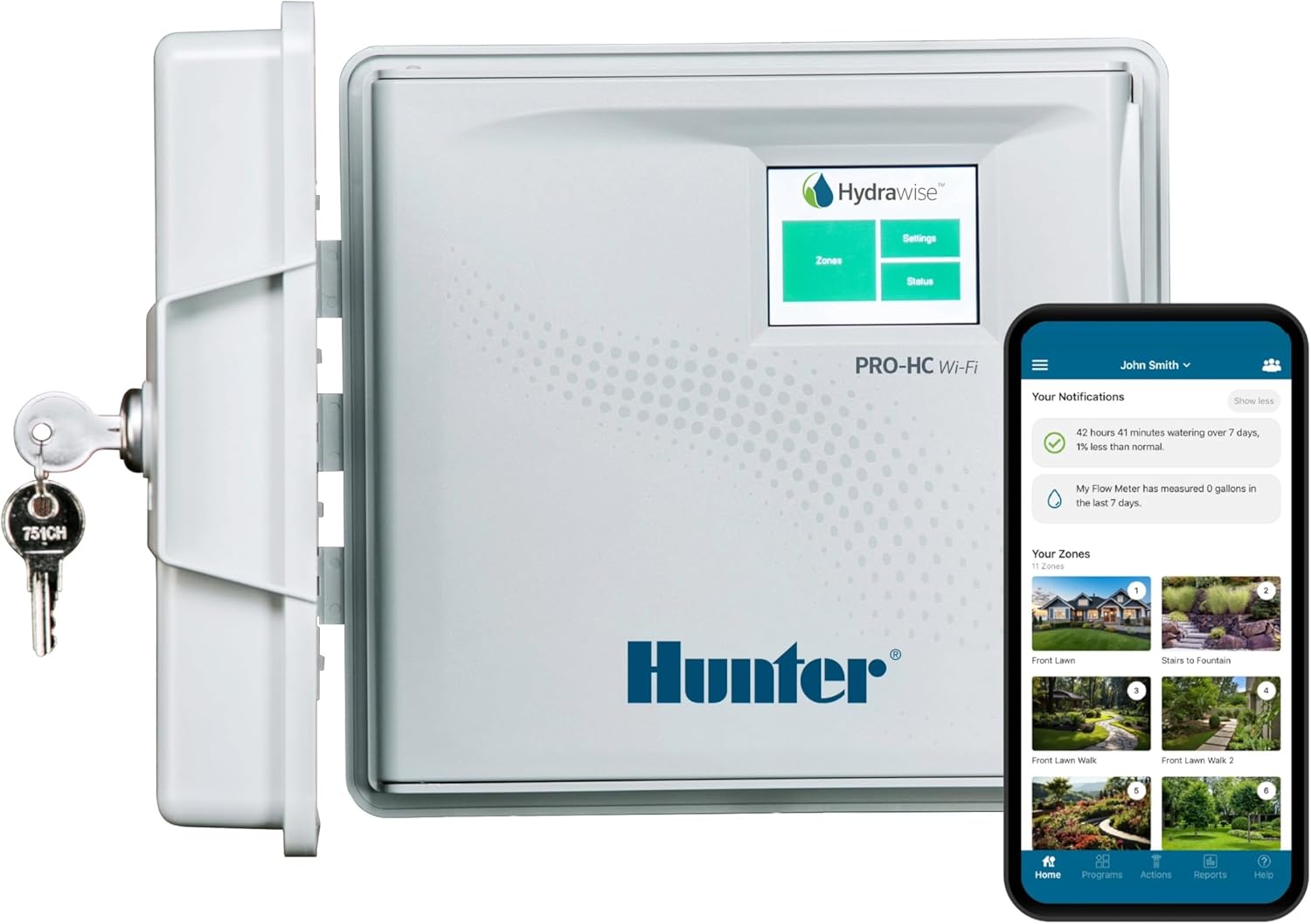
| Zones | 6 stations |
|---|---|
| Wi‑Fi | Built‑in 2.4 GHz |
| Display | 2.75 inch full‑color touchscreen |
| Sensor ports | Two sensor inputs |
| P/MV output | One pump/master valve output |
The Hunter PRO‑HC600 is a 6‑station smart irrigation controller built for reliable, water‑efficient landscape management. It connects to the Hydrawise platform over built‑in 2.4 GHz Wi‑Fi so you can monitor and adjust schedules from a phone, tablet, or desktop, while the full‑color 2.75 inch touchscreen lets you program and test zones at the panel without the app. Hydrawise applies predictive weather data and local station inputs to automatically change run times, and the system supports flow meters, Clik rain sensors, and a pump/master valve output for professional installs. The controller includes wiring diagnostics via a milliamp sensor to speed troubleshooting and an IP44‑rated UV resistant cabinet for indoor or outdoor mounting. For performance‑focused users this translates to precise zone control, fewer callbacks, and measurable water savings, though advanced features require time to configure and optional sensors to realize full leak detection and flow monitoring capability.
Best for: Buyers who prioritize efficient, professional‑level irrigation control and remote management for small to medium landscapes; ideal for contractors or committed homeowners who want precise, data‑driven watering.
Less Ideal for: Casual gardeners who want a simple plug‑and‑play timer without network setup or those who do not plan to add optional sensors for flow monitoring.
- Hydrawise weather‑based scheduling adjusts watering automatically for local conditions
- Built‑in Wi‑Fi and remote app control for on‑the‑go adjustments and monitoring
- Full‑color touchscreen enables quick on‑site programming and zone testing
- Supports flow meters and sensor inputs for leak detection and automated shutoff
- Milliamp wiring sensor provides continuous diagnostics to simplify maintenance
- Advanced features like flow monitoring and full leak protection require buying and installing optional sensors
Verdict: Choose the Hunter PRO‑HC600 if you want professional, weather‑driven irrigation control with on‑site touchscreen programming and full remote management via Hydrawise.
Orbit B-hyve Indoor Smart Sprinkler Controller (8-Zone)

| Stations | 8 zones |
|---|---|
| Connectivity | Wi‑Fi, Bluetooth |
| Display Type | LCD |
| Voltage | 120 volts |
The Orbit B-hyve Indoor Smart Sprinkler Controller is a Wi‑Fi and Bluetooth enabled timer designed to automate underground sprinkler systems for homeowners. You set up programs and zones in the free B‑hyve app or on the console, then let the controller adjust runtimes using WeatherSense local weather data to avoid overwatering after rain and add water during hot spells. Typical use is mounting the unit indoors, connecting to household Wi‑Fi, assigning each valve to a zone, and creating either fixed schedules or letting the app manage watering based on weather. Notable features include an LCD console for local control, voice assistant compatibility, and both remote control and Bluetooth setup for areas with weak Wi‑Fi. Practical benefits are consistent, zone‑specific watering that can reduce water waste and hands‑on time caring for lawns, beds, and vegetable plots. Important limitations are that it is an indoor enclosure model so it still requires wiring to existing valves and a powered 120V supply, and advanced integrations may need familiarity with smart home assistants.
Best for: Homeowners who want to cut watering time and water use by automating multi‑zone irrigation with weather‑aware schedules and remote control.
Less Ideal for: People who need an outdoor‑rated standalone controller or who prefer a simple battery‑powered hose timer for a single faucet and no wiring.
- Wi‑Fi and Bluetooth connectivity for remote setup and control
- WeatherSense automatically adjusts schedules to local conditions
- Supports independent programming for up to eight zones
- LCD console allows local control without the app
- Indoor enclosure requires wiring to outdoor valves and a nearby power source
- Setup and smart‑home linking can be confusing for users unfamiliar with apps and voice assistants
Verdict: Choose the B‑hyve 8‑zone controller if you want a weather‑aware, app‑controlled system that simplifies multi‑zone irrigation and reduces unnecessary watering.
HiOazo Smart Sprinkler Controller (4-Zone, App-Controlled)

| Zones | 4 |
|---|---|
| Watering Plans | Up to 16 |
| Connectivity | 2.4 GHz WiFi |
| Power | 24VAC |
The HiOazo Smart Sprinkler Controller connects to 2.4 GHz WiFi and lets you run up to four zones from the companion app, with space for 16 distinct watering plans. It is designed for DIY replacement of an existing controller and claims a quick install in about 10 minutes using the included screws, wire connectors, and power adapter. The app-led display and schedule editor make daily, intermittent, or soak irrigation simple to set up, and automatic skip logic for rain, freeze, and high wind helps reduce wasted water. Practical benefits include remote control of schedules, multiple program presets for different plant needs, and weather-adaptive watering that can lower runoff and overwatering. Limitations are the 4-zone capacity, which is small for larger yards, and reliance on 2.4 GHz WiFi so homes with only 5 GHz networks will need a compatible router or extender; advanced users may miss granular flow or evapotranspiration integration. Overall this is a straightforward, budget-friendly smart controller for typical residential landscapes that need basic weather-aware automation.
Best for: Homeowners who want an inexpensive, easy-to-install smart controller to automate a small to medium yard and prioritize simple water savings and remote control.
Less Ideal for: Large properties with many irrigation zones or users who need advanced ET-based or flow-monitoring features should consider controllers with higher zone counts and more irrigation telemetry.
- App-based control for remote scheduling and real-time monitoring
- Automatic weather-based skip for rain, frost, and wind to conserve water
- Supports up to 16 distinct watering plans for flexible programming
- Quick DIY installation with included hardware and wide controller compatibility
- Only controls four zones which may be insufficient for larger properties
- Requires a 2.4 GHz WiFi network so it may need network adjustments in some homes
Verdict: A straightforward, budget-friendly 4-zone smart controller that adds remote app control and weather-aware watering to typical residential irrigation systems.
HiOazo Outdoor Smart Sprinkler Controller, Wi‑Fi, 12‑Zone

| Wi‑Fi frequency | 2.4GHz |
|---|---|
| Zones supported | 12 zones |
| Programmable plans | 16 plans |
| Irrigation modes | Standard and Soak |
The HiOazo Outdoor Smart Sprinkler Controller replaces a traditional timer with a cloud‑connected controller you manage from the HiOazo app over 2.4 GHz Wi‑Fi. It is typically installed at the irrigation control panel and used to schedule watering across multiple zones, with options for Standard or Soak irrigation modes. Notable features include support for up to 12 zones and 16 separate watering plans so you can tailor schedules for different plant beds, plus automatic skipping for rain, freeze, and wind to avoid unnecessary runs. The app control makes remote adjustments and monitoring straightforward, and the company advertises a quick DIY install that should fit most existing systems. Limitations to consider are dependence on 2.4 GHz Wi‑Fi and the app ecosystem for smart features, so local manual control is less convenient if your network is unreliable. The controller appears aimed at homeowners who want flexible, weather‑aware scheduling without professional setup, but expect connectivity and app reliance to be central to day‑to‑day use.
Best for: Homeowners who prioritize a dependable, weather‑smart irrigation schedule and want remote control to reduce overwatering without hiring a pro.
Less Ideal for: People with unreliable Wi‑Fi, those who need purely local/manual controllers, or users who prefer controllers that operate without any app dependency.
- Supports up to 12 irrigation zones and 16 separate watering plans for flexible scheduling
- Weather‑aware auto skip for rain, freeze, and wind helps conserve water and protect plants
- App control over 2.4 GHz Wi‑Fi lets you monitor and adjust schedules remotely
- Two irrigation modes (Standard and Soak) allow better soil absorption management
- Requires a 2.4 GHz Wi‑Fi network and app for full smart functionality
- Relies on cloud/app ecosystem so offline/manual operation is limited
Verdict: Choose this controller if you want a dependable, weather‑sensing Wi‑Fi system that simplifies hands‑off irrigation across many zones.
Rachio 3 Smart Sprinkler Controller, 8-Zone

| Item Highlight | 8 Zones, App Control, Rain Skips, Local Weather Scheduling |
|---|---|
| Voltage | 120 volts |
| Display Type | LED |
| Operating Temperature | 4 °F |
The Rachio 3 Smart Sprinkler Controller gives you app-first control of an existing 8-zone irrigation system and uses local weather data to adjust watering automatically. You set schedules in the Rachio app for iOS or Android, then let the controller skip runs for rain, freeze, wind or saturated soil and make seasonal adjustments so you do not overwater. Typical use is straightforward: mount the indoor unit, wire it to zone valves, connect Wi-Fi and configure zones in the app; Quick Run buttons let you manually water a zone from the controller when needed. Notable features include dual-band Wi-Fi, compatibility with Alexa, Google Home and IFTTT, LED status display and grow-in scheduling for new lawns. Practical benefits are reduced water use, simpler remote management, and easier setup compared with legacy dial timers. Limitations: the unit is indoor rated so outdoor installs require a weatherproof enclosure and some advanced setups such as well systems may need a pump for proper pressure. The controller also relies on the app for detailed schedule edits rather than full on-device programming.
Best for: Homeowners who want to reduce water use and move away from manual dial timers, and who prefer a proven smart-home controller with easy app-based setup and integrations.
Less Ideal for: People who need a fully outdoor-rated controller without adding an enclosure or who want complete on-device programming without using a smartphone app.
- Weather Intelligence automatically skips watering for rain, freeze, wind and saturation
- App-based scheduling with Quick Run and grow-in options simplifies remote control
- Works with voice assistants and IFTTT for smart-home integration
- Fast DIY install that fits most existing 8-zone systems
- Indoor-rated unit requires a separate weatherproof enclosure for outdoor mounting
- Relies on the mobile app for most scheduling tasks rather than full on-device controls
Verdict: Choose the Rachio 3 if you want a reliable, app-driven 8-zone controller that cuts wasted watering with automatic weather-aware schedules.
Choosing the Right Smart Water Irrigation Controller: Key Factors to Consider
Setup & Connectivity
How easy a controller is to install and connect matters because many gardeners install these units themselves. Look for clear wiring diagrams, labeled terminal blocks for valves, and straightforward power requirements. Wireless pairing and app setup should be reliable; flaky Wi-Fi leads to missed commands and frustration.
Also consider whether the controller stores schedules locally or relies entirely on cloud services. Local control protects basic operation if internet fails. If you have a weak home network near your irrigation controller, check for external antenna options or support for local hub connections.
Scheduling Flexibility
Different gardens need different watering patterns. A flexible scheduler lets you set per-zone run times, multiple schedules per week, and soak cycles for clay soils. Seasonal adjustment features help reduce manual edits across the year.
Advanced options such as cycle-and-soak, custom repeat intervals, and per-zone calendars are valuable for mixed plantings. If you care about conserving water, look for controllers that make it easy to create shorter, more frequent runs to reduce runoff.
Sensor and Weather Integration
Smart controllers that accept soil moisture sensors, rain sensors, and local weather feeds can prevent unnecessary watering. Soil sensors give the most direct feedback on actual moisture in the root zone, while weather-based adjustments use forecast and historical data to skip cycles.
Check compatibility with the sensor types you plan to use and whether the controller supports threshold adjustments or averaging across sensors. For microclimates or shaded beds, sensor placement and multi-sensor support can significantly improve outcomes.
Leak and Fault Handling
A controller that detects stuck valves, shorted wires, or excessive flow can prevent prolonged flooding and plant damage. Look for fault detection, status alerts, and automatic shutdown behaviors when problems occur.
Notification options matter. Controllers that notify you via app alerts or email let you respond quickly. Some systems also record runtime logs so you can spot unusual behavior over time and trace the source of an issue.
Power Options and Backup
Power reliability affects unattended irrigation. Most controllers use low-voltage AC power, but battery backup or support for auxiliary power can keep schedules running through short outages. Consider how a power interruption affects valve positions and whether manual override is easy.
If your controller will be installed outdoors, verify the power connection is adequately protected. Remote or hard-to-reach controller locations benefit from power solutions that minimize the need for frequent maintenance visits.
Durability and Outdoor Protection
Irrigation controllers face sun, moisture, and temperature swings. Outdoor-rated housings, corrosion-resistant terminals, and UV-stable plastics extend service life. A controller mounted in a shed or under eaves has different needs than one exposed to full sun near a valve box.
Also consider how easy it is to service the unit in place. Removable covers, clear terminal labeling, and accessible fuse or breaker locations reduce labor during repairs or seasonal shutdowns.
How Smart Controllers Reduce Water Use
Smart controllers can cut wasted water by skipping runs during rain events, shortening cycles when soil moisture is adequate, and staggering zone starts to match system capacity. In practice, that means fewer soggy spots and less runoff on compacted soils.
Weather-based adjustments and sensor feedback are the two main mechanisms. Weather adjustments use forecasted conditions to reduce watering across the system. Soil sensors target specific beds and avoid blanket rules that do not reflect microclimates.
- Skip watering automatically when rain is forecast or recorded
- Adjust run times seasonally or by plant type
- Use soil sensors in critical beds to avoid overwatering
Placement and Wiring Tips for Reliable Operation
Place the controller where you can easily access it for seasonal changes and troubleshooting. If mounted outdoors, protect it from direct sunlight and heavy rain when possible. Keep the unit within useful range of your home Wi-Fi or plan for a wired network connection.
Use appropriate wire gauge for long runs to valve solenoids and label each conductor during installation. Avoid sharing conduit with high-voltage wiring and seal any cable penetrations to keep moisture out of the enclosure.
- Mount within sightline or reasonable reach for maintenance
- Label valve wires and use weatherproof grommets
- Test each zone manually before finalizing schedules
Sensor Placement and Calibration
Correct placement of soil moisture and rain sensors makes the difference between useful data and misleading readings. Place soil sensors at root depth for the plants you care about and in several representative beds if conditions vary across the yard.
Calibrate sensor thresholds based on plant type and soil texture. Clay, loam, and sand hold water differently, so the same moisture reading may indicate different irrigation needs. Check sensor readings during and after an irrigation cycle to ensure thresholds are triggering the desired behavior.
- Install sensors in the active root zone, not in mulch or surface soil
- Use multiple sensors for varied microclimates
- Verify threshold responses after initial setup
Common Installation Pitfalls and How to Avoid Them
A frequent mistake is relying on default schedules without confirming each zone's flow and coverage. Walk each zone and run a test cycle to verify sprinkler pattern and runtime. Adjust run times to prevent overspray onto sidewalks or driveways.
Neglecting to connect a rain sensor or not checking Wi-Fi connectivity leads to missed opportunities for water savings. Make a checklist for first-week monitoring to catch wiring errors, weak signals, or mismatched station assignments.
- Test zones individually before enabling automatic schedules
- Include sensor and connectivity checks in initial setup
- Document terminal assignments and take a photo of wiring for future reference
Integrating Smart Controllers With Existing Systems
Most modern smart controllers are designed to replace a standard irrigation controller using the same low-voltage terminals. Confirm the new controller supports the number of zones you need and offers spare outputs for future expansion.
If you use a pump or master valve, verify the controller has the appropriate master valve terminal or a compatible relay. Some gardeners also integrate controllers with home automation systems; in those cases, check for open APIs or common ecosystem support.
- Match zone count and terminal layout to your current valve manifold
- Ensure master valve or pump relay compatibility
- Look for open integration options if you plan to connect to home automation
How We Chose the Best Smart Water Irrigation Controller
We evaluated controllers on functions gardeners actually use in the yard: reliable connectivity and setup, scheduling flexibility, sensor and weather integration, and fail-safe handling for leaks or stuck valves. Each candidate had to support local valve control through standard station outputs, provide clear scheduling options for multiple zones, and offer at least basic remote management via an app or local interface. We prioritized controllers that accept common moisture or rain sensors and those that adjust watering based on forecast or soil data. Durability in outdoor enclosures and clear wiring guides were also required to reduce installation errors. Excluded items included simple mechanical timers, devices that only operate via dumb on/off schedules without remote control, and controllers lacking documented sensor inputs. We also excluded units that rely entirely on proprietary plumbing fittings rather than standard irrigation connections. The result is a set of controllers that balance practical installation, responsive scheduling, sensor compatibility, and safety features for leak and valve faults.
FAQ
Do smart controllers need an internet connection to run irrigation schedules?
Many controllers continue to run stored schedules locally without internet access, but remote control and weather updates typically require connectivity. Check whether the unit stores schedules locally and how it behaves during a network outage.
Can I use my existing moisture sensors with a new smart controller?
Often yes, if the controller supports the same sensor type and wiring. Verify input compatibility and whether the controller accepts a single sensor or multiple probes for averaging across zones.
Will a smart controller help if my yard has both lawn and deep-rooted beds?
Yes. Per-zone scheduling lets you set different runtimes and cycles for turf versus deep-rooted perennials. Using soil sensors in critical beds further tailors watering to root needs and reduces overwatering of tougher turf areas.
How do controllers detect valve or wiring faults?
Controllers use short detection, open circuit checks, and sometimes flow or pressure feedback to identify faults. When a fault is detected, many controllers suspend the affected station and send alerts so you can inspect wiring or valves.
Are weather-based adjustments reliable for microclimates?
Weather-based adjustments are useful for broad seasonal changes but may not account for localized shade, wind, or soil differences. Pairing weather data with local soil sensors gives the most reliable results for microclimates.
Final Verdict
Choosing a Smart Water Irrigation Controller comes down to the features you will use most often: easy setup and reliable connectivity if you value remote control, sensor and weather integration if you want precise moisture-based watering, and robust fault detection to protect plants and property. Balance scheduling flexibility with installation complexity and prioritize models that match your zone count and sensor needs. With the right controller, you can automate sensible watering, reduce runoff, and spend less time managing irrigation.
