

Note: This article contains affiliate links. If you click on these links and make a purchase, I may earn a small commission at no extra cost to you. This helps support my research and content. Read my full affiliate disclosure here.
Picking the right tomato planter box changes how your tomatoes grow, fruit, and fit into small yards, patios, or balcony setups. The right box gives roots room to develop, sheds excess water, and supports larger plants without frequent transplanting or constant staking. In this guide we shortlisted the seven best options for compact and urban tomato growing and tested them against real gardener concerns like moisture control and structural strength. Below you will find concise reasoning for each pick and clear evaluation criteria so you can match a planter box to your site, tomato variety, and maintenance preferences.
Top Picks at a Glance
| Best Overall The best all-around choice for most situations | GREEN MOUNT 56.7" Raised Garden Bed with Trellis and Wheels |  |
| Best Quality Built to a higher standard if you want something more solid | Best Choice Products Raised Planter Box with Diamond Trellis, Walnut |  |
| Best Value The sweet spot between price and what you get | LINEX Raised Garden Bed Planter Box with Trellis and Self-Watering Reservoir |  |
| Best Budget The cheapest option that still gets the job done reliably | MYMULIKE Self-Watering Raised Garden Bed Planter Box with Trellis |  |
| Highest Rated A top-rated pick with lots of positive feedback | Trygoal Metal Planter Box with Trellis (Galvanized Steel, Floor Standing) |  |
| Most Popular A crowd favorite that many people choose with confidence | SnugNiture Galvanized Oval Raised Garden Bed, 2-Pack (4×2×1 ft) |  |
| Best Seller A high-volume bestseller chosen again and again | Quictent Galvanized Tall Raised Garden Bed 6 x 3 x 2 ft |  |
GREEN MOUNT 56.7" Raised Garden Bed with Trellis and Wheels

| Capacity | 6.1 gallons |
|---|---|
| Material Type | Metal, Polypropylene (PP) |
| Other Special Features of the Product | Drainage Hole, Self Watering |
| Mounting Type | Floor Standing |
| Indoor Outdoor Usage | Indoor, Outdoor |
This GREEN MOUNT raised garden bed is a compact, vertical planter built to support a single large tomato plant plus a few low-growing companions. It combines a powder-coated metal trellis frame and food-grade polypropylene planting box, giving sturdy support for heavy vines while resisting outdoor wear. The built-in siphon-style self-watering reservoir reduces watering frequency and has drain plugs to avoid waterlogging. Assembly is tool-free and quick, and the included lockable swivel casters make it easy to move the unit for sun or shade. Practical uses are patio or deck tomato growing, small-space container vegetable beds, or an accessible option for balcony gardeners. Watch for limited soil volume compared with ground beds, so plan for concentrated feeding and more frequent fertilizer applications if you want larger yields. The vertical form works well for indeterminate tomatoes but only fits one main stem comfortably, so growers who want multiple big plants will need larger containers or multiples of this unit.
Best for: Gardeners who want a compact, low-maintenance solution for growing a single tomato plant on a patio, deck, or balcony and value easy mobility and built-in support.
Less Ideal for: Vegetable gardeners who plan to grow several large tomato plants or who need deep root volume for oversized varieties should consider larger planters or in-ground beds.
- Integrated metal trellis provides strong support for heavy tomato vines
- Self-watering reservoir with drain plugs reduces watering frequency and helps prevent overwatering
- Tool-free assembly and included connectors speed setup
- Lockable swivel casters make it easy to move for light or weather management
- Made from food-grade polypropylene and powder-coated metal for outdoor durability
- Soil capacity is limited compared with in-ground beds, which can restrict root volume and ultimate plant size
- Designed for one main tomato plant so not ideal if you want multiple large plants in the same box
Verdict: If you want a compact, mobile planter that supports and waters a single tomato plant with minimal fuss, this trellis-equipped raised bed is a smart pick.
Best Choice Products Raised Planter Box with Diamond Trellis, Walnut

| Material Type | Fir Wood |
|---|---|
| Other Special Features of the Product | Drainage Hole |
| Mounting Type | Floor Standing |
| Indoor Outdoor Usage | Outdoor |
This raised planter box pairs a 48-inch tall planter with an integrated diamond trellis to support vining vegetables like tomatoes. It is assembled from painted fir wood with a drainage hole and includes four attachable wheels two of which lock so you can reposition the planter on a deck or patio and then secure it. The trellis provides a stable lattice for training indeterminate tomato varieties while the long narrow planter bed concentrates soil and roots, making it suitable for one or two tomato plants or a row of smaller determinate types. Practical benefits include mobility for adjusting sun exposure and a finished walnut look that fits entryways. Limitations to consider are the relatively shallow internal planting depth and the 50 lb weight capacity which restricts how much soil and large pots you can use, and the wood will still need periodic maintenance to stay weather resistant in wet climates.
Best for: Growers who want a tidy, mobile solution to grow a couple of tomato plants on a deck, patio, or entryway and who prioritize ease of placement and vine support.
Less Ideal for: Gardeners planning to grow multiple large indeterminate tomato varieties or using heavy soils and large containers should choose a deeper, higher-capacity raised bed instead.
- Integrated diamond trellis provides solid support for climbing plants and tomato vines
- Included attachable wheels with two locks add mobility and on-site stability
- Built-in drainage hole prevents waterlogging and helps maintain healthy roots
- Constructed from fir wood with a painted finish for a finished outdoor look
- Shallow internal planting depth limits the size and number of tomato plants that can be grown
- 50 lb weight capacity constrains how much potting mix and large containers it can hold
Verdict: A portable, trellis-equipped planter that makes growing one or two tomato plants on a patio simple and tidy.
LINEX Raised Garden Bed Planter Box with Trellis and Self-Watering Reservoir

| Capacity | 4 gallons |
|---|---|
| Material Type | Metal and reinforced PP |
| Other Special Features of the Product | Drainage Hole, Self Watering |
| Mounting Type | Floor Standing |
| Indoor Outdoor Usage | Indoor, Outdoor |
The LINEX raised garden bed is a narrow, tall planter designed to support vining plants like tomatoes, peas, and peppers while saving ground space. It pairs a metal trellis frame with a plastic planter box that includes a built-in water reservoir and drainage holes, so the planter will wick water to roots for several days between fills and prevent overwatering. Assembly is tool-free and quick, and the trellis sections are detachable so you can expand or reconfigure multiple units to fit a patio rail or balcony. Because it is floor-standing and made from reinforced PP plus alloy-steel trellis, it is weather-resistant and low maintenance. The planter holds a small soil volume, so plants will need more frequent fertilizing and monitoring in hot weather, and the narrow footprint limits large root development and multi-plant spacing. Wheels and included connectors make moving and linking units convenient but expect modest capacity compared with full raised beds.
Best for: Buyers who want a compact, low-maintenance solution for growing tomatoes or other vining vegetables in limited outdoor spaces and who prioritize easy setup and minimal daily watering.
Less Ideal for: Gardeners who need large soil volume for big or multiple plants or those planning to grow heavy-producing indeterminate tomato varieties in ground-equivalent conditions.
- Integrated self-watering reservoir reduces daily watering frequency
- Tall trellis provides sturdy vertical support for climbing vegetables
- Tool-free assembly and modular sections let you expand or reconfigure quickly
- Lightweight, weather-resistant materials suited for balcony or patio use
- Small soil capacity limits plant size and may require more frequent feeding
- Narrow footprint restricts how many plants can be grown in a single unit
Verdict: A space-saving, self-watering trellis planter ideal for growers who want easy setup and low-maintenance vertical tomato production on patios or balconies.
MYMULIKE Self-Watering Raised Garden Bed Planter Box with Trellis

| Material Type | Alloy Steel, Plastic |
|---|---|
| Finish Type | Plastic Coated |
| Item Highlight | Self Watering, For Climbing Plants, Tomato Cage Trellis |
| Included Components | Tools |
This MYMULIKE planter pairs a shallow raised bed with a multi-layer trellis and a hidden reservoir that uses a siphon effect to deliver water to roots. It is typically filled with potting mix, plants and then anchored on a level surface; the side-mounted fill port makes watering infrequent compared with standard containers. The trellis detaches and can be assembled in one to three layers so you can adjust height for young vines or mature tomato plants. Made from plastic-coated alloy steel and PP plastic, the unit is lightweight, weather resistant and simple to move for seasonal use. Assembly is tool-free and straightforward, which helps gardeners set it up quickly on patios, balconies or small yards. The main limitations are a relatively light build that may need extra anchoring for very heavy, fruit-laden vines and a shallower soil volume than full raised beds, so very large tomato varieties may perform better in deeper containers or in-ground beds.
Best for: Budget-minded gardeners who want an easy-to-install, space-saving tomato planter for patios, balconies, or small yards and prefer lower-maintenance watering.
Less Ideal for: Growers who want to produce large indeterminate tomatoes or need deep soil volume for heavy-feeding vegetables should consider deeper planters or in-ground planting instead.
- Integrated self-watering reservoir reduces how often you need to water
- Detachable trellis with adjustable layers lets you customize vertical support
- Tool-free assembly makes setup quick and straightforward
- Plastic-coated materials and UV-resistant PP offer low maintenance outdoors
- Lightweight construction may require additional anchoring for heavy, fruiting vines
- Shallow soil depth limits suitability for very large tomato varieties
Verdict: A low-cost, self-watering raised planter with an adjustable trellis that makes growing tomatoes on small patios simple and low-effort.
Trygoal Metal Planter Box with Trellis (Galvanized Steel, Floor Standing)

| Material Type | Metal |
|---|---|
| Finish Types | Galvanized Steel |
| Mounting Type | Floor Standing |
| Other Special Features of the Product | Weather Resistant |
This Trygoal metal planter box combines a raised bed and a built-in geometric trellis to support climbing plants while providing a freestanding privacy screen. Made from galvanized steel, it is weather resistant and intended for outdoor installation on patios, balconies, or near fences. The planter includes drainage holes and a removable base to help prevent waterlogging and simplify cleaning, and the manufacturer supplies pre-drilled holes and step-by-step assembly instructions so setup is straightforward for one or two people. In practice it is best used for vining vegetables and ornamentals such as tomatoes, cucumbers, and flowering climbers where vertical support and tidy containment are wanted. Important limitations are that it is a metal container so soil will warm and cool more quickly than wood or plastic, and the fixed trellis height and footprint limit planting width and root volume for larger crops. For anyone prioritizing a durable, low-maintenance perimeter planting solution it reliably delivers support and screening, but gardeners needing deep, high-capacity raised beds should consider other options.
Best for: Buyers who want a durable, low-maintenance planter that also serves as a trellis and privacy screen for vines and compact vegetable plantings on patios or along fence lines.
Less Ideal for: Gardeners who need very deep or wide raised beds for large root vegetables or for growing high-yield food plots over many plants.
- Galvanized steel construction for strong weather resistance and reduced corrosion
- Integrated trellis provides immediate vertical support for climbing plants and creates privacy screening
- Built-in drainage holes and removable base help prevent waterlogging and make cleaning easier
- Pre-drilled parts and a clear assembly guide speed up setup and reduce installation errors
- Metal walls change soil temperature faster than wood or plastic which can affect roots
- Fixed planter dimensions limit soil volume and are less suitable for large, deep-rooted crops
Verdict: Choose this galvanized-steel planter with trellis when you want a reliable, weather-resistant freestanding fence-style planter that gives instant vertical support and privacy screening.
SnugNiture Galvanized Oval Raised Garden Bed, 2-Pack (4×2×1 ft)

| Material Type | Metal |
|---|---|
| Finish Types | Powder Coated |
| Indoor Outdoor Usage | Outdoor |
| Other Special Features of the Product | Drainage Hole |
| Number of Pieces | 2 |
These SnugNiture raised garden beds come as a two-piece kit of oval, powder-coated galvanized steel planters designed to sit directly on soil. They assemble with included stability rods and a protective rubber rim, and the open-bottom frame lets roots extend into native soil for better drainage and nutrient access. At 1 foot deep each, the beds suit shallow-rooted vegetables and herbs and can be placed side-by-side or separated for flexible layouts. The metal construction and powder coating offer corrosion resistance for season-long use, and the built-in drainage hole and bottomless design simplify watering and soil renewal. Expect straightforward, tool-light assembly but plan to add weed barrier fabric if you want to block weeds from the open base. Also, the 12-inch depth limits very deep-rooted crops and the metal sides can warm quickly in full sun, so monitor moisture for tomatoes during heat waves. For gardeners who value durable, space-efficient containers that connect to native soil, these beds are a practical option.
Best for: Gardeners who want low-maintenance, durable raised beds to grow tomatoes, herbs, and shallow-rooted vegetables while keeping a compact, attractive layout and relying on proven product quality.
Less Ideal for: Growers planning large, deep-rooted tomato systems or heavy feeders who need taller beds or planters with contained soil volumes should consider deeper or larger raised beds.
- Open-bottom design lets roots access native soil for improved drainage and nutrient uptake
- Galvanized steel with powder coating resists rust and holds up outdoors
- Two-pack provides flexibility to group or spread beds for multiple crops
- Includes stability rods and protective rubber edging for safer assembly and durability
- One-foot depth is shallow for deep-rooted varieties like indeterminate tomatoes grown in large systems
- Open bottom requires a weed barrier if weeds are a concern
Verdict: Choose this two-pack of galvanized, open-bottom raised beds if you want durable, space-efficient planters that let tomato roots tap native soil for better drainage and growth.
Quictent Galvanized Tall Raised Garden Bed 6 x 3 x 2 ft
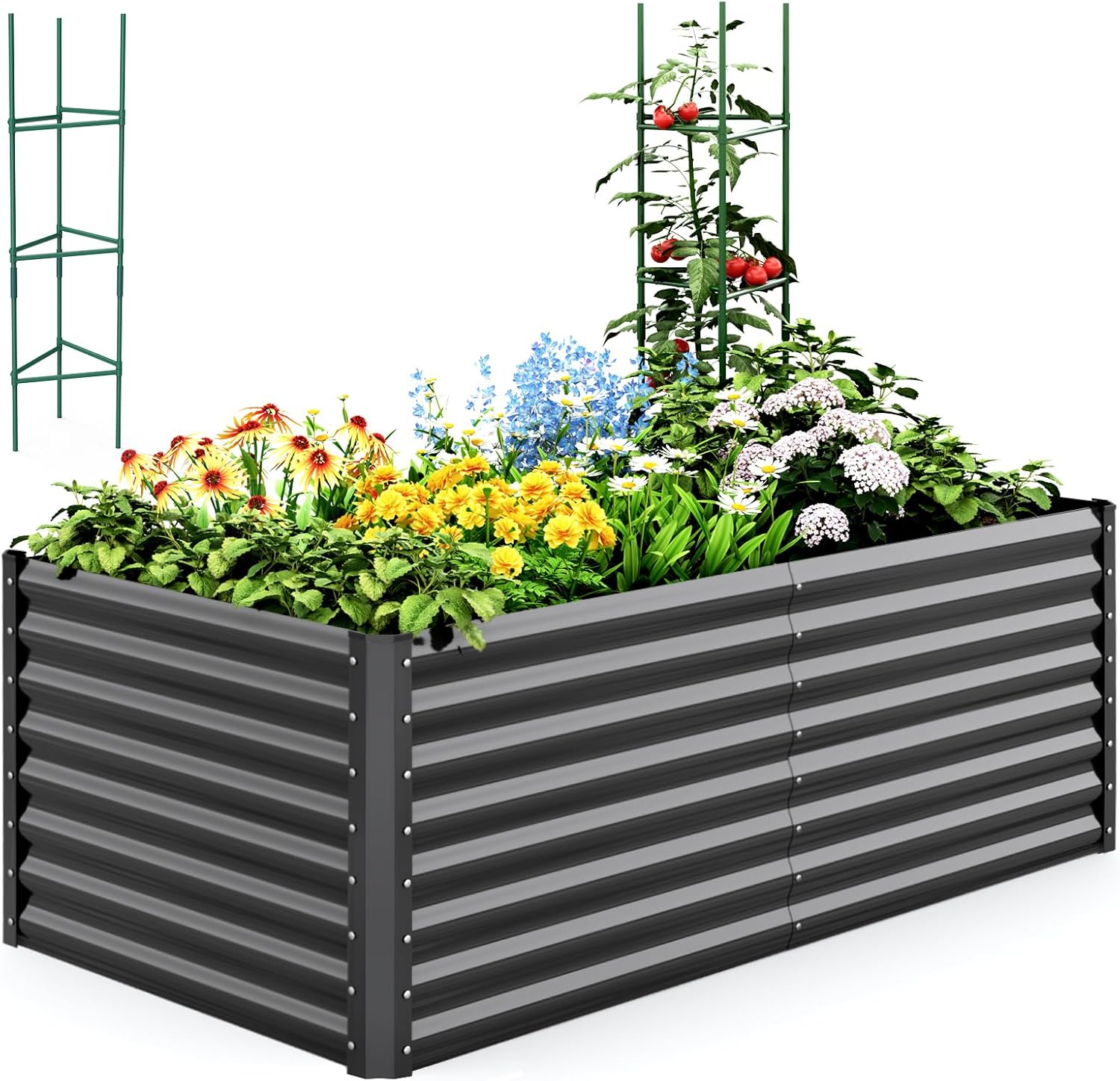
| Height | 22.4 inches |
|---|---|
| Material | Powder-coated galvanized steel |
| Included accessory | Tomato supporting cage |
This Quictent raised garden bed is a tall, galvanized-steel planter designed for growing deep-root vegetables and larger fruiting plants such as tomatoes. At 22.4 inches high it gives you more soil depth than standard beds, letting you layer compost and soil for stronger root development and easier watering. The powder-coated galvanized panels resist rust and weathering, and the reinforced cylindrical crossbar along the center helps keep the long 6 ft bed stable and prevents mid-panel sagging. It arrives as a flat-pack kit that you assemble in place, and the included tomato cage provides vertical support for vining or heavy-fruited varieties. Practical benefits include simpler planting and harvest at a comfortable height, better protection from small pets, and a durable metal build for multi-season use. Important limitations are that it still requires assembly and anchoring, and metal beds can heat up more than wood in full sun so you may need to monitor soil temperature for heat-sensitive seedlings.
Best for: Gardeners who want a durable, higher-profile planter for growing tomatoes and other deep-rooted or heavy-fruiting plants and who prefer a low-maintenance, long-lasting solution.
Less Ideal for: Those who want a lightweight, portable planter to move frequently or who prefer natural materials like wood for aesthetic reasons.
- Extra 22.4 inch height accommodates deep-rooted vegetables and thicker soil layers
- Galvanized steel panels with powder coating resist rust and outdoor weather
- Reinforced cylindrical crossbar increases mid-span stability for the 6 ft length
- Includes a tomato support cage for immediate use with vining or heavy-fruited plants
- Requires on-site assembly and anchoring before filling
- Metal can warm up in direct sun and may affect soil temperature for seedlings
Verdict: Buy this raised steel bed if you need a sturdy, extra-tall planter built for tomatoes and other deep-rooted, heavy-bearing plants.
Choosing the Right Tomato Planter Box: Key Factors to Consider
Container Material and Longevity
Material dictates how a planter box weathers sun, moisture, and freezing conditions. Wood offers good insulation but can rot unless pressure-treated or lined; composite and rot-resistant plastics last longer with less upkeep. Metal can be durable but may heat roots in full sun unless insulated.
Think about how long you expect the box to remain in place and whether you are willing to recoat or line a wooden box each few seasons. Materials also influence weight, which matters if you plan to move the box seasonally or place it on a balcony.
Drainage Design and Water Retention
Tomatoes need consistently moist soil but will fail if roots sit in water. Look for planter boxes with clearly defined drainage paths, raised bottoms, or integrated drain plugs to allow excess water to escape while preventing soil from washing out.
Drainage features should match your watering style. If you hand-water daily, a faster-draining box reduces wet feet risk. If you rely on slow-drip irrigation, look for designs that hold moisture between waterings without becoming waterlogged.
Root Volume and Planting Depth
Tomatoes, especially indeterminate varieties, need deep, well-filled planting space for healthy root networks. Shallow boxes stunt development and reduce yield, so choose boxes that provide enough depth and overall soil volume for the tomato types you plan to grow.
Consider the mature plant size and whether you will bury young stems for extra root development. Larger root volume also buffers against rapid temperature and moisture swings, which is helpful in pots exposed to full sun.
Support for Staking and Trellising
Tomatoes require sturdy support to keep fruit off the soil and reduce disease. Planter boxes that include anchoring points, built-in trellis mounts, or edges designed to accept stakes simplify training indeterminate vines.
If you prefer cages or external trellis systems, ensure the box structure can accept fasteners or that it sits on a surface where external supports can be installed. Weak or flexible sides make secure staking difficult as the plant grows heavier.
Maintenance Accessibility and Harvesting
Access to plants for pruning, tie-ins, and harvest affects daily gardening ease. A box with a comfortable height, wide rim, or removable panels reduces strain and speeds routine tasks. Removable liners or plumbable drain plugs also make soil replacement and cleaning easier.
Think about how often you want to refresh soil or check roots. High-maintenance setups can be worthwhile for heavier-feeding varieties, while low-maintenance boxes with integrated watering features suit busier gardeners.
Sizing Choices for Different Spaces
Choose depth and footprint based on available space and tomato type. For balconies and small patios, long narrow boxes let you grow multiple plants in a limited area while saving floor space. Deep, square boxes work well in-ground-style setups where larger root volume is the priority.
- Narrow railing boxes conserve floor space and suit determinate varieties.
- Deep, wide boxes give indeterminate tomatoes room for extensive roots.
- Consider modular boxes if you want to expand or rearrange planting later.
Positioning and Sun Exposure Tips
Tomatoes need full sun, typically six to eight hours. Planter boxes often sit higher and can get more intense afternoon heat, so site selection should balance sun with an afternoon cooling option on hot days. Elevating boxes slightly improves drainage and reduces pest access from the ground.
- Place boxes where they get morning sun and some afternoon protection in very hot climates.
- Rotate boxes seasonally if one spot overheats or stays too shaded.
- Use light-reflective walls or shade cloth on the hottest afternoons to limit heat stress.
Soil Mixes and Feeding Strategy
A well-draining, fertile mix is essential. Use a mix that retains moisture but is rich in organic matter so nutrients are available through the season. Tomatoes are heavy feeders, so plan a staged feeding routine and consider slow-release granules or regular liquid feeds matched to your planting volume.
- Blend compost, well-aged manure, and a light, aerating component like perlite for balance.
- Top-dress or side-dress midseason to replenish nutrients for fruiting plants.
- Match fertilizer concentration to the planter box volume to avoid salt buildup.
Winter Care and Off-Season Storage
If you live where freezes occur, empty or protect planter boxes that can trap moisture and freeze, which can damage some materials. Lightweight boxes are easier to move to sheltered storage for winter, while durable designs may stay in place with added insulation or covers.
- Drain and clean boxes before storage to prevent mold and pests.
- Disassemble or collapse boxes with modular construction for compact off-season storage.
- Consider leaving perennial herbs in a box but move frost-sensitive tomatoes indoors or clear them out after harvest.
Integrated Irrigation and Watering Options
Planter boxes that accept drip lines or have built-in reservoirs reduce watering frequency and keep moisture consistent. Choose irrigation solutions sized to the box volume so water distributes evenly across the root zone. For hand-watering, look for boxes with easily accessible edges to reach the soil surface without disturbing plants.
- Match drip emitter flow rates to box soil capacity for even wetting.
- Reservoir-style boxes help in hot, dry climates by offering a buffer between waterings.
- Ensure any integrated irrigation can be winterized or drained to avoid freeze damage.
How We Chose the Best Tomato Planter Box
We focused on attributes that directly affect tomato health and gardener convenience. Key evaluation criteria included construction durability to resist rot and collapse, drainage design to prevent waterlogging while retaining enough moisture for fruit set, and root volume to support indeterminate and larger determinate varieties. We also assessed ease of staking or trellising attachment points, portability for seasonal moves, and maintenance features such as accessibility for harvesting and cleaning. We excluded any containers that lacked adequate depth for tomato root systems or that offered only shallow tray-style planting. Very specialized greenhouse-only containers and single-use grow bags were not considered because they do not meet the needs of most patio or small-plot tomato growers. Final selection favored planter boxes that balance robustness with practical details gardeners use every season, such as removable liners, reinforced corners, or integrated watering ports. These concrete, garden-focused filters helped narrow a large field to the practical seven options presented below.
FAQ
How deep should a tomato planter box be?
Aim for at least 12 to 18 inches of workable soil depth for smaller determinate varieties, with 18 to 24 inches preferable for indeterminate types. Deeper boxes allow more root growth and better moisture buffering.
Can I reuse potting mix from last season in a planter box?
You can reuse mix but it often needs refreshing because nutrients deplete and pathogens can build up. Refresh by adding compost and replacing at least a third of the mix, or sterilize and fully replace if disease was present.
Is it better to bury the stem or use a cage in a planter box?
Burying part of the stem encourages extra roots and can strengthen the plant, which is helpful in deep boxes. Cages or trellises control vertical growth and reduce stem rubbing. Many gardeners use both techniques together.
How do I avoid waterlogging in a planter box?
Ensure the box has sufficient drainage holes or a raised base and use a well-draining soil blend. Avoid heavy clay mixes and match watering frequency to the container volume to prevent standing water.
Will tomatoes outgrow a small planter box quickly?
They can, especially indeterminate varieties that develop long root systems. Choose determinate or patio-specific tomato types for very small boxes, or plan to transplant to a larger container before the root zone becomes crowded.
Final Verdict
Choose a tomato planter box that balances depth and drainage with a structure sturdy enough for stakes or trellises. Prioritize root volume and moisture management over cosmetic features, since these factors most directly influence yield and plant health. For small-space growers, compact long boxes and integrated support features reduce daily maintenance, while gardeners who want larger yields should favor deeper, more robust boxes that allow extensive root growth. Decide which tradeoffs you accept between portability, longevity, and maintenance before you buy. That clarity will help you pick the planter box that fits your site and tomato-growing goals with confidence.
