

Note: This article contains affiliate links. If you click on these links and make a purchase, I may earn a small commission at no extra cost to you. This helps support my research and content. Read my full affiliate disclosure here.
Getting broadleaf weeds under control changes how your lawn and garden look and how other plants compete for water and nutrients. The right weed killer for broadleaf plants eliminates dandelions, clover, plantain, and other broadleaf intruders while minimizing harm to grass, ornamental beds, and desirable perennials. This guide covers seven top picks selected for different lawn sizes, application methods, and safety priorities. We evaluated each option on how quickly it acts, how selective it is toward turf, and how easy it is to apply so you can choose a solution that fits your yard and gardening routine. Below you will find the shortlisted products and a clear explanation of the criteria used to judge them, followed by practical advice for application, timing, and safety in common lawn and garden situations.
Top Picks at a Glance
| Best Overall The best all-around choice for most situations | SPEED ZONE SpeedZone EW Broadleaf Herbicide for Turf, 128 oz |  |
| Best Quality Built to a higher standard if you want something more solid | T-Zone Broadleaf Herbicide, 1 Quart (PBI Gordon) |  |
| Best Value The sweet spot between price and what you get | Ortho WeedClear Weed Killer for Lawns Concentrate, 1 gal. |  |
| Best Budget The cheapest option that still gets the job done reliably | Spectracide Weed Stop for Lawns Ready-to-Use Spray, 32 oz | 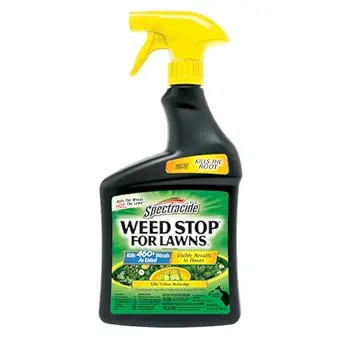 |
| Highest Rated A top-rated pick with lots of positive feedback | Trimec 992 Broadleaf Herbicide, 2.5 Gallons |  |
| Most Popular A crowd favorite that many people choose with confidence | Spectracide Weed & Grass Killer with AccuShot Sprayer, 1.33 gal |  |
| Best Seller A high-volume bestseller chosen again and again | Roundup Weed & Grass Killer with Comfort Wand, 1.33 gal. |  |
SPEED ZONE SpeedZone EW Broadleaf Herbicide for Turf, 128 oz

| Unit Count | 128 Fluid Ounces |
|---|---|
| Item Form | Liquid |
| Coverage | Broad-spectrum weed control |
SpeedZone EW is a concentrated, emulsion-in-water herbicide designed to knock down a wide range of broadleaf weeds in turf quickly. You mix it for application in low-volume or conventional sprayers and target problem weeds across lawns; the EW formulation improves wetting and coverage for faster activity and a lower odor profile compared with older liquid mixes. In practice you can see visible activity in hours and clover reduction within about a week, and the product lists control of more than 90 common broadleaf species plus some grassy pests like goosegrass and nimblewill. Important practical points: it is rain-fast in 3 to 4 hours and allows reseeding after one week, but use is restricted in many states so check regulations before buying. It is a powerful tool for routine lawn weed control but requires careful handling and adherence to safety directions to avoid off-target damage.
Best for: Homeowners or lawn care enthusiasts who want a fast-acting, broadly effective herbicide for regular turf weed control and who follow label directions and local regulations.
Less Ideal for: People who need an all-purpose gardener product for mixed beds or around ornamentals, or those unwilling to follow safety precautions and state restrictions.
- EW formulation improves coverage for faster, more complete weed contact
- Controls 90+ broadleaf weeds plus some grassy weeds like goosegrass and nimblewill
- Visible activity in hours and notable clover control in about one week
- Rain-fast within 3–4 hours and allows reseeding after one week
- Use is prohibited or restricted in many states so availability is limited by local regulations
- Requires careful handling and personal protective measures due to potential skin and eye contact risks
Verdict: Choose SpeedZone EW if you need a fast, broad-spectrum turf herbicide that delivers improved coverage and rapid visible control of common broadleaf weeds.
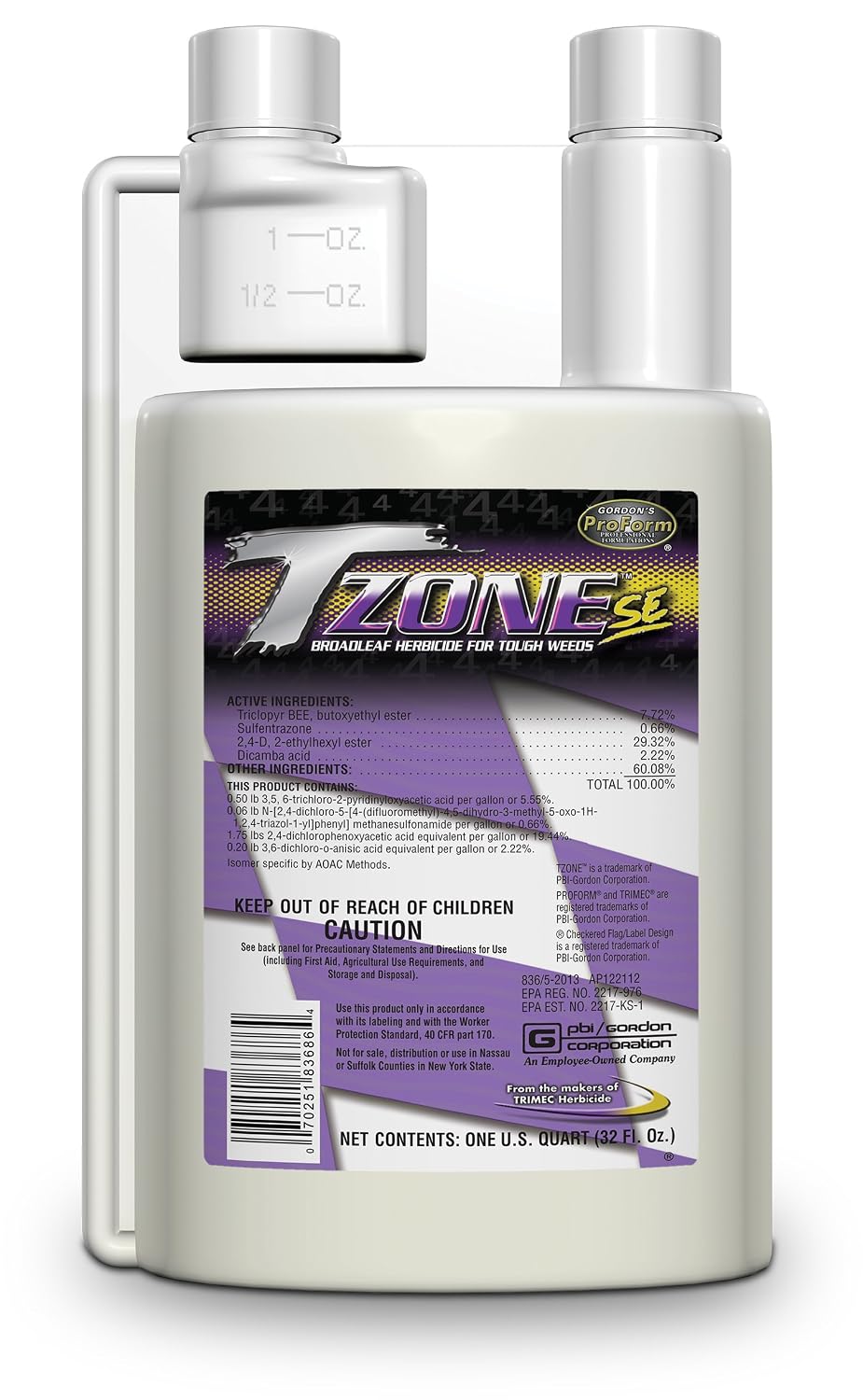
T-Zone Broadleaf Herbicide, 1 Quart (PBI Gordon)
| Unit Count | 32 Fluid Ounces |
|---|---|
| Item Form | Liquid |
| Coverage | broad-leaf weeds, grassy weeds |
| Active Ingredients | Dicamba, triclopyr, 2,4-D, Sulfentrazone |
T-Zone is a concentrated liquid herbicide designed for performance-oriented weed control in lawns, golf sites, and commercial turf. It combines active ingredients including triclopyr, dicamba, 2,4-D and sulfentrazone to deliver fast visible control of many broadleaf weeds and suppression of yellow nutsedge, with effectiveness down to cooler temperatures around 50°F. Typical use is mixing to label rates and spot- or broadcast-spraying established turf while following safety precautions such as gloves and eye protection. Practical benefits include a broad spectrum of activity, quick visual results that reduce repeat treatments, and suitability for commercial or high-expectation residential applications. Important limitations are that it is a non-selective formulation if misapplied to desirable ornamentals or young grasses, it requires careful mixing and application timing for safest turf results, and users must follow label restrictions for sensitive areas.
Best for: Gardeners and turf managers who prioritize fast, reliable control of broadleaf weeds in lawns or commercial turf and who are comfortable following label directions for mixing and application.
Less Ideal for: Casual users who need an all-purpose, ready-to-use product for beds and ornamentals or homeowners unwilling to take precautions against drift and sensitive-plant exposure.
- Broad-spectrum control of many broadleaf weeds and some grassy species
- Active ingredient blend (triclopyr, dicamba, 2,4-D, sulfentrazone) for fast visual response
- Works in cooler conditions down to about 50°F for extended seasonal use
- Formula suited for residential, commercial, and golf turf situations
- Requires careful handling and protective gear due to concentrated active ingredients
- Can damage desirable plants if sprayed drift or overspray occurs
Verdict: Choose T-Zone when you need a high-performance liquid herbicide that delivers quick, broad-spectrum control of tough broadleaf weeds in turf.
Ortho WeedClear Weed Killer for Lawns Concentrate, 1 gal.

| Item Form | Spray |
|---|---|
| Coverage | 64000 square_feet |
| Unit Count | 128 Fluid Ounces |
| Active Ingredients | Herbicide |
Ortho WeedClear Concentrate is a premixed herbicide concentrate designed for spot or blanket application across turf to control broadleaf weeds. You dilute it per label directions and apply with a tank sprayer or the Ortho Dial N Spray hose-end applicator; the formula claims fast visible results in hours and becomes rainproof in about an hour. The product lists more than 250 broadleaf weeds including dandelion, clover and chickweed and is formulated to be safe on many common lawn grasses when used as directed. Its large coverage claim makes it suited to treating whole yards or multiple seasons of spot treatment without frequent repurchase. Important limitations are that it must be mixed accurately and applied only to listed grasses and actively growing weeds for best results, and users must follow safety precautions because the concentrate can irritate eyes and skin. For homeowners focused on efficient, large-area broadleaf control, this concentrate is a practical option, but it requires proper protective gear and careful application to avoid off-target damage.
Best for: Homeowners who want an economical, large-coverage solution to remove broadleaf weeds from maintained lawns and who are comfortable mixing and applying concentrated garden chemicals.
Less Ideal for: Those who prefer ready-to-use sprays, have small lawns where concentrate is excessive, or who avoid herbicides and want nonchemical weed control methods.
- Concentrated formula covers up to 64,000 sq. ft. from one gallon when mixed as directed
- Targets over 250 listed broadleaf weeds including dandelion and clover
- Becomes rainproof in about one hour, reducing wash-off risk
- Compatible with common sprayers and the Ortho Dial N Spray hose-end applicator
- Fast visible results within hours on actively growing weeds
- Requires precise dilution and application to avoid harming desirable turf
- Not labeled for all grass varieties so misuse can damage unlisted lawns
- Safety precautions needed because concentrate can irritate skin and eyes
Verdict: Buy this if you need an efficient, high-coverage concentrate that quickly kills a wide range of broadleaf weeds in established lawns when mixed and applied correctly.
Spectracide Weed Stop for Lawns Ready-to-Use Spray, 32 oz

| Item Form | Spray |
|---|---|
| Liquid Volume | 32 |
| Coverage | Up to 10,000 square feet (for cool season grasses) |
Spectracide Weed Stop for Lawns is a 32-ounce ready-to-use spray designed to target broadleaf and some grassy weeds across common cool- and warm-season turf. You simply aim and spray weeds until wet, so no mixing or pump sprayer is required, and the formula claims visible weed control within hours by killing down to the root. It lists control for more than 460 weed types including dandelion, chickweed, clover and yellow nutsedge and can be used on bluegrass, fescue, perennial ryegrass and Bermuda when temperature guidelines are followed. Practical benefits include fast visible action, wide weed coverage and the convenience of a single bottle for spot-treating or treating several hundred square feet. Important limitations are temperature and grass-type restrictions—do not use above recommended temperatures or on certain lawns coming out of dormancy—and it is a contact killer so thorough spraying is needed for best results. Follow label safety instructions for people and pets and avoid treating stressed turf.
Best for: Homeowners who want a low-effort, budget-friendly spot or blanket treatment for common broadleaf lawn weeds and value quick visible results.
Less Ideal for: People who need a systemic, preventative granular program or who maintain sensitive turf varieties coming out of dormancy should consider alternative products or timings.
- Ready-to-use spray requires no mixing or additional equipment
- Kills a wide list of broadleaf and some grassy weeds, with visible results in hours
- Formulation intended to kill down to the root for lasting control
- Covers up to large lawns for cool-season grasses according to the label
- Performance depends on thorough coverage since it works by contact
- Not safe for some grasses emerging from dormancy and has temperature limitations
- Label warnings require keeping treated areas dry until product has dried, limiting immediate lawn use
Verdict: A convenient, no-mix spray that gives fast, budget-friendly control of common broadleaf lawn weeds.
Trimec 992 Broadleaf Herbicide, 2.5 Gallons

| Unit Count | 320 Fluid Ounces |
|---|---|
| Liquid Volume | 2.5 gallons |
| Item Form | Liquid |
| Coverage | About 975 square feet |
| Active Ingredients | Herbicide, Trimec |
Trimec 992 is a professional‑strength, ready‑to‑mix liquid herbicide designed to control broadleaf weeds in lawns and turf. It is mixed into a sprayer and applied to leaf surfaces where the active ingredients are absorbed to kill targets like dandelion, clover, chickweed and plantain. The 2.5 gallon unit supplies enough concentrate for large lawns and institutional sites, and the label includes recommended spray volumes and safety precautions to ensure effective application. Practical benefits include broad species control, established use on turf and sports turf labeling, and clear application guidance such as wind and rain buffers to avoid off‑target damage. Important limitations are that it is for non‑food turf only, must not be used on certain grass varieties such as Floratam St. Augustine, and requires careful handling and protective equipment; timing and weather restrictions (no application in high wind, wait eight hours before rain) affect when you can treat. This product suits users who want a proven, no‑nonsense chemical solution for persistent broadleaf weeds and are comfortable following label directions for safe, targeted use.
Best for: Buyers who prioritize a reliable, professional‑grade chemical solution for recurring broadleaf weeds and who follow label instructions and safety precautions when applying treatments.
Less Ideal for: Homeowners who prefer nonchemical or spot‑treatment methods, or those unwilling to use protective gear and a pump sprayer for accurate application.
- Effective against a wide range of common broadleaf lawn weeds
- Large 2.5 gallon supply suitable for treating sizable turf areas
- Clear label directions for sprayer dilution and application timing
- Labeling for use on residential and commercial turf and sports turf
- Not labeled for use on food or feed crops and restricted on certain turf varieties
- Requires sprayer equipment and careful handling due to concentrated formulation
Verdict: A dependable, large‑volume broadleaf herbicide for those who want professional‑grade control of common lawn weeds when applied according to label directions.
Spectracide Weed & Grass Killer with AccuShot Sprayer, 1.33 gal

| Unit Count | 170 Fluid Ounces |
|---|---|
| Item Form | Spray |
| Coverage | 1 gallon |
| Active Ingredients | Diquat Dibromide 0.12%, Fluazifop-p-butyl 0.06%, Dicamba 0.04% |
This Spectracide kit combines a concentrated non-selective herbicide with a battery-powered AccuShot wand for targeted spraying of unwanted vegetation. You mix or use the ready-to-apply liquid in the 1.33 gallon container, aim the extendable wand and apply until leaves are fully covered so the active ingredients absorb and move to the root. The continuous-power sprayer reduces hand fatigue compared with pump bottles and the adjustable wand improves reach for cracks, edges, and around landscape features. Formula claims visible browning in as little as three hours and is rainproof after 15 minutes, so treated areas can be replanted quickly. Important limitations are that it will kill any plant it contacts, so careful aiming and PPE are required, and the sprayer uses four AA batteries that will need replacement over time. Also the product is toxic to aquatic life, so avoid use near ponds or drains. For buyers who prefer a proven, easy-to-apply broadleaf and grass killer with a reusable powered sprayer, this is a practical option.
Best for: Buyers who want a fast-acting, easy-to-use broadleaf and grass killer with a powered sprayer for accurate spot treatment and quick results based on peer-tested performance.
Less Ideal for: People with water features, ponds, or who need a selective lawn-safe herbicide should look for alternatives designed for those uses.
- Includes AccuShot continuous-power wand for easier, more precise spraying and less hand fatigue
- Kills both broadleaf weeds and grasses down to the root for longer control
- Rainproof in 15 minutes and visible results in about 3 hours for faster turnaround
- Extendable wand improves reach for edges, patios, and around plantings
- Non-selective formula will damage any desirable vegetation contacted
- Requires four AA batteries for the sprayer which are not included and need periodic replacement
- Toxic to aquatic invertebrates so not suitable for use near water
Verdict: Choose this kit if you want a proven, fast-acting non-selective herbicide packaged with a powered sprayer for precise, low-effort removal of broadleaf weeds and grasses.
Roundup Weed & Grass Killer with Comfort Wand, 1.33 gal.

| Item Form | Liquid |
|---|---|
| Coverage | 400 sq. ft. |
| Liquid Volume | 1.33 gallons |
This Roundup kit combines a 1.33 gallon ready-to-use herbicide with a Comfort Wand for continuous spray, making spot treatments around beds, patios, driveways, and fences straightforward. It targets tough broadleaf weeds and grasses such as dandelion, crabgrass, poison ivy, clover, and spurge and promises visible results within hours and rainproofing in about 30 minutes. The Comfort Wand’s one-touch continuous spray reduces hand fatigue during larger jobs and the built-in wand makes it easy to reach edges and cracks without mixing or separate equipment. Practical benefits include broad coverage up to about 400 sq. ft. per jug and clear instructions on replanting windows for safe follow-up planting. Important limitations are typical for nonselective herbicides: it will damage desirable plants if it drifts or contacts foliage and treated areas must stay clear until spray dries. For users wanting precise application, care is required to avoid overspray and read the label for temperature and replanting guidance.
Best for: Homeowners who want a simple, no-mix solution to remove stubborn broadleaf weeds around beds, paths, and hardscapes and who prioritize an easy-to-use applicator over DIY mixing.
Less Ideal for: People looking to selectively treat weeds inside a turf lawn without harming grass or those who need an organic or nonchemical approach.
- Ready-to-use liquid with an attached Comfort Wand for one-touch continuous spraying
- Kills common broadleaf weeds and grasses to the root with visible results in hours
- Rainproof in about 30 minutes, letting treated areas resist light rain soon after application
- Covers up to roughly 400 sq. ft. per container for targeted spot treatments
- Nonselective formula will damage any desirable plants it contacts, requiring careful application
- Not suitable for broadcast lawn use where selective weed control is needed
Verdict: A convenient, ready-to-use herbicide with a comfort wand that quickly kills broadleaf weeds and makes targeted spot treatments easy.
Choosing the Right Weed Killer for Broadleaf: Key Factors to Consider
Active Ingredient and Mode of Action
Different active ingredients target broadleaf physiology in different ways, and that affects which weeds they control and how fast you see results. Growth-regulator herbicides work by disrupting plant hormone pathways and often provide reliable control of many broadleaf species, while contact herbicides scorch foliage quickly but may require repeat applications to deal with regrowth.
Understanding the mode of action helps you pick a product that matches the weed species in your lawn and reduces the chance of repeated treatments. It also informs safe rotation practices to slow the development of herbicide resistance in persistent weed populations.
Selectivity Toward Turf Grasses
Selectivity determines whether a weed killer will harm your lawn while targeting broadleaf weeds. Some formulations are labeled safe on a wide range of turf grasses, while others are only appropriate for certain cool- or warm-season varieties. Application timing and following label temperature windows also influence how safely the product can be used.
Choosing a product that matches your grass type and following dilution and application rates reduces the risk of patchy or burned turf. If you maintain mixed grass species or ornamental turf, prioritize products with broader turf compatibility or reserve spot treatments for sensitive areas.
Application Method and Coverage
Weed killers come as ready-to-use sprays, concentrates you mix in a pump sprayer, and granular formulations for broadcast application. The method affects how evenly the product contacts weed foliage and how practical it is for your lawn size. Sprays are best for spot treatments and targeted control of tall broadleaf weeds, while granular products simplify coverage of large areas but may act slower.
Consider the sprayer you already own, your comfort with mixing concentrates, and whether you need a handheld option for small patches. Application equipment and technique strongly influence results in real garden conditions.
Residual Activity and Repeat Treatments
Residual persistence describes how long a herbicide remains active in the soil and whether it will control newly emerging weeds after the initial application. Some products have short residual windows, requiring follow-up treatments to catch seedlings, while others offer longer control but may restrict planting or seeding in treated areas for a period.
For lawns where you plan to overseed or establish new turf, choose a product with a label compatible with seeding timelines. In established lawns battling perennial broadleaf weeds, a product with some residual activity can reduce the need for frequent spot spraying.
Safety, Re-entry, and Environmental Considerations
Herbicide safety includes personal protective equipment recommendations, re-entry intervals for treated lawns, and precautions around waterways, pollinators, and garden beds. Some formulations recommend avoiding flowering plants to protect pollinators, while others specify buffer distances from ponds and streams.
Review label guidance on protective clothing, weather conditions to avoid drift, and disposal of unused mix. Choosing lower-toxicity formulations and applying when pollinators are less active can reduce environmental impact while achieving effective broadleaf control.
When to Treat Broadleaf Weeds
Timing influences how well a weed killer for broadleaf will work. Apply treatments when weeds are actively growing rather than dormant. Spring and fall are often the best windows because plants are moving nutrients and herbicides through their systems, which improves uptake and translocation.
Avoid treatments during periods of drought stress or extreme heat because stressed plants absorb products poorly and turf damage risk increases. For perennial broadleaf weeds, schedule follow-up checks several weeks after the first application to catch any resprouts and treat them promptly.
- Treat young, actively growing weeds for faster control and less herbicide use
- Avoid application in drought or extreme heat
- Recheck treated areas in 2 to 4 weeks for repeat spot treatments
Spot Treatments Versus Broadcast Applications
Spot treatments are efficient for isolated patches of broadleaf weeds and reduce chemical exposure across the lawn. Handheld ready-to-use sprays or a pump sprayer with a targeted wand work well for dandelions, clover patches, and individual broadleaf plants.
Broadcast applications suit widespread infestations where many small weeds are present. Granular products or low-volume broadcast spraying can cover larger areas, but you must follow label rates to avoid turf injury and consider whether the product's residual activity aligns with your overseeding plans.
- Use spot sprays for isolated weeds to minimize herbicide use
- Reserve broadcast treatments for heavy infestations or routine lawn maintenance
- Mark treated areas and avoid over-application to protect turf
Application Best Practices
Read and follow the label for mixing rates, water volumes, and recommended application equipment. Spray when wind is low to prevent drift onto desirable plants and avoid mowing at least a day before and after treatment to leave more leaf surface for uptake.
Calibrate your sprayer to ensure even coverage and avoid streaking. When treating near garden beds or ornamentals, use barriers or handheld applicators to limit accidental exposure. Always store mixed product safely and dispose of unused mix according to label instructions.
- Calibrate sprayer and follow label mixing rates
- Apply during calm weather to reduce drift
- Delay mowing around treatment times for better uptake
Managing Resistance and Long-term Control
Herbicide resistance can develop when the same mode of action is used repeatedly. Rotate products with different active ingredient classes or combine cultural practices such as dense overseeding, proper fertilization, and correct mowing height to reduce weed pressure over time.
Use integrated management for stubborn broadleaf perennials: remove large taproot weeds mechanically when practical, follow with targeted herbicide applications for remaining regrowth, and improve lawn vigor to limit reinvasion.
- Rotate active ingredients to reduce resistance risk
- Combine chemical controls with cultural practices
- Mechanically remove large perennial roots before spot treating regrowth
Safe Use Around Gardens and Pollinator Areas
If you treat lawns adjacent to flower beds or pollinator habitat, choose products and application times that minimize exposure to bees and beneficial insects. Avoid spraying when flowers are in bloom and consider physical barriers or spot treatments near sensitive areas.
Maintain buffer zones from water features and follow label instructions for runoff prevention. Washing equipment and cleaning up spills promptly reduces unintended contamination of soil and plants.
- Avoid treating when nearby plants are flowering
- Use barriers or spot applications near pollinator-friendly beds
- Follow label guidance for water protection and spill cleanup
How We Chose the Best Weed Killer for Broadleaf
We limited our selection to products formulated specifically to target broadleaf weeds while sparing common turf grasses, excluding general nonselective herbicides meant for bare-ground use. We prioritized options with documented modes of action effective against typical broadleaf species found in lawns and garden beds. Evaluation focused on measurable, gardener-relevant dimensions: speed of visible control on common targets, selectivity and turf safety on cool- and warm-season grasses, application flexibility (spray, granular, spot treatments), and clear safety and re-entry guidance for homeowners. We also considered persistence in the soil and the need for repeat treatments when managing perennial broadleaf weeds. Products were excluded if they were intended primarily for non-broadleaf targets, required specialized licensing, or lacked clear homeowner application instructions. The resulting shortlist balances quick results, ease of use, and compatibility with typical residential lawn care practices.
FAQ
Can I use a broadleaf weed killer on a newly seeded lawn?
It depends on the product. Many broadleaf herbicides restrict seeding for a defined period after application. Check the label for specific waiting times before overseeding or establishing new turf, as some products allow seeding after a few weeks while others require longer.
How long after treatment will I see results on broadleaf weeds?
Visible effects vary by active ingredient and weed type. Contact herbicides may show browning within days but could require follow-up, while systemic growth-regulator herbicides can take one to three weeks to fully kill perennial broadleaf weeds.
Will treating for broadleaf weeds harm my ornamentals or vegetable beds nearby?
Drift and overspray are the main risks to non-target plants. Use targeted spot treatments, apply on calm days, and place physical barriers when working near ornamentals or vegetable beds. Always follow label precautions regarding proximity to desirable plants.
Is it safe to let pets onto the lawn after application?
Safety depends on the formulation and label instructions. Many products specify re-entry times for people and animals until sprayed surfaces dry. Review the label for any required waiting periods and keep pets off treated areas until safe drying times have passed.
How often should I reapply to control stubborn perennial broadleaf weeds?
Reapplication frequency depends on the herbicide's residual activity and the weed species. Often a follow-up spot treatment after several weeks handles regrowth, but persistent perennials may need seasonal treatments combined with mechanical removal and improved lawn care practices.
Final Verdict
Choose a weed killer for broadleaf based on the dominant weed species, your turf type, and how you prefer to apply treatments. Prioritize selectivity and label guidance for your grass, and balance speed of control with any restrictions for seeding or planting near treated areas. For long-term success, combine targeted herbicide use with cultural practices that thicken turf and reduce weed establishment. With the right timing, application method, and attention to safety, you can restore lawn vigor while minimizing impacts on desirable plants and pollinators.
