

Note: This article contains affiliate links. If you click on these links and make a purchase, I may earn a small commission at no extra cost to you. This helps support my research and content. Read my full affiliate disclosure here.
You want weeds gone without harming the trees that anchor your yard. Targeted weed killers for tree roots behave differently than general herbicides because they must reach aggressive root systems while minimizing movement into a tree's main roots. In a garden setting, the right choice reduces repeat sprouting, lowers maintenance time, and preserves tree health around trunks and root collars. This guide covers five top shortlisted options that are suited for use around trees. We evaluate them on how well they reach root systems, how they limit harm to desirable plants, and how practical they are to apply around trunks and landscape beds. Read on for a practical look at tradeoffs and what matters when managing weeds near trees.
Top Picks at a Glance
| Best Quality Built to a higher standard if you want something more solid | Tordon RTU Herbicide, 1 Quart (Corteva) |  |
| Best Value The sweet spot between price and what you get | Roebic FRK Foaming Tree Root Killer, 1 lb |  |
| Best Budget The cheapest option that still gets the job done reliably | Bonide Stump-Out Granules, 1 lb |  |
| Highest Rated A top-rated pick with lots of positive feedback | Roundup QuickPro Herbicide Powder (108.8 oz) |  |
| Most Popular A crowd favorite that many people choose with confidence | Bonide Stump-Out Stump & Vine Killer, 8 oz with Applicator | 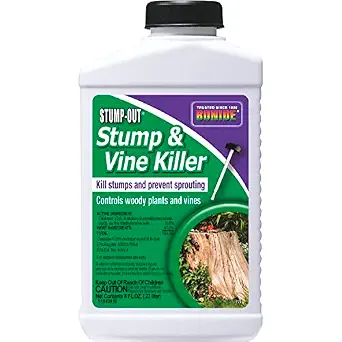 |
Tordon RTU Herbicide, 1 Quart (Corteva)

| Unit Count | 32 Ounce |
|---|---|
| Item Form | Liquid |
| Coverage | Approximately 50-100 cut stumps per quart |
| Item Type Name | Tordon RTU Herbicide QT Size |
Tordon RTU is a ready-to-use liquid herbicide designed for cut-stump and cut-surface treatments to control unwanted trees and brush along fence rows, roadsides, rights-of-way and other non-crop areas. It is supplied in a squirt-bottle applicator with a visible blue dye to help track treated stumps, so you apply directly to the exposed cambium immediately after cutting for effective systemic uptake. The label indicates coverage of roughly 50 to 100 cut stumps per quart depending on stump size and application rate, which makes the product practical for small to medium clearing projects. Important practical points are clear safety instructions and disposal guidance on the label, and the RTU formulation removes the need for measuring or mixing onsite. Because it is for non-crop and forestry-type use, you should follow all label directions and local regulations and use protective gear to avoid skin or eye contact. This product is focused on targeted stump treatment rather than broadcast weed control, so it is best used when you need reliable tree kill without mixing herbicides yourself.
Best for: Buyers who need a convenient, no-mix solution for reliably killing individual tree stumps and brush along fence lines, roadsides, or similar non-crop areas and who prioritize clear application controls and visible tracking.
Less Ideal for: Not a good choice for gardeners seeking a general-purpose weed killer or for large acreage broadcast treatments where a concentrated, sprayer-mixed product would be more economical.
- Ready-to-use squirt-bottle for direct cut-stump application with no onsite mixing
- Blue dye helps track which stumps have been treated
- Formulated specifically for tree and brush control with systemic action
- Label gives an estimated coverage per quart useful for project planning
- Intended only for non-crop and forest/rights-of-way use, not for general broadcast spraying
- Contains concentrated herbicide requiring strict PPE and careful handling
Verdict: Use this ready-to-use squirt-bottle herbicide when you need a straightforward, visible, and effective cut-stump treatment to kill unwanted trees and brush in non-crop areas.
Roebic FRK Foaming Tree Root Killer, 1 lb

| Item model number | FRK-1LB |
|---|---|
| Manufacturer | Roebic |
| Date First Available | September 1, 2004 |
| ASIN | B000BQM5DS |
Roebic FRK Foaming Tree Root Killer is a one-pound foaming chemical treatment intended to clear tree roots and keep sewer or septic lines flowing. You use it by pouring the bottle into a toilet, flushing as directed, then restricting household water use for several hours while the foam works through the pipes. The product contains dichlobenil as its active agent and is formulated to foam on contact so it coats pipe interiors and reaches roots and clogs beyond the immediate bowl. Practical benefits include an easy single-bottle application, compatibility with standard household plumbing, and a formulation that claims not to harm nearby trees. Important limitations are that it is a chemical treatment rather than a mechanical fix and will not restore severely damaged pipes or replace professional root cutting; repeated treatments may be needed to prevent regrowth. Follow label directions and water restriction instructions carefully for safe, effective results.
Best for: Best for homeowners who want a low-effort, at-home solution to clear and slow tree-root intrusion in sewer or septic lines and who prefer preventative maintenance over immediate excavation.
Less Ideal for: Not a good match for properties with collapsed or extensively damaged pipes or for buyers who need an immediate mechanical removal of roots or professional excavation.
- Foaming formula coats pipe interiors to reach roots and clogs beyond the toilet trap
- Single-bottle, pour-and-flush application that requires no specialized tools
- Formulated for use in household plumbing systems and described as safe for plumbing
- Contains dichlobenil, an agent that inhibits new root growth in treated lines
- Chemical treatment only and will not repair physical pipe damage
- Requires restricting water use for several hours after application to be effective
Verdict: A convenient, single-bottle foaming treatment to clear and inhibit tree roots in household sewer or septic lines for homeowners seeking an easy preventative solution.
Bonide Stump-Out Granules, 1 lb

| Unit Count | 16 Ounce |
|---|---|
| Item Form | Granules |
| Active Ingredients | sodium metabisulfite |
| Item Type Name | fertilizers |
Bonide Stump-Out is a granular stump remover designed to speed the natural breakdown of seasoned tree stumps so they can be burned or chopped out more easily. You apply the granules to a stump (manufacturer recommends stumps cut at least 18 months earlier) and within about 4 to 6 weeks the product helps break down lignin and cellulose bonds, softening the wood for removal. The package lists sodium metabisulfite as the active ingredient and the granular form makes targeted application straightforward around the stump without contacting surrounding plants. It is intended for DIY use and is simple to add to drill holes or to the surface of a cut stump. Important limitations are that it works best on well-seasoned stumps rather than fresh cuts and it does not remove large root systems; results vary with species and stump size. Safety precautions are required when handling and the directions include an optional burning step to finish removal, which is not suitable for all users or properties.
Best for: Home gardeners and DIYers who want a low-effort, inexpensive way to soften and remove seasoned stumps without heavy equipment, prioritizing simple application and short-term results.
Less Ideal for: People needing immediate removal of fresh stumps, those who must eliminate extensive root systems, or anyone unwilling to handle chemical products or perform an optional burn step.
- Speeds decomposition so stumps can be burned or chopped out faster.
- Granular form allows targeted application to the stump surface or drill holes.
- Works in a relatively short period of 4 to 6 weeks when used as directed.
- Does not harm surrounding vegetation when applied properly.
- Most effective on stumps cut 18 months or longer, so it is not ideal for fresh stumps.
- Does not remove roots or large underground portions of the stump.
- Contains a chemical irritant so protective gear and safe storage are required.
Verdict: Choose Bonide Stump-Out when you want an affordable, easy DIY solution to accelerate the decay of seasoned stumps so they can be removed without heavy equipment.
Roundup QuickPro Herbicide Powder (108.8 oz)

| Item Form | Powder |
|---|---|
| Coverage | Non-selective broad spectrum coverage |
| Active Ingredients | Glyphosate; Diquat |
| Unit Count | 108.8 Ounce |
| Liquid Volume | 1 gallons |
Roundup QuickPro is a concentrated powder herbicide designed to be mixed with water and applied through standard sprayers for rapid control of unwanted vegetation. It combines glyphosate for systemic, lasting control with diquat for quicker leaf uptake, so you can see visible browning in as little as 24 hours and the spray becomes rainfast in about an hour. Typical use is mixing 1.5 ounces per gallon of water, treating driveways, fence lines, and other areas where nonselective weed kill is acceptable while protecting desirable plants from drift. The powder format yields a lot of product in one unit and is convenient for users who prefer to mix exact doses when treating larger areas. Important limitations include the nonselective nature of the formula, which means careful application and shielding of desirable plants are required, and the product contains glyphosate, which some buyers may want to avoid. Follow label safety directions to protect people, pets, and non‑target plants.
Best for: Buyers who prioritize a reliable, fast‑acting solution for removing unwanted grass and weeds from nonplanting areas and who value predictable, professional‑style results.
Less Ideal for: Gardeners wanting selective lawn treatments, organic-only approaches, or those who need to treat areas near sensitive plants or pollinator habitat should consider alternatives.
- Fast visible control due to combined glyphosate and diquat action
- Concentrated powder mixes to treat large areas with controlled dosing
- Rainfast in about one hour so treatments hold up through brief showers
- Works systemically for control of many annual and perennial weeds
- Nonselective formula can damage desirable plants if not carefully applied
- Contains glyphosate which some gardeners may prefer to avoid
Verdict: Choose Roundup QuickPro when you need a dependable, fast‑acting nonselective herbicide that delivers visible control quickly and holds up through light rain.
Bonide Stump-Out Stump & Vine Killer, 8 oz with Applicator

| Unit Count | 8 Ounce |
|---|---|
| Item Form | Spray |
| Coverage | Stumps, woody plants, vines, broadleaf weeds |
| Liquid Volume | 8 fluid ounces |
| Active Ingredients | 3,5,6-Tricloro-2-Pyridinyloxyacetic Acid |
Bonide Stump-Out is a concentrated herbicide designed for targeted stump and vine control around homes and walkways. It is typically used undiluted on freshly cut stumps or as a foliar spray on woody vines and broadleaf weeds; the included brush applicator helps apply the product directly to the cut surface to prevent resprouting. The active ingredient listed is a pyridinyloxyacetic acid derivative, and the formula is intended to work within one to six weeks depending on the plant. Practical benefits include focused application that reduces drift onto turf, a small 8 ounce size that is easy to store, and compatibility with hose-end or tank sprayers for foliar work. Important limitations are that it must be applied according to label directions for safety and effectiveness, it is a specialized product for woody plants rather than a general lawn weed killer, and multiple applications or physical stump removal may still be necessary for large or well-established stumps.
Best for: Buyers who want a focused, proven solution to stop stump sprouting and eliminate woody vines around yards and structures and who prioritize products with established user feedback and clear instructions.
Less Ideal for: Homeowners seeking a general yard or turf weed control product or those who need large-volume treatments for extensive properties should consider broader-coverage herbicides or professional services.
- Targeted brush applicator for direct application to stumps and cut surfaces
- Effective on woody plants, vines and broadleaf weeds when used as directed
- Works relatively quickly with visible results in 1–6 weeks
- Can be applied undiluted for stump treatment or via hose/tank sprayer for foliar use
- Small 8 oz volume may require multiple purchases for many or large stumps
- Specialized formulation not intended as a broad-spectrum lawn herbicide
Verdict: Choose this product when you need a targeted, easy-to-apply stump and vine killer that prevents resprouting with minimal off-target spray.
Choosing the Right Weed Killer for Tree Roots: Key Factors to Consider
Mode of Action and Root Uptake
How a product moves inside a weed determines whether it will reach and kill deep roots. Systemic herbicides that translocate from foliage or cut stems into roots are typically more effective on perennial and taproot weeds than contact-only products.
For weeds that regrow from crowns or deep roots, you want a mode of action that reaches those tissues. Understand whether the formulation relies on foliar uptake, root absorption, or both. This affects timing and application method because some systemic materials work best when plants are actively growing and transporting sugars down to roots.
Selectivity and Risk to Desirable Trees
Products vary in how selective they are between weeds and woody plants. Some herbicides are nonselective and will damage any green tissue they contact, while others are selective for specific plant families or growth habits.
When working near a tree trunk, consider the risk of spray drift, root-zone movement, and bark contact. Even small amounts of some herbicides on bark or exposed cambium can stress young trees. Choose formulations and application techniques that reduce the chance of translocation into tree roots, and follow label guidance on distances from trunks or the dripline.
Formulation and Application Method
The physical form-spray, gel, wicking wand, granular, or soil drench-changes how precisely you can treat weeds near trees. Gels and wicking applicators let you target individual stems and minimize overspray. Granules can be useful in some situations but may move with water and are less precise near root zones.
Consider tools you have on hand and the layout of beds and root collars. For tight spaces under branches or close to trunk flares, a low-volume, direct-apply method typically reduces accidental exposure to tree roots and bark compared with a broad spray.
Timing and Plant Growth Stage
When you apply matters because systemic uptake is tied to plant physiology. Applications during active growth, when the weed is moving carbohydrates to roots, generally produce better root kill. Late-season applications can be effective for some perennials as plants translocate nutrients into roots for overwintering.
Avoid treatments when plants are stressed, dormant, or under drought because uptake is reduced and control may be incomplete. Also think about seasonality in your climate and how repeated treatments might be scheduled to reduce regrowth without harming trees.
Residue, Persistence, and Environmental Movement
Persistence determines how long a product remains active in soil or plant tissues. Longer persistence can help prevent regrowth but increases risk of affecting non-target plants if the chemical moves in soil water. Products with low soil mobility and controlled persistence are often safer near trees.
Understand whether a product binds to organic matter, breaks down quickly in sunlight or microbes, or leaches with heavy rainfall. Matching persistence to your weed pressure and the sensitivity of nearby tree species will reduce unintended impacts.
Safety Practices and Application Controls
Beyond the chemistry, how you apply a product largely dictates outcomes around trees. Using shields, foam applicators, or wicks reduces drift. Wearing appropriate protective gear and avoiding applications on windy days prevents accidental spread to tree foliage and bark.
Plan for runoff and avoid applying before heavy rain. Measure and mix carefully to reduce over-application. Practical steps during application can be as important as the product choice when protecting tree roots and trunk tissues.
When to Treat Weeds Near Tree Roots
Treat weeds near tree roots when the target plants are actively growing and before they set seed or thicken their root systems. Early intervention prevents extensive root spread that makes later control more labor intensive.
If trees are recently planted or stressed, delay aggressive chemical control close to the trunk and rely on manual removal and mulching until the tree establishes. For mature, well-established trees, spot treatments timed with weed growth cycles are usually effective.
- Prefer cool, calm days for application to reduce drift
- Treat perennial weeds during active translocation to the roots
- Avoid applications immediately before heavy rain
Nonchemical Alternatives and Integrated Strategies
Mechanical removal, hand-pulling, and repeated cutting can reduce weed pressure over time without chemical risk to trees. For some shallow-rooted weeds, careful digging or using a root saw can remove the source without disturbing a tree's major roots.
Combine cultural controls such as thicker organic mulch, landscape fabric in beds, and targeted hand-weeding with spot chemical treatments only where needed. Integrated approaches reduce the amount of herbicide required and lower the chance of impacting tree health.
- Lay 2 to 4 inches of mulch to suppress new weeds while monitoring for smothering tree roots
- Use a weed barrier where root disturbance is minimal
- Repeat mechanical removal for persistent shallow runners
Safe Application Techniques Around Trunks
Control the spray path by using shields, foam brushes, or wicking tools that apply product directly to weed foliage or stems. Keep applicator tips close to target plants and away from bark and root collars to minimize accidental contact.
When using spray formulations, reduce nozzle pressure, use low-drift nozzles, and keep a narrow cone spray pattern. Consider wetting agents only when specified, and rinse tools and equipment away from tree bases to avoid runoff into root zones.
- Apply directly to leaves or cut stems rather than broadcasting
- Hold a cardboard shield behind the target plant to catch overspray
- Clean applicators between uses to prevent cross-contamination
Recognizing and Reacting to Tree Exposure
If you suspect herbicide contacted bark or basal roots, flush the area with water to dilute residues and avoid further applications. Monitor treated trees for signs of stress such as wilted leaves, leaf drop, or dieback in the crown over subsequent weeks.
Mild symptoms may recover with good watering and reduced additional stress. For more serious symptoms, reduce other stressors, increase mulching and watering as appropriate, and avoid further chemical use in the immediate root zone until recovery is observed.
- Flush exposed bark areas with water when safe to do so
- Record application details to help diagnose later
- Delay further treatments near affected trees until recovery
Preparing the Site Before Treatment
Clear loose debris and mow or cut down tall weed growth before applying a product so the herbicide contacts active foliage. Mark the dripline and critical root zones of trees to maintain a safe buffer during application.
Identify desirable groundcovers or nearby plants that you want to protect. Plan a sequence of spot treatments rather than a single extensive application when working in mixed planting areas to keep exposure minimal.
- Mark trunks and root collars with temporary flags
- Remove excess vegetation that can intercept the spray
- Keep a water source and absorbent cloth on hand for accidental spills
How We Chose the Best Weed Killer for Tree Roots
We shortlisted products that focus on killing root-forming weeds without broad damage to nearby desirable trees. Our editorial filters prioritized evidence of root uptake or systemic action, application options suited for tight spaces around trunks, and documented guidelines for reducing tree exposure. Evaluation emphasized measurable, gardener-relevant criteria: root penetration effectiveness, selectivity and tree safety, application practicality for trunk and root-collar zones, and persistence to limit regrowth. We also considered formulation types that minimize off-target movement such as gels, foams, wicking applicators, or spot-spray concentrates with low volatility. Packaging and instructions that allow controlled spot treatment scored higher because they reduce accidental contact with bark or roots to preserve tree health. We excluded broad broadcast herbicides, products labeled only for turf-to-bed transitions, and any formulation that explicitly warns against use within the root dripline of trees. Products without clear application guidance for use near woody plants were also removed from consideration. The resulting picks reflect options gardeners can reasonably use to manage root-related weeds while protecting established trees.
FAQ
Can I use weed killer right next to a tree trunk?
Often you can use targeted products very close to a trunk if you apply carefully and choose a formulation intended for spot treatment. Avoid broadcasting sprays and do not apply to exposed cambium or open wounds on the trunk.
Will a systemic weed killer move into my tree roots?
Systemic herbicides can move inside plants but movement into a tree depends on exposure pathway. Direct contact with bark or heavy root-zone soil applications increase risk. Using precise application methods and respecting recommended buffers reduces that risk.
How long after application should I expect to see results on deep-rooted weeds?
Results vary with the weed species and product mode of action. Some systemic treatments show decline in a few days to weeks, while complete dieback of deep roots may take multiple weeks and sometimes repeat treatments to eliminate resprouting.
Are there safer nonchemical options for weeds growing from tree roots?
Yes. Hand removal, careful digging, smothering with mulch, and repeated cutting are effective for many situations. These methods avoid chemical exposure to tree roots but may require more time and follow-up.
What precautions reduce drift when treating weeds near trees?
Apply on calm days, use shields and low-drift nozzles, keep spray tips low and close to targets, and choose applicators that allow direct contact such as wicks or foam brushes. Reducing nozzle pressure also helps.
Can repeated applications harm established trees?
Repeated or heavy applications near the root zone can increase the chance of non-target uptake and cumulative stress. Alternate methods and use precise, limited treatments to minimize repeated exposures.
Final Verdict
When managing weeds that arise from or near tree roots, prioritize techniques and products that reach root tissues without exposing trunk bark or desirable roots. Focus on formulations and application methods that allow precise, low-volume spot treatments and choose timing when weeds are actively translocating to maximize root uptake. Balance persistence against the risk to nearby trees, and layer nonchemical controls to reduce reliance on herbicides. With careful application and attention to tree safety, gardeners can control problematic root-sprouting weeds while preserving tree health.
