

Note: This article contains affiliate links. If you click on these links and make a purchase, I may earn a small commission at no extra cost to you. This helps support my research and content. Read my full affiliate disclosure here.
If you plan to cultivate mushrooms at home, the right grow tent creates a predictable microclimate so you can focus on substrate and inoculation. A tent designed for mushroom growing helps keep humidity levels high, airflow gentle, and light exposure minimal-three factors that matter far more here than in typical plant gardening. This guide covers seven shortlisted options suited for mushroom cultivation and explains the practical features that make each tent a helpful choice. Below we outline the evaluation criteria and common tradeoffs to help you pick a tent that fits your space, maintenance style, and expected crop size.
Top Picks at a Glance
| Best Overall The best all-around choice for most situations | North Spore BoomRoom II Automated Mushroom Grow Tent, 5-Rack |  |
| Best Quality Built to a higher standard if you want something more solid | ZOYOYES Mushroom Grow Tent Kit with Shelving, Lights and Timer |  |
| Best Value The sweet spot between price and what you get | Terra Fungus 4-Tier Mushroom Grow Tent with Built-In 6500K LED & Timer |  |
| Best Budget The cheapest option that still gets the job done reliably | Heliotera Mushroom Still Air Box with 15W Dual-Spectrum Grow Light |  |
| Highest Rated A top-rated pick with lots of positive feedback | GROWORLD Mushroom Grow Tent with Adjustable LED Light and Timer |  |
| Most Popular A crowd favorite that many people choose with confidence | Salcod Large Transparent Still Air Box Mushroom Grow Tent |  |
| Best Seller A high-volume bestseller chosen again and again | VIVOSUN S448 4×4 Grow Tent (48" x 48" x 80") |  |
North Spore BoomRoom II Automated Mushroom Grow Tent, 5-Rack

| Chamber Volume | 18 cubic feet |
|---|---|
| Capacity | 18 cubic feet |
| Frame Material | Metal |
| Inner Material | PVC |
The North Spore BoomRoom II is a ready-to-run mushroom grow tent built to simplify fruiting multiple blocks, trays, jars, or bags at once. It bundles a clear zippered tent, five reinforced shelving racks, a top-mounted Myco-Mister II humidifier, a bottom-mounted FAE fan with reusable filters, and a MYCOntroller sensor/controller so humidity and fresh air exchange are automated rather than manually tweaked. Practical benefits include large vertical capacity for staging several strains or runs simultaneously, visible vinyl panels for monitoring pinning without opening the chamber, and a waterproof Spore Floor base for easier cleanup. Controls and devices mount externally so you can read and adjust settings without disrupting conditions. Important limitations are that the system is focused on indoor, small-scale production and requires a standard outlet and about 2 amps of draw, so it is not a portable or climate-independent solution. Also, the tent is a complete kit rather than a modular system for users who prefer to pick individual components.
Best for: Growers who want a turnkey, moderately sized indoor mushroom chamber that reduces daily maintenance and lets you run multiple fruiting runs at once.
Less Ideal for: People who need a highly portable setup, a single-piece ultra-small hobby chamber, or want to handpick every individual component instead of buying a complete kit.
- Fully integrated system with humidifier, FAE fan, MYCOntroller, shelving, and base included
- Automation maintains humidity and fresh air exchange without constant manual intervention
- Five reinforced racks and 18 cubic feet of vertical space let you run multiple fruiting blocks or trays at once
- Clear vinyl panels and external-mounted controls allow monitoring and adjustment without opening the tent
- Designed for indoor small-scale production and not suited for mobile or outdoor use
- Consumes mains power and draws about 2 amps, so placement near an outlet is required
Verdict: Buy this if you want a turnkey, automated indoor mushroom tent that reliably controls humidity and fresh air so you can scale beyond a single monotub without daily hands-on adjustments.
ZOYOYES Mushroom Grow Tent Kit with Shelving, Lights and Timer

| Chamber Volume | 20 cubic feet |
|---|---|
| Frame Material | Metal |
| Inner Material | Mylar |
| Item Weight | 6.4 pounds |
This ZOYOYES mushroom grow tent kit creates a controlled, compact fruiting environment for small-scale indoor mushroom projects. The tent encloses a 20 cubic foot chamber and ships with a metal shelving rack, waterproof base tray, and mushroom-optimized grow lights that include a timer so daily light cycles are automated. The Mylar-lined interior and Oxford fabric exterior help stabilize humidity and temperature while the included 4-inch vent ports let you add an inline fan, filter, or humidifier as you scale. Setup is aimed at beginners with clip and zip-tie mounting options for the lights and a redesigned buckle to reduce breakage. Practical benefits include a neat, dedicated space for oyster, shiitake, lion's mane and similar species, no need to source separate lighting or a tray, and the ability to retrofit ventilation equipment later. Limitations are the compact footprint, which restricts large-scale or commercial production, and the kit does not include environmental controllers beyond the light timer, so precise humidity/temperature control requires additional gear.
Best for: Someone who wants a performance-focused starter system to grow edible mushrooms at home with minimal sourcing of separate parts and a plan to add ventilation or humidity gear later.
Less Ideal for: Growers planning commercial-scale production or those who need integrated environmental control without buying extra equipment should consider larger or more advanced systems.
- All-in-one kit with shelving, waterproof tray, and mushroom-optimized lights with timer
- Mylar-lined interior and Oxford fabric exterior help maintain stable fruiting conditions
- 4-inch vent ports allow easy addition of inline fans, filters, or humidifiers
- Revised buckle design and included zip ties provide secure, flexible light mounting
- Compact chamber volume limits throughput for anyone wanting larger harvests
- No built-in humidity or temperature controllers beyond the light timer
Verdict: Buy this kit if you want a compact, performance-minded starter grow tent that includes lights, shelving, and a waterproof tray so you can start cultivating mushrooms at home and upgrade ventilation later.
Terra Fungus 4-Tier Mushroom Grow Tent with Built-In 6500K LED & Timer

| Chamber Volume | 20 cubic feet |
|---|---|
| Frame Material | Electrophoresis Steel |
| Inner Material | Mylar |
| Light Source Wattage | 6500 watts |
This Terra Fungus grow tent is a purpose-built indoor mushroom fruiting chamber that combines a sealed tent, built-in shelving, a programmable full-spectrum 6500K LED and a waterproof base tray. It is typically used for monotub setups and small-scale production: the four internal shelves accommodate multiple tubs across a vertical footprint so you can run continuous flushes without dedicating extra floor space. Notable features include the integrated light and timer for consistent daily cycles, mesh vents positioned for humidifier hose routing and FAE, and a sealed tray that lets you run humidifiers without leaking. Practical benefits are clear for growers who want an all-in-one cabinet ready to plug in and use right away and for those who need repeatable humidity and light cycles. Limitations to consider are the compact internal volume compared with larger chambers and the fixed shelf layout that may not fit unusually sized monotubs or allow wide spacing adjustments. The tent is optimized for serious hobbyists scaling up output within a modest footprint rather than for full commercial production.
Best for: Buyers who want a compact, ready-to-use mushroom fruiting chamber to increase yield per square foot and avoid sourcing separate lights or trays. Ideal for hobbyists and side-producers focused on repeatable, space-efficient cultivation.
Less Ideal for: Not a good fit for commercial growers needing much larger capacity or for users who require fully custom shelf spacing and modular expansion beyond the unit footprint.
- Built-in 6500K LED and programmable timer provide consistent light cycles without extra equipment
- Waterproof sealed base tray allows continuous humidifier use without floor damage
- Four internal shelves maximize vertical capacity for up to eight monotubs in a small footprint
- Mesh vents placed for humidifier hose and fresh air exchange streamline setup and automation
- Fixed shelf spacing may not accommodate unusually large monotubs or nonstandard containers
- Internal volume is limited compared with larger grow rooms or commercial cabinets
Verdict: A plug-and-play, space-efficient mushroom fruiting tent that delivers built-in light, humidity control and vertical capacity for growers scaling output without expanding floor space.
Heliotera Mushroom Still Air Box with 15W Dual-Spectrum Grow Light

| Light Source Wattage | 15 watts |
|---|---|
| Materials | PVC |
| Input Voltage | 110-240V |
| Output Voltage | 12V 1A |
The Heliotera Mushroom Still Air Box creates a controlled workspace for spawn work, agar inoculation, and small grow-bag projects. It assembles quickly into a lightweight frame covered with transparent PVC film so you can observe growth while keeping contaminants out. The included 15W dual-spectrum lamp offers blue and warm-white modes plus combined output, nine brightness settings, and three timer options to match different growth stages. Practical extras include two 150 ml spray bottles, hanging chains, zip ties, and a waterproof mat so you can start cultivating right away. Because it is compact and folds flat, it suits growers with limited space or who need a portable workstation. Expect a plastic frame and PVC shell rather than heavy-duty metal or rigid, lab-grade materials, so durability and long-term sealing may be lower than premium still-air boxes. The tent is best for hobbyists and small-batch cultivation where affordability and convenience matter more than industrial robustness.
Best for: Buyers who want an inexpensive, ready-to-use still air workspace for small-scale mushroom projects and value portability and quick setup.
Less Ideal for: Commercial growers or anyone needing a heavy-duty, long-lasting sterile glovebox or a much larger cultivation chamber.
- Integrated 15W dual-spectrum grow light with adjustable brightness and timers for stage-specific lighting
- Transparent PVC walls let you monitor growth without opening the box
- Complete starter kit includes spray bottles, hanging chains, zip ties, and a waterproof mat
- Folds flat and is lightweight for easy storage and transport
- Plastic frame and PVC film are less durable than metal-frame or rigid glovebox alternatives
- Size is aimed at small batches and may not fit larger substrates or many grow bags
Verdict: A budget-friendly, portable still air box with a built-in adjustable grow light that gets beginners and hobbyists started with small mushroom grows.
GROWORLD Mushroom Grow Tent with Adjustable LED Light and Timer

| Chamber Volume | 18 cubic feet |
|---|---|
| Inner Material | PVC |
| Unit Count | 1 Count |
| Model Number | GR-MGP-L |
This compact mushroom grow tent is built as a self-contained small greenhouse for indoor mushroom cultivation. It includes a 60 cm T8 dual-row LED fixture with 96 LEDs and a 4/8/12-hour timer, which lets you run predictable light cycles without extra controllers. The transparent PVC tent and reinforced metal frame create a waterproof enclosure with five full racks that the manufacturer says provides about 18 cubic feet of usable space, enough to organize multiple monotubs, a humidifier, and a small fan. Practical benefits include the integrated shelving for tidy staging of substrate bags or monotubs, the durable coated frame that resists rust, and the clear cover that makes visual checks easy. Limitations to expect are the small footprint, which is best for a few flushes rather than large-scale runs, and the PVC cover that may need careful cleaning and gentle handling over time to avoid clouding. For growers who prioritize dependable, compact setup with controlled lighting, this tent delivers a straightforward, no-frills solution.
Best for: Growers who want a reliable, compact setup for consistent small-batch mushroom cultivation and value predictable lighting and an organized workspace.
Less Ideal for: People planning high-volume commercial runs or those who need a larger, modular system for dozens of monotubs.
- Integrated full-spectrum LED light with three modes and 4/8/12-hour timer for repeatable light cycles
- Five shelving levels that organize multiple monotubs and accessories in a compact footprint
- Waterproof clear PVC cover with reinforced woven siding for easy viewing and humidity containment
- Coated metal frame designed to resist rust and provide sturdy support
- Small internal volume best suited to hobby or small-batch grows rather than larger operations
- PVC cover can cloud or show wear over time and requires careful cleaning to maintain visibility
Verdict: A compact, dependable mushroom grow tent with built-in timed full-spectrum lighting and organized shelving for hobby growers who want predictable, easy-to-run cultivation.
Salcod Large Transparent Still Air Box Mushroom Grow Tent
| Chamber Volume | 19520 cubic inches |
|---|---|
| Frame Material | Plastic |
| Inner Material | Plastic |
| Outer Material | Transparent Plastic |
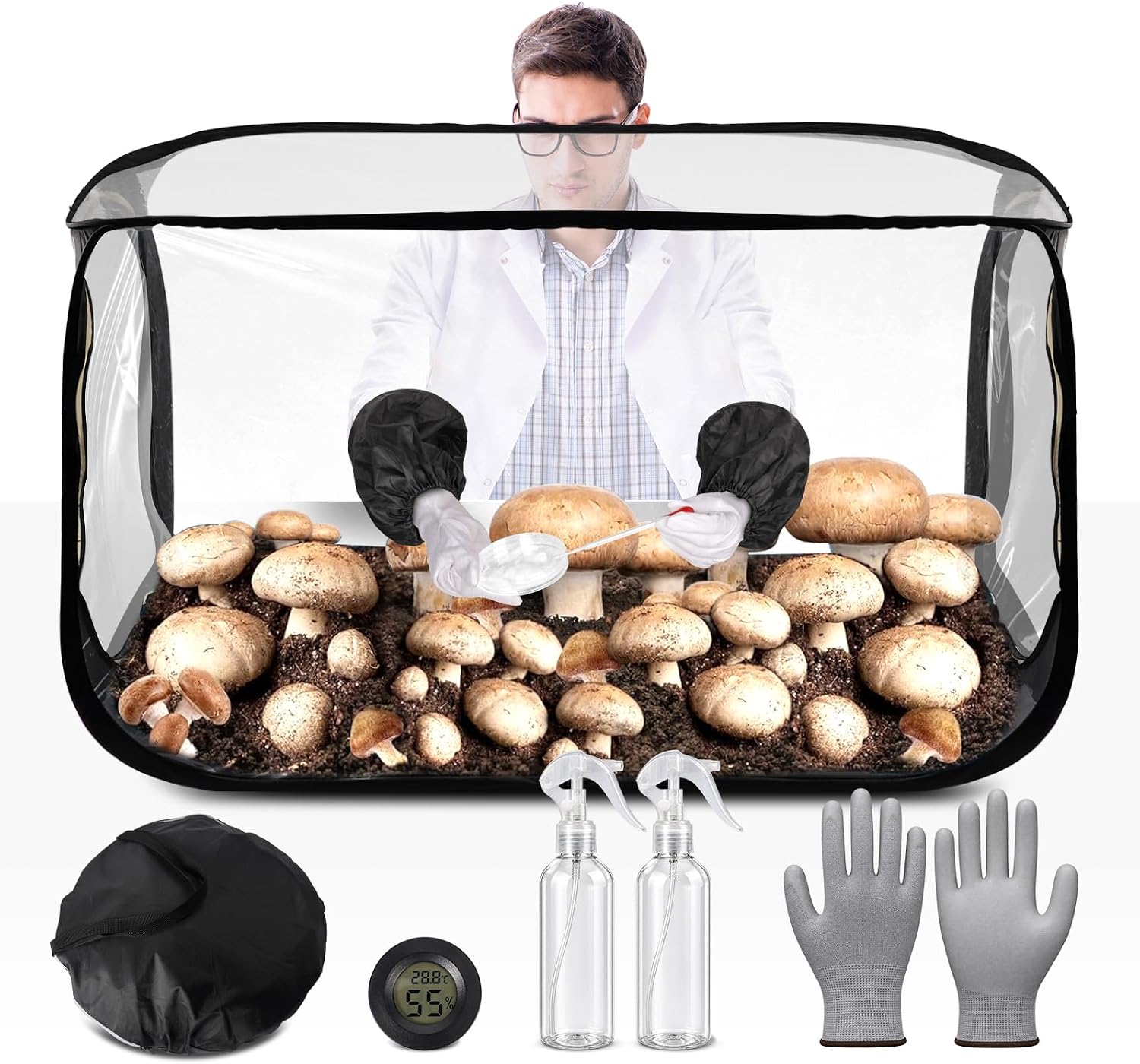
This Salcod still air box is a simple, ready-to-use enclosure for hobbyist mushroom growers who need a clean, visible workspace. It unfolds without assembly into a roomy clear chamber that accommodates multiple grow bags, plates, or small equipment, and the transparent plastic walls make monitoring and recording growth easy. Elastic armholes form a snug seal to limit contaminants while letting you manipulate cultures through the dual-zipper access points on both sides. The included mini thermometer and two spray bottles are convenient for basic setup and routine sterilization. Because the frame and panels are plastic it is lightweight and foldable for storage, but it will not replace a full glovebox or laminar flow hood for sterile-critical work; the still air design reduces airflow but does not actively filter particles. Expect good visibility and portability for inoculation, agar work, and small-batch tasks, with the limitation that extremely stringent sterile environments require more advanced equipment.
Best for: Home mushroom growers and hobbyist mycologists who want a low-effort, visible workspace for inoculation, agar work, and small-batch cultivation and who prioritize ease of use and portability.
Less Ideal for: Laboratories or users needing sterile, high-throughput production or HEPA-level particle control should choose a laminar flow hood or glovebox instead.
- Ready to use with no assembly required for quick setup
- Transparent walls provide clear visibility for monitoring cultures
- Elastic armholes and dual-zipper openings help reduce contaminants while allowing access
- Includes a mini thermometer and two spray bottles for basic monitoring and cleaning
- Still-air design does not provide active HEPA filtration or positive pressure for sterile-grade work
- Plastic construction is lightweight but less durable than metal or rigid gloveboxes
Verdict: A portable, no-assembly transparent still air box that gives hobbyists a clear, easy-to-use workspace for small-scale mushroom cultivation.
VIVOSUN S448 4×4 Grow Tent (48" x 48" x 80")

| Tent size | 48" x 48" x 80" |
|---|---|
| Inner material | Polyethylene Terephthalate (PET) |
| Outer material | Oxford Fabric |
| Frame material | Metal |
| Light source wattage | 400 watts |
The VIVOSUN S448 is a 4×4 grow tent designed to give hobby and small-scale growers a durable, lightproof environment for indoor plants. It uses a high-reflectivity mylar interior to diffuse light and reduce hotspots, plus upgraded heavy-duty zippers and a thick 1680D oxford outer fabric for long-term use. The metal frame and reinforced connectors hold hanging bars for lights and other equipment, while multiple duct ports and cable openings make it straightforward to add fans, filters, humidifiers or controllers. A removable mylar floor tray simplifies cleaning and the observation window lets you check plants without breaking the seal. Setup is intended to be quick with clear instructions and smooth-gliding doors for easy access. Expect a solid, workmanlike tent that supports multimedia grow systems, but be aware it is a dedicated grow environment so you will need to add lighting, ventilation and environmental controls separately to run a complete setup.
Best for: Buyers who value proven construction and clear social proof and want a reliable, long-lasting 4×4 tent to build a complete indoor grow system with separate lights and ventilation.
Less Ideal for: Casual plant owners who want a plug-and-play all-in-one kit or those with very limited indoor space should consider smaller integrated kits instead.
- 100% reflective mylar interior to improve light distribution and reduce hotspots
- Sturdy all-metal frame and reinforced connectors that support hanging lights and equipment
- Thick 1680D oxford fabric and heavy-duty zippers for durability and lightproofing
- Multiple duct ports and cable openings for easy integration of ventilation and climate-control gear
- Removable waterproof floor tray and observation window for easier maintenance and monitoring
- Does not include lighting, fans, or filtration so you must purchase a complete system separately
- Relatively large footprint requires dedicated indoor space and clearance for airflow
Verdict: A well-built, reflective 4×4 tent that gives risk-conscious growers a durable, serviceable base to assemble a reliable indoor grow system.
Choosing the Right Grow Tent for Mushrooms: Key Factors to Consider
Humidity Management Capacity
Mushrooms require sustained high relative humidity during colonization and fruiting. A tent that holds moisture reduces the runtime and cycling of humidifiers, which results in steadier conditions and fewer dry spots on flush trays. Look for tents with options to add a humidifier or misting system and ports sized for tubing. The fabric and zipper design also affect how well humidity is retained; heavier, tightly woven materials and well-sealed seams will keep humidity levels from dropping quickly.
Humidity control matters because short dips can stall pinning or cause uneven caps. If you plan to use an ultrasonic or warm-mist humidifier, ensure the tent can tolerate occasional condensation and that there's a safe place to route power cords and drainage if needed.
Airflow and Ventilation Options
Mushrooms need gentle fresh air exchange to prevent CO2 buildup while avoiding strong drafts that dry the substrate. A good tent offers multiple vent ports that can be opened or closed and that accept ducting for passive or low-speed fan-assisted airflow. Adjustable vents let you tune exchange rates during colonization versus fruiting phases.
Consider how easy it is to mount a small exhaust or intake fan and whether the tent supports inline filters or ducting adapters. Also think about the placement of vents relative to shelving so that airflow moves across trays without blowing directly on developing pins.
Interior Usable Volume and Layout
Usable space is about more than overall dimensions. Shelving compatibility, ceiling height, and the width of entry openings determine how many monotubs, trays, or fruiting chambers you can run. If you intend to layer racks for multiple flushes, confirm the internal clearance between shelves and the ability to reconfigure shelves or remove crossbars.
Taller tents allow for overhead humidifiers or hanging lights, while wider tents make harvesting and substrate management easier. Consider the footprint your workspace can spare and plan for additional equipment inside the tent when estimating usable volume.
Light Sealing and Material Opacity
Many mushroom species fruit best with very low, indirect light rather than full dark or strong grow-light exposure. A tent that blocks external light prevents accidental photoperiod disruptions and protects sensitive stages from UV exposure. Material opacity also contributes to thermal and humidity stability by reducing heat transfer.
Check for double-layered fabric, internal reflective materials where needed, and tight zippers that do not allow light leaks. Even small gaps can change fruiting patterns for light-sensitive species.
Access, Cleaning, and Maintenance
Frequent maintenance tasks include misting, harvesting, substrate turning, and cleaning between runs. A tent with wide, well-placed doors, removable shelving, and easy-to-clean interior surfaces speeds routine work and reduces contamination risk. Smooth, water-resistant liners or removable trays simplify wiping down surfaces and dealing with spilled substrate.
Also evaluate zipper durability and whether the tent allows partial access for small interventions without exposing the whole interior. Good cable management and ports for equipment make long-term maintenance safer and neater.
Choosing the Right Size for Your Setup
Size choice depends on how many flushes you plan to run concurrently and what equipment you will place inside the tent. A small two-tray setup needs much less height and footprint than a multi-tiered production run, so measure your intended shelving and allow extra room for humidifiers and fans.
If space is tight, prioritize internal height over extra floor area so you can stack more shallow trays. For dedicated hobby growers with a consistent schedule, a slightly larger tent reduces handling during harvest and makes contamination control easier because you can isolate individual fruiting chambers.
- Measure equipment dimensions before buying.
- Plan clearances for humidifiers and ducting.
- Leave a few inches above trays for air circulation.
Setting Up Humidification Without Overdoing It
Aim for steady humidity rather than frequent, heavy misting. Ultrasonic humidifiers deliver humid air quickly but can create uneven moisture if not diffused; consider a small circulation fan on low speed to distribute humidity gently. Warm-mist humidifiers can raise humidity but also increase temperature, which matters for some species.
Position humidifiers outside the tent when possible and route mist or ducting inside through a port to avoid water pooling near substrates. Use a reliable hygrometer placed at tray level to monitor conditions and adjust output gradually.
- Use a hygrometer at tray height.
- Diffuse mist to avoid direct wetting of caps.
- Avoid placing humidifiers directly above open substrate.
Managing Fresh Air Exchange
Rather than strong continuous ventilation, aim for intermittent gentle exchanges that keep CO2 in check without drying the substrate. Inline fans with variable speed controls or passive vents coupled with small circulating fans inside the tent offer flexibility. Route intake so fresh air is introduced near the bottom and exits higher to aid natural convection.
Consider adding simple filters on intake vents if you are in a dusty environment or worried about spores moving between runs. Keep fan speeds low during pinning stages to prevent stalled development.
- Introduce fresh air low and exhaust high.
- Use variable-speed fans for fine control.
- Fit intake filters in dusty spaces.
Avoiding Contamination Through Design Choices
Design features that simplify cleaning reduce contamination risk. Removable trays, smooth internal surfaces, and easy-access doors let you perform regular sanitation quickly. Also look for tents with ports that can be closed when not in use to limit airborne contaminants.
Limit unnecessary traffic around the tent and use designated tools and containers inside the tent to reduce cross-contamination. Wiping surfaces after harvest and before new runs dramatically lowers the chance of persistent molds.
- Choose tents with wipeable interiors.
- Use removable shelving or trays for deep cleaning.
- Keep external clothing and tools separate.
Power and Equipment Routing
Plan for safe cable routing and ventilation ducting. Tents with built-in ports sized for common ducting and power pass-throughs make installing humidifiers, small heaters, or fans safer and neater. Keep electrical components elevated and away from pooled water.
Label and organize cords outside the tent to avoid accidental unplugging. If you will add timers or environmental controllers, ensure they fit through available ports or can be mounted nearby for easy access.
- Use elevated trays for electrical safety.
- Label cords and keep controllers accessible.
- Seal unused ports to maintain humidity.
How We Chose the Best Grow Tent for Mushrooms
We selected tents that make controlled mushroom fruiting practical and repeatable in a home or garage setting. Our filters prioritized tents with reliable humidity retention, configurable airflow, and easy access for maintenance and harvest. We also favored designs that accommodate common mushroom gear such as humidifiers, small fans with variable speeds, and shelving for monotubs or trays. Key evaluation dimensions included humidity management capacity, airflow and ventilation options, interior usable volume and shelving compatibility, build quality and light-tightness, and ease of cleaning and access. We excluded tents that lacked any means to route humidification or ventilation equipment or that had poor light-sealing features likely to interrupt fruiting. We also filtered out flimsy zipper systems and designs with limited interior clearance that prevent stacking flush trays. The final selections reflect tents that perform well across these measurable criteria and are practical for hobby and small-scale mushroom growers who need predictable environmental control without complex infrastructure.
FAQ
Do I need a special tent fabric for mushrooms?
Often a heavier, tightly woven fabric helps retain humidity and block light. Breathable fabrics alone can make humidity control harder; look for tents with well-sealed seams and a water-resistant inner layer for easier cleaning and better moisture retention.
Can I run a humidifier inside the tent?
You can, but it is usually better to position the humidifier outside and route mist or ducting inside to avoid direct wetting and condensation on equipment. Running humidifiers inside requires careful placement to prevent water pooling near electrical items.
How much ventilation does mushroom cultivation need?
Ventilation needs depend on species and growth stage, but generally gentle, periodic fresh air exchange is best. Too much airflow will dry substrates and inhibit pinning, while too little leads to high CO2 and malformed fruit bodies.
What size tent is best for beginners?
A compact tent that fits two to four trays is often ideal for beginners. It is large enough to learn routine care and troubleshoot environmental control without overwhelming space or equipment needs.
How do I prevent light leaks from affecting fruiting?
Check zippers, seams, and corners for gaps and use blackout flaps or cover small gaps with tape if necessary. Position the tent away from strong external lights and limit door openings during sensitive stages to maintain consistent low-light conditions.
Final Verdict
Pick a grow tent that balances humidity retention, gentle airflow control, and usable interior space based on the scale of your mushroom runs. Smaller tents reduce the volume you must humidify and can be easier to manage, while larger tents give you room to stack trays and add equipment. Prioritize humidity management and ventilation that you can adjust without disturbing pins. Good access for cleaning and harvest will save time and reduce contamination risk. With the right tent features, you can create a reliable environment for repeatable flushes and steady progress as you scale your setup.
