

Note: This article contains affiliate links. If you click on these links and make a purchase, I may earn a small commission at no extra cost to you. This helps support my research and content. Read my full affiliate disclosure here.
Picking the right lawn selective weed killer matters because a product that removes weeds but damages grass defeats the purpose of lawn care. You want a treatment that targets common broadleaf invaders while leaving desirable grass species intact, with predictable results and manageable application steps. This guide covers seven top-rated options shortlisted for selective use on lawns and explains the performance and safety tradeoffs gardeners should weigh. Below we evaluate each candidate on real gardener priorities like weed control speed, turf safety, and application practicality to help you choose the right fit for your yard.
Top Picks at a Glance
| Best Overall The best all-around choice for most situations | Ortho WeedClear Weed Killer for Lawns with Comfort Wand, 1 gal. | 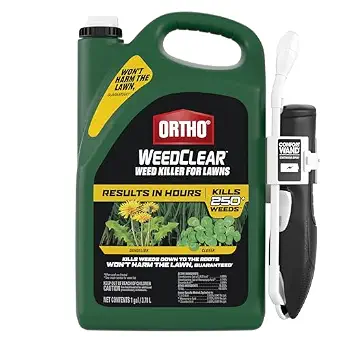 |
| Best Quality Built to a higher standard if you want something more solid | Nufarm Change Up Premium Selective Herbicide, 32 oz |  |
| Best Value The sweet spot between price and what you get | Spectracide Large Plot Weed Stop for Lawns Concentrate, 1 Gal |  |
| Best Budget The cheapest option that still gets the job done reliably | Spectracide Weed Stop for Lawns Concentrate, 32 oz Ready-to-Spray |  |
| Highest Rated A top-rated pick with lots of positive feedback | PBI / Gordon SpeedZone EW Lawn Weed Killer, 20 fl oz |  |
Ortho WeedClear Weed Killer for Lawns with Comfort Wand, 1 gal.

| Unit Count | 128 Fluid Ounces |
|---|---|
| Item Form | Spray |
| Coverage | 16000 square feet |
| Kills Listed Weeds | 250+ weeds |
Ortho WeedClear is a one-gallon, ready-to-use lawn weed killer formulated to target broadleaf weeds while leaving grass intact when applied correctly. The bottle includes a Comfort Wand applicator that provides continuous, targeted spraying for spot treatments or wider coverage when mixed per label directions. Its formula combines three active ingredients to control more than 250 common lawn weeds, delivering visible wilting in hours and becoming rainproof about an hour after drying. For routine lawn care it is practical for spring and fall applications when weeds are actively growing and temperatures are under 90°F. Important limitations are that it is for broadleaf weeds rather than grass or woody brush, and proper timing and application technique matter to avoid damage to desirable plants. Users must follow safety directions about drying time before allowing people or pets back on the lawn and avoid applying before rain. For homeowners seeking an easy, familiar option for selective weed control, this product is straightforward and effective for maintaining a weed-reduced lawn.
Best for: Homeowners who want a simple, targeted solution to remove common broadleaf weeds and keep an established lawn tidy without complex mixing or equipment. It suits gardeners who prioritize ease of use and predictable, quick results for routine lawn maintenance.
Less Ideal for: People needing a product to clear heavy brush, vines, or non-broadleaf weeds should choose a different formulation; turf renovation or bare-ground long-term prevention is outside this product's purpose.
- Ready-to-use formula requires no measuring for spot treatments
- Comfort Wand provides continuous, precise spraying for targeted application
- Kills over 250 common broadleaf lawn weeds down to the root
- Visible results in hours and rainproof about one hour after drying
- Covers up to 16,000 square feet when used as directed
- Not intended for broad spectrum brush or woody vine control
- Contains synthetic herbicide ingredients that require following safety and reentry instructions
Verdict: A user-friendly, ready-to-use selective weed killer with a comfort wand that delivers quick, targeted control of common broadleaf lawn weeds.
Nufarm Change Up Premium Selective Herbicide, 32 oz

| Unit Count | 32 Ounce |
|---|---|
| Liquid Volume | 32 fluid ounces |
| Coverage | 1000 square feet |
| Item Form | Liquid |
| Active Ingredients | MCPA, fluroxypyr, dicamba |
Nufarm Change Up is a concentrated, liquid selective herbicide designed to knock back more than 200 broadleaf weeds in lawns while leaving common turfgrasses unharmed when used as directed. It combines MCPA, fluroxypyr and dicamba for relatively fast activity across both cool- and warm-season turf, and label directions give measured use rates for treating roughly 1,000 square feet from a 32-ounce bottle. In practice it is applied with a pump sprayer or hose-end sprayer to spot-treat or broadcast small to medium lawns, and it is labeled for many turf types including Kentucky bluegrass, fescue, bermudagrass and St. Augustine. The product’s strengths are broad-spectrum efficacy and turf tolerance compared with nonselective options, making it a good fit when you need strong control without killing the grass. Limitations to note are that it is a synthetic chemical requiring careful mixing and accurate application, and it may not be appropriate where dicamba-sensitive ornamentals or nearby crops are present due to potential drift risk.
Best for: Buyers who prioritize strong, reliable weed control across many turf types and who are comfortable handling concentrated chemical herbicides and following label directions.
Less Ideal for: Homeowners with flowering ornamentals, vegetables, or sensitive plantings nearby or those who prefer organic or nonchemical weed control methods.
- Selective formula targets broadleaf weeds while preserving many common turfgrasses
- Contains three active ingredients for faster and wider control of tough species
- Labeled for both cool- and warm-season turfgrass, increasing versatility
- Covers approximately 1,000 square feet per 32 oz bottle, suitable for small to medium lawns
- Contains dicamba which can damage nearby sensitive plants if drift occurs
- Requires accurate measurement and sprayer calibration for safe, effective use
Verdict: Choose this product when you want a powerful, selective herbicide that delivers broadleaf control across cool- and warm-season lawns while preserving turf.
Spectracide Large Plot Weed Stop for Lawns Concentrate, 1 Gal

| Item Form | Liquid |
|---|---|
| Coverage | 32000 square feet |
| Unit Count | 128 Fluid Ounces |
Spectracide Large Plot Weed Stop is a concentrated broadleaf weed killer formulated for large lawns. You mix the concentrate with water and apply it with a tank or hose‑end sprayer to spot treat or cover wide areas; one gallon treats up to 32,000 sq ft of northern grasses or more for southern grasses. The formula targets over 200 listed weeds including dandelion, chickweed and clover and promises visible results in hours and root kill for longer control. It becomes rainproof within hours, so light rain shortly after application is less likely to wash it away. Important practical notes are follow the label for temperature limits and application timing since it can damage grass if used when air temperatures exceed 85°F and you should keep people and pets off the treated area until dry. The product is convenient for large properties because of the built‑in hose connector and concentrate option, but it requires a sprayer and correct mixing to get the coverage claims.
Best for: Homeowners who want an efficient, economy-minded solution to control broadleaf weeds across large lawns and who are comfortable mixing and applying concentrated treatments with a sprayer.
Less Ideal for: People with very small lawns, renters, or gardeners who prefer ready‑to‑spray formulations or nonchemical weed control methods.
- Concentrated formula covers large areas — up to 32,000 sq ft for northern grasses
- Kills over 200 listed broadleaf weeds and works down to the root
- Rainproof within hours so light rain is less likely to reduce effectiveness
- Built-in hose connector makes it straightforward to mix and apply with common sprayers
- Can damage turf if applied when air temperatures exceed 85°F
- Requires a sprayer and correct mixing, which may be inconvenient for small lawns or one-time users
Verdict: Choose this concentrate if you need a cost‑effective, large‑area selective weed killer that removes broadleaf weeds to the root and is rainproof within hours.
Spectracide Weed Stop for Lawns Concentrate, 32 oz Ready-to-Spray

| Unit Count | 32 Ounce |
|---|---|
| Coverage | 8,000 square feet |
| Item Form | Liquid |
| Active Ingredients | 2,4-D, Mecoprop-P, Dicamba, Sulfentrazone |
Spectracide Weed Stop for Lawns is a hose-attach concentrate designed to kill listed broadleaf weeds across common turf types. You connect the QuickFlip sprayer to your garden hose, spray until weeds are wet, and the formula acts by contact down to the root with visible browning in as little as three hours. It lists control of over 460 weeds including dandelion, chickweed and clover and is labeled for use on bluegrass, fescue, Bermuda and perennial ryegrass when applied between 45 and 90 degrees. The main practical benefits are fast visible results, broad weed coverage and the convenience of a hose-ready applicator that removes mixing guesswork. Important limitations are that it is a contact herbicide so thorough spray coverage matters, it should not be used on zoysiagrass coming out of dormancy, and lawn injury can occur if applied above the recommended temperature range. Follow the label for re-seeding intervals and keep people and pets off treated areas until dry.
Best for: Homeowners who want an inexpensive, ready-to-use solution to quickly remove broadleaf weeds from common lawn grasses and value ease of application over specialty formulations.
Less Ideal for: People growing delicate or recently seeded turf, owners of zoysiagrass coming out of dormancy, or those who need systemic long‑term weed control for perennial or deep-rooted weeds.
- QuickFlip hose‑attach sprayer removes need to premix and speeds application
- Kills a wide list of common broadleaf weeds with visible results in about three hours
- Formulated for use on multiple common lawn grasses when label directions are followed
- Contact action requires thorough spray coverage to reach the roots of every weed
- Not safe for zoysiagrass just emerging from dormancy and can damage turf if applied above recommended temperatures
Verdict: A budget-friendly, hose‑attach concentrate that delivers fast, broadleaf weed kill and easy application for common lawn grasses.
PBI / Gordon SpeedZone EW Lawn Weed Killer, 20 fl oz

| Unit Count | 20 Fluid Ounces |
|---|---|
| Item Form | Liquid |
| Coverage | Mix 1.8 fl oz (warm) or 1.5 fl oz (cool) per 0.5–1 gal water to treat 1000 sq ft |
| Active Ingredients | 2,4-D; Dicamba; Carfentrazone-ethyl; Mecoprop-p |
SpeedZone EW is a ready-to-measure liquid selective herbicide intended for treating common broadleaf weeds in lawns while preserving established turf. It mixes with water at low rates and is applied with a garden sprayer to cover treated areas; instructions separate rates for warm- and cool-season grasses and the bottle gives coverage guidance per 1,000 sq ft. The formula contains four active ingredients for broad-spectrum control and is described as fast-acting with visible injury within hours and plant death in about 7 to 10 days. Practical benefits include labeled tolerance for common turf species, rainfast performance in a few hours, and the ability to reseed in as little as a week after application. Important limitations are that it is a chemical control that requires careful reading of the label for safety, exact mixing and application to avoid turf injury, and it targets listed broadleaf weeds only so it will not control all turf pests or grassy weeds equally.
Best for: Homeowners who prioritize dependable, professional-strength weed control and want a product that works across common cool- and warm-season lawns with predictable results.
Less Ideal for: Those looking for an all-in-one solution for grassy weeds or organic/chemical-free lawn care should consider alternative products or cultural controls.
- Broad-spectrum control of 90+ listed broadleaf weeds including clover and dandelion
- Four active ingredients increase efficacy and speed of visible results
- Labeled for cool- and warm-season turf species so it fits common lawn types
- Rainfast within about 3 hours and allows reseeding as soon as 7 days
- Requires careful mixing and strict adherence to label directions to avoid turf damage or safety risks
- Does not target all grassy weeds or nonlisted pests
Verdict: Choose SpeedZone EW when you need a reliable, fast-acting selective herbicide that controls a wide range of broadleaf lawn weeds while preserving common turfgrasses.
Choosing the Right Lawn Selective Weed Killer: Key Factors to Consider
Selective Control Spectrum
Different selective weed killers target different groups of broadleaf weeds. Some formulas are broad-spectrum against dandelions, clover, plantain, and chickweed, while others add grass-targeting herbicides or minor sedge activity. Knowing which weeds dominate your lawn helps you pick a product with the right active ingredients. Using a product with a limited spectrum can leave remnant weed populations that quickly re-establish and may require follow-up spot treatment.
Matching the active ingredient profile to the weed pressure reduces wasted applications and speeds the return to a uniform lawn. Also consider whether single-application control is realistic for perennial or deeply rooted species; some weeds require repeat treatments timed to their growth cycles.
Turf Safety And Grass Type Compatibility
Not all selective herbicides are safe on every turfgrass. Cool-season grasses and warm-season grasses can have different tolerances to specific active ingredients. Always check labeled grass species before applying because injury ranges from temporary discoloration to longer-term thinning if the product is not compatible. Young or recently sodded lawns are often more sensitive and may need delayed treatments until established.
Timing also affects turf safety. Applying during heat stress, drought, or when the grass is actively transitioning growth phases raises the risk of damage. Following label timing windows and avoiding applications during extreme weather helps protect desirable turf.
Application Timing And Growth Stage
Herbicide uptake depends on weed growth stage and metabolic activity. Most selective products work best when weeds are actively growing and not dormant. Early spring and fall often provide optimal conditions for many broadleaf species, while midsummer stress can reduce uptake and efficacy. For perennial weeds, well-timed repeat applications capture regrowth and exhaust root carbohydrate reserves.
Consider mowing schedule as well. Mow a few days before treatment to ensure weeds have enough leaf area for uptake, but avoid mowing immediately after to let foliar-applied herbicides translocate. The label will indicate ideal timing windows and any restrictions related to mowing.
Application Method And Coverage Needs
Coverage quality directly affects control. Some gardeners treat entire lawns with broadcast sprayers while others perform spot treatments with hand sprayers or ready-to-use trigger bottles. Broadcast applications require attention to spray calibration and even overlap to avoid streaks or missed areas. Spot sprays reduce overall chemical use but may miss scattered weed seedlings in large lawns.
Mixing accuracy matters too. Overconcentrating can increase turf risk while under-dosing reduces efficacy. Consider whether you need a concentrate you can dilute for multiple jobs or a ready-to-use option for small patches.
Environmental And Safety Considerations
Selective herbicides can move off-target when sprayed during windy conditions or when irrigation follows too soon. Drift control, buffer distances to ornamentals, and runoff risk near water features should guide product choice and application timing. Read label directions on rainfall-free intervals and restrictions near water or sensitive plants.
Personal safety matters as well. Some formulations require more protective equipment during mixing and application. Choose products where required PPE and handling steps match your comfort and ability to comply.
Residual Activity And Re-Treatment Interval
Residual control refers to how long a product prevents weeds from re-establishing. Some selective herbicides offer short residual windows and rely on follow-up applications, while others provide longer suppression. Longer residual activity can reduce the frequency of treatments but may increase risk to overseeding or new sod operations.
If you plan to overseed or establish new turf, check label guidance on waiting periods after application. Also factor in how long you want suppression versus your tolerance for multiple, timed re-treatments to manage stubborn perennial weeds.
Identifying The Weeds In Your Lawn
Walk the lawn and identify the most common weeds before choosing a product. Broadleaf weeds like dandelion and clover are foliar feeders and respond to many selective herbicides, while grassy weeds and sedges need different chemistries or cultural controls. Photographs or a simple identification app can help you match symptoms to species.
- Note growth habit: rosette, upright, creeping
- Record where weeds are concentrated: sunny patches, compacted soil, or near edges
- Estimate percentage cover to decide spot versus broadcast treatment
When To Apply For Best Results
Aim for applications when weeds are actively growing and soil moisture is adequate. Early morning or late afternoon applications on calm days reduce drift and improve uptake. Avoid treating during drought stress or when temperatures are extremely high, as this can reduce effectiveness and increase turf strain.
- Mow a few days before treatment but do not mow immediately after
- Wait for a rain-free period as specified on the label to allow absorption
- Schedule follow-up checks at 2 to 4 weeks to assess control and any need for retreatment
Safe Practices For Mixing And Spraying
Measure concentrates carefully and use a dedicated mixing container and sprayer. Wear recommended personal protective equipment when handling concentrates, and keep children and pets off treated areas until the label allows reentry. Calibrate your sprayer to ensure even application and avoid over-application that can harm turf.
- Rinse sprayer after use and dispose of rinse water responsibly
- Use drift-reduction nozzles for broadcast spraying
- Keep a small test patch if trying a new product on unfamiliar turf
Combining Chemical Control With Cultural Care
Selective herbicides work best as part of an integrated lawn program. Improving mowing height, irrigation practices, and soil fertility reduces the competitive advantage of many weeds over time. Thick, healthy turf creates shade and root competition that suppresses weed seedlings without further chemicals.
- Raise mowing height slightly to encourage deeper grass roots
- Address soil compaction and fertility imbalances based on soil test results
- Overseeding bare patches after appropriate waiting periods helps prevent reinfestation
Spot Treatment Versus Broadcast Applications
For small, isolated weed patches, spot treatment reduces chemical use and exposure. Large or widespread infestations are more efficiently handled with broadcast applications to ensure even coverage. Consider lawn size, weed distribution, and your comfort with spray equipment when choosing the method.
- Spot treats for scattered weeds and near ornamentals
- Broadcast for lawns where weeds are widespread
- Combine spot and broadcast strategies across the season as needed
How We Chose the Best Lawn Selective Weed Killer
To build this shortlist we focused on criteria that reflect how gardeners actually use selective herbicides on maintained lawns. We prioritized proven control of common broadleaf weeds and pre-existing turf compatibility to reduce the risk of grass injury. Application practicality was evaluated by looking at dilution flexibility, treatment footprint, and timing windows so gardeners can match products to their yard size and schedule. Residual activity and re-treatment interval were measured to balance long-term control against potential stress to the lawn. Safety considerations included labeled restrictions for grass types, maximum seasonal application rates, and clear mixing and PPE guidance. We excluded nonselective herbicides, products intended primarily for spot-use only without lawn labeling, and formulations not registered for turf use. The final selection reflects products that score well across these dimensions while remaining appropriate for common lawn grasses and typical homeowner application practices.
FAQ
Can I use selective weed killer on newly seeded lawn areas?
Most products have waiting periods before overseeding or after seeding. It usually depends on residual activity and the active ingredient. Check label directions because using a product too soon can inhibit seedling establishment.
Will selective weed killers harm nearby flower beds or vegetable gardens?
Drift or runoff can damage non-target plants. Maintain buffer zones, avoid spraying on windy days, and be cautious near ornamentals. Some products list specific restrictions for sensitive plants on their labels.
How long before I see results after application?
Visible yellowing or wilting often appears within a few days to two weeks depending on weed species and growth conditions. Perennial or deeply rooted weeds may take longer and sometimes require repeat applications.
Is it safe to walk on the lawn after treatment?
Reentry intervals vary by product. Many labels allow light foot traffic after the spray dries, but children and pets often need to be kept off treated areas until the specified interval has passed. Follow label reentry guidance.
Can I mix selective herbicides with fertilizer in the same spray?
Mixing with fertilizers is generally not recommended unless the product label expressly permits it. Combining products can alter uptake, increase turf stress, or create compatibility issues. When in doubt, apply separately according to label intervals.
How often will I need to reapply to control perennial weeds?
Perennial weeds often require multiple treatments timed to active growth periods. Expect to monitor and possibly reapply every 4 to 8 weeks until the population is controlled, following label maximum seasonal rates and timing guidance.
Final Verdict
Choose a lawn selective weed killer that matches the specific weeds you need to control and the grass species you have. Prioritize products with clear turf compatibility statements, practical application formats for your lawn size, and timing guidance that fits your maintenance schedule. Remember that chemical control is most effective when combined with cultural practices like proper mowing, irrigation, and overseeding. With the right match, you can greatly reduce broadleaf pressure while keeping turf health the top priority.
