

Note: This article contains affiliate links. If you click on these links and make a purchase, I may earn a small commission at no extra cost to you. This helps support my research and content. Read my full affiliate disclosure here.
Choosing the right yard insecticide matters because pests can quickly damage turf, ornamentals, and edible gardens if control is delayed or inconsistent. You want something that controls the key insects in your yard while fitting your maintenance routine and safety needs. This guide shortlists seven top-performing yard insecticides suited to common home landscape and garden situations. We explain how each option performs on coverage, longevity, and safety so you can pick a product that works for your lawn, beds, or around edible plants. Read on for practical evaluation criteria and clear guidance before you apply anything in the yard.
Top Picks at a Glance
| Best Overall The best all-around choice for most situations | Spectracide Triazicide Large Plot Insect Killer Concentrate, 1 Gal |  |
| Best Quality Built to a higher standard if you want something more solid | Talstar One Insecticide Concentrate, 1 Gallon |  |
| Best Value The sweet spot between price and what you get | Ortho BugClear Lawn Insect Killer, 10 lb granules |  |
| Best Budget The cheapest option that still gets the job done reliably | Spectracide Triazicide Insect Killer for Lawns & Landscapes, 32 oz |  |
| Highest Rated A top-rated pick with lots of positive feedback | Envu Suspend SC Insecticide Concentrate, 16 oz |  |
| Most Popular A crowd favorite that many people choose with confidence | Ortho Home Defense Insect Killer for Indoor & Perimeter, 1.33 gal. with Comfort Wand |  |
| Best Seller A high-volume bestseller chosen again and again | Atticus Talak 7.9% Bifenthrin Indoor/Outdoor Insecticide Concentrate (32 oz) |  |
Spectracide Triazicide Large Plot Insect Killer Concentrate, 1 Gal

| Unit Count | 128 Fluid Ounces |
|---|---|
| Item Form | Spray (concentrate) |
| Target Species | Insects |
| Liquid Volume | 1 gallons |
This Spectracide Triazicide concentrate is designed for homeowners who need wide-area pest control across lawns, garden beds, trees and shrubs. The product is mixed with water and applied with a separate tank sprayer to treat surface insects such as ants, aphids, fleas, ticks and Japanese beetles. The formula claims contact kill for 180+ pests and offers residual protection for up to two months when used as directed. As a concentrate it covers a large area per gallon, which makes it practical for large yards or periodic perimeter treatments. Important considerations are following label directions closely, wearing protective clothing while mixing and applying, and avoiding application on desirable plants or near water to prevent damage or contamination. It is not a ready-to-spray product, so buyers need a compatible sprayer and should be comfortable with measuring and dilution for safe use.
Best for: Homeowners with medium to large yards who prioritize effective, long-lasting perimeter and landscape pest control and are comfortable mixing and applying a concentrate.
Less Ideal for: People who want a ready-to-use spray or who have very small yards and prefer spot treatments should consider simpler, pre-mixed options.
- Broad-spectrum concentrate that lists control of over 180 pests including ants, aphids, fleas, ticks and Japanese beetles
- Long residual protection up to two months when applied as directed
- Large coverage from a single gallon suitable for treating extensive lawns and landscapes
- Non-staining when used according to label and formulated for outdoor plant and turf use
- Requires separate tank sprayer and correct dilution so it is not ready-to-use
- Contains active ingredients that require protective clothing and careful handling to avoid harm to people, pets and non-target plants
Verdict: Choose this concentrate when you need powerful, long-lasting insect control across large lawns and landscapes.
Talstar One Insecticide Concentrate, 1 Gallon

| Active ingredient | Bifenthrin 7.9% |
|---|---|
| Formulation | Concentrate, water-based |
| Container size | 1 gallon |
| Target pests | Controls 75+ listed pests |
Talstar One is a professional-strength bifenthrin concentrate made for large lawns, structures, and perimeter defense against common nuisance pests. Mixed with water according to the label, it is applied with a pump or compression sprayer to foundations, doorways, landscaping, lawns, shrubs, and targeted indoor cracks and crevices. Notable features include a water-based, low-odor formula that dries clear, residual control that reduces reapplication frequency, and EPA-approved use around homes when label directions are followed. For performance-focused users it delivers dependable knockdown and several weeks of control against ants, spiders, fleas, ticks, mosquitoes and more, which is useful for seasonal maintenance or treating multiple structures. Important limitations are that it is a concentrated pesticide that requires proper dilution and protective equipment, it is toxic to aquatic life so care is needed near water, and application beyond labeled uses or rates is unsafe. Expect strong residual performance but plan treatments around safety precautions and non-target exposure.
Best for: Experienced homeowners, property managers, or landscapers who prioritize strong, long-lasting pest control and are comfortable mixing and applying concentrates according to label directions.
Less Ideal for: Casual gardeners, households with pets or children that cannot follow strict application safety, or users who need an off-the-shelf ready-to-use spray without mixing.
- Broad-spectrum control listed for 75+ pests including ants, spiders, fleas, ticks and mosquitoes
- Concentrated formulation stretches across large properties and multiple treatments
- Water-based, low-odor formula that dries clear for discrete application around living spaces
- Residual activity reduces frequency of repeat applications when used per label
- Requires correct dilution and appropriate PPE since it is a concentrated pesticide
- Toxic to aquatic organisms and not suitable for use near ponds or waterways
Verdict: Choose Talstar One when you need a powerful, long-lasting concentrate for professional-grade perimeter and yard pest control.
Ortho BugClear Lawn Insect Killer, 10 lb granules

| Unit Count | 160 Ounce |
|---|---|
| Item Form | Granules |
| Target Species | Insects |
| Coverage | Up to 16,500 sq ft |
Ortho BugClear Lawn Insect Killer is a ready-to-use granular treatment for lawns and landscape beds that targets ants, ticks, fleas, grubs, armyworms and other common outdoor insects. You apply it with a broadcast spreader over turf, ornamental beds or around a home perimeter, then water it in to activate the product. The formula starts killing quickly on contact for most pests and claims up to six months residual control against many ant species and three months against other listed insects. Practical benefits include wide coverage from a single 10 lb bag—listed as treating up to about 16,500 sq ft—and compatibility with standard spreaders, which makes it straightforward to dose evenly across a yard. Limitations to note are the exclusions named on the label for certain ants and that some pests such as fire ants are not controlled rapidly, so local follow-up may be needed. As with any lawn insecticide you should follow label directions closely for application timing, watering-in, and approved uses on ornamentals and listed vegetable plants to avoid off-target damage.
Best for: Gardeners and homeowners who want a straightforward, no-frills granular treatment to reduce common lawn pests across medium to large yards and who prioritize ease of application and multi-month protection.
Less Ideal for: People seeking an organic or non-chemical solution, or those needing rapid eradication of fire ant mounds or pests excluded on the product label should consider alternative products or targeted treatments.
- Broad pest list that includes ants, ticks, fleas, grubs and armyworms
- Fast knockdown on contact for most listed insects
- Long residual control for many ants (up to 6 months) and several months for other pests
- Designed for use with common broadcast spreaders for even coverage
- Does not control all ant species and is less effective against fire ants for quick elimination
- Contains active ingredients that require careful adherence to label restrictions for edible plants and landscaping use
Verdict: A practical, easy-to-apply granular insecticide that delivers broad, fast knockdown and multi-month residual control for typical lawn pests.
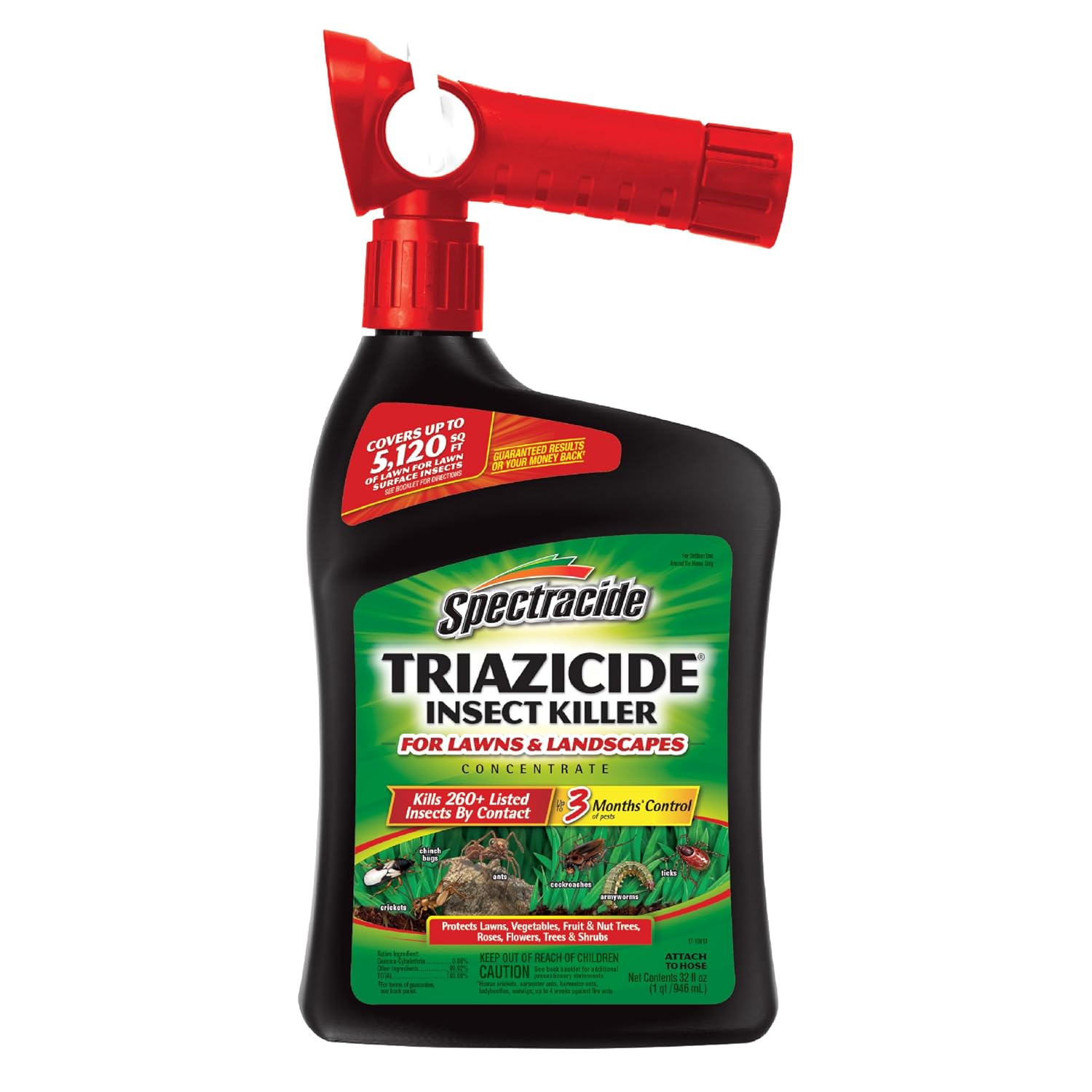
Spectracide Triazicide Insect Killer for Lawns & Landscapes, 32 oz
| Unit Count | 32 Ounce |
|---|---|
| Item Form | Spray |
| Target Species | Insects |
| Active Ingredients | Gamma-Cyhalothrin (0.08%) |
Spectracide Triazicide is a concentrated spray insecticide designed for use across lawns, flower beds, shrubs, trees and edible gardens when used as directed. You mix the 32 oz concentrate with water and apply with a tank or hose‑end sprayer to treat surface insects and soil pests; the manufacturer says it controls more than 260 listed insects including fleas, ticks, grubs and Japanese beetles and can provide up to three months of protection for treated areas. Key features are the Gamma‑Cyhalothrin active ingredient, ready compatibility with common sprayers, and label directions for targeted uses like fire ant mound treatments. In practice it gives fast knockdown of many common pests and covers large areas when properly diluted, making it a practical choice for routine yard maintenance. Important limitations are the toxicity to aquatic life and bees, and the safety precautions required for edible plants and around pollinators, so careful application timing and avoiding drift are essential. Follow the label for maximum treatments per year and post‑application reentry intervals.
Best for: Buyers who need an affordable, broad‑spectrum insecticide to treat lawns and landscapes and who are comfortable following label safety directions to protect pollinators and water. Ideal for homeowners wanting a single product to address many common yard pests on a budget.
Less Ideal for: People with small container gardens, frequent pollinator activity, or who need an organic or non‑synthetic option should consider gentler or targeted alternatives.
- Concentrate covers large areas when mixed, reducing how often you need to buy replacements.
- Kills a broad list of above‑ and below‑ground pests including grubs, fleas, ticks and beetles.
- Can be applied with common tank or hose‑end sprayers for flexible use across lawns, beds and shrubs.
- Non‑staining when used according to the label, so safe for most home siding and landscape surfaces.
- Highly toxic to fish and bees so it must not be applied near water or flowering plants.
- Contains a pyrethroid active ingredient that requires careful handling and adherence to label safety directions.
Verdict: A cost‑effective, broad‑spectrum concentrate that lets budget‑minded homeowners treat large lawns and landscapes for a wide range of pests when used carefully according to the label.
Envu Suspend SC Insecticide Concentrate, 16 oz

| Item Form | Spray |
|---|---|
| Target Species | Ants, Bed Bugs, Cockroaches, Fleas, Mosquitoes, Scorpions, Spiders, Ticks, Wasps |
| Liquid Volume | 16 fluid ounces |
| Active Ingredients | Deltamethrin |
| Specification Met | EPA |
Suspend SC is a concentrated deltamethrin suspension designed for perimeter and spot treatments around homes and structures. It mixes with water to create a long-residual barrier when applied to foundations, door thresholds, window perimeters, lawns, shrubs, garages and crawl spaces. Typical use is dilution to label rates and application with a garden or pump sprayer for targeted band treatments rather than broadcast spraying. Notable features include low odor, EPA registration, and label flexibility that allows crack-and-crevice, spot, surface, and some indoor uses. In practice the product provides multi-week residual control of ants, spiders, cockroaches, ticks and other crawling pests when applied to appropriate contact surfaces. Important limitations are that it is a concentrated insecticide requiring careful dilution and labeled handling, and it targets primarily crawling insects rather than flying pests; application to plants or areas with pollinators should follow label precautions. For homeowners who need dependable perimeter protection, this product performs as a long-lasting option when used according to directions.
Best for: Homeowners who prioritize reliable, long-lasting perimeter protection and are comfortable following label directions for concentrated insecticide mixing and targeted applications.
Less Ideal for: People seeking an all-in-one spray for flying pests or casual users who want a ready-to-use consumer aerosol rather than a concentrate.
- Concentrated formula covers large areas after dilution for good value
- Long residual control on treated surfaces for extended protection
- EPA-registered active ingredient (deltamethrin) with broad-spectrum crawling insect control
- Low-odor, water-based formulation suitable for indoor crack-and-crevice and outdoor perimeter use
- Requires careful mixing and safety precautions since it is a concentrated professional-strength insecticide
- Not formulated for broad broadcast control of flying insects such as mosquitoes
Verdict: Choose Suspend SC if you want a concentrated, EPA-registered perimeter concentrate that delivers dependable, long-lasting control of crawling pests when mixed and applied correctly.
Ortho Home Defense Insect Killer for Indoor & Perimeter, 1.33 gal. with Comfort Wand

| Item Form | Spray |
|---|---|
| Target Species | Insects |
| Liquid Volume | 1.33 gallons |
| Active Ingredients | Bifenthrin 0.05%, Zeta-Cypermethrin 0.0125% |
Ortho Home Defense is a large ready-to-use insect spray formulated to kill and prevent a wide range of common household and yard pests. It is used by spraying a band around doors, windows, foundations, patios and indoor non-porous surfaces to create a long-lasting barrier; the product claims up to 12 months protection against ants, roaches and spiders when applied indoors as directed. The included battery-powered Comfort Wand delivers continuous spray for easier coverage without pumping or bending, which speeds up treating foundation perimeters and decks. Active ingredients bifenthrin and zeta-cypermethrin are broad-spectrum contact insecticides that typically give quick knockdown of listed pests. Practical benefits include simple application, one-gallon-plus capacity for multiple treatments, and a clear, low-odor formula designed to dry quickly. Important limitations are that it is a chemical insecticide requiring careful adherence to label safety and reentry instructions and it is intended for non-porous indoor surfaces and perimeter use rather than direct treatment of plants or soil for garden pests.
Best for: Buyers who prioritize proven, easy-to-apply perimeter protection and want a ready-made solution backed by widespread use and clear application instructions for keeping household and yard insects away.
Less Ideal for: Gardeners seeking an organic or plant-safe treatment for foliage or soil pests or homeowners who prefer non-chemical pest control methods should consider alternatives.
- Ready-to-use formula with included battery-powered Comfort Wand for continuous spray and easier application
- Creates an indoor and outdoor perimeter barrier marketed to provide up to 12 months protection against ants, roaches and spiders on non-porous surfaces
- Broad-spectrum active ingredients (bifenthrin and zeta-cypermethrin) that act quickly on many common household and yard insects
- Large 1.33 gallon volume suitable for treating multiple entry points and perimeter runs without frequent refills
- Contains synthetic insecticides that require careful handling and strict adherence to label safety directions
- Not designed for direct application to plants or soil for targeted garden pest control
Verdict: A large ready-to-use perimeter spray with an included comfort wand that gives fast, broad protection against common household and yard insects.
Atticus Talak 7.9% Bifenthrin Indoor/Outdoor Insecticide Concentrate (32 oz)

| Item Form | Liquid |
|---|---|
| Target Species | Insects |
| Liquid Volume | 32 fluid ounces |
| Active Ingredients | Bifenthrin |
| Specification Met | EPA |
Talak 7.9% is a suspension‑concentrate insecticide that you dilute with water and spray around lawns, landscapes, hardscapes, and indoor perimeter areas to reduce common pests. It uses bifenthrin at 7.9 percent to deliver fast knockdown of ants, ticks, mosquitoes, spiders, roaches and many other insects, and the label reports residual control for up to three months. The formula dilutes easily, dries clear, and is odor free so it is practical for patios, eaves, window frames and under baseboards without leaving visible residue. Application is flexible: low‑rate mixes for routine turf and landscape protection and higher rates for mosquito perimeter treatments or mound drenches for fire ants. Important limitations are that you must follow label directions closely for rates and allowed uses, mixed solutions should be used the same day, and the product is not approved for use in some states. Also it is not labeled for fogger applications. For buyers who want dependable, long‑lasting perimeter control, Talak provides a familiar active ingredient and straightforward application guidance.
Best for: Buyers who prioritize reliable, proven pest control and prefer a labeled product with clear, conservative application instructions for both yard and perimeter indoor use. Ideal for homeowners who want a single solution to protect lawns, landscapes and outdoor living areas with minimal visible residue.
Less Ideal for: People who need an organic or non‑pyrethroid option or those who want products usable in foggers or long‑term stored mixes should consider alternatives.
- Broad spectrum control targeting more than 75 indoor and outdoor insect pests
- Water‑based concentrate that dilutes easily and dries clear with little odor
- Versatile label uses for lawns, landscapes, patios and indoor perimeter treatments
- Residual activity advertised up to three months for fewer repeat treatments
- Mixed spray should be used same day and cannot be stored for later use
- Not approved for fogger application and not available for sale in some states
Verdict: Choose Talak 7.9% when you want a single, water‑based bifenthrin concentrate that provides fast knockdown and up to three months of labeled indoor and outdoor perimeter protection.
Choosing the Right Yard Insecticide: Key Factors to Consider
Target Pest Spectrum
Knowing which insects you need to control determines the right yard insecticide. Some products are broad-spectrum and handle chewing and sucking insects plus many soil-dwelling pests. Others are formulated to target specific groups such as grubs, ants, or certain caterpillars. Matching the active ingredient and labeled pests to the insects you observe reduces unnecessary applications.
Misidentifying pests can lead to poor results and could harm beneficial insects. Inspect damage patterns, look for the insect life stage causing the problem, and check label lists for targeted pests before buying.
Application Method and Coverage
Application method affects how well an insecticide reaches pests. Liquid concentrates and ready-to-use sprays are good for foliar-feeding insects and targeted spot work. Granular formulations excel for uniform turf treatments and can be easier to apply across large lawns. Some yard insecticides require dilution and a sprayer to get adequate coverage, while others are hose-end or spreader-friendly.
Coverage consistency matters because uneven application leaves untreated refuges for pests. Consider how easy it is to get even coverage in beds, around foundations, or over irregular turf when choosing a formulation.
Residual Activity and Re-treatment Interval
Residual longevity determines how long treated areas remain protected before re-treatment is needed. Short-residual materials give quick knockdown but require more frequent applications. Longer-residual options reduce application frequency but may have longer environmental persistence. Think about how often you want to treat and whether long-lasting residues could affect beneficial insects or pets.
Label guidance on re-treatment intervals and persistence in different conditions is essential for planning seasonal management and avoiding over-application.
Safety Around People, Pets, and Edibles
Safety considerations dictate where and when you can use a yard insecticide. Labels differ on re-entry intervals after application, restrictions near edible plants, and precautions for pet exposure. Some products are formulated for minimal drift and reduced risk to non-targets, while others require strict exclusion of children and pets until treated areas have dried.
Always follow label directions for safe use, storage, and disposal. If you have young children, pets, or edible gardens nearby, prioritize products with clear, lower-risk guidance and options that allow safe use around nonbearing edibles or with buffer times.
Plant Compatibility and Phytotoxicity Risk
Not all yard insecticides are safe for every plant. Certain formulations can burn tender foliage, cause spotting, or stress drought-sensitive ornamentals. Labels list tolerant and sensitive plant groups and often include temperature or timing limits to reduce phytotoxicity risk. Consider when you plan to treat relative to plant growth stage and hot weather.
Testing a small area before broad application and reading plant-specific guidance on the label helps avoid accidental damage to sensitive shrubs, newly planted turf, or recently transplanted ornamentals.
Environmental Fate and Non-target Impact
How an insecticide behaves in soil and water affects pollinators, beneficial insects, and nearby aquatic habitats. Products with high runoff potential or long soil persistence can move off-site during heavy rain. Look for label instructions about buffer zones, mixing with surfactants, and rainfall timing to reduce unintended impacts.
Consider using targeted spot treatments, timed applications when pollinators are less active, or formulation types that minimize drift to protect non-target organisms while still controlling pests.
When To Treat Your Yard
Timing treatments for the pest life cycle increases effectiveness. For soil-dwelling pests like grubs, apply during the stage when larvae are actively feeding and near the surface. For caterpillars and foliar feeders, treat when young larvae are present because smaller insects are easier to control.
Weather and lawn conditions matter too. Avoid applications just before heavy rain because runoff can reduce efficacy and move pesticide off-site. Apply during calm conditions to reduce drift and when temperatures are within label recommendations to limit plant stress.
- Target vulnerable life stages rather than reacting to visible damage alone
- Avoid application before rain and during high winds
- Follow label timing for best efficacy and reduced environmental risk
Application Best Practices
Get even distribution by calibrating sprayers and spreaders before you start. For liquids, use recommended water volumes to ensure good coverage. For granules, overlap passes consistently and avoid piling near roots or mulch.
Take personal protective measures listed on the label, including gloves and eye protection when mixing concentrates. Keep children and pets off treated areas for the time specified on the label and store products securely away from living areas.
- Calibrate equipment and test on a small area
- Measure and mix outdoors or in a well-ventilated space
- Clean equipment thoroughly after use to avoid contamination
Integrating Insecticides Into an IPM Plan
Use insecticides as one component of an integrated pest management approach. Combine cultural practices such as proper mowing, irrigation management, and soil health with biological controls and targeted insecticide use to reduce dependence on chemicals.
Monitoring pest populations with traps or visual checks helps time applications and avoid unnecessary treatments. Rotate active ingredients when labeled alternatives exist to reduce selection pressure on pest populations.
- Prioritize prevention and monitoring before chemical treatments
- Use targeted, localized applications when possible
- Rotate modes of action according to label guidance
Safe Use Near Edible Gardens
Many yard insecticides have specific instructions for use near edible plants. Some allow use around nonbearing edibles or have harvest interval guidance; others prohibit application directly to food crops. Read label directions carefully to determine where a product may be applied in relation to vegetable beds and fruit trees.
If you need to treat near edibles, consider physical barriers, spot treatments away from planting rows, or non-chemical control methods to reduce contamination risk. Always follow re-entry and pre-harvest intervals to protect food safety.
- Check pre-harvest intervals before applying near food crops
- Use barriers or spot treatments to limit drift into beds
- Wash homegrown produce thoroughly before consumption
Handling Unexpected Results
If an application does not provide the expected control, stop and reassess. Confirm pest identification and check that application rates, coverage, and timing matched label recommendations. Environmental factors such as heavy rain after application or extreme temperatures can reduce product performance.
Avoid immediately reapplying the same material without understanding the cause. Repeated applications may exceed label limits and harm beneficials. Consider switching tactics, adjusting timing, or consulting extension resources for targeted advice.
- Verify pest ID and application accuracy before re-treatment
- Document conditions at time of application to identify possible failure causes
- Use alternative tactics if the initial method fails
How We Chose the Best Yard Insecticide
We focused on products and formulations that deliver reliable knockdown plus useful residual control in typical home yards. Criteria included proven spectrum of control against common turf and landscape pests, labeled application range and coverage, user and environmental safety directions, and ease of use for a homeowner or small-property manager. We also considered formulation flexibility for spot treatments, broadcast sprays, or granular applications because application method strongly affects real-world performance. Excluded from consideration were restricted-use professional-only materials and specialty greenhouse or indoor-only insecticides. We prioritized products with clear labeled instructions for lawns, ornamental beds, and around nonbearing edible plants to reflect typical yard needs. The evaluation dimensions that guided selection align with the scoring metrics below and emphasize measurable, gardener-relevant features like coverage, residual length, and safety instructions.
FAQ
Can I use yard insecticide around vegetable gardens?
It depends on the product and label restrictions. Some formulations are labeled for use around nonbearing edibles or with specific pre-harvest intervals. Always read and follow label directions regarding proximity to edible plants and required waiting periods before harvest.
How often should I reapply a yard insecticide?
Reapplication frequency varies by active ingredient and residual activity. Some materials provide only short-term knockdown while others give weeks of protection. Follow the label re-treatment interval and base timing on pest pressure and monitoring.
Are yard insecticides safe for pets after application?
Safety depends on the product and how long the label requires pets to stay off treated areas. Many labels specify re-entry times after spray has dried. Keep pets away for the recommended interval and store products where animals cannot access them.
Will yard insecticides harm pollinators and beneficial insects?
Some products can negatively affect pollinators and beneficials, especially if applied to flowering plants or when pollinators are active. Use targeted applications, avoid treating blooms, and follow label guidance on timing to minimize non-target impacts.
How do I choose between liquid and granular formulations?
Choose based on the target pest and application area. Liquids are better for foliar pests and spot treatments, while granules are convenient for uniform turf coverage. Consider ease of application, equipment available, and the need for immediate knockdown versus residual control.
Can weather affect insecticide performance?
Yes. Heavy rain soon after application can wash away treatments, and extreme temperatures can alter efficacy or increase phytotoxicity risk. Apply under recommended weather conditions and follow label directions regarding rainfastness and temperature limits.
Final Verdict
Select a yard insecticide that matches the pests you need to control, the application method you can execute consistently, and the safety constraints of your household and landscape. Prioritize products that offer the right balance of coverage and residual life for your situation while minimizing risk to pets, pollinators, and nearby edibles. When in doubt, rely on pest identification, label directions, and targeted applications as part of a broader IPM approach to make an effective, responsible choice.
