

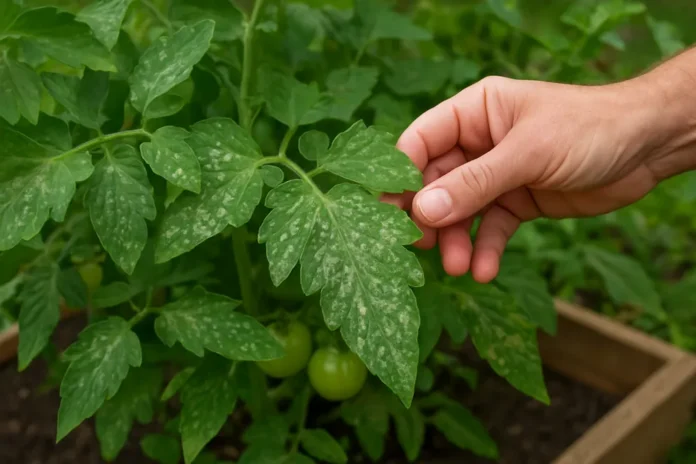
White spots on tomato leaves are most often caused by fungal disease, pest damage, sunscald, or dried spray and water residue. The exact cause depends on whether the spots look powdery, bleached, stippled, or ringed.
Seeing white spots on tomato leaves can be alarming, especially when plants looked healthy just days earlier. In many home gardens, white spotting is linked to fungal disease, insect feeding, sun exposure, or harmless residue left behind by water or foliar sprays.
The good news is that the appearance of the spots usually gives strong clues about the cause. Some problems stay mostly cosmetic, while others can spread fast and weaken the plant, reduce fruit production, and make tomatoes more vulnerable to heat and stress.
If you compare the size, texture, and location of the spots, you can usually tell whether you are dealing with powdery growth, tiny pale stippling, sun-bleached patches, or spots with dark borders. That makes it much easier to choose the right treatment and avoid wasting time on fixes that will not help.
What White Spots on Tomato Leaves Usually Mean
White spots are a symptom, not a single disease by themselves. On tomatoes, they most often fall into a few broad categories: fungal infection, pest damage, environmental injury, or residue from sprays and minerals in water. The pattern matters more than the color alone.
- Powdery or dusty white coating often points to powdery mildew.
- Tiny pale specks or stippling commonly suggest spider mites, thrips, or other sap-feeding pests.
- Large bleached patches can be sunscald or leaf tissue damaged by sudden exposure.
- Circular or irregular spots with darker edges may indicate a fungal or bacterial leaf spot problem.
- Chalky marks that wipe off or appear after spraying may simply be residue from hard water, neem oil, insecticidal soap, or foliar fertilizer.
Because several issues can look similar at first, it helps to examine both sides of the leaf, look at newer versus older growth, and note whether the spotting is spreading. White spots that also come with curling, webbing, yellowing, or leaf drop usually deserve quicker attention.
Fungal Diseases That Cause White Spotting
Powdery Mildew
Powdery mildew is one of the most recognizable causes of white areas on tomato leaves. It looks like a pale, dusty, or flour-like coating on the surface of the leaf. Early on, it may show up as small white patches, then expand until larger sections appear covered.
This disease is more likely in warm days, cooler nights, crowded plants, and poor airflow. Unlike many fungal diseases, powdery mildew does not need standing water on the leaves to spread well. It can thrive when humidity is high around the plant canopy.
Septoria Leaf Spot in Its Early Stages
Septoria usually starts as small circular spots on lower leaves. They are often gray to tan in the center with darker margins, but from a distance or in bright light they may read as whitish specks. As the disease progresses, leaves yellow, dry out, and drop.
If the plant has many tiny spots beginning near the bottom and moving upward after rainy weather or overhead watering, Septoria is a strong possibility. Look closely for numerous small lesions rather than a solid white film.
Leaf Mold and Other Fungal Leaf Problems
Some fungal issues cause pale or yellow-white patches on the upper leaf surface while moldy growth forms underneath. Leaf mold is more common in humid, protected spaces like greenhouses or dense plantings. The upper side may first look faded or mottled before the underside develops olive, gray, or whitish fungal growth.
- Fungal spots usually spread over time rather than staying identical day after day.
- Older lower leaves are often affected first.
- Humidity, poor spacing, and wet foliage increase the risk.
- Removing badly infected leaves can slow spread when done early.
Pests That Leave Pale or White Speckling
Spider Mites
Spider mites are a classic cause of tiny white or pale yellow dots on tomato leaves. They feed by piercing leaf tissue and sucking out contents, which creates a stippled look. At first, the leaf may appear dusted with pinprick-sized white spots. With heavier infestations, leaves turn bronzed, dry, and may show fine webbing.
Mites thrive in hot, dry conditions and are often worse during midsummer. Since they are so small, gardeners may miss them until the leaf damage becomes obvious.
Thrips and Other Sap-feeding Insects
Thrips can also cause silvery-white scarring or stippling. Their feeding often leaves irregular pale patches instead of the more evenly distributed speckling seen with mites. Sometimes black specks of waste appear nearby.
Other small sucking insects may create a washed-out or flecked appearance too, especially on tender new leaves. Damage is often worse during warm weather and on stressed plants.
- Mite damage usually looks like many tiny dots spread across the leaf.
- Thrips often leave silvery streaking or patchy pale scarring.
- Webbing points strongly toward spider mites.
- Pest damage often appears before leaves develop full yellowing or spotting with dark edges.
Sunscald, Weather Stress, and Chemical Injury
Sunscald on Exposed Foliage
Tomato leaves can develop bleached white patches after sudden exposure to intense sun, especially if a plant was recently transplanted, pruned hard, or moved from shade to full sun without a transition period. These areas usually look flat and papery rather than fuzzy or powdery.
Sun injury is more common during heat waves or after a period of cloudy weather followed by strong sun. The whitened area may stay in place rather than spreading like a disease.
Spray Burn and Phytotoxicity
Foliar sprays can leave white spots in two different ways. Some simply dry into a visible residue. Others can burn leaf tissue if applied too heavily, mixed too strongly, or used during hot sunny weather. Neem oil, horticultural oils, insecticidal soap, and some nutrient sprays are common culprits when timing or dilution is off.
Chemical injury often shows up shortly after application and may follow the pattern of where droplets landed. Spots can look bleached, papery, or irregular rather than fuzzy.
Herbicide Drift
Although herbicide damage more commonly causes twisting and cupping, some products can leave pale or bleached spots on foliage after drift. Tomatoes are especially sensitive to broadleaf herbicides, so nearby weed treatments can sometimes injure leaves even when the plant itself was not sprayed directly.
Harmless Residue That Looks Worse than It Is
Not every white mark on a tomato leaf means disease. Hard water, dissolved minerals, dried fertilizer, and foliar treatment residue can leave chalky or dusty spots. These often appear after watering with a hose-end sprayer, misting, or applying organic treatments.
Residue usually sits on top of the leaf rather than changing the leaf tissue itself. If it wipes off gently with a damp finger or cloth and the leaf underneath looks healthy, the problem is cosmetic. It should not continue spreading on new growth unless the same application pattern continues.
- Residue tends to appear suddenly after watering or spraying.
- It is often more uniform than disease lesions.
- It may be heaviest where droplets dried.
- Leaves otherwise stay firm, green, and unstressed.
How to Tell Which Cause You Are Dealing With
A close visual check usually separates the main causes. Start with the spot texture, then look at distribution across the plant and whether the issue is getting worse.
- If the white area looks powdery or dusty, suspect powdery mildew.
- If the white marks are tiny dots spread across the leaf, suspect spider mites or similar pests.
- If the tissue looks bleached and papery, suspect sunscald or spray burn.
- If the white or tan centers have darker borders, suspect a leaf spot disease.
- If the marks wipe off easily and appeared after spraying or watering, suspect residue.
Also check whether the spots are mostly on lower leaves, newer growth, or the sunniest side of the plant. Disease often starts on older lower foliage. Pest damage can appear throughout the canopy but may concentrate on stressed leaves. Sunscald is usually worst on exposed leaves.
What to Do for Each Common Cause
If It Is Powdery Mildew or Another Fungal Issue
- Remove the worst affected leaves and dispose of them away from the garden.
- Improve air circulation by spacing plants properly and pruning lightly.
- Water at the soil line instead of overhead.
- Use a tomato-labeled fungicide if the problem is spreading and weather favors disease.
- Avoid composting heavily infected foliage unless your compost system gets reliably hot.
If Pests Are Causing the Speckling
- Rinse plants with a firm stream of water, especially the leaf undersides.
- Apply insecticidal soap or horticultural oil according to label directions.
- Repeat treatment as directed, since eggs and hidden pests may survive the first spray.
- Keep plants evenly watered because drought stress makes mite problems worse.
- Encourage beneficial insects by avoiding broad-spectrum sprays unless absolutely necessary.
If the Leaves Are Sunburned or Chemically Burned
- Do not remove every damaged leaf unless it is mostly dead, since remaining foliage still helps shade fruit.
- Give the plant steady moisture so new growth can replace injured leaves.
- Avoid spraying oils or soaps during heat, drought, or direct midday sun.
- Harden off transplants gradually before exposing them to full summer sun.
- Watch new growth. Old spots will not heal, but healthy new leaves show the plant is recovering.
If the Spots Are Just Residue
- Leave it alone if the plant is healthy and the residue is minor.
- Rinse foliage early in the day if you want to clean heavy buildup.
- Use softer water or lower concentrations for future foliar sprays if label allows.
- Apply sprays evenly to avoid heavy droplet drying patterns.
When White Spots Are a Serious Problem
Some white spotting is mostly cosmetic, but there are signs that the problem is becoming serious. Rapid spread, widespread yellowing, leaf drop, stunting, fruit exposure, and visible pest buildup all mean the plant may lose vigor quickly.
- More than a few lower leaves are affected and new leaves are starting to spot.
- Leaves are curling, drying, or dropping in large numbers.
- You see webbing, moving pests, or dense mildew growth.
- Fruit is becoming exposed to direct sun because foliage is thinning.
- Multiple tomato plants are developing similar symptoms at the same time.
When the problem is spreading fast in warm, humid weather, early treatment matters more than waiting for perfect confirmation. Tomatoes can decline quickly once leaf loss starts, especially in peak summer heat.
How to Prevent White Spots on Future Growth
The best prevention plan is a mix of sanitation, spacing, careful watering, and stress reduction. Healthy tomato plants are not immune to spotting problems, but they usually resist and recover better.
- Space tomato plants for good airflow and avoid dense overcrowding.
- Mulch the soil to reduce splash-up from rain and irrigation.
- Water deeply at the base instead of wetting foliage whenever possible.
- Stake or cage plants to improve drying and reduce leaf contact with soil.
- Remove lower leaves that touch the ground once the plant is established.
- Inspect leaf undersides regularly for mites and other tiny pests.
- Use foliar products only as labeled and avoid spraying during hot bright conditions.
- Rotate tomato planting areas when possible to reduce disease carryover.
It also helps to choose disease-resistant tomato varieties when available and keep plants growing steadily with balanced fertilization. Overfed, crowded, and drought-stressed tomatoes often run into more foliage problems than plants given steady, moderate care.
FAQ
Can White Spots on Tomato Leaves Go Away on Their Own?
Existing spots usually do not disappear because damaged leaf tissue does not turn green again. What matters is whether new growth comes in clean and healthy after conditions improve or treatment begins.
Are White Spots on Tomato Leaves Always a Disease?
No. White spots can come from disease, pest feeding, sunscald, spray burn, or harmless mineral residue. The texture and pattern of the spots are the best clues.
Should I Remove Leaves with White Spots?
Remove leaves that are heavily infected, badly damaged, or crowding airflow. If only a few spots are present and the leaf is still functioning, it is often fine to leave it while you monitor the plant.
Can I Still Eat Tomatoes From a Plant with White Spots on the Leaves?
In most cases, yes, as long as the fruit itself is healthy and untreated products were used according to label directions. Leaf problems do not automatically make the fruit unsafe.
Do White Spots Spread to Other Tomato Plants?
Fungal diseases and some pests can spread easily to nearby tomatoes, especially in humid or crowded conditions. Residue and sunscald do not spread from plant to plant.
Why Are Only the Lower Tomato Leaves Getting White Spots?
Lower leaves are often first to show fungal leaf spots because they stay damp longer and get splashed with soil during rain or watering. They also receive less airflow than upper growth.
What Is the Difference Between Powdery Mildew and Spider Mite Damage?
Powdery mildew looks like a powdery white coating sitting on the leaf surface. Spider mite damage looks more like many tiny pale dots or stippling, often with fine webbing when infestations are heavy.
Need the right fix fast? See our guide to the best tomato fungicides, insecticidal soaps, and plant-safe treatments so you can stop leaf damage before it spreads.
