

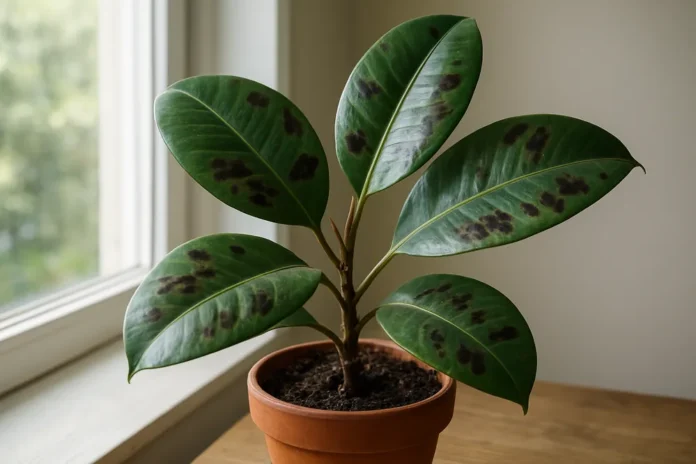
Rubber plant leaves usually get black spots from excess moisture, fungal or bacterial leaf problems, cold exposure, or pest damage. The exact cause often shows up in the spot pattern, leaf texture, and overall condition of the plant.
Seeing black spots spread across a rubber plant can be alarming, especially because these plants usually have such clean, glossy leaves. In my experience, black spotting is rarely random. It is often the plant's way of signaling that something in its environment has stayed too wet, too cold, or too stressful for too long.
The good news is that black spots do not always mean your plant is doomed. Sometimes the issue is as simple as soggy soil or a leaf that stayed damp in poor airflow. Other times, the spots come from infection, pest feeding, or physical damage. The key is to look at black spots on leaves as a pattern, not just a symptom on one leaf.
Below, I will walk through the most common reasons rubber plants develop black spots, how to tell them apart, and what usually works to stop the problem before it spreads.
What Black Spots Are Telling You
Black spots can mean different things depending on where they appear and how the leaf feels. If spots are soft, watery, or surrounded by yellow halos, I start thinking about excess moisture and disease. If the spots are dry, crisp, and mostly on leaves exposed to a cold window or draft, cold injury moves much higher on my list. If the spotting appears with sticky residue, speckling, or distorted new growth, pests are worth checking for.
- Soft, dark, expanding spots often point to overwatering or leaf disease.
- Small black pinpoints with yellowing may be fungal or bacterial spotting.
- Dry black patches near leaf edges can come from cold or physical stress.
- Black residue on top of leaves may actually be sooty mold growing on honeydew from pests.
- Spots limited to older leaves often suggest a root or watering issue rather than a sudden infection.
When I diagnose rubber plants, I compare the newest leaves with the oldest ones first. If the newest growth still looks strong and glossy while lower leaves are spotting, the problem is often tied to roots, watering, or past stress rather than a fast-moving top growth disease.
Overwatering and Soggy Soil Are the Most Common Cause
For most home gardeners, overwatering is the first place to look. Rubber plants like evenly moist soil during active growth, but they do not want to sit in saturated potting mix. When roots stay wet too long, they begin to suffocate. That stress can show up as black spots, dark blotches, leaf drop, or leaves that yellow before turning brown or black.
A rubber plant in overly wet soil may also develop root rot. Once roots are damaged, the plant cannot move water properly, so leaves can look both limp and darkened at the same time. That confuses people because the plant appears thirsty even though the soil is still wet.
- Soil stays damp for many days after watering.
- The pot has poor drainage or no drainage hole.
- Leaves develop dark spots along with yellowing.
- Lower leaves drop more quickly than usual.
- The potting mix smells sour, swampy, or stale.
If this sounds familiar, let the top part of the soil dry before watering again. Check that the plant is in a container with a drainage hole, and empty any saucer after watering so the roots are not sitting in runoff. If the soil is dense or compacted, repotting into a chunkier indoor plant mix can make a huge difference.
I do not judge moisture by the soil surface alone because it dries faster than the root zone. Push a finger a couple of inches down or use a wooden skewer to see whether the middle of the pot is still wet before you water again.
Fungal and Bacterial Leaf Spot Can Create True Black Lesions
Sometimes black spots are not just stress damage. They are actual leaf spot disease. Fungal and bacterial pathogens can create dark, sharply defined spots that slowly enlarge. On rubber plants, these may start as brown or water-soaked dots before turning darker. Some spots develop a faint yellow border, especially when infection is active.
Leaf spot is more likely when leaves stay wet, air circulation is poor, and the plant is crowded among other houseplants. It is also more common when overhead watering splashes from leaf to leaf. If you mist heavily or keep the plant in a dim bathroom corner with little airflow, disease has a better chance of taking hold.
- Round or irregular black spots that slowly enlarge
- Yellow halos around some lesions
- Spots appearing on multiple leaves, not just one damaged leaf
- Wet-looking tissue before it dries dark
- Worsening symptoms during humid, stagnant conditions
Start by removing badly affected leaves with clean pruners. Avoid wetting the foliage for a while, and give the plant more space and airflow. Water the soil directly rather than showering the leaves. If the spotting continues to spread, a houseplant-safe copper-based or fungicidal treatment labeled for leaf spot may help, but cultural fixes matter most.
Cold Damage Can Look Like Black Blotches Overnight
Rubber plants are tropical, and they react badly to cold windows, chilly drafts, and sudden temperature swings. One cold night near glass in winter can leave dark, almost black patches on leaves by the next day. These spots usually look more like blotches than neat circular lesions, and the damaged tissue may feel thin, limp, or later turn papery.
This is especially common when a plant sits close to an exterior door, an air conditioner vent, or an uninsulated window. A healthy rubber plant can handle cooler indoor temperatures than many people think, but actual cold stress shows up when leaves are exposed to sustained chills or abrupt drops.
- Large dark patches rather than many small spots
- Damage concentrated on the side facing a window or draft
- Symptoms appeared suddenly after a cold snap
- Leaves may droop before spotting becomes obvious
Move the plant away from cold glass and keep it out of draft paths. Damaged leaf tissue will not recover, but once temperatures stabilize, new growth should come in normally. If only a small part of a leaf is affected, I usually leave it until the plant is actively growing again.
Pests Can Lead to Black Spotting or Black Residue
Rubber plants can attract scale, mealybugs, spider mites, and occasionally thrips. These pests do not always create black spots directly, but they can cause stippling, stress, tissue damage, and sticky honeydew. That honeydew often leads to sooty mold, which looks like a black coating on the leaf surface.
This matters because true tissue damage and surface residue need different treatment. If the black material wipes off with a damp cloth, the issue may be sooty mold rather than dead leaf tissue. In that case, the real problem is the pest feeding underneath.
- Sticky leaves or nearby surfaces
- Tiny bumps on stems or along leaf veins, often scale
- Cottony clusters, often mealybugs
- Fine webbing and pale stippling, often spider mites
- Black film that smears or wipes away
Inspect both sides of the leaves, the stems, and where leaves attach to the main stem. Wipe leaves clean, isolate the plant if needed, and treat the pest with insecticidal soap, neem, or another labeled indoor plant treatment. Repeat treatments usually work better than one heavy application.
Poor Drainage and Root Stress Can Mimic Disease
A rubber plant may have black spots even when you are not watering too often if the potting setup traps moisture. Decorative cachepots, compacted mix, oversized containers, and blocked drainage holes all keep roots too wet. In other words, watering frequency is only part of the story.
I see this a lot when a plant is bought in a nursery pot, dropped into a decorative outer container, and watered on a schedule without checking how much runoff remains at the bottom. The plant looks stylish, but the root zone stays heavy and airless.
- Water pools at the bottom of an outer pot.
- The root ball stays dense and slow to dry.
- Soil has broken down into a fine, muddy texture.
- Roots are dark, mushy, or have an unpleasant smell during repotting.
If drainage is the issue, repot into a container just one size larger than the root ball, not dramatically bigger. Use a well-draining mix with ingredients such as bark, perlite, or pumice to keep the soil open. Healthy roots need both moisture and air.
Physical Damage and Sun Stress Can Darken Into Black Scars
Not every black mark is disease or rot. A leaf that was bent, bruised, rubbed against furniture, or splashed with very cold water can form a dark scar later. Direct hot sun can also scorch rubber plant leaves, especially if the plant was moved abruptly from lower light to a bright west or south window.
These spots tend to stay in one place rather than spreading leaf to leaf. They are often irregular and linked to a single incident. If only the most exposed leaves have damage and the rest of the plant looks strong, environmental or mechanical injury is more likely than a systemic problem.
- One or two leaves affected instead of many
- Spots are irregular, scuffed, or patchy
- Damage followed a move, cleaning, or transport
- Leaves nearest strong direct sun show the worst injury
I pay attention to whether the spots are still changing. Old physical damage usually stops where it started, while disease and moisture problems keep creating fresh marks on additional leaves.
How to Tell Which Cause Is Most Likely
If you are staring at your plant and everything still looks similar, use a short diagnosis checklist. You do not need to guess from one clue alone. The most reliable answer usually comes from combining soil moisture, spot appearance, plant location, and pest signs.
- Feel the soil several inches down. If it is still wet days after watering, root stress is a leading suspect.
- Touch the spots. Soft or water-soaked tissue points more toward moisture problems or disease than dry, crisp stress damage.
- Look for yellow halos or round lesions. Those patterns often suggest leaf spot disease.
- Check where the damaged leaves sit. Window-facing or draft-facing damage often lines up with cold stress.
- Wipe a black area with a damp cloth. If it lifts off, think sooty mold and pests rather than internal leaf damage.
- Inspect stems and leaf undersides closely for scale, mealybugs, mites, or sticky residue.
Once you identify the most likely cause, resist the urge to change everything at once. If you repot, move the plant, fertilize, prune heavily, and spray all in the same week, it becomes hard to tell what helped and what stressed the plant further.
What to Do Right Now to Stop the Spread
For a rubber plant with black spots, immediate care should focus on stabilizing the environment and removing the factor that is actively causing harm. Most plants recover better from a calm correction than from aggressive intervention.
- Move the plant into bright, indirect light.
- Keep it away from cold drafts, heater blasts, and touching window glass.
- Check the pot for drainage and stop watering until the upper soil has dried appropriately if the mix is wet.
- Remove leaves that are badly infected, mushy, or heavily covered in pests.
- Avoid misting and avoid splashing water on the foliage.
- Increase airflow around the plant without exposing it to cold air.
- Treat pests or leaf spot only after you have identified the likely issue.
Do not expect damaged leaves to turn green again. Judge improvement by the condition of new growth and whether spotting stops appearing on additional leaves. That is the real sign that your fix is working.
How to Prevent Black Spots From Returning
Prevention is mostly about consistency. Rubber plants do best when watering, light, airflow, and temperature all stay in a comfortable range. When one of those conditions swings too far, black spotting becomes much more likely.
- Water only when the top portion of the soil has dried enough for the season and room conditions.
- Use a pot with drainage and a loose indoor plant mix.
- Give the plant bright, indirect light for stronger growth and quicker recovery.
- Keep leaves dry when possible and avoid heavy misting in stagnant rooms.
- Inspect foliage regularly for pests before infestations build up.
- Protect the plant from temperatures below its comfort zone and from sudden drafts.
- Wipe dust from leaves so you can spot problems early and improve photosynthesis.
In my own indoor setups, the simplest prevention habit is checking the weight of the pot before watering. A rubber plant in dry, airy mix feels noticeably lighter than one that is still holding too much moisture. That small habit prevents a lot of black spot problems before they start.
FAQ
Should I Cut Off Rubber Plant Leaves with Black Spots?
Remove leaves if they are badly damaged, mushy, heavily infected, or mostly covered in spots. If a leaf only has minor cosmetic damage and the rest of the plant is stressed, you can leave it temporarily so the plant keeps more foliage for energy.
Can Black Spots on a Rubber Plant Spread to Other Plants?
They can if the cause is a fungal disease, bacterial issue, or pests producing honeydew and sooty mold. Overwatering damage itself is not contagious, but the conditions that caused it can still weaken nearby plants if care habits are similar.
Will Black Spots on Rubber Plant Leaves Go Away?
No, damaged leaf tissue does not return to normal green. The goal is to stop new spots from forming and support healthy new growth.
Do I Need to Repot My Rubber Plant if It Has Black Spots?
Only if the soil stays wet too long, smells sour, drains poorly, or the roots are showing signs of rot. If the cause is cold damage, pests, or a minor leaf spot issue, repotting may not be necessary right away.
Can I Use Neem Oil for Black Spots on Rubber Plant Leaves?
Neem may help when pests are involved and can offer some support against certain surface fungal issues, but it will not fix root rot or cold injury. Always identify the likely cause first and use any treatment according to the label.
Why Are Only the Lower Leaves Getting Black Spots?
When older lower leaves are affected first, watering problems and root stress are common causes. The plant often sacrifices older foliage before newer leaves when roots are struggling.
Is Misting Good for a Rubber Plant with Black Spots?
Usually no. If black spotting is tied to disease or poor airflow, extra leaf moisture can make the problem worse.
Need the right fix fast? Read our guide to the best rubber plant soil mixes, fungicides, and pest treatments so you can choose a solution that actually matches the cause.
