

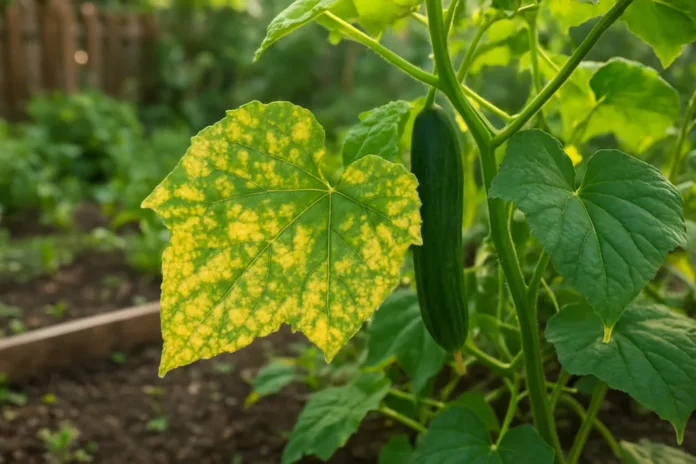
Cucumber leaves usually develop yellow spots because of fungal or bacterial disease, spider mites, or stress from watering and nutrient imbalance. The pattern of the spots often tells you which cause is most likely.
Seeing cucumber leaves with yellow spots can be frustrating, especially when the plants looked healthy just a few days earlier. Cucumbers grow fast, but they also react quickly when something is off, and spotted leaves are one of the first signs that your plant is under pressure.
In my garden, yellow spotting on cucumbers most often comes down to a short list: disease, pests, moisture problems, or a nutrient issue that is showing up in the foliage. The good news is that cucumbers usually give you clues if you slow down and look closely at the shape of the spots, where they appear, and how fast they spread.
If your cucumber leaves are showing scattered yellow specks, angular blotches, or pale patches between the veins, you can usually narrow the problem down without guessing. Once you know the likely cause, it gets much easier to decide whether you need to prune, spray, feed, water differently, or simply improve airflow.
What Yellow Spots on Cucumber Leaves Usually Mean
Yellow spots are a symptom, not a diagnosis by themselves. Cucumbers can spot yellow when leaf tissue is being damaged by pathogens, sucked dry by pests, or stressed enough that chlorophyll starts breaking down. The pattern matters more than the color alone.
- Tiny pale or yellow speckles often point to spider mites or similar sap-sucking pests.
- Angular yellow patches that seem boxed in by leaf veins often suggest downy mildew.
- Round yellow spots that later turn tan or brown can fit several fungal leaf spot diseases.
- Yellowing between veins, especially on older leaves, can indicate a nutrient deficiency such as magnesium.
- Random blotchy yellowing after hot, dry, or waterlogged weather can reflect environmental stress.
When I diagnose cucumbers, I look at several leaves from different parts of the plant before deciding anything. One damaged lower leaf can mislead you, but a repeated pattern across new and old growth usually points to the real problem.
Diseases That Commonly Cause Yellow Spotting
Downy Mildew
Downy mildew is one of the most common reasons cucumber leaves develop yellow spots, especially later in the season or during humid weather. The spots usually begin as pale yellow to light green angular patches on the upper leaf surface. Because the veins limit how the infection spreads, the spots often look blocky instead of round.
As the disease progresses, those yellow patches enlarge and may turn brown and crisp. If you flip the leaf over early in the morning, you may see a dark gray or purplish fuzzy growth on the underside. Plants can decline fast if the weather stays damp.
Angular Leaf Spot
Angular leaf spot is a bacterial disease that also creates vein-limited yellow areas, which is why gardeners sometimes confuse it with downy mildew at first. The difference is that bacterial spots often look water-soaked before turning tan or tearing out, leaving a ragged shot-hole effect in the leaf.
This problem spreads easily in wet conditions, especially when leaves are splashed by overhead watering or rain. It tends to move faster when nights are warm and plants stay wet for long stretches.
Anthracnose and Other Fungal Leaf Spots
Anthracnose, Alternaria, and other fungal leaf spot diseases can all start with yellow halos around small lesions. Over time, the centers may turn brown, dry, or even crack. These spots are often more rounded than downy mildew lesions, though they can still merge together when infections get severe.
Fungal spotting is most common when foliage stays damp and airflow is poor. Dense vines on a trellis can still hold moisture if leaves are packed too tightly together.
- Remove badly infected leaves if the plant still has plenty of healthy foliage.
- Water at soil level rather than spraying leaves.
- Space plants well and prune lightly if growth is crowded.
- Avoid handling vines when leaves are wet.
- Use a labeled garden fungicide only if the disease is clearly spreading and cultural fixes are not enough.
Pests That Leave Yellow Stippling and Spots
Spider Mites
Spider mites are a classic cause of tiny yellow specks on cucumber leaves. They feed by piercing leaf tissue and sucking out contents, which creates a fine stippled look at first. If populations build up, the leaves can turn bronzed, dusty, or patchy yellow overall.
Mites are easiest to miss early because they are so small. In hot, dry weather they can explode quickly, especially on stressed plants. Fine webbing on the leaf undersides or between stems is a strong clue that mites are involved.
Aphids and Whiteflies
Aphids and whiteflies do not always create obvious yellow spots, but heavy feeding can cause pale speckling, mottling, and leaf weakening. They also leave sticky honeydew, which can lead to sooty mold and make the plant look even worse.
Cucumber Beetles
Cucumber beetles usually chew holes rather than create true yellow spots, but their feeding can stress leaves and spread bacterial wilt and other pathogens. If you see yellow spotting along with chewed tissue and striped or spotted beetles, you may be dealing with more than one issue at the same time.
If I suspect mites, I hold a white sheet of paper under a leaf and tap it sharply. The tiny moving specks that fall onto the paper are often much easier to see than the mites on the leaf itself.
- Spray leaf undersides with a firm stream of water to knock down light infestations.
- Use insecticidal soap or horticultural oil if pests are active and labeled for edible crops.
- Treat early, because severe mite damage is harder to reverse.
- Keep plants evenly watered so they are less attractive to stress-loving pests.
- Check the undersides of leaves every few days during hot weather.
Watering and Weather Stress That Can Mimic Disease
Not every yellow spot is caused by a pathogen or pest. Cucumbers are thirsty, fast-growing plants, and they react quickly to uneven moisture. If the soil swings from very dry to very wet, leaves may develop pale patches, marginal yellowing, or blotchy stress symptoms that look suspiciously like disease at first glance.
Overwatering can be just as troublesome as underwatering. Roots need oxygen, and soggy soil can reduce root function enough that leaves begin yellowing in patches. Underwatering, especially during fruit set, can cause leaf tissue to scorch and fade as the plant struggles to support rapid growth.
Weather can make the problem worse. Long humid spells favor disease, while intense heat and dry wind push plants toward stress and mite outbreaks. A plant growing in black plastic, a container, or a raised bed may dry out much faster than one in open ground.
- Aim for steady soil moisture, not constant saturation.
- Water deeply enough to moisten the root zone instead of giving frequent shallow drinks.
- Mulch around plants to reduce evaporation and soil splash.
- Water early in the day so any wet foliage dries quickly.
- Use your finger or a moisture meter before watering if you are unsure.
Nutrient Deficiencies and Soil Problems
Cucumbers can also show yellow spotting or patchy yellowing when they are short on nutrients, though nutrient problems usually create more predictable patterns than diseases do. Instead of sharply defined lesions, you may see chlorosis between the veins, older leaves fading first, or yellowing that spreads evenly over time.
Magnesium Deficiency
Magnesium deficiency often shows up as yellowing between the veins on older leaves while the veins remain greener. At a glance, this can look like scattered yellow spots, especially when the leaf has a mottled appearance.
Nitrogen Deficiency
Low nitrogen causes a more general pale green to yellow cast, usually starting on older foliage. It does not usually create neat spots, but weak plants are more vulnerable to pests and disease, so nutrient stress can set the stage for other problems.
Soil pH and Root Stress
Even when fertilizer is present, cucumbers may struggle to take up nutrients if soil pH is off or roots are compacted, damaged, or staying too wet. In those cases, yellowing can appear despite regular feeding.
I get cautious about adding fertilizer the moment I see spots, because feeding the wrong problem does not help. If the pattern looks lesion-like or the issue appeared suddenly after humid weather, I lean toward disease first and nutrients second.
- Use a balanced fertilizer if plants are generally pale and growth is weak.
- Consider a soil test if yellowing keeps recurring year after year.
- Avoid piling on high-nitrogen fertilizer, which can push lush growth that is more disease-prone.
- Check whether roots are crowded, waterlogged, or damaged by cultivation.
How to Tell the Causes Apart
The fastest way to narrow this down is to compare the appearance and location of the yellow spots. Try to answer a few basic questions before you treat anything. Are the spots tiny and evenly speckled, or larger and angular? Are the oldest leaves affected first, or the whole plant? Is the underside of the leaf fuzzy, sticky, webbed, or clean?
- Look at both sides of the leaf in bright light.
- Check whether the spots follow the leaf veins or cross them freely.
- See if there is webbing, insects, sticky residue, or fuzzy growth underneath.
- Notice whether damage is worst after humid weather or after hot, dry conditions.
- Compare old leaves and new leaves to see where the problem started.
As a rule, angular yellow spots suggest disease, especially downy mildew or angular leaf spot. Fine stippling usually suggests mites. Broad interveinal yellowing points more toward nutrition or root stress than infection.
What to Do Right Now to Help Your Cucumber Plants
If you are not yet certain of the cause, start with the least risky corrections first. Clean up the environment around the plant, reduce leaf wetness, and remove the worst damaged leaves if the plant still has enough healthy growth to keep producing. These steps help with several causes at once and rarely make the problem worse.
- Remove leaves that are heavily spotted, collapsed, or clearly diseased.
- Disinfect pruners between plants if you suspect bacterial or fungal issues.
- Water the soil, not the foliage.
- Mulch bare soil to reduce splash-up of spores and bacteria.
- Inspect the undersides of leaves for mites, aphids, and whiteflies.
- If pests are present, use the appropriate labeled treatment for edible crops.
- Avoid heavy fertilizing until you know whether disease or pests are the main issue.
If disease is advanced and the plant is declining fast, sometimes the most practical choice is removal, especially late in the season. I know gardeners hate pulling a plant that still has fruit on it, but badly infected cucumbers can spread trouble to healthier vines nearby.
How to Prevent Yellow Spots in Future Cucumber Crops
Prevention is much easier than trying to rescue a cucumber plant once leaf spots are widespread. Most yellow-spot problems improve when you combine better airflow, cleaner watering habits, and regular pest checks.
- Rotate cucumbers and other cucurbits so they are not planted in the same spot every year.
- Choose resistant or tolerant varieties when available, especially if downy mildew is common in your area.
- Trellis vines to improve air circulation and keep foliage off damp ground.
- Water early and low at the base of the plant.
- Space plants generously instead of letting them form a dense jungle.
- Remove old plant debris at season's end so disease does not overwinter nearby.
- Scout weekly for mites and other pests before they become severe.
In my experience, the biggest difference-maker is consistency. A cucumber that gets even moisture, good sun, decent spacing, and regular checks is far less likely to surprise you with sudden yellow spotting.
FAQ
Can Yellow Spotted Cucumber Leaves Turn Green Again?
Usually no. Damaged leaf tissue rarely regains its full color. What you want to watch for is whether new leaves emerge healthy after you correct the problem.
Should I Remove All Cucumber Leaves with Yellow Spots?
Not always. Remove badly affected leaves, especially if they are heavily diseased or mostly nonfunctional, but keep enough healthy foliage for the plant to keep growing and ripening fruit.
Is It Safe to Eat Cucumbers From a Plant with Yellow Spotted Leaves?
In many cases, yes, if the fruit itself is healthy and untreated with anything not labeled for edibles. Discard fruit that is soft, rotting, badly misshapen, or shows clear disease symptoms.
Do Yellow Spots on Cucumber Leaves Always Mean Downy Mildew?
No. Downy mildew is common, but spider mites, angular leaf spot, fungal diseases, nutrient issues, and watering stress can all produce yellow spotting or mottling.
Why Are Only the Lower Cucumber Leaves Getting Yellow Spots?
Lower leaves are often the first to show disease from soil splash, age-related stress, or nutrient shortages because they are older and closer to damp soil. If the problem stays low, airflow and splash control may help a lot.
Can Overhead Watering Cause Yellow Spots on Cucumbers?
Yes. Overhead watering keeps leaves wet longer and can spread fungal spores and bacteria by splashing. It also makes conditions more favorable for several leaf spot diseases.
What Is the Difference Between Yellow Spots and Yellowing Between the Veins?
Yellow spots usually look like individual lesions or speckles, while interveinal yellowing fills the leaf area between green veins more evenly. Spotting often points to pests or disease, while interveinal chlorosis more often suggests a nutrient or root issue.
Need a reliable fix fast? Read our guide to the best cucumber disease sprays, insect controls, and prevention tools so you can protect your plants before spotting spreads.
