

Note: This article contains affiliate links. If you click on these links and make a purchase, I may earn a small commission at no extra cost to you. This helps support my research and content. Read my full affiliate disclosure here.
If broadleaf weeds are stealing nutrients and curb appeal from your turf, choosing the right broadleaf herbicide for lawns makes a tangible difference. You want something that kills dandelions, clover, and plantain without leaving bare patches or harming desirable grasses. This guide covers six top-rated options shortlisted for common lawn situations and walks through the practical tradeoffs you will face in a real yard or lawn care schedule. We evaluated products for how quickly they control common broadleaf species, how safely they behave on different turf grasses, and how easy they are to apply. Read on for an overview of what matters and to compare the best choices for maintaining a healthy, green lawn.
Top Picks at a Glance
| Best Overall The best all-around choice for most situations | PBI Gordon T-Zone Broadleaf Turf Herbicide, 1 Quart |  |
| Best Quality Built to a higher standard if you want something more solid | SPEED ZONE SpeedZone EW Broadleaf Herbicide for Turf, 1 gallon |  |
| Best Value The sweet spot between price and what you get | Spectracide Large Plot Weed Stop for Lawns Concentrate, 1 Gal |  |
| Best Budget The cheapest option that still gets the job done reliably | Ortho WeedClear Lawn Weed Killer Ready-to-Spray, 32 fl. oz. |  |
| Highest Rated A top-rated pick with lots of positive feedback | Trimec 992 Broadleaf Herbicide, 2.5 Gallons |  |
| Most Popular A crowd favorite that many people choose with confidence | Scotts Liquid Turf Builder with Plus 2 Weed Control, 32 fl. oz. |  |
PBI Gordon T-Zone Broadleaf Turf Herbicide, 1 Quart
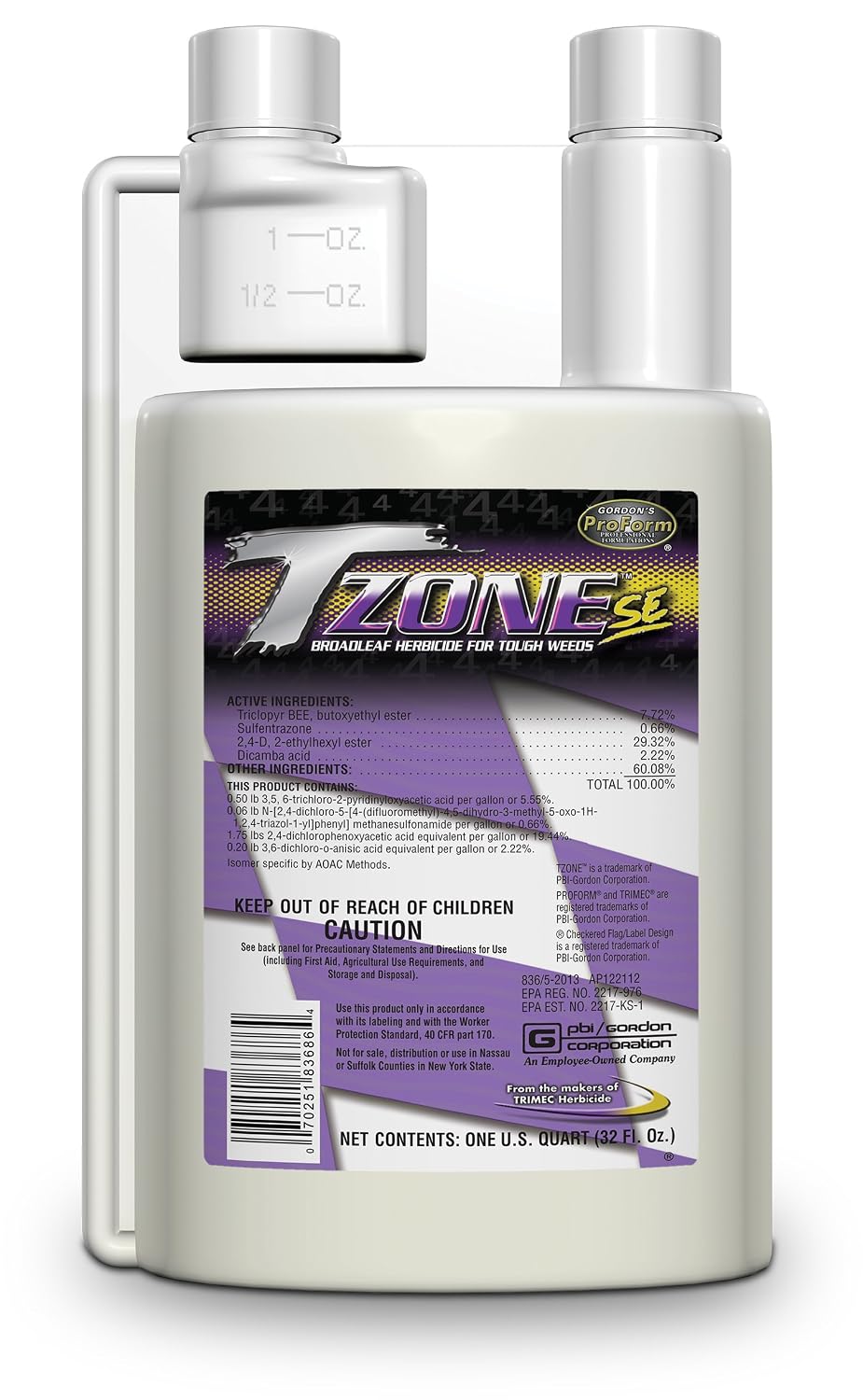
| Unit Count | 32 Fluid Ounces |
|---|---|
| Item Form | Liquid |
| Coverage | broad-leaf weeds, grassy weeds |
| Active Ingredients | Dicamba, triclopyr, others |
T-Zone is a ready-to-mix liquid herbicide formulated to control broadleaf and some grassy weeds in lawns and commercial turf. It is typically diluted and applied with a handheld or tank sprayer to problem areas; the label notes fast visible response and effectiveness down to cool temperatures around 50°F. The formula includes triclopyr and dicamba plus additional actives, which expands its control spectrum to difficult weeds and provides yellow nutsedge suppression. Practical benefits include flexible use on residential, commercial and golf sites and a product form that is easy to measure and mix. Important limitations are that it is a chemical herbicide requiring protective gear during handling and careful application to avoid off-target injury to desirable plants, and repeated use should follow label intervals to reduce resistance and turf stress. This is a performance-focused option for lawn managers who need quick, reliable control of broadleaf weeds and certain grassy pests rather than an organic or nonchemical solution.
Best for: Buyers who want a strong, conventional herbicide to quickly reduce broadleaf weeds across home lawns or managed turf and who follow label precautions.
Less Ideal for: Those seeking an organic, nonchemical approach or inexperienced users unwilling to follow protective and application instructions should consider alternative methods.
- Controls a wide range of broadleaf weeds and some grassy weeds including yellow nutsedge suppression
- Contains multiple active ingredients for faster visible knockdown
- Effective in cooler conditions down to about 50°F for extended seasonal use
- Suitable for residential, commercial and golf turf applications
- Requires protective equipment and careful handling to avoid skin or eye contact
- Chemical formula can harm desirable plants if drift or overspray occurs
Verdict: Choose T-Zone when you need a fast‑acting, broad‑spectrum chemical herbicide to reliably knock down stubborn broadleaf and certain grassy weeds in turf.
SPEED ZONE SpeedZone EW Broadleaf Herbicide for Turf, 1 gallon

| Unit Count | 128 Fluid Ounces |
|---|---|
| Item Form | Liquid |
| Coverage | Broad-spectrum weed control |
SpeedZone EW is a concentrated, emulsion-in-water broadleaf herbicide made for turf managers and homeowners who want fast visible control. It is mixed in a sprayer and applied to weeds where the EW formulation improves spray coverage and absorption compared with older formulations. The label calls out control of more than 90 broadleaf weeds and additional activity on goosegrass and nimblewill, with visible activity in hours and clover dying back in about a week. It is engineered for use in low-volume and conventional sprayers, and the lower odor and reduced VOCs make it easier to work with. Important limitations are legal restrictions in many states and the need to follow safety precautions; it can irritate skin and eyes, and treated areas should be reseeded only after the recommended waiting period. This product is best used on established turf where broadleaf weed control and quick results are priorities, and it performs well when mixed and applied according to the label.
Best for: Buyers who prioritize fast, reliable broadleaf control on established lawns and who are comfortable handling concentrated herbicides and following label directions.
Less Ideal for: People in states where this product is restricted or homeowners who prefer non-chemical or lowest-toxicity weed management options.
- EW formulation improves spray coverage and uptake for faster visible weed control
- Labels list control of 90+ broadleaf weeds plus some grassy pests like goosegrass and nimblewill
- Suitable for low-volume and conventional sprayers for flexible application
- Lower odor and reduced VOC compared with older formulations
- Restricted for sale or use in multiple states so availability and legality vary
- Requires careful handling and PPE because it can irritate skin and eyes
Verdict: Choose SpeedZone EW when you need fast, broad-spectrum control of tough broadleaf weeds on established turf and want a formulation designed for efficient spray coverage.
Spectracide Large Plot Weed Stop for Lawns Concentrate, 1 Gal

| Unit Count | 128 Fluid Ounces |
|---|---|
| Item Form | Liquid |
| Coverage | 32000 square feet |
Spectracide Large Plot Weed Stop is a one-gallon concentrate for treating large lawn areas with a broadleaf herbicide that targets weeds down to the root. You mix the concentrate with water and apply with a tank or hose-end sprayer; the label gives coverage rates for northern and southern grasses so a single bottle can treat many thousands of square feet. It is formulated to kill common problem weeds such as dandelion, chickweed and clover and becomes rainproof within hours, which reduces the chance of washed-away applications. Practical features include clear mixing directions, a hose connector for easy spraying, and guidance on temperature windows to avoid grass damage. Important limitations are the temperature restrictions and the need to avoid overspray near water; it also requires careful measurement and personal protective measures during mixing. For persistent patches you may need a follow-up spot treatment after a few weeks.
Best for: Homeowners who want a single, economical concentrate to treat broadleaf weeds over large lawns and who follow label directions for mixing and timing.
Less Ideal for: People who need a ready-to-use spray for small spot treatments or those who cannot follow safety and temperature restrictions during application.
- Concentrated formula covers large areas so one bottle treats up to tens of thousands of square feet
- Kills more than 200 listed broadleaf weeds and targets roots for longer control
- Rainproof in hours, reducing loss of effectiveness from light rain after application
- Designed for use on common northern and southern lawn grasses when applied as directed
- Must not be applied when air temperatures exceed 85°F which limits use on hot days
- Requires careful mixing and protective measures during application
- Not suitable for use near water or storm drains without following label precautions
Verdict: Choose this concentrated weed killer when you need an economical, large-area solution that controls hundreds of broadleaf weeds without harming the lawn when used as directed.
Ortho WeedClear Lawn Weed Killer Ready-to-Spray, 32 fl. oz.

| Unit Count | 32 Fluid Ounces |
|---|---|
| Coverage | 5000 square_feet |
| Item Form | Spray |
| Active Ingredients | 2,4-D; Quinclorac; Dicamba |
Ortho WeedClear Ready-to-Spray is a hose-end lawn herbicide formulated to kill more than 200 common lawn weeds, including dandelion, clover, chickweed, creeping charlie and crabgrass. You attach it to a garden hose, flip the on switch and spray until the turf surface is wet, so application is quick and needs no measuring or separate sprayer. The formula is fast-acting and becomes rainproof within about an hour, which helps treatment stick during changeable weather. It is labelled for many northern lawn grasses and is intended for spring or fall use on actively growing young weeds. Important limitations: it is not safe for several warm-season and specialty turf types and must be applied carefully to avoid ornamentals, gardens and people or pets until dry. Also follow temperature guidance for bermudagrass to avoid stress. For buyers who want straightforward, no-mix weed control over a medium lawn, this is a convenient, effective option; those needing selective treatment near sensitive plants or different turf types should choose a different formulation.
Best for: A homeowner who wants an inexpensive, easy-to-use, no-mix solution to quickly clear common broadleaf and grassy weeds across a medium-sized lawn and values convenience over specialty selectivity.
Less Ideal for: Gardeners who maintain mixed beds, sensitive ornamentals, or turfgrass types excluded on the label should avoid this product and seek a more targeted or turf-specific herbicide.
- Ready-to-use hose-end applicator for fast, no-mix application
- Covers up to 5,000 sq. ft. from a single 32 fl. oz. bottle
- Fast-acting formula that becomes rainproof in about 1 hour
- Kills a broad list of common broadleaf and grassy lawn weeds down to the root
- Not labeled for use on several turf and groundcover types and must be kept off ornamentals and gardens
- Requires caution around people and pets until spray has dried
Verdict: Choose Ortho WeedClear Ready-to-Spray when you want a budget-friendly, no-mix hose-end herbicide that quickly controls a wide range of common lawn weeds.
Trimec 992 Broadleaf Herbicide, 2.5 Gallons

| Unit Count | 320 Fluid Ounces |
|---|---|
| Liquid Volume | 2.5 gallons |
| Item Form | Liquid |
| Coverage | About 975 square feet |
| Active Ingredients | Herbicide, Trimec |
Trimec 992 is a ready-to-dilute, professional-strength broadleaf herbicide intended for residential and commercial turf use. It contains a blend of proven active ingredients for reliable control of dandelion, clover, chickweed and many other broadleaf weeds and is applied with a sprayer over lawns, sports turf and similar grassy areas. The 2.5 gallon container supplies enough product for large patches and the label lists spray volume guidance and a coverage estimate so you can plan applications. Practical benefits include strong efficacy on a wide spectrum of weeds and label directions for timing, wind limits and rainfall timing that help avoid off-target damage. Important limitations are that it is not labeled for certain grasses such as Floratam St. Augustine and it requires careful handling, sprayer setup and adherence to safety and reentry instructions. This product is best treated as a seasonal, targeted weed-control tool rather than a one-time fix for all turf problems.
Best for: Buyers who prioritize a dependable, professional-strength herbicide for seasonal broadleaf control and are comfortable following label directions and using a sprayer to treat lawns and turf.
Less Ideal for: Casual gardeners who want a ready-to-use bottle without mixing or those managing turf types specifically excluded on the label such as Floratam St. Augustine.
- Broad-spectrum control of common broadleaf lawn weeds including dandelion, clover and chickweed
- Large 2.5 gallon supply suitable for treating multiple areas without frequent repurchasing
- Label includes clear application guidance on spray volumes, wind limits and rain wait times
- Not labeled for use on Floratam St. Augustinegrass which limits use in some regions
- Requires sprayer setup and careful handling because it is a concentrated liquid herbicide
Verdict: A large-volume, proven broadleaf herbicide for gardeners who need reliable, label-directed control across lawns and turf areas.
Scotts Liquid Turf Builder with Plus 2 Weed Control, 32 fl. oz.

| Item Form | Spray |
|---|---|
| Coverage | 6000 square_feet |
| Liquid Volume | 32 fluid ounces |
| Active Ingredients | Nitrogen |
This ready-to-spray bottle combines a fast-acting nitrogen lawn food with a broadleaf weed killer so you can fertilize and spot-treat common weeds in one pass. You attach the bottle to a garden hose, spray evenly over the lawn when weeds are actively growing, then avoid watering for 48 hours so the weed-control chemistry can work. It is formulated to target common broadleaf weeds such as dandelions, clover, chickweed, and ground ivy and is labeled for both warm-season and cool-season grasses with coverage estimates of up to 6,000 sq ft for warm lawns and 4,000 sq ft for cool lawns. The hose-end applicator makes it quick for homeowners to cover moderate areas without measuring or mixing. Important limitations: it only controls the weeds listed on the label, some tough weeds may need a repeat application in 3 to 4 weeks, and bermudagrass may show temporary injury. Follow temperature and timing guidance for best results and do not use around garden beds or nonlisted turf.
Best for: Homeowners who want a simple, evidence-backed way to feed their lawn while reducing common broadleaf weeds without specialized equipment. Good for those who prioritize proven, easy-to-follow products with clear usage instructions.
Less Ideal for: Do not choose this if you need a product for garden beds, vegetable areas, or to control grassy/weeds not listed on the label; large commercial properties with frequent spot treatments may prefer concentrated professional products.
- Two-in-one formula combines liquid fertilizer and broadleaf weed control for faster lawn maintenance
- Ready-to-spray hose-end applicator requires no measuring or nozzle mixing
- Covers large areas per bottle: up to 6,000 sq ft for warm-season lawns and 4,000 sq ft for cool-season lawns
- Targets a long list of common broadleaf weeds including dandelions and clover
- Controls only the weeds listed on the label and may not eliminate tougher or grassy weeds
- Some warm-season grasses such as bermudagrass can show temporary injury after application
Verdict: A convenient ready-to-spray lawn treatment that feeds turf and knocks back common broadleaf weeds in one straightforward application.
Choosing the Right Broadleaf Herbicide for Lawns: Key Factors to Consider
Control Spectrum
Different broadleaf herbicides target different mixes of species. Some formulas are broad-spectrum and will tackle dandelion, clover, plantain, chickweed, and many others in one application. Others are narrower and focus on a few persistent species. Knowing the common weeds in your lawn helps you pick a product that minimizes repeat treatments.
A wider control spectrum reduces the need to combine products or follow up with another treatment, but broader formulations can carry higher risk to certain grass types or ornamentals if misapplied. Read labels for listed weeds and match that list to what you actually see in the turf.
Turf Safety and Grass Type Compatibility
Turf safety depends on both the active ingredient and the grass species. Cool-season grasses and warm-season grasses can react differently to the same herbicide, and newly established or recently overseeded lawns are more sensitive. Applying when grass is stressed from drought, extreme heat, or herbicide drift can increase the chance of turf injury.
Check label instructions for recommended grass types and required turf maturity. When in doubt, choose lower-strength mix rates, spot-treat small patches, and avoid application during heat stress to reduce the chance of yellowing, thinning, or burn.
Application Timing and Conditions
Timing affects both effectiveness and lawn recovery. Many broadleaf herbicides work best when weeds are actively growing in mild temperatures, typically spring and fall. Rain within a few hours of application can wash product off leaves and reduce control, while very dry conditions can slow uptake by the weed.
Windy days increase risk of drift to flower beds and desirable plants. Plan applications for calm, dry periods and follow label guidance on temperature limits and rainfall windows to maximize kill and minimize unintended damage.
Mix Rates, Coverage, and Equipment
Correct mix rate and even coverage determine whether you kill weeds without overexposing turf. Backpack sprayers, trigger bottles, and hose-end applicators all deliver different spray patterns. A fine mist can drift, while coarse droplets reduce drift but may require closer passes to avoid misses.
Calibrate your sprayer to match the label's application rate, and practice even passes across the lawn. For large lawns, professional-style pump sprayers give better control than consumer hose-end units. Spot treatments require less product but need careful targeting to avoid contact with desirable plants.
Residual Activity and Re-Treatment Needs
Some herbicides leave residual activity in the turf or soil that continues to suppress regrowth, while others act primarily through contact and need follow-up treatments. Residual activity can reduce reseeding windows and might affect germinating desirable grasses or nearby garden plants.
Understand how long a product remains active and whether it restricts overseeding or planting. If you plan to reseed or overseed a lawn, choose a product with minimal residual activity or follow label intervals for safe seeding.
Environmental and Runoff Considerations
Herbicide runoff into storm drains or waterways is a practical concern for many homeowners. Some active ingredients bind quickly to soil, reducing runoff risk, while others remain mobile. Application near slopes, bare soil, or before heavy rain increases runoff potential.
Avoid treating hardscapes and keep treated grass clippings out of drains for a short period after application. Read label instructions for buffer zones near water and follow local regulations when treating large areas close to sensitive habitats.
When to Treat Your Lawn
Treat broadleaf weeds when they are actively growing and not under environmental stress. For many regions, early spring and early fall offer the best combination of active weed growth and milder temperatures that help herbicide uptake. Applying in mid-summer heat or during drought can slow translocation within broadleaf plants and reduce effectiveness.
If you plan to overseed, schedule herbicide applications well before or after seeding according to label guidance. Spot-treating small patches can be done outside overseeding windows, but large-scale treatments and seeding should be separated to avoid interference with grass establishment.
- Aim for calm, dry weather with light wind.
- Avoid application before an expected heavy rain.
- Do not treat newly seeded or sodded areas until label-specified turf maturity is reached.
Spot Treatment Versus Lawnwide Applications
Spot treatment minimizes chemical use and risk to desirable plants and is ideal for isolated patches of weeds. Use a targeted sprayer or a shielded applicator to avoid drift onto flowers and shrubs. For widespread infestations, a lawnwide application is more efficient but requires careful calibration and attention to turf compatibility.
Decide based on infestation density, lawn size, and tolerance for temporary turf thinning. Many gardeners begin with spot treatments and move to blanket applications only if weeds remain widespread after several control attempts.
- Spot treat small clusters to reduce product use.
- Use lawnwide application when weeds cover large percentages of turf.
Safe Use Around Flower Beds and Vegetable Gardens
Prevent herbicide drift and runoff into planting beds by creating physical barriers and avoiding spray during wind. Use a low-pressure, coarse spray setting when working near ornamentals to reduce fine droplets that can drift. Protect desirable plants by wetting soil around their bases rather than allowing spray contact with foliage.
If a lawn borders a vegetable garden, leave an untreated buffer or consider spot treatment only on the lawn side. Monitor weather and avoid treating before irrigation that could carry residues into garden beds.
- Use coarse droplets and lower pressure near beds.
- Consider a physical shield when spraying close to sensitive plants.
Managing Resistant or Persistent Weeds
Some lawn weeds become tolerant over time to repeated use of the same active ingredient. Rotate herbicide modes of action when persistent weeds return despite correct application. Integrate cultural practices like improved mowing height, overseeding, and soil fertility to reduce weed pressure naturally.
Repeated spot treatments at the correct timing often control persistent species better than over-application. Keep records of when and what you apply to identify patterns of resistance in your lawn.
- Rotate active ingredient types over seasons if possible.
- Combine chemical control with cultural practices for best long-term results.
Application Safety and Personal Protective Equipment
Follow label directions for protective clothing, gloves, and eye protection. Even homeowner-strength herbicides can irritate skin or eyes and may require respiratory protection in enclosed spaces. Mix products in well-ventilated areas and avoid eating, drinking, or smoking while handling concentrates.
Clean sprayers thoroughly after use and dispose of rinse water according to local regulations. Store concentrates out of reach of children and pets and in original containers with labels intact.
- Wear gloves, long sleeves, and eye protection when mixing and spraying.
- Rinse equipment away from storm drains and sensitive plants.
How We Chose the Best Broadleaf Herbicide for Lawns
We focused on properties that matter to gardeners maintaining turf rather than broad agricultural use. Evaluation centered on six concrete dimensions: control spectrum, speed of visible kill, turf safety across common grass types, application flexibility and ease, residual activity and re-treatment needs, and environmental / runoff risk. Each product considered had to demonstrate effective activity against a range of common lawn broadleaf weeds and provide clear label directions for turf-safe use. We excluded products intended only for spot treatment of non-turf areas, herbicides formulated exclusively for woody plants, and any products lacking clear guidance for common lawn grasses. We also filtered out options that require specialized licensing or equipment beyond typical homeowner sprayers. The shortlist emphasizes practical performance in real yards: how quickly weeds die, how the lawn responds, how often re-application is needed, and how easy it is to apply safely given weather and turf conditions.
FAQ
Can I apply a broadleaf herbicide to a newly seeded lawn?
It usually depends on the product. Many herbicides restrict overseeding for a set interval after application. Consult the label for seeding windows and avoid treating until turf meets the recommended maturity to prevent seedling damage.
Will treating my lawn with a broadleaf herbicide harm nearby flowers?
Drift or accidental spray contact can harm flowers and ornamentals. Use shields, coarse spray patterns, and calm weather to minimize drift. Leaving a narrow untreated buffer near beds reduces risk.
How long before I see weeds die after treatment?
Visible wilting or discoloration often appears within a few days for contact-active products and up to two weeks for translocated herbicides. Complete dieback can take longer depending on species and growth stage.
Can I use the same herbicide every year?
Using the same active ingredient repeatedly can encourage tolerance in some weed species. Rotate modes of action and combine chemical control with cultural practices to limit resistance over time.
Is spot treatment as effective as treating the whole lawn?
Spot treatment is effective for isolated patches and reduces chemical use. For heavy infestations covering large areas, a lawnwide application is usually more practical and consistent if the chosen product is turf-safe.
What should I do with clippings after spraying?
Avoid composting fresh clippings from heavily treated areas for a short period following application, and do not wash clippings into storm drains. Follow label guidance on handling treated clippings to reduce off-target exposure.
Final Verdict
When choosing a broadleaf herbicide for lawns, prioritize turf safety and control spectrum based on the weeds you face and your grass type. Application timing, correct mix rates, and equipment calibration make as much difference as active ingredient choice. For small infestations, spot treatment reduces risk and product use; for widespread problems, select a turf-compatible lawnwide option and follow label directions closely. Weigh the tradeoffs between fast contact control and longer residual suppression, and remember to integrate cultural practices like proper mowing and overseeding to reduce future weed pressure. With careful selection and application, you can restore a dense, healthy lawn while minimizing damage to desirable grass and nearby plants.
