

Note: This article contains affiliate links. If you click on these links and make a purchase, I may earn a small commission at no extra cost to you. This helps support my research and content. Read my full affiliate disclosure here.
Choosing the right Commercial Herbicide matters when you manage large landscapes, production fields, or municipal sites. The right product controls target weeds quickly, reduces reapplication time, and lowers the risk of damage to desirable plants. This guide shortlists top options suited to commercial use and evaluates them on practical performance factors important to professionals and serious gardeners. We look at how quickly weeds die, the breadth of weed control, crop and turf safety, and how application conditions affect results. Read on for a focused overview of strengths and tradeoffs to help you pick the most suitable option for your operation.
Top Picks at a Glance
| Best Overall The best all-around choice for most situations | Ranger Pro Glyphosate Herbicide Concentrate, 2.5 gal |  |
| Best Quality Built to a higher standard if you want something more solid | Roundup Pro Concentrate Herbicide (2.5 gal) |  |
| Best Value The sweet spot between price and what you get | Compare-N-Save 41% Glyphosate Concentrate Grass & Weed Killer, 2.5 Gallon |  |
| Best Budget The cheapest option that still gets the job done reliably | Compare-N-Save Concentrate Glyphosate Grass & Weed Killer, 32 oz |  |
| Highest Rated A top-rated pick with lots of positive feedback | Corteva Agriscience Remedy Herbicide |  |
| Most Popular A crowd favorite that many people choose with confidence | Compare-N-Save 75324 Herbicide, 1-gallon (glyphosate concentrate) |  |
| Best Seller A high-volume bestseller chosen again and again | Ortho GroundClear Year-Long Vegetation Killer2 Concentrate, 2 gal. |  |
Ranger Pro Glyphosate Herbicide Concentrate, 2.5 gal

| Unit Count | 320 Fluid Ounces |
|---|---|
| Liquid Volume | 2.5 gallons |
| Item Form | Liquid |
| Active Ingredients | Glyphosate |
| Coverage | Annual |
Ranger Pro is a professional-strength glyphosate concentrate formulated for large-area weed control. You dilute 2 to 3 ounces per gallon of water and apply with standard sprayers to target foliage; the product is non-selective so it kills most exposed plants, including persistent vines like morning glory when sprayed thoroughly. The 41% glyphosate formulation delivers reliable systemic control, which means treated plants typically brown and die back over several days as the active ingredient translocates to roots. Practical benefits include a high-concentration formula that reduces the frequency of trips to refill and a large 2.5 gallon container suited to yards, parks, or contractor use. Important limitations are that it is non-selective and will damage desirable plants on contact, and it requires careful handling and protective gear due to skin and eye irritation warnings. Do not apply on windy days and follow label directions to avoid runoff and off-target damage.
Best for: Gardeners or property managers who prioritize a dependable, professional-strength chemical solution for eradicating persistent weeds and vines across larger areas.
Less Ideal for: Casual gardeners wanting selective control around ornamentals or people unwilling to use protective equipment should choose a more targeted or non-chemical option instead.
- High glyphosate concentration (41%) for effective systemic control
- Large 2.5 gallon volume reduces refill frequency for big jobs
- Dilutable concentrate compatible with standard sprayers for flexible coverage
- Non-selective formula will damage any plant it contacts
- Requires personal protective equipment and careful handling due to irritation risks
Verdict: Choose Ranger Pro when you need a concentrated, professional-strength glyphosate product that reliably kills persistent weeds like morning glory over large areas.
Roundup Pro Concentrate Herbicide (2.5 gal)

| Unit Count | 300 Fluid Ounces |
|---|---|
| Liquid Volume | 2.5 gallons |
| Coverage | Up to 435,600 sq. ft |
| Item Form | Liquid |
Roundup Pro Concentrate is a liquid herbicide intended for mixing in sprayers to treat large lawns, fields, and commercial areas. The 2.5 gallon jug is a concentrate that dilutes at rates from about 1 to 10.5 ounces per gallon of water, letting you cover up to the manufacturer-stated area without frequent refills. It is formulated to be rainfast in roughly an hour and is best applied when weeds are actively growing and temperatures are above 60°F. Practical benefits include high coverage per container and compatibility with stainless steel or plastic sprayers for standard application workflows. Important limitations are the need for careful dilution and protective handling, strict restrictions around water and runoff, and regulatory or local sale limitations in some states. Users should follow label directions for safety, keep people and pets away until spray dries, and expect that effective use requires proper equipment and basic pesticide handling practices.
Best for: Buyers who need a high‑coverage, performance-oriented herbicide for treating large yards, fields, or commercial properties and who are comfortable following pesticide mixing and safety instructions.
Less Ideal for: Casual gardeners with small beds or people unwilling to handle concentrated pesticides should choose ready-to-use alternatives or nonchemical methods.
- Concentrated formula covers very large areas from a single container
- Rainfast within about one hour which reduces loss from light rain
- Compatible with standard stainless steel or plastic sprayers for easy mixing and application
- Requires precise dilution and proper protective equipment during mixing and application
- Not for use near water or where runoff may occur and restricted in some jurisdictions
Verdict: Choose this concentrate when you need a professional-strength herbicide that treats very large areas with fewer refills.
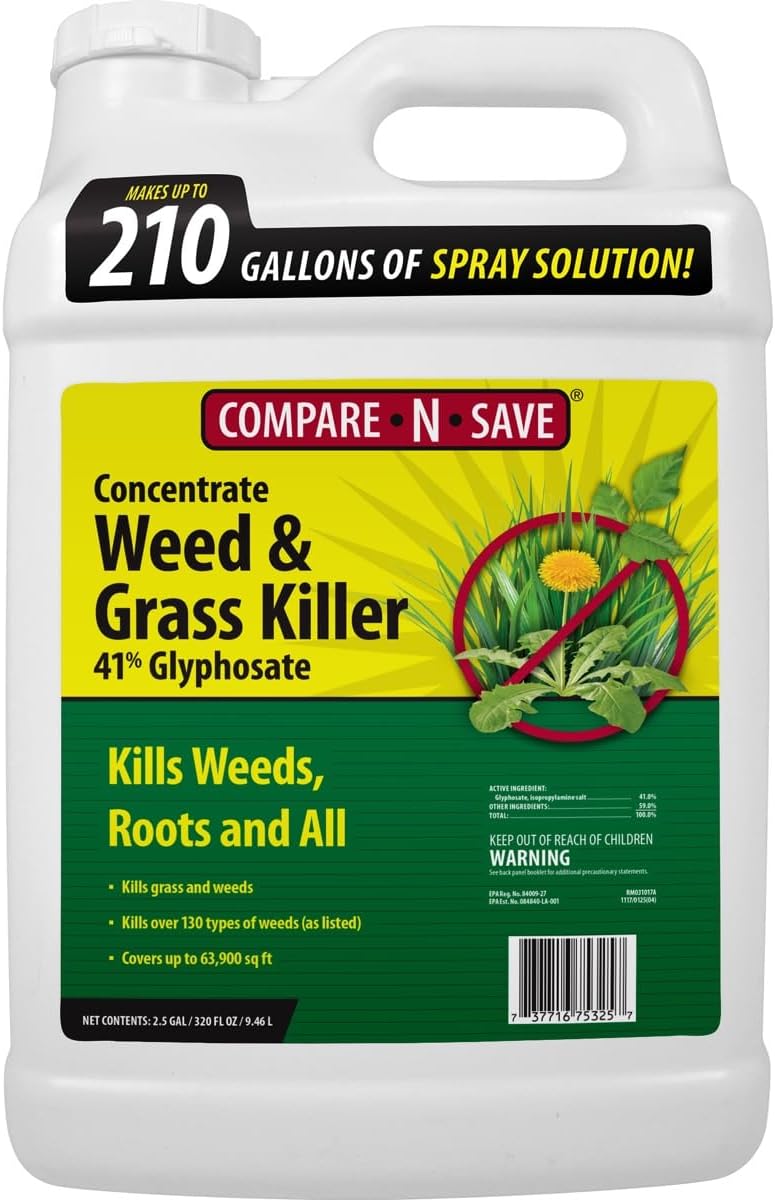
Compare-N-Save 41% Glyphosate Concentrate Grass & Weed Killer, 2.5 Gallon
| Active Ingredients | glyphosate |
|---|---|
| Liquid Volume | 2.5 gallons |
| Coverage | 630000 square feet |
| Item Form | Spray |
This 2.5 gallon concentrate delivers strong, post-emergent control of annual and perennial weeds by killing foliage and translocating to the root. It is mixed with water to make ready-to-use spray and is intended for use on driveways, walkways, fence lines, landscape beds, garden preparation, brush and stump treatment, and for lawn renovation where total vegetation removal is desired. Notable features include a 41 percent glyphosate formulation, the ability to make up to 210 gallons of spray, and fast visible results in 2 to 4 days with a typical rainproof period of about two hours. Practically, this makes it efficient for contractors or property managers who need to treat large areas without frequent reapplication. Important limitations are that it kills all green plants it contacts, has no residual preventing new growth, and requires careful handling and strict adherence to label directions near edible crops and desirable plants. Protective gear and drift control are essential when applying this product.
Best for: Best for landscapers, groundskeepers, and homeowners tackling large-scale weed control who prioritize cost-effective coverage and decisive vegetation removal.
Less Ideal for: Not a good choice for spot treating lawns where selective control is needed or for users uncomfortable working with concentrated herbicides near edible plantings.
- High glyphosate concentration for effective root kill
- Large 2.5 gallon container reduces frequency of repurchasing for big jobs
- Mixes to a large volume of ready-to-use spray, improving coverage efficiency
- Fast visible results within 2 to 4 days and becomes rainproof in about two hours
- Nonselective herbicide that will kill desirable plants on contact
- No residual activity so repeat treatments or other weed-prevention measures may be needed in high-infestation areas
Verdict: Choose this concentrate when you need a cost-efficient, fast-acting solution to clear large areas of unwanted weeds and grasses.
Compare-N-Save Concentrate Glyphosate Grass & Weed Killer, 32 oz

| Unit Count | 32 Ounce |
|---|---|
| Active Ingredients | glyphosate |
| Item Form | Spray |
| Coverage | 25000 square_feet |
This 32-ounce Compare-N-Save concentrate provides a straightforward, no-frills glyphosate solution for clearing unwanted weeds and grasses. You mix the concentrate with water in a sprayer (manufacturer mixes listed for general and tougher weeds) and spray foliage on a calm, warm day; the chemical is absorbed through leaves and translocated to roots for effective knockdown. It is useful for driveway cracks, fence lines, garden bed edges, preparation for planting, stump treatment, and lawn renovation rather than selective spot treatment in a lawn. The product advertises coverage that scales up when diluted and can make multiple gallons of ready-to-use spray, which stretches the bottle for larger jobs. Important practical limitations are safety and nonselectivity: it kills any green plant it contacts, requires protective clothing during application, and needs careful avoidance of drift to nearby desirable plants. There is also no residual control, so repeat applications or follow-up weed management may be necessary for new growth.
Best for: Buyers on a tight budget who need a cost-effective, workhorse herbicide for large or repeated perimeter and renovation jobs and who are comfortable mixing and applying concentrated products safely.
Less Ideal for: Homeowners who need selective spot treatment inside a lawn or those unwilling to follow safety precautions and label directions should consider alternative, more targeted products.
- Concentrated formula stretches into multiple gallons of ready-to-use spray for larger areas
- Active ingredient glyphosate provides systemic control down to the root for annuals and many perennials
- Clear mixing rates provided for general and tough weeds so users can adjust strength
- No residual soil activity allows replanting of ornamentals or vegetables after label-specified intervals
- Nonselective and will kill any contacted green plant, so careful application is required
- Requires personal protective equipment and precautions to prevent drift and exposure
Verdict: A budget-friendly concentrated glyphosate that stretches to cover large areas and delivers reliable systemic weed and grass control when used with proper safety precautions.
Corteva Agriscience Remedy Herbicide

| Manufacturer | Corteva Agriscience |
|---|---|
| Part Number | Remedy |
| Coverage | 1 acre |
Corteva Remedy is a targeted herbicide designed for controlling woody plants and broadleaf weeds on rangeland, permanent grass pastures, CRP acres, fence rows, and non-irrigation ditch banks. It is typically mixed and applied with standard ground equipment by land managers, ranchers, or contractors to treat large areas up to the labeled coverage. Notable features include professional-grade formulation and one-acre coverage per unit as stated by the manufacturer, plus labeled directions for specific noncropland uses. In practice Remedy delivers effective broadleaf and woody plant control when applied according to label directions, and the product's concentrated form reduces the number of trips required to treat a field. Important limitations are that it is intended for noncropland settings only and requires protective equipment during application, so it is not suitable for casual home-garden use and needs someone comfortable with herbicide handling and compliance with label restrictions.
Best for: Buyers who need a reliable, professional herbicide for managing weeds and woody plants across pasture, rangeland, or conservation acres and who follow labeled application practices.
Less Ideal for: Casual gardeners, homeowners, or anyone seeking a multipurpose home garden weed killer or a product for irrigated turf should look for consumer-labeled alternatives.
- Professional-strength formulation for woody plant and broadleaf weed control
- Labeled for large-area uses such as rangeland, pastures, and CRP acres
- Concentrated product covers one acre per unit as indicated by manufacturer
- Clear label directions for the specified noncropland applications
- Not formulated or labeled for general home or ornamental garden use
- Requires use of protective equipment and familiarity with herbicide handling
Verdict: Choose Remedy when you need a dependable, professional-strength herbicide for managing woody plants and broadleaf weeds on pasture and rangeland.
Compare-N-Save 75324 Herbicide, 1-gallon (glyphosate concentrate)

| Active Ingredients | glyphosate |
|---|---|
| Liquid Volume | 1 gallons |
| Item Form | Spray |
| Coverage | 25000 square_feet |
This one-gallon Compare-N-Save concentrate uses glyphosate to kill a wide range of annual and perennial weeds and grasses by foliar uptake down to the roots. It is mixed with water to create ready-to-use spray: the label recommends about 1.5 ounces per gallon for general use and up to 2.5 ounces per gallon for tougher perennials, with the full gallon making multiple gallons of spray for larger areas. Typical uses include clearing driveways, walkways, fence lines, garden preparation, lawn renovation, and stump or brush treatment. Notable features are fast visible results in 2 to 4 days, rainproofing within about two hours, and broad area coverage when diluted (manufacturer states it can cover thousands of square feet at recommended rates). Important limitations are that glyphosate will kill any green plant it contacts so careful targeting and protective gear are required, it has no residual pre-emergent activity, and label directions must be followed for safe use around edible gardens. For commercial lawn work, its concentration and economy make it effective but it demands disciplined application to avoid off-target damage.
Best for: Commercial landscapers or property managers who need an economical, fast-acting nonselective herbicide for clearing large areas and preparing sites for renovation while following safety protocols.
Less Ideal for: Home gardeners seeking a selective lawn-safe product or people who need a long-lasting pre-emergent should consider alternatives.
- Concentrated formula stretches to many gallons of ready-to-use spray for large-area work.
- Fast visible control with results often in 2 to 4 days and rainproofing in about two hours.
- Broad-spectrum activity against annual and perennial weeds and grasses, including root kill.
- Simple dilution instructions let crews mix strength for general or tougher targets.
- Nonselective glyphosate will damage or kill desirable plants if drift occurs.
- No residual activity so repeat treatments or follow-up prevention are required for long-term control.
Verdict: A cost-effective, concentrated glyphosate concentrate that delivers fast, large-area weed and grass control when used with proper precautions.
Ortho GroundClear Year-Long Vegetation Killer2 Concentrate, 2 gal.

| Item Form | Liquid |
|---|---|
| Coverage | 3,200 square feet |
| Liquid Volume | 2 gallons |
Ortho GroundClear Year-Long Vegetation Killer2 is a concentrated, fast-acting herbicide made for clearing and suppressing unwanted weeds and grasses where no plant growth is wanted for up to 12 months. You mix 24 fl. oz. per gallon of water and apply with a tank sprayer; one 2 gallon bottle makes roughly 10.7 gallons of solution and treats up to 3,200 square feet. The formula is rainproof in about an hour and works on driveways, sidewalks, paver patios, gravel areas and fence lines, making it useful for large maintenance runs and spot clearing. Practical features include long residual control that reduces repeat visits and clear label directions for timing and temperature for best results. Important limitations are that it is nonselective and remains active in soil for up to a year, so it must not be applied where future planting is planned and requires careful PPE and exclusion of people and pets until sprays dry. For commercial or high-use properties it speeds up routine vegetation control but demands precise application and site planning.
Best for: Property managers and maintenance-minded users who need a high‑coverage, long-lasting solution for hardscape and nonplanting areas and prioritize reducing repeat treatments.
Less Ideal for: Homeowners or gardeners who plan to plant lawns, vegetables, or ornamental beds in treated areas within a year should choose a selective or shorter‑residual product instead.
- Long residual control prevents regrowth for up to one year, reducing treatment frequency
- Concentrated formula yields about 10.7 gallons of spray from a 2 gallon bottle for up to 3,200 sq. ft. coverage
- Rainproof within one hour so treatments are less likely to be ruined by light rain
- Fast-acting formula begins controlling visible weeds quickly after application
- Nonselective and remains active in soil for up to a year, so it cannot be used where future planting is intended
- Requires tank sprayer and careful protective measures during application
Verdict: Choose this concentrate when you need a fast, rainproof herbicide that clears and prevents vegetation on hard surfaces for up to a year to cut down on repeat treatments.
Choosing the Right Commercial Herbicide: Key Factors to Consider
Weed Spectrum and Target Species
Knowing which weeds you must control is the first step. Some commercial herbicides are broad-spectrum and handle both grasses and broadleaf weeds, while others target one group. Matching the product label to the dominant species in your site prevents wasted applications and cutbacks from incomplete control.
Management of perennial weeds demands different active ingredients and often higher rates or sequential treatments compared with annuals. Consider whether you need early-season residual control for seedling suppression or a post-emergent knockdown for established weeds. Also think about emerging resistant species within your region and whether rotating modes of action will be necessary to manage resistance long term.
Speed of Action and Visible Knockdown
How fast weeds show visible injury affects scheduling and labor. Fast-acting herbicides can reduce the time crews spend monitoring sites and allow quicker follow-up tasks like mowing or replanting. However, rapid foliar browning does not always mean the root system is dead, especially for stubborn perennials.
For some operations, immediate aesthetic control is important, while for production fields the primary goal is mortality and reduced seed return. Choose a product whose typical timeline aligns with your operational window and follow label guidance on timing for any necessary retreatments.
Residual Longevity and Soil Activity
Residual control keeps seedlings from establishing after application and reduces the number of treatments per season. Soil-active herbicides vary widely in persistence depending on chemistry, soil type, moisture, and microbial activity. Longer residuals are useful in high-traffic or re-seeding-sensitive areas, but persistent residues can also limit planting windows for follow-up crops or ornamentals.
Understand label restrictions for rotational crops and soil persistence in your local conditions. In sites where future planting is planned, consider shorter-residual options or spot treatments to avoid unintended carryover.
Crop, Turf, and Non-Target Safety
Protecting desirable plants is critical in commercial landscapes and production settings. Herbicide label directions include crop-specific use rates, buffer distances, and re-entry intervals to reduce off-target damage. Some active ingredients are more likely to injure ornamentals or new seedlings even at low drift exposures.
Evaluate spray droplet size recommendations, wind restrictions, and required buffer zones. Also account for soil uptake risks and root contact exposure for nearby plantings. When working near sensitive species, choose products with lower volatility and approved use patterns for those conditions.
Application Method and Equipment Needs
Commercial applications are done with different equipment: boom sprayers, backpack sprayers, or ATV/UTV mounts. Some formulations require specific nozzles, pressure ranges, or agitation to stay in suspension. The right match between formulation and equipment reduces clogging, ensures even coverage, and cuts rework time.
Consider pump capacity, tank size, and calibration frequency when planning treatments. Also review PPE and handling requirements; products that need extensive personal protective equipment can slow field operations and increase labor costs.
Compatibility, Mixing, and Regulatory Compliance
Tank-mix flexibility matters because combining herbicides, adjuvants, or fertilizers is a common way to broaden control and improve uptake. Not all active ingredients mix well together, and incompatibilities can reduce effectiveness or create clogged filters. Use compatibility tests and follow label guidance on sequence and carrier volumes.
Regulatory restrictions vary by region and by active ingredient. Check local legal requirements for restricted-use designations, permitted use sites, and buffer zones. Keep records of applications to remain compliant with overseen sites and to track resistance management strategies.
When to Use Pre-emergent Versus Post-emergent Products
Pre-emergent herbicides are applied before weed seedlings emerge and work by preventing germination or damaging young roots. They are best used as a preventive strategy in beds, production fields, or high-value turf where stopping weeds before they establish reduces labor and seed banks.
Post-emergent products act on actively growing foliage and are useful when weeds are already present. Deciding between the two depends on timing, the weeds present, and the planting or renovation schedule of your site. Often a combined strategy gives the best long-term control: a pre-emergent to cut seedling flushes followed by targeted post-emergent treatments for escapes.
- Use pre-emergents in stable beds or new plantings where future crop restrictions are understood
- Reserve post-emergents for visible infestations or when perennial weeds need systemic control
- Coordinate timing with irrigation and rainfall to maximize activity
Application Timing and Weather Considerations
Weather at application time strongly influences efficacy. Rain within a few hours can wash away foliar products, while dry conditions may reduce uptake for foliar-applied chemistries that need stomatal activity. Temperature also affects volatility and plant metabolism; very hot days can speed uptake or increase risk to sensitive crops.
Check forecasts and choose calm, mild-weather windows. Follow label guidance on wind speed limits, temperature restrictions, and required rain-free intervals after application.
- Avoid application before expected heavy rain for foliar-only products
- Use lower drift nozzles and larger droplets on windy days to protect non-target plants
- Schedule systemic applications when weeds are actively growing for best translocation
Managing Resistance and Rotating Modes of Action
Repeated use of the same active ingredient class selects for resistant weed populations. To maintain long-term control, rotate products with different modes of action and integrate cultural controls like mowing, tillage, or crop rotation where feasible.
Keep records of what modes of action were applied in each season and consider mixing with non-chemical practices to reduce reliance on a single chemistry. For stubborn species, use integrated approaches and consult regional extension resources for resistance updates.
- Alternate chemistries across seasons rather than repeating the same class
- Combine chemical control with cultural practices to lower selection pressure
- Monitor treated areas and flag any escaping weeds for follow-up testing
Safety, PPE, and On-site Handling Best Practices
Commercial herbicides often require specific personal protective equipment and handling procedures during mixing and application. Proper PPE protects applicators from exposure and reduces risk of accidental transfer to non-target areas.
Set up dedicated mixing stations with spill containment, have clean water and emergency procedures available, and train staff on label requirements. Keep application records and Material Safety Data Sheets accessible at sites where treatments are prepared and stored.
- Use closed transfer systems where possible to reduce spills
- Store concentrates in locked, ventilated areas away from water sources
- Provide staff training on decontamination and emergency response
Post-application Monitoring and Follow-up
After treatment, inspect sites at label-recommended intervals to confirm efficacy and detect escapes early. Some herbicides show slow mortality even when effective, so allow the full labeled interval before deciding on retreatment.
Document results and note environmental conditions during treatment. Use observations to refine timing, rates, and application techniques for future treatments.
- Photograph problem areas and log dates for future reference
- Plan spot treatments for escapes rather than immediate broadcast reapplication
- Adjust future strategies based on observed persistence and crop responses
How We Chose the Best Commercial Herbicide
Our selection focused on products formulated for large-scale or professional use and ranked by criteria that matter in real commercial settings. We prioritized documented control across a range of common annual and perennial weeds, proven speed of visible activity, and the length of residual control to reduce return visits. Safety to non-target crops, turf, and landscape ornamentals was a key filter, with special attention to labeled use patterns and re-entry intervals. We also considered formulation and tank-mix flexibility because ease of blending and compatibility with adjuvants determines operational efficiency. Application practicality was assessed by spray characteristics and required PPE rather than price or branding. We excluded products intended only for small homeowner use or those missing clear labeled directions for commercial application. Products without demonstrated control data for typical commercial weed species or lacking guidance on crop restrictions were also removed. The final list reflects options that meet practical field needs: weed spectrum, speed of knockdown, residual length, crop safety, and on-site handling convenience.
FAQ
Can I use a commercial herbicide near young ornamentals or newly sown turf?
It depends on the active ingredient and label restrictions. Many commercial products carry specific guidance about planting intervals and buffer zones. Choose shorter-residual products or spot-treat and follow label directions to protect new plantings.
How soon after application can replanting or reseeding occur?
Replanting intervals vary by chemistry and soil persistence. Some products allow short intervals, while others restrict planting for weeks to months. Check the label for rotational crop guidance and consider soil type and moisture, which affect breakdown rates.
What is the safest way to avoid off-target drift during commercial spraying?
Use appropriate nozzle types and larger droplet sizes, apply during low-wind conditions, and maintain recommended boom heights. Consider buffer areas and volatility characteristics of the product to lower drift risk.
Are tank mixes always more effective than single products?
Tank mixes can broaden control and improve performance, but compatibility and label allowances are crucial. Perform a jar test for compatibility and follow sequencing instructions on labels. Unapproved mixes can reduce efficacy or create hazards.
How should I manage application records and compliance?
Keep detailed logs of product used, rates, target species, application date, weather conditions, and applicator identity. Retain MSDS and labels, and follow local regulatory reporting requirements for restricted-use products.
When is spot treatment preferable to broadcast application?
Spot treatments are efficient when weed pressures are patchy, reducing chemical use and limiting non-target exposure. Broadcast treatments are better for uniform infestations or when pre-emergent protection of an entire area is needed.
Final Verdict
Selecting the right Commercial Herbicide requires balancing weed spectrum, speed of control, residual needs, and safety for crops and surrounding plants. Prioritize the factors that match your site schedule and sensitivity, such as whether you need immediate knockdown or long-term seedling suppression. Remember that operational practicality, tank-mix compatibility, and resistance management are as important as chemistry. With those tradeoffs in mind, choose products and application strategies that minimize rework and protect desirable vegetation so your control program remains effective over multiple seasons.
