

Note: This article contains affiliate links. If you click on these links and make a purchase, I may earn a small commission at no extra cost to you. This helps support my research and content. Read my full affiliate disclosure here.
If you tend a small to medium garden, a cordless garden tiller can cut the grunt work and let you prepare beds faster without dragging extension cords across the yard. The right cordless tiller balances battery runtime, tine design, and overall weight so you can break up compacted soil, mix amendments, and edge beds with minimal effort. This guide covers seven shortlisted cordless garden tillers that perform well in home gardens. We evaluated each for battery life, tilling depth and width, build durability, and how they handle common backyard soil types. Read on to see which features matter most for your plot before the product listings.
Top Picks at a Glance
| Best Overall The best all-around choice for most situations | ADOTOCAM Cordless Tiller Cultivator (Tool Only) — Compatible with DeWalt 20V Batteries |  |
| Best Quality Built to a higher standard if you want something more solid | LawnMaster 48V Brushless Cordless Tiller Cultivator CLTE4814 |  |
| Best Value The sweet spot between price and what you get | Alloyman 20V Cordless Tiller Cultivator with 2×4.0Ah Batteries |  |
| Best Budget The cheapest option that still gets the job done reliably | Muylux 20V Cordless Tiller Cultivator (1 x 2.0Ah Battery) |  |
| Highest Rated A top-rated pick with lots of positive feedback | SEYVUM 20V Cordless Garden Tiller with Dual 4.0Ah Batteries |  |
| Most Popular A crowd favorite that many people choose with confidence | Greenworks 40V 10" Cordless Tiller/Cultivator with 4.0Ah Battery and Charger |  |
| Best Seller A high-volume bestseller chosen again and again | HEINPRO Cordless Garden Tiller Cultivator (Compatible with DEWALT 20V MAX) |  |
ADOTOCAM Cordless Tiller Cultivator (Tool Only) — Compatible with DeWalt 20V Batteries

| Power Source | Battery Powered |
|---|---|
| Operation Mode | Electric |
This ADOTOCAM cordless tiller is a compact, battery-powered cultivator designed for small to medium garden tasks. It accepts DeWalt 20V Max batteries (tool only) so it integrates with existing battery ecosystems, and its 48 steel tines spin up to 360 RPM to cultivate a roughly 9-inch swath and reach about 7 inches deep. The adjustable auxiliary handle and ergonomic main grip make it easy to use without excessive bending, and the double-safety start requires two controls to be pressed which reduces accidental startups. Detachable gears simplify cleaning when debris or weeds get wrapped in the tines. Practical benefits include quick soil loosening, easy spot cultivation between beds, and portability for gardeners who prefer cordless tools. Important limitations are that battery and charger are not included and runtime will depend on the specific DeWalt battery used, and the compact size means it is best suited to raised beds, vegetable patches, and smaller yards rather than large-scale or continuous heavy-duty tilling.
Best for: Gardeners who want a portable, cordless cultivator for regular bed preparation, weeding, and spot tilling in small to medium plots and who value compatibility with existing 20V battery tools.
Less Ideal for: People needing a heavy-duty tiller for large acreage or continuous deep tilling should choose a larger gas or higher-capacity electric model.
- Compatible with DeWalt 20V Max batteries for use with existing battery packs
- 48 steel tines and up to 360 RPM deliver efficient tilling of a 9-inch wide by 7-inch deep swath
- Lightweight, ergonomic design with adjustable auxiliary handle reduces user fatigue
- Double-safety start system helps prevent accidental operation
- Detachable gears make cleaning and maintenance easier after use
- Sold as tool only so battery and charger must be purchased separately
- Compact power and run time depend on battery choice so not ideal for large continuous jobs
Verdict: A convenient cordless cultivator for small to medium gardens that integrates with DeWalt 20V batteries for portable, quick soil prep.
LawnMaster 48V Brushless Cordless Tiller Cultivator CLTE4814

| Power Source | Battery Powered |
|---|---|
| Tilling Width | 14.5-Inch |
| Tilling Depth | 9-Inch |
| Blades | 4 |
The LawnMaster CLTE4814 is a cordless, brushless 48V tiller designed to cultivate soil without the noise and fuss of a gas engine. It is used to break up compacted beds, mix amendments, and dig small planting holes; the 14.5-inch width and 9-inch depth let you cover a fair swath in each pass while four rust-resistant steel blades run at about 180 RPM for steady cutting. The included 48V 4.0Ah battery package and dual-port charger make it convenient to recharge and swap batteries for longer sessions, and the brushless motor improves efficiency and reduces maintenance compared with brushed designs. Practical benefits include cord-free maneuverability around beds and patios, quieter operation that suits residential neighborhoods, and sufficient runtime — roughly 35 minutes per charge — for routine garden prep. Limitations are its modest blade count and RPM compared with heavier gas or larger electric tillers, so it may struggle in very rocky ground or drive as quickly through very compacted clay as a commercial unit would; users should also plan for battery downtime on bigger jobs.
Best for: Gardeners who prioritize performance and convenience for regular soil prep in small to medium vegetable beds or ornamental gardens and want a low-maintenance, cord-free tiller that handles most residential tasks.
Less Ideal for: Landscapers or users with large acreage, heavy clay, or very rocky ground who need higher torque, deeper penetration, or continuous runtime from a gas or commercial-grade tiller.
- Brushless 48V motor for efficient power and lower maintenance
- Cordless design provides easy maneuvering around beds and tight spaces
- 14.5-inch tilling width and 9-inch depth cover ground quickly for small to medium plots
- Included 4.0Ah battery and dual-port charger allow straightforward recharging and swapping
- 180 RPM with four blades is less aggressive than larger gas or commercial tillers for very compacted or rocky soil
- Runtime around 35 minutes may require spare battery for extended sessions
Verdict: A powerful, low-maintenance cordless tiller that delivers solid performance and quiet, cord-free convenience for small to medium garden soil work.
Alloyman 20V Cordless Tiller Cultivator with 2×4.0Ah Batteries

| Power Source | Battery Powered |
|---|---|
| Voltage | 20V |
| Tillage width | 9 Inch |
| Tillage depth | 6.6 Inch |
| Running time(single battery) | 45Mins |
The Alloyman 20V cordless tiller is a compact electric cultivator aimed at making light soil prep faster and less physical. It uses two 20V lithium batteries (one provides about 45 minutes) to power a motor that turns four steel tines at up to 360 RPM, cutting a 9 inch swath and roughly 6.6 inches deep per pass. Typical uses are aerating small plots, breaking up raised beds, weeding, and refreshing compacted topsoil where a full-size tiller would be overkill. The adjustable auxiliary handle and light overall weight make it easy to steer and reduce back strain during repeated passes. Practical advantages include cordless mobility for working away from outlets and detachable gears for simpler cleaning after hitting roots or debris. Limitations are its small working width and tine count, so it takes longer to cover larger areas and is not intended for heavy clay or very rocky ground. Also battery runtime will vary with soil resistance, so keep a charged spare for longer jobs.
Best for: Buyers who want a compact, easy-to-use cultivator for raised beds, small lawns, and flower beds and who prioritize cordless convenience and manageable weight over raw power.
Less Ideal for: Do not choose this if you need to prep large acreage or break up heavy compacted clay and rocky ground; those tasks need a larger, more powerful tiller.
- Cordless battery power gives unrestricted mobility for small gardens and tight spaces
- Lightweight, ergonomic design and adjustable auxiliary handle reduce user fatigue
- Detachable gears make cleaning after use easier
- Two 4.0Ah batteries with about 45 minutes per battery minimize downtime when alternating
- Narrow 9 inch working width and four tines make it slow to cover large areas
- Not suited for heavy clay or very rocky soils where a larger petrol tiller is needed
Verdict: A lightweight cordless mini tiller that makes quick, low-effort soil prep in small gardens and raised beds simple and portable.
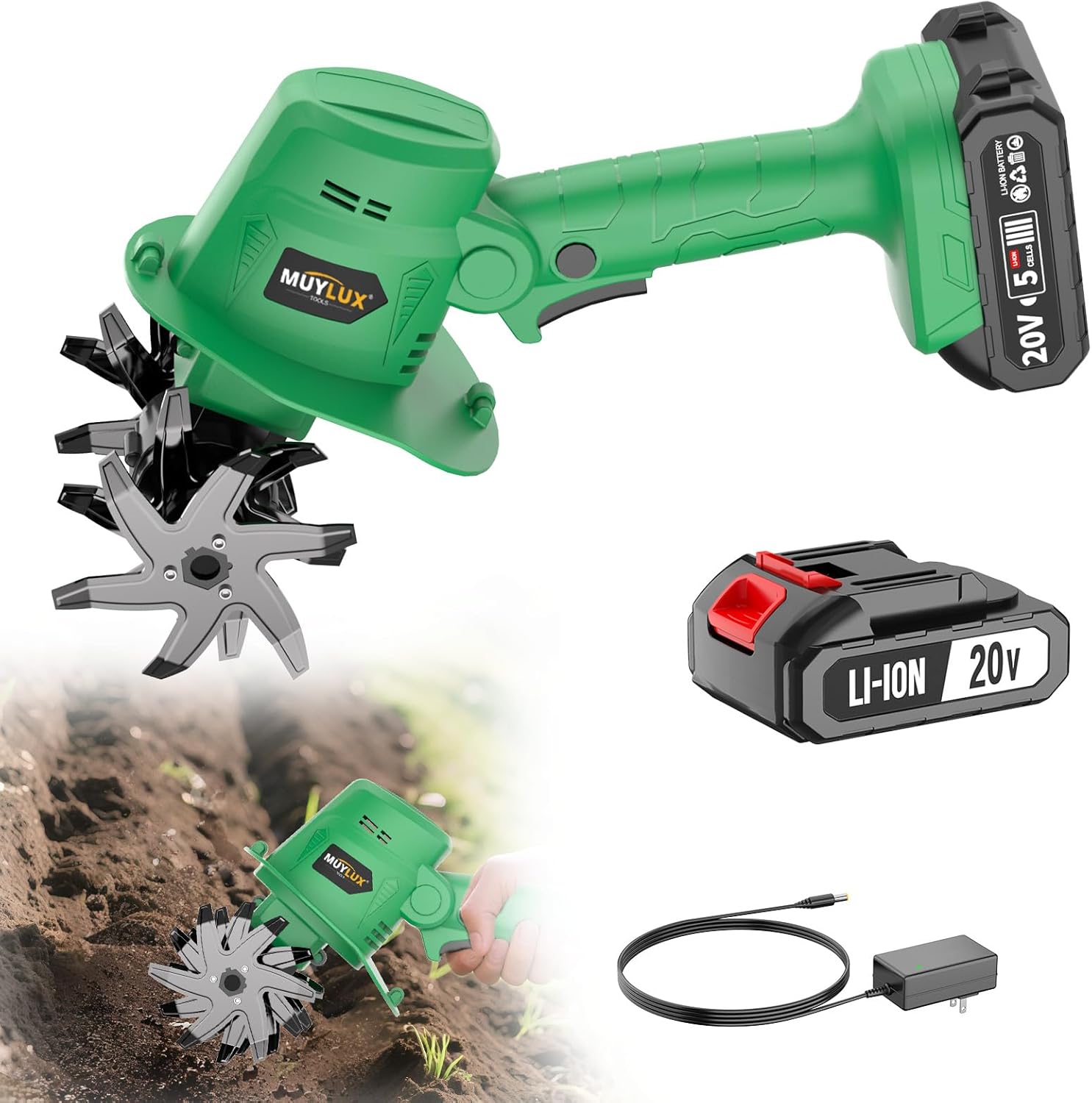
Muylux 20V Cordless Tiller Cultivator (1 x 2.0Ah Battery)
| Power Source | Battery Powered |
|---|---|
| Operation Mode | Electric |
| Model Number | CT-20LS |
| Brand Name | Muylux |
The Muylux 20V cordless tiller is a compact electric cultivator meant for quick soil preparation in small beds, containers, and narrow garden zones. It uses two steel tines that rotate up to 240 RPM to break up soil about 4 inches deep, making it useful for aerating lawns, mixing amendments, and loosening light compacted ground. The included 20V rechargeable battery removes cords and improves maneuverability for working around plants and raised beds. Its lightweight plastic construction and ergonomic grip reduce fatigue during short sessions, and the single-battery setup is easy to swap if you already own compatible batteries. Expect straightforward, low-effort use for light to moderate tasks, but it is not designed for heavy clay, deep digging, or large acreages where a full-size tiller is needed. Battery runtime will limit extended jobs and the small tines work best in previously loosened or loamy soils. For budget-minded gardeners who need a simple cordless option for regular small-area cultivation, this is a practical choice.
Best for: Gardeners on a tight budget who need a simple cordless tool for light soil cultivation in small beds, container gardens, and around established plants.
Less Ideal for: Do not choose this if you need to prepare large areas, dig deep trenches, or work regularly in dense clay where a heavier-duty tiller is required.
- Cordless 20V battery power provides untethered maneuverability in tight beds and around plants
- Two steel tines deliver up to 240 RPM and loosen soil to about 4 inches for quick cultivation
- Lightweight design with ergonomic grip reduces user fatigue during short tasks
- Includes a rechargeable battery so it is ready to use out of the box
- Small tines and limited depth are not suited for heavy clay or large-scale tilling
- Single 2.0Ah battery limits continuous runtime for longer jobs
Verdict: A budget-friendly, lightweight cordless cultivator that makes quick work of light soil preparation in small gardens and tight spaces.
SEYVUM 20V Cordless Garden Tiller with Dual 4.0Ah Batteries

| Power Source | Battery Powered |
|---|---|
| Batteries | 2 x 4.0Ah lithium |
| Tilling Width | 9-inch |
| Tilling Depth | 7-inch |
| Blades | 4 x 12-tooth steel |
The SEYVUM 20V cordless tiller is a lightweight electric cultivator built for routine soil prep in small vegetable beds, raised planters, and narrow pathways. It uses a high-speed brushless motor and four 12-tooth steel blades to break up clods and mix amendments without the fuss of gas engines. The unit ships with two 4.0Ah lithium batteries that the manufacturer rates for about 50 minutes of combined run time, so you can complete most small plots or multiple raised beds on a single charge. Its 9-inch tilling width and 7-inch depth let you work between rows and inside tight beds without disturbing adjacent plants. Practical touches include a compact frame that is easier to carry and store than larger tillers. Expect limits on heavy-duty tasks: it is optimized for light to medium soil and small areas rather than deep, continuous excavation on acreage. Also plan on recharging between longer sessions if you need extended runtime beyond the bundled batteries.
Best for: Gardeners who want a no-fuss, battery-powered cultivator to prepare and maintain small vegetable beds, raised planters, or narrow pathways and prioritize ease of use and storage.
Less Ideal for: Those needing a heavy-duty machine for large acreage, continuous deep tilling, or frequent work in very compacted clay should consider a larger gasoline or commercial-grade tiller.
- Brushless 20000 RPM motor for efficient, quieter operation
- Dual 4.0Ah batteries provide up to about 50 minutes combined runtime
- Compact 9-inch width and 7-inch depth for use in tight beds and between rows
- Four 12-tooth steel blades designed to cut and mix soil effectively
- Not intended for heavy clay or continuous large-scale tilling
- Limited working width means more passes on larger beds
Verdict: A compact, battery-powered tiller that makes quick work of small beds and tight spaces, ideal for gardeners who want an efficient, easy-to-store cultivator.
Greenworks 40V 10" Cordless Tiller/Cultivator with 4.0Ah Battery and Charger

| Power Source | Battery Powered |
|---|---|
| Battery | 40V 4.0Ah removable |
| Tines | Four 8-inch forward-rotating tines |
| Operation Mode | Electric |
The Greenworks 40V 10" cordless tiller is a lightweight, battery-powered front-tine cultivator designed for small to medium garden beds and light soil preparation. It uses a removable 40V 4.0Ah battery to deliver about 45 minutes of run time per charge and starts with a push-button electric switch, so it is simple to use for quick jobs. Four 8-inch forward-rotating tines work across an adjustable tilling width (about 8.25" to 10") and a cultivating depth of roughly 5 inches, which makes it good for turning over planting rows, breaking compacted topsoil, and mixing in compost. The 6-inch rear wheels aid maneuverability and transport around beds. Because it is battery powered there is no gas, oil, or exhaust to manage and maintenance is minimal. Limitations are moderate power compared with gas tillers and the limited run time means it is best for intermittent passes rather than long continuous use on large plots. For a gardener who wants easy startup, low upkeep, and quiet operation, this is a practical all-round front-tine tiller.
Best for: Home gardeners who want an easy-to-use, low-maintenance front-tine tiller for prepping vegetable beds, raised beds, and small plots without the fuss of gas equipment.
Less Ideal for: People with large acreage, heavy clay soils, or those who need long uninterrupted run time should consider a more powerful gas or professional-grade tiller.
- Cordless 40V battery power offers quiet operation and no gas or oil maintenance
- Adjustable tilling width (8.25"–10") for working narrow rows or small beds
- Included 4.0Ah battery and charger provide about 45 minutes run time per charge
- Lightweight design with 6" rear wheels improves maneuverability and transport
- Less torque and continuous power than comparable gas-powered tillers for heavy clay or large areas
- Run time may require recharging or a spare battery for extended jobs
Verdict: A user-friendly cordless front-tine tiller that balances quiet, maintenance-free operation with enough power for routine garden bed prep.
HEINPRO Cordless Garden Tiller Cultivator (Compatible with DEWALT 20V MAX)

| Power Source | Battery Powered (Battery and Charger not Included) |
|---|---|
| Working Width | 9In tilling width |
| Tilling Depth | 7In depth |
| Blades | 4 hardened steel blades |
| Speed | 360 RPM |
This HEINPRO cordless tiller is a compact electric cultivator aimed at quick soil prep in small plots and raised beds. It uses DEWALT 20V MAX-compatible batteries so you can borrow power from an existing tool collection, and an integrated battery gauge shows runtime at a glance. The unit turns soil with four hardened steel blades at about 360 RPM across a 9-inch working width and up to 7-inch depth, making light plowing, aerating, mixing compost, and weeding straightforward. The tiller is easy to assemble with a three-section pole and quick-release collar and has an adjustable auxiliary handle and non-slip soft grip for better control. Safety is addressed with a dual-switch system to prevent accidental starts. Limitations include modest power and a narrow working width that make it unsuitable for heavy sod, dense grass, or large acreage, and the battery and charger are not supplied. For small vegetable plots and tight garden spaces it is a practical, low-maintenance alternative to gas tillers.
Best for: Buyers who want a simple, low-maintenance electric tiller for small vegetable plots, raised beds, or flower borders and who prioritize safety and ease of use over maximum power.
Less Ideal for: People needing a heavy-duty tiller for large gardens, commercial use, or for removing established turf should consider a larger gas or higher‑power electric model.
- Cordless design compatible with DEWALT 20V MAX batteries for convenient shared power
- Lightweight and ergonomic with adjustable handle and soft grip for reduced user fatigue
- Four hardened steel blades provide efficient soil mixing, aeration, and light plowing
- Dual safety switch reduces accidental starts and improves user safety
- Quick three-section assembly and compact storage for tight sheds and garages
- Not intended for heavy sod or dense grass where blades can tangle
- Battery and charger are not included so runtime depends on separate purchase or existing batteries
- Narrow 9-inch width and modest RPM limit efficiency on larger areas
Verdict: A lightweight, safe cordless tiller that makes quick soil prep in small beds easy using DEWALT 20V MAX batteries.
Choosing the Right Cordless Garden Tiller: Key Factors to Consider
Battery Runtime and Recharge Behavior
Battery life is the single biggest limiter for cordless tillers. Longer runtime means you can finish a larger bed or several small plots on a single charge. Pay attention to rated amp-hours and whether the battery is swappable so you can carry a spare for extended sessions.
Recharge speed matters when you have only one battery. A fast charger gets you back to work sooner, while slow recharge times can force fragmented work or multiple short trips to a charging point. Also consider battery temperature tolerance if you work in very hot or cold seasons, because extreme conditions reduce usable runtime.
Tilling Depth and Width
Depth capability determines how deeply you can break compacted soil and how well amendments mix into the root zone. Shallow-only tools are fine for surface cultivation and mixing compost, but planters or beds that need deeper loosening require greater depth range.
Width affects how many passes you need to cover a bed. Wider tillers reduce time but can be harder to manoeuvre in tight beds or between plants. Look for adjustable depth settings so you can use the same tool for shallow finishing and deeper prep.
Tine Design and Soil Turnover
Tine shape, orientation, and speed determine how aggressively the machine digs and whether it chops roots or merely agitates the surface. Curved tines generally lift and turn soil better, while straight tines can be gentler and better for light weeding.
Consider tine guards and spacing to avoid clogging in clay or mulch-heavy beds. Tine materials and mounting should allow for occasional replacement and straightforward cleaning after use in sticky or root-filled soils.
Weight, Balance, and Handling
Overall weight affects fatigue and the ability to control the tiller near existing plants or within raised beds. Heavy machines can dig deeper more easily but are harder to lift for transport or to flip for storage. Good balance keeps the front from digging in unexpectedly and reduces wrist and shoulder strain during extended use.
Check handle adjustability and grip comfort so you can set a posture that suits your height. Folding or removable handles help with storage in small sheds.
Durability, Serviceability, and Maintenance
Durable drivetrain components and a robust shield around the tines extend service life and reduce maintenance. Look for sealed gear housings, replaceable tines, and easy access to bolts and guards so routine cleaning and part swaps are straightforward.
Consider availability of replacement parts and whether common wear items are user-serviceable without specialty tools. Simpler designs often mean fewer failure points and lower long-term maintenance effort.
Safety Features and Controls
Safety controls like dead-man switches, blade/tine guards, and clear start/stop mechanisms are essential when working around roots, rocks, and nearby plants. A predictable, responsive throttle or trigger helps prevent sudden surges that could pull the tool into a bed or cause gouging.
Also think about vibration levels and noise. Lower vibration reduces hand fatigue and makes longer sessions more comfortable, while quieter motors are less disruptive in shared outdoor spaces.
Best Uses for Cordless Tillers in the Home Garden
Cordless tillers are most useful for preparing small vegetable beds, renovating flower beds, and mixing compost into topsoil. Their portability makes them ideal for raised beds, container gardens, and plots that are awkward to reach with larger walk-behind machines.
Use cordless units for seasonal refresh work such as loosening the top 4 to 8 inches of soil before planting, incorporating organic matter, or clearing shallow weed roots. They are not intended for turning over large sod areas or for professional-scale deep plowing.
- Raised bed prep and amendment mixing
- Light clearing of weeds and surface roots
- Edge work and narrow-path cultivation
Soil Types and How They Affect Performance
Sandy soils are the easiest to till and demand less battery power and tine aggression. In contrast, compacted clay requires a combination of deeper tine reach and longer runtime to break up clods and mix in organic matter effectively.
If your garden has heavy clay or a lot of roots, plan for slower pass speeds and possibly multiple passes. For loam or amended garden soil, a single pass from a well-designed cordless tiller often suffices to prepare a good seedbed.
- Sandy soil: faster progress, lighter tines
- Loam: balanced performance
- Clay: slower, deeper, possibly multiple passes
Battery Management Tips for Longer Sessions
Carry at least one spare battery if you expect to work beyond a single battery charge. Rotate batteries between sessions and charge them fully before storage to ensure longevity. Keep batteries cool and dry while working to avoid overheating and voltage sag.
If you only have one battery, schedule work by task priority: finish small, high-value beds first and save wider or deeper projects until you can recharge or swap batteries.
- Bring a spare battery for extended work
- Avoid deep-discharge cycles to prolong battery life
- Store batteries at moderate temperature and charge level
Maintenance Routine to Keep a Cordless Tiller Working
After each use, remove soil and plant debris from tines and the gear housing to prevent rust and clogging. Inspect tines for bends, chips, or excessive wear and replace them if rotation becomes uneven.
Periodically check fasteners and shields to ensure nothing has loosened during operation. Follow manufacturer guidance for lubrication points and service intervals, and replace batteries that no longer hold reasonable charge.
- Clean tines and housing after each use
- Inspect and replace worn tines
- Tighten hardware and follow lubrication guidance
Working Safely Near Plants and Landscape Features
Plan your passes to avoid direct contact with stems and shallow roots you want to keep. Use low depth settings when tilling near established plants and consider using a handheld tool for precision work close to borders.
Watch for hidden obstacles like irrigation lines or buried cable. Mark utilities and slow down when soil conditions change to reduce the chance of kickback or sudden tine stalls.
- Set shallow depth near plants
- Mark hidden irrigation and cables
- Use handheld tools for precision edging
How We Chose the Best Cordless Garden Tiller
We focused on features that affect real-world garden work and excluded walk-behind petrol machines and corded electric models to keep the list strictly cordless. Selection began with models sized for small to medium beds and patios, then filtered for usable battery capacity, accessible maintenance, and user safety features. Key evaluation criteria included battery runtime and recharge behavior, because run time determines how much continuous area you can cover. Tilling depth and tine arrangement were measured for how well machines break through compacted soil and incorporate amendments. Weight and balance were evaluated for operator fatigue during longer sessions or reaching raised beds. Durability of drivetrain components and shield design were assessed to estimate service life and ease of cleaning. Finally, ergonomics and safety controls were considered for confident handling and reduced risk when working near plants and landscaping. We excluded heavy-duty commercial tillers and products intended only for light hand cultivation. Models without clear battery specifications or with limited protective shielding were not considered. The short list reflects machines practical for homeowners who need cordless convenience without sacrificing useful tilling performance.
FAQ
How deep can cordless tillers usually dig?
Most cordless garden tillers reach depths between 4 and 8 inches. Depth capability varies by tine design and power; adjustable depth settings give the most flexibility for shallow finishing or slightly deeper loosening.
Will a cordless tiller handle clay soil?
Cordless tillers can handle clay if they have sufficient tine penetration and you allow for slower, multiple passes. Very compacted or rocky clay may still require more powerful, petrol-powered equipment.
How long does a battery typically last during tilling?
Battery runtime depends on capacity, motor load, and soil resistance. Expect shorter run times under heavy load in compacted soil and longer performance in loose or sandy beds. Swappable batteries extend effective working time.
Can I use cordless tillers in raised beds?
Yes. Cordless tillers are well suited for raised beds because they are portable and avoid cords. Choose a model with appropriate width and good balance to avoid digging into bed edges or disturbing nearby plantings.
What maintenance does a cordless tiller need?
Regular cleaning of tines and gear housings, inspection and replacement of worn tines, and tightening of fasteners are typical. Follow any lubrication and service interval recommendations for moving parts.
Are cordless tillers noisy?
Cordless electric tillers are generally quieter than petrol models. Noise varies with motor power and tines working in soil, but most are suitable for residential areas and early-morning work with less disturbance.
Final Verdict
Choose a cordless garden tiller by prioritizing the features that match your garden size and soil type. If you have multiple small beds or raised planters, put more weight on portability, balance, and swappable batteries. For heavier soils, focus on tine design and available tilling depth. Accept tradeoffs between weight and power: lighter units are easier to handle but may need slower, multiple passes in compacted ground. Use the evaluation criteria outlined above to match a tiller to your typical jobs and you will end up with a tool that speeds prep without adding unnecessary complexity.
