

Note: This article contains affiliate links. If you click on these links and make a purchase, I may earn a small commission at no extra cost to you. This helps support my research and content. Read my full affiliate disclosure here.
Picking the right garden spreader matters because it controls how evenly fertilizer, seed, and granular amendments get distributed across lawns, vegetable beds, and larger landscapes. The wrong spreader wastes material, creates streaks, or makes chores take much longer. This guide collects the top shortlisted garden spreaders suited to different yard sizes and uses. We evaluated each option for coverage accuracy, hopper size and durability, and how easy the unit is to set and maintain. Read on to match spreader features to the tasks you do most often and move directly to the gear that fits your garden.
Top Picks at a Glance
| Best Overall The best all-around choice for most situations | Scotts Turf Builder EdgeGuard DLX Broadcast Spreader |  |
| Best Quality Built to a higher standard if you want something more solid | Buyers Products Grounds Keeper 100 lb Walk-Behind Broadcast Spreader |  |
| Best Value The sweet spot between price and what you get | Amazon Basics Broadcast Fertilizer Spreader, Multi-Gear, 5000 sq ft Coverage |  |
| Best Budget The cheapest option that still gets the job done reliably | CHAPIN 8740A 64 oz Hand Shaker Spreader |  |
| Highest Rated A top-rated pick with lots of positive feedback | PYRGON 20V Cordless Seed and Fertilizer Spreader with 2 Batteries |  |
| Most Popular A crowd favorite that many people choose with confidence | Scotts Turf Builder EdgeGuard Mini Broadcast Spreader |  |
| Best Seller A high-volume bestseller chosen again and again | Scotts Whirl Hand-Powered Spreader |  |
Scotts Turf Builder EdgeGuard DLX Broadcast Spreader

| Capacity coverage | Up to 15,000 sq. ft. |
|---|---|
| Additional features | EdgeGuard Technology, Pre-calibrated |
| Included components | Scotts – 76232 |
| Model number | 76232 |
The Scotts Turf Builder EdgeGuard DLX is a user-friendly broadcast spreader built for routine lawn care and seasonal tasks. It comes pre-calibrated so you can pour granular fertilizer, seed, weed control, salt, or ice melt into the hopper, set the rate dial to the product recommendation, and walk while the dual-bladed agitator and curved hopper funnel material for steady output. EdgeGuard technology blocks the right-side of the spread pattern to keep product off sidewalks, flowerbeds, and driveways, which makes spot control along edges much easier. The unit is sized to cover up to 15,000 sq. ft. of Scotts product so it suits mid-size yards without constant refilling. Practical downsides are typical of broadcast spreaders: it broadcasts material in a wide swath rather than pinpoint placement, and it requires even walking speed for best uniformity. The plastic construction and simple controls keep maintenance low but mean heavy commercial duty use may show wear sooner than heavier metal models. For homeowners wanting reliable, no-fuss spreading for most lawn chores, this model is a solid, easy-to-use choice.
Best for: Homeowners who want an easy, reliable spreader for routine lawn feeding, seeding, and seasonal salt application and who value clean edges and low setup time.
Less Ideal for: Commercial landscapers or users who need very precise spot placement or a heavy-duty metal spreader for daily professional use.
- Comes pre-calibrated for quick setup with common Scotts products
- EdgeGuard side shield prevents product from reaching non-lawn areas
- Dual-bladed agitator and curved hopper promote consistent flow and coverage
- Large capacity covers up to 15,000 sq. ft. between refills
- Simple controls and low maintenance plastic construction
- Broadcast pattern is wide so it is not ideal for precise point applications
- Plastic build may wear faster under heavy professional use
Verdict: Choose this spreader if you want a ready-to-use, homeowner-friendly broadcast spreader that keeps product off sidewalks and simplifies year-round lawn care.
Buyers Products Grounds Keeper 100 lb Walk-Behind Broadcast Spreader

| Capacity | 100 lb |
|---|---|
| Spread width | Up to 24 ft |
| Tire size | 13-inch pneumatic |
| Drive | Axle-driven spinner |
| Hopper material | Polyethylene |
This Buyers Products Grounds Keeper is a work-oriented broadcast spreader built for frequent use on medium to large properties. The 100 lb polyethylene hopper and fully welded powder-coated steel frame let you cover large areas with fewer refills, while the axle-driven spinner produces a broadcast pattern up to about 24 feet for efficient coverage. Material flow is controlled by a simple lever and adjustable poly deflectors so you can direct product away from beds and hardscapes, and a hopper screen plus nylon rain cover help keep material flowing in damp conditions. Commercial-style features include an enclosed gearbox with grease fitting and alloy gears for better resistance to weather and corrosion, and 13-inch pneumatic tires that roll smoothly over uneven turf. Because the hopper is plastic, rinse it after spreading salt or ice melt to avoid corrosion of other components. It is heavier and more utilitarian than homeowner-grade spreaders, so assembly and storage require more space but reward you with durability and season-to-season reliability.
Best for: Users who prioritize reliable, commercial-style performance for frequent spreading tasks on medium to large properties and want a durable all-season tool.
Less Ideal for: Casual gardeners with small yards who need a lightweight, compact spreader or those unwilling to perform post-use cleaning after corrosive materials.
- 100 lb hopper reduces refill frequency for large lawns or properties
- Axle-driven spinner delivers wide coverage up to about 24 feet for faster job completion
- Enclosed gearbox with grease fitting and alloy gears improves durability in wet or cold conditions
- Adjustable flow lever and poly deflectors let you control application and protect adjacent beds
- Larger, heavier build requires more storage space and is less convenient for small yards
- Requires rinsing after salt or ice melt use to prevent corrosion of non-plastic parts
Verdict: Buy this if you need a durable, commercial-grade spreader that covers large areas efficiently and works year-round.
Amazon Basics Broadcast Fertilizer Spreader, Multi-Gear, 5000 sq ft Coverage

| Coverage per load | 5000 square feet |
|---|---|
| Hopper volume | 0.5 cubic feet |
| Item weight | 8.86 pounds |
| Construction | Steel frame with plastic hopper |
| Operation | Multi-gear precision control |
This Amazon Basics broadcast spreader is a straightforward, value-focused tool for treating small to medium lawns. It features a plastic hopper on a steel frame and a multi-gear control that lets you adjust the opening for different granular materials including seed, fertilizer, salt, and ice melt. Use it for one-pass coverage up to about 5,000 square feet per fill; the pre-installed release cable and simple assembly mean you can get working quickly. The steel frame provides durability for seasonal outdoor use while the plastic bin keeps weight down and resists corrosion. Because it is a broadcast model, it throws material over a wide swath which speeds coverage but requires careful overlap management to avoid uneven application. The unit is best for homeowners who want a reliable, no-frills spreader for routine lawn feeding and winter deicing. If you need pinpoint placement, heavy-duty commercial capacity, or advanced calibration markings for very precise application rates, you will likely want a different style of spreader.
Best for: A practical homeowner who wants a durable, easy-to-use spreader to speed routine fertilizing and occasional ice-melt work without overcomplicating setup or operation.
Less Ideal for: Not a great fit for contractors or landscapers who need high-capacity commercial equipment or for gardeners who require exact, spot-specific placement.
- Multi-gear control for adjustable flow and material types
- Covers up to 5,000 sq ft per load for efficient one-pass work
- Steel frame with plastic hopper resists seasonal wear
- Easy assembly with release cable pre-installed
- Suitable for spread of seed, fertilizer, salt, and ice melt
- Broadcast pattern can make precise, narrow placement difficult
- Less suitable for very large or commercial lawns due to single-load capacity
Verdict: A durable, no-frills broadcast spreader that efficiently treats medium lawns and simplifies routine fertilizing and deicing tasks.
CHAPIN 8740A 64 oz Hand Shaker Spreader

| Capacity | 1.8 kg |
|---|---|
| Bottle Type | Shaker Bottle |
| Reusability | Reusable |
| Material Type | Plastic |
The CHAPIN 8740A is a straightforward 64-ounce hand shaker designed for year-round spot spreading where a larger push or tow spreader cannot reach. Its wide screw top and large handle make filling and one-handed use easy, and the twist lid offers three opening sizes to match fine seed, pelletized fertilizer or coarser ice melt and salt. Because it is lightweight plastic with a reusable bottle design, the shaker is easy to carry and store on a shelf or in a vehicle and can even be kept filled between uses. Practical benefits include precise coverage for sidewalks, steps, small lawn patches and shaded areas and a low-maintenance design with few moving parts. Limitations are its manual operation and limited capacity compared with broadcast spreaders, so it is best for targeted spots rather than large lawns, and the plastic body will not offer the durability of metal spreaders under heavy commercial use.
Best for: Homeowners who want an inexpensive, no-frills tool for targeted spreading on sidewalks, steps and small lawn patches and who prioritize simplicity and low upfront cost.
Less Ideal for: People who need to treat large lawns, commercial properties, or who want motorized or tow-behind spreaders for faster, uniform coverage.
- Three twist-to-select openings for fine seed, fertilizer pellets, and coarser salt or ice melt
- Large 64-ounce capacity reduces refills during spot treatments
- Wide screw top and large handle make filling and one-handed use simple
- Reusable plastic bottle that stores upright and is easy to clean
- Manual shaker design is slow for large areas and not suited to full lawn coverage
- Plastic construction is less durable than metal options for heavy commercial use
Verdict: An affordable, easy-to-use hand shaker that delivers precise spot spreading for small areas and seasonal tasks.
PYRGON 20V Cordless Seed and Fertilizer Spreader with 2 Batteries

| Power | 20V |
|---|---|
| Batteries included | 2×2.0Ah |
| Flow settings | 8 levels |
| Max throw distance | 16 ft |
The PYRGON 20V cordless spreader is a battery-powered handheld tool intended to replace multiple small spreaders for routine lawn care. It ships with two 2.0Ah batteries so you can work longer without pausing to recharge, and the lightweight ergonomic body and squeeze-trigger let you operate it one-handed around beds, walkways, and small to medium lawns. Key features include an 8-level flow control for fine to coarse materials, six adjustable spreading angles for targeted application, and a claimed throw distance up to 16 feet to cover ground quickly. In practice the variable flow and angle settings make it easy to dial in even coverage for grass seed or fertilizer and to avoid overspreading on hard surfaces. Maintenance is straightforward but it is not waterproof, so you need to wipe it clean and store it dry between uses. The motor can handle both light seeds and heavier pellets, but battery run time will govern how much area you can cover per charge. For reliable, seasonal use plan to keep batteries charged during the off-season to retain capacity.
Best for: Gardeners who prioritize a dependable, easy-to-use spreader for regular seasonal tasks and want precise control without switching multiple tools.
Less Ideal for: Large-property owners who need long continuous runtime or commercial contractors who require heavy-duty, weatherproof walk-behind spreaders.
- Includes two 2.0Ah batteries for extended runtime between charges
- Eight flow levels and six spreading angles provide precise control over application
- Lightweight ergonomic design enables comfortable one-handed operation
- Capable of spreading a wide range of materials year-round, from seed to ice melt
- Not waterproof and requires careful cleaning and dry storage after use
- Actual coverage per charge depends on battery life and may limit large-area use
Verdict: A reliable, compact cordless spreader that delivers precise, one-handed spreading for homeowners who want dependable seasonal performance.
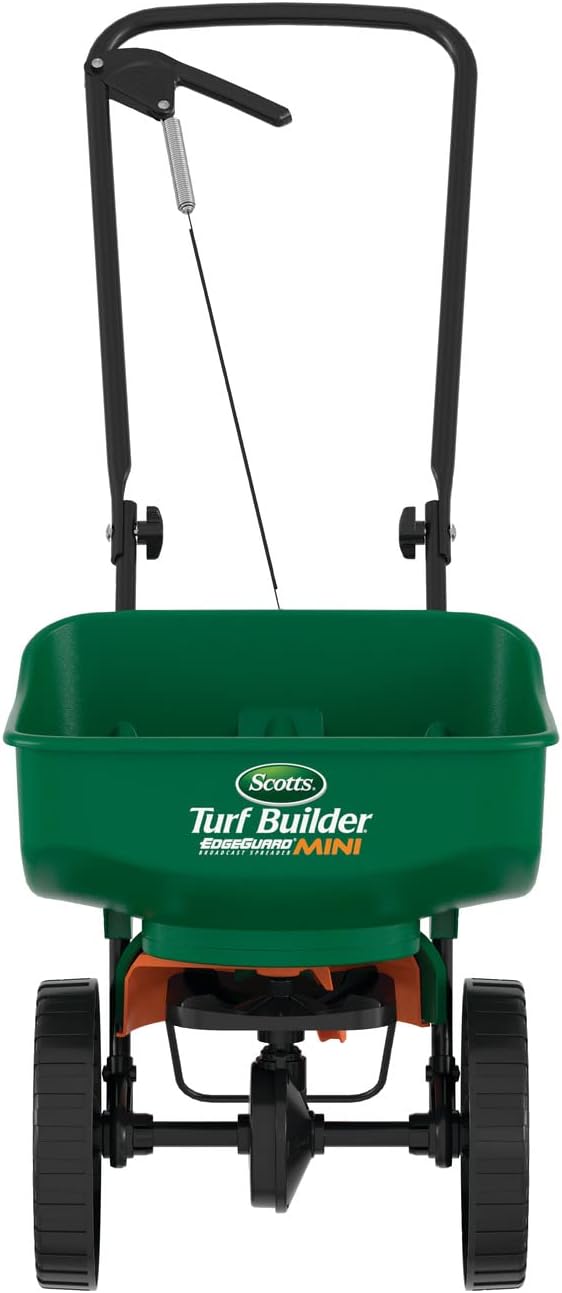
Scotts Turf Builder EdgeGuard Mini Broadcast Spreader
| Capacity | Up to 5,000 sq. ft. |
|---|---|
| Pre-calibrated | Yes |
| Uses | Fertilizer, grass seed, granular weed control, salt, ice melt |
The Scotts Turf Builder EdgeGuard Mini is a small, ready-to-use broadcast spreader made for treating lawns up to about 5,000 sq ft. It comes pre-calibrated so you set the rate dial to the product recommendation, pour in fertilizer, seed, or ice melt, and walk at a steady pace to get even coverage. Notable features are the EdgeGuard side shield that blocks product from driveways and sidewalks, a curved hopper and dual-bladed agitator for consistent flow, and open-spoke wheels that roll across typical yard terrain. The fold-down handle makes storage simple. Practical benefits include reduced waste on non-lawn areas, smoother product distribution compared with hand spreading, and year-round use for deicing. Limitations are its small capacity and compact footprint, which means more frequent refills and a shorter comfortable run length than larger tow or push models, and the manual operation requires a consistent walking speed for best results.
Best for: Homeowners with small to medium lawns who prioritize predictable, low-mess application and want a straightforward tool backed by a well-known lawn-care brand.
Less Ideal for: Large properties, commercial landscapers, or users who prefer motorized or tow-behind spreaders for longer runs and higher capacity.
- EdgeGuard side shield prevents product from landing on driveways and sidewalks
- Pre-calibrated settings and rate dial for easy setup with Scotts products
- Curved hopper and dual-bladed agitator provide smoother, more consistent flow
- Fold-down handle and compact design for convenient storage
- Smaller capacity means frequent refills on anything larger than a small yard
- Manual broadcast pattern requires steady walking speed for uniform coverage
Verdict: Choose this compact EdgeGuard spreader if you want an easy, low-mess way to apply granular lawn and deicing products on small yards.
Scotts Whirl Hand-Powered Spreader

| Capacity coverage | Up to 1,500 sq. ft. |
|---|---|
| Material | Metal, Plastic |
| Handle material | Rubber |
| Additional features | Adjustable Arm Support, Smooth Even Coverage |
The Scotts Whirl is a compact, hand-powered spreader built for small yards and spot treatment. It comes ready to use and holds enough product to cover roughly 1,500 square feet, so it is convenient for overseeding patches, applying fertilizer in targeted areas, or spreading ice melt on walkways. The Whirl delivers smooth, even coverage thanks to its engineered hopper and agitator, and an adjustable arm support plus a rubber handle make it comfortable to hold during short jobs. Because it is hand-powered and lightweight, it is easy to maneuver into tight spaces and requires no setup or power source. The main limitations are its small capacity and manual operation, which make it less efficient for larger lawns or long continuous runs compared with wheeled broadcast or drop spreaders. For routine spot work and seasonal small‑area tasks it simplifies accurate application, but expect to refill more often if treating anything beyond a small yard.
Best for: Buyers who prioritize a simple, low-effort tool for targeted lawn care and winter walk‑way treatments and who want predictable, easy-to-control application in small yards.
Less Ideal for: Homeowners with medium to large lawns or those who need fast coverage over extensive areas should consider a wheeled broadcast or larger-capacity spreader instead.
- Ready to use out of the box with no assembly required
- Engineered hopper and agitator for smooth, even product distribution
- Adjustable arm support and rubber handle improve comfort for short jobs
- Lightweight and easy to maneuver into tight spots
- Small capacity suited to areas up to about 1,500 sq. ft., requiring frequent refills for larger jobs
- Hand-powered operation is slower than wheeled or powered spreaders for big lawns
Verdict: A compact, no‑fuss handheld spreader that gives accurate, comfortable application for small yards and spot treatments.
Choosing the Right Garden Spreader: Key Factors to Consider
Spread Pattern Consistency
How evenly a spreader distributes seed or fertilizer determines the health and appearance of a lawn or bed. Uneven patterning creates streaks or concentrated strips that lead to patchy growth or burned areas when using fertilizer. Look for spread mechanisms and chute designs that produce a uniform fan and allow overlap control so you can walk or tow at a steady pace without worrying about missed bands.
Consistency matters more with fine seeds and salt-based fertilizers because small differences in particle landing can compound across a whole yard. For targeted repairs or striping, choose a spreader with narrower, well-controlled output; for broad coverage, a wider, even fan reduces pass overlap time and effort.
Hopper Capacity
Hopper size affects how often you stop to refill during a job. Larger hoppers reduce interruptions for bigger lawns or municipal-style tasks, while smaller hoppers are lighter and easier to maneuver for raised beds, patios, or spot work. Consider the typical product you apply: heavy granular fertilizers fill the hopper weight quickly, so a mid-size hopper with sturdy supports may be preferable.
Balance capacity with transport and storage. A very large hopper can make the unit awkward for tight garden paths and increases empty weight when moving it around the yard. Match hopper volume to the scale of the chores you do most frequently to save time without sacrificing control.
Flow Control and Calibration
Precise flow adjustment and an easy calibration method matter because product labels list application rates you need to follow. A good spreader has clear, repeatable settings and a mechanism that resists clogging when using damp or variably sized granules. Calibration features let you verify actual output at chosen settings so you do not under- or over-apply material.
Look for indexed dials, simple shutoff gates for transport, and instructions for measuring pounds per pass. Flow control also affects how fine the spread is; smaller openings and slower walking speeds work better for delicate seed, while wider openings are useful for coarse rock salt or large granules.
Durability and Materials
Garden spreaders live outdoors and see exposure to corrosive fertilizers, sun, and wet conditions. Components like the hopper, frame, axle, and wheels should use corrosion-resistant metals or robust plastics. Reinforced axle mounts and sealed bearings lengthen service life and reduce wobbly spreading patterns caused by bent parts.
Consider maintenance needs as part of durability: easily removable hoppers, replaceable tires, and accessible grease points for bearings extend usable life. If you store the unit outdoors or in an unheated shed, choose materials and finishes that tolerate temperature swings and dampness without degrading quickly.
Ease of Use and Transport
How easy a spreader is to push, tow, lift, or store affects whether you will actually use it for routine tasks. Ergonomic handle height, tire size that handles grass and rough terrain, and a simple hookup for towing behind a small ATV or mower matter for efficiency. Lightweight units shine for small, tight gardens, while towable units offer speed and stability for larger properties.
Also think about storage footprint and disassembly. Foldable handles or detachable hoppers make putting a spreader away easier. Controls should be reachable from the walking or towing position so you can adjust settings on the fly without interrupting work.
Choosing Between Walk-Behind and Tow-Behind Spreaders
Walk-behind spreaders are ideal for small to medium yards and raised beds where maneuverability matters. They let you control speed and overlap precisely by foot traffic and are generally lighter to lift into tight storage spaces.
Tow-behind spreaders are built for larger lawns and commercial-style tasks. Their larger hoppers and wider spread patterns cut job time but require a vehicle or mower to move efficiently. Consider whether you have tow points on your existing yard equipment before choosing this style.
- Walk-behind: great for precision and small areas
- Tow-behind: better for large acreage and heavy-duty use
- Consider storage space and transport method before deciding
Matching Spread Width to Task
A wider spread width covers more ground per pass but increases the risk of overspray into beds or planting areas. Narrower widths let you treat targeted strips and avoid damaging sensitive plants.
If you alternate between lawn and garden beds, choose a spreader with an adjustable deflector or a way to reduce spread width so you can switch tasks without swapping tools.
- Wide spread: faster on open lawns
- Narrow spread: better for beds and edges
- Adjustable deflectors add versatility
Maintenance Tips to Prolong Service Life
Rinse the hopper and spread mechanism after each use to remove residual fertilizer and seed. Allow all parts to dry before storing to minimize corrosion and clumping.
Inspect tires, axle mounts, and calibration parts seasonally. Replace worn bearings and tighten fasteners to keep the spread pattern stable and predictable.
- Rinse and dry after use
- Seasonal inspection of moving parts
- Store in a dry, sheltered spot when possible
Best Practices for Accurate Application
Calibrate with a measured test strip before treating the whole yard. Walk or tow at a steady pace, overlap passes slightly, and keep settings consistent to match labeled application rates.
Avoid using damp granules that can clump and clog the flow gate. If conditions are wet, wait for drier hours or break up clumps before filling the hopper.
- Do a test calibration pass
- Maintain steady speed and overlap
- Use dry, free-flowing product when possible
How We Chose the Best Garden Spreader
We focused on the practical traits that make a garden spreader useful in real outdoor work rather than marketing claims. Key evaluation criteria included spread pattern consistency, which affects how evenly seed or fertilizer lands; hopper capacity, which determines how often you refill during larger jobs; flow control and calibration accuracy, for matching application rates to product labels; build materials and axle/wheel design, which influence durability and ease of towing or walking; and cleanup and maintenance needs, since residual fertilizer and wet conditions are common in gardens. Products were excluded if they lacked clear flow adjustment, had no method for changing spread width, or used materials prone to rapid corrosion in outdoor storage. We also filtered out units intended only for very narrow uses such as hand-held spot applicators when the goal was general-purpose lawn and bed spreading. The result is a set of spreaders that score well on measurable, gardener-relevant dimensions and suit a range of scales from small yards to larger properties.
FAQ
How often should I calibrate my garden spreader?
Calibrate at the start of each season and any time you change product type or hopper settings. A quick test run on a measured strip verifies actual application and helps avoid over- or under-treatment.
Can I use the same spreader for seed and fertilizer?
Often you can, but clean the hopper thoroughly between uses to avoid cross-contamination. Some fine seeds require smaller openings or special screens to prevent damage or uneven distribution.
Is a plastic hopper durable enough for regular fertilizer use?
High-density plastic hoppers can be durable and corrosion-resistant, but check mounting strength and axle support. For heavy, frequent fertilizer use, reinforced frames and metal axle components increase longevity.
What tire type is best for rough or uneven yards?
Larger, pneumatic tires or wide-tread wheels offer smoother rolling and better traction on uneven turf. Solid plastic wheels are low maintenance but can struggle in soft or bumpy ground.
How do I prevent clogging when using damp materials?
Sift or break up clumps before filling the hopper, use a larger flow setting, and avoid overfilling. Drying product briefly in a sunny spot can also help if conditions allow.
Final Verdict
Choose a garden spreader by matching spread width and hopper capacity to the scale of your tasks, and prioritize reliable flow control so you can follow application labels accurately. Expect tradeoffs: lighter walk-behind units offer precision and maneuverability, while larger tow-behind units save time on big lawns but need more storage and a towing vehicle. Focus on consistent spread pattern, corrosion-resistant materials, and easy calibration to get the most reliable results across seasons.
