

Note: This article contains affiliate links. If you click on these links and make a purchase, I may earn a small commission at no extra cost to you. This helps support my research and content. Read my full affiliate disclosure here.
Picking the right garden sprinkler system matters because irrigation affects plant health, water use, and your weekly chores. The wrong layout or head type can leave dry spots, waste water, or require frequent adjustments. This guide looks at five carefully shortlisted garden sprinkler systems suited to typical residential lawns, mixed beds, and small vegetable plots. We evaluate each option for how evenly it waters, how durable and weather-resistant components are, and how easy the system is to install and maintain. Read on for practical signals to watch for when you compare layouts, head styles, and control options before you invest in a system.
Top Picks at a Glance
| Best Overall The best all-around choice for most situations | Bonviee 230 ft Drip Irrigation Kit with Quick-Connect Tubing and Adjustable Emitters |  |
| Best Value The sweet spot between price and what you get | MIXC Drip Irrigation System Kit, 230 ft with Quick-Connect Tubing and Adjustable Emitters |  |
| Best Budget The cheapest option that still gets the job done reliably | LZMYIVE 50 ft 360° Adjustable Drip Irrigation System Kit with 15 Copper Nozzles |  |
| Highest Rated A top-rated pick with lots of positive feedback | MIXC 320 ft Drip Irrigation Kit with Brass 2-Way Splitters and Stake-Mounted Tees |  |
| Best Seller A high-volume bestseller chosen again and again | Eden Weighted Essential Oscillating Sprinkler with Quick Connect Starter Set |  |
Bonviee 230 ft Drip Irrigation Kit with Quick-Connect Tubing and Adjustable Emitters
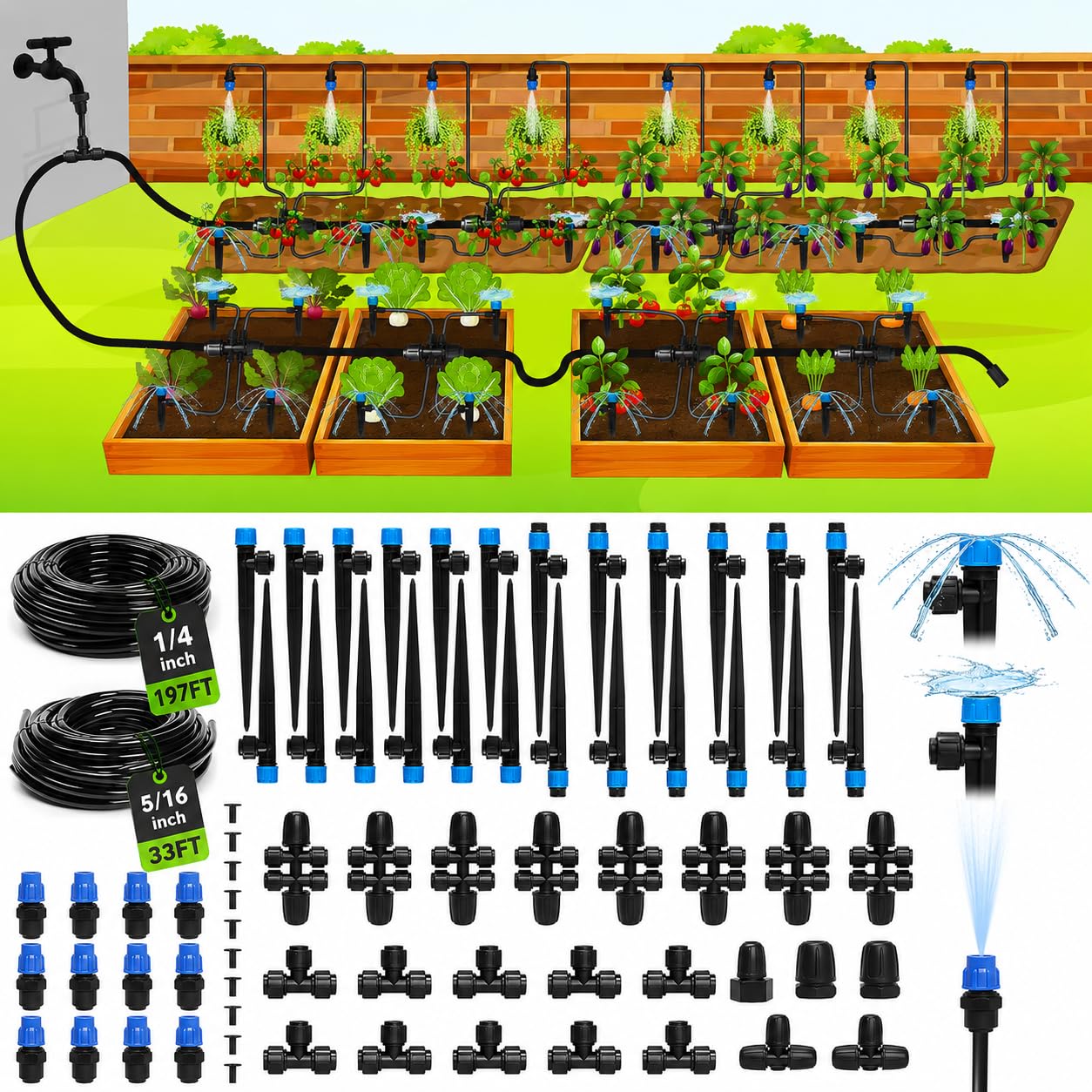
| Hose Length | 230 feet |
|---|---|
| Power Source | Water Pressure-driven |
| Special Features | Automatic Watering |
| Fit Type | Push-to-Connect, Flexible Tubing |
| Included Components | Main line, 1/4" tubing, connectors, emitters |
This Bonviee kit supplies a full 230 feet of tubing (33 ft of 5/16" mainline plus 197 ft of 1/4" distribution tubing) with quick-connect fittings and adjustable emitters so you can build a custom layout for raised beds, containers, or a small greenhouse. It uses water pressure so no pump or electricity is needed, and the push-to-connect design lets you assemble the system by hand in minutes without special tools. The included adjustable stake sprayers and multiple emitter types let you dial flow for different plants, which is handy in mixed vegetable beds. Because the kit follows standard 1/4"/5/16" sizing you can expand later with common parts or attach a hose timer with an adapter. Expect plastic tubing and fittings that are lightweight and easy to route but require careful securing and winter storage to avoid sun or freeze damage. Installation is straightforward, but you will want to plan emitter spacing and test water pressure to avoid uneven flow across long runs.
Best for: Gardeners who want a straightforward, low-effort irrigation solution for raised beds and container plots and who prioritize easy installation and the ability to tune flow by plant.
Less Ideal for: Large-scale lawns or properties needing high-pressure or commercial-grade components; users seeking a fully automated system without buying a separate timer or regulator.
- Complete kit with 230 ft of tubing and 65 pieces for building a full-system layout
- Quick-connect push-to-connect fittings speed installation and reduce leaks
- Adjustable emitters and multiple nozzle types let you tailor flow for different plants
- Compatible with standard 1/4" and 5/16" components for easy expansion or repairs
- Components are plastic and may degrade if left exposed to sun or freezing conditions
- No built-in timer or pressure regulator included so you may need adapters or extras for precise automation
Verdict: A ready-to-build, easy-install drip kit that lets raised-bed gardeners quickly set up and customize efficient, plant-by-plant watering.
MIXC Drip Irrigation System Kit, 230 ft with Quick-Connect Tubing and Adjustable Emitters

| Hose Length | 230 feet |
|---|---|
| Size | 33FT main + 197FT 1/4" tube |
| Control Type | Automatic |
| Power Source | Water Pressure-driven |
| Special Features | Quick Connector Technology |
The MIXC 230 ft drip irrigation kit supplies a full DIY system for watering beds, containers, and small lawns by turning a garden faucet into a pressure-driven, automatic micro-irrigation network. It includes a 33 ft 1/2" mainline, 197 ft of 1/4" branch tubing, multiple emitter types, tees, barbed fittings and a faucet adapter so you can lay out a main hose and branch off to up to 32 emitters. The quick-connect technology and push-fit barbed parts make assembly straightforward and reduce leak points, and adjustable emitters let you change flow patterns from drips to sprays for different plants. Practical benefits include time savings versus hand-watering, flexible layouts for raised beds or potted plants, and the ability to fine-tune delivery to individual plants. Limitations to expect are the plastic construction, which will wear faster than premium materials in harsh sun or freezing conditions, and the need to plan pressure and emitter placement for even coverage rather than relying on a single layout to work everywhere.
Best for: Gardeners who want a practical, ready-to-install drip system to replace frequent hand-watering and who value components that make fast, adjustable layouts for beds and containers.
Less Ideal for: People seeking heavy-duty, long-lasting commercial-grade materials or systems sized for very large agricultural acreage.
- Complete kit that includes both 1/2" mainline and 1/4" distribution tubing plus fittings for a full layout
- Quick-connect fittings simplify assembly and reduce common leak points
- Adjustable emitters and three emitter styles let you tailor flow and spray pattern to different plants
- Designed to run automatically using water pressure so it eliminates frequent manual watering
- Plastic tubing and fittings may degrade faster under prolonged sun exposure or freezing temperatures
- Performance depends on correct pressure and layout planning to avoid uneven watering
Verdict: A practical, all-in-one drip kit that gets a small garden or group of planters on automatic watering quickly with easy-to-connect parts and adjustable emitters.
LZMYIVE 50 ft 360° Adjustable Drip Irrigation System Kit with 15 Copper Nozzles

| Size | 50 feet |
|---|---|
| Number of Pieces | 28 |
| Power Source | Water Pressure Driven |
| Special Features | 360° Adjustable Nozzles |
| Material | Copper |
This LZMYIVE kit provides a practical, low-cost way to set up targeted irrigation for raised beds and small garden plots. The kit includes a 50 foot hose, 15 copper nozzles with 360 degree adjustment and a range of snap-in connectors, nails and ties so you can run lines along bed edges, hang them in a greenhouse, or position emitters beside individual plants. No electricity or complex plumbing is needed because it runs on normal water pressure and the brass nozzles let you choose drip, spray or mist patterns and finely tune flow by the faucet. Installation is straightforward with the provided quick-connect tees, hose cutter and tape, and the metal nozzles should hold up better than plastic options. Limitations are that the kit is sized for small to medium beds only and you may need additional tubing or connectors for larger layouts, and water pressure at your spigot will affect reach and uniformity.
Best for: Gardeners on a tight budget who want an easy, no-fuss irrigation solution for small to medium raised beds or greenhouse benches and prefer durable metal nozzles over inexpensive plastic.
Less Ideal for: Those planning large multi-bed installations or drip systems requiring precise pressure regulation and professional-grade flow control should consider more scalable irrigation systems.
- 360° adjustable copper nozzles let you direct water precisely to plants
- Runs on household water pressure so no electricity or pumps required
- Comes with snap-in connectors, nails, ties and hose cutter for quick installation
- Includes multiple nozzle modes (drip, spray, mist) to match different plant needs
- 50 foot kit may be too short for larger raised-bed layouts without extra tubing
- Performance depends on household water pressure which can limit spray distance
Verdict: A budget-friendly, ready-to-install 50 ft kit that delivers targeted, adjustable watering for small raised beds using durable copper nozzles.
MIXC 320 ft Drip Irrigation Kit with Brass 2-Way Splitters and Stake-Mounted Tees

| Hose Length | 320 feet |
|---|---|
| Included Components | 320ft tubing, 2 brass 2-way splitter, 40 nozzles, 20 tee, 20 tee-stake, ties, stakes, 8 end plugs |
| Special Features | Leak Resistant, Stake-mounted tees, Solid Brass 2-Way Splitter |
| Fit Type | Quick Connect |
| Material | brass, plastic |
This MIXC 320 ft kit supplies a complete drip system for large vegetable beds, raised planters, and landscape strips by providing two 160 ft tubing runs, brass 2-way splitters, and a mix of standard and stake-mounted tees. It uses quick-connect fittings and stake-integrated tees to speed installation and allow layout flexibility for scattered containers or rows. The solid brass splitters and copper adjustable nozzles improve outdoor durability and reduce the common failure point of plastic connectors, while the 360 degree nozzles let you switch between drip and fine mist for seedlings or established plants. Practical limits to note are pressure and spacing: the manufacturer recommends no more than about eight nozzles per 50 ft of tubing and modest spacing to avoid low downstream pressure, so very large or high-flow layouts may require an added main line or a second kit. Installation is tool-free but does require planning and careful push-in seating of tubing to avoid leaks.
Best for: Gardeners who need a robust, low-maintenance irrigation solution for large beds and value durable connectors and flexible emitter placement when reliability matters most.
Less Ideal for: Those with very small patios or a few potted plants who would be better served by a compact kit or single-line emitter system, and users who want an out-of-the-box automatic schedule without buying a timer.
- Large 320 ft coverage suitable for big gardens or multiple beds
- Solid brass 2-way splitters resist corrosion and reduce leaks compared with plastic fittings
- Stake-mounted quick tees let you place emitters directly in soil for flexible layouts
- Quick-connect system speeds installation and is tool-free
- Adjustable copper nozzles offer 360 degree spray control from drip to mist
- Performance depends on following pressure guidelines so very dense nozzle layouts can reduce downstream flow
- Does not include a timer so automated schedules require an additional controller
Verdict: Choose this kit if you need a large-coverage drip system built with durable brass fittings and flexible stake-mounted tees for reliable long-term irrigation.
Eden Weighted Essential Oscillating Sprinkler with Quick Connect Starter Set

| Maximum Pressure | 60 psi |
|---|---|
| Maximum Flow Rate | 30 gpm |
| Nozzle Count | 16 precision nozzles |
| Coverage | Up to 3,600 sq. ft. |
The Eden Weighted Essential Oscillating Sprinkler delivers steady, even watering across mid‑to‑large lawns and garden beds up to about 3,600 square feet. It mounts on a weighted base so it stays put while a sealed turbo drive motor oscillates a bar with 16 precision nozzles for consistent spray distribution. Sliding range tabs let you limit how wide the spray is, and a built‑in nozzle cleaning tool helps clear clogs without disassembly. The included quick connect starter set and stainless steel filter washers simplify hookups and let you swap tools without shutting off the water. In practice this model is quiet, simple to position, and keeps water patterns uniform on level turf. Expect best results on relatively flat lawns where the coverage matches the stated footprint; very large properties will need multiple units or a different sprinkler type to avoid gaps. The unit is plastic, so durability under heavy seasonal use may lag behind metal alternatives, but the design and filters reduce maintenance and leaks for routine garden watering needs.
Best for: Buyers who want a reliable, easy‑to‑use sprinkler that produces uniform coverage for medium to large lawns and value social proof and low maintenance features when choosing a dependable product.
Less Ideal for: Not a great choice for very large estates or professional irrigation needs where metal, higher‑capacity, or multi‑zone systems are preferred.
- Even coverage from 16 precision nozzles for consistent watering patterns
- Weighted base provides stability during operation
- Adjustable range tabs allow precise area control to target lawns or beds
- Quick connect starter set and stainless steel filters simplify hookups and reduce leaks
- Built‑in nozzle cleaning tool makes maintenance fast and simple
- Plastic construction may wear faster than metal sprinklers under heavy seasonal use
- Coverage limited to about 3,600 sq. ft., so large properties may need multiple units
Verdict: A user‑friendly oscillating sprinkler that combines even coverage, a stable weighted base, and quick‑connect hookups for dependable mid‑sized lawn watering.
Choosing the Right Garden Sprinkler System: Key Factors to Consider
Coverage Pattern and Head Types
How sprinkler heads spray water determines where moisture lands and how uniform that moisture is across the lawn or planting area. Rotors, impact heads, and spray heads each produce different patterns and distances; choosing the right head type for turf, beds, or narrow strips reduces overlaps and dry patches.
Consider arc adjustability, throw distance, and spread width when matching heads to zone shapes. Heads with fine adjustment features let you dial in close fits to sidewalks and beds without overspray. Matching nozzle options to water pressure is also important because incorrect nozzles will reduce uniformity and increase run time.
System Layout and Zoning
Zoning divides your landscape into manageable areas with similar water needs and sun exposure. Proper zoning avoids running turf heads with low-volume drip or bed heads on the same zone, which causes under- or over-watering. Think about slope, soil type, and microclimates when grouping areas.
Plan piping paths and valve locations to minimize trench length while keeping valves accessible for maintenance. Shorter runs help retain pressure and reduce friction loss, improving performance of sprinkler heads at the far end of a line.
Water Supply and Pressure Compatibility
Available flow rate and static pressure determine what head types and how many nozzles can run on a single zone. Many residential systems are limited by municipal supply or a well pump; matching head flow to available gallons per minute prevents weak spray and skipped coverage.
Measure actual pressure and flow before finalizing layout. If pressure is marginal, use low-flow nozzles or reduce the number of heads per zone. Pressure-regulating fittings and pressure-compensating nozzles can stabilize delivery and protect delicate nozzles from high-velocity wear.
Controller Options and Automation
Controllers range from simple mechanical timers to smart controllers that adapt schedules based on weather, soil moisture, or local restrictions. A controller that is easy to program and that offers seasonal adjust or sensor inputs reduces manual changes and water waste.
Consider whether the controller supports multiple programs and multiple start times, and whether it can integrate a rain sensor or soil-moisture probe. For gardeners who want minimal intervention, look for models with simple zone naming and clear backup power options.
Materials, UV Resistance, and Freeze Protection
Plastic and metal components vary in how they handle sun exposure and temperature swings. UV-stabilized plastics and corrosion-resistant metals last longer in direct sun and humid conditions. For climates with freezing winters, components that are easy to drain or designed for winterization simplify seasonal shutdown.
Check how unions, valve boxes, and quick-connects perform when exposed to repeated wet-dry cycles. Replaceable nozzles and accessible valves reduce the need to excavate if a part fails.
Maintenance Access and Parts Availability
Systems that allow you to reach valves, filters, and common fittings without extensive digging save time and money over the system lifetime. Standardized fittings and widely available replacement nozzles mean you can repair heads in a single weekend without special ordering.
Look for systems with clear service documentation, simple access risers, and modular components. Filters and pressure-regulating parts that can be cleaned or swapped in place make routine upkeep straightforward and keep downtime low.
Planning a Simple Layout for a Small Lawn
Start by sketching the lawn and fixed features like beds, driveways, and patios. Divide the space into zones based on plant type and sun exposure rather than arbitrary grid squares. For small lawns, aim for one to three zones that balance head spacing with available flow.
Place heads to create head-to-head coverage where each head overlaps the spray of its neighbor. This overlap evens out water distribution and reduces watering time. Use spray heads for short distances and rotors for longer runs to match throw distance to the zone size.
- Measure available flow and pressure before planning zones
- Prefer head-to-head spacing over trying to stretch coverage
- Keep valve boxes accessible near borders or walkways
Adapting a System for Vegetables and Mixed Beds
Vegetable plots and perennial beds often require gentler, lower-volume delivery than turf. Consider separate zones for beds and use lower-pressure spray or micro-spray heads to avoid foliage disease and soil compaction. Drip lines remain the best option for many intensive beds because they deliver water to the root zone directly.
If you must use sprinklers over vegetables, shorten run times and water early morning to reduce leaf wetness duration. Use adjustable heads or convert head stations to micro-spray outlets with adapters so you can fine-tune coverage without reworking the pipe layout.
- Separate beds from turf on different zones
- Favor low-angle, low-volume heads near edible crops
- Schedule beds earlier in the day for quicker leaf drying
Winterization and Seasonal Care
In climates with freezes, seasonally draining or blowing out lines prevents frost damage to pipes and heads. If you do not use compressed-air blowout, install drain valves and remove backflow devices that require winter storage. Labeling valve boxes and using removable risers simplifies off-season maintenance.
During the growing season, inspect heads for clogs, broken nozzles, and misalignment at least twice. Replace or clean nozzles and check for leaks around fittings. A short monthly check prevents small issues from becoming larger failures that require trenching.
- Install accessible drain points for winter draining
- Inspect and clean nozzles and filters regularly
- Label valves to speed winterization and repairs
Maximizing Water Efficiency
Use controllers with multiple start times and seasonal adjustment to reduce run times during cooler months. Integrate rain sensors or soil-moisture sensors to prevent unnecessary cycles after storms. Group plants with similar water needs to avoid overwatering drought-tolerant areas.
Think about irrigation timing and run short cycles with soak periods for clay soils to reduce runoff. For slopes, cycle-and-soak schedules let water infiltrate without creating erosion.
- Use sensor inputs to suspend cycles after rainfall
- Implement cycle-and-soak on clay or sloped areas
- Group plants by water needs to avoid mixed-zone waste
Troubleshooting Common Problems
Weak spray at the far end of a zone usually signals pressure loss or too many heads on the zone. Measure flow and redistribute heads or split the zone into smaller sections if needed. Clogged nozzles show reduced pattern or uneven spray and are often fixed by removing and soaking the nozzle.
Overspray onto paths and driveways is solved by adjusting arc and radius where possible, or by shifting head placement slightly away from edges. For unpredictable heads that pop up unevenly, check for debris in the riser or damaged seals and replace pop-up mechanisms if they fail to seat properly.
- Test individual heads to find weak or clogged units
- Adjust arc and radius before moving head locations
- Split zones when flow or pressure cannot reach all heads
How We Chose the Best Garden Sprinkler System
We focused on features gardeners actually use when installing and living with a lawn or garden sprinkler system. Our selection criteria prioritized irrigation coverage patterns and uniformity because even distribution prevents stress on turf and ornamentals. Durability and materials were considered to assess how components resist UV, corrosion, and freeze-thaw cycles over multiple seasons. Ease of installation and repair was a major filter so systems that require minimal trenching, offer clear layout options, or use common fittings were preferred. Controller flexibility and scheduling options were evaluated for how well they support seasonal adjustments, water restrictions, and rain-sensor integration. Finally, maintenance needs and parts availability were weighed to reduce long-term upkeep time. We excluded highly specialized commercial irrigation gear, temporary single-spray garden hoses, and systems that require professional-only installation. The shortlisted systems represent practical homeowner-friendly solutions that balance coverage, weather resistance, and straightforward servicing. The scoring labels below reflect the exact dimensions we judged when comparing the options.
FAQ
How do I know how many zones my garden needs?
It depends on flow rate, head type, and plant water needs. Measure available gallons per minute and group areas with similar needs. If heads cannot run with adequate pressure across a planned circuit, split the area into additional zones.
Can I install a sprinkler system myself?
Often yes for straightforward residential layouts using shallow trenches and common fittings. Complex pipe sizing, backflow prevention, or large zones may require professional input. Choose a DIY-friendly system if you prefer to avoid specialty tools.
Should I use drip irrigation in beds instead of sprinklers?
Usually for vegetables and densely planted beds, drip is more efficient because it delivers water to roots and reduces foliage wetness. Sprinklers are better for turf and broad coverage. Consider hybrid systems that combine drip for beds and sprinklers for lawn.
What maintenance does a sprinkler system need each season?
Regular tasks include checking and cleaning nozzles and filters, testing valves, and inspecting for leaks or misaligned heads. Before winter, drain or blow out lines in freezing climates. Seasonal checks reduce costly repairs and maintain uniform coverage.
How can I reduce water waste with my sprinkler system?
Use a controller with sensor inputs, group plants by water needs, and schedule watering for early morning. Fixing leaks, replacing worn nozzles, and using cycle-and-soak programming on slopes or clay soils also reduce runoff and waste.
Final Verdict
When choosing a garden sprinkler system, prioritize coverage uniformity, material durability, and how the layout matches your water supply. Decide whether beds and turf should be on separate zones and pick heads that match throw distance and nozzle flow to prevent dry patches and run-off. Balance controller features and ease of servicing with how much hands-on management you want. A thoughtful layout that accounts for pressure limits and seasonal needs will pay dividends in healthier plants and lower water use. Focus on systems that simplify maintenance, permit straightforward winterization, and offer accessible replacement parts so you can maintain reliable irrigation year after year.
