

Note: This article contains affiliate links. If you click on these links and make a purchase, I may earn a small commission at no extra cost to you. This helps support my research and content. Read my full affiliate disclosure here.
Persistent bindweed can choke grass, create bare patches, and make mowing harder. Choosing the right herbicide matters because treatment timing, application method, and selectivity determine whether you remove the vine without harming desirable turf. This guide covers five top options for bindweed in lawn that passed our shortlist for efficacy and turf safety. We evaluate how quickly they control regrowth, how they interact with common turfgrasses, and practical application tips for real yard situations. Read on to understand the tradeoffs so you can match an approach to your lawn and maintenance plan.
Top Picks at a Glance
| Best Overall The best all-around choice for most situations | PBI/GORDON Trimec Lawn Weed Killer, 1 Gallon |  |
| Best Quality Built to a higher standard if you want something more solid | Syngenta Tenacity Turf Herbicide, 8 oz |  |
| Best Value The sweet spot between price and what you get | Image Herbicides Liquid Weed Killer Concentrate for Southern Lawns, 32 oz |  |
| Best Budget The cheapest option that still gets the job done reliably | Spectracide Weed Stop for Lawns Concentrate, 32 oz Ready-to-Spray | 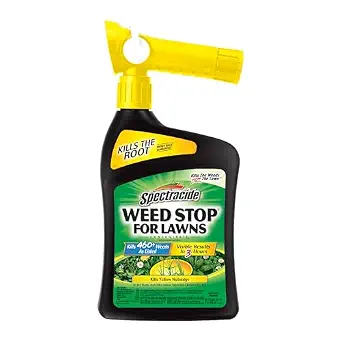 |
| Best Seller A high-volume bestseller chosen again and again | Ortho WeedClear Weed Killer for Lawns with Comfort Wand, 1 gal. | 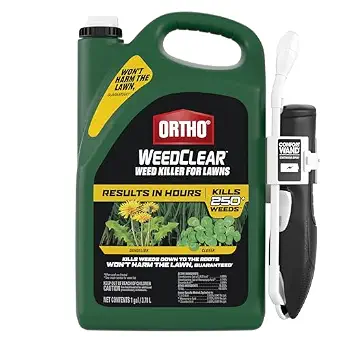 |
PBI/GORDON Trimec Lawn Weed Killer, 1 Gallon

| Item Form | Liquid |
|---|---|
| Coverage | 32000 to 64000 square feet |
| Liquid Volume | 1 gallons |
| Active Ingredients | Trimec |
PBI/GORDON Trimec is a concentrated liquid herbicide designed to control a wide range of broadleaf weeds across turf. It is typically mixed by the ounce per gallon according to whether you have a northern or southern lawn and applied as a uniform spray with a fan nozzle or hose-end sprayer. The formula is a three-way Trimec blend that the manufacturer says controls over 230 broadleaf species and is labelled for common turf grasses including Kentucky bluegrass, fescues, perennial rye and Bermuda grass. The one-gallon concentrate covers a large area, which makes it economical for treating medium to large lawns or spot-treating recurring patches. Important practical points are safety and application care: the product can harm desirable plants if it drifts, requires protective clothing during handling, and must be mixed per label rates for safe results. For persistent or deep-rooted weeds like bindweed, repeated targeted applications and good timing will improve control because systemic uptake can be slower than with annual broadleaf weeds.
Best for: Homeowners who want a versatile, economy-minded herbicide to manage a wide range of broadleaf weeds across an average to large lawn and who will follow label mixing and safety directions.
Less Ideal for: Gardeners who need a selective product labeled specifically for delicate ornamentals or those seeking a fast-acting contact-only herbicide for annual weeds.
- Concentrated 1-gallon formulation covers a large area, making it cost-effective for medium to large lawns
- Three-way Trimec blend targets a broad spectrum of over 230 broadleaf weeds
- Labelled for use on common cool- and warm-season turf grasses when applied as directed
- Can be applied with common spray equipment including fan nozzles and hose-end sprayers
- Requires care to avoid spray drift that can damage ornamental plants and shrubs
- Not an instant knockdown for deep-rooted perennial weeds and may need repeated applications
Verdict: A cost-effective, broad-spectrum Trimec concentrate for homeowners wanting reliable control of common broadleaf lawn weeds across large turf areas.
Syngenta Tenacity Turf Herbicide, 8 oz
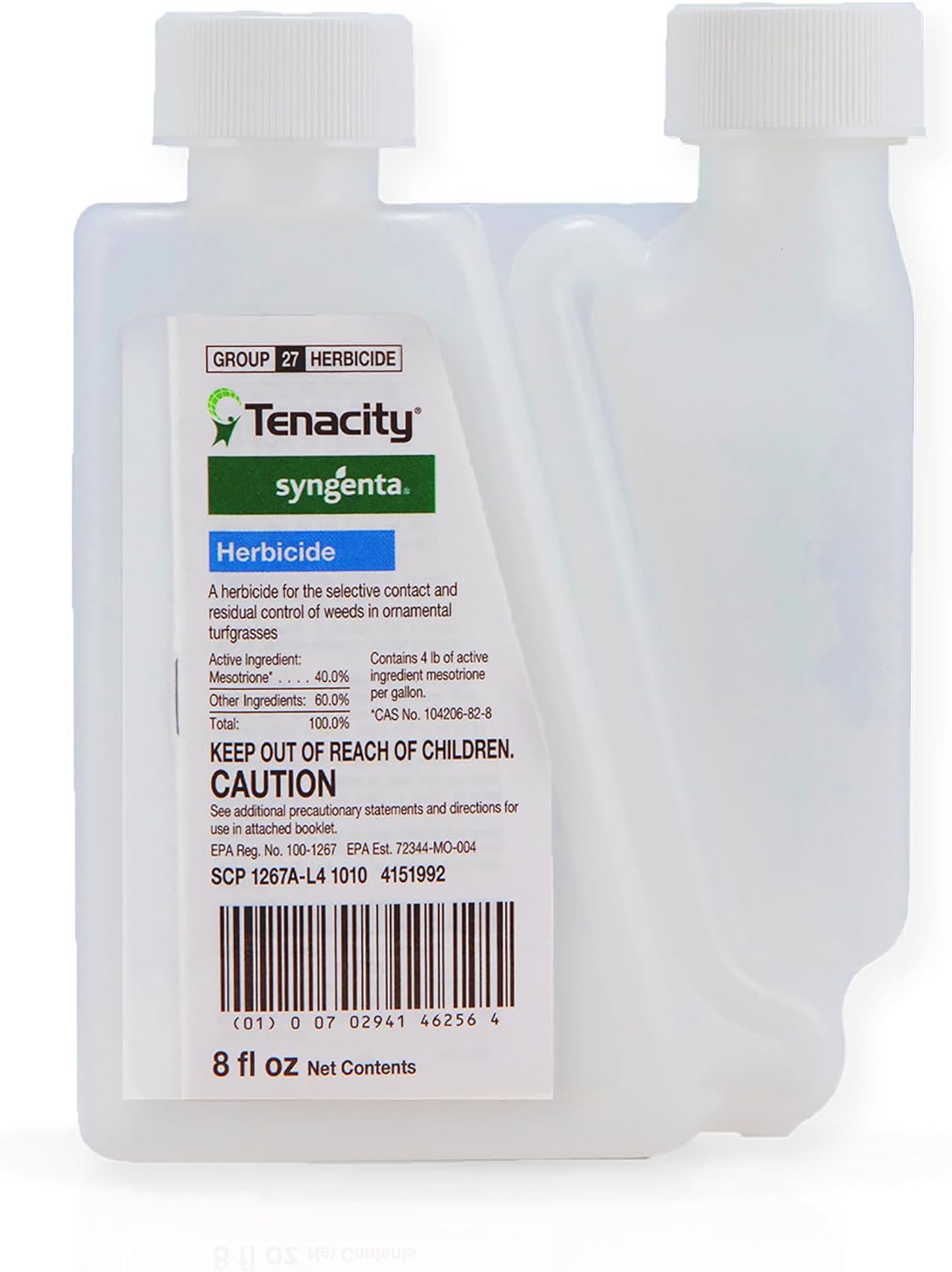
| Unit Count | 8 Fluid Ounces |
|---|---|
| Item Form | Liquid |
| Coverage | 2000 ft^2 per 1sp of product |
| Active Ingredients | Mesotrione |
Tenacity Turf Herbicide is a concentrated mesotrione-based liquid designed for both pre-emergent and post-emergent control of common lawn weeds including crabgrass, clover, chickweed and dandelions. You apply it diluted according to label rates with a handheld or hose-end sprayer to target problem areas or broadcast across the lawn; when used as a pre-emergent it is taken up as weeds emerge and when applied post-emergent it acts systemically for selective control. The product covers a large area per bottle and the active ingredient provides residual control so you can expect longer suppression than a contact-only herbicide. Important practical points are that it is turf-selective so follow the label for grass species and mixing instructions to avoid turf injury, and results can take several days to appear. Also this is a concentrated chemical intended for careful, measured application rather than spot-use by people who prefer non-chemical methods.
Best for: Gardeners focused on strong, reliable crabgrass and broadleaf weed control who are comfortable using concentrated herbicides and following label directions for turf safety.
Less Ideal for: People seeking organic, mechanical, or spot-only solutions or those unwilling to follow detailed mixing and application instructions should consider other options.
- Systemic mesotrione active ingredient controls both pre- and post-emergent weeds
- Selective to turf when used per label, allowing treatment without killing desirable grass species
- Concentrated 8 oz liquid provides wide coverage per bottle
- Provides residual suppression, reducing frequency of repeat applications
- Requires careful mixing and adherence to label for turf safety
- Not a non-chemical or organic option for weed control
Verdict: Choose Tenacity when you want a concentrated, turf-selective herbicide that delivers pre- and post-emergent control of crabgrass and other common lawn weeds.
Image Herbicides Liquid Weed Killer Concentrate for Southern Lawns, 32 oz

| Item Form | Liquid |
|---|---|
| Coverage | 5000 square_feet |
| Unit Count | 32 Fluid Ounces |
| Active Ingredients | Penoxsulam |
This Image Herbicides concentrate is a post-emergent liquid designed specifically for southern turfgrasses like St. Augustine, Floratam, Bermuda, centipede and zoysia. You mix the measured amount into a sprayer, apply evenly across the lawn and should see effects within hours on common broadleaf weeds such as dandelion, clover and chickweed. The product uses penoxsulam as the active ingredient and advertises coverage up to 5,000 square feet from the package volume. Practical benefits include a formulation tuned for warm-season grasses that claims to be safe when applied as directed and a fast-acting result on roots as well as foliage. Important limitations are that it is intended for use in spring or summer when temperatures are between about 45 and 90 F and it targets broadleaf weeds rather than grasses or all weed types. Like all concentrated herbicides it requires careful measuring and proper sprayer application to avoid off-target damage to desirable plants.
Best for: Homeowners with warm-season southern lawns who want a targeted, fast-acting solution for broadleaf weeds and prefer a concentrated product to treat multiple areas.
Less Ideal for: Gardeners needing a non-selective or grass-targeting herbicide or those with cool-season lawns should look for products formulated for their turf type or broader weed control needs.
- Formulated specifically for warm-season southern turfgrasses so less risk to those lawns when used correctly
- Fast-acting on broadleaf weeds with root-killing activity
- Concentrate format treats a large area from one bottle (coverage listed as 5000 sq ft)
- Not a non-selective or grass weed killer so it will not control grassy weeds
- Use window limited to warmer seasons and specific temperature range
- Requires accurate mixing and sprayer application to avoid harming nearby plants
Verdict: A concentrated, fast-acting broadleaf herbicide made for warm-season southern lawns that treats large areas when applied correctly.
Spectracide Weed Stop for Lawns Concentrate, 32 oz Ready-to-Spray

| Coverage | 8,000 square feet |
|---|---|
| Liquid Volume | 32 fluid ounces |
| Item Form | Liquid |
| Active Ingredients | 2,4-D, Mecoprop-P, Dicamba, Sulfentrazone |
Spectracide Weed Stop for Lawns is a hose-attach ready-to-spray concentrate designed to control broadleaf weeds across common turf types. It kills by contact and down to the root, listing over 460 weeds such as clover, dandelion and chickweed, and promises visible browning in around three hours. The QuickFlip sprayer makes treatment fast for larger yards and the formula is labeled for use on bluegrass, fescue, Bermuda and perennial rye, though you should avoid zoysiagrass coming out of dormancy and not spray above 90°F. Practical benefits include quick application without mixing and one-hour rainproofing so treatments are less weather-dependent. Important limitations are temperature restrictions for safe use, the need to keep people and pets off the lawn until dry, and the usual reseeding wait time of three to four weeks. For homeowners focused on routine clover control, this product offers a straightforward, time-saving option, but follow label directions closely to protect desirable turf and nearby plants.
Best for: Homeowners who want an inexpensive, no-mix solution to knock back clover and other broadleaf weeds quickly across a typical lawn and value fast application.
Less Ideal for: Gardens that need constant reseeding, very young lawns or yards with delicate ornamentals close to treatment areas should consider more targeted options.
- Ready-to-spray QuickFlip hose attachment speeds up application for medium to large lawns
- Kills broadleaf weeds including clover, dandelion and chickweed with visible results in about three hours
- Rainproof in one hour which reduces the chance of losing treatment to light rain
- Works on a variety of common turf types when used as directed
- Should not be applied when daytime temperatures exceed 90°F which limits use in hot weather
- Requires waiting 3–4 weeks before reseeding treated areas
Verdict: A convenient ready-to-spray concentrate that quickly controls clover and other broadleaf weeds for budget-minded homeowners who want fast, low-effort treatments.
Ortho WeedClear Weed Killer for Lawns with Comfort Wand, 1 gal.

| Unit Count | 128 Fluid Ounces |
|---|---|
| Item Form | Spray |
| Coverage | 16000 square feet |
| Kills listed weeds | 250+ weeds |
Ortho WeedClear is a 1 gallon ready-to-use weed spray formulated for lawn spot and small broadcast treatments. It combines three active ingredients to target broadleaf weeds and is labeled to control more than 250 species, including clover and dandelions. The included Comfort Wand gives a continuous, precise spray for spot application and makes it easy to treat patches without over-spraying surrounding grass. The formula shows visible decline in weeds within hours and becomes rainproof in about an hour once dry, so short windows between application and light rain are manageable. Practical benefits include simple application with no mixing for spot work, broad weed coverage, and guidance for mixing if you choose a wider broadcast treatment. Limitations to consider are that it is intended for actively growing weeds in spring or fall and is not a year-long preventative; repeated applications may be needed for persistent infestations. Also it contains synthetic herbicides, so follow label directions for safety around children, pets, and desirable plants.
Best for: Homeowners who want an easy, effective spot or small-area solution for common lawn broadleaf weeds and prefer a simple applicator for precise treatment.
Less Ideal for: People seeking a seasonal one-time preventer for long-term control or those who want an organic or non-chemical alternative for clover management.
- Targets over 250 common broadleaf lawn weeds including clover and dandelion
- Comfort Wand provides precise continuous spray for targeted spot treatment
- Ready-to-use formula needs no measuring for spot application
- Rainproof within one hour after drying for quicker windows between treatment and weather
- Not formulated for year-long weed prevention so recurring treatments may be required
- Contains synthetic active ingredients that require careful handling and adherence to label safety instructions
Verdict: A user-friendly ready-to-use weed spray with a comfort wand that makes quick, precise control of clover and other broadleaf lawn weeds straightforward and effective.
Choosing the Right Herbicide for Bindweed in Lawn: Key Factors to Consider
Mode of Action and Targeting
Understanding how a herbicide kills bindweed helps set expectations for control timelines and resistance management. Some active ingredients translocate into roots and will kill perennial vines more reliably, while contact-only chemistries brown foliage quickly but may not stop resprouting from deep roots.
Choose a product whose mode of action fits your long-term plan. If bindweed is established, a translocated systemic option reduces the number of repeat treatments. For light, isolated patches a contact spray can provide acceptable short-term control when followed by mechanical removal.
Turfgrass Selectivity
Herbicide labels indicate which turf species are tolerant and which are at risk. Lawn grass types vary in chemical sensitivity, so label compliance is essential to avoid widespread lawn injury.
Consider whether your lawn is cool-season or warm-season turf, and whether it contains desirable broadleaf ornamentals nearby. Spot-treating reduces exposure but requires careful shielding of adjacent plants. When in doubt, test a small area and observe for a week before broad application.
Application Method and Equipment
The way you apply a herbicide affects coverage, drift risk, and herbicide concentration on bindweed stems. Handheld sprayers are ideal for spot treatments; hose-end or pump sprayers speed up larger areas. Granular formulations can be simpler for uniform turf but may lack the precision of liquid spot sprays.
Check nozzle recommendations and maintain even coverage. For systemic products, thorough wetting of foliage without runoff is the goal. For contact products, ensure good leaf coverage, especially on morning or evening sprays to reduce evaporation and increase uptake.
Timing and Lawn Care Interactions
Timing applications to weed growth and lawn condition improves outcomes. Active, leafy bindweed in spring or early summer absorbs herbicide more effectively than dormant or stressed vines. Avoid treating drought-stressed turf because uptake and translocation can be reduced, increasing the chance of regrowth.
Coordinate herbicide timing with mowing, irrigation, and overseeding. Many labels advise delaying mowing for a few days before and after application to allow leaves to absorb the herbicide. Similarly, avoid heavy irrigation immediately after systemic treatments unless label directions permit.
Number of Treatments and Follow-Up
Bindweed often requires more than a single treatment because of deep, persistent root systems. Expect to make follow-up applications at intervals recommended on the label and to combine chemical control with cultural measures such as improved mowing height and manual removal of vines.
Plan for monitoring and retreatment, especially in the season following an initial knockdown. Some products offer residual control that suppresses new seedlings, while others rely entirely on contact activity and need repeated applications to reduce the population.
Environmental and Safety Considerations
Herbicide choice affects non-target plants, pollinators, and nearby water features. Read label restrictions about buffer zones near ponds, and avoid broadcast applications that risk runoff after heavy rain.
Use personal protective equipment as directed and store concentrates safely out of reach. If you have vegetable gardens, ornamental beds, or native plant patches nearby, choose selective or spot-treatment approaches to limit collateral damage.
When Spot Treatment Works Best
Spot treatment is the most precise option when bindweed appears in isolated patches or along fence lines. Handheld or pump sprayers let you hit only the vine growth and limit herbicide contact with turf and ornamentals.
This approach reduces the amount of chemical used and the risk to desirable grasses, but it requires careful application. Spray during calm conditions, wet foliage thoroughly but avoid runoff, and observe label waiting periods for mowing after treatment.
- Best for small, contained patches
- Requires thorough leaf coverage for systemic products
- Minimizes non-target exposure
Managing Large Infestations
For widespread bindweed across a lawn, broadcast approaches or strategic strip-treating along seedheads and perimeter areas can be more efficient. Granular options can simplify application but may not reach vine leaves as effectively as liquids.
When treating broad areas, plan for a schedule of repeat applications and post-treatment lawn care to repair any thin spots. Improving turf vigor after control reduces the chance of reinfestation by seedlings.
- Consider multiple passes and follow-up checks
- Coordinate with overseeding or aeration if turf thinning occurs
- Use conservative application rates to protect turfgrass
Integrating Cultural Controls
Chemical control is most durable when combined with cultural practices that favor turf over bindweed. Raise mowing height to strengthen grass, improve soil fertility through testing and appropriate fertilization, and maintain consistent irrigation schedules to reduce stress that gives bindweed an advantage.
Removing vines by hand after an initial chemical knockdown can help deplete root reserves over time. Persistent monitoring and quick removal of new shoots prevent the weed from reestablishing a foothold.
- Mow higher to shade out seedlings
- Correct soil fertility imbalances
- Pull or cut weakened vines after herbicide application
Safety and Timing Around Seeding or Sodding
If you plan to overseed or lay sod, check label restrictions about reseeding intervals. Some chemistries require waiting several weeks or months before establishing new turf to avoid interference with seed germination or young grass growth.
When renovating a lawn, you may choose to delay herbicide treatment until after new turf is established, or select products with shorter plant-back intervals. Always follow the label to prevent damage to new grass.
- Confirm reseeding wait periods on the label
- Delay treatment when planning immediate sod installation
- Use targeted methods to protect freshly planted areas
Dealing With Off-Target Damage
If non-target turf or ornamentals show injury after treatment, stop additional applications and irrigate per label guidance if recommended. Identify whether the damage came from spray drift, improper mixing, or treating stressed turf.
Recovery often requires reducing further chemical stress, giving the lawn time to regrow, and repairing with overseeding or topdressing as appropriate. Take steps to prevent recurrence by adjusting application methods or timing.
- Assess cause before additional treatment
- Follow label for post-application steps
- Repair injured turf using cultural methods
How We Chose the Best Herbicide for Bindweed in Lawn
We focused on products and formulations gardeners actually use against bindweed infestations in turf rather than general garden sprays. Our shortlist process prioritized demonstrated bindweed activity on perennial vining weeds, documented selectivity or labeled turf uses, and application versatility for common lawn care equipment. Key evaluation dimensions included speed of visible control, selectivity and turf-safety guidance, required application frequency, and label instructions about mowing and watering. We also weighed formulation type and ease of mixing because some lawns need spot treatments while others benefit from broadcast treatments. Excluded items were products without turf labeling, those intended only for non-lawn landscapes, and experimental mixes lacking clear safety data. The result is a set of options that balance effective bindweed suppression with practical lawn maintenance constraints.
FAQ
When is the best time of year to treat bindweed in lawn?
Treat when bindweed is actively growing and leafy, typically in late spring through summer. Active growth allows systemic herbicides to move into roots. Avoid treating during drought or extreme heat when uptake is reduced.
Will a single application get rid of bindweed permanently?
Often not. Because bindweed has deep perennial roots, multiple treatments and follow-up cultural controls are usually necessary to reduce the population over a season or two. Expect to monitor and retreat as needed.
Can I spot-spray bindweed near flowers and shrubs?
Yes, but take precautions. Use a shield or treat on calm days to prevent drift, and avoid contact with desirable broadleaf plants. Consider using low-pressure nozzles and targeted wand applications for precision.
How does mowing affect herbicide treatment?
Mowing can reduce foliage available to absorb herbicide, so many labels recommend avoiding mowing for a day or more before and after application. Follow label timing to ensure treated leaves can take up the chemical.
Will irrigation or rain wash away the treatment?
It depends on the product. Some systemic treatments require a dry period after application for uptake, while others tolerate light watering. Check label instructions and avoid heavy irrigation or rain events immediately after application when the label advises against it.
Are granular herbicides effective on bindweed?
Granular products can simplify broad applications but may not provide the same foliage contact needed for systemic uptake. They can be useful for preventing seedling establishment but are often combined with targeted liquid treatments for established vines.
Final Verdict
Choose a herbicide strategy that matches the extent of your bindweed problem and the type of turf you have. For isolated patches, precise spot treatments minimize risk to desirable grass and nearby plants. For larger infestations, plan for multiple treatments and integrate cultural steps that strengthen turf so it can outcompete returning weeds. Prioritize products and timing that offer systemic action for perennial roots when long-term control is the goal and follow label directions closely to protect lawn health and the surrounding landscape.
