

Note: This article contains affiliate links. If you click on these links and make a purchase, I may earn a small commission at no extra cost to you. This helps support my research and content. Read my full affiliate disclosure here.
A homeowner wood chipper makes quick work of branches and pruning waste so you can keep a small yard tidy without constant trips to the curb. Choosing the right chipper matters because size, feed method, and maintenance needs determine how often you can use it and how much post-work effort a job creates. This guide covers seven shortlisted homeowner wood chippers that fit common small-property scenarios, from infrequent pruning sessions to regular brush cleanup. We evaluate each option on measurable garden-focused criteria like cutting capacity, portability, and upkeep demands to help you pick the model that matches your routine and physical space. Read on to see how we judged these chippers and what matters most for safe, efficient yard work.
Top Picks at a Glance
| Best Overall The best all-around choice for most situations | SuperHandy 7HP 3-in-1 Wood Chipper Shredder Mulcher (3" Max) |  |
| Best Quality Built to a higher standard if you want something more solid | EFCUT C40 4" Wood Chipper, 9 HP 274cc Gas-Powered |  |
| Best Value The sweet spot between price and what you get | Landworks Rotor Wood Chipper Shredder Mulcher, 3" Max Capacity, 7 HP |  |
| Best Budget The cheapest option that still gets the job done reliably | Westinghouse Corded Electric 1.7-Inch Wood Chipper Shredder with 12‑Gallon Collection Bag |  |
| Highest Rated A top-rated pick with lots of positive feedback | Steelite 15‑Amp Electric Wood Chipper with 45L Collection Bag |  |
| Most Popular A crowd favorite that many people choose with confidence | Sun Joe CJ603E Electric Wood Chipper Shredder (15-Amp, 1.7" Cutting) |  |
SuperHandy 7HP 3-in-1 Wood Chipper Shredder Mulcher (3" Max)

| Power Source | gas_powered |
|---|---|
| Engine | 7HP Horizontal 4-stroke OHV |
| Max Branch Capacity | 3" diameter |
| Item Weight | 133.7 pounds |
The SuperHandy 7HP 3-in-1 Wood Chipper is built for homeowners and small-landscape jobs that need a single machine to chip branches, shred brush and mulch leaves. It uses a horizontal 4-stroke OHV gas engine with recoil start and accepts material through a top hopper for shredding, a side chute for 3-inch branches and an attachable vacuum inlet for leaves. The slanted housing is intended to reduce jams and the unit is EPA/CARB certified. In practice it will simplify yard cleanup by converting limbs and leaves into mulch or smaller chips you can compost or use as groundcover, and the tow bar option makes moving it easier if you have an ATV or small tractor. Important limitations are the recoil-only starting (no electric start), relatively small fuel tank and guidance to avoid certain materials like palm fronds, pine cones and vines that can jam the mechanism. Expect routine maintenance and safe operation practices since this is a gas machine with significant moving parts.
Best for: Buyers who prioritize a single, capable machine to handle routine heavy yard waste and prefer equipment with practical safety and emissions compliance; ideal for homeowners and small-scale landscapers who want to turn branches and leaves into usable mulch.
Less Ideal for: Users who need electric start convenience, commercial crews that process very large volumes daily, or anyone planning to chip atypical materials like palm fronds or stony debris.
- 3-in-1 intake options for chipping, shredding and vacuum mulching
- 7HP horizontal 4-stroke OHV gas engine suitable for residential heavy-duty jobs
- Slanted housing design to help reduce jams during operation
- EPA/CARB certification indicating compliance with emissions standards
- Recoil-only starting rather than electric start
- Not suitable for certain materials such as palm fronds, pine cones or vines which can jam the unit
Verdict: Choose this model if you want a versatile, EPA/CARB‑compliant 3‑in‑1 chipper that handles typical homeowner and small‑landscape debris up to 3 inches effectively.
EFCUT C40 4" Wood Chipper, 9 HP 274cc Gas-Powered
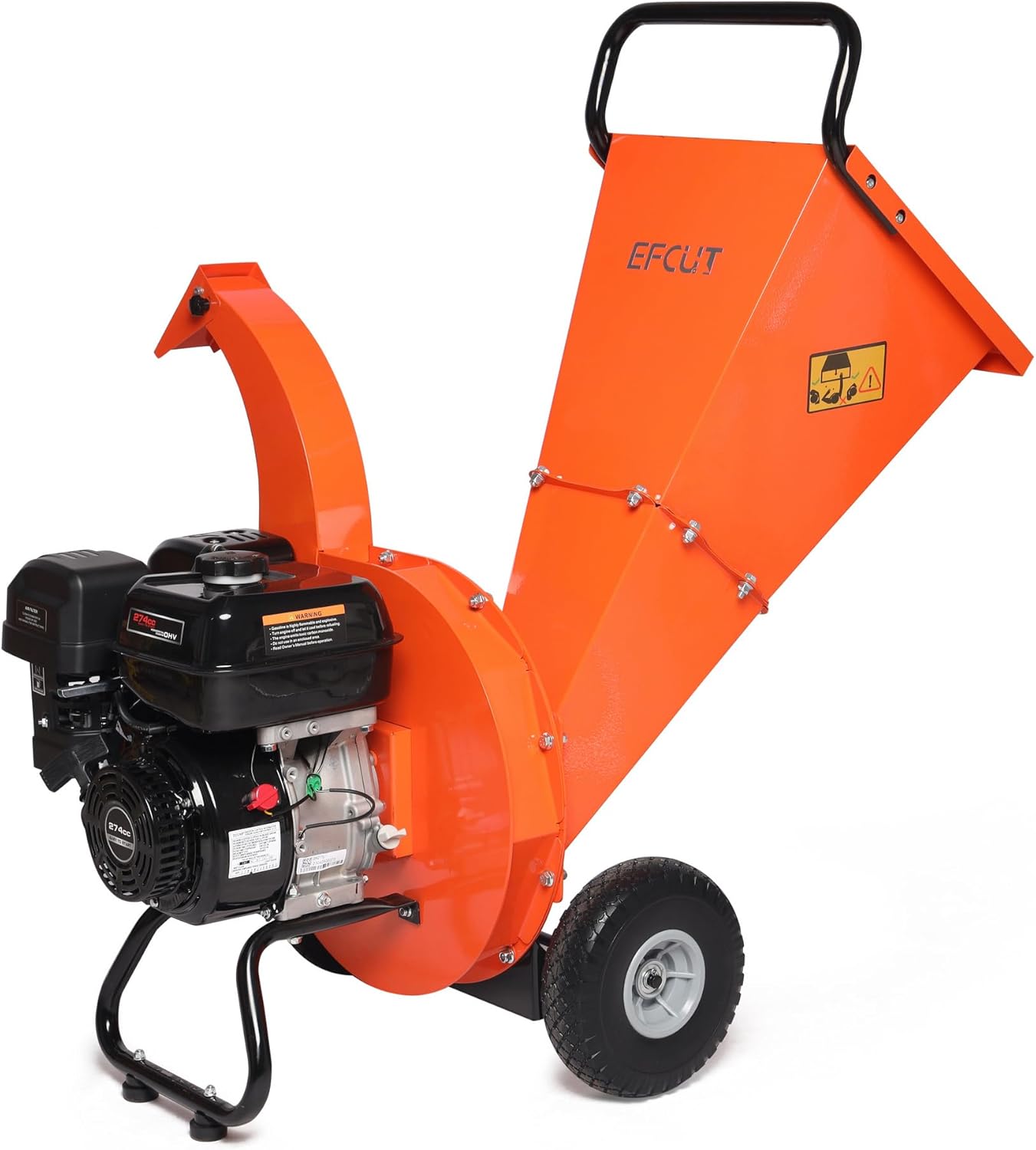
| Engine | 9 HP 274cc |
|---|---|
| Max chip diameter | 4 inch |
| Reduction ratio | 15:1 |
| Hopper opening | 13.6" x 12.2" |
The EFCUT C40 is aimed at homeowners who need a capable, performance-focused chipper for regular yard cleanup. It uses a 9 HP 274cc gas engine and a large flywheel to process branches up to 4 inches thick, converting yard waste into mulch with a high reduction ratio. The all-steel longer blades are made from high-speed steel for longer edge life, and the wide 13.6 x 12.2 inch hopper makes feeding quicker and less fiddly. Practical touches include airless dual-bearing wheels for easier moving, a 90-145° adjustable discharge chute to aim chips where you want them, and inspection windows for clearing jams and checking blade wear. Expect strong throughput and fewer blade changes compared with smaller, lower-powered models, but be prepared for the usual gas-engine upkeep and louder operation. Assembly and maintenance are straightforward if you follow the manual, and the chipper is built for heavy yard use rather than occasional light pruning jobs.
Best for: A homeowner who prioritizes shredding performance and needs to process medium to large branches regularly for mulch or waste reduction, and who is comfortable with gas-powered equipment upkeep.
Less Ideal for: Small-plot gardeners or users who only need occasional light chipping and prefer electric, quieter, lower-maintenance machines.
- Powerful 9 HP 274cc engine delivers high throughput for larger branches
- 4 inch max cutting capacity lets you process thicker limbs without pre-cutting
- High-speed steel blades are longer and designed to hold an edge longer
- Wide hopper and adjustable discharge chute speed feeding and placement
- Airless dual-bearing wheels improve transport and resist flats
- Gas engine requires regular maintenance and produces noise and emissions
- Relatively heavy and large for storage and single-person handling
- Not suitable for loose leaves, fresh greens, palm fronds, or vines that can jam
Verdict: Choose the EFCUT C40 if you want a homeowner chipper that reliably handles thicker branches and delivers high shredding performance for regular yard and landscaping work.
Landworks Rotor Wood Chipper Shredder Mulcher, 3" Max Capacity, 7 HP

| Power Source | Gas Powered |
|---|---|
| Horsepower | 7 hp |
| Item Highlight | Processes branches up to 3" at 3600 RPM |
| Model Number | GUO067-FBM |
The Landworks rotor wood chipper is a gas-powered, performance-focused machine designed to turn small branches and yard waste into chips and mulch. It uses a 7 HP horizontal 4-stroke OHV engine running up to 3600 RPM paired with a rotor reduction system to handle limbs up to 3 inches in diameter. Typical use is feeding twigs and small branches into the large hopper while the vertical discharge chute directs shredded material where you need it, with an adjustable guide for directional control. Notable features include high-speed steel blades, a compact reinforced frame for easier storage, 10 inch rear wheels for mobility, and service-friendly check windows for blade access. Practical benefits are fast throughput for medium-sized cleanup jobs and usable mulch output for beds or compost. Important limitations are that it is not intended for fresh greens, palm or pine cones and requires gas and routine maintenance including oil supply and blade care; the unit also produces normal gas-engine noise and emissions. Follow safety guidance and recommended fuel to avoid damage.
Best for: Buyers who prioritize performance and need a compact, gas-powered chipper to clear medium-sized branches and produce usable mulch for yard or compost work.
Less Ideal for: If you need a quiet electric option, plan to process very large logs, or only chip soft green waste and vines, consider other machines better matched to those tasks.
- Powerful 7 HP gas engine for steady throughput on medium-volume jobs
- Rotary reduction system (15:1) and HSS blades that process up to 3" branches
- Large extended hopper simplifies feeding larger volumes of yard waste
- Adjustable vertical discharge chute helps direct chips where you want them
- Mobility aided by durable 10" rear wheels for moving around the yard
- Not suitable for fresh green material, palm or pine cones and similar debris
- Requires gasoline, oil and regular maintenance and produces typical engine noise and emissions
Verdict: Choose this chipper if you want a compact, high-throughput gas unit that reliably processes up to 3" branches for fast yard cleanup.
Westinghouse Corded Electric 1.7-Inch Wood Chipper Shredder with 12‑Gallon Collection Bag

| Motor | 15A, up to 4000 RPM |
|---|---|
| Cutting capacity | Up to 1.8 inches |
| Blades | SK5 steel, dual |
| Collection | 12-gallon detachable bag |
This Westinghouse corded electric chipper is aimed at homeowners who need a practical, budget-friendly way to reduce yard waste. The 15A motor runs up to 4000 RPM and handles branches roughly 1.7 to 1.8 inches thick through a dual-hole hopper that accepts larger stems and finer twigs. Two SK5 steel blades do the cutting, while overload protection and a safety interlock help protect the machine and operator during use. A detachable push stick and a 12‑gallon collection bag simplify feeding and debris collection, and 7-inch wheels plus a light overall weight make it easy to move around the yard. Expect quick conversion of pruning debris into manageable chips for compost or mulching, but this is not intended for heavy commercial use or thick limbs above the specified capacity. Assembly and routine blade care are typical homeowner chores. For general seasonal cleanup and small-branch jobs it offers a cost-conscious combination of performance and convenience.
Best for: Homeowners who want an affordable, easy-to-move electric chipper for routine yard cleanup and converting pruning debris into mulch or compost material.
Less Ideal for: People who regularly need to process large logs or commercial volumes of woody debris should choose a heavier duty or gas-powered machine instead.
- Corded 15A motor with up to 4000 RPM handles small branches and twigs efficiently
- Dual-hole hopper accommodates both larger stems and finer material for flexible feeding
- Two SK5 steel blades provide clean cuts and are rust resistant
- Lightweight with 7-inch wheels and a detachable 12-gallon bag for easy mobility and cleanup
- Maximum branch capacity around 1.7–1.8 inches limits work on thicker limbs
Verdict: A budget-friendly, lightweight electric chipper that makes residential pruning and yard cleanup faster and simpler for typical homeowner needs.
Steelite 15‑Amp Electric Wood Chipper with 45L Collection Bag

| Motor | 15 Amp, up to 4000 rpm |
|---|---|
| Cutting diameter | 0.9 to 1.8 inches |
| Blades | Dual SK5 steel blades |
| Reduction ratio | 15:1 |
| Collection capacity | 45 L |
This Steelite electric wood chipper is designed for routine homeowner cleanup and compost prep, driven by a 15‑amp motor that reaches up to 4000 rpm and dual SK5 steel blades that handle branches from about 0.9 to 1.8 inches. Typical use is feeding trimmed twigs, small limbs, and some fresh leafy material into the hopper where the 15:1 reduction ratio turns many bags of debris into a single bag of mulch collected in the detachable 45L bag. Safety features such as a feeding paddle, safety interlock and overload protection make it straightforward to operate and restart if it trips. The polypropylene housing and IPX4 splash resistance help it tolerate outdoor conditions without a large price premium. Expect occasional cleaning of chips from the blade area after heavy use and avoid trying to process much thicker hardwood limbs. For homeowners who want a dependable, simple unit for pruning debris and composting input, this chipper balances performance, safety, and low maintenance.
Best for: Homeowners who prioritize a reliable, low‑fuss tool for regular pruning cleanup and compost prep and who need something that starts, runs, and restarts safely on a yard schedule.
Less Ideal for: People who need to process large diameter logs or heavy commercial volumes should look at larger gas or commercial chippers built for heavier duty workloads.
- 15‑amp motor with up to 4000 rpm provides consistent shredding power for typical yard branches
- Dual SK5 steel blades offer effective cutting and rust resistance
- 45L detachable collection bag reduces trips to dispose of debris and concentrates mulch
- Built‑in safety features including feeding paddle, safety interlock, and overload protection
- IPX4 splash resistance and polypropylene housing help protect the unit outdoors
- Maximum branch capacity of 1.8 inches limits use to small limbs and pruning debris
- May require periodic clearing of accumulated chips around blades after extended use
Verdict: A dependable, safety‑minded electric chipper that turns routine pruning and yard debris into mulch with minimal fuss for the everyday homeowner.
Sun Joe CJ603E Electric Wood Chipper Shredder (15-Amp, 1.7" Cutting)

| Power Source | Corded Electric |
|---|---|
| Cut Type | Cross Cut |
| Audible Noise | 94 db |
| Operation Mode | Manual |
| Built-In Media | Feeding Paddle, Hopper, 6 in Wheels |
The Sun Joe CJ603E is a homeowner-focused electric wood chipper and shredder designed for routine yard cleanup. It accepts branches up to about 1.7 inches in diameter and uses a 15-amp motor with cross-cut blades to reduce material into mulch suitable for composting or spreading. Typical use is feeding pruned branches, twigs, and leaves through the hopper while the integrated feeding paddle helps draw material into the cutting chamber; a forward and reverse switch helps clear jams. The unit is corded so it starts instantly with no fuel or emissions and includes a safety lock and hopper lock to stop the machine when opened. Practical benefits are low maintenance compared with gas models, quieter operation for neighborhood use, and 7-inch wheels that make it reasonably portable for moving around a yard. Limitations to expect are the restrictive 1.7-inch maximum branch size and the need for extension power outdoors, which means heavier pruning or larger limbs require a larger or gas-powered chipper.
Best for: Homeowners who want a low-maintenance, no-fuss machine for routine pruning, leaf cleanup, and small-branch mulching and who prioritize safety and quiet operation.
Less Ideal for: Landscape contractors or homeowners who regularly chip large-diameter limbs or need untethered operation should consider more powerful gas or commercial models.
- 15-amp motor and cross-cut blades effectively reduce small branches and leaves into usable mulch
- Corded electric power gives instant start with no fuel, emissions, or spark-plug maintenance
- Safety features include an integrated hopper lock and safety switch to stop operation when opened
- Forward and reverse switch and feeding paddle help clear jams and feed material reliably
- Compact, wheeled design is easy to move and store in typical home yards
- Maximum branch capacity is limited to about 1.7 inches, so larger limbs must be pre-cut or handled separately
- Requires a nearby power outlet or heavy-duty extension cord for outdoor use
Verdict: A user-friendly corded electric chipper that safely and quietly turns routine yard trimmings into mulch, ideal for risk-averse homeowners doing regular small-branch cleanup.
Choosing the Right Homeowner Wood Chipper: Key Factors to Consider
Cutting Capacity and Branch Diameter
Cutting capacity determines the largest branch the chipper can process in a single pass. For homeowners, most pruning and storm debris falls below a certain diameter, but underestimating capacity leads to frequent manual cutting and slower cleanup.
Measure your typical branch sizes before choosing. If you have mature trees or regularly remove storm-damaged limbs, opt for a chipper with a higher inch rating. Smaller-capacity machines are lighter and easier to store but will require you to pre-cut larger pieces, which adds time and physical effort.
Feed Method and Jam Resilience
Chippers use different feed systems: manual feed hoppers, gravity-fed chutes, or active rollers that pull material in. Active-feed systems reduce user strain and lower the risk of operator error, while gravity or manual hoppers are simpler but more prone to jams when processing springy or leafy branches.
Consider how often you want to intervene during a session. If you anticipate processing a mix of fresh, green wood and drier material, choose a design known for jam resistance or easy reverse/clear features. A forgiving feed system saves time and reduces the need for tools or disassembly during routine cleanouts.
Engine or Motor Type and Reliability
Power source affects starting behavior, ongoing reliability, and maintenance rhythm. Gas engines deliver strong torque for tougher wood but need seasonal maintenance, fuel care, and occasional carburetor service. Electric or battery options offer quieter operation and simpler upkeep but can be limited by feed capacity and run time.
Match the power type to how often and where you work. For infrequent, light pruning on a small property, electric models may be ideal. For larger branches or more frequent use, a gas engine with straightforward maintenance access will be more dependable over time.
Portability, Weight, and Storage Footprint
Homeowner chippers vary widely in weight and dimensions. Lighter models are easier to move around a yard, lift into a garage, or tow on a small trailer. Heavier units often offer higher cutting capacity but require a more permanent storage solution and may need vehicle towing.
Think about where you will store the chipper and how you will move it to work sites. Wheel kits, folding chutes, and compact profiles make a difference for one-person homeowners. If storage space is limited, prioritize designs with a smaller footprint and easy teardown for offseason storage.
Maintenance Access and Routine Upkeep
Regular maintenance keeps a chipper working safely. Look for easy access to blades, simple blade-change procedures, and plainly routed service points for oil, filters, and belts. Units that require disassembly for basic maintenance add time and deter regular care.
Evaluate whether you are comfortable performing blade sharpening, belt checks, and engine tune-ups or if you prefer a minimal-upkeep electric model. Clear instructions and accessible components reduce downtime and extend machine life.
Safety Features and Operator Controls
Because chippers handle fast-moving blades and heavy wood, safety features directly affect how confidently you can use the machine. Emergency stop switches, feed-shielding, and well-placed discharge chutes reduce the risk of kickback and accidental contact.
Good operator controls also include clear signage, intuitive reverse or jam-clear mechanisms, and secure feeding hoppers. Prioritize features that let you control material flow and stop the machine quickly if something goes wrong. Safer designs often lead to faster, less stressful sessions in the yard.
Best Uses for Different Home Properties
Not every homeowner needs the same capacity. Small urban lots with ornamental trees and light pruning debris often benefit from compact, electric or small-gas chippers that handle 1 to 2 inch branches smoothly. Suburban yards with a mix of mature trees and shrubs will usually need a chipper rated for 2 to 3 inch branches and a more robust feed system. Rural properties or yards with lots of storm exposure should favor higher capacity and a gas engine that can process larger limbs without frequent feeding.
- Urban yards: prioritize compact size, low noise, and easy storage.
- Suburban yards: balance cutting capacity with portability.
- Rural properties: favor higher inch capacity and stronger power sources.
Typical Maintenance Schedule for Homeowner Use
Establishing a simple maintenance rhythm prevents mid-season breakdowns. For gas units, check oil and air filters before each season, inspect belts and blades after heavy jobs, and sharpen or replace blades as cutting performance declines. Electric and battery models need less frequent mechanical attention but should have connectors and cooling vents kept clean and batteries stored per manufacturer guidance.
Regularly clear the feed path and discharge chute after each use to avoid material buildup and corrosion. Lubricate moving parts according to the manual, and keep a small toolkit and spare belt or blade on hand for common homeowner-level repairs.
- Season start: oil, filters, belts check for gas models.
- After heavy jobs: inspect blades and feed components.
- Offseason: proper fuel treatment for gas engines; battery storage per guidance.
Safe Feeding Techniques and Personal Protective Equipment
Safe feeding reduces jams and injury risk. Feed branches butt-first when possible to let the machine take the thicker end first, and avoid forcing oversized pieces into the hopper. Use a push stick or long wooden pole when needed to keep hands well away from the feed opening. Stand off to the side of the hopper so kickbacks, if any, are less likely to strike you.
Always use eye and ear protection. Leather gloves protect hands from splinters, and sturdy footwear helps when handling heavy debris. A clear workspace and a helper to manage long limbs improve both speed and safety.
- Feed butt-first to reduce jams.
- Use push tools instead of hands near the hopper.
- Wear eye, ear, and hand protection; sturdy footwear is recommended.
Disposal and Reuse of Chips in the Garden
Wood chips make excellent mulch and pathways when sized appropriately. Fine, uniformly chipped material breaks down faster and is better for mixing into compost or using around ornamentals. Coarser chips suit landscape pathways and weed suppression but take longer to decompose.
Consider the source of material. Pine and other resins may affect soil slightly while hardwood chips can be slower to break down but add lasting organic matter. Avoid using fresh chips against the trunks of young trees; let chips age slightly or keep a gap to prevent moisture trapping and bark damage.
- Fine chips: compost or use as planting-bed mulch.
- Coarse chips: pathways and long-term mulch.
- Keep chips off direct contact with tree trunks until settled.
How We Chose the Best Homeowner Wood Chipper
We prioritized models suited to small properties and homeowner tasks, focusing on real-world performance and upkeep rather than commercial specs. Selection began with designs intended for residential use, rejecting heavy-duty or landscape-contractor units that exceed typical homeowner needs or require commercial licensing. We inspected manufacturer-stated cutting capacities, feed systems, and power sources to ensure each candidate could handle the common branch sizes produced by typical pruning and storm cleanup. Key evaluation criteria included cutting capacity in inches, feed method and clog resistance, portability and storage footprint, engine or motor reliability for occasional use, and ease of routine maintenance such as blade access and debris clearing. Safety features like emergency stops and chute placement were also considered. We excluded units clearly sized for commercial workloads, specialty brush grinders, or models that demand professional installation. The resulting shortlist emphasizes practical, low-hassle chippers that match homeowner schedules and maintenance capabilities.
FAQ
What branch size can a typical homeowner wood chipper handle?
It depends on the machine, but most homeowner-grade chippers handle between 1 and 3 inches in diameter. Check the cutting capacity in inches and plan to pre-cut anything larger to avoid jams or excessive wear.
Are electric chippers as effective as gas models for yard cleanup?
Electric chippers are effective for light to medium pruning and are quieter with simpler upkeep. For larger branches or frequent heavy use, gas engines generally offer more torque and continuous power.
How often do blades need sharpening or replacement?
Frequency depends on usage and wood type. Light homeowner use might need blade attention once per season, while heavy or abrasive materials require more frequent sharpening. Inspect blades after major jobs and replace when they no longer hold a clean edge.
Can I use wood chips directly as mulch around plants?
Yes, but let very fresh chips age briefly or avoid direct contact with tree trunks. Fine chips work well in beds and compost, while coarser chips are better for paths and long-term mulching.
What maintenance should I do after each use?
Clear the feed and discharge path of debris, check for loose bolts, and inspect blades and belts for visible damage. For gas units, look for fuel leaks and keep the air intake clear.
Final Verdict
Choose a homeowner wood chipper that matches the size of branches you typically produce and the amount of upkeep you want to perform. Smaller, lighter models suit occasional pruning and tight storage, while higher-capacity units reduce pre-cutting and speed large cleanups at the cost of extra weight and maintenance. Prioritize cutting capacity, feed system design, and maintenance access when deciding. Balance portability and power against how often you will use the machine to arrive at a confident, practical purchase for your yard.
