

Note: This article contains affiliate links. If you click on these links and make a purchase, I may earn a small commission at no extra cost to you. This helps support my research and content. Read my full affiliate disclosure here.
Choosing the right Koi pond pump matters for water quality, oxygenation, and the long-term health of your fish and plants. A properly sized pump keeps filters working, prevents stagnant zones, and supports waterfalls or fountains without overworking equipment. This guide covers six shortlisted pumps selected for their suitability in Koi setups, and explains the practical tradeoffs of flow, head, reliability, and energy use. Below you will find evaluations based on performance in real pond conditions, ease of maintenance, and installation considerations so you can pick the pump that fits your pond's size and features.
Top Picks at a Glance
| Best Overall The best all-around choice for most situations | Alpine Corporation PAL3100 3100 GPH Submersible Pond Pump |  |
| Best Quality Built to a higher standard if you want something more solid | Aquascape AquaForce 1000 Solids-Handling Submersible Pond Pump |  |
| Best Value The sweet spot between price and what you get | VIVOHOME 100W 1600GPH Submersible Pond Pump |  |
| Best Budget The cheapest option that still gets the job done reliably | FREESEA 800 GPH Submersible Pond Pump, 45W Adjustable Flow |  |
| Highest Rated A top-rated pick with lots of positive feedback | OYO WATER PSA2400 2400 GPH Adjustable Submersible Pond Pump |  |
| Most Popular A crowd favorite that many people choose with confidence | VIVOSUN Submersible Fountain Water Pump (800 GPH, Adjustable Flow) |  |
Alpine Corporation PAL3100 3100 GPH Submersible Pond Pump

| Flow Rate | 51.6 gpm |
|---|---|
| Maximum Lifting Height | 21.5 feet |
| Power Source | Cord connected |
| Voltage | 120 volts |
| Horsepower | 276 watts |
The Alpine PAL3100 is a heavy-duty submersible pump aimed at maintaining circulation and supporting waterfalls in medium to large koi ponds. It moves up to 3100 gallons per hour using a 276-watt motor that runs quietly, so it preserves the peace around garden ponds while keeping water oxygenated. The unit supports vertical or horizontal placement, comes with multiple adapters and a 33-foot cord for flexible siting, and can lift water as high as 21.5 feet for multi-tiered waterfalls or elevated features. Its compact ABS housing makes it easy to tuck into skimmers or sumps without occupying much space. Expect reliable continuous flow suitable for aeration and filtration, but plan for routine maintenance to prevent clogging from debris since this is a general circulation pump rather than a dedicated debris-handling model. The included adapters and long cord simplify installation, though users who need very high-efficiency or specialized energy controls will need to look elsewhere.
Best for: Gardeners building or upgrading a medium to large koi pond who want strong, quiet circulation and the ability to run waterfalls without complicated installation.
Less Ideal for: Owners who need a pump built specifically for handling large solids, or those who require integrated variable-speed energy management should consider alternative specialized models.
- High maximum flow of 3100 GPH for strong circulation and aeration
- Quiet 276W motor suited to peaceful pond settings
- Multi-angle installation with multiple adapters and a long 33-foot cord for flexible placement
- 21.5-foot maximum lift supports multi-level waterfalls and elevated features
- Not specified as a dedicated debris-handling or vortex pump so larger solids may require pre-filtration or skimmer placement
- No integrated variable-speed controller for fine-tuning energy use and flow rates
Verdict: A strong, quiet all-purpose pond pump that delivers high flow and flexible installation for medium to large koi ponds and backyard waterfalls.
Aquascape AquaForce 1000 Solids-Handling Submersible Pond Pump

| Power Source | Corded Electric |
|---|---|
| Flow Rate | 4050 liters per hour |
| Maximum Lifting Height | 10 feet |
| Voltage | 120 volts |
| Horsepower | 55 watts |
The Aquascape AquaForce 1000 is built for dependable pond circulation and waterfall filtration where steady, high flow matters. It delivers up to 1,070 GPH with a 10 foot maximum head and uses an asynchronous, oil-free motor that runs quietly and with better torque than typical magnetically driven pumps. The protective pre-filter cage processes solids up to 1/4 inch, keeping the impeller clear and reducing routine clogging. Included threaded fittings, a rotational ball output and a wide flat base make positioning, plumbing and maintenance straightforward for both DIY pond owners and contractors. At 55 watts it is energy efficient for continuous-duty operation, and rubber feet reduce vibration and noise. The main limitations are the 10 foot head height if you need higher lifts and the lack of an adjustable flow feature on this model, so installations requiring long vertical runs or fine flow control will need additional fittings or a different model. For straightforward koi pond circulation, waterfalls and external filter feeds this pump performs reliably and economically.
Best for: Pond owners focused on reliable, high-flow circulation and low-maintenance operation for koi ponds, waterfalls, or external filters who value efficiency and quiet continuous duty performance.
Less Ideal for: Those building high-head installations, multi-level waterfalls, or systems that require precise, on-device flow adjustment should consider a pump with greater head capacity or an adjustable output.
- High flow up to 1,070 GPH suitable for medium-sized ponds and waterfalls
- Asynchronous oil-free motor provides strong torque, quiet operation, and better energy efficiency
- Protective pre-filter cage accepts solids up to 1/4 inch to reduce clogging and maintenance
- Rotational ball output and included plumbing fittings simplify installation and discharge positioning
- Maximum head height of 10 feet limits use on systems requiring higher vertical lift
- No built-in adjustable flow control for fine-tuning fountain or waterfall output
Verdict: Choose the AquaForce 1000 when you need an energy-efficient, solids-handling pond pump that delivers dependable high flow and quiet continuous operation for koi ponds and waterfalls.
VIVOHOME 100W 1600GPH Submersible Pond Pump

| Power | 100W |
|---|---|
| Output | 1600 GPH |
| Maximum Lifting Height | 15 feet |
| Power Source | ac |
| Material Type | PC+ABS |
The VIVOHOME 100W 1600GPH submersible pump is built for continuous pond circulation and small-to-medium water features. It moves a lot of water for its size and can lift water up to about 13.7 to 15 feet, so it suits koi ponds, waterfalls, fountains, and simple filtration setups. The unit includes two hose adapters and a five-position adjustable outlet so you can point flow where you need it, and the 20-foot power cord and four suction cups make placement flexible. Construction uses ABS with a ceramic shaft and silicon carbide drive ring for wear resistance, and the motor is epoxy sealed to IPX8 standards for reliable wet operation. It runs quietly and is relatively energy efficient for steady circulation, and the included filter bag helps keep large debris out. Limitations are typical of mid-range pumps: it is not intended for very large ponds or heavy pressurized filtration without pairing a larger unit, and the plastic housing requires basic seasonal maintenance to avoid clogging and premature wear.
Best for: Buyers who want a reliable, reasonably quiet pump to maintain circulation in a small-to-medium koi pond or run a modest waterfall while keeping energy use and setup fuss low.
Less Ideal for: Owners of large koi ponds, multi-stage pressurized filters, or installations requiring very high head and flow should choose a higher-capacity or purpose-built pump.
- High flow rate of 1600 GPH suitable for medium koi ponds, waterfalls, and fountains
- Adjustable 5-position outlet and two adapter sizes for versatile plumbing and flow direction
- Durable components including ceramic shaft and silicon carbide drive ring for extended service life
- IPX8 epoxy-sealed motor and included filter bag reduce water ingress and large debris entry
- Long 20.3 ft power cord and suction-cup base simplify placement and reduce vibration
- Not powerful enough for large ponds or heavy pressurized filter systems
- Plastic ABS housing may need regular cleaning to prevent clogging and wear
Verdict: A practical, energy-efficient choice for steady circulation in small-to-medium koi ponds and garden water features.
FREESEA 800 GPH Submersible Pond Pump, 45W Adjustable Flow

| Power Source | Corded Electric |
|---|---|
| Flow Rate | 13.33 gpm |
| Maximum Lifting Height | 10 feet |
| Voltage | 110 |
| Horsepower | 45 watts |
The FREESEA 800 GPH submersible pump is designed to circulate water in small backyard koi ponds, fountains, and garden waterfalls. It delivers up to 13.33 gpm (about 800 GPH) from a 45 watt motor, and the adjustable flow plus included nozzle fittings make it easy to set the output for a fountain, waterfall, or general pond circulation. Practical advantages are quiet operation and continuous 24/7 capability, so you can run it overnight without a disruptive hum. The pump includes suction cups and a side-suction design that lets you hide it underwater and mount it close to pond surfaces. Safety features such as dry-burn and overheat protection reduce the risk of motor damage if water levels drop. Expect straightforward maintenance because the product advertises tool-free disassembly for cleaning. Limits to consider are plastic construction and a modest maximum lift of 10 feet, so it is best for small ponds and low-head features rather than tall waterfalls or large pond turnovers. For budget-focused pond keepers who need reliable, quiet circulation, this pump covers core needs without extras.
Best for: Buyers on a budget who need a reliable, low-power pump to keep small koi ponds, fountains, or garden waterfalls circulating quietly and with minimal fuss.
Less Ideal for: People building larger ponds, heavy-flow filtration systems, or tall waterfalls that require higher head pressure should choose a more powerful, heavy-duty pump.
- High flow for wattage: ~800 GPH from a 45W motor provides efficient circulation for small ponds
- Adjustable flow and included 1/2", 2/3", 3/4" nozzles for easy tuning to fountains or waterfalls
- Ultra-quiet operation rated about 20 dB suitable for backyard use
- Built-in dry-burn and overheat protection increases safety and reduces risk of motor failure
- Tool-free disassembly and suction cups simplify cleaning and underwater installation
- Plastic housing may not be as durable as metal options for long-term outdoor exposure
- 10-foot maximum lift limits use on taller waterfall drops or higher-head systems
Verdict: A quiet, energy-efficient 45W pump that delivers strong circulation for small koi ponds and garden features without breaking the budget.
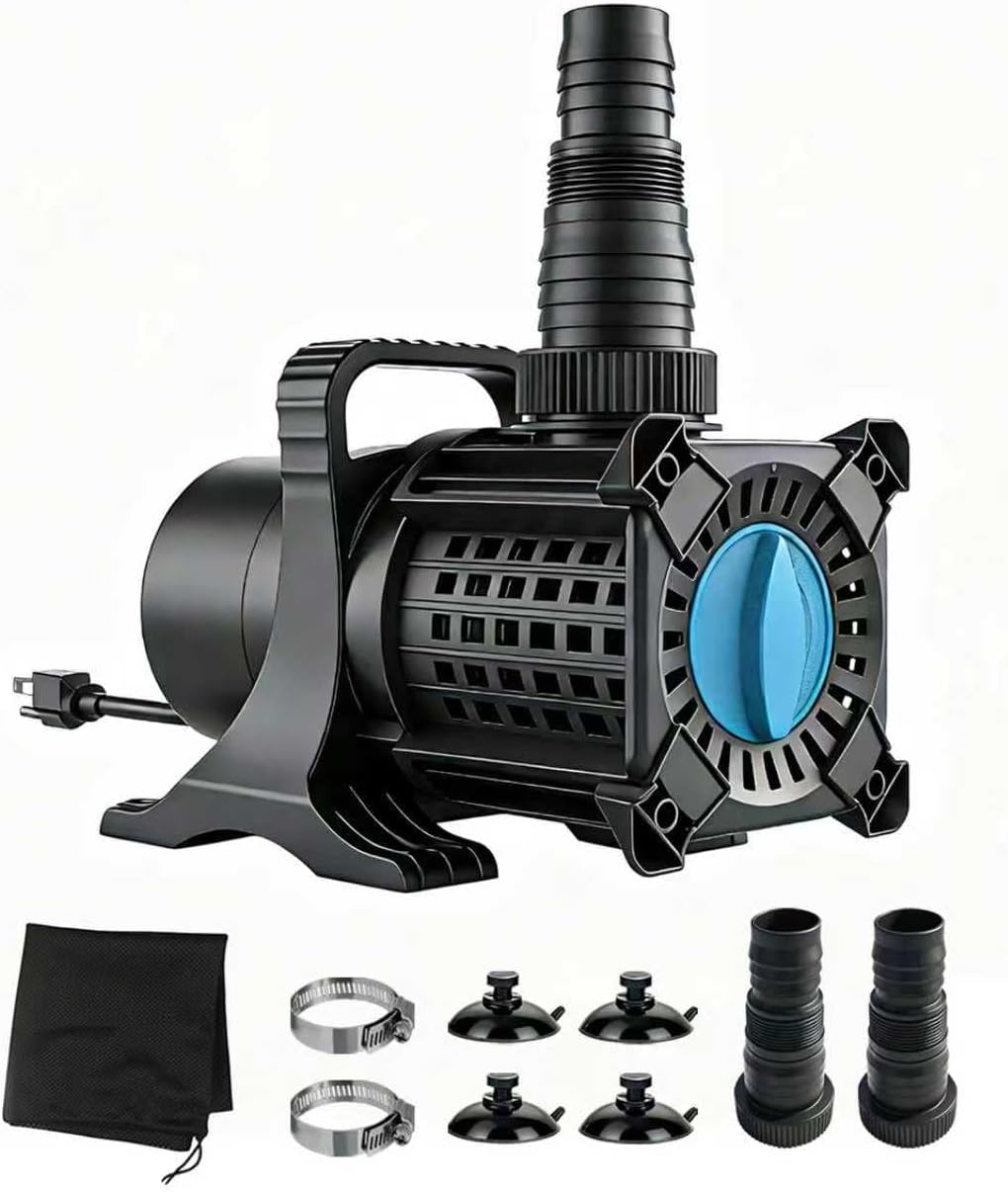
OYO WATER PSA2400 2400 GPH Adjustable Submersible Pond Pump
| Power Source | Corded Electric |
|---|---|
| Maximum Lifting Height | 16.5 feet |
| Horsepower | 180 watts |
The OYO WATER PSA2400 is a 2400 GPH-class submersible pump built for continual outdoor use in ponds, waterfalls, fountains, and irrigation. It delivers adjustable flow from a light trickle up to a strong surge so you can fine-tune circulation for koi ponds or water features without swapping pumps. The unit is UL listed and uses a copper motor with dry-burn protection, which helps prevent motor damage if water levels fall. Practical touches include a 20.3 foot power cord that reduces the need for extension cables, a mesh barrier bag and filter shroud to block debris, and multiple threaded adapters for common hose sizes so you can install it vertically or horizontally. In real use it promises quiet operation thanks to a ceramic shaft and epoxy-potted motor, but like many high-flow submersibles it will require occasional cleaning of the mesh bag and intake when working in debris-heavy environments. This pump is aimed at owners who prioritize dependable, continuous circulation and straightforward installation rather than ultra-compact or decorative units.
Best for: Koi pond and water feature owners who need a reliable, continuously running pump with safety features and adjustable flow for steady circulation and waterfalls.
Less Ideal for: Buyers wanting a tiny, decorative fountain pump or a completely maintenance-free unit should consider smaller low-flow models or external filtration systems instead.
- UL listed and copper motor with dry-burn protection for safer, longer operation
- Wide adjustable flow control (10%–90%) to match pond, waterfall, or irrigation needs
- 20.3 ft power cord gives flexible placement without extension cords
- Includes mesh barrier bag, filter shroud, and multiple hose adapters for debris protection and easy hookups
- Capable of submersible or inline orientation for versatile installation
- Requires periodic cleaning of the mesh bag and intake in dirty ponds
- Relatively large physical footprint may be less convenient in very compact setups
Verdict: Choose this pump when you want a robust, safety-focused pond pump with precise flow control and built-in debris protection for dependable koi pond circulation.
VIVOSUN Submersible Fountain Water Pump (800 GPH, Adjustable Flow)

| Flow Rate | 3000 liters per hour |
|---|---|
| Maximum Lifting Height | 10 feet |
| Power Source | ac |
| Horsepower | 0.07 hp |
The VIVOSUN 800 GPH submersible pump is a small, versatile unit aimed at moving a lot of water quietly in confined installations. It is typically installed fully submerged in ponds, fountains, aquariums, or hydroponic reservoirs and offers three nozzle options plus a control knob to tune flow to your feature. The pump delivers a high maximum flow rate and a claimed 10 foot maximum lift, so it can feed taller fountains or waterfall returns while its detachable design makes routine cleaning straightforward. Suction pads and multiple mounting positions let you set it flat, angled, or vertical to fit tight spaces. Because it runs on standard AC power and is made of plastic, it provides efficient circulation without complex hookups, but real-world flow drops as lift increases so you should match its performance to your pond return needs. For larger koi ponds or very long plumbing runs you may need a higher-capacity pond-specific pump with stronger head performance.
Best for: Buyers who want a compact, easy-to-install submersible pump for small to medium koi ponds, fountains, or pond returns and who value adjustable flow and low noise.
Less Ideal for: Owners of large koi ponds with long plumbing runs or high head requirements who need a heavy-duty pond pump built for continuous high-head operation.
- High maximum flow rate (800 GPH / 3000 L/H) suitable for strong circulation in small to medium features
- Adjustable flow control and three nozzle options for tailoring water pressure and spray patterns
- Detachable design and easy-to-clean components simplify maintenance
- Multiple mounting positions and suction pads allow flexible placement in tight installations
- Relatively quiet operation for use near living areas
- Plastic construction and household AC motor limit durability compared with dedicated pond/wet-end commercial pumps
- Actual flow falls significantly with increased lift so performance depends on plumbing layout
Verdict: A quiet, adjustable submersible pump that delivers strong circulation for small to medium koi pond setups where flexibility and easy maintenance matter most.
Choosing the Right Koi Pond Pump: Key Factors to Consider
Sizing: Flow Rate Versus Pond Volume
Flow rate is the core sizing factor for a Koi pond pump. Koi ponds typically need multiple full water turnovers per hour depending on stocking density, feeding, and filtration. Choose a pump whose flow at the pond's expected head will achieve target turnover without running at the edge of its performance curve.
A nominal pump rating at zero head is not useful on its own. Look for the pump's flow at the actual total dynamic head you will have after plumbing, filter resistance, and elevation of features. Oversizing a pump solely by nominal GPH can cause wasted energy and unnecessary water turbulence; undersizing risks poor filtration and low oxygenation.
Total Dynamic Head and Site Layout
Total dynamic head (TDH) combines vertical lift, horizontal pipe run, fittings, and filter resistance. Even modest vertical elevation for a waterfall or skimmer return can cut effective flow dramatically. Measure vertical distances and estimate losses from pipe length and elbows to determine realistic head.
A pump with a published performance curve lets you read expected flow at that head. Planning plumbing with appropriate diameter piping and minimizing sharp turns reduces head loss and lets a smaller pump deliver more useful flow, saving energy and reducing noise.
Continuous-Duty Motor Durability
Pond pumps usually run many hours each day year-round. Motors built for continuous duty handle heat and load better than intermittent designs. Look for motors with thermal protection and bearings rated for long life under wet or humid conditions.
Durability also includes shaft seals and impeller cages that resist debris impact. Pumps intended for pond use should tolerate small amounts of grit and plant material without seizing, and offer replaceable seals and impellers so you can service instead of replace the whole unit.
Energy Use and Operating Cost
Energy cost is a long-term expense for Koi ponds. A pump that moves water efficiently at the needed head will use less electricity than an oversized unit running flat out. Compare watts drawn to actual flow delivered at your TDH to estimate operating cost.
Consider variable-speed or multi-setting pumps if you run features that do not need full flow all day. Lower speed during quiet periods and higher flow during cleaning or feeding reduces cumulative energy use and can extend pump life.
Maintenance Access and Serviceability
Ease of cleaning and access to wear parts affects downtime and overall cost. Pumps that allow quick access to the impeller, have user-serviceable seals, and use common replacement parts simplify routine maintenance in a pond environment.
Consider how easy it is to remove debris, empty the strainer, and reassemble the pump without specialized tools. Units with clear installation instructions and simple clearances reduce the chance of incorrect reassembly after cleaning.
Materials and Corrosion Resistance
Pond pumps are exposed to wet conditions and often to mineral-rich water. Corrosion-resistant housings, stainless or coated shafts, and durable plastic impellers last longer in outdoor settings. Material choice also affects algae adhesion and cleaning frequency.
Seals, O-rings, and fasteners rated for UV and cold exposure prevent premature leaks or cracking. When pumps sit in colder climates, materials that tolerate freeze-thaw cycles reduce the risk of damage during winter.
Estimating Your Pond's Turnover Needs
Turnover rate depends on stocking and filtration type. A lightly stocked decorative Koi pond may require one turnover per hour, while heavily stocked ponds or those with active biological filtration often need two to four turnovers. Calculate pond volume in gallons and multiply by the desired turnovers per hour to arrive at the target gallons per hour at pump output.
Remember to read performance curves and convert pump output at published head to the flow you will actually see. It is better to size pumps around realistic operating points than nominal maximums.
- Measure pond volume: length × width × average depth.
- Decide desired turnovers per hour based on stocking density.
- Adjust target flow for filtration type and additional features.
Plumbing Choices That Preserve Flow
Pipe diameter, fittings, and valves all change how much head your pump must overcome. Larger-diameter piping reduces friction and preserves flow, especially for longer runs. Avoid unnecessary reducers and sharp elbows that raise head loss.
Use union fittings and rated flexible connectors where maintenance access is needed. Properly supported runs limit stress on pump outlets and make winter removal or servicing easier.
- Prefer smooth interior pipe for lower friction.
- Keep run lengths short when possible and minimize elbows.
- Match pump outlet size to plumbing to avoid bottlenecks.
Winter Care and Frost Protection
In cold climates, plan for winterizing pumps or choosing units rated for seasonal outdoor exposure. Some setups remove and store pumps indoors while others rely on freeze-tolerant installations with drainback and protection for exposed plumbing.
If you leave a pump in place, ensure it cannot draw air or run dry during freezes and that seals and plastics are rated for low temperatures to prevent cracking.
- Drain external plumbing before freeze periods.
- Consider a small heater or de-icer in critical areas to keep a hole for gas exchange.
- Test winter procedures before the first freeze to avoid surprises.
Noise, Vibration, and Mounting
Pumps can be a persistent noise source if not isolated properly. Mount submersible pumps on firm, level bases and use rubber feet or pads for in-line or external models to damp vibration. Acoustic performance matters if the pond is near living spaces.
Softer mountings can prolong bearing life by reducing mechanical stress transmitted through plumbing runs.
- Use flexible hose near the pump to cut transmitted vibration.
- Ensure pump sits level to prevent cavitation.
- Inspect for loose fittings that can rattle under flow.
Variable Speed Options and Feature Control
Variable speed pumps let you dial in exact flow for filtration versus decorative features. Running lower flows at night or when the pond is idle can save energy and reduce wear. For waterfall or fountain use, variable speeds provide smooth flow adjustments without constant valve fiddling.
Confirm compatibility with timers and controllers if you plan automated schedules, and ensure any controller is rated for outdoor pond use.
- Use lower flow for biological filtration to improve contact time.
- Increase flow temporarily for cleaning or to clear debris.
- Check manufacturer guidance on continuous operation at different speeds.
How We Chose the Best Koi Pond Pump
We evaluated pumps using criteria that matter most in Koi pond systems: flow capacity across expected head heights, continuous-duty motor durability, energy consumption relative to delivered flow, ease of routine maintenance and impeller access, and suitability for common pond features such as skimmers, filters, and waterfalls. We prioritized pumps designed for continuous operation with corrosion-resistant components and serviceable parts that reduce downtime. Our selection excluded general-purpose garden pumps not intended for pond use, units rated only for intermittent duty, and models lacking basic wet-running or submersible ratings applicable to Koi ponds. We also filtered out pumps with unclear performance curves or incomplete specification of maximum head and flow at head. The final list focuses on units that reliably deliver advertised flow across realistic head heights, have accessible wear parts, and balance energy draw with required circulation for healthy pond ecology.
FAQ
How do I calculate the correct pump size for my Koi pond?
Calculate your pond volume in gallons and decide how many turnovers per hour you need based on stocking. Multiply volume by turnover rate to get target GPH, then consult pump performance curves to find a unit that delivers that flow at your total dynamic head.
Can I use a pump rated for garden use in a Koi pond?
Often garden pumps are not designed for continuous wet operation or for debris common in ponds. Use pumps specified for pond or submersible service with corrosion-resistant materials and serviceable seals to ensure longer life and safer operation.
What maintenance does a Koi pond pump need and how often?
Routine maintenance typically includes clearing the strainer basket, inspecting and cleaning the impeller, and checking seals and hoses. Frequency depends on debris load but plan basic checks monthly and deeper inspections seasonally.
Is a variable-speed pump worth the extra complexity?
Variable-speed pumps provide flexibility to reduce energy use and fine-tune flow for different pond activities. They are often worth it if you run decorative features or need to balance filtration needs with quieter low-flow periods.
How does pipe diameter affect pump performance?
Smaller pipe increases friction losses and reduces flow at a given head, forcing the pump to work harder. Using appropriately sized, smooth interior piping preserves flow and improves overall system efficiency.
Final Verdict
Selecting the right Koi pond pump comes down to matching flow at realistic head to your pond volume and filtration needs. Prioritize pumps with clear performance curves, continuous-duty motors, and serviceable parts so you can maintain performance over time. Balance energy efficiency against the need for adequate turnover and feature flow. When you size plumbing carefully, choose corrosion-resistant materials, and plan for maintenance, you will have a reliable circulation system that supports healthy water and happy Koi.
