

Note: This article contains affiliate links. If you click on these links and make a purchase, I may earn a small commission at no extra cost to you. This helps support my research and content. Read my full affiliate disclosure here.
Starting seeds indoors changes the calendar for your garden and gives young plants a stronger head start. The right LED grow light for seed starting provides the blue-rich spectrum seedlings need, steady intensity across trays, and low heat so tender cotyledons do not burn. In this guide we shortlisted the top options for common seed-starting setups-from single-cell flats to multi-tray racks-and evaluated them on real gardener priorities like spectrum accuracy, coverage area, and ease of use. Below you'll find our top picks plus practical buying guidance and answers to common seed-starting questions to help you choose the best LED for your setup.
Top Picks at a Glance
| Best Overall The best all-around choice for most situations | Spider Farmer SF1000 100W Full Spectrum LED Grow Light |  |
| Best Quality Built to a higher standard if you want something more solid | VIPARSPECTRA XS1500 Pro 150W Full-Spectrum LED Grow Light |  |
| Best Value The sweet spot between price and what you get | LEOTER 4-Head LED Grow Light with Full Spectrum, Timer and 10-Level Dimming |  |
| Best Budget The cheapest option that still gets the job done reliably | RWNTAO 13" Full-Spectrum LED Grow Light Strips, 2-Head (3500K) |  |
| Highest Rated A top-rated pick with lots of positive feedback | VIPARSPECTRA P1000 100W LED Grow Light (Dimmable, Daisy-Chain) |  |
| Most Popular A crowd favorite that many people choose with confidence | GooingTop HY-021 6000K Full-Spectrum Clip Grow Light |  |
| Best Seller A high-volume bestseller chosen again and again | Barrina T5 1 ft LED Grow Light, 5000K Full Spectrum (4-pack) |  |
Spider Farmer SF1000 100W Full Spectrum LED Grow Light

| Light Source Type | LED |
|---|---|
| Light Output Maximum | 10000 lumens |
| Light Source Wattage | 100 watts |
| Light Source Special Features | Dimmable |
| Specification Met | IP67 |
The Spider Farmer SF1000 is a compact 100W full spectrum LED grow light intended for 2×2 to 3×3 grow spaces and small tents. It uses a high diode count and upgraded LED chips to deliver broad-spectrum output that supports seedlings through flowering, with a dimmer knob to reduce intensity for early stages and ramp up for bloom. The fanless design and thick aluminum heatsink keep operation quiet while providing passive cooling, and the fixture meets IP67 for durable performance. Typical use is ceiling or tent mounting above individual plants or a small canopy where uniform coverage and deeper canopy penetration matter. Notable features include daisy-chain compatibility for linking multiple units under unified dimming, a 0–100% dimmable control, and a driver claimed to offer efficient power delivery. Practical benefits are even light distribution in a small footprint, predictable veg-to-flower capability, and near-silent operation. Limitations are inherent to its class: it is sized for small areas so you will need multiple units for larger tents, and the product description emphasizes specs from manufacturer tests rather than independent third-party PPFD maps.
Best for: Growers who want a quiet, compact full spectrum light for a small tent or single-plant setup and value adjustable intensity for each growth stage.
Less Ideal for: People running larger multi-plant rooms or commercial operations who need higher total output and broader single-fixture coverage.
- Full spectrum output suitable for all growth stages with added red and IR for flowering
- Dimmable 0–100% control lets you tailor light intensity to seedlings, veg, and bloom
- Fanless design with sturdy aluminum heatsink for quiet, low-maintenance operation
- Compact footprint ideal for 2×2 to 3×3 tents and small indoor setups
- Daisy-chain capable so multiple fixtures can be linked and dimmed together
- Coverage and power are intended for small grows so larger areas require multiple units
- Manufacturer gives efficiency and coverage figures without independent third-party PPFD charts
Verdict: A quiet, dimmable 100W full spectrum fixture that is a practical, balanced choice for hobbyists running 2×2 to 3×3 tents.
VIPARSPECTRA XS1500 Pro 150W Full-Spectrum LED Grow Light

| Light Source Type | LED |
|---|---|
| Light Source Wattage | 150 watts |
| Power Source | Corded Electric |
| Mounting Type | Ceiling Mount |
| Dimming | 6-Level Dimming |
The VIPARSPECTRA XS1500 Pro is a compact 150W full-spectrum LED grow light built for seed starting and small grow spaces. It uses an optical lens layout and a densely packed array of LEDs to produce a uniform PPFD across the canopy, which helps seedlings and young plants receive even light without hotspots. The fixture includes a 6-level dimming knob and daisy-chainable dimming so you can fine-tune intensity or link multiple units for consistent control in multi-light setups. With Samsung-style diodes, an aluminum heatsink, and a low 150W draw, it runs cooler and more efficiently than equivalent 250W HID fixtures, making it suitable for 3×3 ft vegetative coverage or 2×2 ft flowering coverage per the manufacturer's guidance. Practical limitations are its coverage ceiling for larger tents and the lack of an integrated timer or smart control; growers who need broader single-fixture coverage or wireless scheduling will need additional units or accessories. Build quality and included hanging hardware make it straightforward to install for hobby and small commercial seed-starting tasks.
Best for: Growers who prioritize plant performance and uniform light distribution for seed starting and early vegetative growth and who want precise, manual control over intensity.
Less Ideal for: People looking for a single fixture to cover large flowering tents or those who require smart scheduling and remote control without extra accessories.
- Full-spectrum output including 3000K, 5000K, 660nm red and 730nm IR for complete growth stages
- Optical lens design and dense LED array for uniform PPFD across the canopy
- 6-level dimming and daisy-chain dimming allow precise intensity control and synchronized multi-unit setups
- Energy efficient 150W draw with aluminum heatsink for lower heat and longer life
- Includes mounting hardware and dimming cable for quick plug-and-play installation
- Coverage is limited to small footprints so larger tents require multiple units
- No built-in timer or wireless control included
Verdict: Choose the XS1500 Pro if you want a compact, energy-efficient LED that delivers even, performance-focused light for seed starting and small veg spaces.
LEOTER 4-Head LED Grow Light with Full Spectrum, Timer and 10-Level Dimming

| Light Source Type | LED |
|---|---|
| Number of Light Sources | 80 |
| Wattage | 80 watts |
| Control Method | Remote |
| Mounting Type | Clip On |
The LEOTER 4-head grow light is a USB-powered, clip-on lamp built for indoor plant care that combines full-spectrum and targeted red/blue diodes to support seedlings, vegetative growth and flowering. It uses 80 LEDs arranged across four adjustable heads on flexible goosenecks so you can position light over individual large plants or groupings. Notable features are three spectral modes (red+blue, warm/full spectrum, and combined), a circular memory timer with 3/9/12-hour presets, and ten brightness levels for fine control over intensity. The strong metal clip and flexible necks make it simple to aim light at tall foliage without permanent installation. Practical benefits include reduced need for supplemental natural light, convenient daily scheduling for busy users, and a compact footprint that suits shelves or plant stands. Important limitations are that the unit is described as a clip/desk lamp rather than a wide-panel fixture, so coverage for very large single specimens may require placing heads close to foliage or using multiple units, and the timer resets if unplugged so it needs occasional reprogramming after power loss.
Best for: Buyers who want a controllable, space-efficient grow light to supplement indoor sun for larger houseplants and prefer a proven, feature-rich unit with preset timers and adjustable heads.
Less Ideal for: Growers who need single-fixture coverage for floor-to-ceiling specimens or large multi-plant setups should consider full-size panel fixtures or multiple units instead.
- Full spectrum plus red and blue LEDs (80 total) to support all growth stages
- Ten dimming levels for precise intensity control
- Three timer presets with memory function for hands-off daily scheduling
- Adjustable 4-head design and flexible goosenecks for targeted placement
- Strong metal clip allows mounting on shelves, desks, or plant stands
- Designed as a clip-on lamp so single-unit coverage is limited for very large plants
- Timer settings must be reset after the light is unplugged
Verdict: A versatile, adjustable clip-on grow light that gives busy indoor gardeners precise control over spectrum, intensity and scheduling to boost large plant growth in compact spaces.
RWNTAO 13" Full-Spectrum LED Grow Light Strips, 2-Head (3500K)

| Light Source Type | LED |
|---|---|
| Power Source | Corded Electric |
| Color Temperature | 3500 Kelvin |
| Number of Light Sources | 96 |
| Light Source Special Features | Dimmable |
The RWNTAO 2-head LED grow light kit provides two 13-inch full-spectrum bars intended to supplement or replace sunlight for seedlings and small potted plants. Each bar contains 48 warm 3500K LEDs (96 total) and the fixture offers 10 dimming levels plus three on/off mode options so you can adjust intensity as seedlings move through germination and early growth. A built-in cycle timer with 3/9/12-hour presets makes daily scheduling hands-off, and the long 71-inch controller cord plus multiple mounting accessories (screws, tape, magnets, ties) make it easy to position the lights over a tray or shelf. The aluminum housing improves heat dissipation and the manufacturer rates long LED life. Expect good light coverage for a single seed tray or a few pots, though the short bars are not designed for large racks or commercial-scale propagation. The unit runs from mains power and the controller is simple but not app-connected, so you trade smart features for an affordable, no-frills setup ideal for hobby seed starting.
Best for: Buyers starting seeds or growing a few seedlings on a tight budget who want a simple, adjustable full-spectrum light they can mount over a tray or small shelf without complex setup.
Less Ideal for: Growers who need wide coverage for multiple large trays, multi-tier racks, or networked smart control should consider larger or commercial fixtures instead.
- Full-spectrum LEDs (380–800nm) suitable for seed germination and early vegetative growth
- 10 dimmable levels and three switch modes for flexible light intensity and coverage
- Built-in 3/9/12-hour cycle timer for automatic daily on/off control
- Multiple included mounting options (screws, tape, magnets, ties) and long controller cord for easy placement
- Short 13-inch bars limit effective coverage to small trays or a few pots
- No Wi-Fi or app control so scheduling and brightness are handled on the inline controller only
Verdict: A budget-friendly, easy-to-install full-spectrum LED strip set that covers a seed tray well and automates light cycles for hobby seed starting.
VIPARSPECTRA P1000 100W LED Grow Light (Dimmable, Daisy-Chain)

| Light Source Type | LED |
|---|---|
| Wattage | 100 watts |
| Color Temperature | 4000 Kelvin |
| Light Source Special Features | Daisy Chain, Dimmable |
| Number of Light Sources | 216 |
The VIPARSPECTRA P1000 is a compact 100W LED grow light intended for seed starting and small grow spaces. It delivers a tailored full spectrum including red, white, and far-red diodes and uses an updated diode layout and aluminum heat sinks for cooler, quieter operation. Typical use is hung above trays or a small tent where its manufacturer-stated coverage fits a roughly 2.5 x 2.5 foot veg area and a smaller flowering footprint at closer hang heights. The built-in dimmer knob lets you fine-tune intensity for delicate seedlings or stronger vegetative light without additional controllers, and the daisy-chain feature supports linking multiple units for expanding bench or vertical setups. Practical benefits include low energy draw compared with older HPS/MH fixtures, a fanless design that reduces noise and maintenance, and a straightforward plug-and-play setup with hangers included. Limitations are its modest single-unit coverage for larger beds and reliance on the supplied dimmer rather than a programmable controller for advanced light schedules and automation.
Best for: Growers who prioritize strong PAR output and energy efficiency for starting seeds and running compact veg cycles and who want a straightforward, tweakable fixture they can scale by adding more units.
Less Ideal for: Gardeners who need wide single-fixture coverage for large grow rooms or who require integrated programmable controls and advanced automation features.
- Full-spectrum diode mix (including 660nm and 730nm) suitable for seedling through bloom stages
- 100W power with low energy consumption compared with equivalent HPS/MH setups
- Dimmable knob for easy intensity control during seed starting and vegetative growth
- Daisy-chainable so multiple fixtures can be linked for larger or vertical setups
- Fanless aluminum heatsink design for quiet, low-maintenance operation
- Coverage is limited per unit so multiple lights are needed for larger trays or tents
- No built-in programmable timer or remote control for automated schedules
Verdict: A compact, energy-efficient 100W full-spectrum grow light that offers precise dimming and daisy-chaining for performance-focused seed starting and small veg setups.
GooingTop HY-021 6000K Full-Spectrum Clip Grow Light
| Power Source | Corded Electric |
|---|---|
| Color Temperature | 6000 Kelvin |
| Light Output Maximum | 2500 lumens |
| Light Source Special Features | Dimmable |
| Number of Light Sources | 84 |
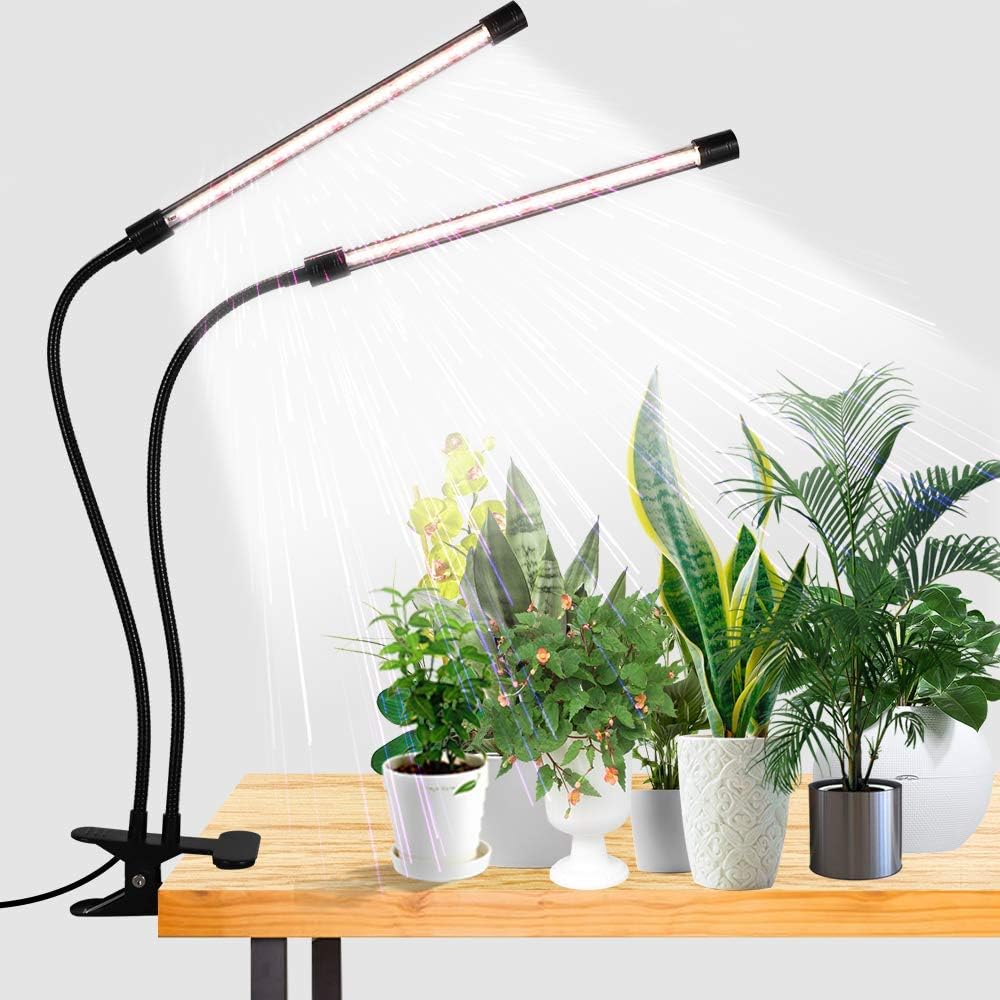
This GooingTop HY-021 is a compact clip-on grow light built for small houseplants, seedlings and shelf gardens. It uses 84 LEDs (white plus deep red) to deliver a 6000K full-spectrum output intended to mimic midday sun, with a high color-rendering output that also makes it pleasant as a reading lamp. Two flexible gooseneck heads and a strong clamp let you aim light precisely over pots and seed trays, while the attached remote provides 50%/100% dim levels and repeating timers at 4, 8 or 12 hours for hands-off scheduling. Practical benefits include low power draw (listed as roughly 10 W LED draw), a claimed 1 to 2 square meter coverage for seedlings, and an included timer that simplifies day/night cycles. Limitations are its design for small setups rather than large grow racks and the clip mounting limits placement compared with freestanding fixtures. The unit also relies on the corded remote instead of a smartphone app and the lifespan claim is typical of LEDs but not independently verifiable from the listing.
Best for: Buyers who want a simple, low-power, plug-and-play grow light to boost seedlings and a few houseplants on a desk or shelf and who value an easy-to-use timer and adjustable brightness.
Less Ideal for: Growers planning multi-shelf installations, larger vegetable grows, or who need networked or app-based control should consider larger bar lights or fixtures designed for commercial racks.
- Full-spectrum 6000K output with added 660 nm red LEDs to support vegetative growth and flowering
- Attached remote with dimming (50%/100%) and repeat timer settings (4/8/12 hours) for easy scheduling
- Flexible dual goosenecks and strong clamp enable precise positioning over small pots and seed trays
- High reported color rendering for comfortable viewing and accurate plant color assessment
- Low electrical draw around 10 W while covering small growing areas
- Clip-mount design and stated 1–2 m² coverage make it better suited to individual plants or small trays rather than large multi-shelf setups
- No smart app or wireless control option; remote is cord-attached which limits placement flexibility
Verdict: A compact, easy-to-use clip grow light that delivers full-spectrum light and convenient timer/dim controls for small indoor plant setups.
Barrina T5 1 ft LED Grow Light, 5000K Full Spectrum (4-pack)

| Wattage | 5W per fixture |
|---|---|
| Color temperature | 5000K Full Spectrum |
| Linkable | Link up to 16 lights |
| Control | Separate on/off switch per fixture |
| Included accessories | Power cords, connecting cords, clips, double-sided tape |
The Barrina T5 1 ft LED grow light kit supplies full-spectrum 5000K light in a compact, linkable T5 form that is useful for starting and growing tomato seedlings under artificial light. Each 1 ft fixture draws 5W and has its own on/off switch so you can run a single tube or multiple fixtures to match light needs. The set includes power cords, connecting cords, clips, double-sided tape and cable ties for quick plug-and-play installation and you can chain up to 16 lights in series to light multiple trays or shelf levels. Practical benefits for seedlings are even, high-PPFD output from an efficient LED array and the ability to tailor coverage by switching fixtures on or off. Limitations are that the small 1 ft form gives narrow coverage per tube so larger seed flats or full-width racks will need many fixtures, and the product is non-magnetic so mounting options depend on the included clips or your own hardware. Overall this kit is a straightforward, budget-friendly choice for growers who want controllable, linkable light for early-stage tomato plants.
Best for: Growers who want a compact, energy-efficient, controllable lighting solution for starting and growing tomato seedlings on shelves or seed trays.
Less Ideal for: People needing single wide-coverage fixtures for large benches or commercial-scale propagation should consider longer tubes or high-output panels instead.
- Full-spectrum 5000K output suitable for seedlings and vegetative growth
- Separately controllable fixtures let you run only the number of tubes needed
- Linkable design supports chaining up to 16 lights for multi-shelf setups
- Includes mounting clips, power and connecting cords for quick plug-and-play setup
- Small 1 ft length provides limited coverage per fixture so more units are needed for larger trays
Verdict: A compact, linkable full-spectrum T5 kit that gives efficient, controllable light ideal for raising healthy tomato seedlings on shelves and seed trays.
Choosing the Right LED Grow Light for Seed Starting: Key Factors to Consider
Spectrum and Color Temperature
Seedlings respond best to a spectrum skewed toward the blue range because it promotes short, stocky stems and robust leaf formation. Lights labeled with a full spectrum can still vary widely; what matters is the relative blue-to-red balance and whether the manufacturer provides spectral output or Kelvin values. A cooler color temperature or a clear blue peak helps prevent leggy, stretched seedlings.
When spectrum data is available, use it to choose fixtures that deliver a consistent blue component during the seedling stage. Some fixtures allow preset veg or seedling modes that emphasize these wavelengths, which is helpful when you need a simple daytime schedule without manual filtering.
Light Intensity and Adjustable Output
Different seeds and stages require different light intensities. Newly sprouted seeds often need gentle light, while cotyledons and true leaves benefit from higher PPFD to drive photosynthesis. Adjustable dimming or multiple output levels allow you to increase intensity as seedlings grow or to lower output for heat-sensitive species.
Check that the fixture offers a usable dimming range and that it maintains good spectral balance when dimmed. Fixtures that only change power without preserving spectrum can alter plant morphology. For multi-tier setups, being able to dial intensity down prevents hotspots and ensures uniform growth across trays.
Coverage Pattern and Fixture Size
Even illumination across the seed tray reduces the need for frequent rotation and prevents uneven growth. Wide, flat fixtures or units with optics that spread light uniformly are better for standard flats and seed trays. Match the fixture size to the tray footprint so the light overlaps slightly at the edges rather than leaving dark zones.
If you grow many trays, consider modular fixtures you can link or daisy-chain. For single trays, a compact bar or panel with a diffuse beam is usually sufficient. Also account for recommended hanging heights, because coverage increases with distance but intensity drops.
Heat Output and Thermal Management
Seedlings are sensitive to heat; excessive fixture temperature can dry out flats, bake soil surfaces, or stress tiny plants. Good thermal design-heat sinks, passive cooling fins, or quiet fans-keeps the LEDs at stable operating temperatures and preserves component life.
Lower operating temperatures let you hang lights closer to seedlings for efficient coverage without risk of burning. Look for fixtures that specify case temperature or list thermal features, especially if you plan to run lights continuously for long photoperiods.
Ease of Installation and Controls
Simple mounting and intuitive controls save time and reduce setup frustration. Practical features include adjustable hangers, ratchet rope dwells, adjustable height chains, and easy-to-use dimmers or built-in light schedules. Timers or onboard programmable cycles are especially useful to maintain consistent photoperiods for rapid germination and early growth.
Also consider the power connection type and whether fixtures can be linked to cover larger areas. A plug-and-play fixture is fine for casual hobbyists, while growers who run many trays may prefer hardwired or chainable fixtures for a cleaner, scalable setup.
How to Position LED Lights for Seedlings
Place LEDs within the recommended hanging distance for the seedling stage and raise them gradually as stems strengthen. For compact, blue-rich fixtures, start lower to give seedlings ample PAR without stretching, then raise to prevent shading as true leaves expand.
- Measure coverage by holding the light at the intended height and checking uniformity across the tray.
- Keep a consistent 14 to 16 hour daily photoperiod for most vegetable and flower seedlings.
- Use a dimmer to reduce intensity at germination, then increase output as cotyledons open.
Common Seed-Starting Light Schedules
Most seeds germinate with a daily light period of 12 to 16 hours once sprouts appear. Many gardeners use 14 to 16 hours for strong vegetative development and 8 to 12 hours for species that prefer shorter days. Consistency matters more than exact hours-use a timer so lights come on and off at the same times each day.
- For very young sprouts: start with 12 to 14 hours and lower intensity.
- After true leaves form: increase to 14 to 16 hours and raise intensity gradually.
- Species-specific tips: some ornamentals or herbs tolerate shorter photoperiods; check seed packet guidance.
Setting Up Multi-Tier Seed Racks
Multi-tier racks let you start many seedlings in a small footprint, but they require attention to airflow and even light distribution. Choose fixtures sized for each shelf and ensure each tier gets its own adjustable light so lower racks are not shaded by upper ones. Maintain a small gap from the shelf above to allow heat to escape and to prevent humidity buildup.
- Install fans for gentle cross-flow to strengthen stems and reduce damp conditions.
- Use diffused fixtures to minimize hotspots in small shelves.
- Arrange seed trays so airflow reaches between pots and around tray edges.
Transitioning Seedlings to Stronger Light
Harden seedlings to higher intensity in stages to avoid shock. Gradually lower fixtures or raise intensity over several days while increasing daily light hours slightly. Also acclimate plants to natural light by placing them in bright shade outdoors for a few hours a day before transplanting.
- Increase light intensity in 20 percent steps over 3 to 7 days.
- Monitor stem thickness and leaf color for signs of stress or stretch.
- Reduce humidity and water slightly less as seedlings harden to encourage root growth.
How We Chose the Best LED Grow Light for Seed Starting
We focused on features that matter for getting seedlings off to a healthy, uniform start. Key evaluation criteria included spectral output and balance, because seedlings need a cool, blue-dominant spectrum for compact growth and strong leaf development; light intensity and adjustable output to let gardeners dial in PPFD for different stages and tray depths; coverage pattern and fixture size so a single unit can uniformly light the intended seed trays; heat management to avoid scorching delicate seedlings while still supporting growth; and ease of setup including hanging options, height adjustment, and plug-and-play controls. We excluded fixtures designed primarily for flowering or high-intensity canopy work where red-heavy spectrum and extreme output are typical. We also filtered out units without reliable spectrum specifications or without clear mounting and dimming options, since those limit control during the seedling phase. The products included met practical requirements for indoor seed propagation and offered documented spectral or output data gardeners can use to set light schedules and distances.
FAQ
How close should an LED grow light be to newly sprouted seeds?
Distance depends on fixture output and optics, but many blue-rich LEDs can be 6 to 12 inches above seedlings at first. Start at the manufacturer-recommended height for seedlings and watch for signs of stress; raise the light if leaves curl or show bleaching.
Can I use full-spectrum LED lights for seed starting?
Yes. Full-spectrum fixtures that include a strong blue component work well. The important part is that the blue wavelengths are present in sufficient intensity for compact growth during the seedling stage.
Do seedlings need a timer for LEDs?
A timer is highly recommended. Regular daily light cycles of 12 to 16 hours help seedlings develop predictable growth patterns and reduce stretch. Timers remove guesswork and make consistent schedules easy to maintain.
Will LED lights dry out seed trays faster than fluorescent lights?
LEDs generally run cooler and can dry trays less than high-heat HID lights, but airflow, ambient temperature, and light intensity all affect surface drying. If drying is a concern, lower intensity, increase humidity, or shorten daily hours until seedlings are established.
Is dimmability important for seed-starting LEDs?
Dimmability is useful because it lets you gently increase light as seedlings mature without changing hanging height immediately. It also helps when seedlings are germinating and require lower light levels to avoid stress.
Final Verdict
Prioritize spectrum and even coverage when choosing an LED grow light for seed starting. The best results come from fixtures that provide a blue-rich spectral balance, adjustable intensity, and a coverage pattern that matches your tray sizes. Accept small tradeoffs: a slightly larger fixture can save time by reducing tray rotation, while advanced controls are worth having if you plan many starts. Choose a light that fits your setup and gives you control over spectrum and intensity during the seedling phase. That approach yields more uniform germination, stronger stems, and easier transplanting later in the season.
