

Note: This article contains affiliate links. If you click on these links and make a purchase, I may earn a small commission at no extra cost to you. This helps support my research and content. Read my full affiliate disclosure here.
Weeds compete for light, water, and nutrients, so the right herbicide strategy can save time and protect your plantings. Choosing a pre and post emergent herbicide matters because these products behave differently before and after weeds sprout, and using the wrong timing can damage desirable turf or ornamentals. This guide shortlists the top options gardeners rely on for both preemergent prevention and postemergent cleanup, and it explains the practical tradeoffs you should expect in performance and safety. Below you'll find our top picks followed by clear explanations of evaluation criteria to help you match a product to your garden situation.
Top Picks at a Glance
| Best Overall The best all-around choice for most situations | Atticus Torocity Mesotrione Herbicide, 8 oz |  |
| Best Quality Built to a higher standard if you want something more solid | Syngenta Tenacity Herbicide, 8 fl oz (Pack of 2) |  |
| Best Value The sweet spot between price and what you get | Liquid Harvest Mesotrione Broadleaf Herbicide, 8 fl oz |  |
| Best Budget The cheapest option that still gets the job done reliably | Liquid Harvest Mesotrione Concentrate (8 oz) – Pre- and Post-Emergent Lawn Herbicide |  |
| Highest Rated A top-rated pick with lots of positive feedback | Sim-Trol 4L Simazine Flowable Pre-Emergent Herbicide (2.5 gal) |  |
| Most Popular A crowd favorite that many people choose with confidence | Syngenta Tenacity Turf Herbicide, 8 oz | |
| Best Seller A high-volume bestseller chosen again and again | Liquid Harvest Mesotrione Concentrate, 32 oz |  |
Atticus Torocity Mesotrione Herbicide, 8 oz

| Active Ingredients | Mesotrione |
|---|---|
| Item Form | Liquid |
| Coverage | 1000 square feet |
| Unit Count | 8 Ounce |
Torocity is a liquid herbicide concentrate built around 40% mesotrione that works as both a pre-emergent and post-emergent treatment for lawns. You measure and dilute the concentrate in a sprayer or watering can, then apply to target areas to prevent weed germination or to knock back existing infestations. The product lists coverage of roughly 1000 square feet per bottle and specifically names problem plants such as crabgrass, clover, dandelion, nutsedge and ground ivy, making it suitable when you need targeted control of stubborn broadleaf and grassy weeds. It is also labeled for use on newly seeded Kentucky bluegrass, tall fescue, perennial ryegrass and centipedegrass, which helps when renovating turf. Important limitations are that it is not labeled for some turf types like bentgrass, zoysiagrass and actively growing bermudagrass and it requires following application timing and watering instructions on the label for effective control. Users should follow safety and label directions when mixing and applying concentrated herbicides.
Best for: Gardeners and lawn-care pros who prioritize strong, reliable control of persistent lawn weeds and want a single product that works both before and after weeds emerge.
Less Ideal for: Homeowners seeking an all-purpose, ready-to-use spot treatment or those who have turf species not listed as tolerant should look for alternate options.
- Dual action formula provides both pre-emergent and post-emergent control
- Contains mesotrione, a proven active ingredient for broadleaf and grassy weeds including ground ivy
- Concentrated liquid form is easy to measure and mix for spray applications
- Label permits use on newly seeded common lawn grasses, aiding turf renovation
- Not labeled for use on certain turf types such as bentgrass, zoysiagrass, and active bermudagrass
- Requires careful dilution, application timing, and post-application watering for best results
Verdict: If you need performance-grade control of ground ivy and other difficult lawn weeds, Torocity delivers reliable pre- and post-emergent action with a mesotrione concentrate.
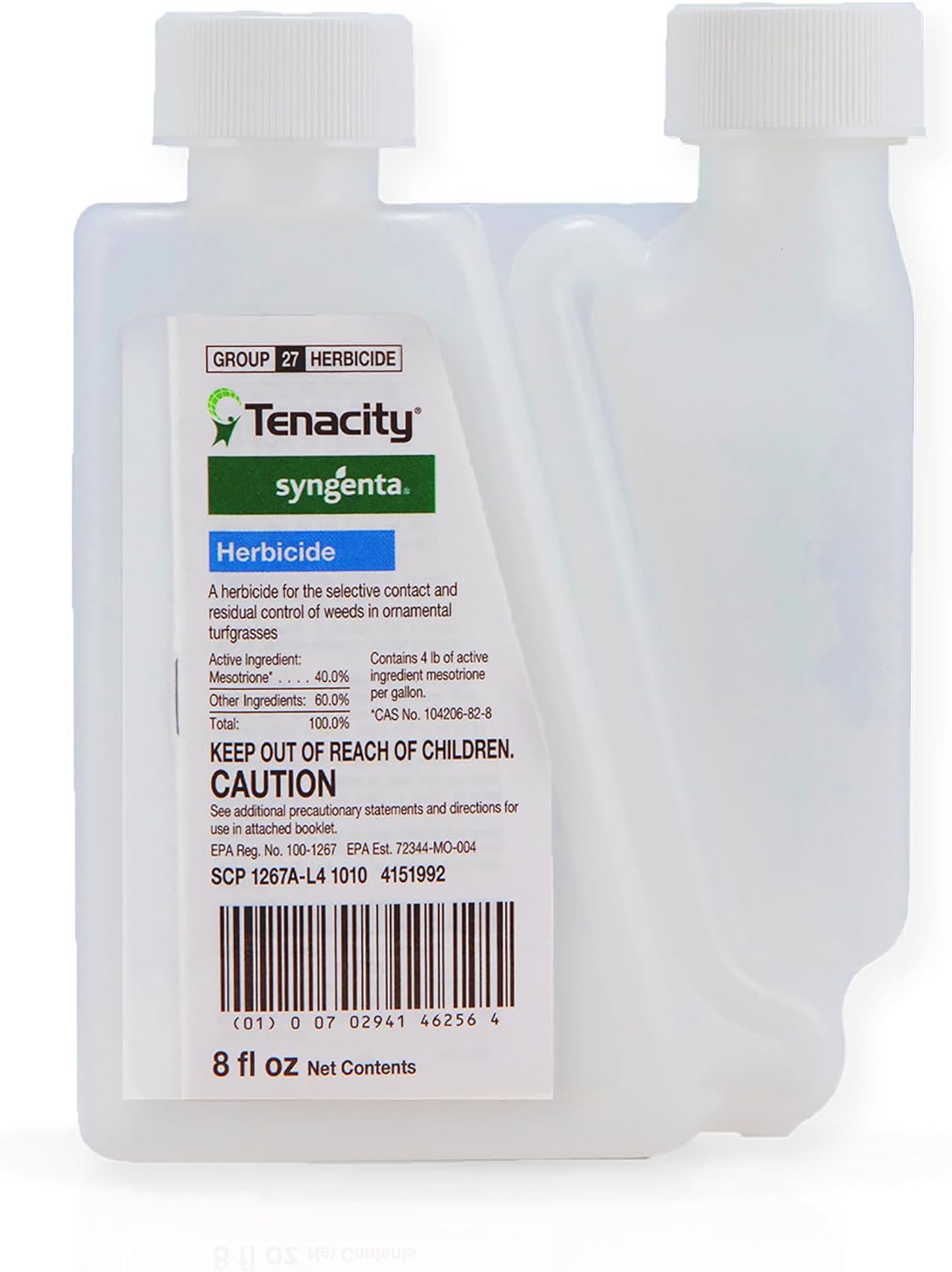
Syngenta Tenacity Herbicide, 8 fl oz (Pack of 2)
| Unit Count | 16 Fluid Ounces |
|---|---|
| Item Form | Liquid |
| Coverage | broad-leaf weeds and grass species |
| Active Ingredient | Mesotrione |
Tenacity is a concentrated liquid herbicide formulated to prevent new weeds from emerging and to selectively knock back existing broadleaf weeds and some grassy weeds in turf. It is typically mixed with water and applied as a spray; the bottle’s built-in dispensing chamber makes measuring straightforward for small jobs. Notable features include activity on both pre- and post-emergent targets and a labeled list of about 46 problem species such as crabgrass, clover, dandelion, oxalis and unwanted bentgrass. A key practical benefit is that it can be used at seeding or overseeding, which lets you treat sites where many other herbicides are restricted. The product is based on mesotrione, a proven active ingredient, and is designed to be selective so desirable turf survives when applied according to the label. Important limitations are that specific application rates, timing, tolerant turf species and safety precautions must be followed from the label and safety data sheet, and the concentrated liquid requires careful handling to avoid skin or eye contact.
Best for: Gardeners and turf managers focused on strong, reliable weed control who need a selective herbicide they can use when seeding or overseeding and who follow label directions closely.
Less Ideal for: Casual users who prefer ready-to-use sprays or those unwilling to read and follow label safety and application requirements.
- Controls both pre-emergent and post-emergent weeds including many broadleaf and certain grassy species
- Can be applied at seeding or overseeding where most herbicides are restricted
- Built-in dispensing chamber simplifies accurate measuring for small-volume mixes
- Concentrated liquid that requires careful handling and following detailed label safety directions
Verdict: Choose Tenacity when you need a selective, mesotrione-based herbicide that works both before and after weed emergence and is safe to use during seeding.
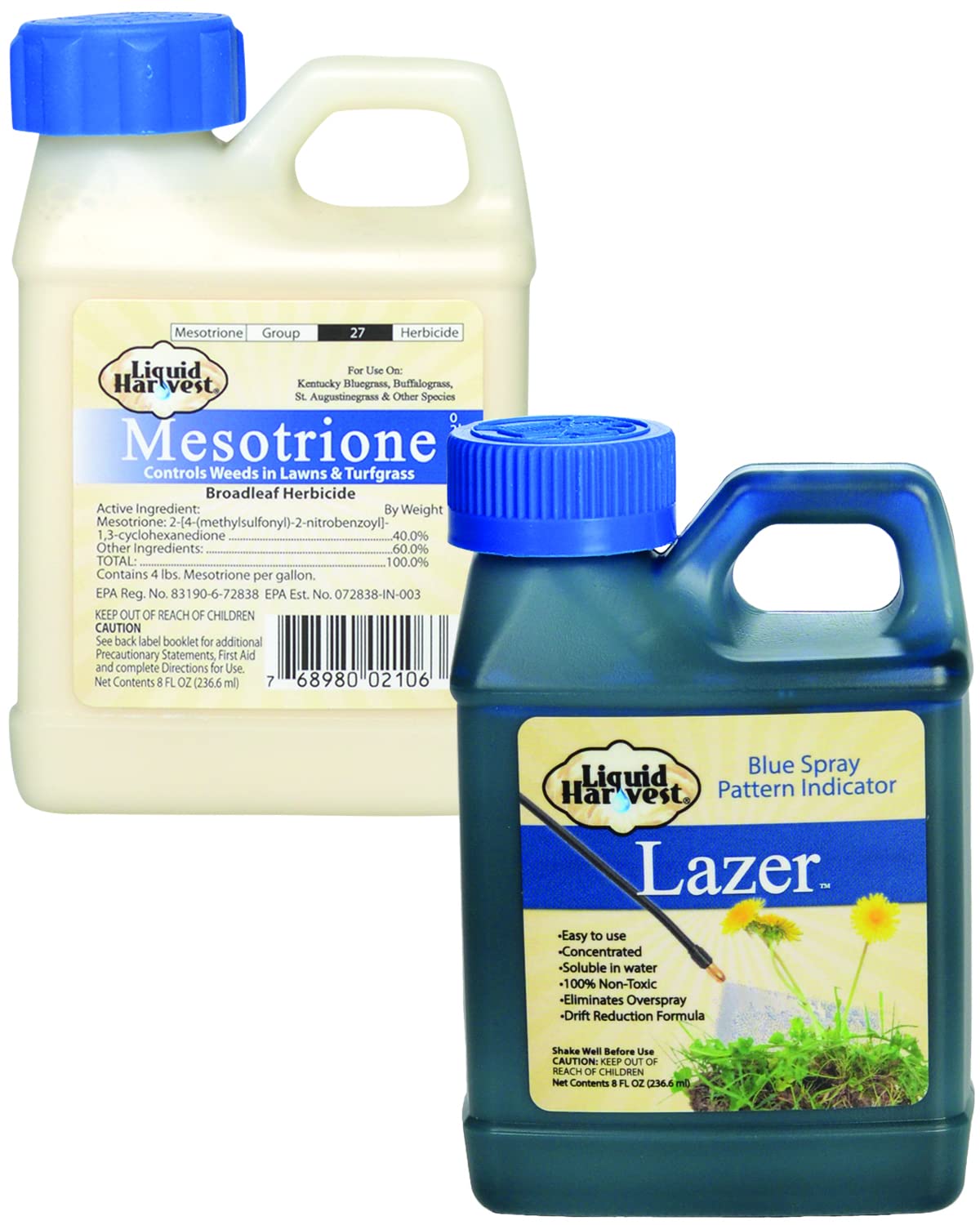
Liquid Harvest Mesotrione Broadleaf Herbicide, 8 fl oz
| Liquid Volume | 8 fluid ounces |
|---|---|
| Active Ingredients | Mesotrione |
| Item Form | Spray |
| Coverage | 16 Fluid Ounces |
Liquid Harvest Mesotrione is a concentrated broadleaf herbicide formulated for both pre- and post-emergent use on many common lawn weeds. It is typically mixed with water (and a recommended surfactant) and applied as a spray for spot treatments or larger area applications; label dosing gives guidance ranging from teaspoons per gallon for spot work to several ounces per acre for broadcast use. The product controls a long list of weeds including dandelion, clover, crabgrass seedlings and chickweed by inhibiting photosynthesis and moving through leaves and roots, and it can also prevent crabgrass seed germination when used pre-emergence. Practical benefits include a versatile label that covers many turf types and both spot and acre-scale applications, plus concentrated packaging that makes small containers stretch for multiple treatments. Important limitations are that it requires activation by moisture within about 10 days and it is not safe on several turf types such as bentgrass, bermudagrass (except dormant applications), zoysia and others listed on the label, so correct turf identification and careful timing are required to avoid damage.
Best for: Gardeners who want an efficient, do-it-yourself herbicide to manage broadleaf weeds across lawns and who prioritize getting the most coverage from a small concentrated bottle.
Less Ideal for: People who maintain delicate or excluded turf types, or those who prefer ready-to-use, non-chemical options for weed control.
- Works as both pre-emergent and post-emergent against many common lawn weeds
- Concentrated formula stretches for multiple spot or area treatments
- Label lists compatible turf types and specific dosing for spot and acre applications
- Requires rainfall or irrigation within about 10 days to activate for full effectiveness
- Not labeled for use on several turfgrasses so misidentification can cause damage
Verdict: Choose this concentrated mesotrione if you need a versatile pre- and post-emergent herbicide that covers many common lawn weeds while maximizing product economy.
Liquid Harvest Mesotrione Concentrate (8 oz) – Pre- and Post-Emergent Lawn Herbicide

| Active Ingredients | Mesotrione |
|---|---|
| Unit Count | 8 Ounce |
| Item Form | Liquid |
| Coverage | Full |
Liquid Harvest Mesotrione is a concentrated liquid herbicide that prevents photosynthesis in susceptible weeds and is labeled for both pre- and post-emergent use on several turfgrass types. Typical use is mixing the concentrate with water and a surfactant then applying it as a spot treatment or broadcast spray; the label gives mix rates for covering from a few thousand square feet up to an acre. It starts working on contact and may take two to three weeks for full weed death, and it must be activated by rainfall or irrigation if no rain occurs within 10 days. Notable features include its broad-spectrum activity against common ground-level broadleaf weeds and ability to suppress crabgrass germination. Practical benefits are flexible application options for spot or large-area treatment and compatibility with the brand surfactant and spray indicator for easier coverage. Limitations are turfgrass restrictions and sensitivity on certain grasses, plus the need for careful mixing, protective gear, and following the label to avoid damage to non-target turf.
Best for: Homeowners looking to control persistent broadleaf weeds like ground ivy on a budget who are comfortable mixing concentrate, following label directions, and treating targeted lawn areas.
Less Ideal for: People who want an immediate visual kill, who have sensitive turfgrass species listed as exclusions, or who prefer ready-to-use formulations without mixing.
- Concentrated formula allows treating spot areas or up to an acre with proper dilution
- Controls a wide range of broadleaf weeds and helps prevent crabgrass germination
- Works as both pre-emergent and post-emergent for flexible timing
- Can be paired with a surfactant and spray indicator to improve coverage and effectiveness
- Restricted on certain turfgrasses and can damage sensitive species if misapplied
- Requires rainfall or irrigation within 10 days for activation or manual watering
- Takes up to 2–3 weeks for full weed death, not an instant visual fix
Verdict: A cost-effective mesotrione concentrate for homeowners who need flexible pre- and post-emergent control of broadleaf weeds like ground ivy when used carefully according to the label.
Sim-Trol 4L Simazine Flowable Pre-Emergent Herbicide (2.5 gal)

| Unit Count | 320 Fluid Ounces |
|---|---|
| Included Components | (1) 2.5 Gallon Jug of Simtrol 4L Herbicide |
| Item Form | Liquid |
| Active Ingredients | Simazine 42.8% |
| Coverage | Broad-spectrum coverage |
Sim-Trol 4L is a concentrated flowable simazine herbicide intended primarily for pre-emergent control of annual grassy and broadleaf weeds on turf, ornamentals, and commercial plantings. It is typically applied in spring or fall to create a chemical barrier that prevents weed seedlings from establishing, and it also offers some post-emergent activity on susceptible species. The product comes as a 2.5 gallon (4 liter) jug and is described as tank-mix compatible with many other herbicides and liquid fertilizers, which makes it flexible for integrated weed programs. Practical benefits include broad-spectrum control for large areas like sports turf, golf courses, and lawns, plus established label directions for seasonal uses such as winter annual control in fall applications. Important limitations are that it contains a high percentage of simazine so it must be used according to label restrictions to avoid crop injury and environmental risks, and it is not a selective solution for all weed species or for sites where simazine is restricted by regulation. Users should follow safety and application guidelines closely.
Best for: Buyers who prioritize a proven, label-supported pre-emergent product for managing weeds across large turf or commercial planting areas and who plan integrated applications with other tank-mix partners.
Less Ideal for: Casual gardeners with small beds, or users needing a selective post-emergent spot treatment for resistant broadleaf species should consider alternative, lower-risk products.
- High active ingredient concentration (Simazine 42.8%) for effective pre-emergent control
- Broad-spectrum activity against many annual grasses and broadleaf weeds
- Tank-mix compatible with a variety of herbicides and liquid fertilizers for program flexibility
- Suitable for large-area uses such as golf courses, sports turf, and commercial lawns
- Requires strict adherence to label directions due to potential crop or ornamental injury and environmental restrictions
- Not effective on all weed species and not a universal post-emergent solution
Verdict: Choose Sim-Trol 4L when you need a concentrated, tank-mixable pre-emergent trusted for broad-area turf and commercial weed control.
Syngenta Tenacity Turf Herbicide, 8 oz
| Unit Count | 8 Fluid Ounces |
|---|---|
| Item Form | Liquid |
| Coverage | 2000 ft^2 per 1sp of product |
| Active Ingredients | Mesotrione |
Tenacity Turf Herbicide is a concentrated mesotrione-based liquid designed for both pre-emergent and post-emergent control of common lawn weeds including crabgrass, clover, chickweed and dandelions. You apply it diluted according to label rates with a handheld or hose-end sprayer to target problem areas or broadcast across the lawn; when used as a pre-emergent it is taken up as weeds emerge and when applied post-emergent it acts systemically for selective control. The product covers a large area per bottle and the active ingredient provides residual control so you can expect longer suppression than a contact-only herbicide. Important practical points are that it is turf-selective so follow the label for grass species and mixing instructions to avoid turf injury, and results can take several days to appear. Also this is a concentrated chemical intended for careful, measured application rather than spot-use by people who prefer non-chemical methods.
Best for: Gardeners focused on strong, reliable crabgrass and broadleaf weed control who are comfortable using concentrated herbicides and following label directions for turf safety.
Less Ideal for: People seeking organic, mechanical, or spot-only solutions or those unwilling to follow detailed mixing and application instructions should consider other options.
- Systemic mesotrione active ingredient controls both pre- and post-emergent weeds
- Selective to turf when used per label, allowing treatment without killing desirable grass species
- Concentrated 8 oz liquid provides wide coverage per bottle
- Provides residual suppression, reducing frequency of repeat applications
- Requires careful mixing and adherence to label for turf safety
- Not a non-chemical or organic option for weed control
Verdict: Choose Tenacity when you want a concentrated, turf-selective herbicide that delivers pre- and post-emergent control of crabgrass and other common lawn weeds.
Liquid Harvest Mesotrione Concentrate, 32 oz

| Unit Count | 32 Ounce |
|---|---|
| Item Form | Liquid |
| Coverage | Lists compatible turf species and target weeds |
| Active Ingredients | Mesotrione |
Liquid Harvest Mesotrione is a concentrated liquid herbicide intended for both pre-emergent and post-emergent control of many common lawn weeds. It works by inhibiting photosynthesis and is absorbed through leaves and roots, producing visible results within days and full weed death in two to three weeks. Typical use is spot treatments or larger acre applications when mixed with water and a surfactant; the label gives recipes for small-area spot treatments and for treating up to an acre. Notable features include coverage recommendations for cool-season turfs such as Kentucky bluegrass and tall fescue, explicit activation instructions if no rain occurs, and compatibility with Liquid Harvest surfactant and spray indicator products. Practical benefits are effective control of broadleaf weeds and certain grassy weeds, flexible application rates for spot or large-area use, and a concentrate format that reduces packaging waste. Important limitations are turf restrictions—several warm-season grasses are listed as incompatible—and the need to follow label rates carefully and use a surfactant for best results to avoid damage to desirable grasses.
Best for: Homeowners who prioritize predictable weed control and follow label instructions, and who maintain compatible cool-season lawns or sod-grown St. Augustine grass.
Less Ideal for: Gardeners with warm-season turf varieties that are listed as incompatible or those who want a ready-to-use spray rather than a concentrate that requires measuring and mixing.
- Effective on a broad list of broadleaf weeds and some grassy weeds when applied correctly
- Suitable for both spot treatments and larger acre applications with clear mixing rates
- Concentrated 32 oz bottle covers large areas when diluted, reducing trips to repurchase
- Includes activation guidance and pairs with surfactant and spray indicator for precise application
- Not safe for many warm-season grasses and must be avoided on listed turf species
- Requires careful mixing, surfactant use, and possible irrigation to activate if no rain occurs
Verdict: A concentrated pre- and post-emergent herbicide best for careful homeowners with compatible cool-season lawns who want reliable, broadleaf weed control.
Choosing the Right Pre and Post Emergent Herbicide: Key Factors to Consider
Control Spectrum
A product's control spectrum describes which weed types it affects. Some products target grassy weeds, others focus on broadleaf species, and a few have combined chemistries that address both. Knowing the specific weeds you need to manage makes a big difference because a preemergent that only suppresses grasses will not stop clover or chickweed from emerging.
Assess the common weeds in your area across seasons. If you have a mix of summer annual grasses and cool-season broadleaves, prioritize a chemistry or combination that covers both, or plan a program that pairs a preemergent with a compatible postemergent for gaps in control.
Residual Duration
Residual duration is how long a preemergent prevents weed seedlings from establishing. Longer residual products reduce the number of reapplications but can restrict planting windows for desirable seeds. Shorter residuals let you plant sooner but require more frequent applications to maintain control.
Consider the cropping or seeding schedule for your lawn or garden beds. If you plan to sow grass seed or transplant annuals, check the label for planting restrictions. For established turf or perennial beds, a longer residual can be an asset for season-long protection against flushes of annual weeds.
Selective Safety
Selective safety refers to how well a product kills weeds while leaving desirable plants unharmed. Some systemic postemergents are nonselective and will injure anything they contact, while many preemergents are designed to be safe on established turf but harmful to newly seeded areas.
Read label directions about treated area, application rates, and vulnerable species. In mixed beds with ornamentals or vegetables, choose products labeled for those uses or avoid broadcast applications near sensitive plants to prevent accidental damage.
Application Flexibility
Application flexibility covers formulation types, allowed equipment, and timing windows for effective control. Granular products are often easier for homeowners to apply to lawns, while ready-to-use sprays are handy for spot treatment. Tank-mix compatibility and label permissions for broadcast versus spot applications matter when you need to treat large areas or isolated patches.
Match the product form to the tools you have and the scale of the job. If you rely on a broadcast spreader or hose-end sprayer, confirm the product is compatible and that rates are clearly listed for those methods.
Environmental and Human Safety
Consider runoff potential, soil persistence, and toxicity to pollinators and aquatic life. Some chemistries bind tightly to soil and have low leaching risk, while others can move in runoff after heavy rain. Human safety considerations include required protective gear and re-entry intervals after application.
Plan applications for calm weather and avoid treating before heavy rain. Follow label guidance for buffer zones around water and observe PPE recommendations to reduce exposure risks.
Ease of Use
Ease of use includes clarity of label instructions, mixing convenience, and whether the product requires special equipment. Products with simple dilution charts and clear timing windows reduce the chance of error. Granules that can be applied with a standard spreader or concentrates that measure easily make routine maintenance less intimidating.
Also factor in storage and shelf life. A product that is stable between seasons and easy to store will be easier to incorporate into an annual weed management plan.
Timing and Seasonal Strategy
Effective weed control depends on timing. Preemergent herbicides must be applied before seeds germinate, which is tied to soil temperature and local climate. For many annual weeds, an early spring application timed to soil warming is essential, while some summer annuals require a later application in late spring or early summer.
Postemergent treatments work best when target weeds are actively growing. Treat small, young weeds for faster knockdown and better uptake. Plan a seasonal calendar that aligns preemergent applications with local germination cues and reserves postemergent treatments for visible flushes or escaped plants.
- Monitor soil temperature and local extension guidance when scheduling preemergent applications
- Treat actively growing weeds for more reliable postemergent results
- Avoid applying postemergents during drought stress or extreme heat to prevent plant stress and off-target damage
Application Methods and Equipment
Choose a formulation that fits your tools. Granular spreaders deliver even coverage for lawn treatments when used correctly. Bottle concentrates and ready-to-use sprays offer spot treatment options and simple mixing ratios for smaller areas.
Calibrate spreaders and sprayers before use to ensure correct rates. Overapplication increases risk to desirable plants and the environment, while underapplication reduces effectiveness and may encourage resistant weed populations.
- Use a drop or broadcast spreader for granular products on lawns
- Rinse sprayers thoroughly after use and follow label cleaning instructions
- Consider a shielded sprayer or targeted wand to reduce drift near ornamentals
Integrating Cultural Controls
Herbicides work best as one part of an integrated weed management plan. Healthy turf and dense plantings can outcompete many weeds, reducing reliance on chemical controls. Practices like proper mowing height, timely irrigation, and soil fertility management improve plant vigor and decrease opportunities for weeds to establish.
Mechanical controls such as hand pulling or shallow cultivation can remove problem plants and reduce seed return. Use herbicides strategically to manage large infestations or persistent perennial weeds that are difficult to control by cultural means alone.
- Raise mowing height to promote dense turf canopy in lawns
- Improve soil health with organic matter to support desirable plants
- Use targeted herbicide applications for large or hard-to-manage infestations
Protecting Pollinators and Water Sources
Many gardeners are concerned about pollinators and aquatic ecosystems. Avoid spraying flowering plants that attract bees and other pollinators. When applications are necessary near water, follow label buffer zone requirements and consider products with lower aquatic toxicity.
Timing applications to avoid bloom periods and using targeted spot treatments can reduce non-target exposure. For areas downhill from water bodies, avoid treating before heavy rain to minimize runoff risk.
- Do not apply to blooming plants or when pollinators are active
- Respect label buffer zones and avoid applications before forecasted rain
- Use low-solubility formulations near ponds or streams when possible
Dealing with Resistant Weeds
Repeated use of the same active ingredient can lead to resistant populations. Rotate chemistries and combine cultural tactics to limit selection pressure. For persistent weeds, consider mechanical removal plus a follow-up chemical treatment using a different mode of action.
Read label instructions for rotation recommendations and avoid underdosing, which accelerates resistance development. Keep records of treatments used so you can rotate products effectively across seasons.
- Alternate active ingredients with different modes of action
- Combine mechanical removal with chemical treatments when necessary
- Keep a log of applications to support an effective rotation plan
How We Chose the Best Pre and Post Emergent Herbicide
We selected products that offer both preemergent and postemergent activity or that are commonly used together for an integrated control plan. Editorial filters prioritized documented control spectrum, application flexibility, and label guidance relevant to common garden and lawn species. We evaluated efficacy against grassy and broadleaf weeds, the speed and duration of control, and how product chemistry influences reapplication intervals. We also assessed safety characteristics that matter for home gardeners, including plant selectivity, restrictions for use around ornamentals or vegetable beds, and recommended PPE. Ease of application and available formulations were considered because sprayer type and dilution needs affect real-world results. Finally, we excluded products without clear label directions for home landscapes or those with application restrictions that make safe residential use impractical. The scoring metrics below reflect these same dimensions and guided which items made the shortlist.
FAQ
Can I use a pre and post emergent herbicide around vegetable beds?
It depends on the product and label restrictions. Many preemergents restrict planting of seeds or transplants for a specified interval, and some postemergents can injure vegetables if drift or contact occurs. Always read the label for crop-specific directions and consider using targeted spot applications away from edible plantings.
How soon can I plant grass seed after applying a preemergent?
Planting windows vary by chemistry and formulation. Some preemergents require waiting several months before seeding, while others have shorter restrictions. Check the label for exact planting intervals and follow best practices for seedbed preparation to improve establishment once the waiting period ends.
Will a preemergent stop perennial weeds like dandelions?
Preemergents mainly prevent seed germination and are less effective on established perennials that regrow from roots or crowns. Perennial weeds usually require targeted postemergent treatments or physical removal of the root system for long-term control.
Is it safe to apply these herbicides when it's windy?
No. Wind increases the risk of drift, which can harm desirable plants. Apply herbicides on calm days and use low-drift nozzles or shielded wands for spot treatments to reduce off-target movement.
How often should I reapply for season-long control?
Reapplication frequency depends on the product's residual duration and the weed pressure in your area. Some products provide several months of control and may need only one application per season, while others require repeat treatments. Follow label intervals and monitor treated areas for breakthrough weeds.
Can I mix a preemergent and postemergent in the same tank?
Tank-mix compatibility varies by formulation and active ingredients. Some combinations are compatible and useful for broad-spectrum control, but others can reduce effectiveness or increase phytotoxicity. Refer to label guidance and conduct a small compatibility test if the label allows tank mixing.
Final Verdict
Selecting the right pre and post emergent herbicide means balancing the weeds you need to control, the planting schedule for desirable plants, and environmental safety. Prioritize products that match your dominant weed types and offer a residual and application method that fits your routine. Be realistic about tradeoffs: longer residuals reduce repeat treatments but restrict seeding, and broad-spectrum options may increase the risk to nearby ornamentals or edible plantings. Use timing, cultural practices, and targeted applications to minimize risks and maintain effective weed control throughout the season.
