

Note: This article contains affiliate links. If you click on these links and make a purchase, I may earn a small commission at no extra cost to you. This helps support my research and content. Read my full affiliate disclosure here.
Picking the right small pond filter matters because ponds under a few hundred gallons have limited water volume and can become cloudy or nutrient-rich quickly. The right filter keeps water clear, supports biological balance, and makes routine maintenance less of a chore in a backyard, patio, or container pond. This guide covers seven shortlisted small pond filters that suit tight spaces and modest flow needs. We evaluate each pick for flow control, mechanical and biological media capacity, ease of cleaning, and adaptability to common small-pond setups so you can find a compact system that fits your pond and schedule.
Top Picks at a Glance
| Best Overall The best all-around choice for most situations | coospider-repta Submersible Pond Filter with 18W UV Clarifier and 660 GPH Pump |  |
| Best Quality Built to a higher standard if you want something more solid | TotalPond Complete Pressurized Pond Filter with 9W UV Clarifier |  |
| Best Value The sweet spot between price and what you get | COODIA CHP-1500 Pond Pump and Filter Kit with 400 GPH Pump |  |
| Best Budget The cheapest option that still gets the job done reliably | Beckett CGFK60 120 GPH 5W Submersible Container Fountain Pump Kit |  |
| Highest Rated A top-rated pick with lots of positive feedback | Augicy PF-3000 850GPH Submersible Pond Pump and 4-Layer Filter Kit |  |
| Most Popular A crowd favorite that many people choose with confidence | VIVOHOME VH556 530 GPH All-in-One Submersible Pond Filter Pump with Fountain |  |
| Best Seller A high-volume bestseller chosen again and again | POPOSOAP 660 GPH Pond Pump and Filter Kit with Fountain Attachments |  |
coospider-repta Submersible Pond Filter with 18W UV Clarifier and 660 GPH Pump

| Horsepower | 42 watts |
|---|---|
| Flow rate | 660 GPH |
| UV power | 18W |
| Suitable pond size | Up to 1500 Gal |
This all-in-one submersible filter pairs a powerful 42W pump with an 18W UV clarifier and six layers of filtration to tackle green water and debris in small backyard ponds. Typical use is plug-and-play: submerge the unit, let it fill with water, and run it to circulate up to 660 gallons per hour while the UV lamp helps clear algae. The filtration stack includes mechanical pads, activated carbon, lava rock, and bio-balls, which together remove solids, odors, and provide biological surface area for beneficial bacteria. Three interchangeable fountain nozzles add decorative spray patterns and extra surface aeration. Practical benefits include strong circulation for oxygenation, reduced maintenance thanks to the multi-stage media, and visible improvement in water clarity within days when used as directed. Important limitations are the need to routinely clean the filter sponge every few days for fastest results and to ensure the unit is fully submerged and primed before starting; replacement UV bulbs and eventual media refresh will be required over time. For balanced small-pond owners this unit simplifies filtration and adds a fountain feature in one package.
Best for: Gardeners who want a single, easy-to-install unit that improves water clarity and circulation while adding a fountain effect to a small backyard pond.
Less Ideal for: Owners of very large ponds or those seeking a fully hands-off system that requires minimal routine cleaning should consider more heavy-duty or automated solutions.
- Integrated 18W UV clarifier reduces green water algae quickly
- 42W pump delivers up to 660 GPH for good circulation and aeration
- Six-layer filtration (mechanical, carbon, lava rock, bio-balls) handles debris and supports biological filtration
- Three interchangeable nozzles provide decorative spray patterns and extra surface agitation
- Filter sponge requires frequent cleaning (every few days) for best performance
- UV bulb and filter media will need replacement over time
Verdict: A compact, all-in-one filter and fountain that balances strong circulation, multi-stage filtration, and UV clarifying power for clearer small ponds.
TotalPond Complete Pressurized Pond Filter with 9W UV Clarifier

| Capacity | 1200 gallons |
|---|---|
| Other Special Features of the Product | UV Clarification |
| Purification Method | Ultraviolet |
| Power Source | Ac/DC |
| Included Components | Filter body, 9W UV Clarifier, 2 filter pads, 12 bio-balls |
The TotalPond Complete Pressurized Pond Filter combines mechanical pads, bio-balls and a 9W ultraviolet clarifier into a single freestanding unit for ponds and waterfalls up to 1200 gallons. You install your own pump and route water through the inlet so it passes the UV chamber, then two filter pads and the bio-ball chamber where beneficial bacteria establish. The enclosed, pressurized design keeps water moving and reduces clogging compared with open-media boxes, and the included stepped adapters accept 3/4 or 1 inch ID tubing for common pond setups. Practical benefits include simpler maintenance from the removable lid and preloaded media, plus UV-treated flow that helps clear green water and controls single-cell algae. Limitations are that the unit requires a separate pump sized to your pond and the 9W UV is modest for very high sunlight or larger koi ponds, so heavy algae pressure may need a stronger clarifier or supplemental filtration. The plastic housing is lightweight and easy to hide but not as rugged as heavy-duty commercial filters.
Best for: Buyers who want a single, compact filter that simplifies startup and maintenance while improving water clarity for backyard koi or decorative ponds and who prefer choices supported by established product reviews.
Less Ideal for: Large commercial koi collections, very high-biomass ponds, or owners who want an all-in-one pump-plus-filter solution without adding a pump.
- Integrated 9W UV clarifier to reduce green water and microscopic algae
- Pressurized design promotes steady flow and helps prevent debris settling
- Includes mechanical filter pads and bio-balls for combined mechanical and biological filtration
- Fits common tubing sizes with stepped adapters for straightforward plumbing
- Removable watertight lid and included media make initial setup and routine cleaning easier
- Requires a separate pond pump so additional cost and pump sizing are necessary
- 9W UV output is limited for very large or high-algae ponds
Verdict: A compact pressurized filter with UV and biological media that reliably improves clarity for backyard koi ponds up to 1200 gallons.
COODIA CHP-1500 Pond Pump and Filter Kit with 400 GPH Pump
| Power Source | Corded Electric |
|---|---|
| Power | 25W |
| Max flow rate | 400 GPH |
| Maximum Lifting Height | 6.5 feet |
| Cord length | 16.5ft |
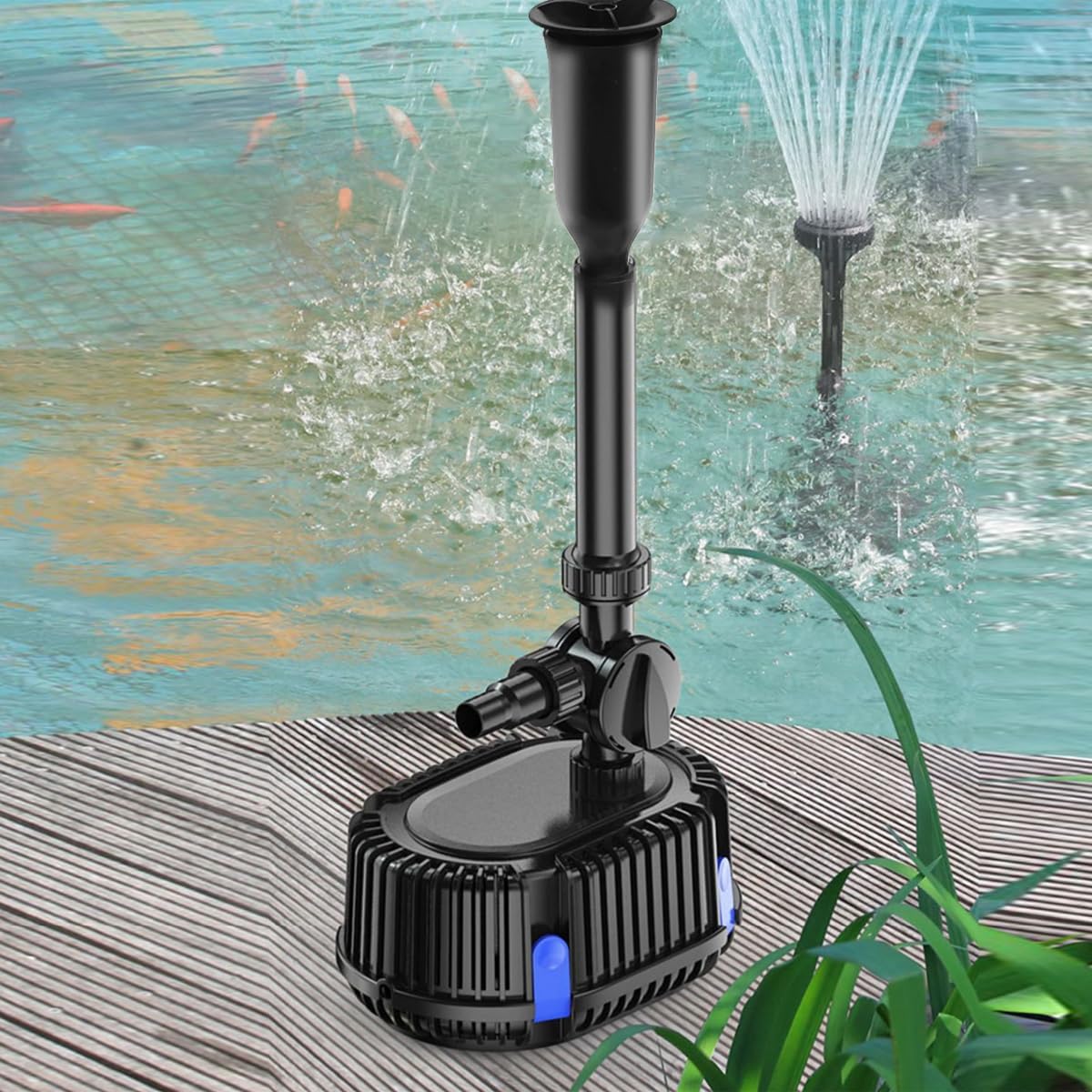
The COODIA CHP-1500 bundles a 400 GPH submersible pump with an integrated filtration housing and three fountain heads so you get circulation, mechanical filtration, and a decorative fountain from one compact unit. You install it in a small-to-medium pond or water garden where it pumps water up to a 6.5 foot head and routes flow through replaceable sponge media to trap debris and reduce clogging. The included three-way diverter and multiple fountain nozzles let you switch between fountain patterns or divert more flow to a waterfall or skimmer. Practical touches like a screw-free lid with a safety clasp and a 16.5 foot cord make routine cleaning and placement straightforward. Expect quiet operation and steady flow suitable for ponds up to roughly 1,300 gallons, but note the unit is made of plastic and is a single combined assembly so heavy-duty commercial use or very large ponds would need a larger, serviceable pump and separate filtration. For gardeners who want an easy all-in-one solution, this covers filtration and visual appeal with minimal setup.
Best for: Gardeners who want a compact, low-effort solution to keep a small pond clear while adding a decorative fountain, and who prioritize easy installation and simple maintenance.
Less Ideal for: Owners of large ponds, intensive koi collections, or those who prefer modular, high-capacity multi-stage filtration setups should look for a more heavy-duty, serviceable system.
- Integrated pump, filter, and fountain nozzles simplify setup and reduce the number of separate components
- 400 GPH pump provides strong circulation suitable for ponds up to about 1,300 gallons
- Three-way diverter and multiple fountain heads let you change fountain patterns or route flow to features
- Screw-free lid with safety clasp and sponge media make cleaning and maintenance quick and tool-free
- Plastic construction and combined unit design limit long-term heavy-duty servicing compared with separate commercial-grade systems
- Not suitable for very large ponds or heavily stocked koi systems that need higher-capacity or multi-stage filtration
Verdict: A handy all-in-one pump and filter kit that keeps small ponds circulating and clear while adding an easy decorative fountain.
Beckett CGFK60 120 GPH 5W Submersible Container Fountain Pump Kit
| Flow Rate | 2 gpm |
|---|---|
| Maximum Lifting Height | 2.25 feet |
| Power Source | Corded Electric |
| Voltage | 120 volts |
| Horsepower | 5 watts |
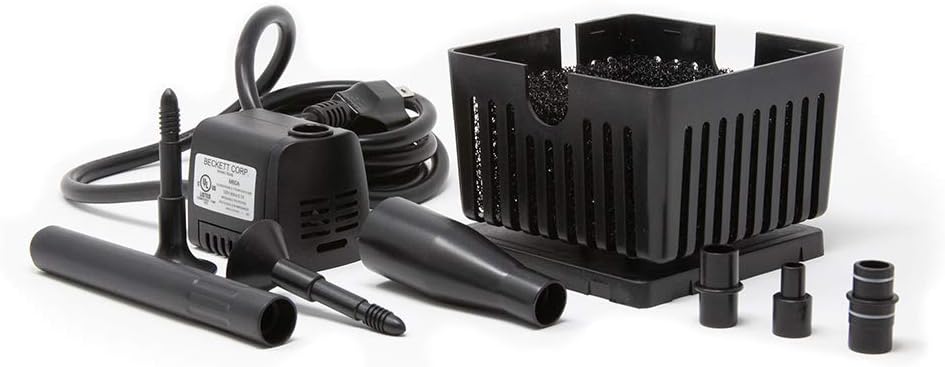
The Beckett CGFK60 is a compact submersible pump kit intended to convert a waterproof container into a small fountain or pond. It delivers up to 120 gallons per hour at just 5 watts and includes a 6 foot cord, adapters, filter, extension tube, and two nozzles for different water patterns. Typical use is straightforward: submerge the pump in a 1–2 foot deep container, attach the desired nozzle and extension, and plug into a GFCI outlet. The low wattage makes it economical to run for long periods and its weighted base helps keep the unit stable in shallow displays. The included intake screen and removable impeller simplify basic maintenance, but the pump’s 2.25 foot maximum lift limits it to low columns of water and small installations. Plastic construction keeps cost and weight down but may not be as durable as heavier materials in uncovered outdoor settings. Overall it is a practical, low‑cost option for adding moving water to patios, balconies, or tabletop gardens where modest flow and energy efficiency matter.
Best for: Buyers who want an inexpensive, energy‑efficient pump to add running water to small containers, patio planters, or tabletop fountains and who prioritize low operating cost and simple setup.
Less Ideal for: People planning taller water features, larger ponds, or heavy outdoor use that requires higher lift capacity and more rugged construction should consider more powerful, heavy‑duty pumps.
- Very low power draw at 5 watts for economical continuous operation
- Includes adapters, filter, extension tube, and two nozzles for immediate setup
- Weighted base and compact size suit small containers and tabletop fountains
- Oil‑free design is safe for plants, fish, and wildlife
- Maximum lift of 2.25 feet restricts use to low fountains and shallow ponds
- Plastic construction may wear faster outdoors compared with metal pumps
Verdict: A budget‑friendly, ultra‑low‑power pump kit that’s ideal for small container ponds and tabletop fountains where economy and easy setup are the priority.
Augicy PF-3000 850GPH Submersible Pond Pump and 4-Layer Filter Kit

| Power Source | Corded Electric |
|---|---|
| Maximum Lifting Height | 6 feet |
The Augicy PF-3000 combines an 850 GPH submersible pump with a built-in 4-layer filter and interchangeable fountain nozzles to serve as a single unit for circulation, filtration, and a decorative fountain in small ponds. You install it directly in the pond and use the included coarse and fine sponges, ceramic rings, and bio balls to capture debris and support biological filtration without chemicals. The pump offers a secondary outlet for a waterfall and three spray patterns for adjustable fountain effects, while a 6 foot maximum lift provides enough head for modest waterfalls or elevated displays. Maintenance is straightforward: open the filter box, lift out the sponges and rinse them and the impeller cover, and leave the ceramic media and bio balls in place for ongoing biofiltration. Practical limitations are that a hose is not included for the secondary outlet and the unit is sized for 100 to 750 gallon ponds, so it is not intended for very large water gardens. It is a quiet, single-unit choice when you want circulation and filtration without installing separate components.
Best for: A pond owner who prioritizes dependable, low-fuss filtration and circulation for a small to medium backyard pond and prefers an integrated single-unit solution over separate pump and filter components.
Less Ideal for: People planning very large ponds, multi-stage filtration systems, or who need included accessories like hoses and lights should consider more specialized or fully equipped alternatives.
- Integrated 4-layer filtration (coarse and fine sponges plus ceramic rings and bio balls) for mechanical and biological cleaning
- High flow 850 GPH pump suitable for 100–750 gallon ponds providing strong circulation and oxygenation
- Three interchangeable fountain nozzles and a secondary outlet allow fountain and waterfall features from one unit
- Tool-free access to filter media and a removable impeller cover for easy routine cleaning
- Secondary outlet requires a separately purchased hose to run an external waterfall
- Designed for small to medium ponds only and may be undersized for large water features
Verdict: A compact, reliable all-in-one pump and biological filter that simplifies maintenance and provides strong circulation for small to mid-size ponds.
VIVOHOME VH556 530 GPH All-in-One Submersible Pond Filter Pump with Fountain

| Power Source | Corded Electric |
|---|---|
| Flow Rate | 2000 liters per hour |
| Maximum Lifting Height | 6.5 feet |
| Horsepower | 42 watts |
| Material Type | PP+ Copper |
The VIVOHOME VH556 is an all-in-one submersible filter pump designed to clean and circulate water while creating a decorative fountain. It houses a 42 W pump that moves up to 530 GPH (about 2000 L/h) through an internal sponge and bio-ball filter before returning water through one of three fountain nozzles. Typical use is simple: set the unit submerged in a backyard pond or water feature, choose a nozzle pattern, and plug in the long 33 ft cord. Notable features include multi-stage filtration to reduce debris and improve clarity, an integrated 9 W LED for nighttime display, and an IPX8 sealed design for weather resistance. Practical benefits are easy setup, reduced maintenance compared with separate pump and filter components, and added aeration from the fountain that helps pond health. Limitations are that it is sized for small to medium ponds and may need occasional cleaning of sponges and bio-balls; the unit is not intended for very large water gardens or heavily silted installations where a larger external filter would be better.
Best for: Buyers who want a low-hassle, single-unit solution to keep a small to medium garden pond clear and attractive with minimal installation and routine maintenance.
Less Ideal for: Gardeners with large water gardens, heavy fish loads, or ponds with substantial sediment buildup should consider a higher-capacity external filter and pump system instead.
- Integrated pump and multi-stage filtration simplifies setup and reduces equipment clutter
- 530 GPH (2000 L/h) flow rate suitable for aeration and circulation in small to medium ponds
- Three interchangeable nozzles let you change fountain patterns for decoration
- IPX8 sealed construction and a 33 ft UL-certified power cord for safe outdoor use
- Built-in LED light adds nighttime visual interest and shows when the light is functioning
- Not designed for very large ponds or heavy sediment where an external canister filter is preferable
- Requires periodic cleaning of sponge and bio-balls to maintain flow and filtration performance
Verdict: A convenient all-in-one pump and filter that adds aeration and a decorative fountain while keeping small to medium ponds cleaner with minimal fuss.
POPOSOAP 660 GPH Pond Pump and Filter Kit with Fountain Attachments

| Power Source | Corded Electric |
|---|---|
| Flow Rate | 2500 liters per hour |
| Maximum Lifting Height | 8.2 feet |
| Voltage | 110 volts |
| Horsepower | 40 watts |
This POPOSOAP kit combines a 660 GPH corded pump with an integrated filter box and a small fountain kit to keep pond water circulating and clearer with minimal setup. It is typically used in backyard koi ponds, water gardens, or decorative courtyard waterfalls where a single unit that handles mechanical and biological filtration plus a fountain display is preferred. The kit includes two filter pads, filter balls, bio-ceramic rings and multiple nozzle heads with a diverter so you can run a fountain, a secondary outlet, or both while adjusting flow. Practical benefits include straightforward installation and easy maintenance thanks to the clip-access lid and replaceable media, plus the pump’s adjustable flow for matching different water features. Important limitations are that the unit is a compact, plastic-bodied system intended for ponds up to the stated capacity so larger or heavily stocked koi ponds may need a dedicated external filter and higher-capacity pump for heavy waste loads. The included components cover basic filtration and aeration but advanced multi-stage filtration or UV sterilization are not part of this single-unit kit.
Best for: Buyers who want a compact, easy-to-install solution that combines filtration, circulation, and a decorative fountain for small to medium backyard ponds and who prioritize convenience and low-maintenance operation.
Less Ideal for: Owners of large, heavily stocked koi ponds or hobbyists seeking advanced multi-stage filtration and professional-grade, long-term durability should consider separate high-capacity pumps and external filters.
- Integrated pump and filter simplifies installation and reduces plumbing work
- 660 GPH pump provides strong circulation suitable for small to mid-size ponds (manufacturer-rated up to 1,180 gallons)
- Includes multiple filter media (pads, balls, bio-ceramic rings) for mechanical and biological filtration
- Fountain kit with three nozzles and diverter enables different water displays and adjustable flow
- Easy-access lid and simple clips make routine cleaning and media replacement straightforward
- Plastic construction may be less durable than heavier-duty external filters over many years
- Not a substitute for large-capacity, multi-stage filtration in heavily stocked or very large koi ponds
Verdict: A convenient, all-in-one pump and filter kit that delivers strong circulation and basic mechanical and biological filtration plus fountain options for small to mid-size koi ponds.
Choosing the Right Small Pond Filter: Key Factors to Consider
Flow Rate Compatibility
Matching filter flow rate to your pond volume matters because too-high flow can stress plants and fish and too-low flow reduces oxygenation and filtration efficiency. Look at the filter's rated liters or gallons per hour and compare it to your pond size; small ponds usually need gentler circulation and may require a flow-control feature to fine-tune performance.
Flow influences how well solids settle and how evenly water passes through media. A controllable flow also helps if you plan to run a small waterfall or stream feature off the same pump.
Mechanical Filtration Capacity
Mechanical filtration captures debris and prevents it from fouling biological media. For small ponds, a filter that traps leaves, hair algae strands, and fish waste in replaceable or washable pads extends the time between cleanings and prevents nutrient spikes.
Consider the accessibility of the mechanical media and whether the pads are easy to rinse without breaking apart. Filters that allow staged mechanical filtration, from coarse to fine, tend to clog less quickly and protect biological zones downstream.
Biological Media Volume
Biological media houses beneficial bacteria that break down ammonia and nitrite. Even in small ponds, adequate media surface area is essential to maintain stable water chemistry, especially with fish or heavy planting.
Evaluate how much porous surface area the filter provides and whether media is retained in a way that maintains flow across the whole bed. Removable bio-cartridges or stacked media trays make inspection and partial maintenance simpler without knocking out the entire bacterial colony.
Ease Of Cleaning & Access
Small-pond owners often prefer filters that minimize hands-on time. Easy-open lids, slide-out media trays, or backwashable designs let you clear solids quickly without interrupting the biological filter more than necessary.
Maintenance design also affects how often you need to empty or lift components. Lightweight cartridges and clear access points reduce the strain of cleaning and make seasonal winter prep or spring startups less of a hassle.
Installation Flexibility
Space around small ponds can be limited. Filters that can be placed below the rim, hidden in compact housings, or mounted externally with simple tubing give you more layout options. Consider whether the unit supports common hose sizes, vertical or horizontal placement, and inclusion of a flow control or valve.
Flexible installation reduces the need for custom plumbing and lets you locate the filter for easier access or better visual integration with landscaping.
Durability & Materials
Filters live in wet, sun-exposed environments and should resist UV, cracking, and corrosion. Durable plastics, sturdy seals, and simple mechanical parts extend service life and reduce the chance of leaks or sudden failures.
Also consider replaceable wear parts. Filters that allow swapping worn seals, O-rings, or media trays avoid full-unit replacement and save time when repairing after freezing or accidental knocks.
Sizing a Filter to Pond Volume
For small ponds, correct sizing reduces algae blooms and keeps oxygen levels steady. Calculate your pond volume and choose a filter system rated for that volume or slightly higher, bearing in mind that manufacturers often rate flow under ideal conditions. Allow margin for plants and fish load which increase filtration demand.
- Aim for a turnover rate that gently circulates the pond several times per hour rather than blasting high flow through shallow margins.
- When using a pump with adjustable flow, set it to avoid disturbing bottom gravel or plant beds.
Placement and Hidden Installation Options
A compact filter that tucks under the pond lip or into a nearby box saves visual space and protects equipment from weather. If space is tight, consider external mounting on a nearby post or a small utility cabinet so service access is easier than reaching into water.
- Ensure any below-rim location still allows airflow to prevent overheating of pump motors.
- Plan hose runs that minimize bends and maintain a steady downward slope where gravity drains are involved.
Preventing and Managing Clogs
Clogging is the biggest maintenance headache in small systems. Use coarse pre-filters or skimmers at the intake to catch big debris before it reaches the main filter. Regular skimming and judicious plant trimming upstream cut down on solids entering the filter. Backwashable designs or easily removable mechanical media let you clear trapped solids without disturbing the biological media too much.
- Schedule light maintenance more often rather than deep cleans rarely to protect bacterial colonies.
- Keep a spare set of mechanical pads on hand so you can swap and rinse without waiting for parts to dry.
Winter Care and Freeze Protection
Small ponds can be more vulnerable to freezing-through because of lower thermal mass. Select a filter and placement that allow you to isolate or winterize the unit easily. Some compact filters permit removal and indoor storage of sensitive components, while others can be run with reduced flow and a small de-icer to keep a breathing hole in the ice. Avoid designs that trap water in high points where freezing can crack housings; easy-drain features are helpful for seasonal shutdowns.
- If you remove the filter for winter, make note of reassembly order and keep small parts in labeled containers.
- Use non-toxic antifreeze products only in external plumbing if absolutely necessary and according to local environmental guidance.
Noise and Wildlife Considerations
In small garden and patio settings, mechanical noise and splash can be more noticeable. Look for filters that operate quietly or can be mounted in sound-dampening enclosures. Also consider wildlife and pet access-filters should protect small animals from getting trapped by intakes and avoid attracting insects with exposed organic buildup. A well-sealed lid and screened inlets reduce nuisance insects and protect beneficial wildlife from accidental entrapment.
- Rubber feet or isolation mounts reduce vibration transferred to hard surfaces.
- Screened intakes and protective grates are inexpensive additions that improve safety.
How We Chose the Best Small Pond Filter
We focused on attributes that affect real-world pond health and owner effort for small ponds. Primary evaluation criteria included flow rate compatibility with pond volume and pump pairing, the balance and quality of mechanical versus biological media, user-friendly cleaning and maintenance features, and the filter's footprint and installation flexibility for constrained pond edges or below-deck placement. We also considered construction durability and materials that resist UV and wet/dry cycling, plus how well designs limit clogging and fish disturbance. We excluded filters designed strictly for large water gardens or waterfall-only systems because their flow profiles and media loads do not scale down well. Systems requiring complex plumbing or constant professional servicing were also omitted. The final shortlist favors units that reliably support clear, healthy small ponds with manageable upkeep and straightforward pump matching.
FAQ
What flow rate is best for a small pond filter?
It usually depends on pond volume and stocking level. Aim for a gentle turnover that circulates the pond several times per hour rather than a very high flow. A filter with adjustable flow makes matching the pump easier.
How often should I clean the filter pads in a small pond?
Often it depends on debris load, but many small ponds benefit from a light rinse every one to three weeks and a deeper clean monthly. Frequent light maintenance protects the biological media better than infrequent harsh cleanings.
Can a small filter support a waterfall or fountain feature?
Sometimes. Small filters can power modest water features if the combined pump and plumbing are sized correctly. Make sure flow control is available so the feature does not overwhelm filtration or disturb plants and fish.
Do I need biological media in a small pond filter?
Usually yes. Biological media provide surface area for beneficial bacteria and are important for ammonia and nitrite control even in smaller volumes. Ensure the filter design keeps this media wet and oxygenated while protecting it from clogging by solids.
How do I winterize a small pond filter?
Options include lowering flow, removing and storing sensitive components indoors, or ensuring the unit can fully drain to avoid freeze damage. Choose a filter that allows easy access for seasonal shutdown steps.
Will the filter remove green water and algae?
Mechanical and biological filtration help control the causes of green water by removing solids and cycling nutrients. For free-floating algae causing green water, additional steps like UV clarification or nutrient reduction are often needed.
Final Verdict
Focus on matching the filter flow and media balance to your pond size and biological load. Prioritize a design with accessible mechanical pads and sufficient biological surface area so you can maintain bacterial colonies without frequent full cleanings. Tradeoffs are real: compact units save space but may need more frequent attention, while slightly larger housings offer more media and longer service intervals. Choose a unit that fits your installation constraints and cleaning habits so you maintain clear, healthy water with minimal hassle.
