

Note: This article contains affiliate links. If you click on these links and make a purchase, I may earn a small commission at no extra cost to you. This helps support my research and content. Read my full affiliate disclosure here.
When you grow vegetables, knowing what is in your soil changes the way you fertilize, lime, and amend beds. A good soil test kit for vegetable gardens gives you pH, key nutrient levels, and sometimes organic matter guidance so you can make targeted adjustments rather than guesswork. This guide shortlists seven top options suited to home vegetable plots, patio raised beds, and community gardens. We evaluated each kit on the accuracy of its readings, how easy it is to use in the field, the range of nutrients measured, and any follow-up resources for interpretation. The picks below are the most practical choices for gardeners who want reliable, actionable results without specialized equipment.
Top Picks at a Glance
| Best Overall The best all-around choice for most situations | LaMotte Turf and Garden Soil Test Kit (pH, N, P, K) |  |
| Best Quality Built to a higher standard if you want something more solid | MySoil Professional Mail-In Soil Test Kit (Single Test) |  |
| Best Value The sweet spot between price and what you get | Luster Leaf Rapitest Soil Test Kit (40 Tests) |  |
| Best Budget The cheapest option that still gets the job done reliably | Palinoia 2-in-1 Soil Test Kit for pH and Nitrate-Nitrogen (100 Strips) |  |
| Highest Rated A top-rated pick with lots of positive feedback | SaySummer 4-in-1 Soil Test Kit (80 Tests) for pH, N, P, K |  |
| Most Popular A crowd favorite that many people choose with confidence | SONKIR MS02 3-in-1 Soil Meter (Moisture, pH, Light) |  |
| Best Seller A high-volume bestseller chosen again and again | Luster Leaf Rapitest Soil Test Kit (20 Tests) |  |
LaMotte Turf and Garden Soil Test Kit (pH, N, P, K)

| Tests included | pH, nitrogen, phosphorus, potassium |
|---|---|
| pH tests | 30 tests |
| N/P/K tests | 15 tests each |
| Includes | Garden Guide manual and Soil Handbook |
The LaMotte Turf and Garden Soil Test Kit is a reagent-based kit designed to measure soil pH and the three primary macronutrients (N, P, K) with color-matching charts and step-by-step instructions. You collect representative samples from the area you plan to plant, follow the contained procedures for each parameter, and compare results to the included laminated charts and Garden Guide to decide on lime or fertilizer adjustments. The kit supplies more tests for pH (about 30) and roughly 15 tests each for N, P and K, which makes it useful for tracking multiple beds over a season. Its strengths are clear instructions, an educational handbook for interpreting results, and replaceable reagent-based chemistry that tends to be more accurate than simple reader strips. Limitations are that tests require careful sample prep and handling, they are not instant digital readouts, and interpreting borderline color matches can be subjective. For vegetable gardeners who want actionable guidance rather than a single quick reading, this kit delivers a thorough, repeatable soil picture.
Best for: Vegetable gardeners who want a practical, educational soil analysis to inform lime and fertilizer decisions and are willing to follow reagent-based procedures for repeatable results.
Less Ideal for: Gardeners who need a single fast digital reading or those unwilling to collect and prepare representative soil samples.
- Measures pH plus nitrogen, phosphorus and potassium for a rounded soil analysis
- Includes Garden Guide manual and Soil Handbook to interpret results and plan amendments
- Supplies multiple tests (about 30 pH tests and 15 tests each for N, P and K) for tracking over time
- Reagent-based chemistry typically gives more reliable results than basic test strips
- Color-matching requires careful technique and can be subjective on borderline readings
- Testing involves multiple steps and sample preparation rather than instant electronic readouts
Verdict: A thorough reagent-based kit that gives vegetable gardeners actionable pH and NPK results plus interpretive guidance for informed fertilizing and liming decisions.
MySoil Professional Mail-In Soil Test Kit (Single Test)
| Number of Packs | 1 |
|---|---|
| Unit Count | 1 Count |
| Manufacturer | Predictive Nutrient Solutions, Inc |
The MySoil mail-in kit is designed to give vegetable gardeners a lab-quality nutrient and pH analysis without needing specialty equipment. You collect a single soil sample using the included vial and instructions, register the kit online, and return the prepaid envelope to the lab; results arrive in about 6 to 8 days in an online dashboard. The report covers 13 plant-available nutrients plus pH and pairs those measurements with clear, crop-focused recommendations for what to apply, how much, and when, including organic and conventional options. For performance-driven gardeners this reduces guesswork and helps target fertilizer and lime applications to improve yields and plant health. The kit is single-use, so larger beds or repeated monitoring require additional kits, and turnaround time means it is not an instant field test. But the trade-off is professional accuracy and tailored guidance that can prevent wasted product and improve results in vegetable beds.
Best for: Vegetable gardeners who prioritize accurate, actionable soil data to fine-tune fertility and maximize crop performance and yields.
Less Ideal for: Gardeners who need instant field results, want a reusable handheld meter, or who only need a quick pH check for casual container plants.
- Laboratory-grade analysis of 13 plant-available nutrients plus pH for reliable results
- Includes prepaid mailer and online registration for simple sample submission and results delivery
- Custom, crop-focused recommendations that specify what to apply, how much, and when
- Works for all soil types and growing scenarios relevant to vegetable gardens
- Single-use kit requires buying more kits for multiple beds or repeat testing
- Results take 6–8 days, so it is not useful for immediate, on-the-spot decisions
Verdict: Get lab-accurate nutrient and pH analysis plus tailored fertilizer plans to optimize vegetable garden performance.
Luster Leaf Rapitest Soil Test Kit (40 Tests)

| Includes tests | pH, Nitrogen, Phosphorus, Potash |
|---|---|
| Number of tests | 40 tests (10 per parameter) |
| Battery | No batteries required |
The Luster Leaf Rapitest kit is a straightforward, at-home soil test kit built for vegetable gardens and general garden beds. Using a capsule system and printed color comparator, it provides quick visual results for soil pH and the three primary nutrients N, P and K. The kit includes materials for 40 tests (10 each for pH, N, P and K) and comes with instructions plus a plant pH preference list to help interpret results and pick amendments. In practice it is easy to use: collect small soil samples, mix with the provided reagents, then compare the sample color to the chart. That makes it handy for routine checks across multiple beds or for tracking changes after fertilizing. Limitations are its reliance on visual color matching rather than digital readouts, which can introduce user variation, and it reports broad nutrient levels rather than detailed concentrations or micronutrients. For growers who need fast, repeatable guidance for feeding and lime decisions, this kit covers the essentials without extra complexity.
Best for: Home vegetable gardeners who want a quick, repeatable way to check soil pH and the main nutrients and act on results without lab work.
Less Ideal for: Users who need laboratory-grade accuracy, precise nutrient concentrations, or micronutrient analysis for professional soil management.
- Covers four core tests (pH, nitrogen, phosphorus, potash) useful for vegetable garden fertility planning
- Supplies for 40 tests allow regular monitoring across multiple beds
- Easy capsule system and color comparator require no batteries or special tools
- Includes plant pH preference list and simple instructions for actionable recommendations
- Color-matching method is subjective and less precise than electronic meters or lab analysis
- Does not measure micronutrients or provide exact concentration values
Verdict: A simple, reliable kit for vegetable gardeners to routinely check pH and primary N-P-K levels and make informed amendment decisions.
Palinoia 2-in-1 Soil Test Kit for pH and Nitrate-Nitrogen (100 Strips)

| Unit Count | 100 Count |
|---|---|
| Sterility Rating | 0.0-14.0 |
| Recommended Uses For Product | Soil Testing, pH Test |
The Palinoia 2-in-1 kit gives vegetable gardeners a low-cost way to check soil acidity and the plant-available form of nitrogen quickly at the bed or in containers. Use it by mixing a soil sample with water, letting solids settle, dipping a strip, and matching the strip to the included color chart. The pack includes 100 strips plus a sampling spoon, test tube, and resealable pouches so you can test multiple beds or check repeat samples over a season. Measuring both pH and nitrate-nitrogen in the same strip helps you decide whether to lime, sulfur, or adjust nitrogen applications for leafy vegetables and fruiting crops. The main limitations are that the nitrogen result is for nitrate only so it will not reflect ammonium or urea-based fertilizers, and color-chart strip tests are less precise than lab analysis or digital meters. For gardeners on a budget who need straightforward, repeatable spot checks, this kit is a practical and easy option; if you need lab-grade accuracy or a broader nutrient profile you will want a different method.
Best for: Vegetable gardeners watching costs who want an easy, repeatable way to monitor soil pH and nitrate levels across beds and containers throughout the season.
Less Ideal for: Gardeners who require lab-quality nutrient analysis, a full N-P-K profile, or precise digital pH readings for research or commercial production.
- Two-in-one strips test soil pH and plant-available nitrate-nitrogen in a single step
- Large 100-count supply suitable for seasonal testing across multiple beds
- Includes sampling spoon, test tube, and resealable pouches for clean, repeatable sampling
- Simple mix-and-dip procedure with fast, color-chart results ideal for beginners
- Nitrogen measurement detects nitrate only and does not report ammonium or urea forms
- Color-chart strips are less precise than laboratory tests or electronic meters
Verdict: A budget-friendly, beginner-friendly kit that delivers quick pH and nitrate-nitrogen checks so vegetable gardeners can make informed feeding and lime decisions.
SaySummer 4-in-1 Soil Test Kit (80 Tests) for pH, N, P, K

| Tests included | 80 total (20 per element) |
|---|---|
| Parameters tested | pH, Nitrogen, Phosphorus, Potassium |
| Manufacturer | SaySummer |
The SaySummer 4-in-1 Soil Test Kit provides a practical, low-cost way to monitor the four key soil factors vegetable gardeners care about: pH, nitrogen, phosphorus, and potassium. It includes 80 tests (20 per element) and a full set of consumables and tools such as test strips, reagent tablets, centrifuge and graduated tubes, a sampling scoop, and a color chart, so you can perform routine checks at home without lab fees. Typical use involves sampling soil, mixing with the provided reagents, and comparing the result to the printed color chart to decide on lime or fertilizer adjustments. Notable benefits are the high test count for ongoing monitoring and the clear step-by-step instructions that make it accessible to novice gardeners. The kit is best suited for regular maintenance testing rather than precise laboratory analysis, so results are good for trend tracking and day-to-day decisions but may lack the finer resolution of professional lab reports. Expect simple, actionable guidance for improving vegetable bed fertility when used consistently over a season.
Best for: Vegetable gardeners who prioritize dependable, repeatable home checks to keep fertility on track and prefer doing routine testing themselves instead of sending samples to a lab.
Less Ideal for: Users who need laboratory-grade accuracy for research, certification, or diagnosing subtle nutrient imbalances should use professional lab testing instead.
- Covers four critical measurements (pH, nitrogen, phosphorus, potassium) useful for vegetable gardens
- Includes 80 tests (20 per parameter) so you can monitor soil across a season
- Complete kit with tubes, scoop, dropper, reagents, and a color chart for straightforward field use
- Clear instructions make it accessible to gardeners with limited lab experience
- Color-chart strip and strip-based readings are less precise than laboratory analyses
- Requires careful sample preparation and subjective color matching which can introduce variability
Verdict: This kit is the practical choice for vegetable gardeners who want a reliable, all-in-one home testing solution to track pH and macronutrients across a growing season.
SONKIR MS02 3-in-1 Soil Meter (Moisture, pH, Light)
| pH range | 3.5-8 |
|---|---|
| moisture range | 1-10 |
| probe length | 7.9 inches |
| power | No battery required |
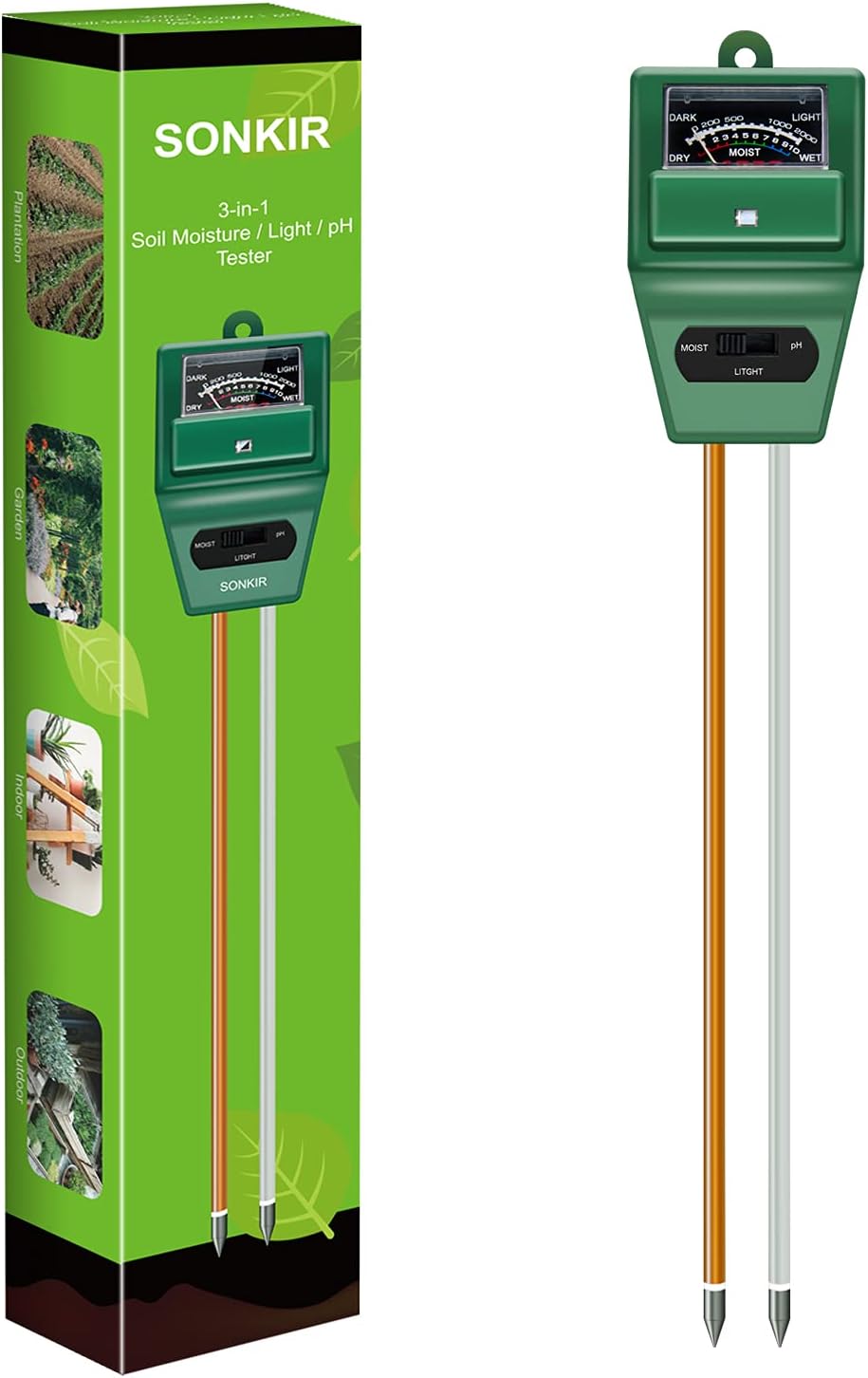
The SONKIR MS02 is a handheld, battery-free soil meter that gives quick, at-a-glance readings for moisture, pH, and light using a dial display and a single probe. To use it you switch the dial to the desired mode, insert the probe about 6 to 7 inches into the soil, wait roughly 10 minutes, then read the needle on the panel. Its key strengths are straightforward operation, portability, and no-battery convenience, which make it useful for routine checks across raised beds, vegetable rows, and potted seedlings. The pH scale covers roughly 3.5 to 8 and moisture is shown on a 1 to 10 scale so you can judge dry, normal, or wet conditions quickly. Important limitations are its analogue accuracy compared with lab tests, sensitivity to very dry soil where the indicator may not move, and the probe should not be forced into hard ground or left permanently in soil. For a vegetable garden this meter is a practical, low-effort tool to spot-check conditions and guide watering and basic pH adjustments, but it is not a substitute for precise laboratory analysis.
Best for: Gardeners who want an affordable, low-effort way to monitor basic soil conditions across a vegetable garden and make practical watering and pH decisions without technical setup.
Less Ideal for: Users who need laboratory-grade pH accuracy, continuous logging, or who frequently test in compacted, rocky soil should consider a digital meter or professional soil testing service.
- 3-in-1 functionality measures moisture, pH, and light with a single probe
- No batteries required for simple, always-ready use
- Compact and portable for spot checks across beds, pots, and raised planters
- Clear analog dial that shows moisture on a 1–10 scale and pH from 3.5–8
- Analog needle is less precise than lab or digital meters
- Will not register in very dry soil unless prewatered and cannot test liquids
- Probe can be damaged if forced into hard or rocky ground
Verdict: A cheap, no-battery 3-in-1 meter that gives quick, practical spot checks of moisture, pH, and light for everyday vegetable garden care.
Luster Leaf Rapitest Soil Test Kit (20 Tests)

| Brand Name | Luster Leaf |
|---|---|
| Unit Count | 20 Count |
| Item Type Name | Soil Test Kit |
| Number of Packs | 5 |
The Luster Leaf Rapitest kit gives vegetable gardeners a straightforward way to check soil pH and the three primary nutrients (N, P and K) at home. It uses a capsule-based chemistry system and a patented color comparator chart so you mix soil with reagents, compare the resulting colors, and read approximate levels for each test. The kit includes enough reagents and materials for 20 tests, which is typically enough to spot-check several beds and planting areas. Practical benefits include simple step-by-step instructions, a plant pH preference list for over 450 plants, and no special tools or lab trips required. Limits are that results are approximate rather than laboratory-accurate, color matching can be subjective in low light, and the kit does not measure secondary or micronutrients or organic matter. For a risk-averse home vegetable gardener this kit is an affordable, easy first step to guide pH adjustments and basic fertilization decisions, but it should be treated as a screening tool rather than a precision analysis.
Best for: Home vegetable gardeners who want an easy, low-risk way to check soil pH and basic nutrient levels before amending or fertilizing.
Less Ideal for: Gardeners who need laboratory-accurate soil analysis or who require tests for micronutrients, organic matter, or advanced soil chemistry.
- Covers pH plus primary nutrients N, P and K in one kit
- Includes supplies for 20 individual tests to check multiple beds
- Simple capsule system and clear instructions suitable for beginners
- Plant pH preference list for over 450 species helps translate results into action
- Provides approximate, not laboratory-grade, results
- Color comparator readings can be subjective under poor lighting
Verdict: A simple, beginner-friendly kit for quickly screening pH and primary nutrient levels across vegetable beds so you can make informed basic fertilizer and lime decisions.
Choosing the Right Soil Test Kit for Vegetable Gardens: Key Factors to Consider
Test Accuracy and Method
Accuracy determines how closely a kit's numbers reflect the actual soil chemistry. For vegetable gardens you need results you can act on, such as reliable pH readings and realistic nutrient concentrations rather than broad categories. Kits using calibrated reagents, colorimetric comparisons with reference standards, or that send samples to certified labs generally give more dependable data.
Understanding the underlying method helps you interpret borderline results. Some field kits are best for rough troubleshooting, while lab-style tests reveal subtle deficiencies that matter for heavy-feeding crops. Choose a method with documentation so you know the margin of error for each parameter.
Which Nutrients and Properties Are Measured
Vegetable crops respond differently to pH, nitrogen, phosphorus, and potassium levels, but micronutrients like magnesium and calcium can also affect yield and flavor. A useful kit measures at least pH, available phosphorus, and exchangeable potassium, and ideally includes tests for organic matter or cation exchange where relevant.
If you grow specific crops that have unique nutrient needs, check whether the kit covers those elements or whether additional testing will be needed. The more targeted the coverage, the fewer follow-up tests you will need to plan amendments effectively.
Sampling Procedure and Tools
Good results start with good sampling. Kits that include probe tools, clear sampling depth guidance, and labelled sample containers reduce user error. For vegetable beds, sampling at planting depth and combining multiple subsamples into a composite sample gives a truer picture of the root zone.
Clear instructions on cleaning tools between samples and where to collect across the bed or garden prevent contaminated readings. Consider whether the kit supports multiple tests from a single sampling session if you plan seasonal monitoring.
Clarity of Results and Recommendations
Numbers are useful only if you know what to do with them. Kits that present results with clear ranges, crop-specific recommendations, or conversion guidance for common fertilizers make it easier to translate a test into an amendment plan. Some kits provide interpretation charts for vegetable crops, while others offer online calculators.
Look for kits that explain how to adjust pH safely and how to apply nutrient corrections in pounds per 100 square feet or grams per pot to avoid under- or over-application.
Repeatability and Long-Term Monitoring
Vegetable gardening benefits from seasonal testing so you can track how amendments change soil chemistry over time. A kit that gives repeatable measurements and enough reagents or test strips for multiple uses reduces long-term cost and effort.
Consider whether the kit's components have shelf life limits and how easy it is to replicate the same sampling and testing routine month to month. Consistent methods let you compare results reliably and refine your fertility program.
Safety and Environmental Considerations
Some soil tests use chemical reagents that require careful handling and disposal. For home gardeners, kits with nonhazardous reagents, clear safety instructions, and minimal waste are more practical. If sending samples to a lab, verify how they handle and return data rather than chemical waste.
Also weigh whether the recommended corrective actions align with organic gardening practices if that is important. Kits that offer guidance for both synthetic and organic amendments give more flexibility for different growing philosophies.
When to Test Vegetable Garden Soil
Test before planting, especially at the start of the growing season, to set pH and nutrient baselines for your main crops. A pre-plant test lets you correct pH with lime or sulfur and add phosphorus and potassium where needed so amendments integrate before seedlings need them.
Repeat testing after heavy-feeding cycles or when yields decline. Regular checks help you spot persistent deficiencies, track the effect of compost or fertilizer programs, and avoid the damage that comes from repeated over-application of nutrients.
- Ideal timing: early spring and after main harvest for fall crops
- Test every 2 to 4 years for stable beds, more often for new beds or problem spots
- Sample after soils have dried to a workable moisture level for consistent readings
Sampling Best Practices for Vegetables
Collect multiple subsamples from each bed or planting area and mix them into a single composite sample. For small raised beds, take 6 to 8 subsamples across the bed; for larger in-ground plots, take 10 or more spaced samples. This evens out localized variability caused by spot fertilizing or past amendments.
Sample at the effective root zone depth for the crops you grow. For shallow-rooted vegetables sample 3 to 6 inches deep; for deeper-rooted crops like tomatoes sample 6 to 8 inches. Avoid sampling directly next to compost piles, fertilizer bands, or obvious anomalies.
- Use a clean trowel or soil probe and label samples clearly
- Remove plant debris and let samples air-dry if a kit requires dry soil
- Record location and planting history for repeatable monitoring
Understanding pH and Why It Matters
Soil pH controls nutrient availability more than most gardeners realize. Many vegetables prefer a slightly acidic to neutral range. Outside that window certain nutrients become less available even when present in the soil.
Adjusting pH takes time. Lime raises pH slowly and must be worked in before planting when possible. Sulfur lowers pH but acts over months. Use kit results to plan seasonal corrections rather than quick fixes.
- Slight pH tweaks can unlock locked-up nutrients without adding more fertilizer
- Different vegetables tolerate pH differently; check crop-specific ideal ranges
- Follow application rate guidance tied to test results to avoid overshooting
Interpreting Nutrient Numbers for Action
Look for test kits that report nutrient levels on a usable scale with clear thresholds labeled low, medium, and high. For vegetable gardens, low phosphorus or potassium readings suggest where to apply targeted fertilizers or rock phosphate and potash alternatives.
Consider nutrient interactions. High phosphorus can interfere with micronutrient uptake, and excess potassium can affect magnesium balance. Use reported levels to plan balanced feeding rather than adding a single nutrient repeatedly.
- Translate lab numbers to application rates in household terms before applying
- Pair soil test results with tissue testing or observation when diagnosing stubborn problems
- Monitor the same spots year to year to see amendment effectiveness
Using Test Results With Compost and Organic Amendments
Compost supplies slow-release nutrients and organic matter but is not a substitute for targeted mineral corrections when tests show specific deficiencies. Use soil test results to decide when to add concentrated sources like bone meal or greensand versus relying solely on compost.
Organic gardeners can use test-guided inputs like rock phosphate, kelp meal, or dolomitic lime to move nutrient levels into the preferred range while maintaining organic certification practices. The goal is balanced fertility that supports continuous vegetable production.
- Match amendment choice to the nutrient shortfall and crop needs
- Avoid over-applying compost to correct micronutrient deficiencies; it may dilute or mask issues
- Schedule heavier mineral corrections at least a few weeks before planting where possible
How We Chose the Best Soil Test Kit for Vegetable Gardens
We focused on features that matter in a vegetable garden context rather than marketing claims. Primary evaluation criteria were analytical accuracy, represented by lab-style or calibrated test methods; test coverage, meaning which nutrients and soil properties the kit reports; user workflow, including sampling tools, instructions, and clarity of result interpretation; and repeatability, or whether the kit produces consistent readings across multiple samples. We also considered sample preparation and safety, so gardeners are not handling reagents with unclear instructions. Kits that included clear corrective guidance, such as fertilizer recommendations keyed to vegetable crops, scored higher. We excluded any products that only provided vague pass-fail color charts without a documented testing method, and we did not include kits that required sending samples to obscure or unverified labs. In short, listed kits met thresholds for measurable accuracy, practical nutrient coverage for vegetables, straightforward field use, and reliable documentation. These filters ensure options are suitable for home and community gardeners who need actionable soil data.
FAQ
How often should I test soil in a home vegetable garden?
Test at least once every two to four years for established beds. Test annually or seasonally if you grow heavy-feeding crops, have new beds, or see declining yields.
Can I use a simple pH strip test for all vegetable needs?
pH strips are useful for quick checks but do not report nutrient levels. For targeted fertilization and diagnosing deficiencies, choose a kit that measures pH plus phosphorus and potassium at minimum.
Do I need to send samples to a lab for reliable results?
Not always. Some home kits use calibrated methods that provide actionable accuracy. Lab testing can be more precise for complex micronutrient analysis, but many vegetable gardeners get everything they need from high-quality field or mail-in kits with documented methods.
How much soil do I need for an accurate test?
A composite sample made from multiple subsamples totaling a few cups is usually sufficient. The key is mixing several spots within the same planting area to average out localized variation.
Will test results tell me exact fertilizer amounts to apply?
Good kits will translate soil levels into recommended application rates or ranges. Use those recommendations as starting points and adjust based on crop response and follow-up testing.
Final Verdict
For vegetable gardeners the best soil test kit is the one that produces reliable numbers you can act on. Prioritize kits with documented accuracy, the right nutrient coverage for your crops, and clear interpretation guidance that converts results into amendment plans. Balance short-term fixes with a longer-term monitoring routine so you can refine fertility over seasons. Ultimately, choose a testing approach that fits your workflow and growing philosophy. If you need precise micronutrient data, favour a calibrated lab-style method; if you want quick, repeatable checks for pH and primary nutrients, select an easy-to-use kit with solid documentation.
