

Note: This article contains affiliate links. If you click on these links and make a purchase, I may earn a small commission at no extra cost to you. This helps support my research and content. Read my full affiliate disclosure here.
If your yard has weak municipal pressure, a well-chosen sprinkler head can mean the difference between patchy watering and a healthy lawn. Low-pressure sprinkler heads are designed to run efficiently with limited flow, using nozzle geometry and spray patterns that maintain coverage without wasting water. This guide shortlists five thoughtfully selected options built for low-pressure situations and evaluates them on real gardener concerns like spray efficiency and clog resistance. Read on to understand which features matter for your system and why these picks work in low-pressure yards.
Top Picks at a Glance
| Best Overall The best all-around choice for most situations | WOVSTNOV 1/2" Adjustable Pulsating Impact Sprinkler Head, 2-Pack |  |
| Best Quality Built to a higher standard if you want something more solid | Rain Bird 1804HDSP PRS Dual Spray Pop-Up Sprinkler, 4" Pop-Up, 180° Half Circle |  |
| Best Value The sweet spot between price and what you get | Rain Bird 1804QDSPRS Pressure‑Regulating 4" Dual Spray Pop‑Up (90° Quarter, 8–15 ft) |  |
| Best Budget The cheapest option that still gets the job done reliably | Orbit Rectangular Spot Spray Sprinkler (58023N) |  |
| Highest Rated A top-rated pick with lots of positive feedback | Rain Bird 1804APPR25 1800 Series PRS Pressure-Regulating 4" Pop-Up Sprinkler |  |
WOVSTNOV 1/2" Adjustable Pulsating Impact Sprinkler Head, 2-Pack

| Thread Size | 1/2 inch |
|---|---|
| Number of Pieces | 2 |
| Material Type | Plastic |
These WOVSTNOV impact sprinkler heads are designed for homeowners who need reliable coverage on lower-pressure systems. Each plastic head threads onto a standard 1/2-inch hose or pipe and uses a pulsating impact mechanism to deliver a rotating spray that can be set anywhere from a partial arc up to full 360 degrees. The package includes two heads so you can run two zones or keep a spare. Notable features are the tool-free, hand-tight 1/2-inch thread for quick installation, an adjustable flow control for matching delicate seedlings or thirsty turf, and a pressure-adaptive design claimed to maintain up to about 60 feet of reach under lower pressure. Because the bodies are molded plastic with UV and rain resistance, they are lightweight and corrosion-free but not as rugged as metal sprinklers for heavy commercial use. Expect straightforward setup and wide-area, even watering for lawns, beds, and vegetable plots, with the usual limitation that plastic parts can wear faster than brass under constant exposure or high-impact conditions.
Best for: Gardeners who need an affordable, easy-to-install sprinkler that performs well on low-pressure supplies and covers medium to large home lawns or beds without extra pumps.
Less Ideal for: Commercial users or those wanting the longest-lasting, heavy-duty hardware should consider metal impact sprinklers or brass models instead.
- Designed to work with standard 1/2-inch hose or pipe for easy, tool-free installation
- 0–360° adjustable spray pattern lets you target partial or full-circle coverage
- Pressure-adaptive pulsating mechanism intended to maintain long reach on low-pressure systems
- Two-pack gives value for multi-zone setups or a spare replacement
- Plastic construction is less durable than metal under heavy use or impacts
Verdict: A practical two-pack impact sprinkler that delivers adjustable, wide-area irrigation on low-pressure garden systems with quick, tool-free installation.
Rain Bird 1804HDSP PRS Dual Spray Pop-Up Sprinkler, 4" Pop-Up, 180° Half Circle

| Pop-up height | 4" |
|---|---|
| Pattern | 180° half circle |
| Spray distance | 8' – 15' |
| Pressure regulator | Built-in 30 psi |
The Rain Bird 1804HDSP PRS is a performance-focused pop-up spray head designed to give even, reliable irrigation in zones with fluctuating or high pressure. It installs like a standard 1800 Series head and is typically used for lawns and small planting beds where precise half-circle coverage is needed. The built-in PRS regulator holds outlet pressure near 30 psi so the nozzle avoids misting and wind drift while keeping radius and distribution consistent. The dual-spray nozzle supplies close-in watering near the head plus a longer outer ring to eliminate brown spots. Practical features for maintenance include a stainless-steel spring for positive retraction, a co-molded wiper seal to resist grit and leakage, and top-accessible components for quick flushing or nozzle swaps. You can fine-tune spray distance with the stainless adjustment screw and the MPR nozzle maintains matched precipitation with other Rain Bird fixed/adjustable heads. Limitations are that it is a fixed half-circle pattern and intended for 4" pop-up installations only, so it is not a one-size-fits-all rotor replacement and requires matching inlet and head spacing for ideal coverage.
Best for: Homeowners or installers focused on efficient, reliable irrigation performance who need consistent spray behavior in low or variable-pressure systems and want commercial-grade durability.
Less Ideal for: Gardeners who need full-circle or highly adjustable arc control, or those replacing rotor heads for large-radius coverage should consider other head types.
- Built-in 30 psi PRS regulator reduces misting and evens performance across zones with variable pressure
- Dual-spray nozzle provides close-in and outer-ring coverage to prevent dry spots near the head
- Top-serviceable design and stainless-steel spring allow easy maintenance and reliable retraction
- Adjustable radius (8'–15') with captured adjustment screw for precise tuning and matched precipitation rate compatibility
- Fixed 180° half-circle pattern limits flexibility compared with adjustable or rotary heads
- Designed for 4" pop-up installs only, so different pop-up heights require other models
Verdict: Choose this head when you need a durable, pressure-regulated spray that delivers consistent close-in and outer-ring coverage in low or variable-pressure lawn zones.
Rain Bird 1804QDSPRS Pressure‑Regulating 4" Dual Spray Pop‑Up (90° Quarter, 8–15 ft)
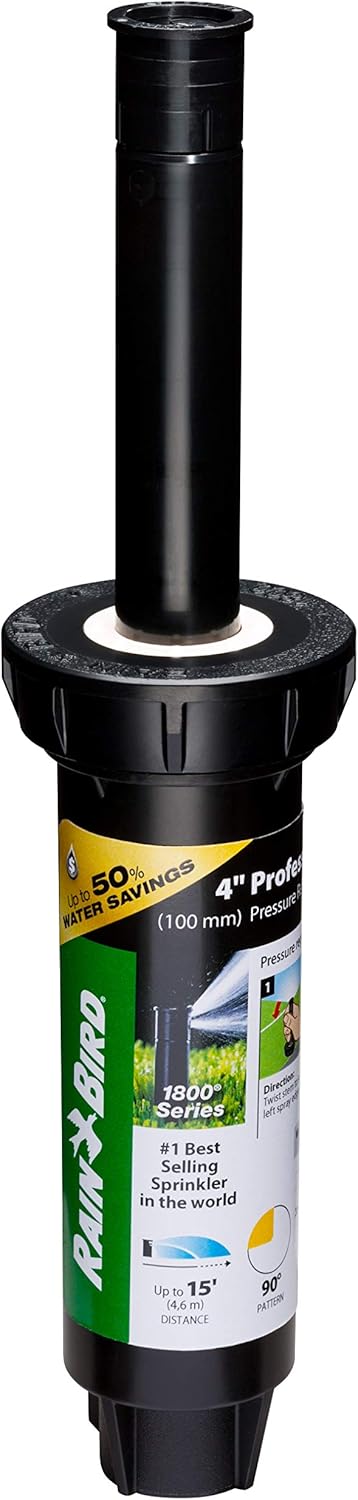
| Pop‑up height | 4" |
|---|---|
| Pattern | 90° quarter circle |
| Spray distance | 8'–15' |
| Nozzle type | Matched Precipitation Rate dual spray MPR |
| Inlet size | 1/2" |
The Rain Bird 1804QDSPRS is a 4" pop‑up spray head built for steady, efficient watering in zones with fluctuating or high pressure. It integrates a 30 psi pressure regulator in the stem so the nozzle sees consistent outlet pressure, which cuts misting and wind drift and can reduce water use by up to half compared with non‑regulated heads. The factory‑installed MPR dual‑spray nozzle gives both close‑in and longer reach coverage across a 90° quarter‑circle pattern with an adjustable radius from about 8 to 15 feet. Installation and maintenance are straightforward because the top‑serviceable design and stainless‑steel spring allow flushing and nozzle swaps without digging. Important limitations are that this is a fixed‑pattern quarter‑circle head so you need the correct arc for the location, and it is one head size and pop‑up height (4") so matching adjacent heads for aesthetics or mowing clearance may require different models. Overall it is a practical choice when you want reliable, water‑saving performance in low or variable pressure systems.
Best for: Homeowners optimizing irrigation efficiency who need a reliable spray head that controls pressure-related misting and improves uniformity across low or variable pressure zones.
Less Ideal for: People who need multi‑arc adjustable heads or a different pop‑up height for turf management or where quarter‑circle coverage is not appropriate.
- Built‑in 30 psi pressure regulator prevents misting and improves uniformity
- Dual‑spray MPR nozzle provides close‑in and longer reach watering for fewer dry spots
- Top‑serviceable design and stainless‑steel spring make maintenance and nozzle changes easy
- Adjustable radius (8–15 ft) via simple top screw for on‑site tuning
- Fixed 90° quarter‑circle pattern means you must choose the correct arc; not adjustable to other arcs
- Available only in a 4" pop‑up height for this SKU, which may not suit all lawn mowing or aesthetic preferences
Verdict: Choose this head when you need a simple, top‑serviceable spray that enforces 30 psi at the nozzle to cut misting and save water in low or variable pressure systems.
Orbit Rectangular Spot Spray Sprinkler (58023N)

| Included components | Zinc Rectangular Spray Sprinkler |
|---|---|
| Material Type | Polyvinyl Chloride |
| Model Number | 58023N |
| Item Type Name | Lawn Sprinkler |
The Orbit Rectangular Spot Spray Sprinkler is a simple, hose-end sprinkler made for watering small patches of lawn or garden. It connects to a standard garden hose and produces a gentle, rain-like rectangular spray that covers up to about 30 square feet, making it useful for flower beds, small turf patches, and vegetable rows. Built with zinc construction and PVC components, it is rated to operate across a range of water pressures and is reported to work with both low and high pressure supplies. Installation is plug-and-play: attach to a hose and place on the ground where you need even coverage. The notable benefits are straightforward operation, consistent spray distribution for small areas, and durability for seasonal use. Limitations are its small coverage area and lack of adjustable arc or automated timing features, so it is not suited to large lawns or systems that require zone control. For a low-pressure scenario this sprinkler is a practical, inexpensive solution for targeted watering but you may need multiple units or a different head for broader coverage or programmable irrigation.
Best for: Buyers who need an inexpensive, no-frills sprinkler to water small beds, patches of lawn, or garden rows where pressure may be limited and precision is more important than range.
Less Ideal for: People who need to irrigate large lawns, want adjustable spray arcs or integrated timers, or who prefer a single head to cover broad areas.
- Covers up to 30 sq. ft. for focused spot watering
- Gentle, rain-like spray that is plant-friendly
- Works with both low and high water pressure
- Durable zinc construction for seasonal reliability
- Small rectangular coverage not adjustable for larger zones
Verdict: A compact, durable spot sprinkler that reliably delivers gentle, even coverage for small areas and low-pressure hookups.
Rain Bird 1804APPR25 1800 Series PRS Pressure-Regulating 4" Pop-Up Sprinkler

| Maximum Pressure | 30 psi |
|---|---|
| Maximum Flow Rate | 15 liters per minute |
| Material Type | Plastic, Stainless Steel |
| Spray Distance | 8' – 15' |
| Pop-Up Height | 4" |
The Rain Bird 1804APPR25 is a professional 4 inch pop-up spray head that keeps nozzle pressure steady at 30 psi to improve uniformity and cut misting and overspray. It is used in standard in-ground irrigation zones where mid-range spray distance (8 to 15 feet) is needed, and the adjustable collar lets you set the arc from 0° to 360° for corners or full-circle coverage. The integrated PRS regulator and matched precipitation nozzle reduce pressure-related variability across a zone so heads perform more evenly even when system pressure fluctuates. Durable construction — plastic body with stainless-steel spring and a co-molded wiper seal — makes retraction and sealing reliable and simplifies maintenance since components can be removed from the top. Practical benefits include measurable water savings, easier nozzle alignment with the ratchet mechanism, and fewer issues from wind or misting. Important limitations are that it is a fixed spray-style head so it is best for lawns and beds rather than long-distance rotary coverage, and you must choose the correct nozzle type and pop-up height for the exact layout of your system.
Best for: Homeowners or landscapers who want reliable, water-efficient fixed-spray coverage for lawns, beds, and irregular edges and value consistent performance when system pressure varies.
Less Ideal for: Large properties that need long-range rotary rotors or users who prefer variable-flow rotor heads for very wide turf areas.
- Built-in pressure regulator maintains 30 psi at the nozzle for consistent spray performance and reduced misting
- Adjustable 0°–360° arc and top-access distance adjustment provide precise placement without digging
- Durable materials with stainless-steel spring and co-molded wiper seal for reliable retraction and long life
- Matched precipitation nozzle options and ratchet alignment allow uniform coverage across mixed heads
- Spray head design is limited to short-to-mid range fixed spray patterns, not suitable for long-distance rotary needs
- Requires selecting the right nozzle/pop-up height for specific zones which adds planning during installation
Verdict: Choose this Rain Bird PRS pop-up if you need dependable, water-smart fixed-spray coverage with consistent pressure and reduced misting across a lawn zone.
Choosing the Right Sprinkler Head for Low Pressure: Key Factors to Consider
Minimum Operating Pressure
Low-pressure sprinkler heads list a minimum operating pressure that indicates the lowest psi at which they achieve rated spray distance and pattern. Choosing a head with a minimum operating pressure at or below your available household or irrigation zone pressure prevents underperformance and patchy coverage. If your measured zone pressure sits near that minimum, plan for modest overlap in spray patterns to avoid dry spots.
Minimum pressure also affects how nozzle size behaves. At lower psi, a larger-orifice nozzle can help maintain coverage but may change precipitation rate, so consider the combined effect on run times and distribution uniformity.
Spray Distribution Uniformity
Uniform distribution determines how evenly water is applied across a lawn or planting bed. In low-pressure conditions uneven sprays and short throw produce runoff in some spots and dryness in others. Look for heads and nozzles that are designed for broad, gentle patterns rather than narrow, high-velocity streams.
Good uniformity lets you schedule shorter, more frequent cycles and reduces compensation by increasing run time, which can waste water. Consider how heads perform at full, half, and quarter arcs since partial-arc watering is common around beds and paths.
Clog Resistance & Maintenance
Lower flow rates and finer nozzles are more susceptible to clogging from sand, sediment, and small organic matter. Clog-resistant designs use larger filtered inlets, screen filters, or self-flushing features to keep spray patterns consistent. Ease of disassembly for cleaning without specialized tools makes seasonal maintenance faster and reduces downtime.
If your water supply has visible particulates, plan for inline filtration at the control valve or choose heads with integrated screens. Regular inspection and simple cleaning extend reliable operation in low-pressure setups.
Nozzle Efficiency and Precipitation Rate
Nozzle efficiency refers to how well a head converts available water into useful coverage without misting or producing excessive drift. In low-pressure systems, inefficient nozzles can produce fine mist that evaporates or blows away, wasting water. Efficient nozzles create larger, more uniform droplets and maintain intended precipitation rates so run times are predictable.
Matching nozzle precipitation rate to soil infiltration helps prevent puddling and runoff. For slow-infiltration soils, choose nozzles that deliver lower precipitation per hour and run multiple short cycles.
Installation and Retrofit Ease
Many gardeners are working with existing risers, pop-up wells, or fixed sprinklers. A low-pressure head that fits standard risers and uses common thread sizes reduces installation time and the chance of leaks. Retrofit-friendly heads often provide adjustable arc stops, compatible thread adapters, and clear instructions for converting from high-pressure nozzles.
Also consider how easy it is to adjust trajectory and arc in the field without removing the head. Heads that allow tool-free adjustments or that include clear markings save time during system setup and seasonal tuning.
Durability and Weather Resistance
Outdoor irrigation components face UV exposure, freeze-thaw cycles, and mechanical stress from mowers and foot traffic. Durable materials and robust housings help heads maintain alignment and seal integrity over years. Look for corrosion-resistant internals and replaceable parts to extend service life.
A more durable head can be worth the extra effort up front because it reduces leak repairs and the need for frequent replacements, which is especially important in low-pressure systems where precise nozzle geometry matters for performance.
How Low Pressure Affects Irrigation Performance
Low water pressure changes the behavior of spray nozzles and pop-up heads. Underpowered sprays fall short of their rated throw, deliver uneven droplet sizes, and can produce a fine mist that drifts away. Understanding these physical effects helps you choose heads that produce useful droplets and maintain coverage at your site pressure.
Measuring pressure at a representative zone while the system runs gives practical data to match against head specifications. If pressures vary across zones, select heads that tolerate the lowest common denominator or adjust zone design to balance flows.
- Lower psi reduces throw distance and can change spray pattern
- Fine misting increases evaporation and drift losses
- Matching head specs to measured zone pressure avoids patchy coverage
Simple Pressure Checks You Can Do
You can get a rough idea of system pressure with an inline gauge at the control valve or by using a hose-end gauge while a zone is running. Record pressure under normal operation because static pressure alone is not enough; pump start-up and valve flow change psi under load.
Once you know the operating pressure, compare it to minimum operating pressures on product literature. If a head's minimum is higher than your measured pressure, it is likely to underperform.
- Measure pressure while a zone is active
- Check multiple zones if your system uses different pipe diameters or valves
- Note pressure changes when sprinklers nearby run at the same time
Retrofit Tips for Existing Systems
Retrofitting with low-pressure heads can often be done by swapping nozzles or replacing the head body while keeping the existing riser and piping. Use adapters if thread sizes differ and confirm the pop-up height matches mowing patterns and landscape features. When replacing multiple heads in a zone, try to match nozzle precipitation rates to maintain uniform coverage.
If you have persistent low pressure across multiple zones, consider redistributing zones or adjusting valve sequencing so fewer heads run at once. This reduces flow demand and can improve pressure per head without changes to the water source.
- Match thread sizes and pop-up heights to existing hardware
- Balance precipitation rates across a zone to avoid uneven watering
- Adjust zone sequencing to reduce simultaneous flow demand
Maintenance Routine to Prevent Low-Pressure Failures
A short seasonal maintenance routine keeps low-pressure heads working predictably. Inspect nozzles and screens at the start of the watering season and after heavy rains that may bring sediment into the system. Flushing lines before installing new heads removes debris that could clog fine orifices.
Regularly check arc and trajectory after mowing or accidental knocks. Replace worn seals and O-rings before leaks develop, and keep spare nozzles on hand to quickly restore proper coverage if a nozzle becomes damaged.
- Flush lines and clean filters before the season starts
- Inspect nozzle screens and replace damaged parts promptly
- Keep spare nozzles and basic tools accessible
When to Consider a Pressure Booster or System Reconfiguration
Sometimes low pressure is systemic and not solvable by head selection alone. If measured zone pressure is far below the minimums of available low-pressure heads, a booster pump or reconfigured zones may be needed to achieve reliable coverage. Pumps add complexity and should be considered if you have multiple zones with chronic underperformance.
Before adding a booster, evaluate pipe diameters, valve sizing, and simultaneous-use scenarios. Often simple changes like splitting zones or reducing the number of heads per zone deliver better results with less expense and maintenance than installing a pump.
- Use boosters only when head-level fixes and zone adjustments are insufficient
- Check piping and valve sizing for flow restrictions before adding equipment
- Consider phased changes: start with zoning adjustments, then evaluate booster need
How We Chose the Best Sprinkler Head for Low Pressure
We focused on attributes that actually change irrigation results when water pressure is limited. Primary filters included minimum operating pressure ratings and measured coverage at low flow, because a head that claims low-pressure compatibility but needs higher psi will underperform in practice. Spray efficiency and distribution uniformity were weighed heavily, since even coverage reduces run times and prevents dry spots. Clog resistance and ease of maintenance matter in low-pressure systems where fine nozzles and low flows are more easily affected by debris. Build durability and materials were considered to ensure heads last through seasonal cycles and adjustments. Compatibility with common risers and retrofit ease were included so gardeners can swap heads without reworking piping or valves. We excluded heads that require booster pumps or specialized control systems, and we filtered out units with unverifiable low-pressure specs. The final shortlist balances actual low-pressure performance, straightforward maintenance, and installation practicality.
FAQ
What is considered low pressure for sprinkler heads?
Low pressure is typically where operating psi falls below the minimum ratings many standard sprinkler heads require to achieve rated throw. For practical purposes, gardeners often consider pressures under 25 psi as low, though some heads are designed to work down near 10 to 15 psi.
Can I just use a larger nozzle to fix low-pressure coverage?
Using a larger orifice can increase reach at low psi, but it also raises the precipitation rate and may cause runoff or change distribution uniformity. It is better to choose nozzles and heads designed for low pressure that maintain droplet size and pattern efficiency.
How often should I clean nozzles in a low-pressure system?
Inspect nozzles at least twice a season and more often if your supply has sediment. Clean screens and flush lines during seasonal start-up and after any events that could introduce debris, such as pipe repairs or heavy storms.
Will a pressure regulator help low-pressure performance?
A pressure regulator reduces excessively high pressure and is not a solution for low-pressure zones. Regulators can help even out pressure fluctuations, but they do not increase available psi. For low-pressure issues, look at booster options or heads rated for lower operating pressures.
Are pop-up heads available specifically for low-pressure systems?
Yes, there are pop-up sprinkler heads and nozzles engineered for lower psi that use nozzle geometry and internal flow paths to maintain coverage. When choosing pop-ups, confirm their minimum operating pressure and clog resistance before installing.
Final Verdict
For gardeners dealing with limited water pressure, prioritize heads with low minimum operating pressure, good spray distribution, and clog-resistant designs. Balance nozzle efficiency and precipitation rate to match soil infiltration, and favor retrofit-friendly models that fit existing risers to save installation time. If zone-level adjustments and low-pressure heads still leave gaps, address system flow by reconfiguring zones or evaluating a booster. With the right tradeoffs, you can achieve even coverage and predictable run times without overhauling your irrigation system.
