

Note: This article contains affiliate links. If you click on these links and make a purchase, I may earn a small commission at no extra cost to you. This helps support my research and content. Read my full affiliate disclosure here.
A well-maintained lawn depends on managing weeds without damaging the turf you want to keep. Selecting the right herbicide for lawns matters because different products target different weed types and affect grass species in different ways. You need an option that matches the weeds you have, the type of grass, and how soon you plan to overseed or fertilize. This guide covers six top shortlisted herbicides for lawns and explains the evaluation criteria we used. We focus on weed control spectrum, turf safety, application timing, and practical handling considerations to help you pick the best fit for your yard.
Top Picks at a Glance
| Best Overall The best all-around choice for most situations | Scotts Turf Builder Weed & Feed 3, Granular Lawn Fertilizer and Weed Killer, 14.29 lb |  |
| Best Quality Built to a higher standard if you want something more solid | Syngenta Tenacity Turf Herbicide, 8 fl oz |  |
| Best Value The sweet spot between price and what you get | Ortho WeedClear Lawn Weed Killer Ready-to-Spray, 32 fl. oz. |  |
| Best Budget The cheapest option that still gets the job done reliably | Spectracide Weed Stop for Lawns Plus Crabgrass Killer, Ready-to-Use, 1 Gallon |  |
| Highest Rated A top-rated pick with lots of positive feedback | LebanonTurf Prodiamine 0.58% Granular Pre-Emergent (covers 20,000 sq ft) |  |
| Most Popular A crowd favorite that many people choose with confidence | Envu Celsius WG Herbicide Easy Mix Packet (0.226 oz) |  |
Scotts Turf Builder Weed & Feed 3, Granular Lawn Fertilizer and Weed Killer, 14.29 lb

| Item Form | Granule |
|---|---|
| Coverage | 5000 square_feet |
| Active Ingredients | 2,4-D 1.220%, Mecoprop 0.081% |
Scotts Turf Builder Weed & Feed3 is a granular lawn product that combines a fertilizer with broadleaf weed control for routine lawn maintenance. It is applied with a broadcast or drop spreader to a wet lawn when daytime temperatures are between 60 and 90°F, and it uses WeedGrip technology to help granules stick to weed leaves for better uptake. In practice it kills common weeds such as dandelion and clover while delivering nutrients to thicken grass, so treated areas often green up and look fuller over a few weeks. The package covers about 5,000 sq. ft. and manufacturer instructions recommend avoiding certain grass types and keeping people and pets off the lawn until dust settles. Important limitations are that it is not safe for some turf species and must not be watered for 24 hours after application; timing and correct spreader settings affect results. For homeowners wanting a combined feed-and-weed treatment for standard lawns, it simplifies two tasks into one application, but it requires following the label closely for safe and effective use.
Best for: Homeowners seeking a straightforward, combined fertilizer and weed-control treatment to maintain and thicken common cool- and warm-season turf in a typical yard.
Less Ideal for: Specialist turf managers, owners of sensitive turf varieties (listed on the label), or those who need spot treatment only rather than whole-lawn applications.
- Combines fertilizer and broadleaf weed control in one granular product
- WeedGrip formulation helps granules adhere to weed leaves for improved herbicide contact
- Covers approximately 5,000 sq. ft. per 14.29 lb bag, suitable for many small to medium lawns
- Clear application guidance for use with common spreaders and specific temperature/wetting windows
- Contains active herbicide ingredients not appropriate for all turf types and must be avoided on listed grasses
- Requires strict timing and no watering for 24 hours after application to be effective and safe
Verdict: A practical one-step weed-and-feed for typical lawns that feeds turf while targeting common broadleaf weeds across a 5,000 sq. ft. area.
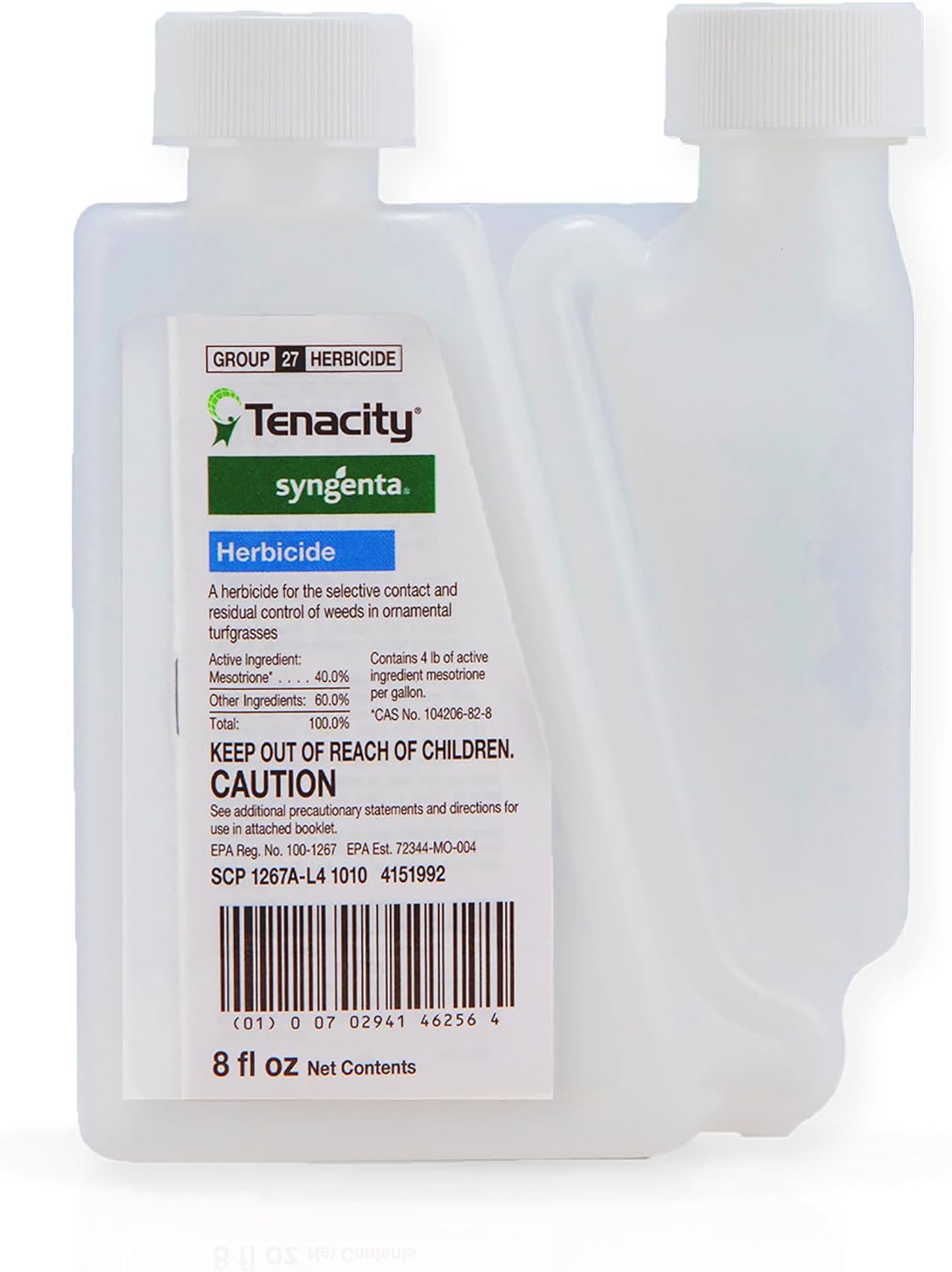
Syngenta Tenacity Turf Herbicide, 8 fl oz
| Unit Count | 8 Fluid Ounces |
|---|---|
| Item Form | Liquid |
| Coverage | 2000 ft^2 per 1sp of product |
| Active Ingredients | Mesotrione |
Tenacity Turf Herbicide is a concentrated liquid containing mesotrione that works both as a pre-emergent and post-emergent treatment for common lawn weeds. It is typically mixed and applied to established turf to suppress or kill species such as crabgrass, dandelion, clover, chickweed and others, and can also provide some residual control when used before weeds emerge. The product covers roughly 2000 ft2 per unit when mixed as directed, making it suited to spot treatments or treating moderate-sized yards. Its systemic mode of action helps control difficult-to-manage weeds rather than just burning foliage, and the fact it works on both grasses and broadleaf weeds gives it versatility. Important limitations are that it is selective to turf but can damage desirable ornamentals if oversprayed, and application timing and correct rates are important for safety and effectiveness. Storage recommendations note a long shelf life when kept out of extreme temperatures.
Best for: Buyers who prioritize effective, performance-driven weed control for lawns and want a single product that handles both pre- and post-emergent needs.
Less Ideal for: Those who need an all-purpose garden spray for beds or around ornamentals or who do not want to manage precise application timing should consider alternatives.
- Works as both pre-emergent and post-emergent for broader timing flexibility
- Systemic active ingredient (mesotrione) controls established weeds rather than only burning foliage
- Concentrated 8 fl oz bottle covers about 2000 ft2, suitable for moderate lawn areas
- Selectivity to turf makes it practical for lawn use when applied correctly
- Can harm non-target plants if overspray reaches ornamentals or flowers
- Requires careful mixing and timing for best residual control
Verdict: For performance-focused lawn care, Tenacity delivers versatile, systemic pre- and post-emergent control of tough turf weeds in a compact, concentrated bottle.
Ortho WeedClear Lawn Weed Killer Ready-to-Spray, 32 fl. oz.

| Item Form | Spray |
|---|---|
| Coverage | 5000 square_feet |
| Liquid Volume | 32 fluid ounces |
| Active Ingredients | 2,4-D; Quinclorac; Dicamba |
Ortho WeedClear Ready-to-Spray is a hose-end weed killer designed for homeowners who want a quick way to remove common lawn weeds without mixing concentrates. You attach the bottle to a garden hose, turn the water on and spray until the lawn surface is wet; the formula is rainproof in about an hour and claims visible results in hours for many weeds. It targets more than 200 broadleaf and grassy weeds including dandelion, clover, chickweed and crabgrass and is labelled safe for many northern lawn grasses when used as directed. The convenience of the built-in sprayer and one-application coverage for up to 5,000 sq. ft. makes it a time-saving option for routine weed control. Important limitations: do not use on several warm-season or specialty grasses and avoid treating ornamentals or garden beds, and follow safety guidance to keep people and pets off treated areas until dry. For spot or whole-lawn treatment in the recommended temperature range it is a straightforward, low-effort solution.
Best for: Homeowners who want a low-effort, ready-to-use spray to control common lawn weeds across medium-sized lawns and prefer a quick hose-end application over mixing concentrates.
Less Ideal for: Gardeners who need product safe for delicate ornamentals, specialty turf types, or who prefer selective granular or organic options should look elsewhere.
- Ready-to-use hose-end applicator for fast, no-mix application
- Covers up to 5,000 sq. ft. from a 32 fl. oz. bottle for broad area treatment
- Works on a wide list of common broadleaf and grassy weeds, including crabgrass and dandelion
- Rainproof in about 1 hour so treatments are less likely to be washed away
- Not safe for several warm-season and specialty grasses and cannot be used on ornamentals or garden beds
- Contains multiple active herbicide ingredients which require adherence to safety and application limits
Verdict: Choose this if you want a fast, no-mix hose-end spray that treats common lawn weeds across up to 5,000 sq. ft. with one application.
Spectracide Weed Stop for Lawns Plus Crabgrass Killer, Ready-to-Use, 1 Gallon

| Item Form | Spray |
|---|---|
| Coverage | Up to 5,000 sq ft |
| Liquid Volume | 1 gallons |
Spectracide Weed Stop for Lawns Plus Crabgrass Killer is a one-gallon, ready-to-use spray designed to kill broadleaf and grassy weeds by contact, with visible browning in as little as five hours. It is typically used by mowing two to three days before application and spraying when daytime temperatures are between 45°F and 90°F, taking care around Bermudagrass to avoid temporary discoloration at higher temperatures. The product covers up to 5,000 square feet and lists more than 470 weeds it targets, including dandelion, clover and crabgrass. Practical benefits include no mixing, fast visible results, and straightforward application for spot treatments or broadcast spraying with a hose-end or pump sprayer. Limitations are that it kills by contact so it works best on actively growing weeds and may require repeat applications for deep or established roots; label directions and temperature limits must be followed to avoid lawn stress. For routine lawn maintenance this is a convenient, fast-acting option, but it is not a selective systemic solution for all persistent perennial weeds.
Best for: Homeowners seeking an affordable, no-fuss herbicide to quickly tackle common lawn weeds across a medium-sized yard and who prefer straightforward application over specialized treatments.
Less Ideal for: Gardeners needing a systemic, long-term solution for deeply rooted perennials or those who require products safe for all turf types and use in high-temperature conditions.
- Ready-to-use formula requires no mixing for quick application
- Claims visible results in about five hours for fast weed control
- Targets a wide range of weeds with a labeled list of 470+ species
- Covers up to 5,000 sq ft per gallon for moderate lawn areas
- Kills by contact rather than being fully systemic so some deeply rooted weeds may need follow-up treatments
- Temperature restrictions for safe application, especially on Bermudagrass, limit use windows
Verdict: A budget-friendly, ready-to-use spray that delivers fast visible control of a wide range of common lawn weeds for medium-sized yards.
LebanonTurf Prodiamine 0.58% Granular Pre-Emergent (covers 20,000 sq ft)

| Item Form | Granule |
|---|---|
| Coverage | 20,000 sq. ft. |
| Active Ingredients | Prodiamine |
This granular pre-emergent uses 0.58% prodiamine on a BIODAC carrier to stop crabgrass and many grassy weeds from germinating across lawns and landscaped areas. It is applied with a broadcast spreader in early spring, with a recommended follow-up in late May or early June; the manufacturer warns not to overseed for three to four months after application. The product covers a large area per unit, making it suitable for whole-yard preventive programs and for professional maintenance of turf, trees, shrubs, and flowers. Its granular form simplifies handling compared with liquids and reduces immediate runoff risk, while the prodiamine chemistry provides season-long residual control when applied correctly. Limitations include the planting restriction after application and that it prevents seed germination so it cannot be used where you plan to establish new lawn from seed shortly after treatment. Also availability is restricted in several states, so check local regulations before planning use.
Best for: Buyers who prioritize a dependable, season-long preventive approach to crabgrass control and want a product that fits routine lawn maintenance schedules used by homeowners or pros.
Less Ideal for: Gardeners planning to establish new lawns from seed shortly after treatment or those needing an option legal in excluded states should consider alternatives.
- Granular formula on BIODAC carrier for easy broadcast spreading
- Contains 0.58% prodiamine, a proven pre-emergent for crabgrass and grassy weeds
- Large coverage of 20,000 sq. ft. per unit reduces application frequency
- Suitable for use across lawns and landscaped beds to protect turf and plantings
- Prevents seed germination so you cannot overseed or plant grass seed for 3–4 months after application
- Not labeled for sale or use in a number of states, limiting availability and compliance
Verdict: Choose this granular 0.58% prodiamine product when you need a reliable, large‑area pre-emergent to prevent crabgrass and other grassy weeds.
Envu Celsius WG Herbicide Easy Mix Packet (0.226 oz)

| Item Form | Powder |
|---|---|
| Coverage | broad-leaf weeds and grassy weeds |
| Active Ingredients | Dicamba 57.4%, Iodosulfuron-methyl-sodium 1.9%, Thiencarbazone-methyl 8.7% |
Celsius WG comes as a single easy-mix packet of wettable granules designed for post-emergent foliar application on warm-season lawns. It contains three active ingredients and is intended for use on grasses such as Bermudagrass, St. Augustinegrass, Zoysiagrass, and Centipedegrass to control more than 120 annual and perennial broadleaf weeds and some grassy weeds. In practice you empty the packet into application equipment, spray actively growing weeds when daily averages are above about 60°F, and expect visible injury within hours and plant death within one to four weeks depending on temperature and weed maturity. The packet format makes measuring straightforward and the triple‑action chemistry improves spectrum and speed of control. Important limitations are the label restrictions: it is not labeled for cool-season turf, is toxic to non-target plants, and is sensitive to spray drift and wet conditions at application, so careful mixing, timing, and equipment calibration are required. Read and follow the label for safety and site-specific directions.
Best for: Homeowners or grounds managers who maintain warm-season lawns and prioritize predictable, fast post-emergent control and prefer a measured packet for mix-and-apply convenience.
Less Ideal for: People with cool-season lawns or those who need a herbicide safe for spraying near sensitive plantings or water features should consider alternative products.
- Broad-spectrum control covering over 120 broadleaf and some grassy weeds
- Wettable granular easy-mix packet simplifies measuring and reduces handling mistakes
- Triple active ingredients provide faster symptom development and wider activity
- Formulated specifically for common warm-season turf types used on lawns and sports fields
- Not labeled for use on cool-season grasses
- Toxic to non-target plants and requires strict drift management
Verdict: Choose Celsius WG when you need a fast-acting, packet-measured post-emergent herbicide specifically for warm-season turf to control a wide range of weeds.
Choosing the Right Herbicide for Lawns: Key Factors to Consider
Weed Spectrum
Different herbicides target different categories of weeds. Some are formulated for broadleaf weeds like clover, dandelion, and plantain, while others tackle grassy weeds such as crabgrass or annual bluegrass. Knowing which weeds dominate your lawn makes a big difference because using a product with the wrong spectrum wastes time and can leave problem species untouched.
Matching the herbicide to your weed list also affects how many applications you need. A selective broadleaf herbicide can clean up dandelions and clover without harming turf, but it will not touch grassy summer annuals. Conversely, a grass-selective product will reduce crabgrass but do little for broadleaves. Read labels and plan treatments around the specific targets in your yard.
Turfgrass Compatibility
Herbicide labels list the turf species that tolerate a given product. Cool-season grasses like fescue, ryegrass, and bluegrass have different tolerances than warm-season grasses such as bermudagrass or zoysia. Picking a herbicide labeled for your grass type reduces the risk of scorch, thinning, or long-term damage.
Beyond species, turf health matters. Stressed or newly seeded lawns are more vulnerable to injury, so timing and product choice should reflect existing turf vigor. When in doubt, choose formulations with broad turf compatibility or delay treatment until the lawn has recovered from stressors like drought, construction, or recent overseeding.
Application Timing and Seasonal Use
When you apply a herbicide affects both effectiveness and turf safety. Preemergent products prevent weed seeds from germinating and must be applied before target weeds emerge, making timing relative to soil temperature critical. Postemergent herbicides work on visible weeds and are most effective when weeds are actively growing.
Seasonal considerations also include temperature and mowing schedule. Some active ingredients perform poorly in hot, dry weather or at very low temperatures. Plan applications for cool, moist periods when weeds are actively transporting chemicals to roots, and avoid mowing immediately before or after treatment unless the label allows it.
Mode of Action and Residual Activity
Understanding how a herbicide works helps manage resistance and plan follow-up care. Contact herbicides kill the parts of the plant they touch and usually act fast but offer limited residual control. Systemic products are absorbed and translocated through the plant to roots, offering longer control of perennial weeds.
Residual activity in the soil can prevent new weeds for weeks or months but may also affect desirable seedlings. If you plan to overseed or establish new turf, select a product with minimal residual effect or follow label intervals for safe seeding. Rotate modes of action across seasons to reduce the chance of resistant weed populations.
Application Method and Ease Of Use
Practical handling matters for homeowners. Ready-to-use sprayers and hose-end applicators simplify spot treatments, while concentrated liquids and granules require measuring and mixing. Consider whether you are comfortable calibrating and applying concentrates or prefer premixed options.
Equipment also affects coverage and drift risk. A pump sprayer with a fan nozzle gives better contact on broadleaf weeds, while granules are useful for preemergent applications. Choose a method that matches the size of the area you plan to treat and your comfort level with mixing and cleanup.
Environmental and Safety Considerations
Herbicides vary in toxicity to people, pets, pollinators, and nearby plants. Labels provide precautionary statements about re-entry intervals, pet exposure, and buffer zones for water bodies. If your lawn borders a vegetable garden, pollinator habitat, or water feature, select formulations and application techniques that minimize off-target movement.
Proper storage, handling, and disposal are part of safe use. Follow label instructions for protective gear and avoid applying before heavy rain to reduce runoff. Choosing products with lower environmental persistence or that degrade rapidly can reduce long-term impacts.
Identifying Your Lawn's Weed Problems
Start by surveying your lawn at different times of the year. Some weeds are most visible in spring, others in midsummer or fall. Note the growth habit, leaf shape, and whether weeds come back from roots or only from seed. That quick field diagnosis points you toward preemergent or postemergent strategies and whether systemic control is needed.
- Photograph representative weeds to compare with ID guides.
- Check high-traffic and shady areas separately; they often have different weed profiles.
- Record when weeds first appear to help time preemergent controls.
Preemergent Versus Postemergent Strategies
Preemergent herbicides create a chemical barrier that prevents seeds from germinating. They are best for seasonal annuals like crabgrass and must be applied before soil temperatures trigger germination. Postemergent herbicides are applied to visible weeds and are the main tool against perennial and established broadleaf weeds.
- Use soil temperature or local extension guidance to schedule preemergent timing.
- Reserve postemergent products for actively growing weeds, not drought-stressed or dormant plants.
- Combine cultural practices such as mowing height and watering to reduce future weed pressure.
Safe Timing Around Seeding and Overseeding
Many herbicides restrict seeding for a specified interval after application. If you plan to overseed, check label re-seeding timelines and choose products with short or no residual where possible. For newly seeded lawns, delay herbicide use until turf seedlings are established and have been mowed a few times unless the label explicitly permits earlier treatments.
- Wait the full label interval before seeding or overseeding.
- For spot-treating weeds in a new lawn, consider hand-pulling or spot applications with turf-safe formulations.
- Fertilize and water new seedings according to best practices to help turf outcompete weeds.
Minimizing Drift and Protecting Nearby Plants
Drift can deposit herbicide on desirable plants and damage them. Use coarse spray nozzles, low wind conditions, and avoid spraying during temperature inversions. Keep spray droplets large and apply close to the target to reduce off-target movement.
- Avoid spraying when wind exceeds recommended speeds on the label.
- Close windows and cover sensitive plants during nearby treatments.
- Rinse sprayers and spray lines away from garden beds and storm drains.
Record-Keeping and Integrated Weed Management
Track what you apply, where, and when. A simple log helps evaluate effectiveness and avoid overuse of any single active ingredient. Integrated weed management pairs herbicide use with cultural controls such as proper mowing height, soil fertility, and irrigation to reduce long-term reliance on chemicals.
- Rotate modes of action to slow resistance development.
- Note weather conditions and turf status at application to judge efficacy later.
- Combine spot treatments with core practices that strengthen turf health.
How We Chose the Best Herbicide for Lawns
We prioritized products and formulations that balance effective weed control with minimal harm to common turfgrass species. Our selection filters emphasized documented activity against widespread lawn weeds and compatibility with cool- and warm-season grasses. We also looked for products offering clear labeling for timing and application rates, plus availability in homeowner-friendly package sizes or ready-to-use formats. Evaluation criteria included weed spectrum, turf safety, application timing and flexibility, ease of use and mixing, and environmental and non-target considerations. We excluded products labeled only for agricultural or industrial use and anything requiring special licensing. We also filtered out formulations with unclear safety instructions or excessively narrow weed lists. The result is a set of herbicides suited to typical home lawn problems and practical seasonal schedules.
FAQ
When should I apply a preemergent to prevent crabgrass?
Timing depends on soil temperature rather than calendar date. Apply preemergent when soil temperatures reach about 50 to 55 degrees F for several days, typically in early spring in many regions. Local extension services often provide regional timing guidance.
Can I seed my lawn right after using a herbicide?
It depends on the product. Some herbicides have little residual and allow seeding within a few days, while others require waiting several weeks or months. Always check the label for the re-seeding or overseeding interval before applying.
Will spot-treating weeds harm my grass?
Spot treatments reduce overall exposure but still carry risk if the product is not turf-safe. Use formulations labeled for your grass species and avoid overspray. Spot applications are a good way to target isolated weeds with minimal turf impact.
How do I protect pollinators when applying lawn herbicides?
Avoid spraying flowering plants and apply when pollinators are least active, such as early morning or late evening. Do not treat areas where pollen and nectar sources are present, and follow label precautions for pollinator protection.
What should I do if my lawn looks stressed after treatment?
Stop further applications and water lightly if the label allows. Assess stressors like heat, drought, or recent cultural changes that might have made turf vulnerable. If damage is severe, contact local extension or a turf professional for recovery steps and avoid reseeding until the label interval has passed.
Final Verdict
Choosing the right herbicide for lawns is about matching the product to the weeds, your turf species, and seasonal constraints. Prioritize turf safety and application timing, and pair chemical control with cultural practices to reduce future weed pressure. Consider ease of use and environmental precautions when selecting a product and plan for follow-up care based on residual activity. With those tradeoffs in mind, you can confidently select an approach that controls problem weeds while preserving a healthy, resilient lawn.
