

Note: This article contains affiliate links. If you click on these links and make a purchase, I may earn a small commission at no extra cost to you. This helps support my research and content. Read my full affiliate disclosure here.
Getting the soil right is the most practical step toward a healthy, uniform lawn. A grass soil test kit tells you whether the turf needs lime, fertilizer, or drainage fixes before you apply treatments that may be unnecessary or harmful. This guide collects the top shortlisted options and explains how they behave in real yards and small lawns. We evaluated kits for how accurate their field readings are, how simple they make sampling across different lawn types, and how clearly they translate results into actionable steps. Read on to see which kits match your lawn size, testing frequency, and comfort with interpreting results.
Top Picks at a Glance
| Best Overall The best all-around choice for most situations | MySoil Professional Mail‑In Soil Test Kit (1 Test) |  |
| Best Quality Built to a higher standard if you want something more solid | LaMotte Turf and Garden Soil Test Kit (5679-01) |  |
| Best Value The sweet spot between price and what you get | Luster Leaf Rapitest 40-Test Soil Test Kit (pH, N, P, K) |  |
| Best Budget The cheapest option that still gets the job done reliably | Palinoia 2-in-1 Soil Test Kit for pH and Nitrogen, 100 Strips |  |
| Highest Rated A top-rated pick with lots of positive feedback | Jxikatx 7-in-1 Soil Test Kit with Dual Display |  |
| Most Popular A crowd favorite that many people choose with confidence | SONKIR MS02 3-in-1 Soil Moisture, pH and Light Tester |  |
| Best Seller A high-volume bestseller chosen again and again | Luster Leaf Rapitest Soil Test Kit (20 Tests) |  |
MySoil Professional Mail‑In Soil Test Kit (1 Test)
| Number of Packs | 1 |
|---|---|
| Unit Count | 1 Count |
| Manufacturer | Predictive Nutrient Solutions, Inc |
| Item Weight | 4.6 ounces |
The MySoil kit is a single‑use mail‑in soil test designed to give a professional laboratory analysis rather than an instant at‑home reading. You collect a sample in the included jar, register the kit online, mail the prepaid envelope to the lab, and get a detailed report in about 6–8 days. Results cover pH plus 13 plant‑available nutrients and include step‑by‑step recommendations for what to apply, how much, and when, with both organic and conventional options. That makes it useful for diagnosing lawn problems, planning fertilization for turf or vegetable beds, or checking soil before planting. The kit contains everything needed for one test and saves time by replacing guesswork with specific advice, which can reduce unnecessary product use. The main limitation is that each kit covers only a single sample, so testing multiple areas or repeated checks requires buying multiple kits; turnaround also depends on mailing times. For a homeowner who wants accurate, lab‑grade guidance for improving grass and garden soil, MySoil provides actionable results without complex equipment.
Best for: Homeowners focused on improving lawn health who want reliable, lab‑grade soil data and clear amendment instructions rather than DIY meters or strips.
Less Ideal for: People who need rapid, repeated tests across many spots or instant field readings should consider multi‑test packs or handheld meters instead.
- Laboratory analysis of pH plus 13 plant‑available nutrients for accurate results
- Includes prepaid mail envelope and everything needed to collect and send one sample
- Custom, easy‑to‑follow recommendations for what, when, and how much to apply
- Works for any soil type and a wide range of uses including lawn and turf
- Single‑use kit covers only one sample location
- Results take several days since samples are mailed to a lab
Verdict: For reliable, lab‑grade soil diagnostics and clear fertilizer guidance to improve grass and garden performance, choose this single‑test MySoil kit.
LaMotte Turf and Garden Soil Test Kit (5679-01)

| Brand Name | LaMotte |
|---|---|
| Set Name | Turf and Garden Soil Test Kit |
| Tests Included | pH (30), N/P/K (15 tests each) |
| Educational Objective | STEM |
The LaMotte Turf and Garden Soil Test Kit is a lab-style kit intended for gardeners and turf managers who want reliable, repeatable readings at home. It provides colorimetric tests for pH (30 tests) and for nitrogen, phosphorus and potassium (15 tests each) along with a Garden Guide manual and Soil Handbook to interpret results and plan fertilizer or lime applications. Typical use involves collecting representative soil samples, following the separate procedures for each parameter, mixing reagents, and comparing colors to the included laminated charts. The main benefits are the depth of information you get without sending samples to a lab and the ability to track changes over time. Limitations are that each parameter requires its own procedure and handling reagents, so testing takes more time and care than single-strip meters, and replacement reagents may be needed for long-term use. For performance-focused users this kit trades convenience for accuracy and instructional support, making it suited to people who want actionable results for turf management and serious garden improvement.
Best for: Gardeners or turf managers who prioritize accurate, actionable soil analysis and are willing to follow multi-step test procedures to guide fertilizer and lime decisions.
Less Ideal for: Casual gardeners who want instant, one-step measurements or people unwilling to handle chemical reagents and follow detailed sampling instructions.
- Covers four key soil parameters (pH, N, P, K) for a fuller fertility picture
- Includes Garden Guide manual and Soil Handbook to interpret results and plan corrections
- Multiple test counts allow repeat testing and seasonal monitoring (pH 30, nutrients 15 each)
- Each test uses its own procedure and reagents, so the workflow is more involved than single-strip testers
- Requires careful sample collection and color matching for accurate results
Verdict: Choose this kit when you need lab-style pH and NPK results plus interpretive guidance to make precise turf and garden fertility decisions.
Luster Leaf Rapitest 40-Test Soil Test Kit (pH, N, P, K)

| Tests included | pH, Nitrogen, Phosphorus, Potash |
|---|---|
| Number of tests | 40 total (10 per test type) |
| Mounting type | Tabletop |
| Battery description | No batteries required |
The Luster Leaf Rapitest kit gives quick, at-home readings for soil pH and the three primary nutrients gardeners watch for: nitrogen, phosphorus and potash. It ships with reagents and a patented color comparator system plus instructions and a plant pH preference list, and is designed to perform 40 total tests (10 each for pH, N, P and K). Typical use is straightforward: collect small soil samples, add the provided capsules or solutions, and compare the resulting color to the chart to determine whether your lawn needs lime, fertilizer, or other amendments. The tabletop format and printed recommendations make it useful for routine checks through the growing season. Limitations are that results are qualitative rather than lab-accurate numbers and interpretation depends on correct sampling and careful color matching under good light. For gardeners who want fast, actionable guidance for lawn feeding and pH adjustment, this kit balances simplicity and coverage; it is less suitable when precise ppm measurements are required.
Best for: Buyers who want a practical, no-fuss way to monitor lawn soil health and adjust fertilizer or lime between seasons; ideal for homeowners who prefer actionable, easy-to-read guidance over laboratory testing.
Less Ideal for: Users who require laboratory-grade nutrient concentrations or professional soil reports for diagnostics or commercial turf management.
- Covers four key tests (pH, nitrogen, phosphorus, potash) in one kit for routine lawn checks
- Includes enough reagents for 40 tests, allowing multiple checks through a season
- Patented color comparator and clear instructions make results easy to interpret for beginners
- Includes plant pH preference recommendations to help translate results into amendment choices
- Provides color-based, qualitative results rather than lab-precise numeric readings
- Accuracy depends on sampling technique and consistent lighting when matching colors
Verdict: An affordable, easy-to-use kit for routine lawn and garden checks that delivers quick, actionable pH and nutrient guidance.
Palinoia 2-in-1 Soil Test Kit for pH and Nitrogen, 100 Strips

| Unit Count | 100 Count |
|---|---|
| Recommended Uses For Product | Soil Testing, pH Test |
| Sterility Rating | 0.0-14.0 |
The Palinoia 2-in-1 kit uses test strips to measure soil pH and nitrate-nitrogen, giving gardeners a fast way to check lawn soil health without lab work. To use it you mix a soil sample with water, let solids settle, dip a strip, and compare the resulting color to the included chart; the kit includes a sampling spoon, test tube, and resealable pouches so you can test multiple spots and store unused strips. With 100 strips, it is convenient for checking several areas across a yard or repeating tests over the season. The nitrate result reports plant-available nitrate-nitrogen only, not ammonium or urea, so it is useful for diagnosing nitrogen available to grass but not all fertilizer forms. Accuracy depends on careful sampling and following the color chart, so results are best seen as a quick diagnostic rather than a laboratory-grade measurement. For routine lawn monitoring or deciding whether to apply fertilizer or lime, this kit gives clear, inexpensive guidance.
Best for: Homeowners and lawn caretakers who want an affordable, easy way to monitor pH and available nitrogen across multiple lawn areas to guide fertilizer or lime decisions.
Less Ideal for: Users needing laboratory-grade nutrient analysis or a complete breakdown of all nitrogen forms should choose a professional soil test or a more comprehensive kit.
- Includes 100 strips for many tests across a lawn or repeated seasonal checks
- Measures both soil pH and plant-available nitrate-nitrogen in one kit
- Comes with a sampling spoon, test tube, and resealable pouches for organized testing
- Simple procedure suitable for beginners with quick color-chart results
- Nitrate test does not measure ammonium or urea forms of nitrogen
- Color-chart strip method is less precise than lab tests and sensitive to sampling technique
Verdict: A low-cost, easy-to-use option for routine lawn soil checks that delivers fast pH and nitrate-nitrogen guidance for smarter fertilizer and lime choices.
Jxikatx 7-in-1 Soil Test Kit with Dual Display

| Functions | Moisture, pH, fertility, light, soil temp, air humidity, ambient temp |
|---|---|
| Display | Analog dial plus LCD |
| Probe | Multi-metal single probe |
| Viewing | 90° adjustable head |
The Jxikatx 7-in-1 Soil Test Kit is a compact handheld meter built to give quick, on-the-spot readings for lawns and garden beds. You insert the single metal probe into moist soil and the upper analog dial reports moisture, pH, fertility and light while the LCD shows soil temperature, ambient temperature and humidity. The 90 degree adjustable head makes it easy to read without kneeling, and the single-probe design keeps testing simple and minimally disruptive to turf. It is especially useful for checking moisture and pH across multiple lawn spots to guide watering and fertilizing. Important limitations are that it requires moist soil to work reliably and should not be used in standing water, hydroponics, or very hard ground, and readings for some measures are analog so expect less precision than lab tests. Regular cleaning of the probe and inserting it to the recommended depth improves consistency. For grass care this gives fast, practical answers to routine questions about when and where to water or apply amendments.
Best for: Gardeners who want a dependable all-in-one meter for routine lawn spot checks and seasonal pH and moisture monitoring to guide watering and feeding decisions.
Less Ideal for: Users needing laboratory-grade precision, continuous monitoring, or use in hydroponics, standing water, or very hard packed soil should choose a different testing method.
- Measures seven key soil and environmental factors in one handheld unit
- Dual display separates analog readouts (moisture, pH, fertility, light) from digital temperature and humidity for quick interpretation
- 90° adjustable head reduces bending and improves usability across lawns and beds
- Single metal probe minimizes root disturbance and is suitable for spot checks across a yard
- Requires moist soil for accurate readings and will not work reliably in dry, flooded, or very compacted ground
- Analog dial measurements are less precise than laboratory or digital-only instruments
Verdict: A practical, easy-to-use 7-in-1 meter that gives fast, reliable spot readings to help maintain healthy lawn soil.
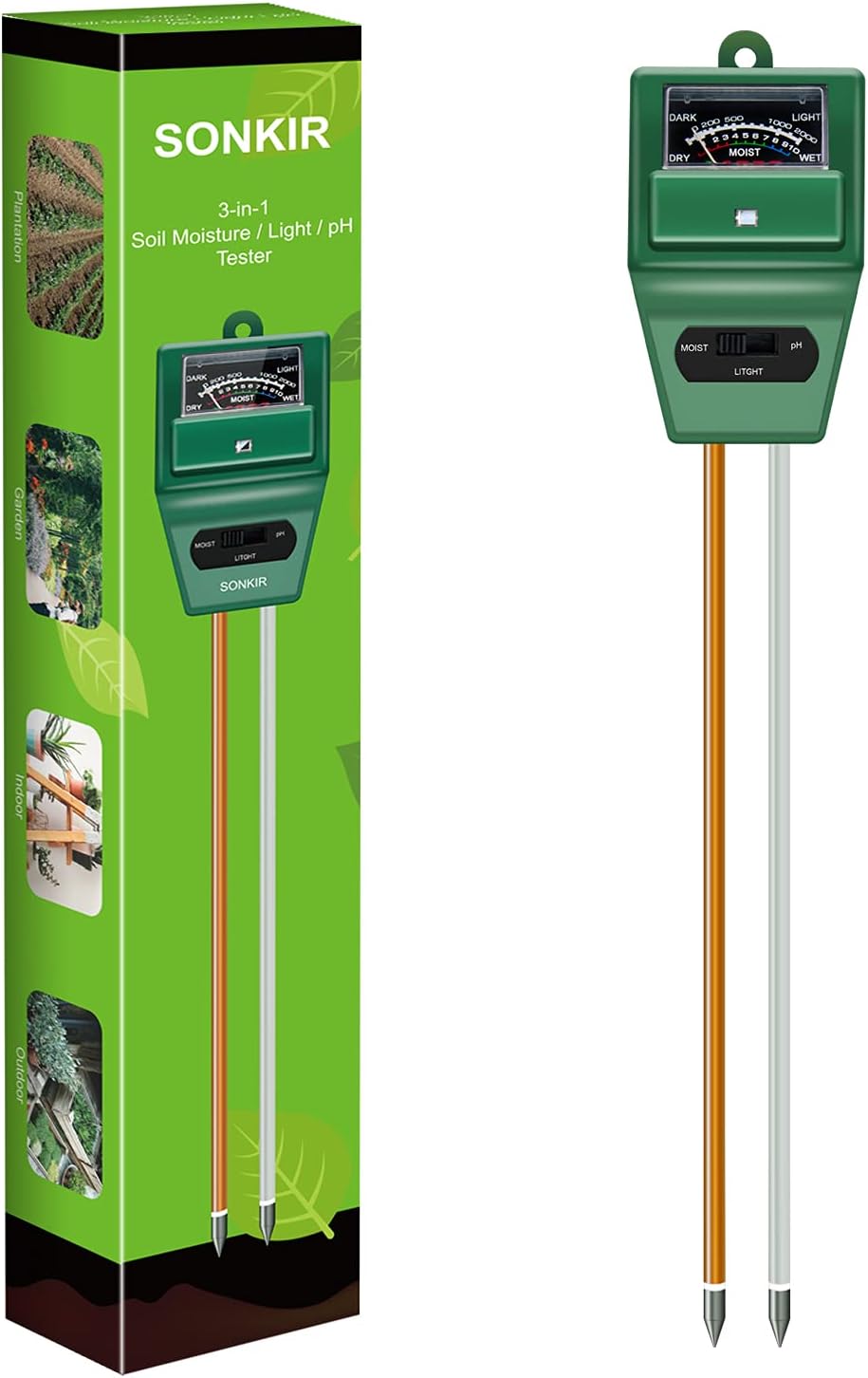
SONKIR MS02 3-in-1 Soil Moisture, pH and Light Tester
| pH range | 3.5-8 pH |
|---|---|
| Moisture range | 1-10 scale |
| Probe length | 7.9 inches |
| Power | No battery required |
The SONKIR MS02 is a handheld, no-battery soil meter that gives quick, visual readings of moisture, pH and sunlight to help you maintain healthier grass and garden plants. You switch the dial to the desired function, push the probe into the soil about 6 to 7 inches, wait roughly 10 minutes and read the needle on the analog display. The meter covers a practical pH range for lawns and gardens and shows moisture on a 1 to 10 scale so you can decide when to water. Its long probe and compact, lightweight body make it convenient for spot-checking multiple areas of a lawn or garden bed. Important limitations are that the pH probe is intended for soil only and the analog needle can be slow to move in very dry soils or close-to-neutral pH, so readings sometimes require rechecking after moistening the sample or testing several spots. The unit is best for gardeners who want an affordable, easy-to-use tool for routine soil checks rather than laboratory-accurate analysis.
Best for: Someone who wants an inexpensive, easy-to-use tool for routine soil checks across a lawn or garden and values practical, repeatable guidance over laboratory precision.
Less Ideal for: Users who need lab-grade pH or moisture measurements, continuous data logging, or digital readouts for precise record keeping should consider more advanced instruments.
- 3-in-1 functionality measures moisture, pH and sunlight without extra tools
- No battery required so it is always ready to use and low maintenance
- Long probe and compact form factor make spot checks across a lawn or garden quick
- Simple analog dial is straightforward for fast, at-a-glance decisions
- pH function is designed for soil only and cannot test water or other liquids
- Analog needle can be unresponsive in very dry soil or near-neutral pH, requiring repeated tests
Verdict: A straightforward, no-battery 3-in-1 tester that gives fast, practical soil moisture, pH and light checks for everyday lawn and garden care.
Luster Leaf Rapitest Soil Test Kit (20 Tests)

| Brand Name | Luster Leaf |
|---|---|
| Unit Count | 20 Count |
| Number of Packs | 5 |
| Item Type Name | Soil Test Kit |
The Luster Leaf Rapitest kit gives home gardeners a simple way to check soil pH plus nitrogen, phosphorus and potash levels without lab work. It uses a capsule and color-comparator system with clear instructions and a plant pH preference list so you can test multiple spots in a lawn or garden and match results to feeding recommendations. The kit includes enough materials for 20 tests (five each for pH, N, P and K), which is enough for spot-checking problem areas or confirming seasonal conditions. Results are immediate and straightforward to interpret, making this friendly for beginners and for people who prefer low-risk, hands-on checks before applying fertilizers or amendments. Limitations are that the comparisons are visual rather than digital so readings are approximate, and the kit does not measure secondary elements or give exact numeric concentrations; for precise analysis a lab test would be required.
Best for: Gardeners who want a low-risk, easy-to-use way to verify soil pH and basic nutrient levels before treating lawn or garden areas; especially suited to mainstream homeowners who prefer practical, straightforward tools over technical diagnostics.
Less Ideal for: Specialists or commercial operations that need laboratory-grade quantitative analysis or tests for secondary and micronutrients should choose a professional lab or a digital meter instead.
- Measures pH plus primary nutrients (N, P, K) in one kit
- Includes components for 20 tests so you can check several lawn or garden spots
- Patented color comparator and clear instructions make results easy to read
- Includes a plant pH preference list with recommendations for over 450 plants
- Visual color matching yields approximate results rather than precise numeric readings
- Does not test secondary nutrients or trace elements
Verdict: A user-friendly, no-frills kit for quick pH and NPK spot checks that helps cautious homeowners make informed fertilizer choices.
Choosing the Right Grass Soil Test Kit: Key Factors to Consider
pH Measurement and Range
Soil pH is central to turf health because it controls nutrient availability. A reliable kit measures pH across the typical lawn range and shows whether lime or sulfur is needed.
Look for kits that give a clear numeric pH or a tight color match rather than a vague acidic/neutral/alkaline label. Small lawns often have microvariations, so a kit that performs consistently at the common lawn pH range is more useful than one optimized for extreme garden soils.
Nutrient Detection and Practicality
Grass needs a balanced supply of nitrogen, phosphorus, and potassium, but field kits often detect only P and K plus general nitrogen indicators. Decide whether you need lab-level precision or a field-level assessment that tells you whether major nutrients are deficient, sufficient, or excessive.
A practical kit provides readings tied to actionable rates or ranges for lawn fertilizers. If you plan seasonal feeding, a kit that flags persistent deficiencies will be more valuable than one giving single, hard-to-interpret numbers.
Sampling Method and Coverage
How you collect soil matters more than the kit type. Kits that include a soil probe or sturdy sampling tool make consistent depth samples easier, which is crucial because lawn nutrient concentrations vary with depth.
Consider how many samples the kit allows you to run. For small to medium lawns, composite sampling from several spots gives a more representative reading. If you have visible problem patches, choose a kit that makes spot-testing quick so you can compare problem areas to healthy turf.
Result Presentation and Guidance
A test is only useful if you can act on it. Kits that offer clear charts, treatment suggestions, or app-based interpretation reduce guesswork. Simple color charts can work if they are well-calibrated and explain thresholds for lime or fertilizer application.
Check whether the kit explains how to convert deficiencies into treatment rates or whether it simply flags low or high levels. For many gardeners, guidance that ties results to common lawn fertilizer formulations and application timing is especially helpful.
Durability and Reusability
If you test seasonally, a reusable kit with robust probes, containers, and reagents is more economical and consistent. Disposable strips may be cheap but yield inconsistent results if storage and handling are poor.
Durability also affects field use. Sturdier scoops and probes resist bending in compacted lawns and produce cleaner samples. Reusable kits should include clear instructions for reagent storage and calibration to keep results stable over time.
Ease of Use and Interpretation
Gardeners vary in comfort with chemistry and apps. A good lawn soil kit minimizes steps, uses intuitive sampling depth markers, and has an easy-to-read result display. Kits that require complex dilution steps or precise timing are prone to user error and inconsistent readings.
Prefer kits with straightforward step-by-step instructions, clear labeling of reagents, and example tests. If you are comfortable with smartphone tools, consider kits that augment readings with app-based notes or photo interpretation to track changes season-to-season.
When to Test Your Lawn
Test soil in early spring before major fertilizer applications and again in fall to check how pH and nutrient levels have shifted after the growing season. Testing after prolonged wet or dry spells can reveal short-term nutrient availability changes related to soil moisture.
- Test problem patches separately to compare to healthy turf
- Avoid testing immediately after topdressing or heavy fertilizer applications
- Take samples when the soil is workable and not frozen
Taking Representative Samples
Walk the lawn and collect several small cores from areas that represent high-use, shade, and healthy turf. Combine these into a composite sample for a general lawn reading. For localized issues, keep separate samples for those spots to compare results.
- Aim for uniform sampling depth, typically 2 to 3 inches for cool-season lawns
- Use a clean scoop or probe to avoid cross-contamination
- Label samples with the location and date for seasonal tracking
Interpreting pH and Nutrient Results for Lawns
Low pH often looks like slow, patchy grass and can lock up phosphorus and molybdenum. High pH can cause iron deficiency and patchy green color despite adequate nitrogen. Use pH readings to decide lime or sulfur applications and adjust fertilizer choices accordingly.
If a kit shows a phosphorus or potassium deficiency, match the result to fertilizer formulations with higher ratios of the lacking nutrient. Remember that nitrogen is often managed through routine feedings rather than single-test corrections, so kits that show relative nitrogen levels are most useful as trend indicators.
- pH adjustments take time; plan applications months before peak growth
- Address drainage or compaction in problem areas rather than only treating with fertilizer
- Repeat testing annually to monitor the effect of amendments
Using Field Kits Versus Sending a Lab Sample
Field kits give immediate, usable information for routine lawn decisions and are ideal for quick checks and seasonal monitoring. They let you test multiple spots at low cost and see relative differences across a yard.
Lab samples are still the best option when you need precise nutrient concentrations, micronutrient profiles, or regulatory-grade analyses. Use lab testing when persistent problems remain after you have followed field kit recommendations or when diagnosing complex micronutrient issues.
- Use field kits for trend tracking and quick checks
- Send lab samples for persistent, unexplained issues or detailed micronutrient analysis
How We Chose the Best Grass Soil Test Kit
Our shortlist focused on tools that give gardeners reliable, repeatable readings and clear next steps for lawn care. We prioritized kits that measure the core metrics turf managers need: soil pH, primary macronutrients, and basic soil texture or organic matter indicators when available. Ease of sampling and consistency across multiple test points were weighted heavily because lawn soils can vary within a small area. We also evaluated how easily results translate into lawn-specific recommendations. Kits that included straightforward charts, color keys, or app-based interpretations scored higher for usability. Durability and the quality of probes or scoops were considered so kits hold up to repeated seasonal use. Exclusions: products that only offered single-use strips without a way to verify readings, kits aimed solely at containers or garden beds without lawn guidance, and tools requiring specialized lab access were excluded. The final list balances field convenience with readings precise enough to guide lime and fertilizer decisions. Evaluation criteria used: Nutrient & pH accuracy, Sampling ease across lawns, Result clarity and guidance, Durability and build quality, and Repeatability across multiple tests.
FAQ
How often should I test my lawn soil?
Usually test once a year, typically in spring or fall. If you are troubleshooting a problem patch or making pH changes, test before and several months after applications to track results.
Can a home kit measure nitrogen accurately?
Home kits vary. Many give only a rough indicator of nitrogen availability rather than precise concentrations. Use nitrogen readings as trend indicators and rely on feeding schedules for maintenance.
What sample depth should I use for turf testing?
Sample to the root zone, usually about 2 to 3 inches for most lawns. Deeper sampling may be useful in newly established or heavily thatched lawns, but consistency across samples matters most.
Do I need to test different areas separately?
Yes. Lawns often have micro-variations from shade, traffic, or past treatments. Composite samples work for a whole-lawn plan, but separate samples help diagnose localized problems.
Will soil texture affect kit readings?
Yes. Heavy clay or very sandy soils handle nutrients differently and may affect reagent reactions. Adjust interpretation based on texture notes and consider repeated tests to confirm results.
Can I rely on color charts under low light?
Color charts can be misread in dim light. Use natural daylight or good artificial light and compare samples against the chart on a neutral background for best accuracy.
Final Verdict
Choose a Grass Soil Test Kit that matches how you manage the lawn: quick, repeatable field readings for routine seasonal decisions, or more detailed testing when diagnosing stubborn issues. Prioritize accurate pH measurement and clear nutrient guidance because these directly inform lime and fertilizer choices. Balance ease of sampling and kit durability with the level of detail you need, and plan to retest after any amendment to confirm you achieved the desired change.
