

Note: This article contains affiliate links. If you click on these links and make a purchase, I may earn a small commission at no extra cost to you. This helps support my research and content. Read my full affiliate disclosure here.
If you manage a spacious yard, choosing the right large garden robotic lawn mower changes how much time you spend on routine turf care. These machines run on schedules, navigate complex lawns, and keep grass at consistent heights so you spend less time pushing a mower and more time enjoying the landscape. The options shortlisted here are the leading choices for larger properties and were selected for their ability to handle wide coverage, perimeter systems, and varied terrain. This guide explains why those factors matter, what we evaluated, and what you should prioritize when selecting a large garden robotic lawn mower. The following sections summarize the key tradeoffs and practical considerations before the product list below.
Top Picks at a Glance
| Best Overall The best all-around choice for most situations | roborock RockMow X130H Robot Lawn Mower with 4WD and Quad-Vision Navigation |  |
| Best Quality Built to a higher standard if you want something more solid | Husqvarna Automower 550 Robotic Lawn Mower (Commercial, 1.25 Acre) |  |
| Best Value The sweet spot between price and what you get | Mammotion LUBA 2 AWD 5000HX Robot Lawn Mower with Cleaning Stand |  |
| Highest Rated A top-rated pick with lots of positive feedback | LOPKIN L2500 Robot Lawn Mower with NetRTK, AI Vision and Wi‑Fi HaLow |  |
| Most Popular A crowd favorite that many people choose with confidence | ECOVACS GOAT A2500 RTK Robotic Lawn Mower |  |
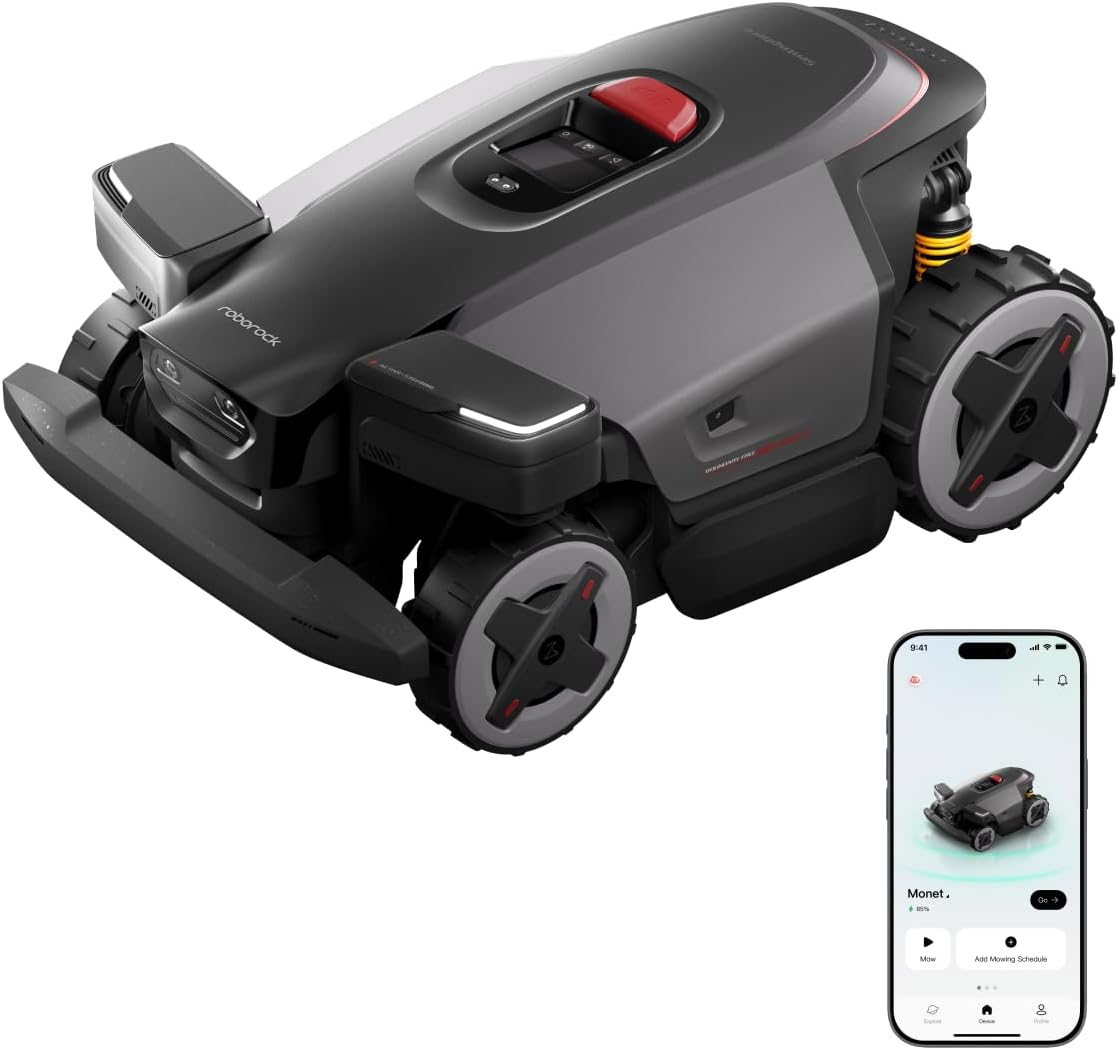
roborock RockMow X130H Robot Lawn Mower with 4WD and Quad-Vision Navigation
| Power Source | Battery Powered |
|---|---|
| Cutting width | 9.5 inches |
| Maximum Adjustable Cutting Height | 3.5 inches |
| Battery Average Life | 140 minutes |
The roborock RockMow X130H is a high-capability robot mower built to handle steep, uneven, and complex lawns without a buried perimeter wire. It uses Full-Band RTK plus a quad-camera AI vision system for precise positioning and dual mapping modes so you can either auto-map open areas or manually trace boundaries from the app. The pro-grade four-wheel drive, active steering, and dynamic suspension let it climb slopes up to 80% and roll over obstacles up to about 3.1 inches while keeping a floating cutting deck for consistent surface-following. Practical benefits include a relatively wide 9.5-inch cut to reduce runtime, multi-zone scheduling and a real-time app dashboard, plus anti-theft features and 4G connectivity. Important limitations are its weight and size for handling and storage, and the advanced navigation and connectivity mean a learning curve during setup and when customizing complex zones. For homeowners with steep or irregular yards who want largely hands-off mowing, this mower brings robust, reliable performance.
Best for: Homeowners with steep, irregular, or obstacle-filled lawns who want a durable, hands-off mower that prioritizes precise navigation and traction over simplicity.
Less Ideal for: Small, flat lawns or buyers who want a very lightweight, simple plug-and-play robot mower with minimal setup and fewer connectivity features.
- Four-wheel drive, active steering, and dynamic suspension that handle slopes up to 80% and 3.1-inch obstacles
- Full-Band RTK plus quad-camera AI vision for accurate positioning under trees and near fences
- Wire-free dual mapping options with app control and multi-zone scheduling for flexible setup
- 9.5-inch cutting width and floating deck for efficient, even mowing across contours
- Built-in anti-theft features including PIN lock, alarm, and GPS tracking
- Heavy and bulky compared with smaller robotic mowers, making manual transport and storage more cumbersome
- Advanced navigation and connectivity increase setup complexity and may require time to fine-tune for complex yards
Verdict: Choose the RockMow X130H if you need a wire-free, high-traction robot mower that can reliably conquer steep, uneven lawns with precise navigation.
Husqvarna Automower 550 Robotic Lawn Mower (Commercial, 1.25 Acre)

| Power Source | Electric |
|---|---|
| Operation Mode | Automatic |
| Covers | 1.25 acres |
| Maximum Adjustable Cutting Height | 3.5 inches |
| Minimum Adjustable Cutting Height | 2 inches |
The Husqvarna Automower 550 is a heavy-duty robotic mower built for large or divided properties up to roughly 1.25 acres. It uses triple guide wires, five remote start points, and GPS-assisted navigation to find and evenly mow complex lawns while large coarse-tread wheels handle slopes up to 45%. Primary use is autonomous scheduled mowing managed through Husqvarna Fleet Services and the Automower Connect app, with remote start, geofencing and theft tracking for peace of mind. Practical benefits include reduced labor, consistent cut heights between 2 and 3.5 inches, and flexible charging-station placement that simplifies installation on commercial sites. Smart home integration with major voice assistants and fleet controls make it straightforward to coordinate multiple machines or monitor status remotely. Important limitations are that this is a commercial product intended for larger properties and fleet management workflows, so it may be more complex to set up and maintain than consumer models and carries capabilities that exceed simple residential needs.
Best for: Buyers who need a robust, mostly hands-off mower for a large or divided 1-acre-plus lawn and who prioritize reliable coverage and remote fleet-style management.
Less Ideal for: Homeowners with small yards under 0.5 acres or buyers who want a simple plug-and-play consumer robot without fleet features or professional setup.
- Designed for properties up to 1.25 acres so it covers larger lawns without constant intervention
- Triple guide wires and five start points reduce search time on divided or complex sites
- GPS navigation plus geofencing and theft tracking provide reliable location awareness and security
- Large coarse-tread wheels offer traction on slopes up to 45% for hilly terrain
- Commercial-grade features and fleet management add setup complexity compared with consumer models
- Higher operational and maintenance demands typical of professional equipment
Verdict: Choose the Automower 550 when you need a professional, remotely managed robotic mower that reliably covers large or divided lawns up to about 1.25 acres.
Mammotion LUBA 2 AWD 5000HX Robot Lawn Mower with Cleaning Stand

| Cutting width | 15.7 inches |
|---|---|
| Operation Mode | Automatic |
| Number of Positions | 7 |
| Power Source | Battery Powered |
| Battery Capacity | 12 Ah |
The Mammotion LUBA 2 AWD 5000HX is built for demanding yards: its four-wheel 165 W drive and all-wheel traction let it tackle steep slopes and uneven terrain while the dual-blade disk and 15.7-inch cutting width deliver efficient, clean cuts. It uses UltraSense AI vision plus RTK positioning to map lawns precisely, mow close to edges, and avoid more than 200 object types without a physical boundary wire. You can manage up to 50 zones, set planned patterns, and control the mower remotely via 4G/Wi‑Fi/Bluetooth and the Mammotion app; it also offers GPS tracking and anti-theft safeguards. Charge time and area-per-charge figures indicate this is sized for roughly 1.25 acres per the spec sheet, and automatic return-and-resume behavior keeps large multi-zone jobs moving. Expect a setup and learning curve for mapping complex properties and reliance on app connectivity for advanced features, plus periodic maintenance on blades and sensors like any robotic mower. For performance-focused owners this mower prioritizes terrain capability, precise routing, and autonomy over the simplicity of basic consumer models.
Best for: Buyers who prioritize robust off-road performance and precise autonomous control for large, varied lawns and steep terrain and who are comfortable using app-driven features to optimize mowing patterns.
Less Ideal for: Small, flat lawns where a simpler, lower-cost robotic mower or push mower would be more practical or for buyers who want a fully plug-and-play device with minimal setup.
- True all-wheel-drive and 165 W motors provide strong traction for steep slopes and rough terrain
- UltraSense AI Vision with RTK navigation enables precise mapping, edge cutting, and obstacle recognition
- Supports management of up to 50 mowing zones and multiple mowing patterns for complex properties
- Connectivity via 4G, Wi‑Fi, and Bluetooth plus app control allows remote monitoring and customized schedules
- GPS tracking and anti-theft features help protect investment on larger properties
- Requires app connectivity and initial mapping that can be complex for intricate landscapes
- Plastic bodywork may need careful handling in very rough environments
Verdict: Choose the LUBA 2 AWD 5000HX when you need a heavy-duty, terrain-capable robotic mower that delivers precise AI-guided mowing and full multi-zone control for challenging large lawns.
LOPKIN L2500 Robot Lawn Mower with NetRTK, AI Vision and Wi‑Fi HaLow

| Power Source | Battery Powered |
|---|---|
| Battery Average Life | 4 hours |
| Maximum Adjustable Cutting Height | 3 inches |
| Minimum Adjustable Cutting Height | 1.2 inches |
| Operation Mode | Automatic |
The LOPKIN L2500 is a wire‑free robotic mower built for large, complex yards that combines NetRTK, GNSS/INS fusion and AI vision to map and mow without a boundary wire. Typical use is app driven: initial mapping takes minutes, then you set schedules, multi‑zone plans and no‑go areas from your phone while the mower handles routine cuts automatically. Notable features include Wi‑Fi HaLow for extended, stable connectivity across large properties, AI vision that recognizes and avoids common obstacles, and a 10Ah battery providing up to four hours of runtime with a 5A fast charger. Practical benefits are precise navigation around trees and structures, multi‑zone management for separate lawn areas, and IP66 protection so it can pause for rain and continue night mowing when appropriate. Limitations to weigh are its relatively narrow cutting width compared with ride‑on options and the need for the dedicated router for HaLow range; very steep or highly debris‑strewn sites may still require occasional human intervention. Installation and daily operation are geared to owners who want mostly hands‑off mowing with strong connectivity across large properties.
Best for: Owners of large, complicated yards who prioritize dependable, hands‑off mowing and precise navigation across multiple zones and signal‑challenging areas.
Less Ideal for: People who need very wide swath cutting for fastest possible full‑acre mowing or who prefer a simple plug‑and‑play device without installing a dedicated long‑range router.
- RTK + GNSS/INS fusion and AI vision enable high‑precision, wire‑free navigation in complex yards
- Wi‑Fi HaLow router provides long‑range, stable connectivity for large properties
- App-based multi‑zone mapping and scheduling for separate lawns and customized plans
- Up to four hours runtime per charge with a 5A fast charger for relatively long continuous operation
- IP66 rating and rain sensor for reliable outdoor operation in wet conditions
- Cutting width is modest, so full‑acre jobs may take longer than larger commercial mowers
- Requires the dedicated HaLow router to realize maximum connectivity range
Verdict: If you need reliable, wire‑free automated mowing across a large, complex yard with strong long‑range connectivity and smart obstacle avoidance, the LOPKIN L2500 is designed for that job.
ECOVACS GOAT A2500 RTK Robotic Lawn Mower

| Power Source | Battery Powered |
|---|---|
| Operation Mode | Automatic |
| Battery Average Life | 45 minutes |
| Cutting width | 0.39 inches |
| Number of Positions | 78 |
The ECOVACS GOAT A2500 RTK is a high-tech robotic mower built for largely hands-off lawn care on bigger properties. It uses RTK-enhanced positioning combined with 3D ToF LiDAR and an AI camera to map yards and navigate with centimeter-level accuracy, which reduces missed spots and keeps mowing paths consistent. The dual blade-disc and 32V motor offer strong cutting performance and an adjustable cutting height range to suit common grass types. A 5Ah battery provides roughly 45 minutes of runtime and the mower will automatically return to its charging base for top-ups, letting it maintain larger areas in multiple passes. Notable practical benefits include edge-to-edge trimming capability, obstacle detection for safer operation around common garden objects, and relatively quick 45-minute charging. Important limitations are the specialized navigation hardware and advanced setup that may require careful initial configuration, and the listed runtime may require multiple cycles for very large landscapes. This model is engineered more for reliable autonomous coverage than for budget-focused simplicity.
Best for: Homeowners who prioritize reliable, autonomous mowing for larger lawns and want precise navigation to minimize missed areas and manual oversight.
Less Ideal for: Buyers who prefer a simple plug-and-play mower with minimal setup or those who need continuous single-charge operation for extremely large estates without scheduling multiple runs.
- RTK plus LiDAR and AI camera deliver very precise navigation and consistent coverage
- Dual blade-disc and 32V motor provide strong cutting performance and adjustable heights
- Edge-to-edge mowing capability for close trimming along walls and fences
- Auto-return charging and 45-minute quick charge reduce manual intervention
- Advanced setup and calibration required to get full RTK/LiDAR performance
- Runtime may necessitate multiple sessions to fully cover very large properties
Verdict: Choose the GOAT A2500 RTK if you want RTK/LiDAR precision and autonomous edge-to-edge mowing for managing a large yard with minimal hands-on time.
Choosing the Right Large Garden Robotic Lawn Mower: Key Factors to Consider
Coverage and Battery Endurance
How much ground a robotic mower can cover on a single charge is the primary practical constraint for large gardens. Larger batteries and efficient power management reduce the frequency of recharge cycles and the need for crossover runs. However, battery size alone does not guarantee coverage; charge-to-run ratio, recharge speed, and the mowing algorithm that determines time spent per square meter all affect usable area.
When planning a purchase, estimate your lawn square footage and then add a margin for complex zones like flower beds, driveways, and slopes. Consider charging station placement as part of coverage planning because distance between the station and remote lawn areas can create dead zones or require extended transit time that reduces effective mowing coverage.
Navigation System and Perimeter Definition
Robotic mowers use different methods to define boundaries and navigate: buried perimeter wires, wireless guide signals, GPS-assisted mapping, or hybrid approaches. For large gardens with irregular shapes, built-in mapping and adaptive navigation reduce the need for perfectly-laid guide wires and help the mower find efficient routes across expanses.
Perimeter systems matter for both installation effort and long-term reliability. Buried wire is precise once installed but takes time to lay and repair. GPS or beacon guidance simplifies coverage for wide open areas but may struggle under dense tree canopies. Think about how often you will alter garden layouts and whether you want a system that supports temporary obstacle overrides or scheduled virtual boundaries.
Cut Quality and Lawn Health
How the mower cuts and distributes clippings directly affects turf appearance and health. Look at blade design, cutting width, and cut height range. A finer, more consistent clipping discharge supports natural fertilization, while scalloped or uneven cutting decks can leave striping or missed patches, especially over large areas where imperfections are repeated.
Also consider how the mower handles high grass and seasonal variability. Some units are designed for frequent, low-cut maintenance while others can manage occasional heavier growth. For large gardens, favor systems that offer adjustable cutting schedules and height settings to keep the lawn uniformly healthy across changing growth rates.
Slope Performance and Traction
Large properties often include slopes, terraces, and variable surfaces. A mower's ability to climb and work safely on inclines is critical. Look for torque, wheel design, and explicit slope ratings. Traction control and wheel patterns influence whether a mower slips on wet grass or leaves rutting on softer ground.
Steep zones may require specialized models or separate mowing strategies. Understand the steepest grades on your property and confirm the mower's supported incline percentage. Also consider whether the unit can transition smoothly between turf types, gravel paths, or retaining edges without getting stuck or causing damage.
Reliability, Serviceability, and Weather Resilience
Because large garden mowers cover more ground and operate more hours, durability and ease of maintenance are major considerations. Check how easy it is to access blades, replace consumables, and perform regular cleaning. Corrosion resistance and sealed electronics matter in climates with frequent rain or humidity.
Also factor in how the system handles bad weather and winter storage. Units with clear stall protection, lift sensors, and well-designed parking routines reduce the chance of component damage. While you will still need routine checks, a model designed for long-term durable use reduces intervention and keeps the machine working reliably through the mowing season.
Installation and Ongoing Setup
Installation complexity affects the total time and cost of ownership for a large garden. Systems that rely on buried perimeter wiring require careful planning and trenching, while GPS-based or boundary-beacon systems may be faster to bring online but need clear signal paths. Consider whether you will DIY installation or need professional help.
Ongoing setup includes schedule programming, virtual boundary updates, and seasonal adjustments. Models with intuitive apps or simple remote controls reduce the learning curve and make it easy to tweak mowing schedules, no-go zones, and cutting heights as your garden changes.
Planning Coverage for Complex Large Lawns
Start by making a simple map of your property showing lawned areas, garden beds, paths, and obstacles. Mark any narrow corridors or isolated patches that could confuse a mower so you can decide whether to use secondary boundary signals or manual trimming in those zones.
Think about charging station placement early. Ideally the base sits central to the largest contiguous turf area to minimize transit time. If the property has widely separated sections, plan for additional stations or use a model designed to shuttle longer distances efficiently.
- Measure lawn square footage and add 15 to 25 percent for obstacles and irregular shapes
- Place the charging station on firm, level ground with weather protection
- Consider auxiliary guide beacons for remote turf islands
Dealing with Slopes, Terraces, and Transitions
Evaluate each sloped area for grade percentage and surface firmness. Short, steep sections might be manageable, but long inclines require a mower rated for sustained climbs. If sections are steeper than a mower supports, plan to manually mow or use a different approach for those strips.
Pay attention to transition areas such as stone borders or gravel paths. A mower that handles small ridges and changes in surface without clumping or getting stuck will reduce time spent rescuing the unit.
- Walk slope lines to estimate incline rather than relying on visual guesswork
- Reinforce soft transitions with edging or compacted gravel to prevent wheel sink
Installation Choices and Long-term Layout Changes
If you expect to reconfigure garden beds, paths, or sprinkler layouts, pick a navigation system that is easy to update. Buried wire offers permanence but makes frequent layout changes more work. Wireless mapping or GPS options are typically easier to adapt but inspect signal reliability under your tree canopy.
Plan cable routing and base station wiring so routine lawn care tasks do not interfere with the mower. Concealing the perimeter where possible reduces accidental damage from garden tools and makes seasonal maintenance simpler.
- Sketch likely future changes before finalizing installation
- Use protective conduit for any exposed sections of perimeter wiring
Seasonal Care and Winter Storage for Large Garden Units
Large garden robotic mowers need an end-of-season routine to preserve battery life and prevent corrosion. That includes a thorough cleaning to remove grass buildup, inspection of blades and fasteners, and following manufacturer guidance for long-term battery care.
Store the unit and charging station in a dry, frost-free area if possible. If outdoor storage is unavoidable, ensure the parking spot is elevated and shielded from persistent water and debris to avoid damage to electronic components.
- Clean blades and underside after heavy mowing sessions
- Remove or secure consumables before winter storage to prevent corrosion
Integrating a Robotic Mower Into Broader Garden Maintenance
Robotic mowers excel at frequent, short cuts that encourage dense, healthy turf. Use them as part of a schedule that also includes periodic deep-care tasks like aeration and overseeding. Rely on the robot for routine surface trimming and add manual attention where precision edging or bed work is required.
Coordinate the mower schedule with irrigation and fertilization. Mowing wet grass often increases wear and can cause clumping, so plan runs for drier parts of the day when possible.
- Use the mower daily or several times a week for best surface consistency
- Suspend automated runs during heavy fertilization or when spreading seed
How We Chose the Best Large Garden Robotic Lawn Mower
We focused on features that determine real-world performance across large lawns rather than marketing claims. Key evaluation criteria included maximum coverage and run time to ensure a mower can handle acreage between charges; navigation and boundary handling to assess how well the mower maps complex perimeters and avoids obstacles; cut quality and deck design to evaluate evenness of finish and grass health over repeated passes; slope and terrain capability to confirm safe operation on inclines and uneven ground; and reliability and serviceability so owners face minimal downtime and straightforward maintenance. Battery capacity and charging behavior were weighed as part of coverage assessment rather than as standalone factors. Models were excluded if they lacked documented ability to manage larger coverage areas or if they relied solely on temporary, manual guidance unsuitable for permanent installation in big lawns. We also excluded hobbyist or micro-yard units that are clearly sized for patios or small urban lawns. The result is a group of machines that meet thresholds for area coverage, robust navigation, and practical long-term ownership for large garden use.
FAQ
How much lawn can a large garden robotic mower typically handle?
It often depends on battery capacity and navigation efficiency. Many large-garden units are rated for several thousand square meters on a charge, but real coverage varies with terrain complexity, slope, and transit time to remote zones.
Can these mowers handle steep slopes and uneven ground?
Some models are designed for moderate slopes and uneven terrain, but slope ratings differ. For steep or very uneven areas, you may need a specialized unit or to mow those sections manually to avoid slippage or damage.
What maintenance should I expect during the season?
Expect routine blade inspection and replacement, periodic underside cleaning to remove grass buildup, and occasional checks of wheels and sensors. Battery and software updates may also be part of seasonal upkeep.
Do I need buried wire to use a large garden robotic mower?
Not always. Some systems use GPS or beacon guidance to define zones, while others rely on buried perimeter wire. The choice affects installation effort, flexibility for future layout changes, and signal reliability under tree cover.
How do these mowers behave in wet weather?
Most units will avoid heavy rain or have rain sensors to pause operations. Cutting wet grass can cause poorer results and more wear, so many owners schedule runs for drier periods and allow the mower to return to base during sustained rain.
Will a robotic mower replace all other lawn care tasks?
They handle frequent surface mowing well but do not replace tasks like aeration, dethatching, fertilizing, or precision edging. Plan to complement the robot with periodic manual or powered maintenance for full lawn health.
Final Verdict
For large gardens, prioritize coverage capability, robust navigation, and slope performance when choosing a robotic mower. Expect tradeoffs between installation complexity and long-term flexibility: permanent perimeter wiring gives precision while GPS or beacon systems simplify changes. Also weigh cut quality and serviceability because these determine the lawn finish and how much time you spend on upkeep. Choose the unit that matches your property's size and shape, plan charging station placement carefully, and be realistic about slopes and transition areas. That approach will help you pick a mower that reduces routine mowing labor while keeping a large lawn looking consistent and healthy.
