

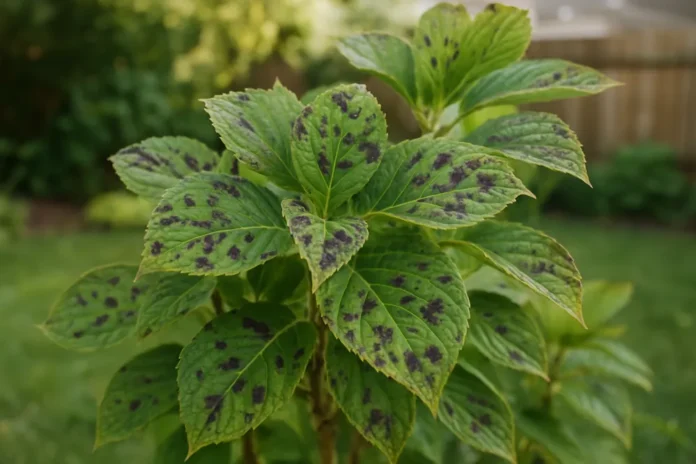
Hydrangea leaves usually develop black spots because of fungal or bacterial leaf spot problems, especially during warm, wet weather. Wet foliage, crowded growth, and poor air circulation make the issue much more likely.
Seeing hydrangea leaves with black spots can be alarming, especially when a shrub that looked lush a week ago suddenly starts looking tired and blotchy. In most home gardens, black spotting is tied to leaf diseases that thrive when leaves stay damp for long periods, though insects, sooty mold, and general plant stress can sometimes play a role too.
When I troubleshoot this problem, I do not start by assuming the plant is dying. I look at the shape of the spots, where they show up first, whether the leaves are yellowing around them, and what the weather has been doing. On hydrangea leaves, those details usually tell you whether you are dealing with a common fungal issue, a bacterial problem, or a less serious surface coating that only looks dramatic.
What Black Spots Usually Mean on Hydrangeas
Black spots are a symptom, not a single diagnosis. On hydrangeas, they most often show up when disease organisms infect the leaves during periods of rain, overhead watering, heavy dew, or high humidity. Spots may stay small and scattered, or they may expand, merge together, and cause leaves to yellow, brown, or drop early.
The most common causes are fungal leaf spot diseases such as Cercospora and anthracnose. Bacterial leaf spot can look similar, and sooty mold can create dark patches that resemble spotting even though it sits mostly on the leaf surface. Less often, severe sun scorch, chemical burn, or decaying tissue after stress may be mistaken for disease.
- Small purple, brown, or black dots with distinct edges often point to fungal leaf spot.
- Large irregular dark blotches, especially after cool wet weather or plant injury, can suggest anthracnose or bacterial issues.
- A black film or smudgy coating on top of leaves often points to sooty mold, which is linked to sap-sucking insects.
- If damage appears mostly on older inner leaves first, poor airflow and prolonged moisture are often part of the problem.
Common Causes of Black Spots on Hydrangea Leaves
Cercospora Leaf Spot
Cercospora leaf spot is one of the most common reasons hydrangea leaves develop dark spots in late summer. It usually begins as small circular spots that are purple, brown, or nearly black, often with lighter tan centers as they age. The spots start on lower or interior leaves where humidity lingers longer, then spread upward if weather stays wet.
The good news is that Cercospora is usually more disfiguring than deadly on established shrubs. A healthy hydrangea can often bloom and survive just fine, but repeated heavy infections weaken the plant over time by causing early leaf drop and reducing vigor.
Anthracnose
Anthracnose tends to create larger, darker, more irregular spots than Cercospora. Lesions may look water-soaked at first, then turn dark brown or black and expand quickly, sometimes crossing leaf veins. In severe cases, stems and flower parts can be affected too.
This disease is especially common during long spells of rain and on plants that are heavily fertilized with nitrogen, which pushes soft, lush growth that is more vulnerable. If your hydrangea has very large blotches rather than pinhead-sized dots, anthracnose moves higher on the suspect list.
When I compare several leaves at once, spot size tells me a lot. If every leaf has many tiny spots, I usually suspect Cercospora first. If I see fewer but much larger dead patches that seem to spread fast after rain, anthracnose becomes more likely.
Bacterial Leaf Spot
Bacterial leaf spot can produce dark, angular lesions that may follow the veins and sometimes develop a water-soaked appearance. The tissue may look greasy before it dries and darkens. Bacteria spread easily through splashing water, handling wet plants, and contaminated tools.
This issue is harder to distinguish from fungal spotting without close inspection, but bacterial spots often look less neatly circular and may spread rapidly during warm wet periods. Sanitation and keeping foliage dry are especially important when bacteria are involved.
Sooty Mold From Insect Activity
If the black material looks more like soot, dust, or a thin surface coating than true dead tissue inside the leaf, you may be seeing sooty mold. This fungus grows on the sticky honeydew left behind by aphids, whiteflies, scale, or other sap-sucking insects. The mold itself is usually a secondary problem, but the insects feeding on the plant still need attention.
Sooty mold often wipes off partially with a damp finger or cloth, while true leaf spot lesions do not. That simple difference can save you from treating the wrong problem.
Weather, Watering, and Site Conditions That Make Spotting Worse
Hydrangeas love moisture, but they do not love having wet leaves day after day. Black spotting gets much worse when shrubs are planted too tightly, shaded so heavily that leaves never dry, or watered from above late in the day. Morning dew, summer storms, and humid nights can be enough to keep disease cycling.
- Overhead irrigation that regularly wets the foliage
- Dense plant growth with limited airflow
- Mulch or old infected leaves left directly under the shrub
- Frequent rain, high humidity, and warm temperatures
- Excess nitrogen fertilizer that pushes lush, susceptible growth
- Heavy shade where leaves stay damp well into the day
This is why one hydrangea in the yard may be spotless while another has a disease problem every summer. The plant nearest a wall, fence, hedge, or sprinkler often has the worst symptoms because moisture lingers longer and air movement is lower.
How to Tell Which Problem You Have
A careful look at the pattern matters more than a guess based on color alone. Start with several leaves from different parts of the plant, including lower leaves, inner leaves, and newer outer growth. Then compare what you see.
- Tiny round spots with purple or dark margins: often Cercospora.
- Large irregular black or brown blotches: often anthracnose.
- Angular dark lesions that seem blocked by veins: often bacterial leaf spot.
- Black coating that smears or wipes partly off: often sooty mold.
- Damage only on sun-exposed edges or tips after heat: more likely scorch than disease.
- Spots concentrated where a sprinkler hits the plant: moisture is likely driving the issue.
Also look for timing. If spotting begins after a long wet spell, disease is much more likely than nutrient deficiency. If the plant otherwise looks vigorous and the roots are not under obvious stress, leaf spot usually rises to the top of the list.
Do not judge success by old damaged leaves. Once a leaf is spotted, it usually stays spotted. I watch the new growth over the next couple of weeks, because clean new leaves tell me the fix is working even if older leaves still look rough.
What to Do Right Now if Your Hydrangea Has Black Spots
Most hydrangeas recover well if you reduce leaf wetness, improve airflow, and clean up infected debris. Your first goal is to slow the spread, not to make damaged leaves look perfect again.
Remove Badly Affected Leaves and Debris
Pick up fallen leaves under the shrub and remove badly infected leaves that are covered in spots, especially if they are yellowing and ready to drop. Do not compost heavily diseased material unless your compost pile gets hot enough to fully break pathogens down. Bagging and discarding is safer in most home gardens.
Stop Wetting the Foliage
Water at the base instead of with a sprinkler or spray nozzle over the top. A soaker hose or drip irrigation is ideal. If you hand water, do it early in the day so any accidental splash dries quickly.
Improve Airflow Without Overpruning
If your hydrangea is crowded by nearby shrubs or packed into a still corner, selectively thin surrounding growth so air can move through. Be cautious with pruning the hydrangea itself, because some types bloom on old wood and aggressive cuts can remove next season's flower buds.
Treat Insects if Sooty Mold Is Present
If the black layer is linked to aphids, scale, or whiteflies, control the insects first. A strong spray of water can knock aphids off. Horticultural oil or insecticidal soap may help with soft-bodied pests when used according to label directions. Without solving the honeydew problem, sooty mold tends to return.
Use Fungicides Only when They Make Sense
Fungicides can help protect new leaves from further infection, but they do not cure spots that are already there. Home gardeners sometimes use products labeled for ornamental leaf spot diseases, often containing chlorothalonil, copper, or other active ingredients approved for ornamentals. The label must specifically include hydrangeas or ornamental shrubs, and timing matters most when applied early in the disease cycle.
Should You Use a Fungicide or Let the Plant Ride It Out
If the spotting is light and appears late in the season, cultural fixes may be enough. Many established hydrangeas can tolerate a modest amount of leaf spotting without long-term harm. In that case, cleaning up debris, watering properly, and improving airflow are often the best return on effort.
If the shrub defoliates early every year, develops large expanding lesions, or loses aesthetic value before an event or peak bloom season, a fungicide program may be worth it. Prevention works better than rescue. Once weather turns persistently wet and symptoms are obvious, treatment becomes less effective.
- Skip fungicide if symptoms are minor, late-season, and mostly cosmetic.
- Consider fungicide if the plant has a recurring history of severe spotting.
- Act sooner if anthracnose is suspected because it can be more aggressive.
- Avoid random spraying if you are not sure whether the problem is fungal, bacterial, or insect-related.
I rarely reach for a spray after a hydrangea is already heavily spotted unless the plant has a long history of repeating the problem. In many yards, better watering habits and fall cleanup do more good than a late reaction treatment.
How to Prevent Black Spots Next Season
Prevention is mostly about reducing the hours that leaves stay wet. Hydrangeas are naturally lush shrubs, so they create their own humid microclimate when packed too tightly or irrigated from above. A few small changes can make a big difference next year.
- Water the root zone, not the leaves.
- Space shrubs so air can move around them.
- Thin nearby plants that trap humidity around the hydrangea.
- Mulch the soil to reduce splash-up from rain and irrigation.
- Remove and discard fallen infected leaves in fall and again in spring.
- Avoid heavy nitrogen feeding that pushes weak, overly lush growth.
- Prune only as appropriate for your hydrangea type so you do not sacrifice blooms.
Location matters too. Hydrangeas usually do best with morning sun and afternoon shade in much of the U.S. That combination helps dew dry earlier while still protecting the plant from intense late-day heat. Deep shade may seem gentle, but it can leave the foliage damp for too long.
When Black Spots Are a Sign of a Bigger Problem
Black spotting is often manageable, but sometimes it comes with deeper stress that deserves attention. If your hydrangea is also wilting despite moist soil, has stem dieback, shows blackening on stems or flower buds, or declines rapidly from top to bottom, there may be root stress, crown issues, or a more aggressive disease involved.
Plants in poorly drained soil are especially vulnerable because stressed roots reduce the shrub's ability to outgrow leaf disease. Likewise, repeated drought followed by heavy watering can weaken the plant and make every foliar problem look worse.
- Leaves drop heavily by midsummer year after year
- Stems develop dark sunken areas or die back
- Spots spread to flowers and tender shoots
- The plant is sparse, weak, or failing to leaf out well overall
- Soil stays soggy for days after rain
- The problem worsens despite better watering and sanitation
Those cases may justify help from a local extension office, garden center professional, or plant clinic, especially if you want a closer diagnosis before using any treatment.
FAQ
Will Black Spots Kill My Hydrangea?
Usually not. Most leaf spot problems are more cosmetic than fatal on established hydrangeas, though severe repeated infections can weaken the plant over time and reduce vigor.
Should I Cut Off All the Spotted Hydrangea Leaves?
No. Remove the worst infected and fallen leaves, but do not strip the plant bare. The shrub still needs healthy foliage to make energy, and heavy pruning can stress it further.
Can Overhead Watering Cause Black Spots on Hydrangeas?
Yes. Overhead watering keeps leaves wet longer and splashes disease organisms from leaf to leaf, which makes fungal and bacterial spotting much more likely.
Is Neem Oil a Good Treatment for Black Spots on Hydrangea Leaves?
Neem may help in some situations, especially if insects are involved, but it is not a universal fix for every black spot problem. Always match the product to the cause and follow the label for ornamental shrubs.
Why Do the Lower Leaves Get Spots First?
Lower leaves tend to stay wetter longer, receive more soil splash, and get less airflow. That makes them the easiest place for leaf spot diseases to start.
Can I Compost Spotted Hydrangea Leaves?
It is better to discard heavily infected leaves unless you maintain a hot compost system. Cool home compost piles often do not kill enough disease organisms to make that risk worthwhile.
Do Black Spots Mean My Hydrangea Needs Fertilizer?
Not usually. Black spotting is more often linked to disease and wet foliage than to a nutrient deficiency. In fact, too much nitrogen can make some leaf spot problems worse.
Need the right product for leaf spot control or insect-related black coating? Check our recommended hydrangea disease treatments and sprayers so you can protect clean new growth faster.
