

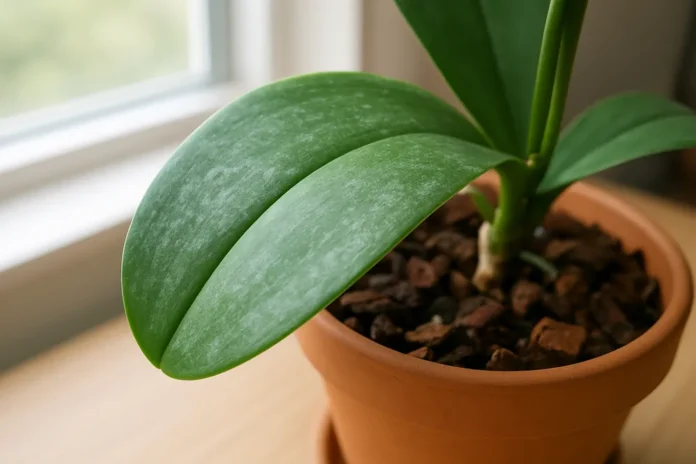
White powder on orchid leaves is often powdery mildew, mineral residue from water or fertilizer, or a waxy coating linked to pests like mealybugs. If it looks fuzzy and spreads, fungus is the most likely cause.
A white coating on an orchid leaf can be confusing because it does not always mean the same thing. On orchids, that powdery look may come from a fungal problem, dried mineral residue, leftover spray deposits, or even insects that leave a cottony or dusty coating behind. The key is not just the color, but how the white material looks and behaves.
When I check an orchid with white powder on the leaves, I start by asking a few simple questions. Does it wipe off cleanly? Is it fuzzy or flat? Is it sitting mostly on top of the leaf, or does the tissue underneath look damaged too? Those small details usually separate a harmless residue from something that needs treatment.
If your orchid leaves have a white powdery film, do not panic. Many cases are fixable, and some are more cosmetic than serious. The goal is to identify the cause before you start spraying or repotting, because orchids do best when you make a targeted correction instead of throwing several treatments at them at once.
What the White Powder Usually Is
The most common causes of white powder on orchid leaves fall into three groups: fungal disease, residue, and pests. The first is powdery mildew, a fungus that creates a pale, dusty, sometimes fuzzy coating on the leaf surface. It may begin in small patches and then expand. The second is mineral or fertilizer residue, which often looks chalky rather than fuzzy and usually comes from misting with hard water or splashing fertilizer solution onto leaves. The third is pest-related material, especially from mealybugs, scale, or their waxy secretions.
- Powdery mildew often looks soft, dusty, or slightly fuzzy and may spread from one area to another.
- Mineral residue usually looks flat, chalky, or crusty and often appears where water droplets dried.
- Pest residue may look cottony, clumped, or concentrated in leaf joints, under leaves, and near the crown.
When I am unsure, I look at the pattern before anything else. A uniform film after watering points me toward residue, while random expanding patches on otherwise dry leaves make me suspect fungus.
How to Tell Powdery Mildew From Residue or Pests
Clues That Point to Powdery Mildew
Powdery mildew tends to look like someone dusted the leaf with flour. It can start as a few pale spots and gradually become more noticeable. On orchids, affected leaves may also look dull, slightly distorted, or stressed over time. In a more advanced case, the white coating can thicken and the leaf underneath may begin to yellow or weaken.
This fungus is more likely when airflow is poor, humidity is high, and foliage stays crowded. Orchids kept close together on a shelf, in a stale room, or near cool damp windows are more likely to develop fungal issues than orchids with good air movement.
Clues That Point to Mineral or Fertilizer Residue
Residue usually sits on the leaf surface without changing much from day to day. It often shows up as spots, rings, or a thin white film where mist or splashed water dried. If you use tap water that leaves deposits on faucets or shower doors, your orchid can show the same kind of chalky buildup. Fertilizer salts can also dry on leaves if you splash them during feeding.
In these cases, the leaf itself often remains firm and healthy underneath. The coating may wipe away with a damp cloth, though stubborn salt buildup can take a little more effort.
Clues That Point to Mealybugs or Scale
Mealybugs do not usually create a smooth powdery film across the whole leaf. Instead, they leave cottony white masses, especially where leaves meet the stem, around roots, under the rim of the pot, or tucked into crevices. Soft scale can also leave a waxy residue and sticky honeydew that later supports sooty mold.
- Cottony clumps suggest mealybugs.
- Sticky leaves suggest sap-feeding pests rather than simple residue.
- Tiny bumps that do not move may be scale insects.
- A plain dusty film with no insects in hiding spots is less likely to be a pest issue.
Why Orchids Develop Powdery Mildew
Powdery mildew is a fungal disease that thrives when conditions favor spores settling on leaf surfaces. Orchids are especially vulnerable when they are kept in humid rooms with little airflow. Unlike some leaf diseases, powdery mildew does not always need dripping wet leaves to start. It often takes hold when air is stagnant and humidity hangs around the plant for long stretches.
Indoor growing conditions can accidentally create the perfect setup. A plant tucked tightly into a decorative corner, grouped in a dense collection, or placed near a cool surface at night may stay damp and still for too long. If light is also on the weak side, leaves may stay softer and more prone to infection.
- Poor air circulation around leaves
- High humidity with stale air
- Overcrowded orchid shelves or windowsills
- Low light that slows drying and growth
- Stressed plants weakened by watering or root problems
If I see white fungal growth on one orchid in a group, I give the whole area more air before I reach for sprays. Better airflow often stops a small problem from becoming a shelf-wide problem.
When the White Coating Is Harmless Residue
Not every white film is a disease. Orchids often collect residue from hard water, foliar sprays, fertilizer splashes, or even household dust that sticks to a slightly damp leaf. This is especially common on smooth, broad-leaved orchids like Phalaenopsis because the leaves show every spot and streak.
Residue is mostly a cosmetic issue unless it is heavy enough to block light or sit in the crown. If the leaf looks green and firm and the white marks do not spread, fungus is less likely. I often see this after gardeners start misting regularly with tap water. The droplets dry, and the minerals stay behind as a pale film.
Fertilizer salts can do the same thing. If you feed overhead and solution dries on the leaves, it may leave a powdery or chalky trace. Over time, frequent residue can dull the leaf surface and make it harder to tell when a new issue starts.
What to Do if It Is Powdery Mildew
If the white powder is fungal, start with sanitation and environment. Isolate the orchid from others if you have a collection. Remove the worst affected leaves only if the damage is severe and you can do it cleanly without injuring the plant further. Then improve airflow, reduce crowding, and avoid wetting foliage late in the day.
For mild cases, gently wiping the leaf surface can reduce the spore load, but do not scrub hard enough to damage the leaf cuticle. After that, a houseplant-safe fungicidal treatment labeled for powdery mildew can help stop spread. Neem-based products, sulfur products, potassium bicarbonate, and some general fungicides may be used depending on the label and the orchid type, but orchids can be sensitive, so always test carefully and follow label directions exactly.
- Move the orchid away from unaffected plants.
- Trim only badly damaged tissue with clean tools if needed.
- Increase airflow with wider spacing or a small fan nearby, not blasting directly on the plant.
- Avoid misting and overhead watering until the problem is controlled.
- Use a labeled treatment suitable for orchids and repeat only as directed.
With orchids, I judge recovery by the condition of new growth more than by old marks. A leaf that was already scarred may never look perfect again, but clean new leaves tell me the environment is back in balance.
What to Do if It Is Mineral Buildup or Fertilizer Salts
If the white coating is residue rather than disease, the fix is simpler. Wipe the leaves gently with a soft damp cloth. Distilled water, rainwater, or filtered water works better than hard tap water for cleanup because it does not add more minerals as it dries. If residue is stubborn, a very dilute solution of water with a small amount of mild acid such as vinegar can help dissolve deposits, but use it sparingly and wipe again with plain water afterward.
Going forward, keep fertilizer off the leaves as much as possible and water the potting mix directly. If you like to rinse foliage, use cleaner water and dry the crown area afterward, especially on moth orchids. Salt buildup in the pot can also reflect a broader fertilizer issue, so flushing the growing medium occasionally with plain water is often worthwhile.
- Use soft water when possible for orchids that show frequent spotting.
- Apply fertilizer to the root zone, not over the leaves.
- Flush the potting medium periodically to reduce salt buildup.
- Dry pooled water from the crown and leaf joints.
What to Do if Pests Are Causing the White Material
When the white material is cottony, sticky, or clustered in crevices, treat it as a pest problem. Mealybugs are a common orchid headache, and they can hide around roots, under sheaths, and near the base of leaves. A single visible patch may mean there are more insects tucked out of sight.
Start by isolating the orchid. Remove visible mealybugs with cotton swabs lightly moistened with isopropyl alcohol if your orchid type tolerates it, taking care not to saturate tender tissue. In heavier infestations, insecticidal soap or horticultural oil labeled for indoor ornamental plants may be more useful, though these products must be used carefully on orchids and according to the label.
Check the undersides of leaves, the crown, the pot rim, and exposed roots. If honeydew is present, wipe it away so you can tell whether new pest activity is happening after treatment.
Mistakes to Avoid While Treating Orchid Leaf Problems
A lot of orchid setbacks come from treating too aggressively instead of too slowly. It is tempting to spray multiple products, cut off every marked leaf, or repot immediately, but that can stress the plant more than the original issue. Orchids recover best when you identify the cause and change only what needs changing.
- Do not assume every white mark is mildew.
- Do not use homemade leaf sprays without considering orchid sensitivity.
- Do not leave water trapped in the crown after cleaning.
- Do not combine several fungicides or insecticides unless the label clearly allows it.
- Do not judge treatment success by old leaf appearance alone.
Another common mistake is focusing only on the leaf surface and ignoring the growing conditions. If stale air, hard water, overfeeding, or hidden pests caused the problem, cleaning the leaf once will not prevent it from coming back.
How to Prevent White Powder on Orchid Leaves in the Future
Prevention is mostly about keeping leaves clean, dry enough, and well ventilated. Orchids like humidity, but they do not like stagnant conditions. A bright spot with indirect light, steady airflow, and careful watering goes a long way toward preventing both fungal problems and residue buildup.
I find that orchids stay cleaner when watering is consistent and deliberate. Water the potting mix thoroughly, let it drain well, and avoid frequent light misting that leaves repeated mineral spots. If you grow several orchids together, give them enough space that leaves do not constantly touch.
- Provide gentle airflow around the plant.
- Use cleaner water if hard water leaves spots in your home.
- Avoid crowding orchids tightly together.
- Keep fertilizer diluted appropriately and rinse excess salts from the potting medium.
- Inspect leaf axils and crowns regularly for hidden pests.
When the Problem Is Serious Enough to Act Fast
A white powder issue deserves quicker attention when it is clearly spreading, when several orchids are showing the same symptom, or when the leaves underneath are yellowing, softening, or becoming distorted. That points away from harmless residue and toward disease or pests. It also deserves prompt action if the crown or newest growth is affected, since damage there can set the whole plant back.
If you have tried cleaning the leaves and correcting the environment but the problem returns quickly, consider whether the plant is under deeper stress. Root issues, overwatering, weak light, and poor sanitation can make an orchid more vulnerable to repeated outbreaks.
FAQ
Can I Just Wipe the White Powder Off My Orchid Leaves?
Yes, if it is residue or a light fungal coating, gentle wiping can help. It is only a complete fix when the cause is cosmetic residue. If it is powdery mildew or pests, the underlying problem still needs to be addressed.
Is White Powder on Orchid Leaves Always Powdery Mildew?
No. It can also be mineral deposits from hard water, dried fertilizer salts, spray residue, or waxy pest material. The texture and location usually help separate these causes.
Will Powdery Mildew Kill an Orchid?
A mild case usually will not kill an orchid, but it can weaken the plant and spread if ignored. Severe or repeated infections can reduce vigor, damage leaves, and make the orchid more susceptible to other problems.
Are Mealybugs the Same as White Powder?
Not exactly. Mealybugs are insects that often look like bits of white cotton or fuzz. They may be mistaken for powder, but they usually gather in crevices rather than forming a smooth film across the leaf.
Can Hard Water Leave a White Film on Orchid Leaves?
Yes. Hard water often dries into a chalky white film or ring, especially after misting or overhead watering. This is common on smooth-leaved orchids and is usually cosmetic.
Should I Repot My Orchid if the Leaves Have White Powder?
Not automatically. Repot only if you also see potting mix breakdown, root problems, salt buildup in the medium, or pest issues in the root zone. Most white residue and mild mildew cases can be handled without immediate repotting.
Need the right treatment fast? Read our orchid care and pest control guides to choose the safest fungicides, insecticidal soaps, and watering tools for healthier blooms.
