

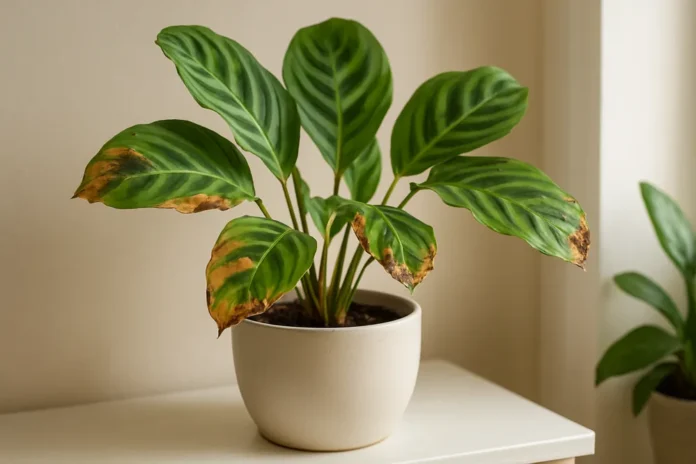
Brown spots on calathea are most often caused by dry air, inconsistent watering, mineral-heavy tap water, too much direct sun, or pest damage. In some cases, fungal or bacterial leaf spot is the reason.
A calathea with brown spots is frustrating because these plants can look perfect one week and rough the next. When I see calathea brown spots, I do not assume there is only one cause. These plants react quickly to dry air, uneven watering, harsh water, and too much sun, and the spots can look similar at first glance.
The good news is that the pattern usually tells the story. Some spots start at the edges and spread inward. Others appear as crisp tan patches in the middle of the leaf, or as tiny dark lesions with yellow halos. Once you match the spotting pattern to the likely cause, it gets much easier to stop new damage and help the plant put out clean growth.
In most homes, the issue is not that the plant is impossible. It is that calathea leaves are sensitive and show stress early. Old spots will not heal, but if you correct the cause, the next leaves should emerge healthier.
What Brown Spots on Calathea Usually Mean
Brown spots are a symptom, not a single diagnosis. On calatheas, they commonly come from one of six sources: watering stress, low humidity, mineral or chemical buildup from tap water, direct sun, pest feeding, or leaf spot disease. The tricky part is that several of these problems can happen at the same time. A plant kept too dry in bright sun with hard tap water can show multiple kinds of browning at once.
Start by noticing where the spots appear. Brown tips and margins usually point to dry air, inconsistent moisture, or water quality issues. Random bleached or crispy patches in the center of the leaf often suggest sun scorch. Small dark spots that enlarge, especially if they look wet, sunken, or ringed in yellow, raise concern for disease. Fine stippling or rough brown scars can signal pests.
When I diagnose a calathea, I look at both old and new leaves. If only the oldest leaves are spotted, the plant may be recovering from a past stress. If the newest leaves are emerging marked or distorted, the problem is usually still active.
Watering Problems Are the Most Common Cause
Underwatering and Uneven Moisture
Calatheas like lightly and consistently moist soil, not bone dry soil followed by a heavy soaking. If the potting mix dries too far between waterings, the plant struggles to move enough moisture into the leaves. That often shows up as crisp brown edges, patchy browning near the tips, or larger dry spots that spread as the leaf ages.
A badly dried-out root ball can also become hydrophobic, meaning water runs down the sides of the pot without fully soaking in. In that case, the top may look damp right after watering while the center stays dry. The plant keeps spotting because the roots are not getting even access to moisture.
Overwatering and Root Stress
Too much water can also lead to brown spots, though the texture is often different. Instead of crisp dry areas, you may see dark brown blotches, yellowing around the spots, limp foliage, or leaves that feel soft before turning papery. Constantly soggy soil limits oxygen around the roots and can lead to root rot, which then shows up above ground as browning and collapse.
- Underwatering often causes dry, crispy tips and margins.
- Overwatering often causes dark, soft, or spreading brown patches with general droopiness.
- Wild swings between too dry and too wet can create a mix of both symptoms.
If the root ball has gone very dry, I prefer rehydrating it slowly instead of pouring a lot of water through once. A bottom soak for a short period often rewets the mix more evenly and reduces repeat stress.
Low Humidity Can Spot and Crisp the Leaves
Calatheas are famous for reacting to dry indoor air. In many U.S. homes, especially in winter or in air-conditioned rooms, humidity drops low enough that the leaf edges lose moisture faster than the roots can replace it. The result is browning that starts at the tips, then spreads along the margins, and sometimes forms irregular crisp patches.
Low humidity damage is especially common when the plant sits near a heating vent, radiator, drafty window, or air conditioner. Even if you water correctly, the leaves can still spot because the surrounding air is too dry. Thin-leaved calathea varieties tend to show this quickly.
Humidity damage by itself usually looks dry and papery, not wet or mushy. It may also affect the side of the plant closest to a vent or draft more severely. If browning appears worse after a weather shift or when the heat comes on, dry air is a strong suspect.
Tap Water Quality Often Shows Up as Brown Spots or Edges
Many calatheas are sensitive to fluoride, chlorine, chloramine, and dissolved salts found in ordinary tap water. Over time, those minerals can build up in the soil and stress the roots. The leaves may respond with brown tips, marginal burn, or scattered tan spots that seem to appear even when watering frequency is otherwise fine.
This issue is more likely if you live in an area with hard water, if white crust forms on the soil surface or pot rim, or if your plant improved in the past after switching water sources. Sensitive plants often react gradually, so the spotting can feel mysterious until you consider what is in the water rather than how much you are using.
- Browning from water quality often starts at the tips and edges.
- Salt buildup can be worse when the pot drains poorly or fertilizer is used heavily.
- The damage usually does not appear overnight. It accumulates over time.
Too Much Direct Sun Can Scorch Calathea Leaves
Calatheas prefer bright, indirect light. Strong direct sun, especially afternoon sun through glass, can burn the leaf surface. Scorched spots often look tan, beige, or brown in irregular patches, usually on the most exposed leaves. The area may seem faded at first, then turn dry and brittle.
Sun scorch tends to affect the side facing the window. If only the topmost leaves or the leaves nearest the glass have damage, and the rest look fine, light exposure is a likely cause. South- and west-facing windows are the usual trouble spots, though even an east window can be harsh in some climates or seasons.
Sun damage does not spread like a disease. Once the light is corrected, new leaves should stop developing those patches. Existing scorched areas will stay brown.
Pests Can Leave Brown Specks, Scars, and Blotches
Spider mites, thrips, mealybugs, and scale can all stress a calathea enough to create brown spotting. Spider mites are especially common in dry indoor air. Their feeding causes fine stippling, faded leaves, and eventually bronzed or brown patches. Thrips may leave silvery scars, tiny dark specks, and distorted new growth.
Pest damage often looks different from simple humidity stress because the pattern is more speckled or scarred, and you may see activity on the undersides of the leaves. Fine webbing points toward spider mites. Tiny moving slivers suggest thrips. Sticky residue can indicate scale or mealybugs.
I always flip over the worst-looking leaf before I blame humidity. A lot of calatheas that seem dry at first are actually hiding spider mites along the midrib and leaf undersides.
- Check leaf undersides, stems, and where the leaf meets the petiole.
- Look for webbing, sticky residue, tiny black specks, or moving insects.
- Isolate the plant if you suspect pests so they do not spread.
Leaf Spot Disease Is Less Common but Important to Recognize
Fungal and bacterial leaf spots can occur on calatheas, especially when foliage stays wet, airflow is poor, and the plant is already stressed. These spots often start small and dark, then enlarge into round or irregular lesions. Some have yellow halos. Others look water-soaked before drying brown.
Unlike humidity burn or mineral buildup, disease spots may continue multiplying across a leaf or jump to neighboring leaves. If the plant sits in a crowded area, is misted heavily, or has water splashing onto the leaves often, disease becomes more likely. Severely affected leaves can yellow and die back faster than with simple dry air damage.
Disease is not always dramatic at first. Early lesions can be small enough to overlook, so pay attention if the spots have a defined border, appear wet or greasy, or keep appearing even after you improve watering and humidity.
How to Tell Which Cause Is Most Likely
The fastest way to narrow this down is to compare the spot pattern, the plant's location, and the condition of the soil. Do not focus on one damaged leaf in isolation. Look at the whole plant and ask what all the affected leaves have in common.
- Mostly brown tips and edges across many leaves: low humidity, inconsistent watering, or poor water quality.
- Large pale or crispy patches on the window side: too much direct sun.
- Dark soft spots with yellowing and constantly wet soil: overwatering or root trouble.
- Tiny speckles, bronzing, or scarring with signs under the leaves: pests.
- Small defined lesions that spread, especially with yellow halos: possible fungal or bacterial leaf spot.
Also consider timing. If the problem worsened when you turned on heat or moved the plant near a vent, dry air is a strong clue. If it started after repotting into dense soil or after a period of overwatering, root stress moves up the list. If the plant was recently moved to a brighter window, sun scorch becomes more likely.
How to Fix Brown Spots on Calathea
Adjust Moisture First
Water when the top portion of the mix starts to dry, but before the root ball becomes fully dry. The goal is even moisture, not constant saturation. Make sure excess water drains freely and the pot is never left standing in water for long periods.
Improve Humidity Around the Plant
Move the plant away from heating and cooling vents, drafty doors, and hot windows. A humidifier is more reliable than occasional misting. Grouping plants can help a little, but it usually will not solve a serious dry-air problem by itself.
Use Gentler Water if Needed
If your tap water is hard or heavily treated, switch to filtered, distilled, or rainwater when practical. Flushing the pot thoroughly from time to time can also help reduce salt buildup, as long as the soil drains well and the plant is not already staying soggy.
Protect It From Direct Sun
Keep calatheas in bright indirect light. If the plant is near a strong window, pull it back a bit or soften the light with a sheer curtain.
Treat Pests or Disease Promptly
Rinse foliage, clean the leaves, and use an appropriate treatment if pests are present. For suspected leaf spot disease, remove badly affected leaves, avoid wetting the foliage, improve airflow, and separate the plant from others until you know the issue is under control.
Change one major variable at a time when possible. If you switch the water, move the light, repot, and start treatments all at once, it becomes much harder to tell what actually helped or hurt.
Should You Cut Off the Spotted Leaves?
Brown spots do not turn green again, so pruning is mostly about appearance and plant hygiene. If a leaf is only lightly marked, I usually leave it in place because it can still photosynthesize. If a leaf is heavily damaged, yellowing, or infected, removing it can improve the look of the plant and reduce stress.
Use clean scissors or pruners and cut close to the base of the leaf stem. If only the tips are brown and the rest of the leaf looks healthy, you can trim just the dead portion for a tidier look. Follow the natural shape of the leaf so the cut edge appears less obvious.
When Repotting Helps and when It Does Not
Repotting helps if the soil has become compacted, the roots are rotting from poor drainage, or mineral buildup is severe. A fresh, airy indoor plant mix can restore better moisture balance around the roots. Choose a pot with drainage holes and avoid jumping to a container that is much larger than the old one.
Repotting will not fix low humidity, sunburn, or pests by itself. In fact, repotting a stressed calathea unnecessarily can add another layer of shock. If the plant's roots look healthy and the soil still drains well, focus on correcting the environment first.
What Recovery Looks Like
A recovering calathea usually shows improvement in new growth, not in the old damaged leaves. The clearest sign that you solved the problem is that fresh leaves emerge with clean edges, better color, and less spotting. Existing brown areas will remain, even if the plant is now perfectly healthy.
Be patient for a few weeks. Calatheas do not erase damage quickly, and they can respond slowly after stress. If new leaves keep spotting in the same way, revisit your diagnosis and look again for a missed factor like water quality or hidden pests.
FAQ
Can Brown Spots on Calathea Go Away?
No. Brown spots are dead tissue, so they do not heal or turn green again. What you want to watch for is healthier new growth after the underlying problem is corrected.
Is Misting Enough to Stop Brown Spots on Calathea?
Usually not. Misting gives only brief humidity and can sometimes encourage leaf spot problems if the foliage stays wet. A humidifier and better placement away from vents are usually more effective.
Should I Use Tap Water on My Calathea?
Some calatheas tolerate tap water better than others, but many develop brown tips or spots from fluoride, chlorine, chloramine, or mineral buildup. If you suspect water quality, filtered, distilled, or rainwater is often a safer choice.
Do Brown Spots Mean My Calathea Has Root Rot?
Not always. Root rot is only one possible cause. It becomes more likely when the soil stays wet for long periods, the plant droops, leaves yellow, and the roots smell sour or look dark and mushy.
Can Too Much Fertilizer Cause Brown Spotting?
Yes. Excess fertilizer can raise salt levels in the soil and burn the leaf tips and margins, which can look a lot like damage from hard tap water. This is more common when feeding is frequent and drainage is poor.
Why Does My Calathea Only Have Brown Spots on One Side?
When spotting is much worse on one side, direct sun, a nearby vent, or a draft is often to blame. The side facing the stress source usually shows damage first.
Should I Isolate a Calathea with Brown Spots?
If you suspect pests or disease, yes. Isolation helps protect nearby plants while you inspect and treat the problem. If the cause is clearly low humidity or water quality, isolation is less important.
Want to stop calathea leaf damage faster? Read our guide to the best humidifiers, water filters, and indoor plant care tools for keeping prayer plants healthy indoors.
